Analysis of 501 Queen: Part IV — Saturday & Sunday December 9 & 10, 2006

Weekend operations on Queen have some problems in common with the weekday service, but these show up at different times and locations.  In place of rush hour effects, the line is affected by shopping and entertainment-related congestion that builds and ebbs over longer periods.

On Saturday, the service is reasonably well behaved until early afternoon, but at that point, bunching sets in.  As on weekdays, there appears to be no effort to space out the service and pairs of cars travel across the city together.  This is difficult to justify especially considering the long layovers most cars get at Humber and Long Branch. Continue reading

Swan Power in L.A.

A reader, Vic, remembering my fondness for Swan Boats as the only possible solution to our transit woes, sent along a link to an article in the Long Beach (California) Press-Telegram. 

I know that many people who read this blog don’t use an RSS feed to see recent comments on old threads, and since the last post about Swan Boats was last July, I thought that you wouldn’t want to miss this.

The article details (with lovely photos) the seven-week project by Sierra Brown to commute to class once a week by  different human powered forms of transport.  The grand finale was an 11-mile paddle by Swan Boat.

TTC 2008 Capital Budget and Long Term Funding Issues

[For those who are wondering where their comments are:  Several of these touch on the question of Transit City project costs.  I plan a separate post on that topic and am holding your comments until that is ready.

[The many comments about the future of the RT have been moved to their own thread.] 

On November 14, the TTC considered its 2008 Capital Budget.  Although there are major issues with funding of many projects, especially on a long term basis, the budget has been passed on to Council. 

One important approval, made with the concurrence of the City Budget Committee, is that work can begin on the three top-priority Environmental Assessments for Transit City:  Eglinton-Crosstown, Sheppard East and Finch West-Etobicoke.  This work will stop Queen’s Park does not make funding available as part of their budget announcement for the fiscal year starting in April 2008.

The Capital Budget presentation at the meeting is not available on the TTC site, nor are several tables and charts from the main report.

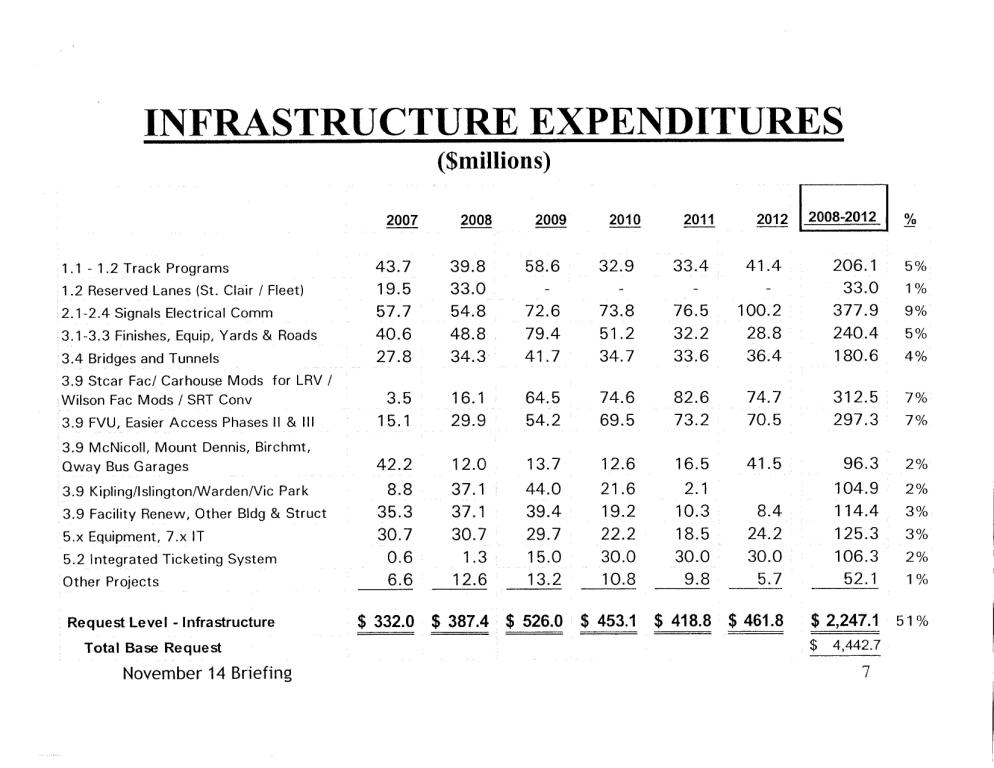
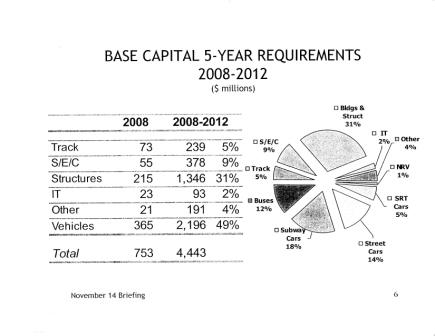
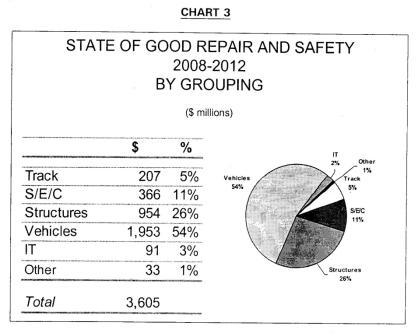
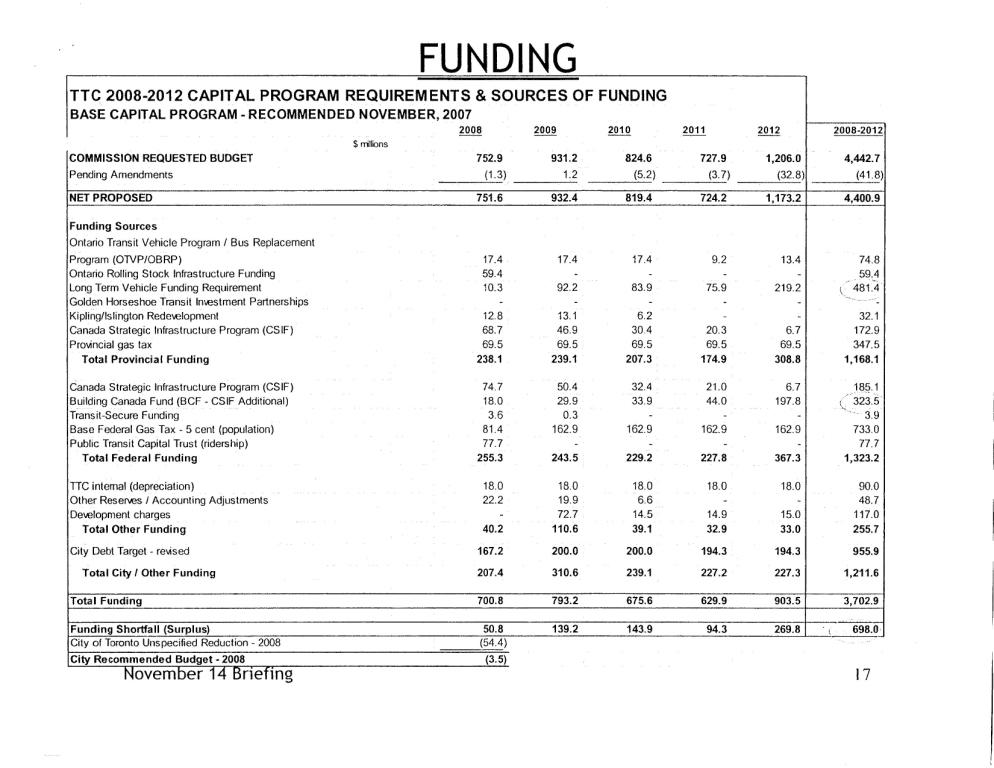
The 2008 Capital Budget Summary gives a broad overview of the five and ten year projections.  The 2008 Capital Infrastructure and 2008 Capital Vehicles tables give some break downs.

The same information is subdivided in a different ways:

Growth and system renewal drive many aspects of the budget.

  • Peak period riding increases the fleet and garage space requirements.
  • The shift to low-floor buses reduces vehicle capacity and increases the size of the fleet needed to handle demand.  This changeover will be completed by 2010.
  • Replacement and expansion of the streetcar fleet for the existing base system plus planned additions such as the Waterfront lines.
  • Replacement and expansion of the SRT fleet both for capacity and for the proposed extension to Sheppard & Markham Road.
  • Expansion of the subway fleet and partial replacement with new cars to increase capacity on the Yonge-University line.
  • Transit City will add seven new LRT routes to the network.
  • Subway expansion on both the Spadina/York and North Yonge lines.

The Base Budget of $4.4-billion for 2008-2012 (detailed in the links above) covers only State of Good Repair projects.  At present, there is a $0.7-billion funding shortfall for this work.  Later in this article, I will return to this issue. Continue reading

TTC 2008 Operating Budget & Service Overview

On November 14, the TTC gave approval in principle to the proposed 2008 Operating Budget.  A short report is available online but it is missing one critical page, the table the table giving the details of the budget by major revenue and expense area.

You can read the details in the report including a line-by-line discussion of the changes.  Overall, the TTC’s operating expenses will rise about $74.6-million or 6.8% over 2007, and this does not include provision for wage settlements in the coming contract negotiations. 

Each 1% increase in wages translates to about $8-million in annual costs, of which $6-million would affect the current budget year because the new contract will take effect on April 1, 2008.

Ridership and service will both increase in 2008, and the cost of new and improved services accounts for over one quarter of the year-to-year change ($20.9-million). Continue reading

The Original Connection to Union Station (Updated)

In the comments thread on my main Union Station post, some have remarked about a mysterious, abandoned tunnel that links Union subway station to the railway station.  Scott Haskill from the TTC sorted this one out for us, and the moment I saw the plans and one of the photos, I had an “aha” moment and remembered the connection.

Scott sent along a copy of the TTC’s plans for the station from 1953 modified at about the time the Royal Bank connection was underway (1977).   The original tunnel appears on the City’s drawings for the existing retail level.  If you compare the 1953 plan and the existing plan, you will see exactly where the abandoned tunnel is relative to the rest of the structure.  Scott menioned that “there’s even a fire alarm plan in public view, mounted on the wall separating the GO concourse from the TTR part, near the McDonalds, that clearly shows the tunnel.”

Scott also pointed me to the City Archives.  I went hunting and here are photos of the connection under construction in 1953: 1 2 3 4.

Here is an archive photo showing the connection tunnel under construction and a modern view of the same location supplied by Scott.

Robert Lubinski sent me a photo taken by Lewis Swanson showing the Union subway connection in Nov 1955

There is a page on the infiltration.org site describing this tunnel including a photo of its current state.

What Could We Do With Union Station? (Update 2)

[Although I am a member of the Union Station Revitalization Public Advisory Group, this post reflects my personal views and should not be construed as statement by or for that group.]

Updated at 3:00 pm November 16:  The geometry of the Moat at the subway connection has been clarified further.

Updated at 6:45 pm November 14:  A description of the new treatment of the between the subway station and the GO Concourse has been added.

Today in the Great Hall, Mayor Miller unveiled the latest proposal in the long story of Union Station’s revitalization.  I’m not going to delve into this in detail, but want to give an overview to supplement the information on the City’s website.

First, I must talk about what is not in today’s announcement:

  • A detailed staging plan for building restoration
  • A governance plan for operation of the station as a City property
  • A financial plan

Some of this information will come in a report to the Executive Committee meeting of November 26, and some will come separately early in 2008.  Today’s announcement sets the stage with a design for what could be.  The proposed design draws on work that has gone before, but improves it especially in light of the station’s primary function:  a major transportation hub and historic public building. Continue reading

Will The TTC Ever Finish On St. Clair?

I spoke to Vice-Chair Joe Mihevc at the TTC meeting on Wednesday about the situation at St. Clair West and on the portion of the line east to Yonge.  Here is the current status.

The problem with rebuilding the track is that there is one section on the east side of the loop where there are electrical cables buried in the concrete.  Breaking up the concrete so that these can be moved is a delicate business and won’t be done for a few months.  Meanwhile, the rest of the loop is being installed.

In about two weeks, this will allow pavement restoration in most of the loop.  At that point, the buses that enter from the west will be able to loop down the ramp and around the west and north sides of the platform.  They will all exit via the ramp that comes out in the Loblaw’s building on the north side of the street.

Meanwhile, Mihevc is getting a complete runaround from staff on the installation of new shelters.  It’s always something that will happen in a week or two, and has been like this since the summer.  He is getting very frustrated because he takes the blame every time he parrots information to his constituents.

TTC staff should carefully consider what they are doing.  Mihevc has defended staff positions on the St. Clair right-of-way against all criticisms and burned up some of his credibility, with me among others, in the process.  The last thing the staff needs is to lose that champion in the Vice-Chair’s office.  If he stops believing what he is told, they are in big trouble.

Of course, many of us stopped believing what staff said about St. Clair a long time ago.  Vice-Chair Mihevc has some catching up to do.

A Place to Stand, Revisited

Some time ago, I wrote about the disappearance of “Walk Left, Stand Right” on TTC escalators and the cock-and-bull story the TTC puts out on why such an unusual burst of efficiency was launched to remove all of these overnight.

The latest installment in this saga is a new brochure that has shown up on TTC vehicles called the Escalator Safety Guide.  Notable by its absence in this guide is any reference to walking on escalators.  Indeed, we are told:

Escalator steps are not the correct height for normal walking and should not be used in that manner. The risk of tripping and falling is greatly increased.

I would have more faith in this statement if the escalators I use regularly were actually running.  In many locations, walking to an alternate route either requires a considerable detour, or the available stairs are incapable of handling the demand in both directions.  People walk on escalators whether they are stopped or running, and the TTC should get used to it.

Later, the brochure goes on, in the best TTC tradition, to blame customers for all of their problems:

Many escalator incidents are due to:  falls, resulting from the rider losing balance;  entrapment in the mechanics of escalators caused by clothing, footwear or suitcases; and use of mobility devices or strollers.

Strollers and the like are supposed to use the elevators, if you can find one, and it’s working that day.

But bless the TTC.  One of their great traditions is the preservation of old signs, and they even manage to do this online.  There is an Escalator Safety Poster (I passed FIVE of them leaving Broadview Station) linked from the Safety page on their website.

The third bullet, complete with illustration, is “Stand Right”!

TTC Operating & Capital Budgets For 2008

The covering reports for the 2008 budgets are now available on the TTC’s website, although as usual there are severe formatting problems and the tables don’t display at all.  Once I have “real” reports, I will scan and publish the pictures here.

The TTC is supposed to be converting to PDF format.  Given that their IT Strategic Plan [sic] (also on the agenda for November 14) includes items that are six years old and counting, my guess is that we will see PDFs only after a multi-gazillion-dollar website redesign.

In the Operating Budget, we learn that the TTC is a bit shy of cash for next year, $13.6-million to be exact, to which must be added the cost of any contract settlement.  The annualized cost of a 1% increase in wages is about $8-million according to the report, although I have problems with this statement.  It implies that total wage costs for unionized staff are $800-million before any benefits are added, and before the cost of materials, fuel, power, fixed plant operations and, oh yes, those pesky non-union managerial staff.  I will return to this once I have a chance to review the detailed budget figures.

Ridership is growing, and is forecast to rise to 464-million next year.  However, we also learn than this year’s projected ridership, 454-million, is about 10-million high because the TTC overestimated Metropass usage.  Poof!  Ten million rides gone from the 2007 projection.  This may be the first time the TTC has lost rideship due to an accounting error.

An ironic side effect is, of course, that with fewer notional “riders”, the revenue per rider has gone up without the TTC lifting a finger (well maybe a few fingers to dip the quill pen into the inkpot).

Try telling people jammed onto the subway that there are really 10-million less of them.

The Ridership Growth Strategy kicks in next fall along with, if we are lucky, improvements to get service simply back to the TTC’s own standards early in 2008.  There has been no definitive announcement on the timing of this change, although February had been mentioned by some at TTC.

The story in the Capital Budget is much darker.  As I reported a few weeks ago, the TTC will scrape by in 2008 within the City’s budget target but future years are grim without major increases in subsidy from any government willing to lend a hand.  There is no funding in place for the proposed new streetcar order, and this needs to be sorted out by next spring if the procurement process is to continue on schedule.  This is only the first of several major unfunded projects.

(There is a followup report on the streetcar project listed on tomorrow’s Supplementary Agenda, but the report is not yet online.)

As the TTC rightly points out, we are in the “unusual” (their term) or “ludicrous” (my term) position of having a $1.5-billion shortfall in the base capital budget while, simultaneously, the Spadina/York Subway extension us fully funded.  If anyone says “the cupboard is bare”, we know where to look.  Anyone who feigns surprise that this extension has elbowed other projects off of the table deserves a dunce’s cap (in TTC colours of course).

Meanwhile, both the new streetcar procurement and Transit City are getting more expensive as cost estimates are refined.  This is not making friends among Councillors who want so badly to be pro-transit, but who are sideswiped by the TTC’s inability to price their projects.

Finally, there is a long report about Transit City laying out the rationale for the choice of lines and in particular the selection of Sheppard East, Etobicoke-Finch and Eglinton-Crosstown as the candidates for the first three Environmental Assessments.  There isn’t much here that we haven’t seen before, and some of the discussions about how to fit new LRT lines onto streets echo the comments in earlier posts on this site.  Transit City was designed to fit with known planning goals and to serve those communities with reasonable expectation of demand.  This is, of course, totally contrary to good transit system design where lobbying and political favouritism win out over, dare I say it, common sense.