Funding for New Streetcars (Updated)

Update June 19 at 10:20 am:  My interview today with Metro Morning is now available online.

The Toronto Star and Globe & Mail report that Premier Dalton McGuinty and Mayor David Miller will announce that the purchase of 204 new streetcars Toronto will proceed.  This is expected to occur on Friday in Thunder Bay.

There is no word at present on the status of funding from Ottawa.

Meanwhile, a study prepared for Bombardier shows that there would be significant benefits to both Queen’s Park and Ottawa both for job stimulus and for tax revenue that would come back to them from this order plus the follow-on option for Transit City cars.  The study is available on the Globe & Mail’s Toronto Blog (in small print down at the bottom of the article).

An important component of the calculation is the premise that the Transit City fleet will have 50% Canadian content, not 25% as in the initial 204 cars for the “legacy” streetcar system.  This substantially increases the economic impact of the combined order.

One troubling comment in the Star’s article is that the existing cars are “failing so fast, the TTC anticipates having to use buses on some routes later this year”.  Well now, if memory serves, TTC staff were asked to produce a report on fleet availability and planning back around the start of 2009.  This was expected to surface in April, and the latest I have heard is that we might see it in July.

Considering that the TTC will have parts of various lines shut down for track or other repairs, the idea that they don’t have enough cars that work is laughable.

  • 512 St. Clair won’t see service west of Bathurst until late 2009 at best
  • 504 King is cut back to Queen and Roncesvalles this Sunday until late 2010
  • 505 Dundas is cut back to Bathurst Station for July and August
  • 502 Downtowner and 503 Kingston Road will be replaced by buses for the August and September periods due to track replacement at Bingham Loop (why this is taking so long is a total mystery, and I cannot help thinking that it is a handy excuse)

The reliability problem with our streetcar fleet is known, but what is alarming is the lack of information about what is really happening.  The TTC wrings its hands about problems with adding service to accommodate new demand, and they don’t even have enough working cars, they claim, to run the existing service.

Why are they failing?  What is happening here?  What’s the big secret?  Are we simply trying to save money by cutting back on maintenance?

Answers please!

Service Changes Effective June 21, 2009 (Updated)

Updated:  The Service Summary is now available online.

The June/July schedule board period will bring many seasonal cuts to transit service on the TTC.  I will not list all of them, but the real issue will be to see whether they are reversed in the fall.  A few cuts in this round are identified as a response to budget concerns (see my previous article about Metropass use and its effect on revenues).  If this is just reasonable belt-tightening, that’s just good management.  If this is a return to the bad days of stealth service cuts even while riding grows, the TTC is in for problems. Continue reading

Metrolinx Speaks With A New Voice

For the past few months, Metrolinx has been rather quiet as Queen’s Park worked through the legislation abolishing the old board and merging GO Transit into Metrolinx.  How is “Metrolinx 2” going to work?  What are its priorities?  The transitional board has been meeting informally, and signs of change have been obvious in recent announcements such as the GO Electrification Study.

On June 9 and 10, the new President and CEO of Metrolinx, J. Robert S. Prichard, more commonly known simply as “Rob”, gave similar speeches to the Greater Toronto Marketing Alliance and the Building Industry and Land Development Association.  These are available from the Presentations page on the Metrolinx site in both text and Powerpoint versions.  (Both are saved as PDFs.)

Much of the content is in the “rah rah, we’re a new agency with a new mandate” cheerleading vein, but some points are worth noting.

Metrolinx has a mandate to actually do things, and do them quickly.  In times past, this took on an aggressive, negative tone attacking NIMBYism and suggesting that anyone perceived to get in the way would be pushed aside.  Today, the need for action remains, but it is presented as a widely supported, long overdue program to reverse the damage of lost decades of underinvestment in transit infrastructure.

Prichard cites priorities he has received from Premier McGuinty, and the focus is on results, not on process. 

  • Get it done.  Residents … are tired of announcements.
  • Improve the quality, reliability and availability of GO Transit.
  • Develop an investment strategy to fund programs beyond the initial $10-billion already allocated.

That list implies things were not happening under the old Metrolinx, and we’ve heard rumblings about unco-operative, foot-dragging politicians.  More about them later.

Yes, we are all tired of announcements, and it’s refreshing to know that not only will money be pledged, it will actually be spent.  (Earth to Ottawa: Are you listening?)  I have shelves full of plans, but I can’t actually visit the sites or ride the lines because they remain only on paper.  In a few cases, this is a blessing in disguise. Continue reading

Safety for Lake Shore Streetcar Riders

As a followup to the Waterfront West thread, “Ed” left a long comment which really belongs in a post of its own.  My own comments follow at the bottom.

I’ve been thinking about safety for riders on Lake Shore Blvd.

Currently, there are safety islands west of Humber loop through Louisa, and east of Long Branch loop through Thirtieth. The long central part of Lake Shore has no safety islands.

It’s been my experience that motor vehicles speeding by the open doors of a streetcar is a regular occurence on Lake Shore; I suspect that it’s a likely occurence *every* run. Why?

  • suburban area; drivers not really familiar with streetcars and the door laws
  • fast traffic on Lake Shore
  • wide road

This [last point] deserves attention: drivers seem to feel that the further they are from the streetcar, the more they’re allowed to pass. On Queen itself, the prime points for cars zipping past open doors seems to be eastbound and Shaw and westbound at Ossington, where there are clear additional right-turn lanes. This is the same behaviour that leads MTO to put signs up saying “Stop for School Bus with Signals flashing BOTH DIRECTIONS” on four-lane highways.)

Note that St. Clair had safety islands for just about every stop along its wider part (roughly east of Old Weston Rd.), and the width of St. Clair is quite similar to the width of Lake Shore, taking the varying widths of both roads into account.

Finally, the long and potentially dangerous walk to and from the curb makes stops slower along Lake Shore than they would be on central-city routes with equal numbers of embarking/disembarking passengers (outer ends of the Carlton car, for example).

Is the answer putting in safety islands all along Lake Shore?

Unfortunately, the speed of motor vehicles on Lake Shore, and again a general unfamiliarity with street railways, results in safety islands being struck (delaying streetcar service!), and also the safety islands distracting drivers who then run the red light (or so I suppose — for some reason, I see a lot of red-light running on Lake Shore at intersections where there’s also a safety island, for example at Long Branch Ave.).

With go-around-either-side safety islands disappearing on St. Clair due to the ROW, they will remain only in a few scattered locations in the city (offhand: Dundas at Bloor, Bathurst at Queen, Main and Gerrard, Queen at Kingston) prompting motorists to hit the remaining ones as things they just don’t understand or are unfamiliar with.

Also, I just went and measured the lane width inside a safety island; it’s 3.0 metres from the edge of the island to the centre line. This isn’t too much of a problem with cars (though you get splashed in rain and snowy conditions) but Lake Shore also has a lot of truck traffic, particularly in the west end. Trucks are allowed a width of 2.60 metres; so two trucks meeting at 39th where there are safety islands facing each other have 80 cm *total* to miss each other and also the safety island. This is one reason I often wait at the curb, instead of on the safety island.

And I’ve seen a semi-trailer sideswipe a streetcar going in the opposite direction at 39th. Maybe significantly, the tractor had western Canadian plates. After a 6 or 8 hour shift on the 401, he made it down Brown’s Line and then just couldn’t place the rig properly when faced with an oncoming ALRV in a safety island gap?

So, what are the potential solutions?

1) Status quo/do nothing (not attractive).
2) Put in safety islands all along the route (still a problem with auto/island collisions and trucks passing centimetres from your face as you wait for the car).
3) Drastically narrow Lake Shore through lanes so safety islands aren’t necessary.
4) LRT so there is no traffic passing by the safety islands and less chance of a motor vehicle getting confused and trying to split the sides of an island, thus running into it.
5) Move to bus operations on Lake Shore.

Of these choices, I expect the locals will be in favour of:

1) These are the ones who don’t ride the TTC at all, and I have confirmation from WWLRT planning that they haven’t looked at safety issues on Lake Shore yet; certainly safety wasn’t a significant part of the LRT presentations.
5) Hey, buses are “superior, quicker” technology, right?

Personally, I’m in favour of 4) or 3). I bet the anti-LRT crowd dislikes these choices equally — even though 3) would solve a number of other issues raised in Lake Shore transportation planning workshops.

This all begs the interesting question of whether issues with access to streetcars — the walk from the curb, the vertical height to board, the width of the “safety island” and the comfort of riders on that island — can be addressed without going for a full-blown right-of-way.  (At the risk of beating a worn-out drum, better service would also shorten the length of time would-be riders have to wait on an island.)

The recent charette held by the Lake Shore Planning Council produced a lot of concerns and ideas, and although this happened after the formal cutoff for feedback to the TTC’s study, I hope that this material finds its way into the hopper.  The TTC was represented at the charette, and that’s a good sign.

Now we await an updated set of design options and, one hopes, more sensitivity and less lecturing from the TTC at public meetings.

Bombardier Markets Streetcars

Normally, I wouldn’t use my site to plug a manufacturer’s products, but with some recent discussions here about the relative merits of ICTS/Skytrain and streetcar/LRT technology for Scarborough, I have to make an exception.

LRT is well established all over the world, and Bombardier uses its market presence to great effect in their promotional material.  The jumping off point is a press release for the “Olympic Line” in Vancouver, a streetcar line (and that’s the term Bombardier uses) that will operate during the 2010 winter games using cars loaned by the Brussels system.

But it gets better:  more details are on Bombardier’s Vancouver 2010 Streetcar page which proclaims “The Streetcar Returns to Vancouver”.  You can view the information, photos and videos in the pulldowns yourself.

If anyone thinks that Bombardier might be ashamed of its streetcars, that it needs a Toronto ICTS line to justify its existence as a major vehicle supplier, well, just look at this site.  This is not just a Vancouver page, but a catalogue of Bombardier’s technology, almost all streetcars, worldwide.

Toronto, that “world class city”, lost decades in transit progress to an attitude typified by former megamayor Mel Lastman who said “real cities don’t use streetcars”.  We have a lot of catching up to do.

Scarborough-Malvern LRT Update

I have been remiss in not reporting on the open house for the Scarborough-Malvern LRT line.  The display from that open house is available on the project’s website.

This is probably the most straightforward of the projects although it has a few interesting design features.  Most notable is the section west and north of the University of Toronto Scarborough Campus where the line will run side-of-road.  About half-way between Kingston Road and Ellesmere, the line will move from centre-of-road to side-of-road and will cross Highland Creek on its own new bridge.  From that point north and east, the line runs alongside parkland and there is no need to provide access to the property as there would be in a commercial/residential neighbourhood.

The line makes a dogleg to serve UTSC, but this is a major destination.  After turning northwest on Military Trail, the line rejoins Morningside for the run up to Sheppard.  The track layout will be designed so that Sheppard LRT trains could run through to UTSC and provide direct service between the campus and Don Mills Station.

The section on Kingston Road is a fairly standard centre-of-road LRT design with the only special feature being the triangular junction at Eglinton.

Similarly, the Eglinton section uses the standard LRT street profile.  Kennedy Station, as noted elsewhere in this blog, is the subject of a future design to integrate the subway, a relocated RT station and the Eglinton and Scarborough/Malvern lines.

The following is a comment I received after the open house from Robert Wightman, but held onto until I got around to posting this item.

Some Thoughts on The Scarborough Malvern LRT line that only goes to Morningside and Sheppard.

I attended the meeting on Bellamy Road tonight with my son and we were impressed by the presentation. The presentation for each line seems to depend on the group responsible for that line and this was the best of any that I have been to. They had all the usual boards about culturally, scientifically or ecologically sensitive area and noted that there are many in my former borough.

The detail panels about the line itself were quite detailed and showed proposed pocket tracks, bridge design, platform location etc. The entrance to Kennedy station and one other area were not finalized so they left a circle around them and said final details to be determined. They even put in two pocket tracks to turn service back to the outer end of the line “in case they decide to run some of the Sheppard Service to UTSC.” It is a lot cheaper to put in now and it also lets you turn a bad car and send it back to the barns at Sheppard and Meadowvale.

They said that all of the storage facilities would have heavy maintenance capabilities with only a few items being shipped out. The line will probably be 750 V and have centre poles. They don’t seem to need to consult with Toronto Fire Services and Toronto EMS like the Waterfront designers do. They said that you needed a pocket track for short turns and storing dead trains every 4.5 to 5 km and could not believe that they were not doing this on Sheppard East. They also thought that the SRT would be more SRT and not LRT but they said that the final decision had not been made.

They thought that construction on Sheppard would start this Fall with preliminary work on the grade separation on the Uxbridge Sub. Since the storage facilities are almost at the end of the line it can be built in stages.

All in all a good meeting.

Yes, this line definitely needs a new name.

A Few Questions About the Scarborough RT Extension

Updated 11:25 am:  Information about maximum gradients added as well as a comment about costing of the underground alignment north of Sheppard.

Last week, the TTC and City conducted an open house for the Scarborough RT extension project.  As regular readers here know, I have long advocated that the RT technology be changed from ICTS to LRT, but there is little sign of a move in that direction in the materials on view at the open house.  A single panel (page 32 in the presentation) says that the technology is yet to be determined, but the design clearly is based on an RT implementation.

This is rather odd considering that a rethink of the RT/LRT debate has been floating around since last fall when Metrolinx produced its report comparing the benefits and costs of various alternatives for the RT extension.  If a real comparison were underway, we would see two designs that reflect the requirements specific to each technology and exploiting the advantages of each.  Moreover, the keep/replace decision would be part of the larger context of the future of the existing RT and its place in the context of Transit City.

Back in 2006, after a study of the RT’s future, the TTC adopted a policy of retaining the ICTS technology.  The context for that decision was very different from today:

  • Neither Transit City nor the Metrolinx Regional Plan had been formulated, much less announced, and a “Scarborough LRT” would have been a free-standing new LRT just as the RT is a self-contained implementation of ICTS.
  • “Rapid Transit” plans consisted of a network of higher-order bus routes plus modest subway expansion.
  • The decision was taken in the context of replacing the existing line, not of extending it to Malvern and, possibly, beyond.

In less than a decade, the RT will truly be a technology orphan, an ICTS line surrounded by a network of LRT lines.  However, the 2006 policy decision has yet to be revisited.

The TTC, echoing a tactic used decades earlier, has created a scenario that demands complete grade separation of the RT extension by claiming an 10,000 per peak hour demand for the line.  However, this only applies to the section between Scarborough Town Centre and Kennedy, not to the whole line.  Demand north of Sheppard is projected to be only 2,500 by 2031.  (During the original LRT scheme’s debates in the 1980s, TTC claimed that an elevated LRT would be needed through STC to avoid isolating property south of an LRT right-of-way.  The LRT proposal took the hit of what was then considered an intrusive elevated structure thus paving the way for ICTS.)

The design shown at the open house was clearly prepared for an ICTS implementation.  All of the illustrations show trains that look suspiciously like Mark II ICTS, and the route is integrated only with the existing RT, not with Transit City for vehicle maintenance.

Several questions remain unanswered:

  • If this were an LRT line, why does it need a separate maintenance yard?  At most, the line would need a storage yard, but heavy maintenance could be performed at the proposed carhouse for the Sheppard LRT.  What is the additional cost of supporting a technology for one line?  The FAQ talks about possible savings from a consolidated LRT maintenance facility, but the design shows a carhouse that would only be needed for ICTS.
  • The RT extension passes under Sheppard with no connection to the LRT line.  As an ICTS route, this is logical, but not as LRT.
  • Demand north of Sheppard, by comparison to other Transit City routes, is well within the capability of LRT, but there is no provision for a “short turn” service at the Sheppard Station, nor of a transition to at-grade operation in anticipation of extending service beyond Malvern.
  • Structures appear to be sized for ICTS, not LRT, both in the underground section and at stations.  What is the effect on cost for LRT?
  • Although it is impossible to know from the presentation, what is the maximum gradient on the line and is this appropriate for the Transit City LRT vehicle specification?  This question is answered in a comment below left by Karl Junkin.  The answer is “yes” the proposed alignment is within Transit City vehicle specs.
  • What would be the price of ICTS and LRT options?  We already know that vehicles for each technology cost roughly the same (about $5-million each), but the LRT cars are much larger.  What other differences would there be in an LRT implementation?
  • The evaluation of alignments north of Sheppard includes a footnote that cost comparisons are based on an at-grade alignment through the old rail corridor, not underground as the plans now show.  What is the extra cost of going underground, and would this be needed for an LRT line running with less frequent service?

Difficult though this may be, the TTC needs to address the technology issue for the entire RT line and do this in the larger Transit City context.  Many design issues hinge on the technology choice notably the reconfiguration of Kennedy Station.  If this will be a junction of three LRT lines (Eglinton, Scarborough-Malvern and “RT”), the layout will be very different from that with ICTS technology on the RT.

The short-sighted 2006 policy decision to retain ICTS must be reviewed.  Too often, I hear rumours and comments suggesting that support for ICTS is dwindling among transit professionals in Toronto, but none of this surfaces in public debate.  We need that debate now.

A Long Day At City Hall

Tuesday, June 2 was a long day for members of Toronto Council’s Executive Committee.  Many transportation issues were on the agenda including Union Station Revitalization, Western Waterfront Master Plan, Queen’s Quay redesign, and the Gardiner Expressway replacement EA.

As if that wasn’t enough, an open house for the Scarborough RT extension took me out for a ride on the Milner bus.

This transit blogging is harder than my pre-retirement work! Continue reading

Weston Corridor Update

Metrolinx has now released Part 2 of the Draft Environmental Report for the Georgetown South Service Expansion Project, and will hold a series of Open Houses over the next few weeks.

I will add more details to this post once I have a chance to digest several hundred pages of online information.

Updated 6:15 pm:

Mark Dowling sent along a note about a rather bizarre statement in the Metrolinx document:

Are Metrolinx trying to pull a fast one?  Section 5.1.7 Page 204 (page 216 of the PDF):

“At present there are no electric double-deck commuter cars that can legally operate on North America railway lines.”

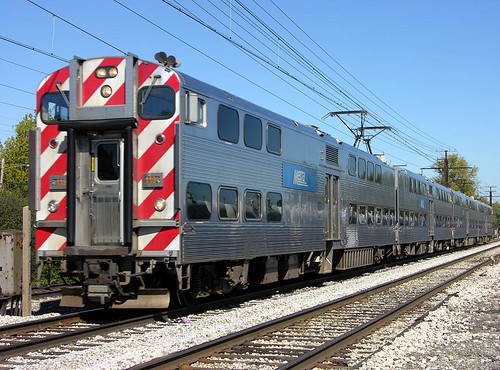
What would they call these then? Or has this fleet been retired by METRA since 02?

In any case, nobody said they had to be EMUs, did they? (Although EMU would have its advantages, obviously).

It’s this sort of thing that makes one wonder about the accuracy of so much else Metrolinx produces, or of the (possibly unintentional) bias in their studies.