Help Avoid Short Turns (Updated)

Today I received a note in another thread from Drew who said:

I was riding the 512 home last night, and noticed a sign that read:

HELP AVOID SHORT TURNS – EXIT FROM THE REAR DOORS.

There. Short-turns are our fault.

Of course, exiting through the rear doors is written all over every surface vehicle —  it does make boarding/alighting much faster … it could be done without the inference that we cause short-turns.

Now we KNOW on St. Clair, it can’t be traffic causing short-turns (or where, aside from St. Clair West Stn these turns take place), so it must be us.

I too saw this notice on a 504 King car.

Update:   Joe Clark has supplied a photo of the sign.

I was sorely tempted to start a guerilla campaign of my own with signs saying “Manage headways, not schedules”, but I would probably be arrested for defacing TTC property.  I won’t say anything about loading delays caused by three cars leaving the end of the line in a pack with the first one having to wait forever to board passengers at each stop.

Yes, passengers do need to move back, but that’s not the whole story.

Looking Back at “A Grand Plan”

At the end of my series on Transit City, I refrained from offering my own recipe for a new transit system.  That sort of issue is hard to address, and without first knowing just how much any government, future mayor or council might want to commit to transit, it’s very hard to pick a “solution”.

Indeed, we have seen exactly this conundrum with Metrolinx, a body formed to sort out the details and priorities of MoveOntario2020.  With much effort, they whittled a $90bn plan down to $50bn and change, only to find themselves in a recession and a desire by Queen’s Park to limit spending.

All the same, having a network view of things is absolutely essential.  We need to know what we will do as and when money is available either from a booming economy or a change in relative budgetary priorities.  That is the philosophy behind Transit City and The Big Move.

Some readers are relatively new to this site and probably have not delved into the archives.  There are a lot of archives, and I don’t blame people for not reading every word.  Back in March 2006, I wrote an article called A Grand Plan that attempted to give a unified view of transit from my perspective.  Note that this was a year before Transit City was announced, 15 months before MoveOntario, and well before Metrolinx came into being.

Sadly, that agency regarded me as an arch-rival, an enemy to be neutralized, not as a potential friend and supporter of transit.  They are under new management now.

Reading my words from 2006, I am struck by how much survives either because it has already been implemented or is an integral part of current plans.  There are a few points where I took a hard line on the subway-vs-LRT argument, notably what we now know as the DRL East, but the paper stands up.  For the record (in case you haven’t read anything else here), I now agree that the DRL requires heftier service than an LRT line integrated with surface operations on Don Mills could provide.  This change comes in the context of the DRL’s “relief” function for the Yonge line and the Richmond Hill subway extension.

I recommend it to any would-be mayors, and to those planners whose gaze rarely extends beyond their own drawing boards.

Transit City Revisited (Part III, Updated)

(Updated at 3:00 pm, February 1.  I omitted a section on the proposed Sheppard subway extensions to Downsview and to Scarborough Town Centre.  This has been added.)

In this, the final installment of my review of Transit City, I will look at the unfunded (or underfunded) TTC transit projects.  Some of these spur passionate debates and the occasional pitched battle between advocates of various alternatives.  There are two vital points to remember through all of this:

  • Having alternatives on the table for discussion is better than having nothing at all.  It’s very easy to spend nothing and pass the day on comparatively cheap debates.  The current environment sees many competing visions, but most of them are transit visions.  The greatest barrier lies in funding.  Governments love endless debate because they don’t have to spend anything on actual construction or operations.  Meanwhile, auto users point to the lack of transit progress and demand more and wider roads.
  • Transit networks contain a range of options.  They are not all subways or all buses or all LRT.  Some are regional express routes while others address local trips.  Most riders will have to transfer somewhere, even if it is from their car in a parking lot to a GO train.  The challenge is not to eliminate transfers, but to make them as simple and speedy as possible.

I will start with the unfunded Transit City lines, and then turn to a range of other schemes and related capital projects. Continue reading

Transit City Revisited (Part I)

Transit City and transit in general are much in the political news thanks to one mayoral candidate’s declaration that there would be a moratorium on additional routes among other changes at the TTC.  Christopher Hume’s column in the Star gives an overview of the landscape.

In the midst of TTC problems from lousy customer relations to service reliability, from Enbridge cutting into the subway tunnel to a maladroit handling of the recent fare increase, everyone needs to step back a moment and divorce the TTC from the politicians.

Transit City has many good points, and they need to be reinforced, not simply tossed aside as part of the anti-Miller rhetoric brewing in some campaign offices and newspapers.  Transit City isn’t perfect, but the map may as well be cut into stone tablets rather than being a living document to hear some of its supporters. Such inflexibility undermines the plan itself.

There’s an odd parallel to Metrolinx’ Big Move plan.  Metrolinx claims that their plan is a work in progress, but just try to criticize it, try to suggest changes, and their professed love of public input evaporates.  Transit City isn’t quite as bad, and we are at least having some public feedback through the Transit Project Assessments.  However, some fundamental changes are needed.

Before I talk about the plan, it’s useful to see where it came from. Continue reading

Four Years

Four years ago today, stevemunro.ca came to life as what I thought might be a handy, small blog where I could make available comments and analysis on a variety of (mainly) transit issues.  It didn’t quite work out that way, and I’ve been quite pleased at the way this site has grown as a forum.

Daily page views are now sitting in the 2-3,000 range, although the all-time high (4,723) arrived on the day I published the old GM “New Look” product literature.  I think the gods of blog activity are having a laugh at my expense with the most popular post being one about buses.

Some people don’t like the fact that this is a pro-LRT site.  That’s their privilege.  I am not against subways or buses, but each mode has its place, and for far too long Toronto (and Queen’s Park) ignored what hundreds of other cities are doing.  The subway and LRT camps need to view transit improvement as the goal, rather than arguing a zero-sum game in which any “gain” for one mode is a “loss” for the other.

The heart of this site is the readers and the comments they leave.  Back in April 2009 came the landmark of 10,000 active comments.  We will hit 15,000 early in February.

All those comments make for a lively conversation whether we agree with each other or not.  I think this improves the general quality of transit advocacy in Toronto because people get to read about and discuss issues in depth.

This blog is well read in professional and political circles, and I have often been complimented on the quality and range of the discussions here.  It’s not just the pearls of wisdom, such as they may be, from my electronic pen that attracts such an audience.

Thank you to all the readers.  Without your contributions, this would be a rather quiet place.

Customer Service Excellence Our Goal: TTC

On January 27, the TTC announced a number of new programs and policies designed to substantially improve all aspects of customer service.  I won’t go into all of the details, but for those who have not seen them, you can follow the links below.

TTC Site

Spacing Toronto

The Toronto Star

This will probably be the last transit announcement by Adam Giambrone who is widely expected to announce his candidacy for Mayor of Toronto next Monday.   Once that happens, he cannot maintain a high-profile position and use the TTC for electoral good news.

In his introduction of the new program, Giambrone talked about four essential parts of TTC customer service:  courtesy, information, responsiveness and reliability.  Some of these are “people skills”, some are technical, but many require changes to organizational culture.  Just making the trains run on time isn’t enough (although I suspect many riders would be happy just for that small miracle).

The TTC will create an external panel of customers, employees, and others outside the TTC with a customer service background.  The work plan sounds depressingly like so much public consultation.  First there will be a terms of reference, then the panel will review current plans, consult the public and draft a “bill of rights” for transit customers.  This process is hoped to wrap up by June 30 — an unusually fast schedule for consultation and reporting. 

For the record, I have neither applied for nor been invited to be a member of the panel.

The TTC plans a number of technology-related changes to improve information flow including screens showing information about service status at subway entrances, real-time vehicle information via SMS (text) messages, new microphones at collectors’ booths to improve conversational quality between staff and passengers, an internet trip planner, and completion of next vehicle information throughout the subway.

We know that the GPS-based line displays have been available internally for some time.  The TTC included a view of one as part of a recent presentation, and real time trip information cannot work without the underlying data.  Why are these not available to the public?

A significant omission in the vehicle tracking system is knowledge of the advertised destination of a vehicle.  Like so much else in TTC operations, the only available information is the scehduled destination.  However, this is meaningless on routes with frequent short-turns and ad-hoc service restructuring.  Someone waiting for a car wants to know where it is really going, not where it is scheduled to be.

(One amusing note about the TTC presentation:  If you scroll down to the “Backgrounder” section, there is a picture of a “next car” info sign saying that a car is now “due” and coming in 1 minute.  The streetcar in the background is a 504 signed for Dufferin, a short turn.  The information system has no way of knowing it is advertising the arrival of a car that may not go where the rider wants.)

The trip planner is still at a beta-testing stage (comment threads on other sites have talked about various peculiarities in early versions), but it will be released with the clear intent of getting customer feedback.  This will be an early test of the TTC’s intentions because bug fixes and enhancements will be essential to having a really good product.

I will not discuss the relative merits of the TTC’s system and other available software, although one wonders why the TTC went down the “roll your own” path on this project. Once the TTC version has actually been up for a while and had some fine tuning, then we can get into comparative discussions about other products.

The TTC plans to add 50 new pass vending machines at locations in the system and to expand the use of debit/credit car transactions.  I hope that, while they are rewiring stations, they take into account future needs for Presto so that they don’t have to tear everything apart in a few years’ time.  Indeed, the idea of provisioning new equipment when we are close to a system-wide conversion to automated fare collection begs the question of how serious the TTC really is about the latter.

One big complaint about TTC information services is their availability during business hours only.  The TTC hopes to incorporate a complaints line into the City’s 311 service so that customers can call in immediately when an incident occurs.  The TTC should simply ditch its own info line and make transit information part of 311, transferring staff if necessary to the City operation.

Passengers expect cleaner stations.  Report after report showing how Toronto’s mythical “station cleanliness index” is inching up year by year simply are not enough.  There are now plans in the TTC budget to beef up the cleaning staff, but even this is a multi-year scheme.  Don’t expect spotless stations soon.

Good customer service is to be an organizational goal.  After several years’ focus on safety and absenteeism, the TTC will now look to its customers.   They should never have looked away.

Particularly striking in the list of goals is “reliability”.  This is the heart of good transit service, and it removes many of the annoyances that plague both riders and operators.  The TTC must stop finding excuses for poorly managed and operated services.

If changes in scheduling rules are needed to substantially reduce short turns, then find out how to make this work.

Don’t tell us about all the added route supervision, show us the service evenly spaced out rather than running in packs.  The operation of the St. Clair car since it reopened to Lansdowne is a disgrace.  This was not even mentioned during the press conference.

The TTC did talk about the subway shutdown brought on by Enbridge Gas construction work.  This incident revealed not only a problem with clear communications, but with emergency preparations in general.  Certainly, buses can never replace the subway particularly at the peak time.  However, the first thing that should happen in this type of situation is the closure of an affected street like Yonge to all non-essential traffic so that buses can move as quickly as possible.  The TTC, City and Police do not appear to have a standard protocol for this type of situation, and it’s badly needed.

Without question, there are employees whose public manner leaves much to desire, but they are, in my experience, a minority.  Both passengers and employees are made all the more sensitive and aggressive when they must deal with irregular service and an almost total lack of information.  Fix those problems, and some of the contention between riders and staff will disappear.  It won’t be perfect, but those employees who want to do a good job need to see that management is actively trying to improve their lot.

Many of these initiatives will take time to be implemented on the street, and a review committee must exist long enough to compare promises to reality.  The TTC is not a credible evaluator of its own success, if only because it has ignored its problems far too long.

Customer Service On The Rocket (Update 3)

Updated January 24 at 5:30 pm:  The TTC has decided that it will accept the temporary adult tickets for refund until the end of March rather than having them turn into worthless confetti on February 1.  The original concern was with redemptions of counterfeit tickets, but few people would have any reason to have a large number of tickets on their own.  Only organizations that hand out TTC fares to their clients would buy large stocks in advance.

Updated January 24 at 8:00 am:  The TTC has added route-based advisories to its schedule pages.  47 Lansdowne now tells me about the diversion at the north end of the route.  504 King tells of the bus replacement on Roncesvalles.  41 Keele has three advisories — two for construction at Keele Station and one for the diversion at St. Clair.

This change addresses the problem of having to search in multiple locations for notices affecting the same route.

Updated January 23 at 11:00 am:  Revised and expanded to include comments on the Commission meeting of January 20 and CP24’s “On The Rocket” of January 21.

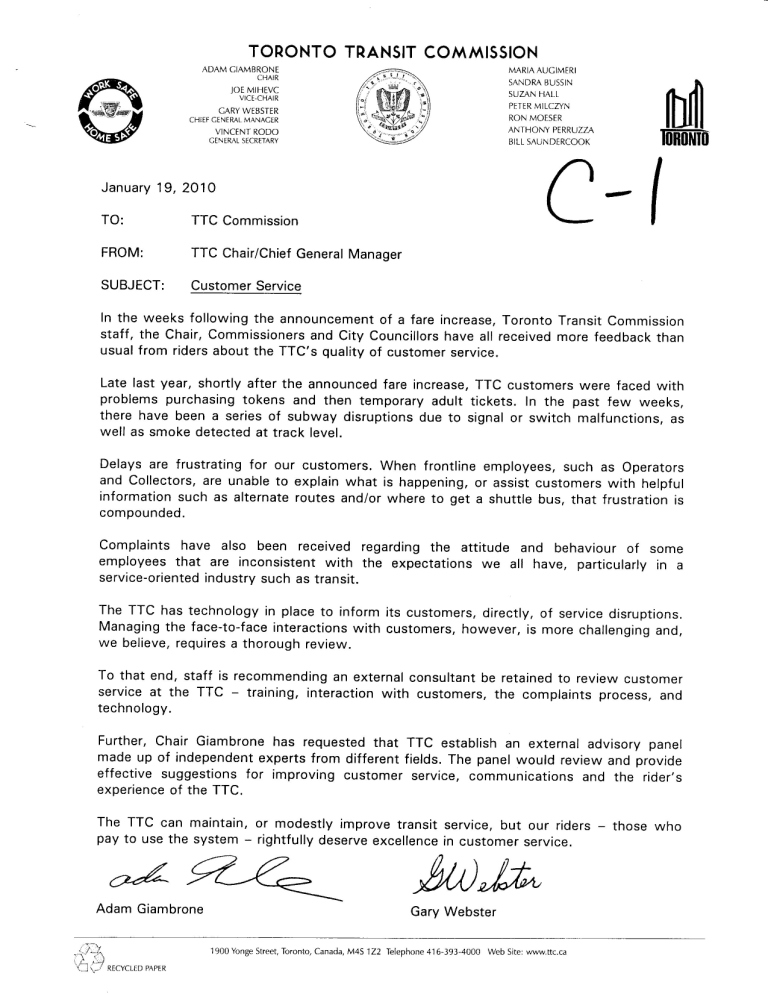
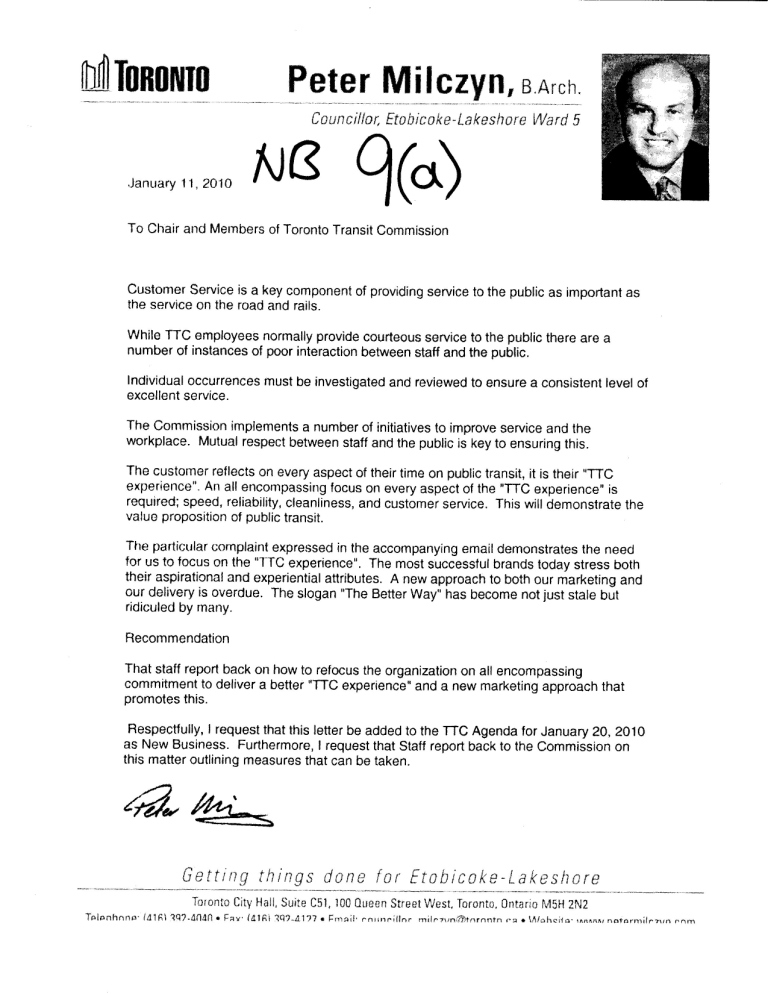
At the January 20th TTC meeting, on proposals by Chair Adam Giambrone and Commissioner Peter Milczyn, the Commission decided to seek out a “blue ribbon panel” to review customer service and improve the TTC.

What’s missing here is the very first step in any such review — a recognition that “customer service” is not just a smiling face on the front line, but an organization that really, truly, top to bottom believes that this is important.  Too much of what the TTC talks about is focussed on the employees’ interaction with customers.  Of course that’s part of the overall picture, but that relationship is coloured by the tools and support employees are given.

The TTC takes every chance to pat itself on the back, to tell Torontonians how great the system is.  Inevitably this shows up with praise for TTC management.  Indeed, Commissioners are loathe to publicly criticize management’s efforts.

That’s a huge shame because it sends the message that management is just fine, thank you, and doesn’t have to change the way they do business. Continue reading

Put Transit City On Ice: Rocco Rossi (Updated)

At the Empire Club today, Mayoral candidate Rocco Rossi proposed that all of Transit City, except for the Sheppard East line, be put on hold pending a financial review.

Rossi may not be familiar with local issues, but he should at least know that Queen’s Park (and, for Sheppard, Ottawa) is paying for these lines, not the City of Toronto.

There are issues with Transit City about which I will write in coming days, but stopping the projects is hardly the correct approach.  It smacks of simplistic anti-Miller campaigning — whatever David Miller did must be wrong and so we’ll stop, or at least slow down, the plan.

I will be generous and assume that the candidate may be badly advised, but this is the second gaffe of Rossi’s platform (the first is the proposal to sell Toronto Hydro), and I can’t help thinking he’s headed for an electoral graveyard.

Updated 11:30 pm:  I am advised that Rossi is aware of funding from other levels of government, but is concerned about future operating costs.  He might start by looking at the extension to Vaughan which is expected to increase net TTC operating costs after any incremental fare revenue by well over $10-million annually when it opens.  The projected riding north of Steeles Avenue is lower than on the Eglinton LRT.

Flexity Cars Running in Vancouver

Stephen Rees blog has an article about the two Bombardier Flexity trams loaned from Brussels for operation in Vancouver during the Winter Olympics.  These cars are similar to those Toronto will see, but with a few important differences.

  • The Brussels cars are 2.3m wide because, as with many European systems, they run on a streetcar network built for smaller cars.  The Toronto “legacy” cars will be 2.54m wide, the same as the CLRVs.  When you look at interior shots from Vancouver, remember that there will be slightly more room on the Toronto cars.
  • The Transit City fleet may be wider still than the legacy cars, but this has not yet been decided.
  • The interior view from Vancouver shows the front entrance right beside the operator’s cab.  This is not the layout currently planned for Toronto because of the different placement of the front truck.  This change, visible in the standard shot of the proposed cars, was required to deal with clearance and derailment issues on our system and its tight curves.

As for the Transit City fleet, I understand that Metrolinx will decide whether Bombardier will, in fact, get the add-on car order in the near future.  This matter needs to be settled so that cars will be available by the time the first Transit City line opens.