
NextBus, er NextStreetcar, Comes To Broadview

This morning, the TTC held a press conference at Broadview Station to launch the rollout of next vehicle information on the streetcar network.

This was something of a non-event given that all we had to look at was one small text display on the platform for the 505 Dundas car and two of the familiar video screens showing expected arrival times for 504 King and 505 Dundas inside Broadview Station.  Oh yes, I mustn’t forget to mention that the display out on the shelter is solar powered.  It will be intriguing to see how well it works next winter.

The announcement neglected to mention that you can obtain the same info online.

Go to www.nextbus.com.  Depending on the behaviour of the browser you are using, you will be taken directly to your most recent selection if you have been to NextBus before.  Otherwise, you will have to navigate to the TTC for your first time in by selecting “Ontario” and then “Toronto”.

It’s a good idea to bookmark at least one lookup (preferably one you want to use regularly) to save on the navigation if your browser won’t “remember” where you have been.

While I was at Broadview, I noticed that the information on the display did not match what was actually happening with the cars.  This was sorted out by a conversation with the NextBus folks.  What they are displaying is a predicted arrival time as this is what people want to know at regular stops.  Terminals are a bit odd in that vehicles arrive and then tend to sit for a while.  They will show up briefly as “Due” and then the display will drop them and show the time for the following vehicle.

This could be confusing especially to someone looking at the video screen inside the station where it is not immediately obvious, especially to a rider unfamiliar with the station, that a vehicle is actually at the platform.  (Indeed a bus may not actually be at the platform but hiding somewhere for a break.)  This information needs to be added, and will be especially valuable in large terminals where displays and vehicle bays may be quite some distance apart.  If someone is waiting for the “next” bus and it has already “arrived”, and will depart (according to the schedule) in five minutes, people need to know this.

Meanwhile in other Broadview Station news:

A display panel about the size of a TTC route map was installed beside the route map last fall.  It is still empty.

The Station Vicinity map here (and everywhere else on the system, except where ancient ones were never removed) is still missing in action.  These were to have been replaced last  fall after the debacle of the many inaccurate maps posted by the TTC.  Maybe the Customer Service Panel will fix this.

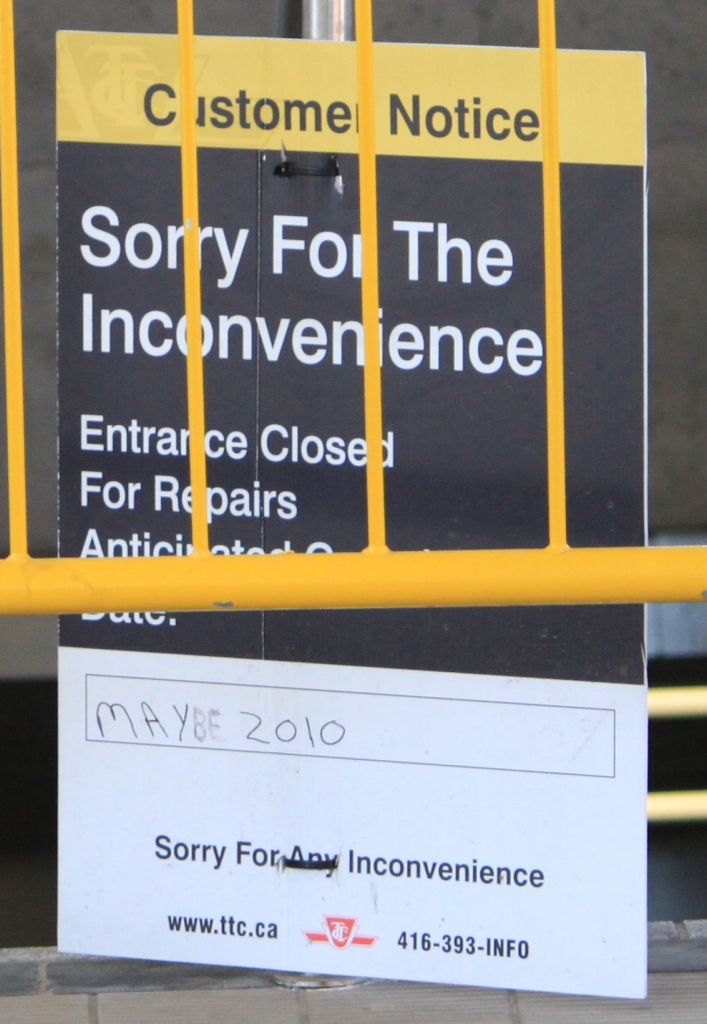
Finally, it’s almost May, and there is no sign of any work of the long-closed second entrance to the station.  There is a sign on the barricade saying it will re-open in May 2010, but this has been discretely modified, possibly in the interest of clarity.
Metropass Turns 30

Saturday, May 1, 2010 brings the 30th birthday of the Metropass.

Back in the dark ages when creative cheating on one’s transfer produced roughly the same effect as a ride-at-will pass, TTC management said a pass would simply not work in Toronto.  Over the years, they have trotted that story out for a lot of things, sadly, and the record is wearing out.  (It would have been a record, probably a wind-up grammaphone knowing the TTC back in those days.)

Then a strange thing happened.  Hamilton, little often-ignored Hamilton down at the end of the lake, got a monthly pass.  If it could work there, why not in Toronto?

Metropasses now account for over half of the rides taken by adult customers on the TTC.  With some luck we may see a shift to some form of smart card (that’s an article in its own right) and a much more flexible fare system on the TTC sometime this decade.

On Saturday, go have a coffee and a small pastry of your choice with a little candle, and sing Happy Birthday to your Metropass!

Attention 905: Transit Cuts Hurt You Too

Yesterday evening, a full crowd at Toronto Council Chamber chanted the words “Save Transit City”, the mantra-de-jour of the Public Transit Coalition.  This was a rousing meeting, a rally to spur people to get out and develop support in their communities, and it ended with a surprise visit from David Miller to send everyone out in high spirits.

Some media and political reaction was quite predictable and treated this as an event to be ignored by all right-thinking folks and especially by Queen’s Park.  MPP Glen Murray was there to put a goverment spin on the situation by claiming that all of the projects are still going ahead, and we’re only having a short delay while the treasury recovers from recent unpleasant circumstances.

Would that it were so easy.  Already, word is leaking out of Metrolinx that some Transit City routes are on the chopping block.  Not deferred.  Cancelled.  The Scarborough RT will never reach Malvern because it won’t be rebuilt, merely re-equipped with aging second-hand cars from Vancouver.  Eglinton may never reach the airport.  Jane?  Don Mills?  In your dreams.

This may play well to 905 voters and to the press who pander to an us-vs-them viewpoint of relations with the City and especially with the Miller regime.  However, it’s time for the folks “out there” to wake up and see what funding deferrals mean for them.

The Metrolinx Big Move contains roughly $50-billion worth of projects spread over a 25-year period.  I doubt that this estimate (leaving aside inflation, changes in interest rates, or capacity limits of the construction industry) is any more valid than the oft-criticized estimates for TTC projects.  Somehow we are to believe that Metrolinx has a much more accurate crystal ball than the TTC, but I have my doubts.  They certainly do not have a track record to prove it.

Queen’s Park hoped that Ottawa would come in for 1/3, but that clearly isn’t happening with a Harper government, and I wouldn’t hold my breath waiting for Iggy, if he ever gets to the corner office, to be any more helpful.  We’re not the only city wanting federal handouts.

That means Ontario has to find $2-billion a year in new money, and likely another $1-billion to handle future operating costs once the lines are up and running.  So far, they had announced $11-billion and change, but that would not cover anywhere near all of the 50-plus projects in The Big Move.

Remember that The Big Move has 15 Top Priority projects (see page 60 in The Big Move):

  • Express rail on the GO Lakeshore corridor (frequent, electrified all-day service)
  • Rapid transit from Eastgate Mall to McMaster University in Hamilton
  • Rapid transit on Dundas Street in Halton and Peel
  • 403 Transitway from Mississauga City Centre to Renforth
  • Hurontario rapid transit from Port Credit to Brampton
  • Brampton’s Queen Street Acceleride
  • Rail link from Union Station to Pearson Airport
  • VIVA Highway 7 and Yonge Street projects
  • Spadina Subway to Vaughan Corporate Centre
  • Yonge Subway capacity improvements and Richmond Hill extension
  • Eglinton rapid transit from Pearson to Scarborough Centre
  • Finch/Sheppard rapid transit from Pearson to Meadowvale
  • Upgrade and extention of the Scarborough RT
  • Rapid transit on Highway 2 in Durham
  • Improvements of existing GO services and extension to Bowmanville

A few of these projects are funded and in progress, but many are not.  How will their timetables be affected by pushing back the “Top 5” projects?  How long will people in the 905 have to wait for their transit services?

Debates about funding sources seem to focus on commutes into Toronto, but many of the “Top 15” projects have nothing to do with downtown-oriented travel.

Queen’s Park and Metrolinx were also big on “alternative procurement” involving private sector capital, construction and possibly operations.  Strangely, the delay in the early projects is all put down to provincial spending constraints, and there’s no word of the bucketloads of capital supposedly available elsewhere.

Queen’s Park has a lot of explaining to do, and they need to set out a clear roadmap for transit development.

Meanwhile, out in the 905, voters need to wake up.  Queen and Bay may be a long way from where they live, and a Toronto rally may seem of little consequence.  That bus, that LRT, that subway you were hoping to see soon is still a long way off and it’s not headed your way.

Public Transit Coalition / Save Transit City Rally

The Public Transit Coalition, a recently formed umbrella group for supporters of Public Transit, will hold a rally at City Hall in Council Chambers on Wednesday, April 21 at 6:00 pm.

Additional related information is on the TTCriders website.

Facebook groups have been created for “Friends of” the various Transit City lines.

Speed or Frequency

There’s an excellent post, complete with several links, on Jarrett Walker’s Human Transit blog talking about the fundamentally different way that highway engineers and sustainable transit folk think about questions of “speed”.  Their views are totally at odds, and the result when a highway thinker takes on a transit problem may leave much to be desired.

Looking at the speed of a trip (or trip segment) may not tell the whole story.

In the context of technology debates here in Toronto, some will take issue with the “or” in this article’s title.  After all, a subway can be both fast and frequent as we all know.  However, part of the total trip is also the access time to service, and that brings us to debates about stop spacing, development patterns and pedestrian-friendly neighbourhoods.

The article also links to a piece about streetcars vs buses on Walker’s site.  The extensive comment thread covers many aspects of the debate we have seen here in Toronto.  One important distinction that Walker himself makes is that the article deals with streetcars vs buses, not LRT vs BRT.  He has a separate article on the distinction between streetcars and LRT.

NextBus Maps Vanish: Is TTC Embarrassed by Crappy Service?

Those who have been following the on again, off again appearance of NextBus information on the TTC have noticed that the route maps are no longer visible, only the next vehicle predicitions for stops.

Apparently, the maps showing the locations of the cars were just too embarrassing for TTC management as they show how erratic the service is even on lines with their own rights-of-way and supposedly good service.

This is an odd development considering that a rollout of NextBus to all streetcar lines was expected soon, and the maps are an integral part of the product.  Most of the streetcar routes appeared for a few days, and even were announced by the Mayor, but they were pulled back from public view.

At some point, TTC operations has to learn who they are working for.  We hear a lot about customer service these days, but perish the thought we actually find out how bad things really are.

If there is anyone at TTC with a reasonable explanation of why we should not see these maps, I want to hear it.

Transit City Cars to be Built by Bombardier

Today, Metrolinx announced that they would exercise the option in the TTC’s order for Light Rail Vehicles with Bombardier for the Transit City fleet.

Here is the press release:

Metrolinx will be entering into formal negotiations with Bombardier Inc. to exercise the option from the replacement streetcar contract to purchase Light Rail Vehicles (LRVs).

The negotiations with Bombardier to procure LRVs are part of Metrolinx’s phased plan which is being developed for the four Light Rail Transit (LRT) projects as requested by the Province.

In June, 2009, following an open competitive procurement process, Bombardier was awarded the original contract to produce vehicles for TTC’s legacy streetcar replacement. This contract contains an option clause that provides Metrolinx with the ability to purchase additional LRVs from Bombardier for the four LRT projects.

Over the past six months, Metrolinx, with the assistance of the TTC and the international transit car expert LTK Engineering Services, evaluated its procurement alternatives. Metrolinx, with the unanimous support of its Board of Directors, concluded that entering the negotiation to exercise the option would obtain the best value for Ontario.

If the negotiations are successful, Metrolinx will announce the details of the procurement when an agreement is reached.

Note the reference to the “phased plan”.  This is the stretched out implementation scheme for the funded Transit City lines contemplated by the March budget cuts to transit.

The timing of this announcement is odd in that it falls between Metrolinx Board Meeting cycles.  It’s almost as if Queen’s Park is trying to tell us that they have not forgotten Transit City.

Updated at 10:15 pm:  See also coverage by the Toronto Star’s and National Post of this announcement.

GO Transit Pile Driving Ruled Unreasonable (Update 3)

Updated April 12, 2010:  Metrolinx has dropped the appeal of the CTA’s order.  The Star quotes Transportation Minister Kathleen Wynne:

“This is about working with the community and repairing any damage that has been done and building a good relationship,” said Ontario Transportation Minister Kathleen Wynne.

“These transit projects are going to be going to go on for a number of years, as they should be. That means there will be disruption in the communities,” she said.

But the government is committed to working with residents to make the process as comfortable as possible, said Wynne.

Continue reading

Saving Transit City

Just over two weeks ago, the wheels came off Transit City and many more plans for new transit routes in the GTA.  Queen’s Park, feeling poorly after bailing out the auto industry and promissing tidy sums for non-transit portfolios, decided to defer $4-billion of spending on The Big Move, the GTA’s transit master plan.  The effect was felt most by Transit City whose projects were those already prepared, out the door and ready to build.  Whether the work on VIVA that is also part of the first batch of funded projects will be affected, we don’t yet know.

Metrolinx has been handed the thankless task of figuring out what to do, and they’re being very quiet about it.  Word on the street is that nothing is to be annouced until the May 19, 2010 Metrolinx board meeting.

For months, it was no secret that Metrolinx was working with the TTC to rein in costs on Transit City so that the projects would stay within the funding envelope, and some trimming was expected (if only by way of creating a “phase II” for some projects).  As long as the total stayed within the announced funding, all would be well, or so everyone thought.

Now, Queen’s park wants to push spending (and associated debt) out into future years, and wants to “defer” about half of their previously committed funding.  Reaction at the municipl level was predictable with the Miller administration openly attacking Queen’s Park for renegging on a promise.  Would-be mayors are thrilled with the opportunity to have someone else delay Transit City so that candidates don’t seem obstructionist.  Meanwhile, such bastions of anti-Miller sentiment as the Toronto Star and the Board of Trade have both criticised the transit cutbacks.

The unhappiness does not stop at the 416 border.  Politicians who were expecting funding for transit improvements including BRT and LRT now wonder openly whether their projects will ever see the light of day.

Continue reading

Electronic Fare Collection: Lessons From New York

The TTC will present an information session on Open Payment systems:

Thursday, April 15, 2010
6:30 to 9:30 pm
Committee Room 1, Toronto City Hall

Here is the meeting description:

Open payment is an exciting breakthrough in fare collection. Instead of using a traditional farecard, it allows transit riders to use their credit or debit cards – even cell phones – at the turnstile or farebox. A prepaid card will also be available for children and others who choose not to use their personal cards.

By using the same technology as every bank, business and retailer, transit operators can be assured that their fare systems will have the highest level of security and will never be obsolete. Visitors from across Canada and around the world will be able to tap and go without having to figure out how to buy a fare.

The TTC is a full participant in the Presto farecard project and continues to work with the provincial agency to identify funding to bring farecards to Toronto. By proceeding with open payment in parallel with Presto’s traditional farecard the TTC is leading a revolution on how riders experience public transit.

Come to an information session on open payments led by Paul Korczak, former Chair of the Transportation Council of the Smart Card Alliance, a current member of the Near Field Communications Academy, and is actively involved in peer reviews and public forums on transit fare payments around the world.

With all the discussion of Smart Cards, this will bring a much-needed update on the evolution of payment technology to Toronto.