A New Carhouse for TTC Streetcars (Update 4)

Updated June 9, 2010 at 7:40 pm:

Council today voted to support the TTC’s proposal for the Ashbridge Carhouse including an access route via Leslie Street.  This was little surprise given that Councillors are loathe to override staff recommendations unless there is an overwhelming case in favour of an alternative.

The first part of the debate turned on whether the carhouse should be at the Ashbridge site at all.  Despite some uninformed grandstanding by would-be mayor Ford, and handwringing by others over what might have been at the Lever site (Sunlight Park) if only its availability had been known sooner in the process, the Ashbridge site selection was approved.

The second part of the debate focussed on the access route.  The TTC argued strongly against the Knox/Russell option and that position won the day, in part because few champions of this route rose in the debate.

The Transit Project Assessment now enters its formal 90-day phase for comment and then goes to the Minister of the Environment for approval.

Continue reading

Furious George Has A Plan (Update 2)

Updated June 8, 2010 at 11:00 pm:

The Smitherman campaign has posted a backgrounder to his transportation plan which has been updated to reflect the funding of inflation by Queen’s Park.

In a previous update, I noted that there was a bit over $1-billion still unaccounted for.  This is explained in the backgrounder as follows:

Once the provincial government formally approves their contribution escalation the Smitherman construction cost increment is reduced to $3.87­billion, or $5-billion once financed to 2021. [Page 3]

Although this issue has been addressed, the method of paying for transit investments has not been changed.  Smitherman still depends on revenue from gas tax and dividends from City agencies, money that is already spoken for by existing budgets at the TTC and the City.  He also depends on new tax revenue from developments along the routes to be built.  However, those taxes traditionally have been at least partly spent to serve new residents and businesses these developments would bring.

While I applaud Smitherman for at least producing a detailed plan, I still do not agree with elements of it such as the Bloor-Danforth subway extensions or with his financing scheme.  (For the record, at Council today TTC staff responded to a question from Councillor Thompson about a subway extension and explained that any subway extension could not be built along the existing SRT corridor.)

The original content of this post follows the break.

Continue reading

Still Waiting For A Long Branch Car (Updated)

Updated June 3, 2010:

On June 2, the Commission didn’t decide to implement the 507 Dundas West option (described below), but didn’t kill off the idea entirely either.  Some Commissioners balked at the $825k/year pricetag, but the greatest failing was the lack of strong support from the local Councillor who is not a member of the Commission.

I had the sense that individual Commissioners wanted to do what they could to improve service on Lake Shore, but could not figure out a way to do so without out appearing to overrule staff and give in to a local pleading, especially in an election year.

There was a side discussion of the Park Lawn Loop whose installation would extend the 501 Humber service a short distance westward providing better service to some of the Humber Bay condo area, but this project is one of many competing for capital funds in a tight budget.

The motions passed by the Commission were:

Vice-Chair Mihevc:

That the Lakeshore Boulevard Streetcar service matter be referred to staff for consideration during the 2011 budget process.

Commissioner Milczyn:

That TTC staff consult with City Transportation staff on the possibility of constructing a portion of the civil works related to roads, curbs, sidewalks and utilities required for the Parklawn Loop in conjunction with road construction this year, and further authorize the Chair and Vice-Chair to approve any reallocation of funds required for this.

Commissioner Moeser:

The Chief General Manager be authorized within his authority spending level of $100,000.00 to approve any pro-active work considered appropriate for the proposed Park Lawn Loop.

[From draft minutes of the meeting supplied by the General Secretary’s office.]

I spoke to the subject, but nobody from the community appeared probably due to timing constraints and a sense that deputations would be fruitless in the face of TTC staff’s position on the matter.

The original post follows the break.

Continue reading

Sunlight Park Carhouse?

The TTC has a report on its Supplementary Agenda for the June 2 meeting regarding the Unilever property at the foot of Broadview as a possible carhouse site.

During the initial search for new carhouse and maintenance sites, this property was rejected because the then-available acreage was too small.  The situation has now changed, and quite a large block of property is available.  However, the lead time to acquire and clear the site means that a new carhouse and maintenance facility could not be ready in time for the delivery of the Flexity LRV fleet.

All the same, it would be worthwhile investigating this property as a long-term site for a new carhouse replacing Russell and/or Roncesvalles once the high-floor fleet is completely retired.  This would allow redevelopment of two choice pieces of property on Queen Street.

Those familiar with the old Lever Bros. property know it is bordered by Sunlight Park Blvd., a street named after a well-known product.  If this does become a carhouse, that would make a fitting and historical name.

Of course, with that BMW dealership next door, the carhouse would have to feature a large window framing an LRV looking out onto the DVP!

The SRT As It Might Have Been

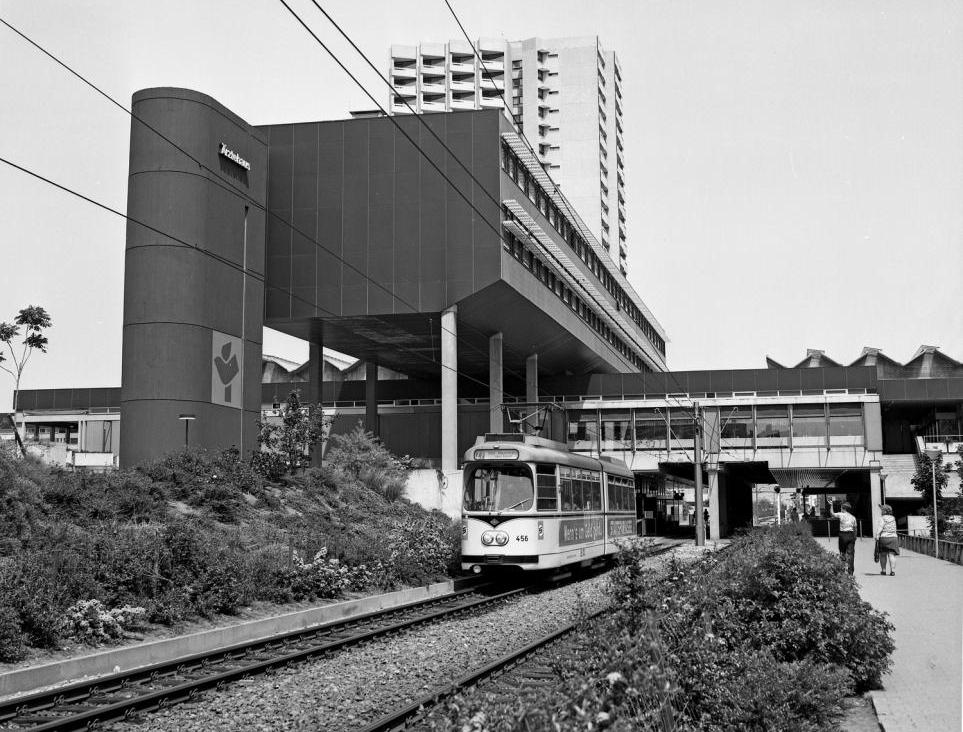
John F. Bromley sent me a photo of a new LRT line running through a commercial development.

Look familiar?  Can you say Scarborough Town Centre?

The photo is from June 1972.  The cars were the first in Europe to be air conditioned.

This shows the kind of thing done with LRT in Europe even before the TTC reversed its anti-streetcar policy, about the time Queen’s Park decided that we needed an “intermediate capacity” system midway between buses and subways, and before the TTC collaborated with Queen’s Park in destroying an LRT plan that could have been built 40 years ago.

How Clean Is My Station?

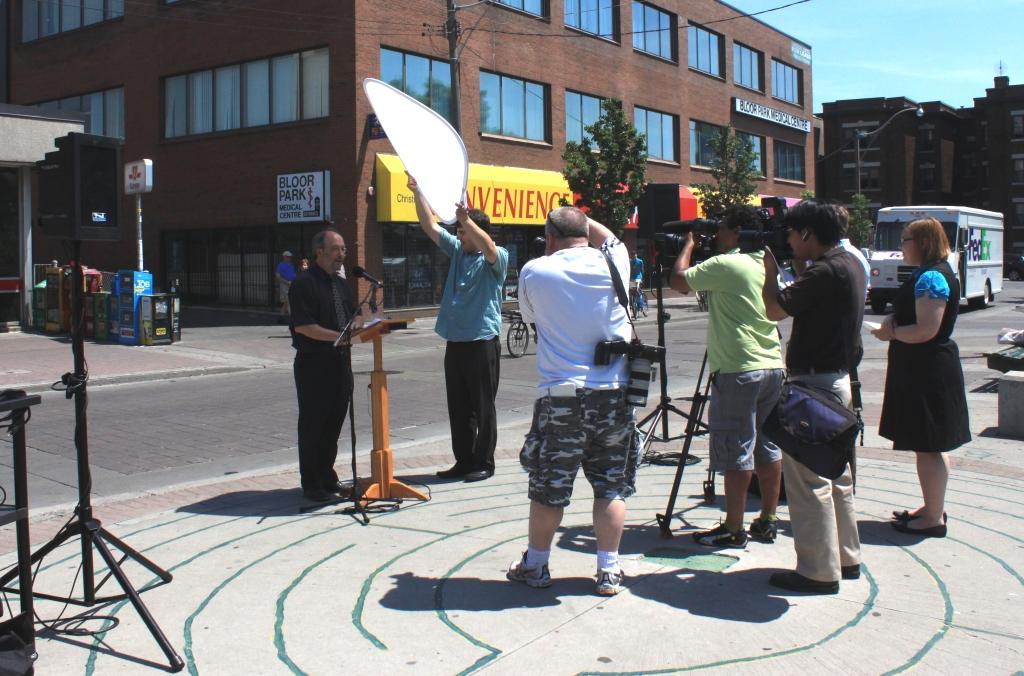
On May 27, TTC Vice-Chair Joe Mihevc staged a most unusual press conference at Christie Station.  The purpose?  To announce a new website, ttcpassengeraudit.com, where riders can report issues about the subway stations they use.

On July 17, 2010, volunteers who sign up for a specific station will audit their sites and post responses via an online form (available only in hard copy as I write this).  Topics to be reviewed include lighting, cleanliness, maintenance, way-finding, the station exterior and surroundings, safety and quality of ride (not strictly speaking a “station” related issue).

The need for customer-based reporting is an admission of failure in “official channels” to get things done.  Customers report lots of things to the TTC today, and some are even addressed, but many languish for months with no apparent action.  The TTC maintains web pages with information about escalator and elevator maintenance, as well as construction projects, but these cover the large, planned works, not day-to-day housekeeping.

Some issues, such as the long-standing closure of the “new” entrance to Broadview Station, are not listed on the TTC site at all.  (As a passing update, some work appears to be taking place, but very slowly, and the notices now claim the entrance will reopen by June 30, 2010.)  Riders should be able to get up-to-date information about the status of such projects online without counting on transit activists or Councillors to chase TTC staff.

The TTC hires an outside agency to audit its stations to give an unbiased view of what is happening.  Although there are goals for improvement, the index for the system as a whole inches up very slowly.  TTC claims that it is hamstrung by the availability of staff and things would be so much better if only there was a greater subsidy.  Whether the staff they have is properly managed and monitored is not discussed, at least not publicly.
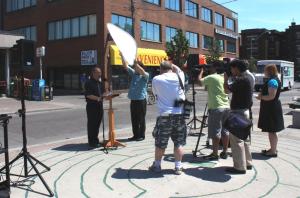
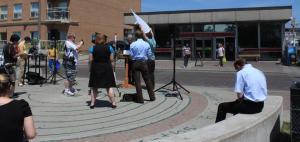
The press conference was unusual in that it had no TTC official presence, and it was conducted, at least initially, outside of the station.  It was very hot, and Mihevc’s assistant Anthony Schein held a reflector to act as a parasol.

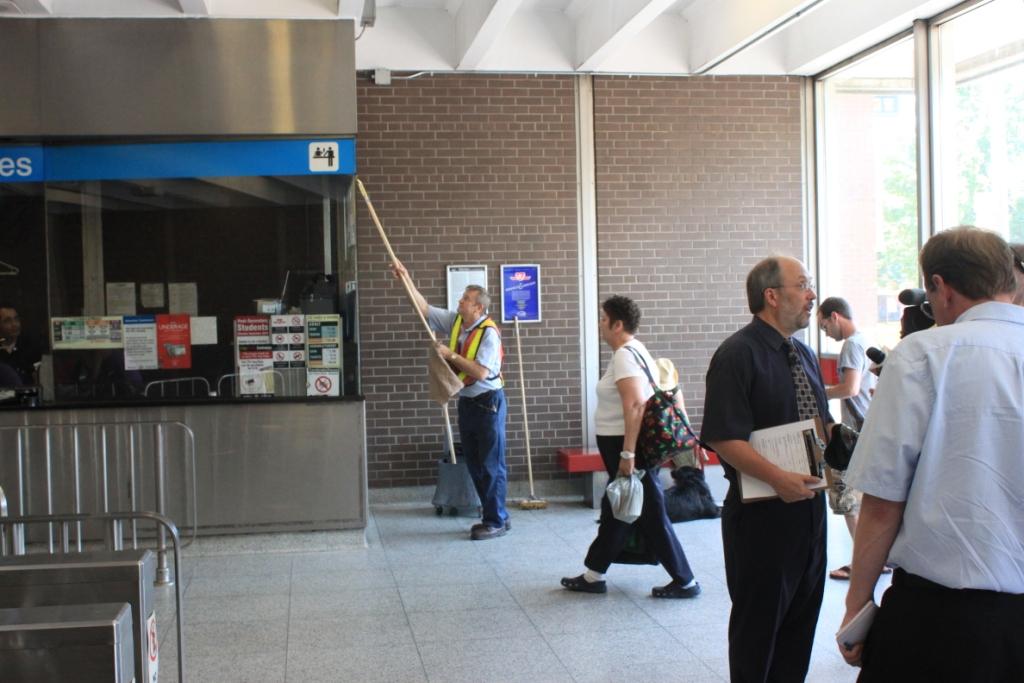
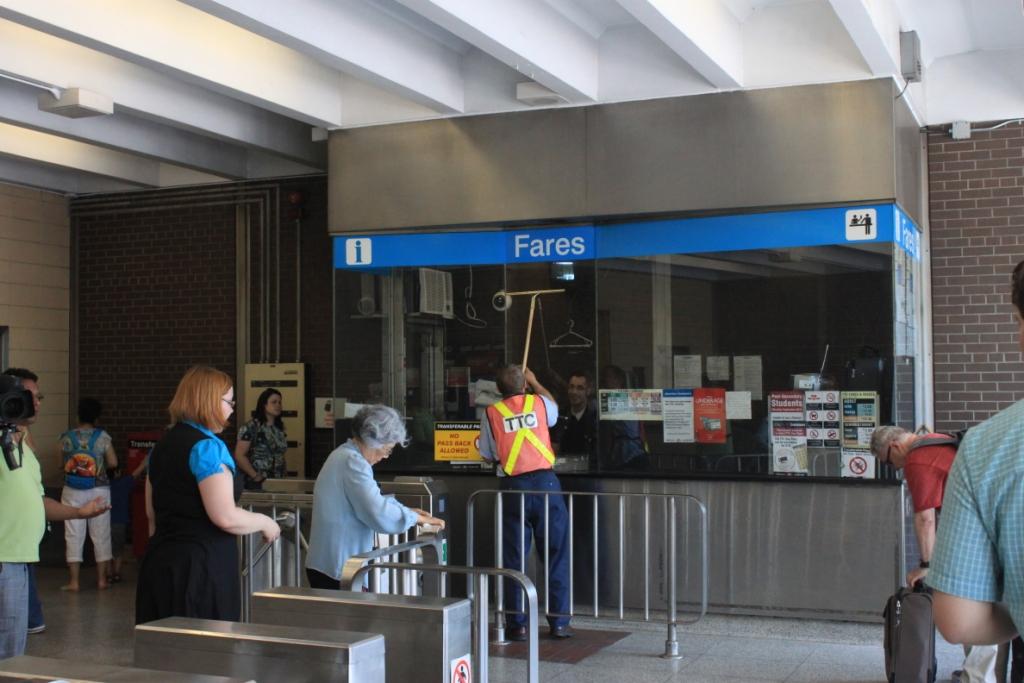
Later, we all moved inside, and things took quite an amazing turn.  Strangely enough, the TTC had two workers on hand cleaning the station.  I had seen one sweeping the platform when I arrived, but upstairs there was another.  As Joe spoke, the cleaner was washing the glass of the Collector’s booth.  I have been riding the subway since it opened, and I have never seen this activity.  Maybe I just don’t frequent the right stations.
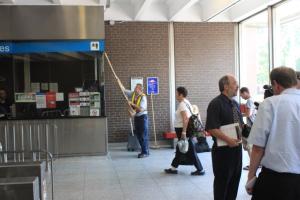
Note also that the signs in the booth window are all lined up.  If you look closely, you will see that only one of them is hand-written.

Meanwhile, elsewhere in the station, we have:
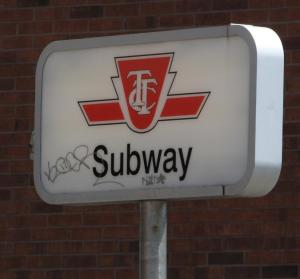
The entrance sign bearing a tag, and …
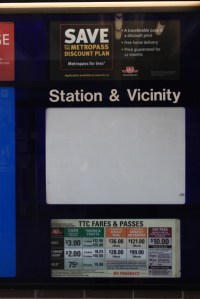
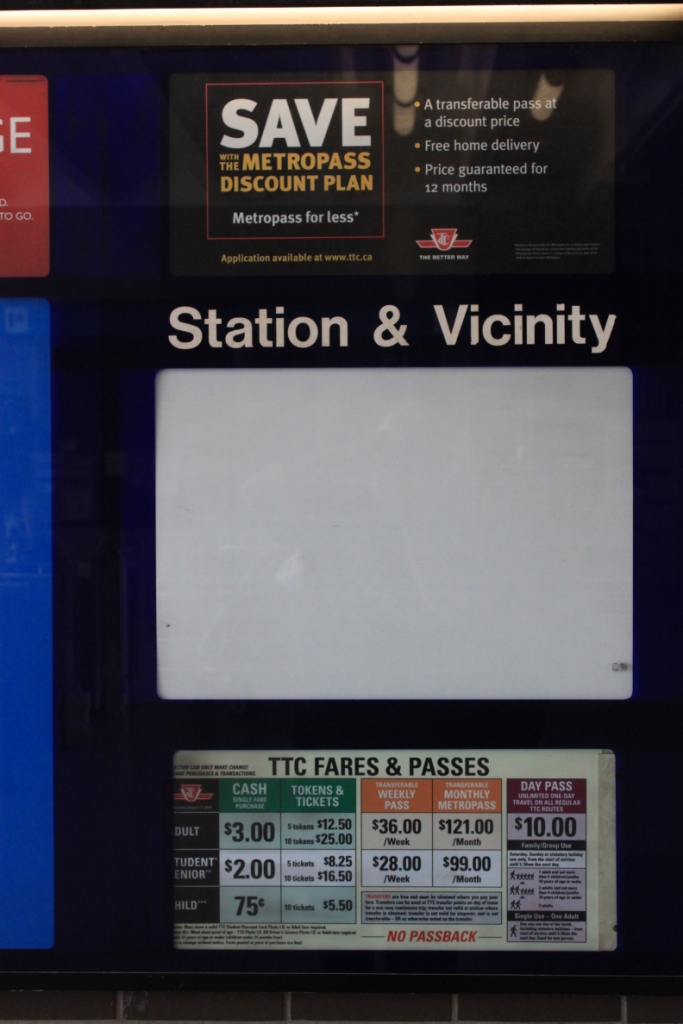
The long-missing vicinity map.  After the debacle of new and wildly inaccurate maps last September, maps that vanished in the blink of an eye once the problem was reported, the TTC assured us that new maps would be in place by November.  It is now May.

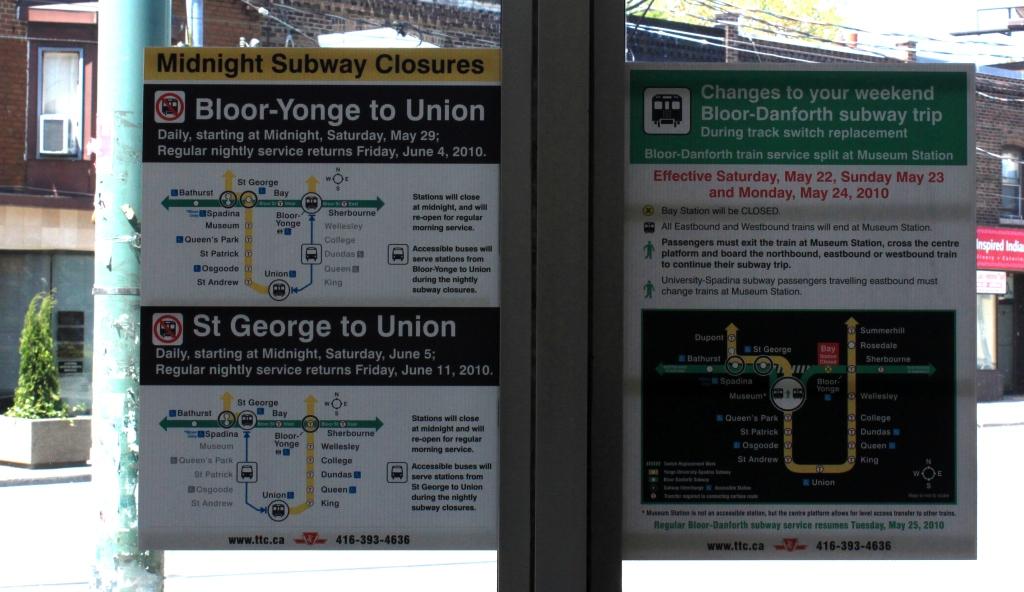
On the subject of removing and installing signs, the TTC has outdone itself in recent days.  An ongoing problem is that old signs are never taken down, they just fall down, eventually, after being vandalized, shredded, or just slowly crumbling off of the wall.  Last weekend, there was a subway diversion at St. George, and posters announced the temporary routing.  Starting this weekend, there are nightly shutdowns of parts of the Yonge-University line.  Signs for the new diversion were installed days after the St. George diversion ended, but the old signs remain in place.

At Broadview, main level, they are side by side.  At the mezzanine level, the St. George notice occupies pride of place at the foot of the main stairway in front of the newsstand, while the YUS notices are tucked away in corners.

Why is it not possible to take down out-of-date notices, especially when the space could be better used for current information?  How long will these two signs languish at my station?  Will we give a prize for the station with the most out-dated signs or maps?

For many years, I have urged the TTC to adopt a simple tactic I saw decades ago in Boston where all notices have a “stale date” and text at the bottom saying “Remove after xxx”.  Station cleaning staff take down old signs as part of normal housekeeping.  Somehow, this simple process is beyond the abilities of the best transit system in the known universe.

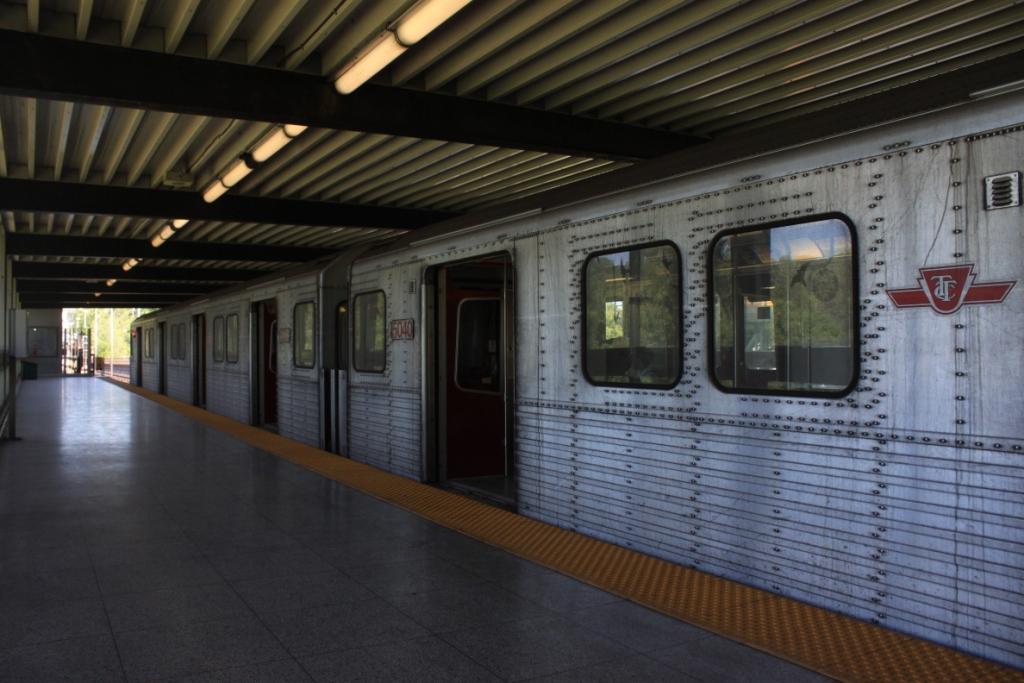
Riding over to Christie Station, I was on a train that was not just dirty, the exterior was black.  The fleet number on one car was covered with a tag, and many people had “finger painted” in the dirt on the windows.  Indeed, I started to notice how few cars did not have such “inscriptions”, and was astounded a day later to see a train that was almost gleaming, the only freshly-washed train I have seen in months.  The problem seems to exist mainly on the Bloor-Danforth line.

This train is fairly typical of BD-line equipment.  Dirt streaks run down from the roof, and although it’s not immediately obvious, the windows are coated with dust.  Our stations may be spotless, but from inside the trains, it’s like looking through a fog.
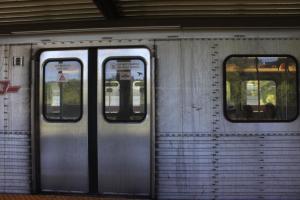
This car has beautiful clean, shiny doors.  That’s the colour the whole thing is supposed to be.  Maybe not mirror-bright, but a decent silver, not a shoddy imitation of pewter.
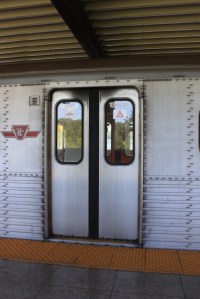
This shows a common problem with doors on cars that are somewhat cleaner than average.  There is an area at the top of the doors that simply doesn’t get scrubbed clean.

[Technical note:  These photos were taken in Old Mill Station using daylight that came in through the north window on a cloudless late afternoon.  You can see the exterior lighting condition in each of these photos, one way or another.]

Joe Mihevc wants riders to have a sense of ownership in their system.  At times, riding the TTC is like living in a run-down apartment building where I want the place to look nice, to be proud to bring friends, but the landlord has excuses for not doing anything.  There is even  plaque in the lobby congratulating him for the condition of his building.

When the TTC starts to care about its system again, when it stops using the “we need more money” excuse as a blanket response to every criticism, riders might really feel they are part of the TTC.

Metrolinx Board Wrapup for May 2010

The Metrolinx Board met on Wednesday, May 19 for an unusually long public session.  Rather than post separate articles, herewith a compendium report.  The major topics are:

  • The Board Speaks!
  • The Managing Director Reports
  • We Have A Vision, We Just Don’t Know What It Is Yet
  • Achieving 5 in 10, or Transit City Rescheduled
  • GO Rail Service Expansion Benefits Cases
  • A Question of Advocacy

The Board Speaks!

Probably the most astounding thing about this meeting, the first anniversary of the “new” Metrolinx, is that the Board members finally found their voices.  I was beginning to wonder if they were ever going to show some indication of earning their keep and actually asking hard questions of staff in public.  We’re not quite there yet, but at least the discussion gave an indication that the Board is thinking about its role.

As regular readers will know, I believe that organizations such as Metrolinx should be publicly accountable through an electoral process and through direct access to one’s representatives.  Boards that answer to nobody but the government which appointed them, and entertain no criticism from the public, can leave much to be desired.

To be fair to Metrolinx, even when it had a political board, much of the “public participation” was managed to achieve concensus with, more or less, what Metrolinx planned to do anyhow.  That other well-known transit board, the TTC, is elected, but has succumbed to the disease of being cheerleaders for the organization right-or-wrong.

Metrolinx has not had to actually do much (as opposed to GO Transit which was simply merged into its new “parent”), and we have yet to see how the Board and the Government will react if Metrolinx badly fouls up any of its projects.

Continue reading

The Board of Trade Discovers Transit Funding

After years of howling that taxes in Toronto are too high, that no business would dream of locating here, that the Toronto economy is going down the tubes because politicians are not generous enough with their handouts, the business community has discovered transit funding as a major issue.

The Toronto Board of Trade published The Move Ahead:  Funding “The Big Move”, a document arguing that lack of infrastructure investment, specifically in transit, is a serious impediment to economic vitality in the Greater Toronto Area.  The Board’s report is based on a June 2008 Metrolinx report, but adds observations about the mechanics, implications and practicality of various revenue-generating measures, as well as examples of their use in other cities.

Continue reading