Planning for SmartTrack

At its meeting of January 22, 2015, Toronto’s Executive Committee will consider a report (SmartTrack Work Plan 2015-2016) recommending a work plan for the study of Mayor Tory’s SmartTrack proposal together with other related transit projects. This is intended to dovetail with Metrolinx’ work on their Regional Express Rail (RER) network, and will have spillover effects on studies of both the Downtown Relief Line (DRL) and the Scarborough Subway Extension.

The most important aspect of this report is that, at long last, a study is reviewing transit options for Toronto on a network basis rather than one line at a time. Factors such as alternative land use schemes, fare structures and service levels will be considered to determine which future scenarios best support investment in transit. Rather than starting with a “solution”, the studies are intended to evaluate alternatives.

If this outlook actually survives, and the studies are not gerrymandered before they can properly evaluate all strategies, then the process will be worthwhile and set the stage for decisions on what might actually be built. The challenge will be to avoid a scenario where every pet project on the map is untouchable rather than making the best of the network as a whole. The term “best” will be open to much debate.

Continue reading

TTC 2015 Budget Preview: Business As Usual or Transit Renaissance?

Toronto will get a sense of where its new Council and TTC Board are headed next week when the City launches its budget for 2015 on Tuesday, January 20. This will be followed by debates at Budget Committee and the TTC’s own budget meeting on Monday February 2.

After months of election campaigns and an early honeymoon, our politicians will have to pick which “Transit City” they really want.

  • Do we face more of the small-minded penny-pinching, the false economies of the Ford era, or a view of Toronto and its transit services where policy is more than drawing fantasy subway maps and stuffing more people in fewer buses?
  • Will Toronto be a city with expanding, attractive transit service for riders on the network as a whole?
  • Will Council spend money on transit today and make real changes, or do we face four more years of making do with inferior service?
  • Will capital spending focus only on megaprojects (ideally ones paid for with other governments’ money), or will Council recognize the needs of the existing system for maintenance and improvement?

Continue reading

GO Transit Pilots Cut Rate Fare For Short Trips

Today, Metrolinx announced that GO Transit will offer a pilot low-cost fare on its Lake Shore line between Exhibition, Union and Danforth Stations. For $60, riders can buy a monthly sticker that would be added to their Metropass much as the Premium Express stickers for TTC services are today.

This is a substantial discount from the $181.60 that it would cost for the 20 days’ commuting trips based on the fares effective February 1, 2015. ($5.09 for each of rides 1-35, and $0.69 for rides 36-40.) The scheme began with a call for cheaper fares between Liberty Village and downtown Toronto, given that Exhibition Station is at the south end of the neighbourhood. Not to be outdone, east end Councillors jumped on the bandwagon, and Danforth Station was added to the request. GO’s announcement responds to these two “squeaky wheels”, but falls short on a number of other points.

  • Having a Metropass is a pre-requisite to using the lower GO fare. Depending on a rider’s travel pattern, a Metropass may be more expensive than pay-as-you-play token purchases.
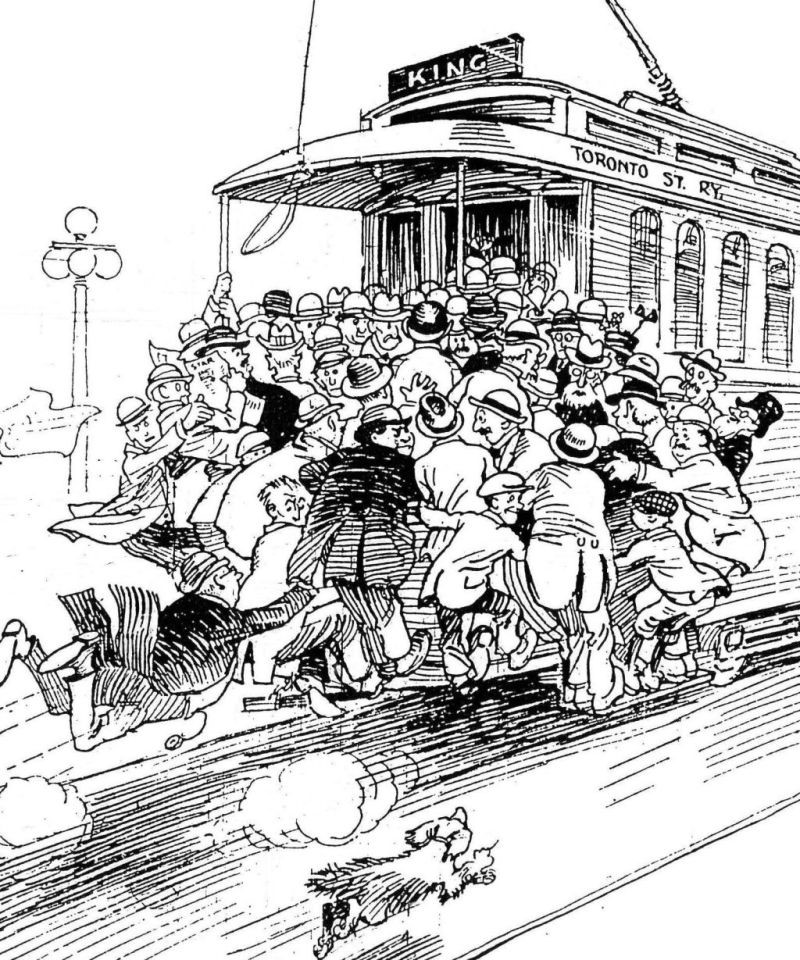
  • The further one lives from Exhibition Station, the less attractive a walk to GO will be, especially during off-peak periods when finding space on the King car would be less of an issue.
  • One advantage touted for the scheme is offloading subway demand. In fact, this requires passengers to walk from Main Station to the GO Danforth Station, roughly a seven minute journey from the subway platform, plus the wait time added by the transfer connection. Ironically, many of the peak trains stopping at Danforth will also serve Kennedy Station which would be a much simpler transfer point for many east end riders, but the cheaper fare will not be available there.
  • The fare from Danforth to Union is the same as the fare from Scarborough, Eglinton, Kennedy, Weston, Etobicoke North, Oriole, Old Cummer and York University Stations. It is higher than the fare from Bloor, Long Branch, Mimico and Kipling. However, the cheaper “integrated” fare is offered only to those riders who have the least potential time saving by switching from TTC to GO for their commute trips.

Many peak period trains now run express and skip Danforth and Exhibition Stations. As of January 16, 2015, service is provided only by Lakeshore corridor trains (all Stouffville trains run express).

  • Danforth to Union
    • AM Peak: 6:36, 7:01, 7:16, 7:55, 8:27, 8:55.
  • Union to Danforth
    • PM Peak: 15:43, 16:30, 17:05, 17:20, 17:35, 18:18
  • Exhibition to Union
    • AM Peak: 6:27, 7:00, 7:37, 7:58, 8:24, 8:56, 9:04
  • Union to Exhibition
    • PM Peak: 15:43, 16:13, 16:43, 17:10, 17:43, 18:13

The schedules will change effective February 2:

  • Stouffville line trains will stop inbound at Danforth at: 6:15, 7:36, 7:48, 8:20, 8:46, 9:46
  • Stouffville line trains will stop outbound at Danforth leaving Union at 16:18, 16:48, 18:00

Some counter-peak Lakeshore trips that now run express will stop at Danforth. Details are on the GO website.

No additional trains will stop at Exhibition Station.

At the press conference announcing this pilot project, Metrolinx President & CEO Bruce McCuaig spoke of how this would be a “revenue neutral” undertaking. No additional trains will be operated. Whatever handful of commuters who now pay the full GO fare from Exhibition or Danforth to Union will get a big discount, but any new riders are found money for GO Transit. Whether this would be the case if the arrangement were extended throughout GO’s inner fare zones is another matter.

This is supposed to be a one-year pilot, and riders who originate in, say, Scarborough might reasonably ask why they have been left out in the cold even though there are many GO stations including those in the future SmartTrack corridor. How this pilot will establish much about the actual market for an integrated TTC/GO fare is a mystery, but the announcement provided yet another photo op for the politicians.

As of 1:45 pm on January 16, I await a formal response from Metrolinx to a query about the scope of the pilot and the absence from it of many potential stations.

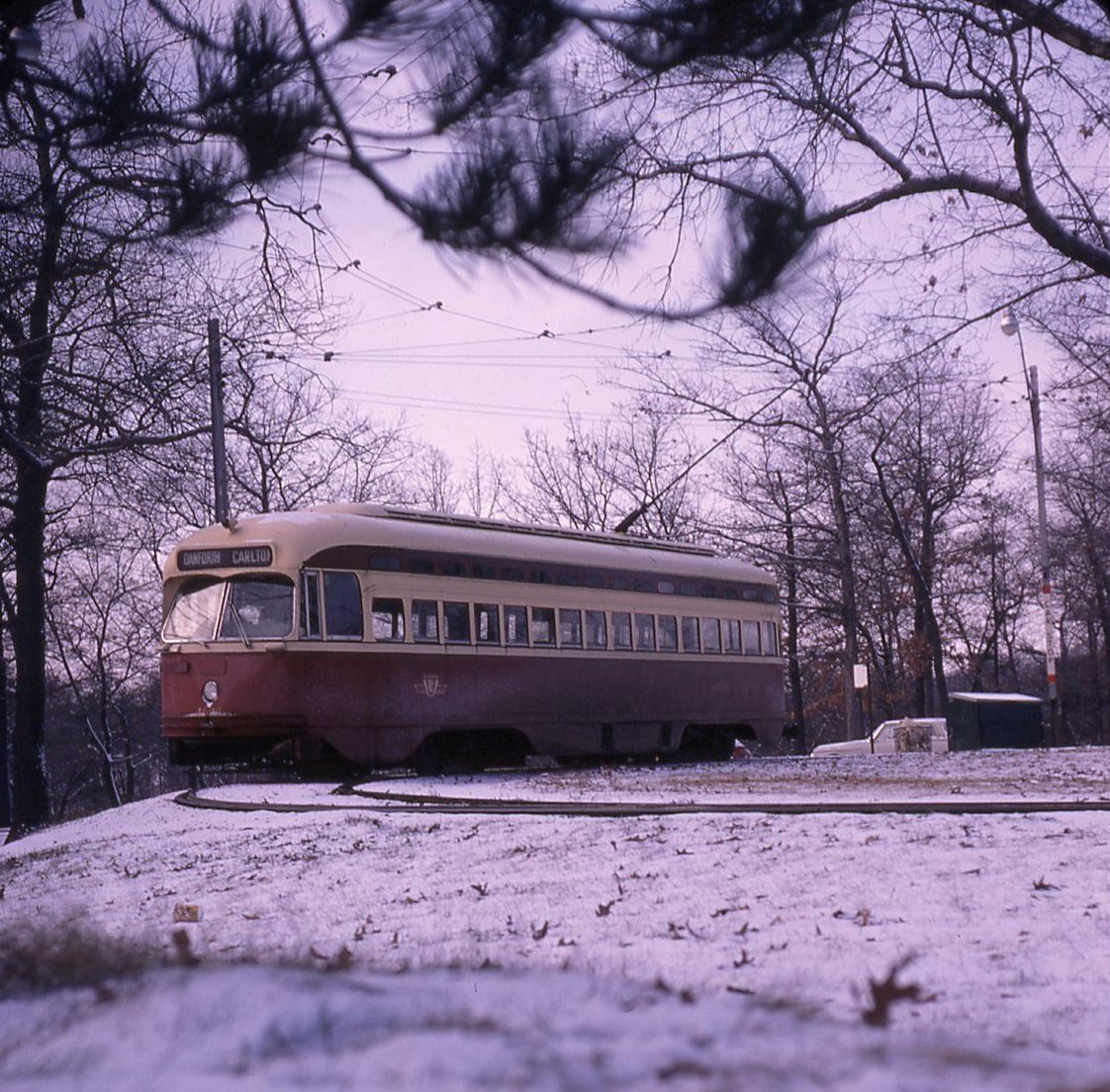
Looking Back: Bloor-Danforth Shuttles

From February 1966 when the original Bloor-Danforth subway opened between Keele and Woodbine, and May 1968 when the extensions to Islington and Warden were added, two streetcar shuttles served the remaining outer part of the Bloor carline.

Looking at the old streetscapes, much remains familiar, but much has been lost especially to cheap rebuilds and infill developments.  Very much a vanished breed from this era are the car lots, gas stations, furniture stores and, in a few cases, houses.

Continue reading

Bloor-Danforth Streetcar Shuttles: Demand Without Density

A frequent part of debates about technology choices and network planning is the premise that to succeed, rapid transit must be surrounded by high density development. This is an odd claim given the counter-examples available on Toronto.

The situation is more subtle, and “demand” turns not just on density adjacent to the line, but on its ability to act as a corridor drawing on feeder services to concentrate demand. Whether such concentration is “good” is another matter. Higher demand requires more infrastructure in the corridor and in a worst-case scenario, a line can run out of room. Two good examples in Toronto are the Yonge subway and Highway 401.

Focus on a single corridor can also distort travel patterns and network design. As a non-driver, I have often been amused by motorists who will go miles out of their way to use an expressway, only to find themselve trapped in a traffic jam. For transit riders, the need to force-feed rapid transit can interfere with travel that is not oriented to the primary trip pattern. Try getting around Scarborough if you are not bound for Kennedy or STC stations.

Recently, I was scanning another batch of old phographs and they reminded me of an even older example of high demand in a low density area: the streetcar shuttles on Bloor-Danforth that operated between the opening of the original Keele-Woodbine service, and the extensions a few years later to Islington-Warden. Neither Bloor West nor the Danforth — particularly in the late 1960s — were forests of high rise apartments. All the same, the shuttles had service, capacity and demand beyond that we see on any streetcar line today.

The Bloor West shuttle from Keele Station to Jane Loop operated with 17 cars at peak over a distance of only 2.1km at a headway of 1’07”. That’s 53.7 cars/hour for a design capacity of about 4,000/hr (based on about 75 riders per car) with headroom for peaks at a higher level.

The Danforth shuttle from Woodbine Station to Luttrell Loop operated with 12 cars on a 1.6km line at a headway of 1’30”. At 40 cars/hour this gave a design capacity of about 3,000/hr.

An important point about these shuttles is that the lion’s share of their traffic was bound to or from the subway, and local traffic was comparatively light. Many riders boarded inbound at the Jane and Luttrell terminals, and the streetcars were not attempting to serve very heavy demand from on-street stops. That demand depended on feeder bus services from what we now call “the inner suburbs”.

Moreover, the level of service on the outer ends of the old Bloor-Danforth streetcar route shows how considerable the demand was for these segments, even allowing for some added demand due to the subway’s presence.

The moral of this short article is that a transit network and its routes cannot be thought of with a simplistic model of transit stations surrounded by development. The larger context includes the diversity or concentration of demand patterns and the degree to which the network serves them.

In the next article, a look at Bloor West and The Danforth as they once were.

Correction January 6, 2015: In the original version of this article, I cited the number of cars/hour as the actual assignment of vehicles to each route. Thanks to John F. Bromley for catching this howling error.

Will We Ever See Our New Streetcars?

In the Financial Post, Peter Kuitenbrouwer reports on problems at Bombardier’s Thunder Bay plant.

It’s a sad tale of cock-ups with parts that don’t fit and claims that designing for Toronto’s streetcar environment is too challenging. Fortunately for Bombardier, they have not yet had to start producing the Metrolinx cars that should be an off-the-shelf design as a point of comparison.

Sorry, Bombardier, you bid on this contract, and you pass yourselves off as a world-class supplier. Stop complaining and start delivering.

Welcome to My New Site for 2015

Updated February 28, 2015: The domain stevemunro.ca now points to the site hosted at WordPress and is synonymous with swanboatsteve.wordpress.com.

Updated February 17, 2015: All articles and attachments from the old site have now been migrated here.

Starting on January 1, 2015, all of my new content will appear here.

For a period of time (likely until March 2015) “stevemunro.ca” will take you to my original site where articles are still active with comments. Given the number of hotlinks to recent activity, I am leaving those articles in their original locations.

Access to the new site will use the URL swanboatsteve.wordpress.com until February 28, 2015.

When the migration is completed and activity on the old site dies off, I will switch my domain to point to the new site and it will be accessible either via the WordPress domain name or using stevemunro.ca.

Continue reading

Birth of a Name: Transit City

Today, December 29, 2014, is the tenth birthday of the name “Transit City”.

No, this was not an early version of David Miller’s LRT network (still two years away), but rather an attempt by the TTC to show what might be done with surface transit improvements. I had an advance copy of the proposal for comment, and a request for a name that could give it some presence. Something better than “Expansion of Bus and Streetcar Rapid Transit” by which it would appear on the January 2005 agenda.

In a somewhat fanciful, stream of conscience email, I wrote back:

Hmmm … “Better Late Than Never” would be a good description for some TTC services, not to mention for a plan that we could actually achieve rather than endlessly debating.

[…] it is important that we somehow emphasize that this is something we really can do, and can do in a reasonable timeframe at a cost we might be able to afford.  Also, we have to tie this in with the idea that Toronto is growing through transit to support the OP [Official Plan].

As a sidebar, somewhere the plan has to acknowledge that the TTC is NOT the only game in town, and that some of the growth will be handled by other systems, notably GO Transit.  What is vital is that we do not repeat the errors of “Network 2001” which planned for lots of growth but ignored the potential contribution of commuter rail.  That’s where the so-called justifications came from for the Sheppard Subway and for the scheme to massively expand Bloor-Yonge station.

Somewhere, we have to say that we should not try to handle all of the regional demand on the subway, and that this approach will leave resources (and subway capacity) free to handle comparatively-speaking local demand.

The LRT (or whatever) study needs to acknowledge this context — that it is NOT trying to be a mega solution to all transportation problems of the 416 and 905, but that it is trying to address the growth of population on The Avenues, and more generally in a built form that is not suitable for a network of subway lines.

Alas “Wheels to the Future” has already been used by the TTC over 60 years ago, and some bright spark might point out that hovercraft and maglev trains do not use wheels for propulsion — we want to give no indication that this study may be biased to one particular mode, after all.

“Transit for the Avenues” or “Transit Avenues” only makes sense if you know about the OP and the special meaning it assigns to that word.

“Network 2011” has been used before, and we really need to get a shovel into the ground sooner than that anyhow.

Hmmm … I have just had a brainwave along another, er, avenue …

“Toronto, A Transit City” is generic and it shows the focus we want for overall growth using transit (be it on the Avenues or elsewhere).  It’s also broad enough to embrace a larger scheme of studies … “Toronto:  Building a Transit City” … which would probably come to be shortened in general parlance as the “Transit City” plan …

The presentation duly appeared on January 12, 2005, and it makes interesting reading, if only for a very different view of where transit was headed 10 years ago. The report is no longer available on the TTC’s website, but thanks to Transit Toronto, it is still online.