TTC Fare Increase For 2016

After a long, rambling, and less-then-well-informed debate, the TTC Board has approved increases in selected fares for 2016 at its meeting of November 23, 2015.

  • Adult cash fares will rise from $3.00 to $3.25.
  • Adult tokens will rise from $2.80 to $2.90.
  • Metropass prices (all classes) will not change.
  • Student and senior fares will not change pending the outcome of a study on Fare Equity that will report early in 2016.

The cash fare last changed in 2010, while the adult token fare, then $2.50, will have gone up $0.40 by 2016.

Freezing the Metropass prices will have the effect of lowering the “trip multiple”, the ratio of the pass price to the token fare from 50.5 in 2015 to 48.8. For monthly discount plan (MDP) subscribers, the ratio will fall to 44.7. The multiple is even lower for those who can claim the transit tax credit pulling it down to 38 for MDP users. This is only available to people with taxable income against which the transit credit can be applied.

This will make the pass more attractive to riders who now feel that it is priced beyond their normal transit usage level, and of course will provide a fare freeze for all existing pass users.

The gap between the adult and senior multiple will now be wider because seniors’ fares have not changed leaving the ratio between passes, tickets and cash fares as they were in 2015.

The unfocused debate can be blamed directly on the TTC’s own Budget Committee and its failure to actually discuss fare policy beyond producing a range of options for consideration by the full Board. Absent a clear idea from Mayor Tory or the City’s own budget process of subsidy that the TTC might receive in 2016, debates about “fares” turn into efforts to minimize the subsidy call against the City where “fighting taxes” takes priority.

When the issue reached the full Board, any idea that the TTC could magically survive without more subsidy had evaporated, but we still don’t know what will actually happen to fares or service if Council fails to deal with the TTC’s shortfall.

By the end of the meeting, there were several overlapping motions on the table, the product of many Board members each cooking up their own version of an appropriate new structure and policy framework.

  • By Vince Crisanti: That student and senior fares be frozen pending the outcome of the Fare Equity report in 2016. Carried.
  • By John Campbell: That a revised fare structure (see below) be implemented including a $0.20 jump in the adult token fare. Defeated 10:1 against.
  • By Shelley Carroll as amended by Glenn De Baeremaeker: That staff report back on a common fare multiple for adult, senior and student passes. Carried.
  • By Alan Heisey: That TTC and City Transportation Services work together on improvements to enhance transit service especially for special events such as subway shutdowns, and report to the Board in six months. Carried.
  • By Joe Mihevc: That all seven options for service enhancements be approved. Defeated 8:3 against.
  • By Joe Mihevc: That the three options not approved by the TTC Budget Committee (Subway service reliability, three minute service on Line 1 YUS, Cherry Streetcar) be referred to the City Budget Committee for consideration. Carried.
  • By Josh Colle: That the TTC and Toronto Parking Authority study means by which parking revenue can be maximized with a report to the Board in 3Q16. Carried.
  • By Josh Colle: That the TTC examine ways to increase non-fare revenue and reduce office space costs through consolidation, and that staff report by 2Q16 on annual and long term revenue targets. Carried.
  • By Ron Lalonde as amended above: That the TTC adopt fare scenario 7 with no Metropass, student or senior fare increase ($0.25 more on adult cash fares, $0.10 more on adult token fares). Carried.

The combined effect of these decisions leaves the TTC with a $41-million gap between its proposed budget and the 2015 subsidy level. Considering that they are not even sure of getting that much when the first cut of the City’s 2016 budget is launched on December 15, 2015, this leaves Council facing an 8.7% increase in the main TTC operating subsidy request and a similar increase (although a smaller dollar amount) for Wheel-Trans.

When the final text of these motions is published by the TTC, I will update this article.
Continue reading

TTC Proposes Cherry Street Service Revision / Surveys Riders (Updated)

Updated November 26, 2015 at 2:30 pm: The TTC will be conducting a “Meet the Planners” session at George Brown College on Dockside Drive on Tuesday, December 1 from 2:00 to 4:00 pm. There has already been a similar session at Pape Station.

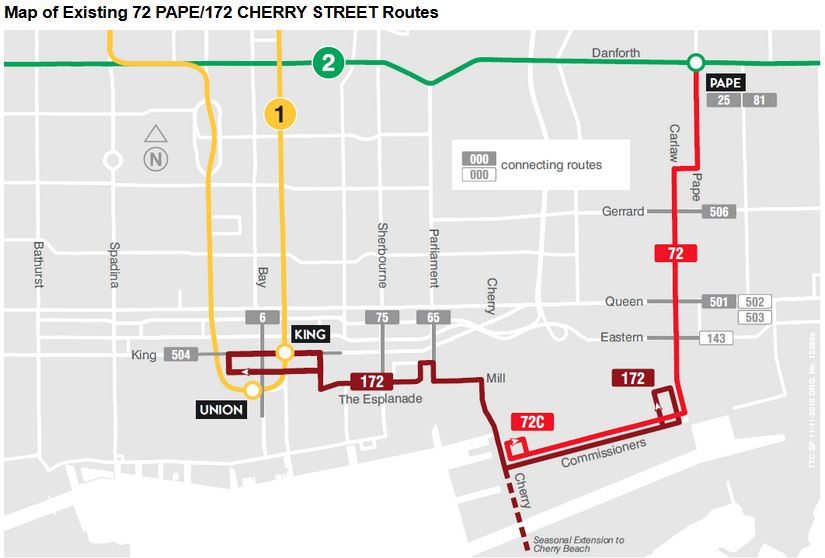
Route 172 Cherry was split off from 72 Pape a few years ago due to congestion from construction at Union Station. The question now is how to put the routes back together again, or indeed, if they should be in their original form.

The TTC has a survey active on its website until mid-December 2015 to poll riders on proposed changes to service mainly in the eastern waterfront.

The current arrangement of routes is shown in the map below (taken from the survey):

MapExisting

This arrangement provides a fairly large loop through downtown and acts as a parallel service to the 504 King car for riders along The Esplanade and in the Distillery District. It was particularly useful during the recent Pan Am Games when service here was substantially improved because the route served the Athletes’ Village.

However, the connection between the 72C Pape and 172 Cherry services is not good. It is not a scheduled connection and the two routes operate on different headways. Moreover, the Port Lands is not exactly the best place to connect between routes at night or in bad weather. Splitting the routes also effectively eliminates a direct link from the Danforth subway to Queens Quay East and the Distillery District.

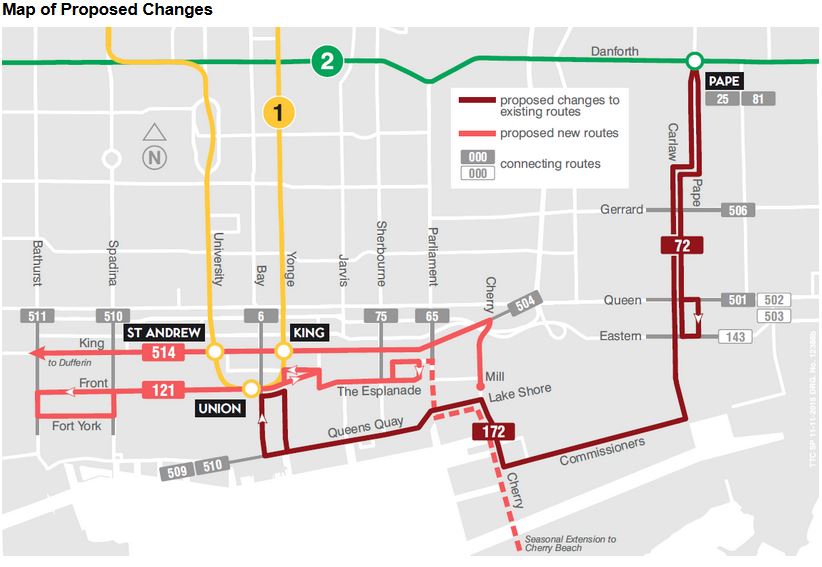
The new proposed route structure is shown below:

MapProposed

Route 72 Pape would be confined to the shuttle between Queen and Danforth, with route number 172 belonging to a revised Cherry bus that would operate via Queens Quay rather than using The Esplanade. The 172 would loop via Bay, Front and Yonge. It is unclear what the service level on 172 would be or whether this would be blended with the 72 Pape bus on the common section.

A new route 121 would operate on Front and The Esplanade between Parliament and Bathurst.

Service to the Distillery District along Mill Street would cease to exist, and the Distillery District would only be served at a distance by the 172 Cherry bus on Lake Shore and by the new 514 streetcar on Cherry itself.

The 514 car would operate from Dufferin Loop via King to Cherry Street, although given TTC scheduling, many of these cars could well short-turn without serving the outer ends of their route.

The 514 is less a new service for Cherry than a supplementary service for King, although this is not how it was presented in the 2016 Operating Budget. Indeed, provision of this map could have informed the discussion about streetcar service on Cherry considerably more than the way it was presented as a small spur off of King that would attract no new riders.

The survey itself is interesting because it asks, among other questions, whether this route structure would encourage people to use the TTC more. What is missing is a direct question about whether this arrangement is more convenient, not to mention any indication of service frequencies on which any discussion of “convenience” inevitably turns. There is a big difference between a line on a map and whether service is worth planning on and waiting for. One obvious question is whether the new routes – 172, 121 and 514 – would become part of the 10 Minute Network.

The survey claims that the new 172 Cherry route on Queens Quay would improve service to George Brown College (GBC), but it misses two important points:

  • The primary service to GBC, the 6 Bay bus, loads diagonally opposite from the likely stop for the 172 at Bay and Front. The option of taking whichever bus shows up first is not available to riders.
  • Similarly, westbound from GBC to downtown service would not use the 6 Bay stop within the loop at the college, but would speed past likely using the stop on Queens Quay well west of Sherbourne.

Looping through Dockside Drive in both directions, and a revised loop at Union Station should be considered if this is to be advertised as an “improvement” to GBC service.

The 121 bus as an alternative to the streetcar service on 509 Harbourfront only makes sense if it is quite frequent and reliable, not if this is a one or two bus shuttle showing up now and then for whoever happens to be passing by.

This is a good first attempt, but more thorough community feedback is needed than just this survey, and the TTC has to be more forthcoming about how each neighbourhood along the proposed routes would be affected.

TTC 2016 Operating Budget

On November 23, 2015, the TTC Board will consider its operating budget for 2016 including issues of fares and possible service improvements. The version of the budget before the Board was approved at the TTC’s Budget Committee meeting of November 9, 2015 with some amendments from the original staff proposal. The only recommendation related to fares was that the price of a Metropasses be frozen in 2016, but no other specifics. (I have already commented on the motions passed by the Committee in a previous article.)

The matter is complicated by the fact that the actual subsidy that will be made available to the TTC by City Council will not be set until early in 2016, and the TTC will compete with other agencies for available money.

(The 2016-2025 Capital Budget is also on the November 23 agenda, but it has not changed from the version discussed at Budget Committee.)

Although the Operating Budget report is long, it is better organized than the previous version with more detail, rather than depending on whatever questions might arise from a long PowerPoint slide deck and the skill (or lack thereof) of the presenter.

This budget is always a balancing act between competing forces and interests:

  • A political imperative to “keep taxes down” and limit the growth of the TTC’s call on City subsidies from the property tax base. This often manifests itself in calls for “efficiency” year after year in the hopes that the TTC can do more with less funding in constant dollar terms.
  • A political will to keep riders happy with benefits such as controlling growth in, or even freezing fares while providing more and better service. This includes targeted fare changes to benefit groups who are perceived to be more deserving of support through lower fares.
  • Annual increases in the cost of labour, materials and utilities.
  • The cost of additional service to handle demand from a larger population and a shift to transit from other modes.

In 2015, Council approved an extra $95-million for a number of improvements to service, elimination of the fare for children, and a capital-from-current purchase of 50 new buses to be used for new express routes in 2016. This increase only covered the part-year cost of the changes, many of which came into effect only in recent months, and additional subsidy will be needed in 2016 for the full 12-month cost. Additional improvements are on the table as part of the 2016 budget, and some of these were approved in the Budget Committee. The bottom line here is that improving transit has an ongoing cost and is not something to be done on a one year “feel good” program followed by a return to penny-pinching. Indeed, even that $95m might not have come to the TTC had Council been aware of unexpected costs from changes in Provincial funding arrangements for other programs that came to light after the extra transit money was announced by Mayor Tory and TTC Chair Josh Colle.

Continue reading

Port Lands Planning Update

Waterfront Toronto, together with the City of Toronto and the Toronto Region Conservation Authority, are conducting several studies that will shape the future of Toronto’s eastern waterfront for decades to come. Recently, they held a series of open houses to outline the current status of their work and to solicit feedback. The materials from these sessions are available on the Port Lands Consultation website, and you can provide feedback through the “Discussion Questions” links.

This article deals primarily with the transportation component, given this site’s focus, but with some introductory material to set this in context.

Illustrations here are taken from five sets of display panels. Note that these are large pdfs.

Two large areas, the Port Lands and the “South of Eastern” district, are the subject of three studies in this consultation round:

  • A planning framework for the multi-decade redevelopment of these areas into the fabric of the city.
  • A transportation and servicing master plan.
  • A precinct plan for a new community to be called “Villiers Island”.

Other parallel studies affect this area:

  • The Don Mouth Naturalization and Port Lands Flood Protection Environmental Assessment (EA)
  • The Lower Don Lands Infrastructure EA
  • The Gardiner Expressway study
  • The SmartTrack and GO/Regional Express Rail (RER) study
  • The Relief Line study

Lest this seem like overkill and an undue focus on one area of the city, remember that the amount of land involved is equal to much of what we now call “downtown” between Bloor and the Lake. This is not a small area, and converting it from primary uses as a port and light industry to a much more mixed-used and higher density set of communities requires careful planning and a lot of infrastructure. Work on this has been underway for almost a decade, although it was almost derailed during the Ford era. Continue reading

Metrolinx Fare Integration Survey

Metrolinx is running a survey of “fare integration”, whatever that might mean to you, until November 30, 2015.

This survey is striking in the way that it reinforces options and viewpoints commonly seen in Metrolinx analysis of fare systems. It is quite 905-centric both in the types of questions and options, and the view of how people might use a transit network.

The survey begins by asking about someone’s “typical trip” to establish an origin-destination pair. Of course, many riders within the city have many regular destinations, especially when their travel (like my own) is not dominated by commute trips to work or to school. After one gets through that section, another comes up asking about non-commute trips but with no attempt to quantify them or ascertain where they might occur.

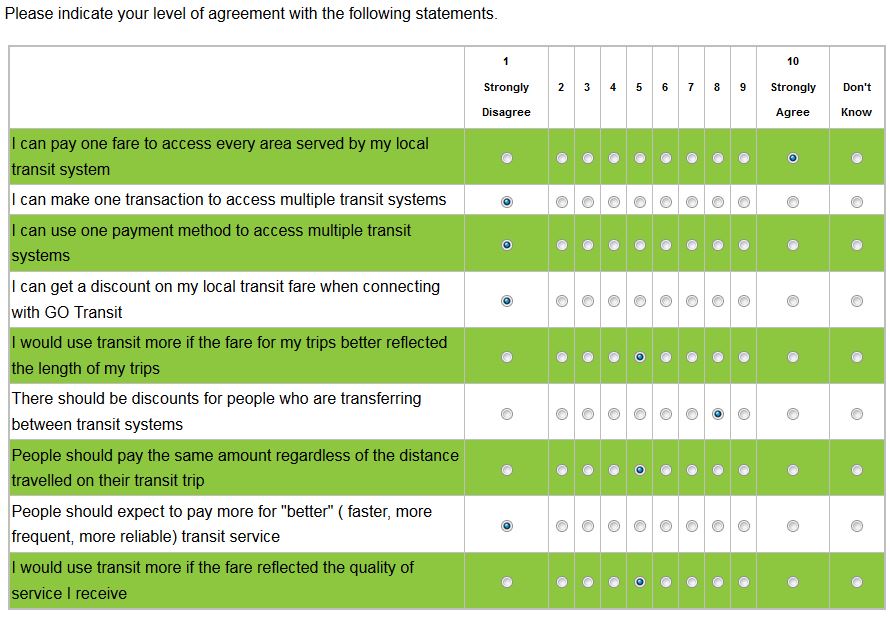
Cross-border and multi-carrier travel figure prominently in the survey, something by which, self-evidently, a regular TTC rider using only that system is not affected. The following list of fare options reappears in different guises elsewhere in the survey. As a piece of design, it fails because some questions are in the “I can …” format while others are “would” or “should” questions. It is unclear how an “I can” question can have anything beyond a “yes” or “no” answer. Does Metrolinx want our opinion on paying one fare for all of a local transit system, or asking if I can already do this?

There is a big problem in that some options interact, but there is no provision for this. Metrolinx is obsessed with the idea of paying more for “better” service which could mean anything from a GO Train or a Highway coach, to a local express bus, the subway or even a new LRT line. One might agree with a premium for the GO train (although that would also relate to distance travelled), but not for other types of service. There is no option to distinguish between these.

20151118_Survey_FareOptions

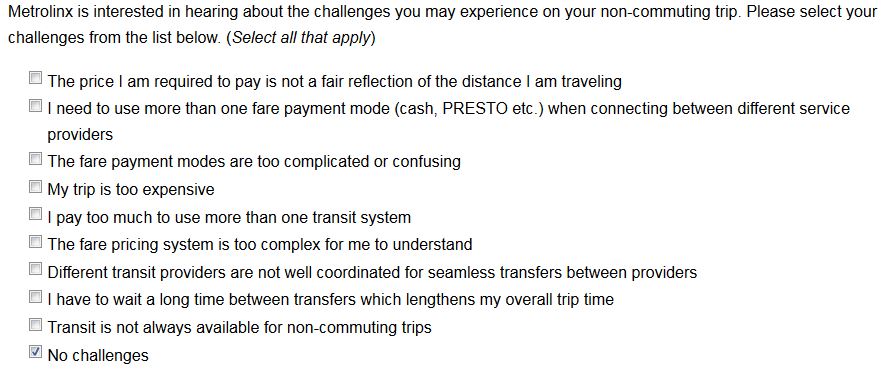
The ideas reappear as a list of challenges to transit travel. For a monthly pass holder, many of these options don’t really apply although one could certainly complain about the cost (high fare multiples) and the fact that on some parts of even the TTC, transfers can be a big headache thanks to unreliable service.

20151118_Survey_Challenges

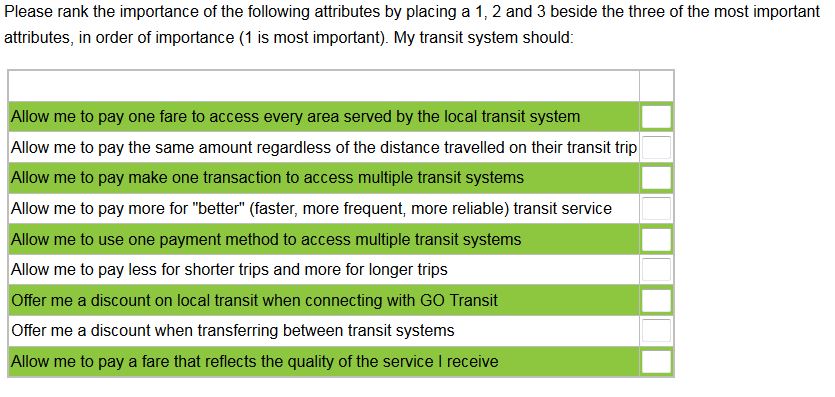
Another set of options requires the choice of a top three issues and ranking them rather than using the 1-to-9 scale for all of them.

20151118_Survey_Wants

Later the survey asks about co-fares between systems including local-to-GO and local-to-local transfers, but is silent on the question of how new co-fares might be funded, indeed on the whole question of regional fare revenue and subsidy sharing. Similarly, questions about distance or zone-based fares give no hint of what the effect might be for different journeys. Time based transfer and return trip privileges are nowhere to be found, typical for Metrolinx that only grudgingly acknowledges them as an option within local systems, not for the network as a whole.

No doubt the results from this survey will be trotted out to support whatever fare scheme Metrolinx comes up with, but it could be strongly biased to “typical” Metrolinx riders who have a very different view of the transit world and fares than their (much more numerous) “local” network cousins. It would be amusing to see what a similar survey carried out for the population within Toronto would yield. The survey includes a request for one’s postal code, and so at least there should be some idea of the distribution of responses across the GTHA.

The Dubious Joys of Making a Public Deputation

TTC Board meetings (not to mention meetings of various Committees of Toronto Council) often entail a series of presentations by members of the public. In Toronto parlance, these are “deputations”. Some of these are entertaining, some are heartbreaking, and some are, let’s face it, an ongoing soapbox for a few regulars who can be counted on to show up at every meeting. I used to fall into that category, at least until I got my own much larger soapbox with this site.

It is no secret that some members of boards and committees regard this as a huge waste of time. It is common to see many of them wander out of the room, hold press scrums, consult their email, and generally ignore what the poor, ignorant public might have to say. Moves to restrict speaking time, normally five minutes, to three, or to limit a speaker to one presentation regardless of the number of items they might wish to address, are not unusual.

They are also wrong, very wrong.

Continue reading

TTC Budget Meeting: November 9, 2015 (Updated)

Updated November 10, 2015 at 6:00 pm:

The Budget Committee meeting was not the best-organized or well-informed of TTC meetings thanks to a combination of factors. It was held in the boardroom at TTC headquarters which is no longer configured suitably for such events and cannot handle a large presence by the media who were out in force anticipating a story about 2016 fares. Almost all of the material was presented by one person who, unfortunately, trusted to memory rather too often and got the odd fact wrong as the meeting wore on. Moreover, there simply was too much material to absorb in the manner it was presented.

Committee members, for their part, tended to view the situation through their personal lenses of which hobbyhorse needed attention. This did not necessarily make for a broad view of TTC issues, and many erroneous assumptions, often uncorrected, crept into the debate.

We will go through this and much more all over again at the November 23, 2015 meeting of the full Board when we can also expect a very long parade of deputations on the subject of fares.

The entire exercise of having a Budget Committee has been useful, up to a point, in that some Commissioners have been exposed to the gory details, but they remain confused, and we have yet to see an actual philosophical discussion of just what the TTC should be as a basis for the budgets for 2016 and beyond.

The following motions were approved by the Committee:

Continue reading

TTC Service Changes Effective November 22 and December 20, 2015

There are few service changes planned for the remainder of the year.

Leslie Barns is scheduled to open on November 22, and operation of the low-floor Flexity fleet will transfer to that location. This will trigger some rearrangement of route allocations between Russell and Roncesvalles Carhouses, and the temporary storage of cars at Exhibition Loop will end.

Off peak schedule changes on 504 King will remove some of the excess running time in the schedules and improve service on weekdays.

“Run as directed” buses will be added to 501 Queen during peak periods to be used as needed to fill gaps in service. This is a temporary arrangement pending a major rewrite of the Queen schedules for January 2016 that will see some streetcars transferred from 504 King to 501 Queen, and more buses added to the 504 peak service.

Weekend schedules on 165 Weston Road North and 96 Wilson are substantially revised to implement the 10-minute network (this was done for weekdays in the October schedules), to reduce crowding during some periods, and to extend all day service to the 96F Thistledown branch.

Just before Christmas, the tunnel liner replacement project on the Yonge line north of Eglinton will be finished, and all late evening service will run through to Finch. The last day for the Eglinton turnback will be Friday, December 18.

New Year’s Eve will see the usual extended service throughout the system. The TTC has not yet announced whether free transit service will be provided that evening.

2015.11.22 Service Changes

Eglinton Crosstown Station Names Update (Update 2)

Updated Nov. 17, 2015:

Although Metrolinx has yet to publish a report on the result of their consultation, it is clear that they have already decided on some changes to station names. This is revealed by a report for the TTC’s Board Meeting on November 23.

A proposed 2021 map (click map to expand) shows changes from the consultation information provided by Metrolinx (see original post below).

20151115_SystemMap

  • The station at Keele, originally proposed to be named “Silverthorne”, has become “Keelesdale”.
  • The existing Eglinton West station is to be renamed either “Allen” or “Cedarvale” (the TTC will pick one at its meeting).
  • The station at Avenue Road, originally proposed to be named “Oriole Park”, has become “Avenue”.
  • The station at Ferrand Drive, originally proposed to be named “Aga Khan & Eglinton”, has become “Aga Khan Park & Museum”.
  • The station at Bermondsey has become “Sloane”.
  • The station at Victoria Park, originally proposed to be named “Wexford”, has become “O’Connor”.
  • It is unclear whether the “& Eglinton” suffix has disappeared from all of the surface stop names because it was not included on the Metrolinx map either.

I will leave it to the trivia collectors to spot the stations shown as not accessible on this map where elevators are now under construction or well into the design stage.

Continue reading

TTC Will Take Legal Action Against Bombardier, Demands Explanation

At its meeting of October 28, 2015, the TTC Board unanimously passed the following motion regarding the order for Flexity streetcars from Bombardier:

  1. Authorize the TTC General Counsel to immediately commence a claim or legal action against Bombardier for all damages sustained by the TTC relating to or arising from the schedule delays in the delivery of the streetcars and any other non-performance related issues.
  2. Direct the Chair to write to the CEO Bombardier requesting he appear before the Board at its November Commission meeting to explain Bombardier’s failure to meet past deadlines and its delivery commitments for streetcars going forward.
  3. Request TTC management to consult with alternative suppliers for delivery of the remaining TTC streetcars, should Bombardier be unable for whatever reason to fulfill this order within contractual timelines.
  4. Request TTC staff to report back on the financial and operational impacts on the TTC should Bombardier not be able to fulfill their contractual obligations to deliver streetcars.
  5. Request TTC staff to seek the advice of an outside business analyst to present to the Board on their assessment of Bombardier’s corporate outlook.
  6. Request TTC staff, in any negotiations on damages, liquidated or otherwise, to consider as a priority additional LRV’s as compensation.
  7. Direct the Chair to write to the Premier of Ontario requesting the Province’s support in facilitating the completion of the City of Toronto’s order for streetcars from Bombardier.

This motion came out of a confidential session of the Board which led to the text approved here. Point 1 was the staff recommendation in the report on the agenda, and the remaining points were added.

The story of constantly shifting delivery timelines and excuses from Bombardier has gone on for a very long time, and they have exhausted the TTC’s patience. Several comments in public session suggested that if Bombardier expects ever to be awarded work by the TTC in the future, they will have to try very, very hard to win their trust.

This is something of an empty threat, at least in the short term, because the TTC will not be ordering more subway cars until the early 2020s. Moreover, Bombardier has long been Queen’s Park’s vendor of choice for rail car orders that receive provincial funding, and it would take a major upheaval to dislodge them from this position.

Whether the Bombardier CEO actually shows up at the November 23, 2015, meeting remains to be seen. Indeed, it would be an odd situation should the TTC action have already been commenced to make such a presentation, let alone subject himself to questions he could not reasonably answer without compromising his own company’s position.

Chair Josh Colle noted that clause 7 recognizes the fact that he has already been contacted by the head of Bombardier Transportation in Germany, three Cabinet Ministers, the Mayor of Thunder Bay, and others, and that this is a politically high profile file. It will be interesting to see whether the union representing Thunder Bay workers shows up with tales of incompetence at their plant, or at least first hand descriptions of the quality problems with material received from Bombardier’s plant in Mexico. Such a move would be to establish their own credibility and fight for their jobs, a situation akin to what happened during the Canadian content debates when the contract was awarded.

Queen’s Park also has an interest through Metrolinx where concern about on time delivery of cars for the Kitchener-Waterloo ION line (whose cars will come from the Metrolinx share of teh Toronto order), and there are effects further down the line for other LRT projects if the contract completely collapses.

No doubt there will be updates on this story in the regular media in coming days.