
TTC’s Line 2 Bloor-Danforth subway service suffered two major interruptions on Tuesday, April 7 and Friday April 10 due to work cars developng leaks in their hydraulic systems and fouling rails for normal revenue service.
At its April 16 meeting, the TTC Board received a preliminary report from Hatch, the consulting engineers who also reviewed a similar incident in 2024. The images in this article are taken from the Hatch presentation deck.
RT-6:
RT-6 is a vacuum excavation car that is about 7 years old. The failure was caused by an incorrectly installed part during recent maintenance (date unspecified) by TTC.
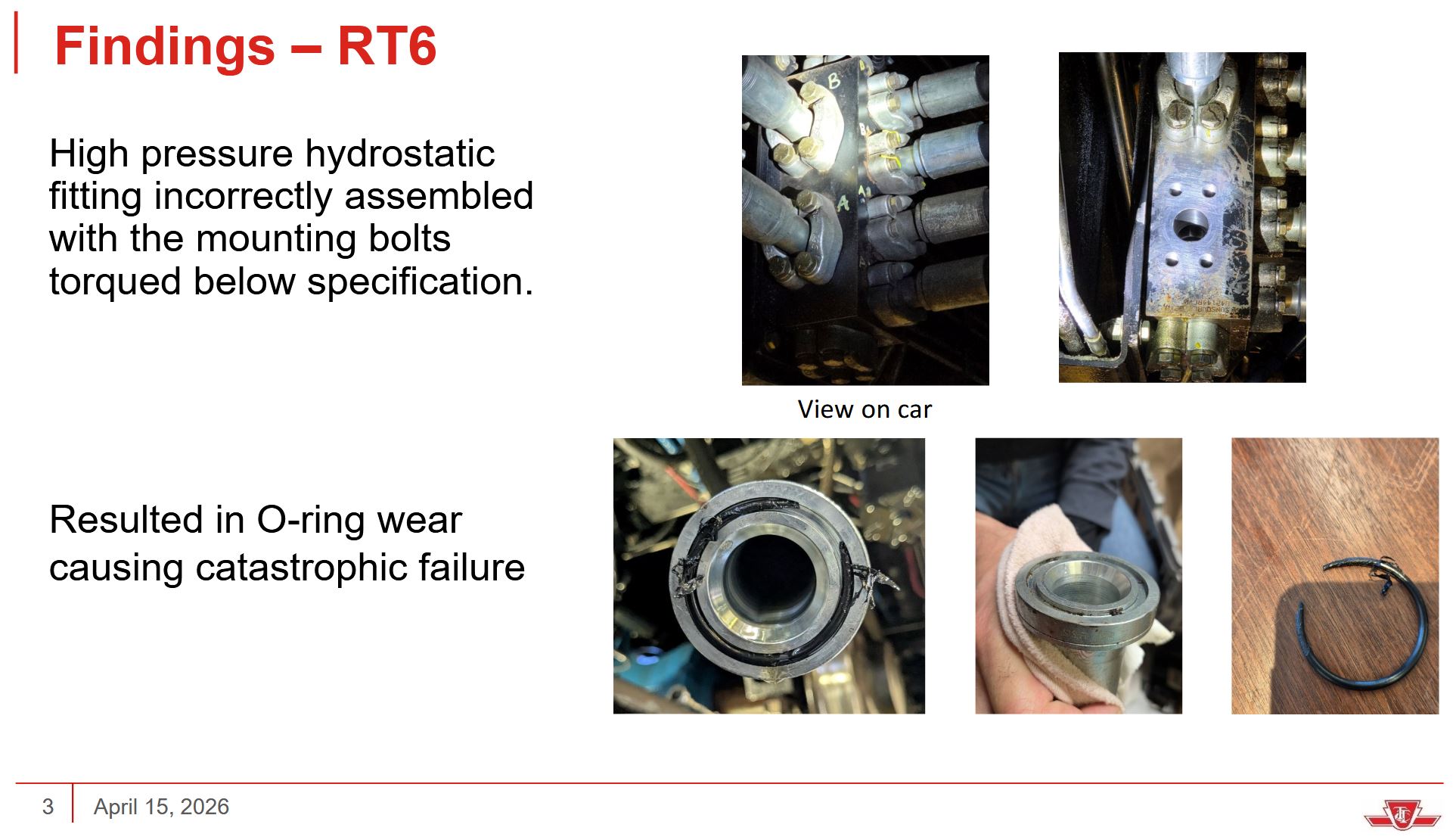
The recommended next steps are:
- Review the installation process for areas of potential incorrect assembly and develop improvement steps and protocols.
- Inspect other work cars with similar fittings repaired over the last 3 to 4 weeks and recertify work performed as a containment measure.
- Send the failed O-ring for analyses to confirm failure mode, chemical composition and mechanical properties. [p. 4]
RT-17
This car is close to 30 years old. The fault lay in a defective valve on the car. The report does not state how recently this valve was installed. The valve was defective as supplied, but this was not caught by TTC before it was installed.
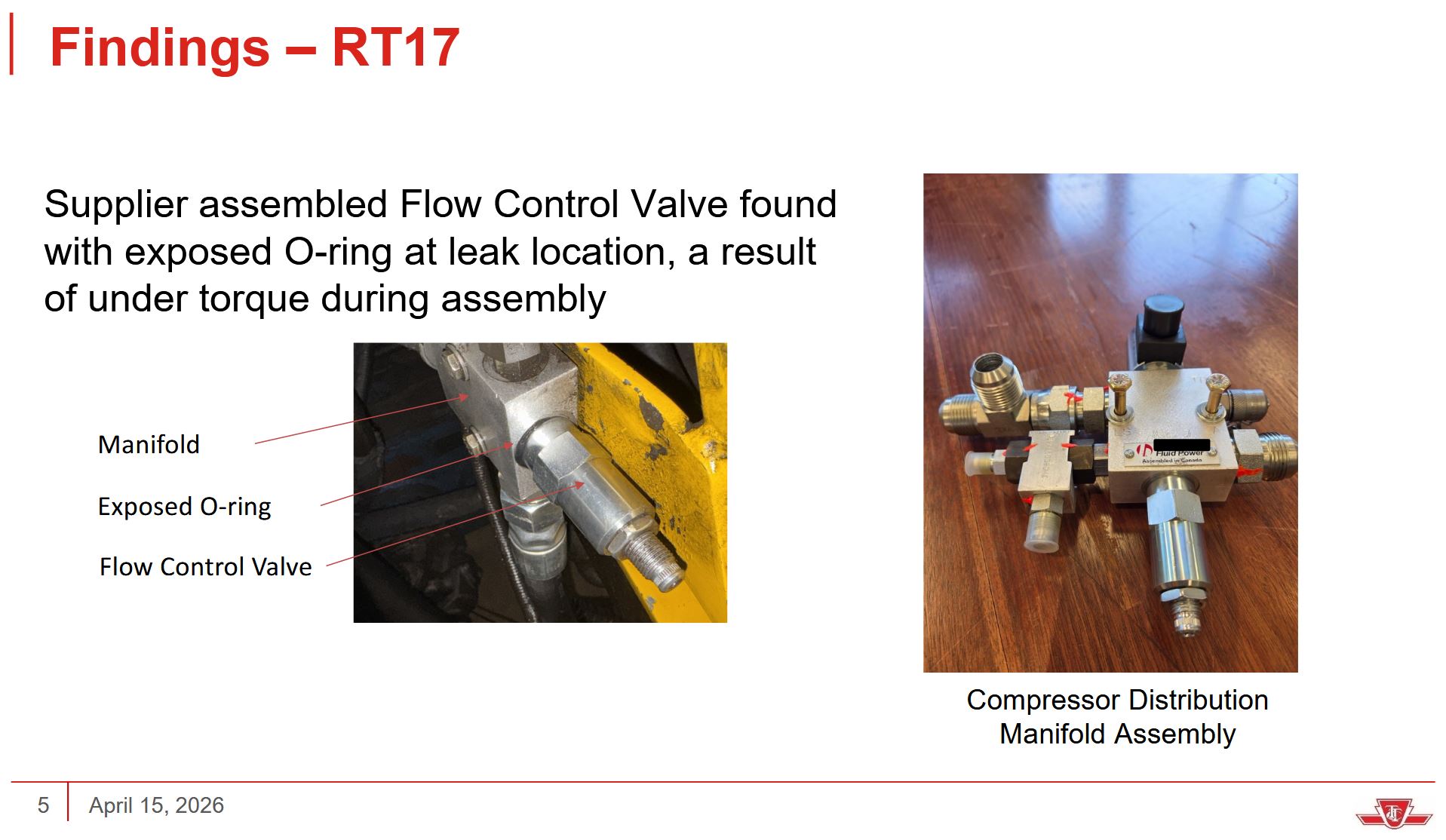
Next steps:
- Immediately identify and quarantine all similar manifold assemblies, including on-car and in-stock inventory.
- Supplier to perform failure analyses on RT17 manifold assembly including inspection of the FCV mounting geometry and analyse of the O-ring (material, mechanical properties)
- Supplier to develop and implement a quality control policy that assures specification compliant assembly of the units and a pre-ship inspection process
- Review TTC’s incoming inspection process for vendor supplied hydraulic components where there is a concern and ensure they are compliant to the manufacturing specifications before they are assembled into work cars. [p. 6]
The Hatch review states that these incidents are:
- Random in nature
- Could not have been predicted.
- Do not appear to be atypical
- Not uncommon for a similar sized transit authority such as the TTC. [p. 2]
These findings do not entirely line up with the details cited above. In both cases, there were failures waiting to happen. For RT-6, the significant factor appears to be incorrect maintenance. For RT-17, the shortcoming lies with a combination of the manufacturer and incoming parts inspection by TTC.
The events were “random” and unpredictable in that the time to failure after parts were installed could not be known. However, shortcomings in maintenance and parts inspection are both generic issues that could affect other parts of the fleet. Saying these are “not uncommon” in effect excuses these shortcomings.
Failing Parts Are Not The Only Issue
A common source of extended delays on Line 2 is failures of the signal system. Much of this dates from the original Bloor-Danforth subway built in the 1960s, and it has been overdue for replacement for several years. An original plan to implement Automatic Train Control with new signals was on the books in Andy Byford’s day as TTC CEO, but it was delayed by his successor to trim the capital budget. The project is back on the books, but the new system will not enter service until 2037 once new trains for line 2 (another delayed project) are delivered.
TTC management claims to have a plan to keep the existing signals working for another decade, but there are no details of what this entails. The Board asked no questions about signals even though there have been failures recently, notably one on April 9 in the week of the two hydraulic failures.
Thanks to bad planning under a previous regime at the TTC, Toronto faces a decade with aging trains and signals on Line 2, and this will no doubt undermine attempts to provide reliable service.
 Steve Munro
These guys think it’s some Space Shuttle accident investigation board with all these reports they do on these incidents but never actually addressing the root causes.
LikeLike
I think Columb makes a good point.
You shouldn’t need consulting engineers at $XXXX per report (hope I used enough X’s) to spot a failed coupling.
Could TTC staff not figure this out for themelves, possibly including contact with vendors and suppliers for the more technical details? Needing a consultant smacks either of incompetence or buck passing.
Steve, do you know the extent of the most recent spill? Was it in one location, or once again spread for a long way through the tunnels?
I would also expect that the TTC would have implemented procedures to catch leaks more quickly and have ways to mitigate the spill. I wonder if there was any of that in the recent spills.
Steve: Alas the past few years have shown that TTC management don’t stay on top of this sort of thing and sometimes prefer to report the least necessary.
Even with a consultant there’s no guarantee they will see everything. At the board meeting, Hatch made the point that in the 2024 investigation their access to front line staff was filtered through supervisors. They have been assured this will not be the case in 2026.
LikeLike
Oops! Typoo?
Steve: Fixed. Thanks.
LikeLike
The part on RT17 looks pretty new regardless of how old the car itself is. It’s not a good look for Canadian manufacturing when such a glaring quality control oversight can get through on a critical part.
LikeLike
Funny how if it was line 1 these issues would been solved years ago but guess what it ain’t downtown where most of them live and work so why bother.
Steve: The same work cars are used to maintain both lines. And, BTW, Line 1 has had very long-standing track problems, some worse than on Line 2. Your claim that Line 2 gets second class treatment is complete garbage.
LikeLike
The suspension of the use of the work car fleet has coincided with it being much quieter at night particularly living near Broadview Station. It could also be fan shaft noise but the timing seems more than coincidental. Some of those work cars [have] diesel engines.
LikeLike