Actual vs Advertised Wait Times

A central part of any transit rider’s journey is the wait for a vehicle that may or may not show up when expected. Even with an app that tells you where the bus is, the news might not be good. Rather than being just around the corner, the bus might be several miles away, and heading in the wrong direction.

The only statistic the TTC publishes on service quality is an “on time” metric. This is measured only at terminals, and even there “on time” means that a bus departs within a six-minute window around the scheduled time. Performance is averaged over all time periods and routes to produce system-wide numbers, although there are occasional references to individual routes in the CEO’s Report.

Riders complain, Councillors complain, and they are fobbed off with on time stats that are meaningless to a rider’s experience.

The problem then becomes how to measure the extra time riders spend waiting for their bus, and to report this in a granular way for routes, locations and times.

This article presents a proposed method for generating an index of wait times as a ratio comparing actual times to scheduled values, and their effect on the rider experience. The data are presented hour-by-hour for major locations along a route to see how conditions change from place to place.

An important concept here is that when buses are unevenly spaced, more riders wait for the bus in the long gap and fewer benefit from buses bunched close together. The experience of those longer waits raises the ratio of the rider’s waiting experience to the theoretical scheduled value. The more erratic the service with gaps and bunching, the higher the ratio of rider wait time to scheduled time. This is compounded by comfort and delay problems from crowded buses, and is responsible for rider complaints that do not match the official TTC story.

There’s some math later to explain how the calculations are done for those who want to see how the wheels turn, so to speak.

Note that this is a work in progress for comment by readers with suggestions to fine tune the scheme.

Continue reading

The Mythology of Service Recovery – November 2024 Update

Back in September, I wrote about the gap between the TTC’s claims of service coming back to pre-pandemic levels and the actual service riders face in their daily travels. See:

I will not repeat all of the information in that post, but we are coming into budget season and the most current info should be available for debate.

When the 2025 budget comes out, we will hear much about service recovery including the obligatory photo op with the Mayor, TTC Chair and other worthies. This will be a sham because actual service today has not been restored to early 2020 levels.

The fundamental problem with TTC claims is that they measure “service” by hours for the simple reason that the primary driver of costs is the labour associated with driving vehicles. Some costs don’t actually vary with driving time, but these are generally a smaller component of the total. (For example, some costs vary with mileage, and others such as garaging are per vehicle.) For budget purposes, the variable that counts is hours.

When comparing pre- to post-pandemic service levels, one hour of vehicle operation does not necessarily provide the same amount of service as in the past. The primary reasons for this are:

  • Buses and streetcars run more slowly today than in early 2020 due to a combination of traffic congestion and operating practices (notably the pervasive slow orders on the streetcar system).
  • More recovery time is included in schedules to reduce short turning. The premise is that if there is enough padding, vehicles will rarely be late enough that they must turn back before reaching their terminals.

The combined effect is that more vehicles (and hence vehicle hours) are required to provide the same service on many routes today compared with early 2020.

I have tracked the changes in operating speed on various routes in past articles, and will return to that subject to refresh the charts in coming months.

A related problem for riders is that thanks to uneven service (gaps and bunching), the average wait for a transit vehicle can be considerably higher than the advertised headway. TTC reports “on time performance” only at terminals where service tends to be (but is not necessarily) close to schedule. The information is averaged over many routes and all hours of the day, and bears little relevance to a rider at a specific bus stop at a specific time.

I will turn to the problem of experienced vs advertised wait times in a separate article now in preparation.

The remainder of this piece updates the September charts with planned service hours by mode to the end of 2024, and a comparison of service levels by route and time of day in January 2020 versus November 2024. PDF versions of the chart sets are provided at the end.

Continue reading

Subway Hydraulic Fluid Spills – Investigative Report

The TTC has released the reports investigating the cause of the hydraulic fluid spills from subway work cars during the first half of 2024.

This report contains six sections:

PDF PagesContent
1-6Covering report from TTC management
7-13Attachment 1: Management action plan
14-56Attachment 2: Root Cause Assessment of Leaks by Hatch
57-99Acuren Group report: Failure Analysis Examination of a Hydraulic Hose
100-120Timeline of events on May 13, 2024
130-144APTA (American Public Transit Association) Peer Review of Incident Management

See also:

Introduction

The primary report among these is from Hatch, a consulting engineering firm with rail industry expertise. Their task, as they state clearly, was to determine the underlying technical reasons for each incident, but not to delve into TTC operational practices.

There are many cases cited of inadequate vehicle inspection and maintenance, lack of procedures and standards, undertrained staff, and poor record-keeping to document the history of affected vehicles. These are not isolated incidents, but ongoing problems.

The Management Action Plan consolidates all of the recommendations from Hatch and APTA together with their current status. Many are “complete” and others are “in progress”. What is clear from the extent of the list is that many problems, some quite serious, required action by the TTC. How did the system get into that state in the first place?

The TTC management report looks only at the hydraulic fluid spills, but does not consider the wider context of two previous reviews of maintenance and record keeping: the Streetcar Overhead Section, and the post-mortem report on the SRT derailment. There is a sense that “we have fixed this” through the substantial implementation of consultant recommendations, but without the broader context.

On a more general level, there are two obvious questions:

  • How many more sections or processes within the TTC suffer from similar issues, and are problems just waiting to surface?
  • Is the lower maintenance standard really confined only to work vehicles, or have staffing and funding limitations affected support for revenue vehicles and infrastructure too?

The management report states:

Both reports [Hatch and APTA] identified common root causes, and while they found that the TTC’s practices are typical of the industry, they recommend implementing a more robust preventative maintenance program of procedures, training, and quality control modeled after what the TTC has in place for revenue service vehicles. [Management report at p. 1]

The comment about TTC practices being “typical of the industry” is telling. If the situation described in the reports really is typical, the transit industry is in perilous condition. Saying “everybody else does it this way” does not explain how work car maintenance is nowhere near what one would expect from a once pre-eminent transit system in North America.

The Hatch report described the situation differently:

The lack of detailed documentation for the design and maintenance of the work car fleets is highlighted as a major issue in this report, especially for the repair of hydraulic hoses. However, Hatch’s experience with other major transit agencies in North America like TTC, suggest that design and maintenance documentation supplied by work car OEMs does not usually contain detailed information on the installation of the hydraulic hoses except when mandated by a procurement specification or used for very specific applications (e.g. rigid hoses, specialty hoses and fittings, and components that are hard to procure and/or have long lead times). [Hatch at p. 39]

That remark refers to the availability of documentation, not to day-to-day maintenance practices.

The APTA report is silent on practices at TTC compared to other systems.

This is a significant discrepancy between the management report and the documents from Hatch and APTA, and one cannot help seeing this as “spin” to put TTC practices in the best possible light.

Summary of Incidents

The table below gives an overview of the incidents reviewed by Hatch.

DateDescription
Sun Jan 14Car RT56 spilled 10L of fluid between Sherbourne and Donlands Stations.
Cause: Hydrostatic hose failure
Wed Jan 17Car RT17 spilled 120L of fluid between Eglinton West and Dupont Stations.
Cause: Filter O-ring failure
Sat Feb 10Car RT7 spilled 5L of fluid in Greenwood Yard during a pre-departure inspection.
Cause: A faulty hydraulic filter O-ring
Mon Apr 22Car RT41 spilled 50L of fluid while shunting into Greenwood wye north of the yard.
Cause: O-ring failure
Mon May 13Car RT56 spilled 100L to 140L of fluid at Spadina Station (Line 1) and other locations while it was being towed back to Greenwood Yard.
Cause: Abraded hose
Service effect: Line 2 was shut down for over 12 hours as the affected area was greatly expanded by moving a leaking car through the system rather than isolating it for inspection and repair.
Wed May 15Car RT84 spilled 200L of fluid on the trackbed north of Eglinton Station.
Cause: Excessively worn driveshaft clutch plates seized and disintegrated leading to further damage including a severed hose.
Thu May 16Car RT41 leaked 0.25L of fluid on the trackbed at Keele Station.
Cause: O-ring failure under a pressure sensor
Sun May 26Car RT18 leaked 30L of fluid onto open track between Victoria Park and Kennedy Stations.
Cause: Incorrect hose and fitting used in a previous repair cause a hose failure.

Some of these incidents were cleaned up before affecting revenue service, or occurred in yards where there would be no effect. This does not minimize the severity of so many failures in such a short time span. Some of the cleanup efforts required multiple passes to complete satisfactorily.

One outcome of this review is the recognition that clean-up of spills requires better handling than in the past, but the basic issue is that the spills should occur less frequently, if at all, in the first place.

Readers who want to see complete details and photographs of these incidents should peruse the Hatch report.

One key point should be knocked on its head: back in May, there were questions about possible sabotage given the spate of events in a two-week interval. The investigation showed that all incidents were due to component failure from lack of maintenance, or of incorrect maintenance. The May 13 incident was a direct result of the routing of a hose through a floor grate where it would chafe and eventually fail. “Sabotage” was a red herring at the time, and remains so today. [There is an extensive review of the metallurgical condition of the hose and the floor grate in the Acuren Group report.]

TTC plans to up its spending on work cars. It is worth noting that a plan to refresh and expand the work car fleet under former CEO Andy Byford was sidelined when Rick Leary took over as, initially, was the plan to renew the Line 2 fleet.

The TTC’s 2024-2033 Capital Budget and Plan includes $34.0 million of approved funding for work car overhauls and $63.4 million toward work car procurements.

TTC staff will include a funding request in its 2025 Operating Budget submission to establish a more robust work car preventative maintenance program.

This statement is a clear admission that the program now in place is inadequate. A related issue is that the backlog of necessary work is directly related to work car availability, and in turn that drives the longevity of slowdown orders on the subway.

Continue reading

On Winning CUTA’s 2024 Excellence Award

This morning (November 20), I was honoured by the Canadian Urban Transit Association with one of their two 2024 Excellence awards. In my case, it was for decades of transit advocacy, and my co-winner, Blaire Sylvester, won for her work transforming Norfolk County’s transit system from a fixed route to an on-demand model. You can read about the award winners and their accomplishments on CUTA’s Award Winners page.

Two other winners, both of Lifetime Achievement Awards, deserve more than a passing “hat tip” from me.

Scott Haskill, retired Chief Strategy & Customer Officer at TTC, had a long career born of an interest not unlike mine riding the transit system with his father. Through decades of changing political contexts, Scott was always a professional, honest and open, to the degree he could be, when talking about transit.

Ted Wickson, who died in January 2024, received the award in memoriam. He worked in various roles at the TTC including the Advertising Department which also housed some of the TTC’s archives. Even after leaving the TTC, he provided deep knowledge of the system’s history, and co-authored a book celebrating the centennial in 2021.

One day early in his career, there was an office downsizing and clear-out. Ted had to cull through thousands of glass-plate negatives to decide which the TTC would keep, and which would be discarded. Several fans descended to rescue items the TTC did not want and provide them a new home. The remaining TTC collection is now in the Toronto Archives, and Ted changed the way the TTC looked at the importance of historical material.

(The subway station design paintings by Sigmund Serafin were among the rescued items, and they stayed in my care for decades until going to the Archives.)

All three of us, and many others in transit management, are unrepentant “fans” of public transit. Less complementary terms we hear include things like “trolley jolly” and “foamer”, and not a few suggestions that we can be ignored because of our monomania. (A recent thread on Facebook had a particularly nasty example of this which I will not repeat.)

Yes, some of us can be obsessive about bus numbering, or fantasy maps, or other arcana, but I can think of many areas (sports, motor cars, plants, Broadway musicals) with equivalently detail-oriented folks who are not ridiculed for their knowledge. In each case, the issue is not what you know but how you use that walking encyclopedia.

People with long, deep memories can be troublesome for so-called professionals. In some transit circles (you know who you are) a common “communications” technique is to co-opt people as cheerleaders. “You love transit so you must love our project.” When that does not work, turn to ridicule and gaslighting. “You’re the only person who isn’t on board.” I hate to break the news, but it is not my job, nor that of any community group, to provide cover for bad planning and management, and especially not for incompetence.

When I started this blog back in 2006, one goal was to provide an alternative, detailed view of transit issues in Toronto beyond the level local media would cover. (There still were local media then, although the decline had set in.) There was a growing interest in all things urban, how cities worked, and how Toronto could be a better place. I have watched a generation of urban activists grow up, and I hope to have contributed to their knowledge of transit’s role and possibilities.

In turn, I have learned a lot listening to all those voices, and my own voice is less lonely today. Toronto is a better place for all of them, for that critical mass of activists.

Sitting here with my nice glass plaque, I think back over a lot of Toronto history, good transit years, and some that were horrid. But they should not be forgotten. Some of the pitfalls of the 1990-95 recession resurfaced only recently in the pandemic’s aftermath and the revelation that TTC maintenance was not quite up to scratch. Political cycles when we try to just “get by” can be catastrophic, although the effects are not immediately obvious.

There is a continued need for transit advocacy, holding management and political feet to the fire. I look forward to seeing the work of new generations who may, in time, get their own awards.


Postscript:

Personal thanks to Chris Prentice for my nomination to this award, and to Andy Byford who provided a glowing letter of endorsement.

Analysis of 129 McCowan North – September/October 2024

This article reviews the quality of service and crowding on the 129 McCowan North bus in September and October of 2024.

Updated Nov . 18/24 at 5:00 pm: Bus spacing charts were omitted in the original posts, and they have been added. Also, crowding and spacing charts have been added for Wednesday, October 2 as an example of route behaviour before the October 6 schedule change.

Summary

This route has two branches:

  • 129A operates north of Steeles under contract to York Region to Major Mackenzie Drive.
  • 129B operates to Steeles Avenue.

In the September schedules, much of the 129A service was provided as an “every nth” through bus on the Steeles service. This changed on October 6 so that the 129A and 129B services operate independently, and the 129B service changed from regular-sized to articulated buses. Service in peak periods is scheduled to be uneven even if it is “on time” by TTC standards.

With a combination of bus sizes and uneven headways, the effect on crowding can be severe if a smaller bus is travelling on a headway designed for a larger one.

Details of the scheduled service are in the main part of the article.

Construction at Sheppard severely affected travel times for much of the last two weeks in October. In turn, there was more bunching and gaps, and headway reliability declined considerably.

The segment of the route where bus crowding is most reported lies between STC and Steeles, and extends into York Region.

Service leaving Kennedy Station northbound shows a small range of headways only with the September schedule which had regular departure intervals. From week 2 of October onward, and compounded by effects of construction, headway reliability at Kennedy Station was poor. The situation was worse further north on the route. Southbound services merging at Steeles did not do so on a controlled basis even though the schedule purports a “blended” service.

Service north of Steeles can be quite erratic northbound. Southbound service benefits from recovery time at the Major Mackenzie terminus, but can still be uneven.

The remainder of this article contains many charts for readers who like the detailed analysis.

Continue reading

TTC Service Changes Effective November 17, 2024

This article details upcoming service changes on the TTC network, most of which will occur on Sunday, November 17.

Updated Nov 14 at 1:10pm: The section about supplementary service on many routes and the possible future for 2025 has been clarified based on additional info from the TTC.

Major changes include:

  • Re-opening of St. Clair West Station Loop. 512 St. Clair streetcars return there on Thursday, November 14, and bus service 33 Forest Hill, 90 Vaughan and 126 Christie on Sunday, November 17.
    • Note that routes 33 and 126 will return to independent operation and the buses will not interline.
    • Route 90 will no longer operate south of St. Clair to Bathurst Station.
  • The final stage of overhead reconstruction will occur on the western end of 509 Harbourfront and 511 Bathurst.
    • 509 cars will operate to Exhibition Loop until November 24 as part of the extra service for Taylor Swift concerts. After that, they will run only to the loop at Queens Quay and Spadina.
    • 511 Bathurst cars will be rerouted to Union Station effective November 14. A shuttle bus will operate from Queen & Bathurst to Exhibition Loop beginning November 17. (The 510D Spadina bus already serves Exhibition Loop.)
  • The 35 Jane bus will operate with split service on the regular 35A and the via Hullmar 35B branch at the north end of the route at all times, not just in peak periods.
  • Service in southwestern Scarborough will be modified:
    • The 12D Kingston Road service to UTSC will now operate weekday midday and early evenings in addition to the existing peak period service.
    • The 12C St. Clair branch will be removed
    • The 69 Warden South bus will operate to the Barkdene Hills area at all hours replacing the 12C Kingston Road branch.
    • A new route 117 Birchmount South will operate between Warden and Victoria Park Stations via Kingston Road.
    • Routes 69 and 117 will interline at Warden Station so that passengers can ride through between them.
  • The 110C Islington South branch to Kipling Loop is rerouted to better serve Lakeshore Village. Northbound buses will run north on Kipling, then east via Birmingham, Twelfth, Garnett James, Ninth and Birmingham to Islington. Northbound buses will no longer operate on Lake Shore and Thirteenth.
  • The stopping pattern for 54 Lawrence East, 954 Lawrence East Express and 154 Curran Hall will be standardized so that all Lawrence corridor services use the same stops in the SRT replacement corridor. Hours of service on 154 Curran Hall will be corrected to match the former 54B service which it replaced.
  • Service on 304 King Night and 305 Dundas Night cars will improve from every 20 to 15 minutes.

These and other changes are detailed in the full article.

Continue reading

Analysis of 903 Kennedy Station-STC Express October 2024

The 903 Express bus replacing the former Scarborough Rapid Transit Line 3 began operating formally in September 2023 after the SRT shut down in July. Initially the route operated totally in mixed traffic, but red lanes were added to speed operation. Also, the route initially operated via Progress, but shifted to Ellesmere in mid-November after roadway changes to support the route.

Initial service was extremely frequent, but this was cut back in November 2023 when several other routes were extended south from STC to Kennedy Station to provide a one-seat ride to passengers who otherwise would have to transfer at STC station. The 903 Express remains in operation, but less frequently thanks to the presence of other services.

Although many routes now share the corridor south via Midland and north via Kennedy between Ellesmere and Kennedy Station, the 903 Express can stand in for all routes to measure travel times.

A few points revealed here:

  • Service on this route is fairly regular with much less of the headway spread into gaps and bunches seen on other route analyses. This is likely due to the demand pattern with few stops, and less cumulative delay from boarding/alighting passengers along the route, combined with reliable departures at the terminals.
  • Where buses are crowded, this usually shows up as a series of regularly spaced vehicles with heavy loads, not as single crowded buses after wide gaps.
  • The benefit of the red lanes varies by location, direction and time of day. Travel times are included here as a reference point for future comparison when the SRT busway goes into service, as well as to track any spillover effects from Scarborough Subway construction.

Updated November 9, 2024 at 4:40pm: The operating chart including crowding status has been added for October 16 as a counterpart to the bus spacing charts for the same day.

Continue reading

501/301 Queen Diversion via Richmond/Adelaide Begins November 10 [Corrected Date]

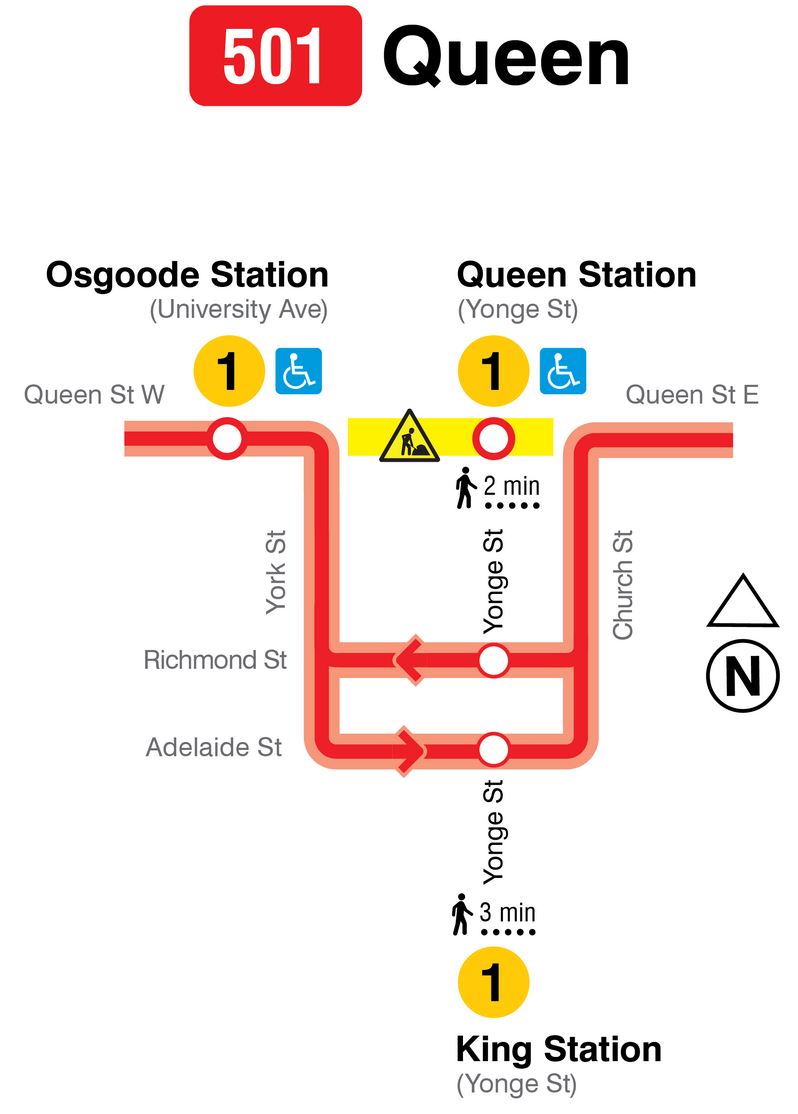
The TTC has announced that the Queen car diversion around Ontario Line construction at Yonge Street will be simplified effective Sunday, November 10, 2024.

Streetcars will operate westbound via Church, Richmond and York, and eastbound via new track on York, Adelaide and Church. Connections to the subway will be via walking transfers south from Queen Station to Richmond (westbound service) and north from King Station to Adelaide (eastbound service). Connections to the University Line will be at Osgoode Station both ways.

Updated Nov 8 at 6pm: The TTC has confirmed that there will be no stops at Victoria, Bay or York as these are within walking distance of other stops.

The 501B shuttle bus from Broadview/Gerrard to Wolseley Loop at Bathurst Street will no longer operate.

There will be no 501/301 service on King Street at King or St. Andrew Stations.

Other services in the King Street corridor will remain: 503 Kingston Road, 504 King and 508 Lake Shore.

[An earlier version of this article cited November 6, not the 10th.]

Analysis of 29/929 Dufferin – September 2024 (Updated)

This article continues a series of reviews of various routes in September 2024, and in particular the crowding conditions on buses.

The data for Wednesday, September 25 are reviewed in detail to show some of the factors that vanish in stats averaged at the level of a month.

Updated Nov. 4, 2024 at 6:45am: Charts have been added at the end of the article showing the combined local and express service on September 25, and comparing travel times over segments of the route.

General notes:

  • Although the TTC Service Standards are based on the premise that vehicles leave terminals more-or-less “on time”, in practice there is a considerable variation that extends beyond the approved standard.
  • Irregular vehicles spacing tends to grow along a route so that bunches and gaps become more accentuated. There does not appear to much attempt to regulate vehicle spacing enroute.
  • Crowded buses are likely to appear after gaps in service, and loads on groups of buses are not evenly distributed. The average load measured over time might be within standards, but the load experienced by most riders is above that average.
  • Both the local and express services suffer from irregular vehicle spacing. The express buses make the journey between King and Wilson about five minutes faster than the locals.
  • Severe traffic congestion northbound near Yorkdale in the afternoon affects both the local and express buses.

This is a rather long article with a lot of charts to illustrate how vehicle tracking data can be presented in many ways.

Continue reading

TTC Board Meeting – October 29, 2024

The TTC Board met on October 29 with an agenda that did not give the impression of being an all-day affair, but that is not how things turned out.

An extended debate in both public and confidential session arose from a management proposal to ban eBikes from the system from mid-November to mid-April as a safety measure. This arose from a fire onboard a subway train earlier in 2024 and a more general concern about eBike fires as these vehicles become more common.

There were many overlapping threads in the debate, but in the end the Board referred the matter back to staff for additional information, especially in regards to harmonization with existing City and Metrolinx policies, and the problem of enforcement. This will be on the December 3, 2024 meeting agenda.

To me, the most frustrating part of the discussion was the amount of time devoted to that issue compared to the almost non-existent debate on basic matters like service quality and management, as well as reconciliation of TTC plans with Council’s rather lofty aims to increase transit use as an essential environmental policy.

There was little new in the CEO’s monthly report. Ridership continues to build at a modest pace, and the profile of demands by day-of-week and time-of-day requires a rethink of service provision.

Other issues in this article:

  • Hydraulic fluid leaks from subway work cars
  • Reduced speed zones
  • Ending legacy media
  • The size of the TTC bus fleet
  • Transport buses for warming centres
  • Streetcar open door cameras
  • The CEO’s mandate
  • Gambling advertising
Continue reading