TTC Service Changes: October 6, 2024

The TTC will make several changes to their services on October 6.

One major construction diversion in Parkdale ends with restoration of normal routes on King and Queen Street West, and the downtown 501B bus shuttle will end with resumption of through streetcar service on 501 Queen.

Updated September 27 at 3:20: The TTC advises that although the schedules have been drawn up for a unified 501 Queen car service, the changeover will not take place on October 6, but at a later date. Service details from October 6 until eventual cutover have not yet been announced.

Service on the Bloor-Danforth subway, Line 2, will be improved to address crowding.

Several late night and early morning schedules will be adjusted to better integrate routes during the transition from regular daytime routes to the 300-series Blue Night Network.

Other changes adjust service for reliability and/or to reallocate service hours between routes.

Updated September 29 at 3:30: The spreadsheet showing the details of all service changes is now available.

Updated October 2 at 2:20 pm: Although the service change notice for October 6 showed a 30 minute headway would continue for the 303 Kingston Road night car, the electronic schedule published for this route shows a 20 minute headway from 1:40am onward. TTC has confirmed that the 20 minute headway will operate.

Service Changes 2024.10.06 V2

Continue reading

TTC Financial Update: September 2024

At its September 24 meeting, the TTC board considered several items, among them the quarterly financial update and a preview of the 2025 budget.

2024 Projected Results

The TTC expects to end the year with a lower than budgeted gap between revenue and expenses. Revenues are running ahead of projections because of strong ridership and a higher than expected average fare. For the six months to June, revenues are $15.6-million above budget. In turn, this translates to a better position going into the 2025 budget cycle.

Expenses are running below budget through a combination of unfilled vacancies and savings due to timing changes in some work. The projected year-end position is that the TTC will come in $52.2-million below its net budget (the portion requiring subsidy).

Ridership reached 81% of pre-covid levels in fiscal period 6 (most of the month of June) and is expected to hit 81.5% by the fourth quarter.

Note that ridership and revenue recovery are not the same thing because, allowing for inflation, the value of a fare has dropped while operating costs continued to rise.

Looking ahead to the next two years, there continue to be pressures on the TTC’s operating budget. As things currently stand, service increases will be small with the major changes coming when Lines 5 and 6 open, a date that is still not announced by Metrolinx.

The City’s target is for a 0% change in TTC funding. This is not as straightforward as it seems. Budgets are struck on a budget-to-budget basis, not actual-to-budget, and so the starting point is the budgeted subsidy in 2024. This arrangement has been in place for many years, and it gives an incentive for the TTC to end the year in a “surplus” position. Other aspects are changes, if any, in external subsidies and which aspects of TTC costs these offset. For example, the extra cost of Lines 5 and 6 are substantially covered by a new, albeit temporary, provincial subsidy and the City does not face this cost at least for 2025 and 2026.

The “Reserve Draw Reversal” is an accounting adjustment. Originally, the 2024 budget included a $15-million withdrawal from a reserve, but this was not required and will not be carried forward into 2025. Therefore, on a budget-to-budget basis this item shows up as reduced revenue. Like the “surplus”, this tactic is also fairly common in TTC budget planning.

Challenges the TTC recognizes going into 2025 include:

  • The need for attracting riders through “customer experience and satisfaction”
  • Changing demographics of Toronto
  • The ability to meet the 0% target without affecting service
  • Limited funding for state of good repair (this is the Operating Budget component that covers day-to-day work as opposed to major overhauls and asset replacement)

The Mayor’s Vision

The meeting agenda includes a letter from Mayor Chow regarding the hiring of a new permanent CEO.

We must be a city where people choose transit first because it’s the fastest, safest and most convenient choice to get to work, school or run errands – everywhere.

Imagine a city where a commuter taps their card to enter, paying an affordable fare, and then takes a working escalator or elevator down to the subway platform. The station is clean and well-maintained, the message board is working and tells them their train is on time. People aren’t crowded shoulder to shoulder waiting to get on the train, only to be shoulder to shoulder during their ride. If while they wait they feel unsafe, there’s someone there to help them. And they can rely on high quality public WiFi or cell service to chat with a friend or send that important text to a family member.

Imagine a system with far-reaching, frequent bus service. Where riders aren’t bundled up for 20-30 minutes outdoors, waiting for bunched buses to arrive. Where transfers are easy and reliable. Where there is always room to get on board. Where people can trust their bus to get them to work and home to their families on time.

In short, to make the TTC the better way again it needs to be reliable, safe and remain affordable.

People have to be able to count on their train, streetcar or bus to arrive on time, and to get them where they are going quickly – without surprise route changes, delays or bunching. Vehicles, tracks, stations and stops should be proactively maintained and in a state of good repair. Riders and transit workers should feel safe and respected on the system.

That’s a fine vision for what transit should be, but it does not align with the budget process now underway, nor with the projected level of service additions in the next few years.

Continue reading

Subway Restricted Speed Zones

At its meeting of September 24, 2024, the TTC Board received a presentation from Fort Monaco, Chief Operations and Infrastructure Officer, on subway restricted speed zones (aka “RSZs”).

From the sheer number and duration of these, it has been clear to riders that the TTC fell behind both in the quality of its track maintenance, and in its ability to work through the backlog. It is one thing to say that RSZs are implemented for safety, but when they are so numerous, “safety” had become a matter of necessity beyond routine levels.

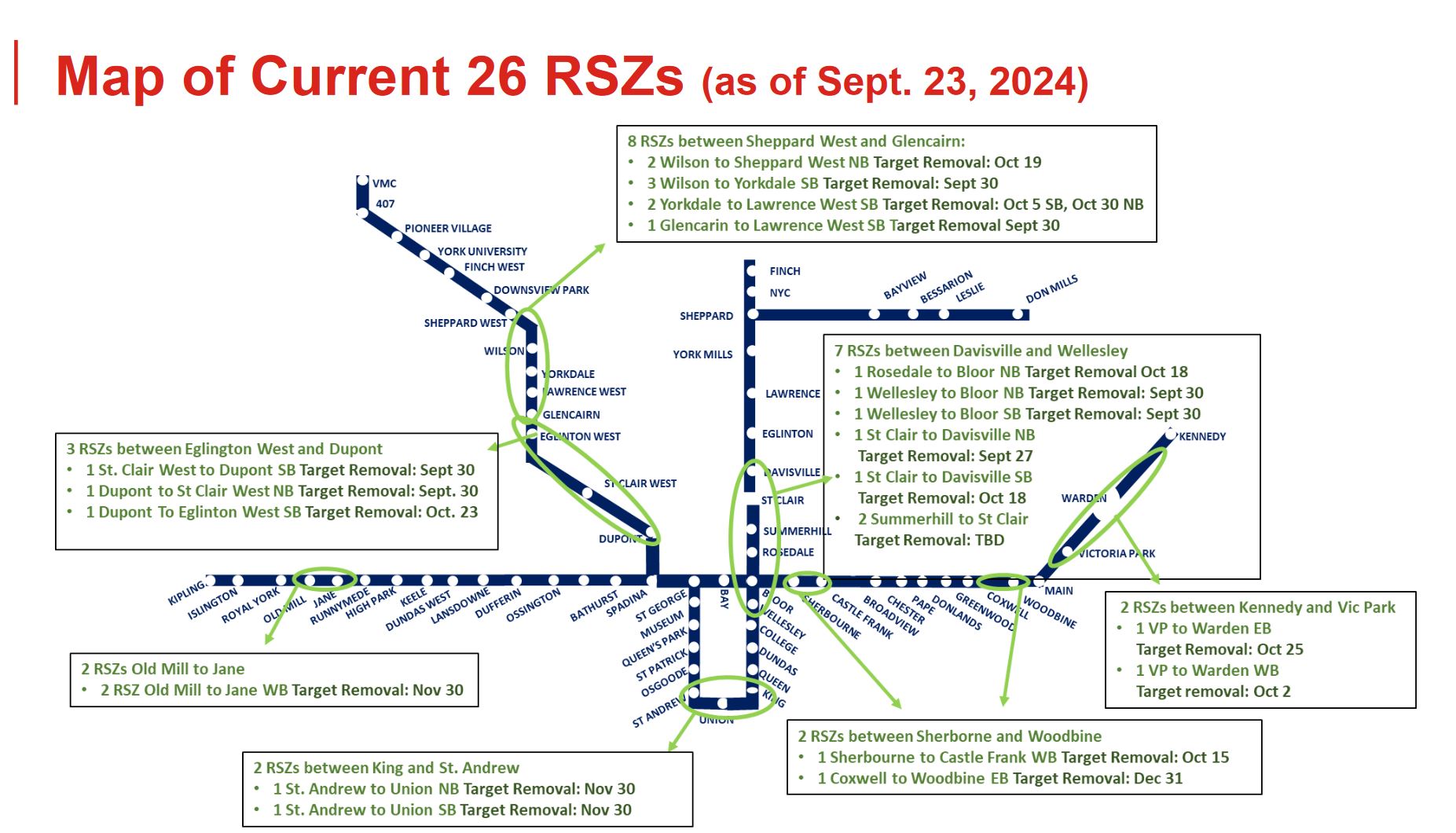
The current RSZ map, together with expected dates when these zones will be repaired, is from the appendix of the presentation deck. Monaco noted that with each RSZ adding about two minutes of travel time, the trip from Wilson to Union Station is extended by about 15 minutes.

The locations where these occur are overwhelmingly in “open cut” locations where rail is laid on ties and ballast. In tunnels, rail is either mounted directly on the concrete tunnel floor, or on structures which themself are fixed to the tunnel. Such track cannot shift around as much from forces of passing trains. Other track issues include several types of wear that can induce noise and rough train operation, but also fractures from metal fatigue.

Since January 2023 the accumulated count of RSZs is almost 300. Of these, only 30 were planned, typically for track renewal projects where a slow order is required over an extended period while work is in progress.

Continue reading

TTC Line 2 Modernization Update

The TTC Board will meet on September 24 with several items of interest on the agenda. Among these is:

Also on the agenda is the quarterly financial report. I will review it in more detail in another article, but it includes material relevant to the Line 2 project

The modernization report updates the status of various projects, notably the proposed purchase of replacement trains for the T1 fleet on Line 2. Related projects include installation of Automatic Train Control, upgrades to Greenwood Yard, and various infrastructure changes to support future service increase.

Recent months have seen much hand-wringing over the timing of a subway car purchase and the state of both the aging T1 fleet and the 1960s-era signal system. The newfound urgency at TTC is due, in part, due to deferral of an entire package of Line 2 upgrades in past years.

A comprehensive plan was presented to TTC management’s Executive Committee in March 2017, but it sat on the shelf. [Note: This plan is not available online.] The plan included many components including a new fleet with a delivery window of 2026-2030, and conversion of Line 2 signalling to Automatic Train Control. Trains, signals and other infrastructure continue to age, costs rise, and the first of the replacement trains is not expected until 2030.

With later delivery of new trains, the existing T1s require another five-year overhaul cycle for continued service. This adds an estimated $163 million to overall costs which are already up due to inflation.

Thanks to the delay when the TTC and City were constraining the capital budget, the need for a Line 2 modernization was not “rediscovered” until 2023.

Toronto is now in the difficult position of having a huge appetite for transit capital, but with funding sources inadequate and uncertain beyond the immediate future. Assuming that each level of government will pony up one third of any project is a foolhardy basis for planning, and hard decisions will be needed about which projects can go ahead.

At a time when Toronto claims it wants to shift urban travel from cars to transit, the level of investment we will likely see will at best preserve existing operations and infrastructure.

Continue reading

Queen East Service Diversion: Sept. 26 – Oct. 2

Metrolinx work at Queen and Degrassi Streets will require a street closure and diversion of transit service during installation of a new bridge deck for the Lake Shore East GO corridor. As part of the Ontario Line work, the GO corridor will be raised to the now-standard elevation above roads it crosses. This work has been underway at various locations northward from Eastern Avenue along the corridor.

The Metrolinx work will begin on the evening of Friday, September 27 at 9pm, but the TTC will remove its streetcar overhead and power supply beginning on Thursday, September 26 at 9pm.

The Metrolinx work will end on the morning of Monday, September 30 at 5am, but streetcar service will not resume until Wednesday, October 2 at 4am to allow for reinstallation of streetcar overhead. A benefit of the new, higher bridge is that problems with passing trucks tearing down the overhead should cease.

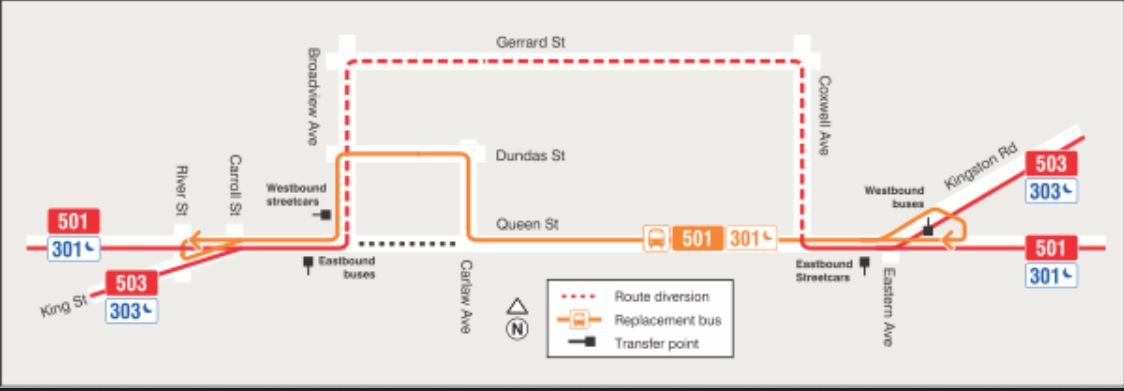
TTC will run a shuttle bus service between River Street and Kingston Road, diverting both ways via Broadview, Dundas and Carlaw around the construction area.

This will affect the daytime and overnight services on 501/301 Queen and 503/303 Kingston Road.

TTC map:

Metrolinx map:

The TTC and Metrolinx notices for this work contain slightly different information. I have confirmed the dates shown above with TTC Media Relations.

TTC CEO’s Report September 2024

With the arrival of an Interim CEO, Greg Percy, at the TTC, the CEO’s Report has been somewhat reformatted, although the overall content has not changed much. All of the performance metrics and associated commentary have moved to a separate file on the TTC’s CEO Report page.

The covering report is signed by Josh Colle, recently appointed as Chief – Strategy and Customer Experience Officer and by Percy. Further changes to format and content are in the works “to align with the new 2024-2028 Corporate Plan”.

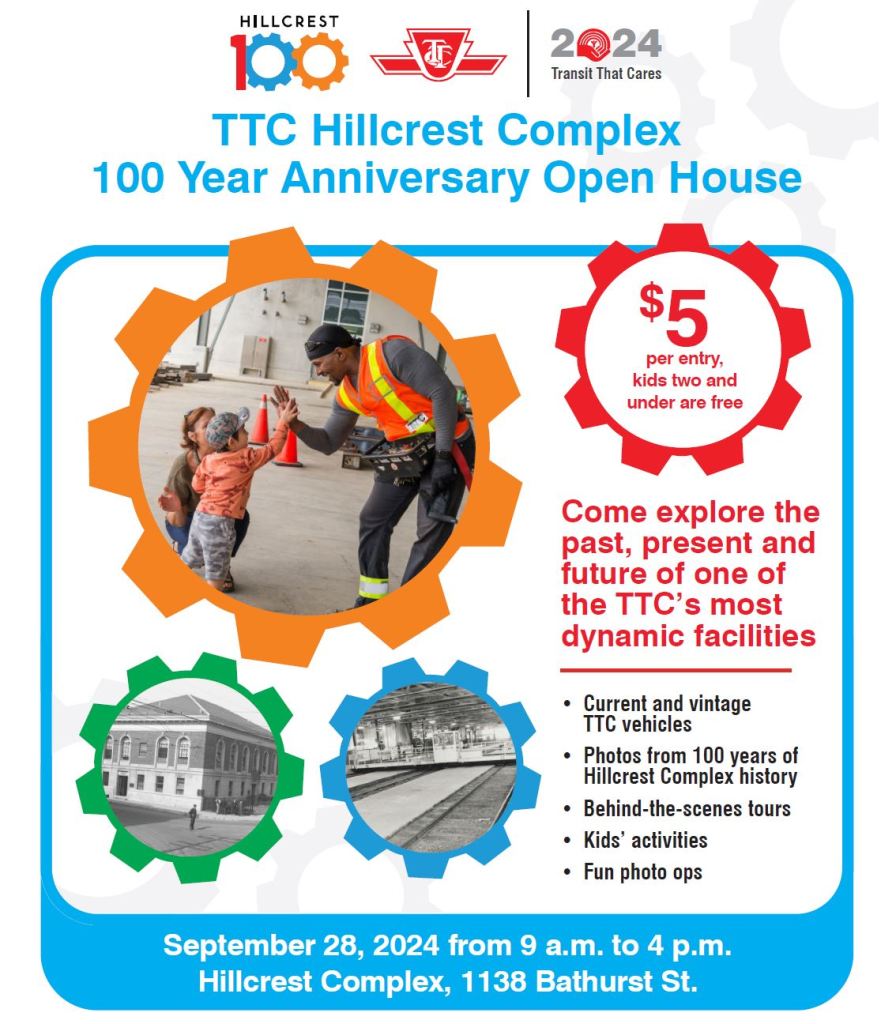
In his introductory remarks, Greg Percy announces that there will be an open house and guided tour of the Hillcrest complex on Saturday, September 28. Details are available here.

Ridership Update

In the ridership update, the report notes that weekday boardings reached 2.6 million per day during the week ending September 7, a post-pandemic high since March. Note that this count is not the same as “rides” which are linked trips, in planning terms, from one point to another. “Boardings” are unlinked trips which count each transfer separately. Most ridership numbers cited by TTC, certainly from pre-pandemic times refer to daily trips, not boardings. Here is a sample trip:

  • Bus–Subway–Streetcar

That trip counts as one ride but as three boardings. When the fare structure was simpler, rides and fares tended to be the same thing because one fare bought one ride. However, with the arrival of passes and now with the two-hour fare, the distinction is much more vague. It is not clear how the TTC reconciles historical “riding” counts with the new fare structure.

This distinction has been misreported in the press where the terms are used interchangeably:

During the first week of September, the Toronto Transit Commission told CTV News Toronto that 2.66 million riders boarded local transit each day—a post-pandemic high since the last week of March 2024.

[…]

Out of all modes of public transportation, the TTC said weekday boardings were highest across its bus routes, with 1.30 million commuters per day. Comparatively, the streetcar saw 230,000 and the subway had 1.13 million riders.

Source: CP24

This misinformation has been repeated elsewhere.

Pre-pandemic, the TTC typically carried 1.6 million rides per day, with two record days being 2 million (Papal visit) and 2.7 million (Raptors win). The TTC is doing better in 2024 than past covid-era years, but it is most definitely not close to 100% ridership recovery across the board.

Bus, streetcar and subway demand are up 3%, 10% and 9% respectively compared to a year ago. The higher increase for the rail modes implies that the downtown area is starting to see a return of peak riding that had already bounced back in the areas served mainly by buses.

Boardings vary greatly depending on the mode and day of the week. Numbers in the metrics are from July which has typically lower demand due to vacations and the absence of student traffic. However, numbers in the main report are cited from early September. This can lead to confusion when monthly numbers are compared from the two sections.

Ridership and boardings are reported in detail in the metrics. Revenue rides to July 27 are reported as 237.6 million, 0.8 million above budget, 8% above 2023, and 79% of the pre-covid level.

Demand continued to vary across weekdays, with Tuesday to Thursday being the busiest, and Thursdays being 11% busier than Mondays. Compared to pre-pandemic levels, average weekday boardings in July were 84% for bus, 65% for streetcar, and 73% for subway. The busiest weekday, however, was 87% for bus, 68% for streetcar, and 77% for subway.

Weekday peak- and off-peak demand recovered to 67% and 79% of pre-pandemic levels in July, respectively; demand in AM and PM peak periods continue to make up about 52% of all-day weekday demand.

That 52% figure is extremely important. Although there is much focus on commuting travel, this is only slightly more than half of weekday demand. There are more off-peak and weekend hours, and so their demand is less concentrated, but these periods carry a lot of TTC’s riders.

Continue reading

The Mythology of Service Recovery

Every few months, the TTC brings the cheery news that service is pushing ever closer to pre-pandemic levels.

Approved as part of the TTC 2024 Operating Budget, service investment will increase to 97% of pre-pandemic levels this fall, from 95% at the end of 2023. The first 1% increase occurred in the spring of 2024 and additional investment of 1% will be made through the fall.

These changes will be implemented alongside continued adjustments and reallocation of service to match capacity to demand. Overall, the changes will increase frequency, improve reliability, and strengthen connections throughout the city.

[CEO’s Report, September 2024, p. 10]

Riders waiting for their bus, streetcar or subway train might beg to differ.

This is an example of the “good news” mentality that overplays the achievement of the TTC and its recently-departed CEO, and contributes to the gap between publicity and day-to-day rider experience.

The basic problem is that the TTC measures “recovery” based on the weekly hours of scheduled service. This is not the same as the service riders see which is most easily expressed in buses/hour or in the scheduled interval between vehicles. (A 6 minute headway of buses is equal to 10 buses/hour.)

Over the years, service hours have grown because of traffic congestion (more buses are needed to provide the same frequency), recovery time (time for breaks at terminals), padding to avoid the need for short turns, and system expansion. None of these contributes more service to existing routes. These changes can inflate total hours needed to operate the network or, conversely, they can spread existing budgeted hours more thinly across routes.

A meaningful comparison looking route-by-route, time period-by-period, shows that in many cases the level of service, measured by frequency, has declined since January 2020, and in some cases the service is substantially worse. Details are shown later in this article.

A compounding factor to service reductions is the unreliability of service. Bad enough that buses and streetcars come less often, but when their spacing is not regular, gaps add considerably to waiting time and to crowding. In theory a route might have a scheduled number of vehicles per hour, but in practice their spacing causes most riders to jam on the first of the duo or trio that shows up. The average rider experience is a packed bus even if the average load over an hour meets standards. Few riders experience the relatively empty second and third buses in a pack. TTC reports crowding based on hourly averages without showing the variation between vehicles.

In brief, it is time for the TTC to start reporting service quality on a basis that corresponds to what riders see day-to-day in their travels. The current scheme may allow feel-good media events, but the contrast with actual experience undercuts the credibility of announcements.

Continue reading

TTC Audit & Risk Management Committee – Sept. 11, 2024

The TTC’s Audit & Risk Management Committee met on September 11 a short agenda including:

There was also a report updating the status of work on past recommendations of the City’s Auditor General, but this was discussed mainly in camera. The Committee also asked for an update on fare evasion. Staff provided a brief overview of recent events and noted that a full report would be on the Board’s September 24 agenda.

Committee Chair Dianne Saxe continued her style of running a more activist meeting pressing management for details and urging more thorough, data-driven content behind reports and recommendations so that Board members have the ammunition needed to argue TTC positions.

This approach can be seen either as meddlesome, or as actual participation of Board members in understanding the organization under their direction. That balancing act can either encourage management to aim higher, or can force a retreat into inaction. With former CEO Rick Leary now departed, let us hope that management will be inspired.

Continue reading

King West Construction Diversions End Early

The City/TTC project to rebuild utilities, track and the roadway on King Street between Dufferin and Shaw Streets has completed earlier than originally planned. The roadway is now open, and TTC will be restoring power to allow testing of its new tracks and overhead.

Streetcar service between Shaw and Roncesvalles on King will resume with the October schedule change on October 6. Affected routes will resume their normal destinations:

  • 501 Queen will operate to Humber Loop.
  • 504B King will operate to Dufferin Loop.
  • 63 Ossington will resume its Liberty Village loop via Atlantic Avenue and King Street. (Although there was a proposal to change this route to use Dufferin Loop as a western terminus in the Service Plan, this is not being implemented.)

This project originally included the reconstruction of the King/Dufferin intersection, but this was deferred to 2025 as part of a planned water main and track replacement project from Dufferin Street west to Close Avenue.

According to the TOInview map of planned construction work, other water main and track projects affecting King Street in 2025 include:

  • The Church Street intersection
  • Shaw to Bathurst

Updated September 18, 2024 at 3:40 pm:

The 63 Ossington bus will revert to using Atlantic Avenue, and then King west to Roncesvalles on Monday, September 16 until October 5. From October 6 onward, the Ossington bus will loop east on King to Shaw, its original pre-construction route and streetcars will serve King Street.