
Updated March 14, 2024: The table listing subway restricted speed zones has been updated by addition of the TTC’s March 12 and 14 lists.
Updated March 22, 2024: The table of restricted speed zones has been updated with the TTC’s March 21 list.
In July 2023, the Scarborough RT met its unexpected end with a derailment south of Ellesmere Station. The underlying cause was a loose segment of reaction rail struck by the train. The last car separated from the train and the rear truck lifted completely off of the tracks. A major issue raised by the investigation was poor track inspection and maintenance procedures, possibly influenced by a combination of badly trained junior staff and the assumption that the line would close soon and did not require much ongoing work.
Fortunately, the location was an at-grade segment where there was little danger of the car falling far. Had the accident happened on the elevated stretch from Midland to McCowan, this could have been a very different story.
For a detailed look at this accident and the investigation, see:
The SRT would never re-open. Subsequent inspections found other problem locations including some with similar faults to the one causing the derailment.
This might be regarded as poor management choices and bad luck for a line that would soon close, but only half a year later, the subway was beset with widespread slow orders that hampered service. These arose from an annual track geometry inspection performed by a contracted service using a test rig that is run through the entire subway system. The equipment looks for problems a visual inspection will not spot including rails out of gauge and potential failures due to metal defects and fatigue.
At the January 2024 TTC Board meeting, management claimed that this was a normal outcome of the annual inspection. However, a month later in February, management admitted that the number of defects was higher than usual. Unfortunately, for unknown technical reasons, the video record of the February meeting is not available on YouTube to provide an exact quote.
An obvious, but unasked question is why there was such a jump in defects. Have past inspections missed problems or been too infrequent? Have their findings been ignored? Have repairs been less than adequate?
Quite recently, on March 1, 2024, a broken switch blade was discovered north of Museum Station. This defect was so serious it required service to be suspended from early morning until mid-afternoon when repairs were complete.
Riders on the streetcar system know that there are slow orders everywhere. Any junction slows streetcars to a crawl, and any facing point switch has a mandatory stop-and-proceed so that the operator can verify the switch is correctly set. There is even a rule, not much observed except by junior operators, that streetcars should not pass at junctions lest one of them derail and strike the other. (This rule originated from just such a sideswipe collision several years ago.)
The attitude that poor track condition can be dealt with simply by going slow spread from the streetcar system outward, and now affects the key routes of the TTC’s network.
Somebody made decisions over the years that led to declining maintenance on the rail systems. This was never presented to the TTC Board or Council explicitly, but was the inevitable effect of making do year-by-year with cuts to the Operating and Capital budgets. Three decades ago during a recession and funding cuts, TTC management claimed that they could get by without compromising the system. The parallels are far too clear, and that era’s result was the Russell Hill subway crash.
The term “State of Good Repair” (aka “SOGR”) comes up a lot in TTC budgets as a key component – maintain what we already have, ensure that the system continues to provide safe, reliable service and only then worry about spending on shiny new projects.
A report making its way to Council’s March 20 meeting includes a rough prioritization list of many rapid transit proposals, but the first priority above all is to invest in SOGR. However, the backlog on that account is so big that were this priority taken seriously, Toronto would never have another penny to spend on anything else.
One problem in discussing SOGR is that there is much emphasis on the Capital Budget with big ticket projects like new subway cars and buses, automatic train control, electrification, and replacement of major items such as track, escalators and elevator. We rarely hear about the SOGR buried in the Operating Budget and the day-to-day work of keeping the system in good condition.
An important difference is that the Operating Budget is funded by fares and City subsidies, while the Capital Budget comes from taxes and borrowing at all levels of government. As an example, the cries for Line 2 subway car funding are familiar in recent years. This diverts attention from much-needed ongoing repairs, a very unglamourous part of transit operations.
Spending on operations means money goes out the door today, not in future years for a project that might only now be a line on a map. That money comes from current revenue, not from borrowing, and directly affects taxes and fares depending on which pocket we reach into. There is a lot of competition for whatever spare change we might find.
Any decision to limit tax increases for transit or to freeze fares has a direct effect on how much service the TTC can operate and how well it can maintain the system. Under the Ford and Tory administrations and their low tax policies, there was very strong political pressure to say “we can make do” with no detailed examination of the effects.
This might change under Mayor Chow, but there is no indication that the current TTC budget philosophy has shifted. Indeed, the big push is to restore service and freeze fares. Raising uncomfortable questions about maintenance shortfalls will not serve that agenda.
In this article, I will review the issues with subway and streetcar infrastructure, and then turn to the wider problem of whether “State of Good Repair” can stay as the City’s “priority 1” in the face of typical Council politics. The focus here is on track because that links many current events on the three rail networks, but the concern should be general for the adequacy of TTC maintenance and budgetary limits that are now baked in to overall system quality.
Subway Reduced Speed Zones
In January, riders noticed that the number of locations where trains slowed in anticipation of future rail repairs grew substantially. On the TTC’s Reduced Speed Zones Page there is a list of slow order locations, and the tables below show how this evolved over the past two months. Between mid-February and early March, the list became much shorter as TTC forces worked through many problem areas.
The list is dominated by areas with curves and/or with track mounted on ties and ballast rather than on a concrete slab. Curves are a concern because they wear more quickly than tangent (aka straight) rail, and any location with switches and crossings is particularly important.
The Yonge-University-Spadina Line (1) was hard hit.
| Line 1 | Jan 18 | Feb 2 | Feb 12 | Mar 7 | Mar 12 | Mar 14 | Mar 21 |
|---|---|---|---|---|---|---|---|
| Hwy 407 to Vaughan | NB | ||||||
| Dupont to St. Clair W | NB | ||||||
| Spadina-St. George | NB & SB | NB & SB | NB & SB | ||||
| St. George-Museum | NB | NB | NB | ||||
| St. Andrew-Union | NB & SB | NB & SB | SB | SB | SB | SB | SB |
| Union-King | NB | NB & SB | NB | NB | NB | NB | |
| College-Wellesley | NB & SB | NB & SB | NB & SB | ||||
| Bloor-Rosedale | NB | NB | NB | NB | |||
| Summerhill-St. Clair | NB & SB | NB & SB | NB | ||||
| St. Clair-Davisville | NB & SB | NB & SB | NB & SB | NB & SB | NB & SB | SB | |
| Lawrence-York Mills | NB | NB | |||||
| York Mills-Sheppard | NB | NB | NB | NB | NB | NB | NB |
| North York Centre-Finch | NB | NB |
The Bloor-Danforth Line (2) had fewer reported locations.
| Line 2 | Jan 18 | Feb 2 | Feb 12 | Mar 7 | Mar 12 | Mar 14 | Mar 21 |
|---|---|---|---|---|---|---|---|
| Royal York-Jane | EB & WB | EB & WB | |||||
| Runnymede-High Park | WB | ||||||
| Keele-Dundas West | EB & WB | ||||||
| Sherbourne-Castle Frank | EB | EB | |||||
| Castle Frank-Chester | EB | EB | EB | EB | EB | EB | EB |
| Chester-Broadview | WB | ||||||
| Victoria Park-Warden | EB | EB & WB | |||||
| Warden-Kennedy | WB |
From well-informed sources, I learned that there were several places with rails out-of-gauge (the spacing between the rails) beyond TTC and industry standards. This is not something that happens overnight, but can develop from a lack of regular inspection and/or deferred corrective action.
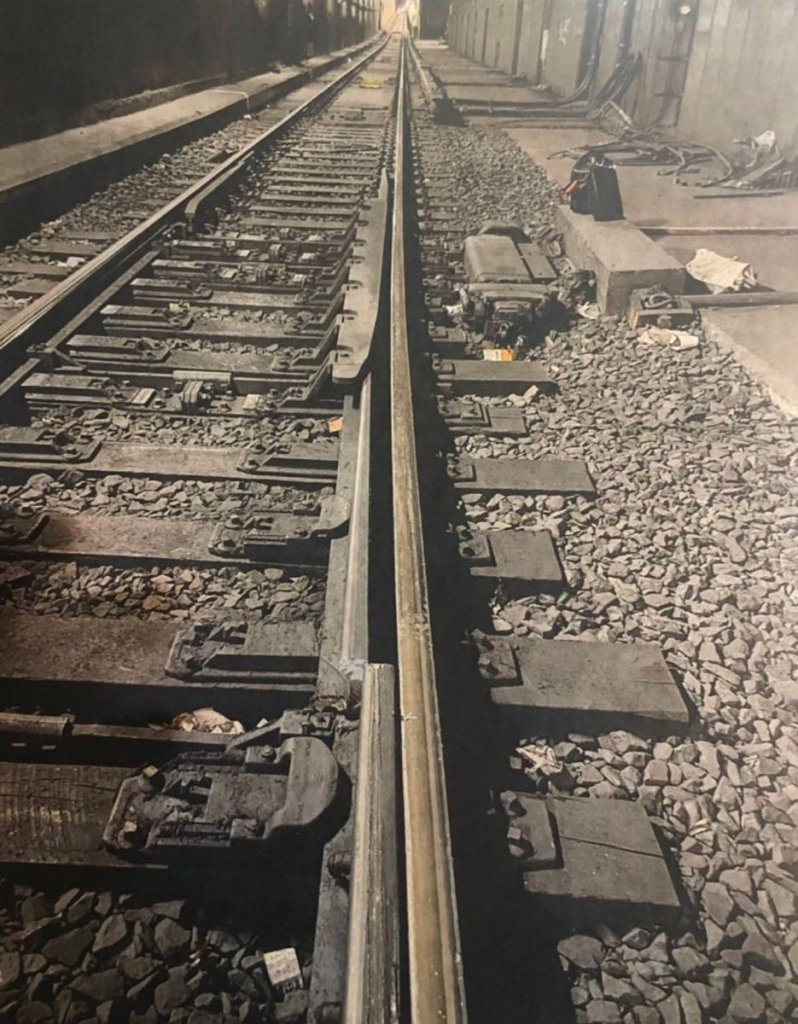
On the morning of March 1, 2024, a much more serious defect was discovered at the switch north of Museum Station northbound where the tracks leading west to upper St. George station, the normal Line 1 route, and east to lower Bay station diverge. The moving part of the switch has two pieces, one on each rail, that move back and forth to set the route for trains. The switch on the right hand track in the photo below has a complete break in the rail in the central foreground. The space where a train’s wheel flanges would have run was blocked by the broken rail that is completely misaligned with the rest of the switch.
Directly behind (north of) the photographer is the split between the WB and EB curves and a wall that, were a train to climb over the switch, would be struck by the train. How such an accident was avoided is had to say, but the slow order already in place might have allowed trains get past the misaligned rail without coming completely off of the track.
This defect was so serious that the University line was closed from about 4:15am to 2:20pm while the switch was repaired.
The photo below shows the broken switch north of Museum Station looking south on Friday, March 1, 2024. The image is from Megan Kinch’s Twitter/X feed (@meganysta) who in turn received it from a reliable source.
The primary method of track inspection on the TTC is performed by teams walking the line, and their schedule is such that this occurs regularly system-wide. The SRT investigation documented a three-day standard for this cycle. However, the work must either be done overnight when service is not running, or during the day with slow orders in affected sections for safety of the inspection teams. Weather conditions can make the job very uncomfortable. The SRT investigation noted the large number of junior staff as more experienced workers bid out to other jobs.
One problem is familiarity because much of the infrastructure will look the same from one inspection to the next, and small changes that could eventually grow into problems might not be obvious. Some problems are invisible, but can be detected with test equipment. Ideally such equipment should be able to move along the line at service speed so that more territory can be covered, and thorough inspections can occur frequently during regular service hours.
Another factor affecting track mounted on ties and ballast is that the ballast itself (the granular rock under the wooden ties in the photo above) must be monitored and refreshed from time to time. The structural function of ballast is not to be a hard base like a concrete slab, but to cushion and distribute the weight of trains and track onto the ground below.
Normal ballast is “springy” as anyone who has watched a heavy freight train pass will know. But even that has limits. Water and silt can accumulate in the ballast, and voids can open up below the track. This makes the ballast and tie structure either too inflexible or too soft.
The Subway Work Car Fleet
The TTC has a fleet of specialized cars used for various maintenance activities. Most of these are not regularly seen by riders as they operate overnight. Some are simple utility vehicles like flat cars, and others are highly specialized like the beam replacement car for work on the Prince Edward Viaduct.
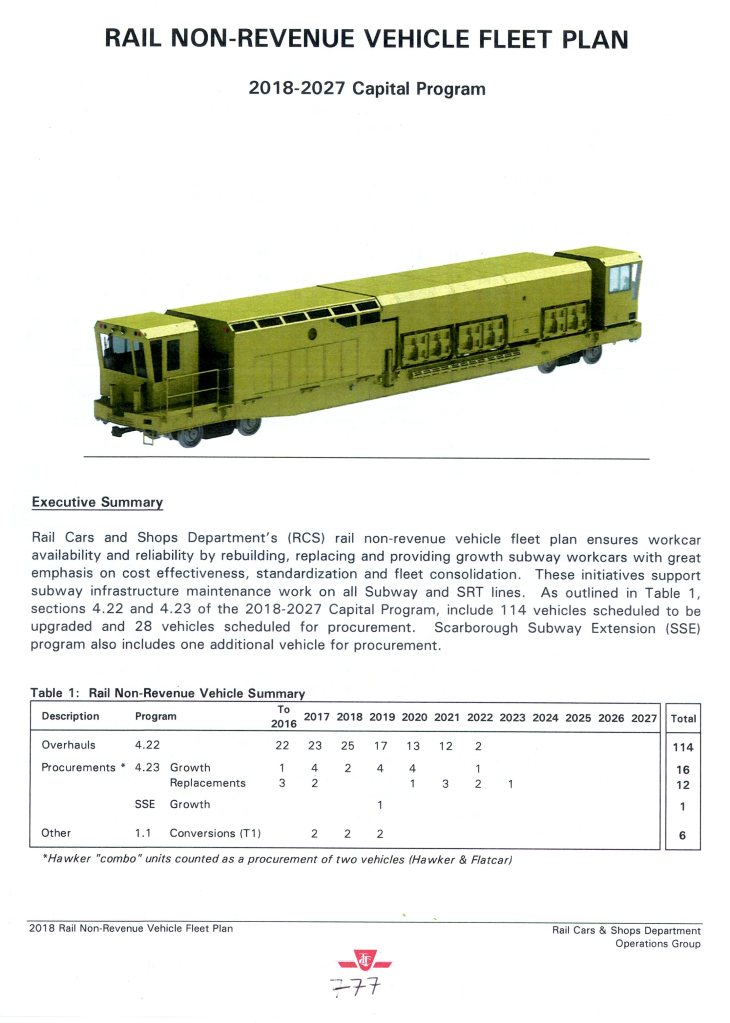
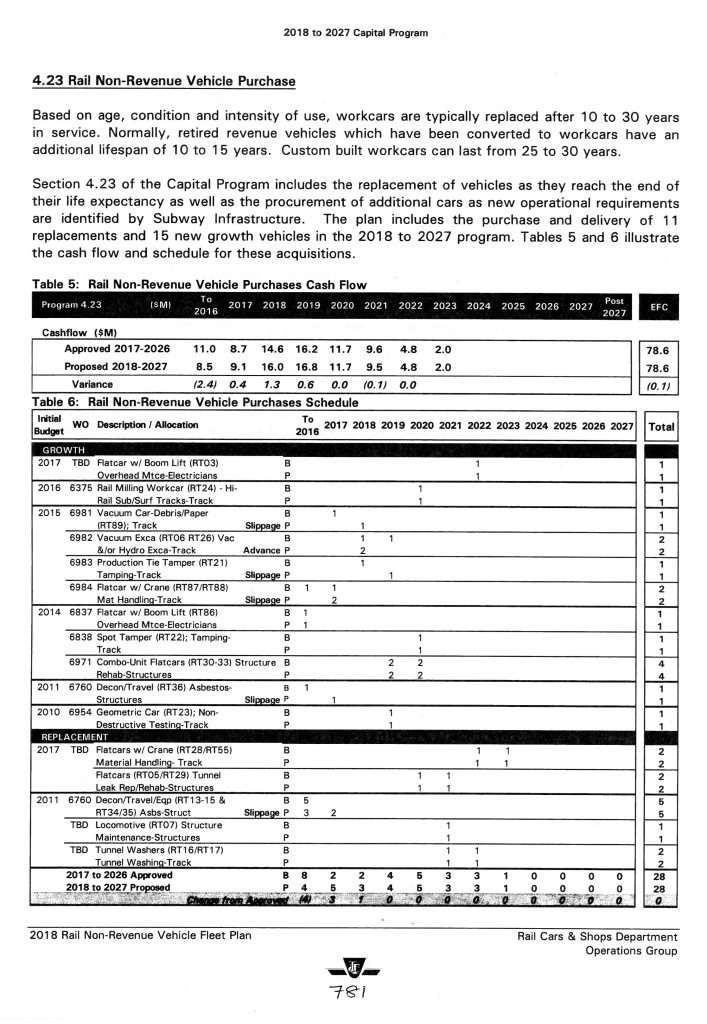
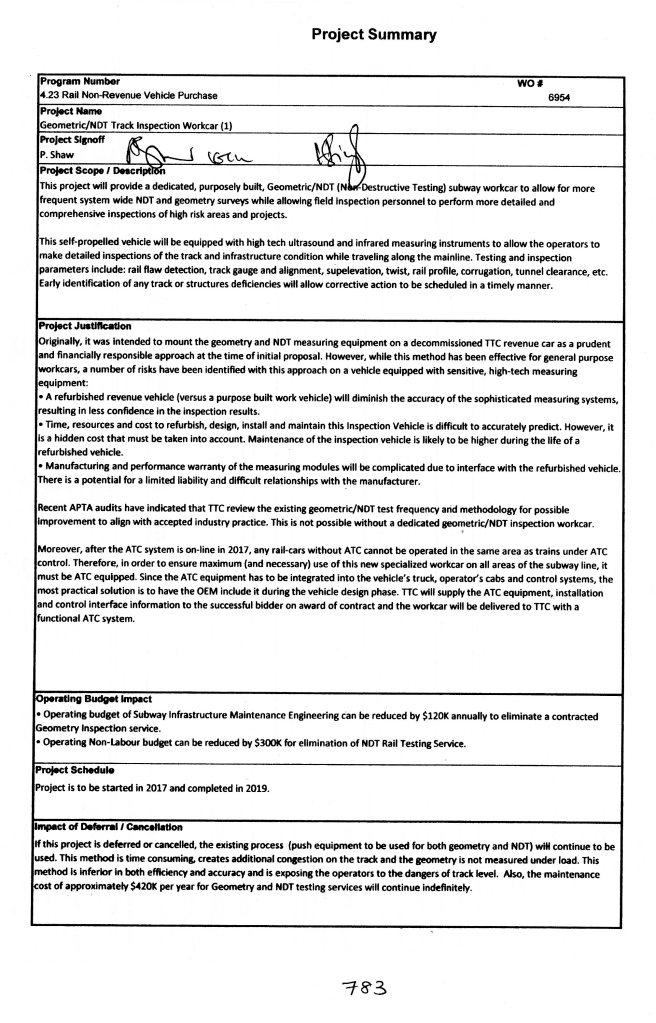
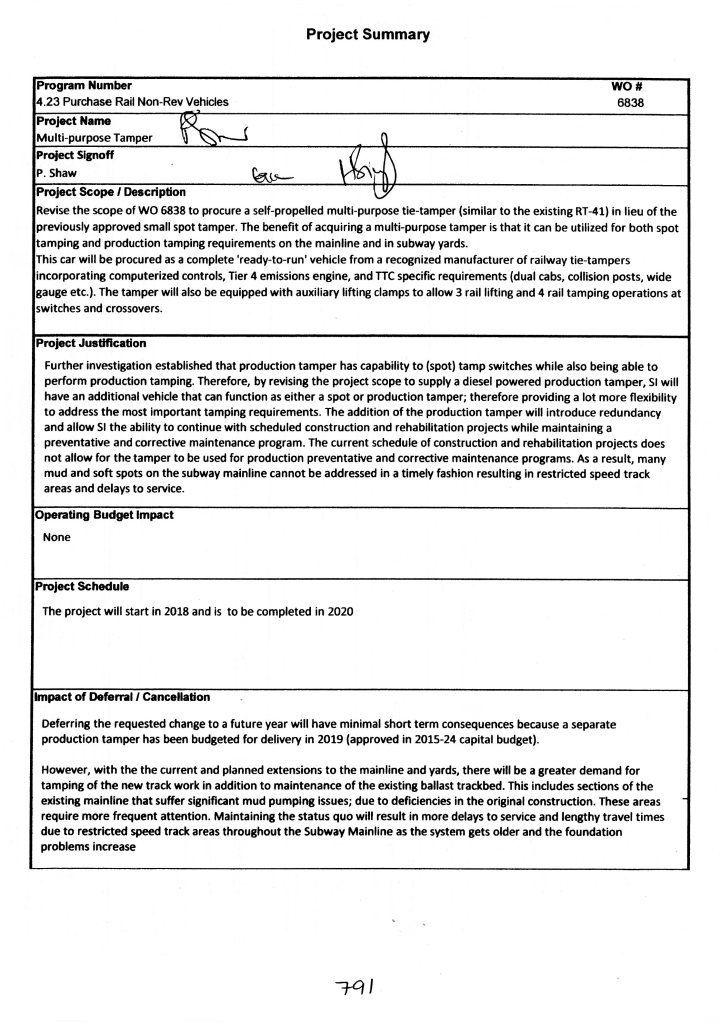
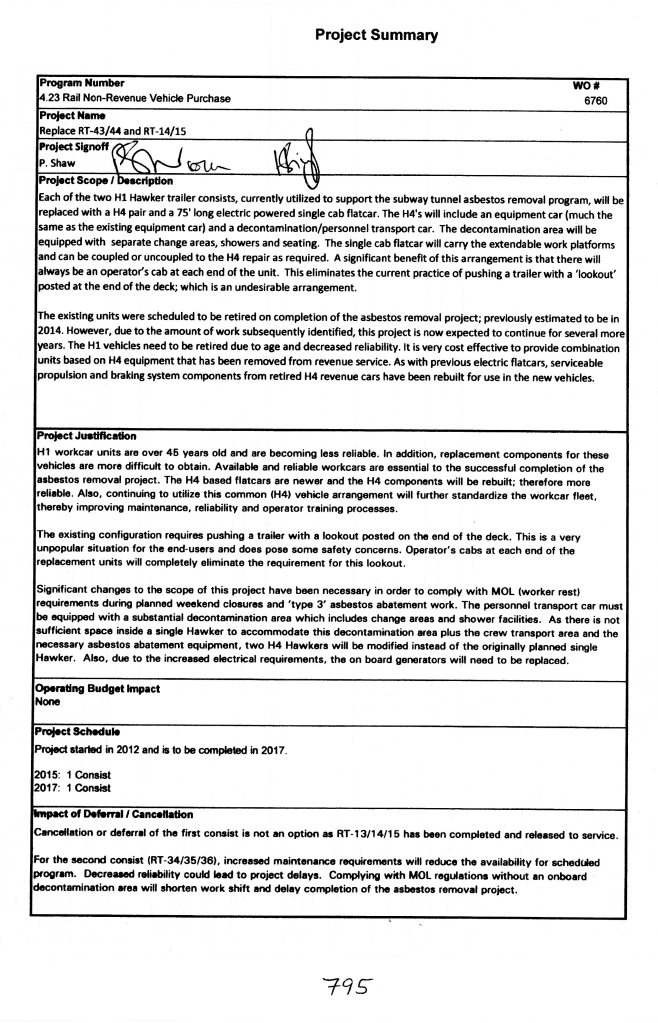
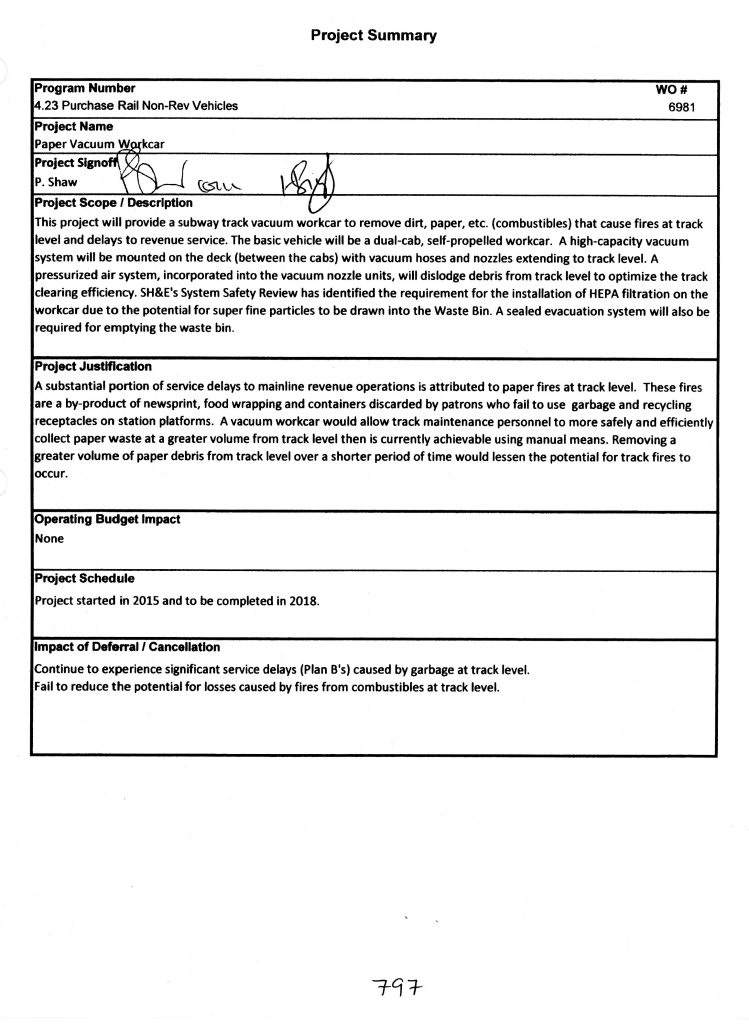
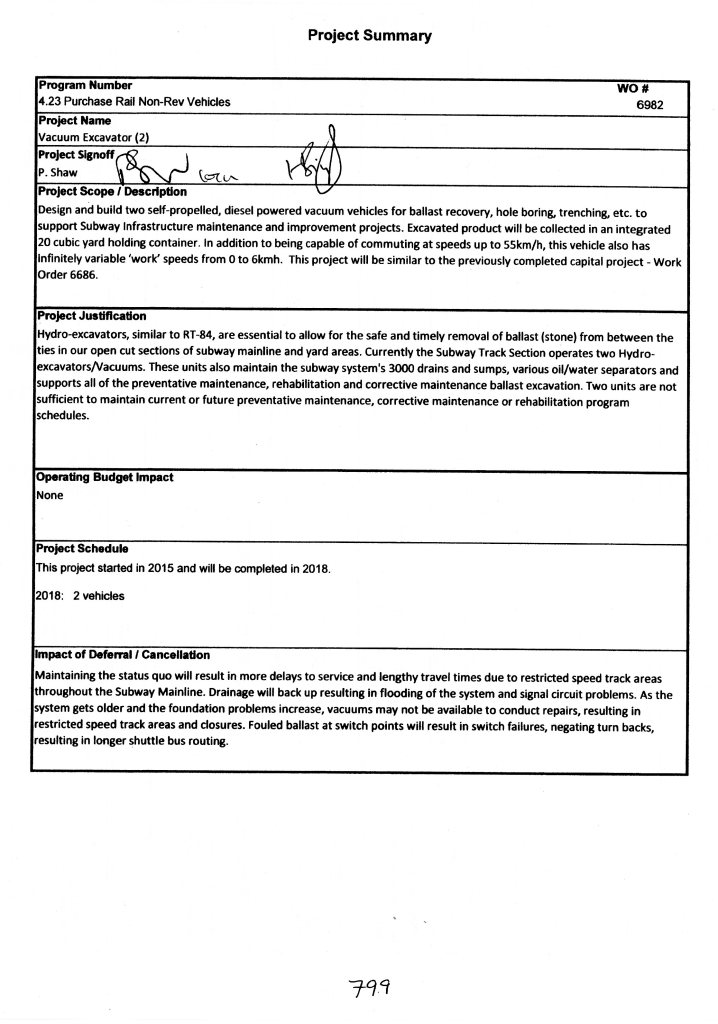
In the 2018 Capital Budget, there were plans to acquire several new cars both in recognition of the growing extent of the subway and the need for TTC-owned vehicles that could perform work often and throughout the year. TTC leases equipment for track geometry tests and rail milling from time to time, but such vehicles must be adapted to TTC track gauge, and they are only available when not working in other cities. It is to the TTC’s advantage to have its own cars that can do work at any time. The larger the system, the more critical having an adequate fleet both in size and functionality.
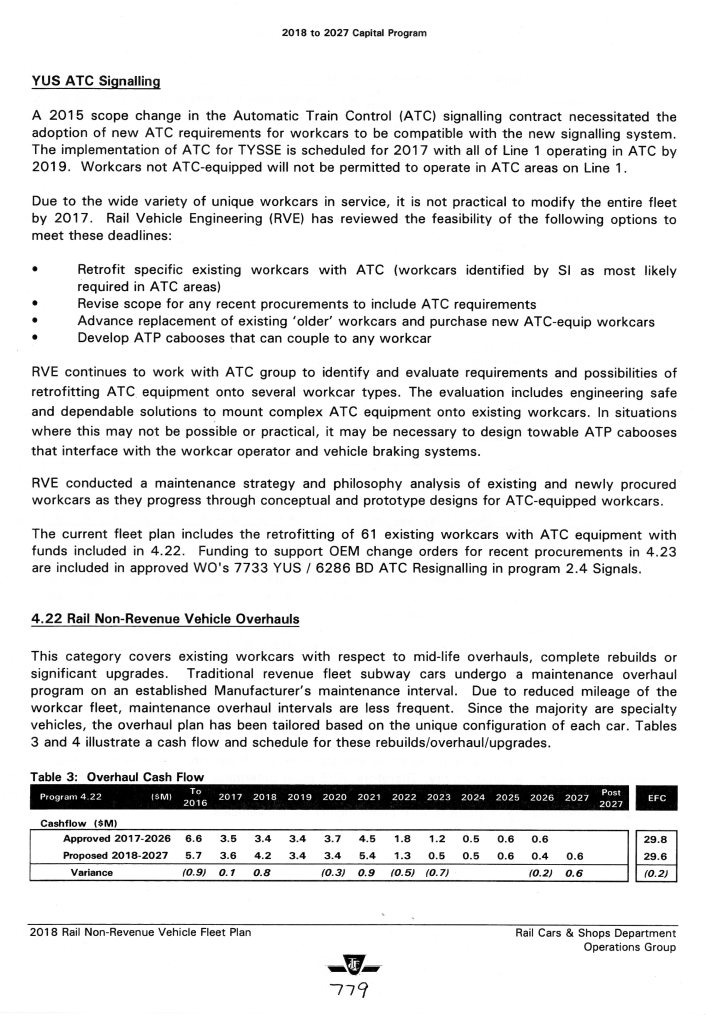
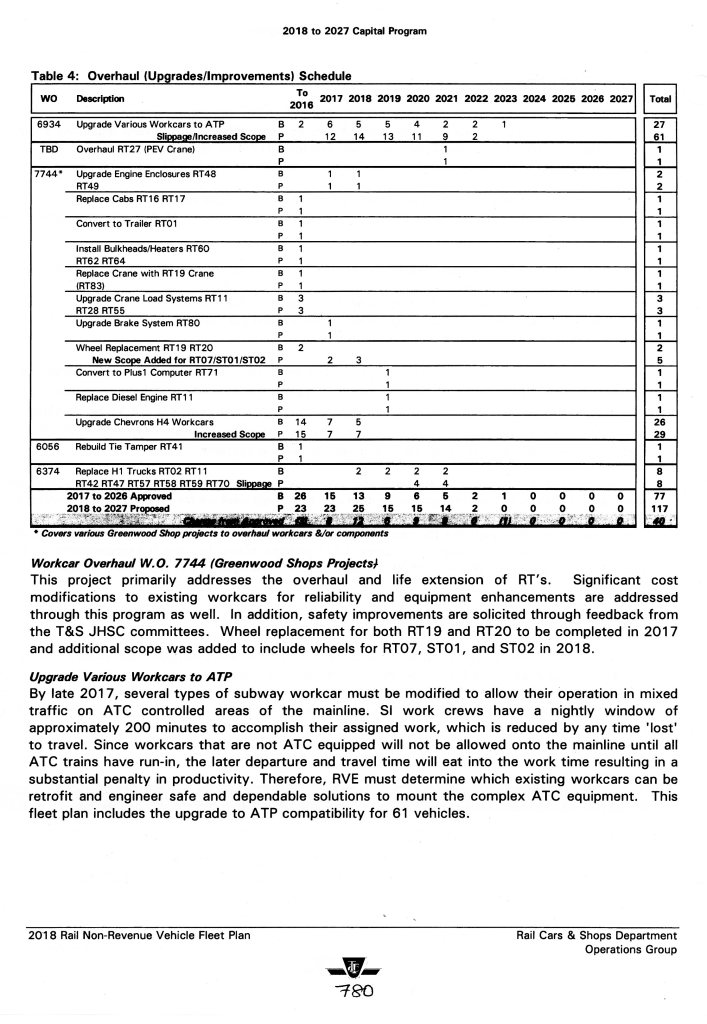
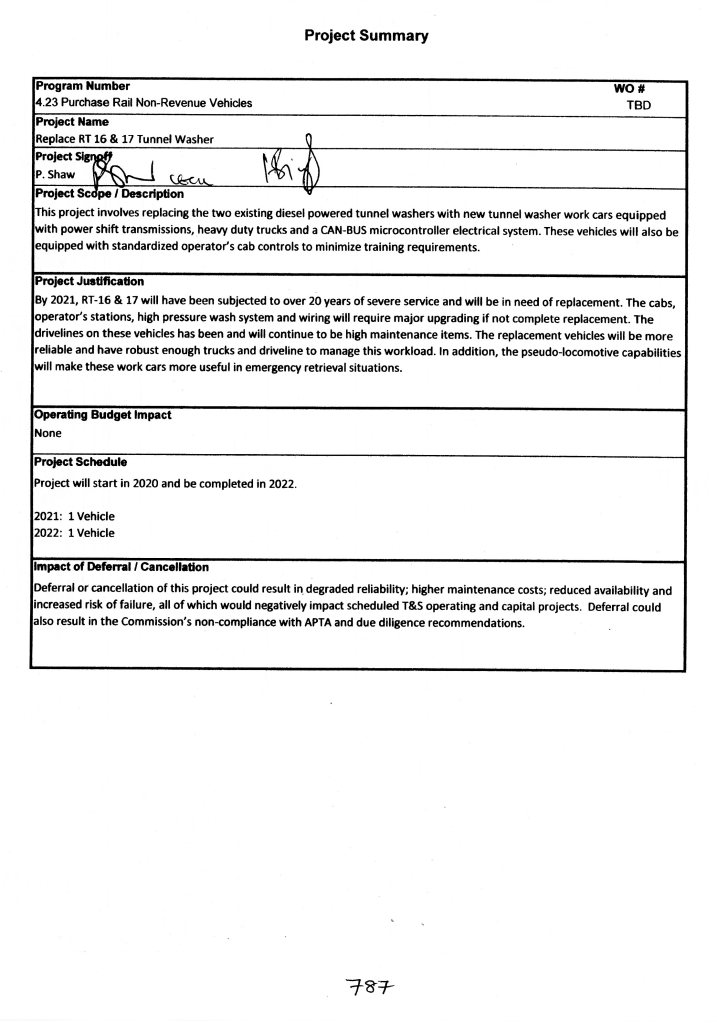
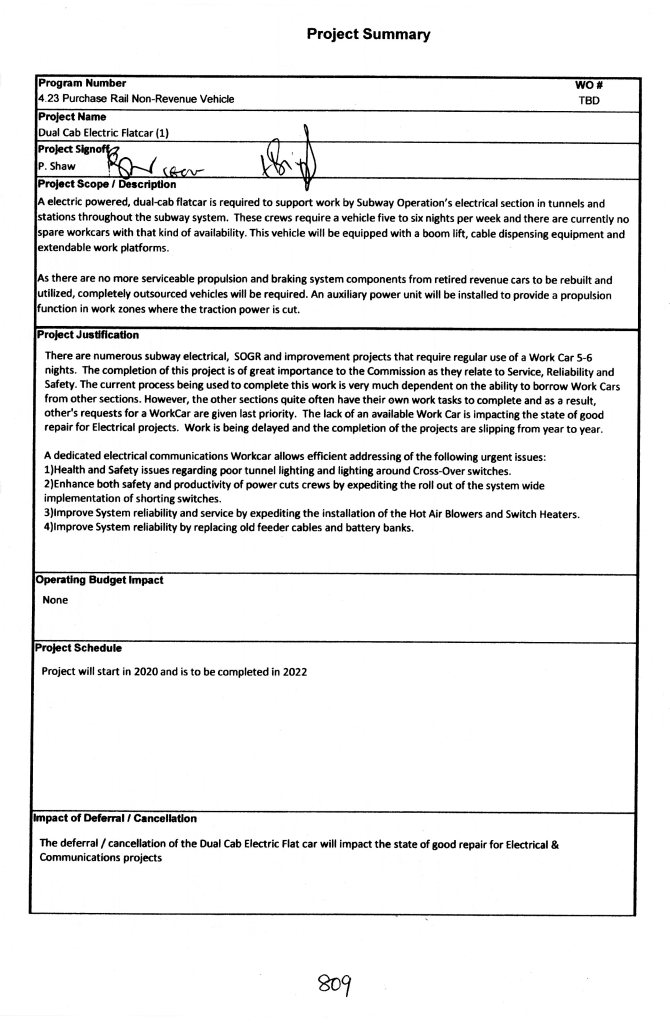
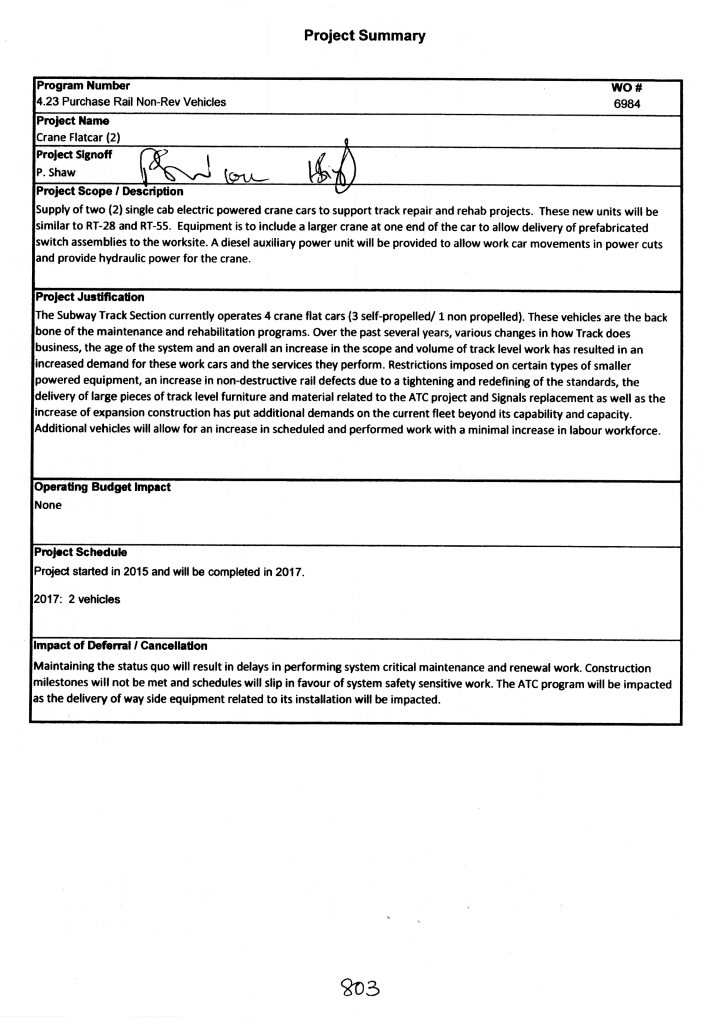
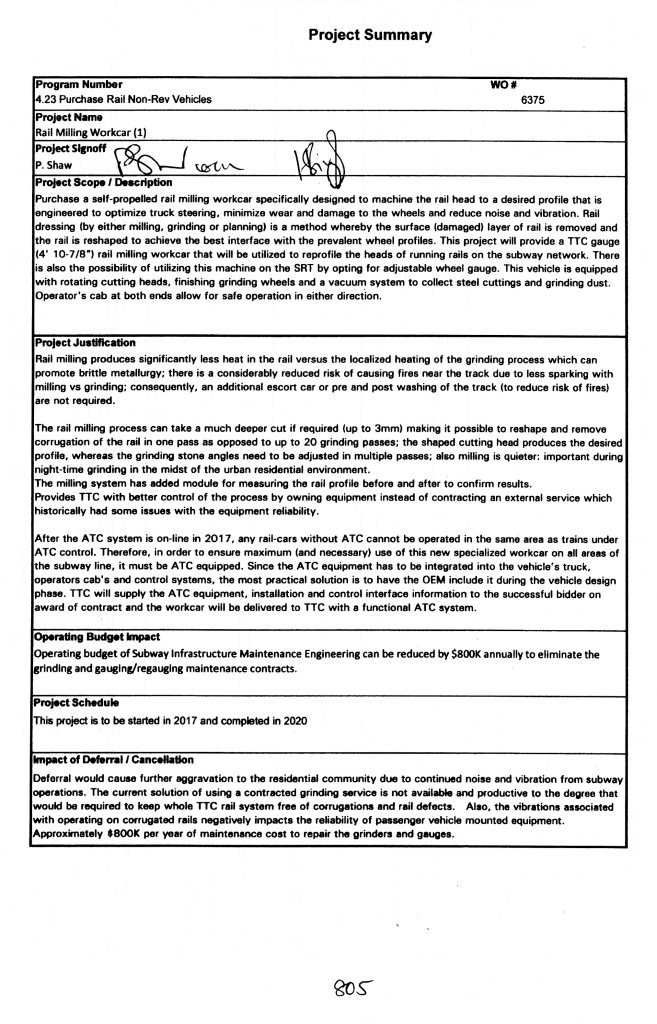
The gallery below contains pages from the 2018 Capital Budget “blue books” which show all details of proposed vehicle construction and purchase projects. I include them here because they explain the purpose and need for the work car fleet thoroughly.
This shows a comprehensive program to address the need for a larger fleet to add capacity and reduce or eliminate conflicting requirements for work trains by various sections and projects.
These were public documents, but 2019 was the last year when they were made available. My request for the 2024 books has gone unanswered by the TTC.
This was the last budget prepared on former CEO Andy Byford’s watch, but this plan was subject to constant deferral under Rick Leary. Most of the new equipment described here was never purchased, and it exists only as a funding reservation in future years.
The table below shows how the spending allocated for non-revenue vehicle purchase was constantly shifted ahead year after year with major acquisitions always in the future.

What we do not know is the degree to which ongoing maintenance has been hampered or deferred simply because the TTC does not have the equipment necessary to support the work. A related “catch-22” issue is that staff numbers will be sized based on the work that can be achieved, and the amount of maintenance in turn can be limited by staff availability.
This is similar to the problem in regular service operation where the amount of service is limited by the number of operators, not by the size of the fleet. None of this is ever discussed by the TTC Board, especially when their focus is on shaving costs and head count to defend “precious taxpayer dollars”.
The proposed new vehicles in 2018 are listed below. Some provide net new functions such as the rail milling car, some are replacements for aging equipment, and some expand the fleet to reduce competition for equipment among various groups. For details, read the project details in the gallery. (The list below and detailed pages have been ordered to group similar vehicles.)
- A track geometry / non-destructive testing inspection car.
- A new diesel-electric locomotive to replace a (then) 20-year old diesel locomotive.
- Two new tunnel washing cars to replace existing 20-year old equipment.
- Two new electric flatcars to provide a dedicated vehicles for communications cable installation and for electrical work.
- Two tampers for ballast maintenance.
- Two new combo flatcars for use with enclosed crew quarters using repurposed H4 passenger cars for tunnel maintenance work.
- Replacements for four flatcars running on 45-year old H1 equipment.
- Two new work trains using retired H4 cars to replace existing 45-year old H1 cars. These trains are used for asbestos remediation work.
- A subway vacuum car to clean tunnels of debris which can lead to fires.
- Two additional vacuum excavator cars (adding to two existing) for ballast and drainage maintenance.
- Two additional crane cars (adding to four existing).
- Rail milling car.






Streetcars
The streetcar system has been beset by slow orders for many years. There is much talk of “transit priority”, but rarely of systemic issues that slow operations. Among the causes for slow orders are:
- All special work (switches and crossings) is operated at restricted speed because some intersections are in poor condition.
- Local bad rail issues, notably worn track awaiting repair.
- Intersections with left turn conflicts where non-transit traffic goes before transit. Even with signal controls, there are slow orders in some places such as The Queensway lest errant motorists make left turns in front of streetcars. How the TTC will operate the much higher-speed Eglinton and Finch routes remains to be seen.
- Old style trolley-pole overhead under bridges with low clearance (notably the King Street Atlantic Avenue underpass) will continue to have slow downs until all overhead is converted for pantograph operation.
The quality of track at intersections varies widely from nearly pristine new installations to aging track that has been patched together, sometimes repeatedly, awaiting complete reconstruction. King & Church is a prime example of the latter. Rather than flagging the problem locations for slow orders, the rule applies to the entire system.
As I have documented in several articles, when special work is rebuilt today, this is done with pre-assembled track panels and welded rail components. The rails are coated with an elastic substance to reduce noise and vibration in the track slab that can speed concrete deterioration. However, many intersections predate this technique because of the long replacement cycle for track work.
Even after the decision to retain streetcars in 1972, new track up to and including the original Harbourfront line in the late 1980s was laid on untreated wooden ties. Such track fell apart much faster than expected because track was built to a standard dating from an era when streetcars would be abandoned soon. Tangent track now is in better shape because the TTC switched to a mixture of treated wooden ties and steel ties in the early 1990s. Since then, almost all tangent rail has been rebuilt with steel ties and rubber sleeves around track to limit vibration.
Issues with electric track switches go back four decades to the introduction of the ALRVs. Because these cars were longer than PCCs and CLRVs, the existing system of switch control using overhead contactors had to be replaced. The new system used antennae under the cars and in the pavement, and it never worked reliably. This led to some accidents and a stop-and-proceed rule at all facing point switches whether they were electrified or not. This delays streetcars and can interfere with the logic behind green time extensions – cars take longer to enter intersections after stopping than some signals allow for. The worst example of slow operation is westbound on The Queensway at Roncesvalles where there are five switches between Roncesvalles Avenue and the entrance to Sunnyside Loop, each one requiring a stop.
A project to upgrade the switch electronics started years ago. The first of two budget extracts below from 2012 shows it as underway with completion over five years to 2017. The second extract from 2024 shows that it is still underway and only partly funded at substantially higher cost.


These are examples of how spending and design decisions can have implications for decades in the future and hobble the system until the replacement cycle comes fully around.
The State of Good Repair Backlog
Assuming that Council endorses the Executive Committee recommendation that SOGR should be top priority, this will create much difficulty in ranking any rapid transit schemes because there will be no money to build them. Here is the SOGR shortfall chart from the 2024 capital budget report. The accumulated total ten years out will be $8.2 billion, and it will only be worse in the years beyond. We might have several newly opened lines, but the existing system will crumble.
If SOGR really will take first place, Council has to drum up a lot of money very quickly either from City resources or from other governments. Saying “buy me a subway” when we claim to most need repair and re-equipment funding sends, at best, a mixed message. At worst it says that only photo ops really matter.


The nature of this backlog must be clearly understood because this is only a subset of the unfunded “needs”. I put that in quotation marks because projects get onto the transit funding shopping list without a full understanding of their cost or how they fit in overall plans. Are they truly “needs”, or are they on a wish list?
The full list is in a report grouping them by major portfolio within the system. I discussed this report, among others, in an earlier article.
- Report: TTC’s 2024-2038 Capital Investment Plan: A Review of Unfunded Capital Needs
- Article: TTC Board Meeting: December 20, 2023 – Part II
The grand total of unfunded projects is $35.5 billion, vastly more than the $8.2 billion SOGR shortfall listed above. There are important distinctions between the two lists:
- The SOGR shortfall chart runs to 2033, but the unmet needs list and price runs to 2038.
- There are some very large items in the unmet needs list that have never been prioritized including:
- Full embrace of the 2050 Vision Zero plan including very substantial increase in transit service affecting fleet and facilities needs, as well as ongoing operational funding.
- Capacity increases on Lines 1 and 2
- Platform edge doors
- Replacement and improvement of traction power supply systems to support more frequent service
- Accessibility improvements beyond the current elevator program
- A new Transit Control Centre
- New maintenance and storage yards for Lines 1 and 2 to handle a larger fleet
Where do these and other proposals fit compared to the list of BRT, LRT and subway projects now before Council?
There is a tendency to confuse the two lists and speak of the big ticket items related to system growth and improvement in the same breath as SOGR. They are not the same.
This article was concerned primarily with infrastructure, but there is also the question of vehicles, drivers and mechanics. Promises of service improvements will ring hollow if we get a stand-pat budget and staffing plan. That is a topic for a separate essay.
The TTC Board and Council must put much more effort into understanding the current state of the transit system and their options for future renewal and growth. This will require hard decisions about spending and revenue that have been avoided for years.
 Steve Munro
Why annually? Shouldn’t that be done on a monthly basis?
And what about the streetcar tracks? Do they use the “test rig” on the streetcar tracks, alternating with the subway tracks (since they are the same track gauge)?
What about the light rail tracks? Will they have their own “test rig” because of the different track gauge? Or will they wait 10, 15, 25 years?
Steve: In light of recent events, the TTC plans to shift to semi-annual inspections. If they had bought their own inspection train, they were planning to move to at least quarterly.
There is no automated inspection of streetcar tracks. As for the new LRT lines, that will be up to the private sector partners responsible for track maintenance.
LikeLike
A while back, I remember the TTC mentioning building Obico Yard near Kipling Station to accommodate an expanded fleet of trains. With the province mulling a Sheppard Subway Extension, along with more trains for Line 2, I would assume this causes more pressures for both the TTC and the City to fund SOGR.
As for the streetcars, I was somewhat aware of the Stop-and-Go policy, but I never knew it came from the antennae below. You mentioned that they’re not reliable, but I’m somewhat unsure as to what happens; do they not properly detect the streetcars?
Thanks for the article, I know this is a lot of work to compile, but it’s much appreciated. 🙂
Steve: The City has already bought Obico Yard, but the immediate need for it was reduced through a combination of factors. First, Rick Leary got the idea that that T1s could be rebuilt, and plans for a replacement fleet were put on hold. The idea was that the new yard and shops would be designed around the new trains. Greenwood would be used for the Relief Line (which was still a TTC project at that point) as well as providing increased storage for the works fleet’s planned expansion. Now, they are going to try somehow to have the new and old BD fleets co-exist without any more storage. That should be “interesting”. All of this was in aid of trimming the capital budget, even though it really did not make sense. There was also a point where Leary was still not keen on ATC, and the work for Line 2 was deferred even to the point where the SSE is being built with conventional block signals and provision for ATC conversion later.
There are a few failure modes for the antennae, but all relate to lack of communication from the car to the wayside equipment. If the front antenna does not communicate, the switch does not “know” a car is there, and will neither set nor lock. If the rear antenna does not register, the switch does not unlock, and the next car will not be able to throw it. There are other ways to fail, but those are a common problem that shows up as unpredictable behaviour. There have also been cases where a switch throws unexpectedly either just as a car arrives, or under a car sending the centre or rear truck on the wrong path.
If subway signalling equipment was so unreliable, it would have been torn out decades ago. But streetcars? It’s easier to impose a “safety” restriction than to bother actually fixing the infrastructure. Note that the old system with overhead contactors would fail occasionally, but rarely.
LikeLike
Traffic signals, traffic signs, and the paint on the roads are not the responsibility of the TTC. The Toronto Transportation Services’ priority is the single-occupant automobile, not cyclists, not pedestrians, and definitely not public transit.
In other jurisdictions, they give priority to streetcars, trams, and light rail. In Charlotte, North Carolina, for example, they use crossing gates in the left turn traffic lane. They force single-occupant motorists to stop and give priority to light rail vehicles. This video was produced by LYNX Blue Line as a PSA. The TTC and especially Transportation Services should do the same. But will they?
Steve: Yes, transit priority lies with the City, but so does funding as well as a fascination with making new priority lanes while failing to make those we already have better.
LikeLiked by 1 person
That’s the good old Bostonian expertise shining through.
How does the curve between Union and King appear in this list? This is just plain sad. It was 5 years ago they had to embark on emergency repairs for this section. It was flagged as a blind spot for maintenance then!
There was a whole portion of a board meeting dedicated to explaining how their regular inspection routine was insufficient to detect the broken chairplates in this location, as well as neat little explanations about the premature corrosion caused by rail greasers.
If they’re still missing problems with track wear then clearly they haven’t improved their procedures enough! How did management not learn their lesson???
Much like the OCS [Overhead Contact System] project, which was supposed to run from 2013 to 2016, but morphed into ‘maybe we’ll get it done by 2043’, perhaps the switches will be upgraded in time for the TTC’s 125th.
LikeLiked by 1 person
Hello Steve;
I first want to explain that I am a 63 year old man that has rheumatoid arthritis in my right hip that forces me to use a cane to help walk.
Since Metrostinx took over control of the TTC it has gone to hell in a handbasket on a bullet train.
There are 2 examples I am going to give you here;
First I use the Castle Frank subway station to utilize the TTC. Now there used to be an escalator to get to the bus platform from the mid rise on the Eastbound side which was torn out in favor of an elevator to accommodate wheelchairs, strollers, people with walkers and passengers like myself that can not climb the stairs. After months of painful negotiation up the stairs I finally met a supervisor of the construction being carried out there. I asked him when the elevator(s) were going to be operational possibly by Christmas as they were still waiting for the elevators to arrive from overseas.
My response to him was why would you start a major project like this without first having all the necessary parts to replace what you are tearing out on site ready to be installed?
That is the number 1 rule in the construction industry everywhere around the world!😐
He looked at me and said I didn’t give the orders I just follow them.
Pathetic, do you have any idea what it is like with a pregnant woman pushing a stroller with 2 children in tow trying to climb those 31 stairs? Or a 78 year old woman who is using a walker trying to climb those stairs, god forbid a person with a wheelchair ever trying to get upstairs.
Steve: This comment has been edited by the removal of a long section about homeless people, non payment of fares and other issues. I have preserved the text for reference, but will not publish it.
First off, Metrolinx has not taken control of the TTC, although the province is certainly meddling in Toronto’s transit affairs.
Second, I too dislike the situation at Castle Frank Station for similar reasons and now avoid it if possible. The story about the long lead time to source the elevator says something about TTC project management, and the long periods required for accessibility changes and maintenance generally.
LikeLiked by 1 person
Regarding streetcar operations and the state of streetcar infrastructure. I had a realization: people who occasionally pop up saying that World Class Cities™ don’t use “19th-century” streetcars… have probably never been in a World Class City™ that does use streetcars, and are instead basing their understanding of best practices for streetcars on how Toronto does it.
After all, people who have only seen streetcars in Toronto would think that lurching stops at intersections, crawling through underpasses, waiting at stoplights, and manually changing switches with an iron are the best of what streetcars can do. Sigh.
LikeLiked by 4 people
Are we surprised that the exact same thing has happened to Toronto’s trackwork as Boston under Rick Leary? I wonder if he was deliberately chosen by the TTC board and city as someone who wouldn’t make too much of a fuss about non-critical things such as “safety” and “maintenance”.
Thanks for summarizing all of this. It really makes it sad seeing us spend billions on extensions to serve the Canada Tire at Sheppard/McCowan while the existing network disintegrates in front of us.
LikeLiked by 3 people
That ain’t no way to run a railroad.
LikeLiked by 1 person
Read with interest. Your factual analysis of TTC infrastructure maintenance short comings was breathtaking given your long experience and singular passion. However the opinion that Metrolinx does not control the TTC I believe to be a falsehood. For 12 years the commission has been blackmailed into using the multibillion dollar defective Metrolinx fare system under threat of risking all capital projects. Metrolinx has had access to TTC bank accounts at will. Metrolinx and provincial and city politicians have gas lighted and condemned Toronto to 50 years of public transit and traffic chaos. It is unfortunate but this is not Toronto 1975. It is regrettable that bad policy has no consequences.
yours truly
Gus Rizakos
Institute for Public Transit
Steve: Metrolinx does not run the TTC, which was the implication in the original comment. Yes, provincial policy has forced the TTC into certain arrangements, notably with Presto, but not for most decisions. Metrolinx’ only financial recourse to the TTC is to withhold fare revenue from Presto. This is not the same as having access to all of the TTC’s bank accounts.
As for the “Institute for Public Transit”, it has no presence on the web. You might try to avoid posting under a made-up name in the future.
LikeLike
Dear Steve
Thank you for your reply.
Here are the facts for those interested. Having spent most of life working in public transit looking out for the health and morale of the travelling public has been a passion and a calling.
I know we stand with thousands of dedicated others who have given service in their own way throughout the years.
You will not find any reference to the ‘institute’ on the web or anywhere else as I started it in the 1980s when running the Gray Coach Sunnyside Bus Terminal agency with my father.
Something that is a great source of pride sacrifice and satisfaction for my family.
In one of his last TTC board meetings Councillor Jim Karygiannis questioned staff at length about how the TTC was being ‘ripped off’ by Metrolinx. Draining it’s account and advised there was nothing that could be done. Even bank stop orders failed.
This Can be found on YouTube and the web.
I hope this answers any made up concerns.
With high regard
gus
Steve: Thanks for the background. I reiterate that Metrolinx only had access to the TTC fare account and could withhold Presto payments to satisfy their “claims” for money the TTC allegedly owed them. That is different from all TTC accounts.
LikeLiked by 1 person
If SOGR eliminates slow zones, repair should improve service and/or decrease cost.
Is this part of the case brought to the Board when they are setting the budget?
Steve: Maintenance details do not come to the Board, and they are simply assured that all is well. The target spending is based on the level of expected subsidy and management decisions about where to spend. The first political response to asking for more money would be to say “is there something else you can cut”. Also, of course, at the point the budget went to the Board, the extent of track problems had not been revealed, and the assumption was that maintenance was adequate.
LikeLiked by 1 person
Hi Steve
What are your thoughts on platform doors? Are they really worth all of the expense or are they a case of others have them and we need them to be just like the big boys?
Steve: If we are building a new line like the Ontario Line, then PSDs are straightforward to integrate with signalling and the station structure. However, a retrofit is much more of a challenge. The current price (a $4 billion+ marker in the long range capital plan) is money that could be better spent on other things. The “big boys” by the way tend not to have PSDs on “legacy” routes.
LikeLike
Thank you for an excellent post.
Several years ago I searched your site and found a circa 1970 report (or perhaps link to it) about why Line 2 was operated at speeds well below what the trains were capable of. IIRC the main reason was that higher speeds require better track maintenance, and better track maintenance costs more money.
So (assuming my memory isn’t faulty) it seems that the TTC has a long history of operating lines slowly in order to save money.
That said, IMO a lot of the TTC’s problems are because us, the citizens of Toronto, are unwilling to properly fund it. You get what you pay for.
Dave Ings
Steve: The main reason that Line 2 was downgraded from high to low rate was that the H1 fleet used then was unstable at high speed with severe truck sway. The TTC got into the habit of buying enough trains to run in low rate and, frankly some of them were a make-work project for Thunder Bay. That said, the TTC would definitely have to up their game to move to “high rate” operation again, and I am not holding my breath.
LikeLiked by 1 person
Steve said, “The “big boys” by the way tend not to have PSDs on “legacy” routes.”
As an alternative to full screen doors, the various train and subway operators in the major cities in Japan have been installing chest-high barriers on most of their old lines. Even ones without ATO. They just make the platform gates much wider than the train doors (like, more than double), so even if the train’s stopping position is off, there’s enough wiggle room.
Steve: Yes, I am not sure this is what the TTC has been looking at given the cost figures they’re citing.
LikeLiked by 1 person
Paris is slowly installing PSDs on its oldest lines as part of a bigger automation project. According to wikipedia, the recently completed Line 4 automation (27 stations) cost around $375 million, including around $150 million for station renos and PSD installation.
Maybe the TTC should hire some RATP executives!
Steve: A few points worth noting. First, the stations on Line 4 are about 60% of the length of those on the Toronto subway. The current estimate for the Toronto project likely assumes construction about a decade after the Line 4 work was undertaken, and so one must allow for inflation in costs. Another important consideration is ventillation depending on the roof height in stations and the degree to which air circulation would be blocked by the new door structures. There is also the question of whether structural improvements would be needed to the platforms to support the doors.
All that said, it would not surprise me to see a Toronto project come in more expensive, even adjusting for conditions, but I await a pending TTC study to see (a) what they propose to build and (b) how much it is expected to cost. There was a period when an out-of-date cost estimate was being cited, and then there appeared to be a big jump in part because the update covered a fair length of time.
LikeLike
Good points! The factors pushing Toronto costs up relative to Paris (e.g. station size) might be partially offset by the fact that the lines in Toronto are 50 years newer and overall in a less dense urban environment. That said, my guess is that a lot of the cost differential would come from the RATP’s higher internal engineering and project delivery capacity and lower reliance on external consultants and contractors (and of course they’re now building capacity/experience for this type of project specifically).
Anyway, I’m not arguing in favour of Toronto installing PSDs – the cost structure is what it is (without major institutional and cultural changes) and you know better about the most effective use of the funding.
In case of interest, you can see pictures of how high the doors go here and here – generally between head height and the height of the train. I don’t know what that means for ventilation and the Paris metro certainly has air quality issues. Line 13 is another interesting example closer to the Japanese example Melissa mentioned, with somewhat lower barriers and no automation.
Steve: Toronto Public Health was looking at subway air quality just before the pandemic struck, at which point the work stopped. Generally speaking, their finding was that air quality was poorest in the stations with little or no external ventillation (i.e. underground), but that exposures for passengers were well within accepted limits. Train crews and others who worked all day in the tunnel environment were quite another matter. Same source – brake shoe dust, although there is also a substance delicately called “tunnel fur” which has a lot of not nice stuff in it too.
LikeLike
Track repairs and elimination of nearly all slow zones between Finch and King had the expected effect. Today southbound trip was 30 min and northbound was 32 vs 35 and 45 like it was in February.
LikeLike
Thanks for all of this Steve, and commenters. It’s not necessarily the fault of those within it all that it’s devolving from transick to something else, but it sure seems we need transit ‘management’ overhaul, including prying the “metrostinx’ out from the regime of the day, so no more Sorbara Subway Extensions or another Suspect Subway Extension worth billions to some folks.
This might also mean the outside expertise from Europe, somehow, and a few million in consulting fees etc. would be very good value for taxpayers, if the results and processes were quite open, and there was also recognition of the many many obscured costs of private mobilities, eg. climate, oops, sorry kids.
And there’s a further bit of ammo for overhaul here, it seems:
LikeLike
I have seen some possible trouble spots on tangent streetcar rail. Passing streetcars in these spots have been making the classic thumping noise while passing over. I had thought they were welded together but in a few areas noticed perhaps an inch gap between rail sections. Is this beyond TTC and industry standards or problematic at all?
Steve: There are places where rails are not welded together and the reasons vary depending on track construction techniques at the time they were installed. An inch gap is far too wide, although could be during colder weather when rails contract and so any opening widens up. This is a symptom of the lack of running repairs across the streetcar system.
LikeLiked by 1 person
One such spot is just ahead of the west to north curve at Queen and Broadview where there is a small gap before the turn off. I think there is another spot east of that area with a gap. I’ve seen others but those were the first two to come to mind.
Steve: There are gaps on the west side as well where the switch is not welded to the tangent runoff track.
LikeLike