
The TTC Board met on February 22 with what appeared at first glance to be a light agenda. In fact the meeting ran on into the early evening. Various items were discussed including:
- The CEO’s Report
- Customer Satisfaction, Fare Evasion and Deployment of New Staff
- The SRT Derailment and Subway Slow Orders
- Free Rides for Student Field Trips
- Renaming of Dundas and Dundas West Stations
CEO’s Report
Ridership
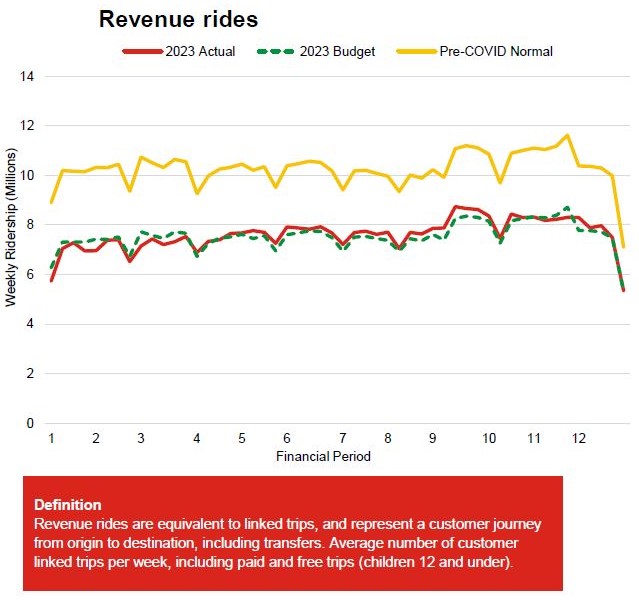
Ridership on the transit network continues to recover, although at varying rates by route, location and time-of-day. The charts below show “boardings” and “revenue rides”, two metrics that have been used to track system performance for years. These terms correspond to “unlinked” and “linked” trips in planning jargon where an unlinked trip is a segment of a journey on one vehicle, except on the subway where transfers do not count as a new “boarding”. Linked trips used to be the collection of boardings making up a continuous journey, but this distinction is difficult now that riders have options both of unlimited use passes and two-hour transfers. “Revenue rides” includes trips by those who ride free (e.g. children) to maintain consistency with older stats.
Both values show a typical drop in December due to the holidays with the temporary disappearance of many work trips and all school trips.
Note that these show overall system usage, but do not tie directly to crowding because that is affected by service quantity and reliability, as well as variations in the time and location of demand. The TTC did not publish a chart of crowding stats in this month’s CEO Report.
Over early 2024, there should be a return to Fall 2023 riding levels plus an indication of whether demand will continue to grow, or will stagnate. In March, the effect of cross-border fare elimination and the restoration of the co-fare with GO Transit should appear, and we will see how much riding that really does generate (as opposed to giving existing riders a cheaper trip).
A perennial debate has pitted better service versus cheaper fares, and industry experience has shown that service is the more important factor. A cheap ride is useless if the service to make the trip is poor or absent. The flip side of that argument is that if the fares are attractive, then they are less of a barrier to attracting riders with new and improved services.

Vehicle Reliability
The TTC continues to present vehicle reliability in a format that hides the actual behaviour of the fleet and prevents comparison between different vehicle types.
For buses, the metric is based on mean distance between “mechanical road calls”, typically one where a bus is taken out of service. There are several issues here:
- From the charts below (top row), it is clear that the reported values are capped at 20k for Clean-Diesel buses, but at 30k for eBuses and Hybrids. It is clear that eBuses are having problems, but this generally reflects the prototype fleet, not the newest vehicles. As for diesels and hybrids, it is not clear how much different they are in the values above the cutoff lines.
- Because the metric is based on in-service failures, there is no indication of how many buses never left the garage and sit, most of the time, idle because they are unreliable.
- There is no distinction between newer and older buses, except to the extent that they are represented by their technologies with diesels being the oldest. However, many of these buses are inactive and do not contribute to in service failure counts.
For streetcars, there is only one vehicle type, although there are now two generations as the add-on order of 60 cars begins to arrive. As with the bus fleet, only in service failures count, and there is no indication of how many cars rarely leave the barns.
Spare ratios, a topic discussed here often, are higher than the industry average. The question is whether this is due to lack of budget to operate service, or lack of vehicles that can be trusted on the road. The issue is not “did TTC make service”, but “how much more service could they run”.
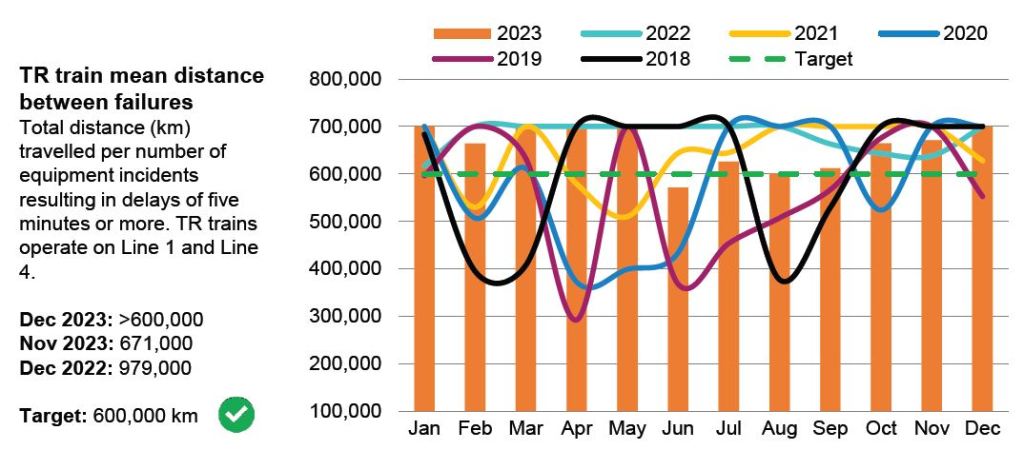
There are two subway fleets. The TRs (Toronto Rockets) serve Lines 1 Yonge-University and 4 Sheppard, and the T1s serve Line 2 Bloor-Danforth (T1 fleet). The T1s are older and were delivered between 1995 and 2001. With a 30-year design life, they are coming up for replacement if only the project can be fully funded (Toronto and Ontario have signed on, but not yet the Federal government).
The two fleets have different targets for distance to failure with the older T1s aiming for 330,000 km while the newer TRs have a goal of 600,000. Subway cars have much higher MDBF targets than surface vehicles because they run faster (more km accumulated per service hours) and they run in trains. Some problems do not count as a “failure” because they do not disable the entire train.


On Time Performance
Overall, the TTC’s metrics for service quality portray service that is generally better than actual customer experience. Uneven and missing service, and their effect on vehicle crowding, are not reported, and only the worst of gaps bump the not-on-time counts.
On time performance is measured at terminals, and is based on departure that is no more than one minute early or six minutes late. As most routes operate on a ten minute headway or better, this makes it possible for two vehicles to leave together and be counted as “on time”. This is not an appropriate metric of service quality as seen from a would-be rider’s point of view.


On the subway, on time performance is measured based on headways, not on schedules. A train must be within 1.5 times the headway to be “on time”. For example, if service is supposed to arrive every 4 minutes, the gap between trains can be 6 minutes.
This metric does not account for missing trains, and in fact a third of the service could be missing and the remaining trains would score 100% on time. (15 trains/hour every 4 minutes vs 10 trains/hour every 6 minutes)
Equally a service of alternating 2 and 6 minute headways would meet the standard and keep up the trains/hour target, but most riders would be crammed on the trains carrying a wider gap.

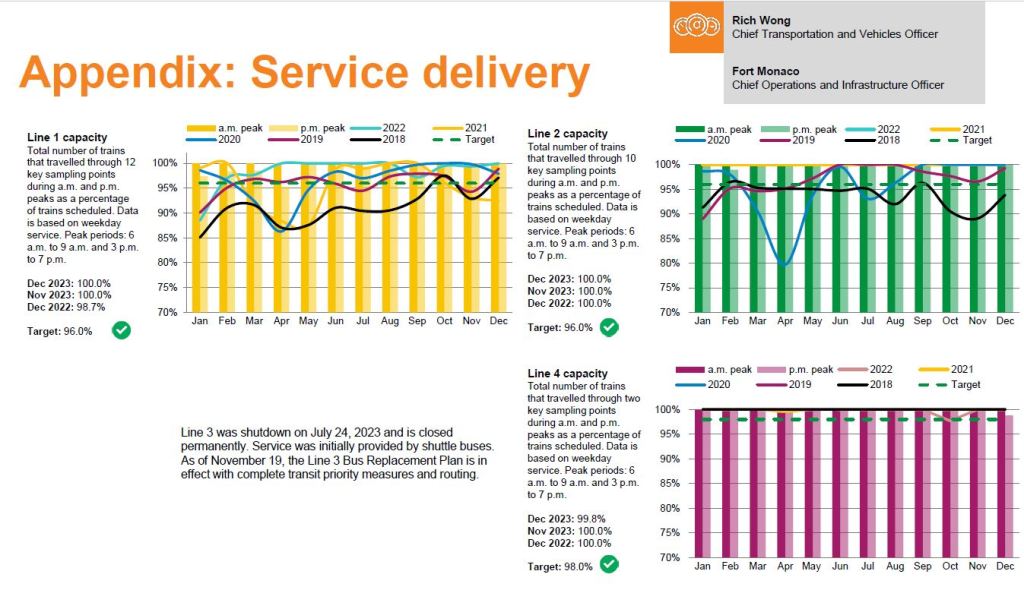
A separate metric reports whether all of the planned service actually operated. These charts show the count of total trains passing sampling points, but do not account for variations in headways. With the current scheduled headways being wider than the minimum possible (due to signal and other geometric constraints), it is possible to operate all scheduled trips, but on an uneven headway. It is easy to achieve a 100% count over several hours when trains can run closer together rather than sitting in a parade caused by a delay. Even after full pre-pandemic service is restored, this will also be an advantage of Automatic Train Control on Line 1 where trains can run very close to each other safely.
When the stats come out for January 2024, we will see the effect of widespread slow orders on train throughput, but even then the metric will combine data from many points and possibly hide the worst cases under a system-side average.
Short Turns
In the December 2023 CEO’s Report, a new metric for short turns was introduced. Previously, the raw count of short turns was reported for streetcar and bus routes. This figure is only comparable month-by-month as a trend, but gives no indication of the proportion of service that did not reach its terminus. The new metric is based on percentage of vehicles short turned.
The target for streetcar routes is 1% of trips, and for buses 0.1%. This difference recognizes the more difficult operating circumstances of the streetcars amid congestion and construction.

One problem with the new metric is that it averages all routes, all terminals and all times together. Locations where short turns are rare can add to the total count, while others see many more short turns. This is a problem common to many TTC metrics – they hide details by bundling information into weekly and monthly values for all routes and locations.
One statement in the notes to this chart stands out regarding “an innovative, zero-tolerance approach to reduce short turns”. This policy was widely known and is still observed within the TTC, although it was denied for years. An unintended effect was that bunches of streetcars and buses were left to travel the length of routes in packs rather than being, in part, short-turned to restore reliable headways. This had a darkly comical result during a TTC centenary celebration at Hillcrest Yard when travel from Bathurst Station to Hillcrest was impeded by most of the 7 Bathurst buses being in a pack at Steeles Avenue.
That is not “Innovation”. The policy was designed to “prove” that the CEO was “doing something” about short turns even if appallingly bad service was the result of poor implementation. True innovation would figure out an appropriate balance between short turns, headway management, schedule design and metrics that did not depend on an unworkable and misleading concept of “on time performance”.
The statistics, restated by this new metric, appear below. Note that it is already late February, the charts do not include January 2024 data.
There is one small problem: it is trivially easy to count short turns based on vehicle tracking data.
- The percentage of streetcar trips short turned eastbound on 501 Queen at Woodbine Loop was 4.2% in December 2023 (138 of 3319 trips) and 3.5% in January 2024 (118 of 3335 trips).
- Of the 504A King trips westbound at King-Queen-Roncesvalles from the January 7 schedule change onward, 5.4% of trips did not reach Dundas West Station (155 of 2852 trips).
- Of the 504 King trips eastbound at Yonge in January, 2.8% did not reach Jarvis indicating that they were short-turned at Church (190 of 6834 trips).
- Of the 505 Dundas trips westbound at Dufferin in January, 3.0% did not reach Roncesvalles, let alone Dundas West Station, indicating that they short-turned at Lansdowne (100 of 3336 trips).
- Of the 506 Carlton trips eastbound at Coxwell in January, 3.2% did not reach Danforth (106 of 3352 trips).
Looking at the detailed tracking information, many of these short turns were legitimate responses to delays or blockages. They are scattered in time and number from day to day indicating that these are not scheduled trips (e.g. for carhouse pull-ins). The point is that the numbers are higher than those claimed by the TTC. Stats should reflect what is actually happening, what riders experience, not be an artificial validation of management targets.
The number of reported short turns has always been much lower than actual counts, and changing the metric does not correct this problem. The values shown in these charts are simply not credible. I will explore this in more detail in a separate article.

Customer Satisfaction
Customer satisfaction scores have been falling on three regularly-reported metrics for some time. The numbers bounce up and down, but this will be the result of statistical variation or special circumstances that cause a one-interval drop or spike.
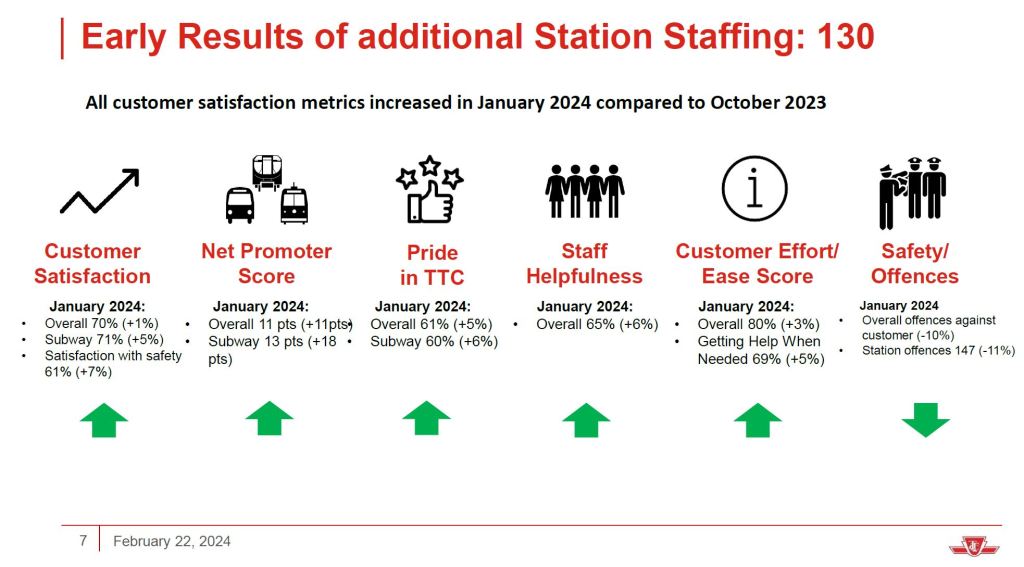
The first chart below is from the CEO’s Report and tracks values to the end of 2023. The second chart purports to show the turnaround caused by hiring more station staff. However, the point of comparison used in that chart is October 2023, a particularly bad month for “Net Promoter Score” which had a value of zero. Compared to December 2023:
- Customer Satisfaction overall rose to 70% versus about 67.5% in December.
- Net Promoter Score rose from about 2% to 11%. This is a substantial bump, and the score has not consistently sat at or above 10% in over a year.
- The Proud of TTC score rose from about 57% to 61%.
What remains to be seen is whether these are one-month fluctuations, something clearly visible in the first chart over past years, and whether an upward trend back to pre-pandemic levels will appear. The TTC has benefited from a mild winter and so service has not been as badly affected, except on rare occasions, as in some past Januarys.

Deployment of Additional Staff
Customer satisfaction is a system-wide issue, not simply one affected by fielding more staff primarily in subway stations.
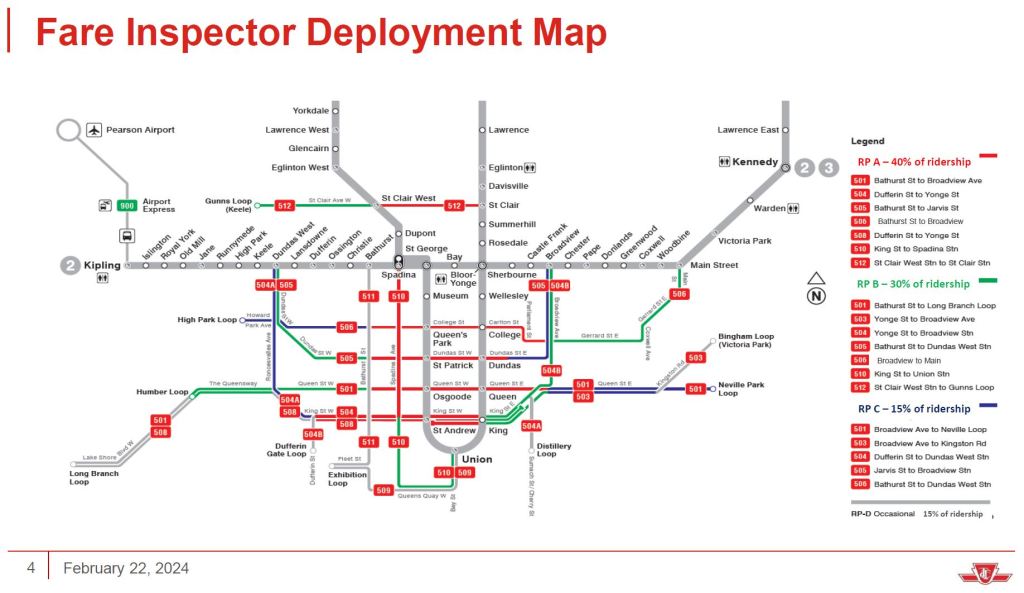
Part of the added funding given to the TTC by City Council and the Ontario government is intended to improve safety by providing a more visible staff presence, mainly in stations. A parallel concern among budget hawks is that fare evasion is out of control and this will be “fixed” by deploying more roving fare inspectors. Although the nominal reason for most of the extra staff is to comfort passengers and react to problems when they occur, there is an element of fare control if only by the deterrent effect that “someone is watching”.
Fare inspectors work the streetcar lines as shown in the map below. This is based on the premise that this is the location of much fare evasion through unsupervised all-door boarding. However, this says nothing about fare evasion on bus routes, some of which use centre-door loading at busy stops, nor by “children” of dubious age who breeze by the farebox unchallenged. Moreover, there are subway stations where walk-ins from the street are common, but unmonitored.
Customer Service Agents, who have no fare inspection duties, but who might at least keep an eye on their station, have been “strategically deployed to 37 secondary entrances across 33 stations”. This statement should raise eyebrows on two counts:
- First, that secondary entrances that formerly used “high-gate” turnstiles, but now have regular low barriers, are a point of fare evasion.
- Second, that several stations shown on the map do not have second entrances (Main Street, Jane, Eglinton West, Queen’s Park, St. Patrick, Osgoode, St. Andrew, Dundas, College). They may have multiple points of entry, but all lead to a common concourse and fare line.
The overlapping duties of station collectors, supervisors, customer service agents and fare inspectors in theory provide greater assurance to riders, but also can lead to clusters of staff who are all “supervising” the same location rather than roving through their territory. It also does little for on-train supervision.
The claimed fare evasion rate is about 13% which, based on annual revenue of $1 billion, would translate to $130 million. This is a big jump from the days not long ago when the TTC claimed that evasion was only about 5%. What is not clear is where this statistic comes from on a system wide basis. There are almost certainly areas and times when fare evasion is high, but 13% across the board is a stretch.
There is a symbiotic relationship between this number and the push to hire more staff, even if most of them are not fare inspectors. In theory, we should now see fare evasion rates drop, although the planned deployment leaves large swaths of the system “unguarded”. Will there be a drop, showing that the new staff earned their keep, or will the number will stay the same showing that their deployment did not address the problem?


Subway and SRT Track Issues
The condition of track inspection and maintenance has received recent coverage from me and from the commercial media.
- The Unhappy State of SRT Track
- The Scarborough RT Derailment Technical Reports
- Line 3 SRT Replacement Service and Derailment Investigation
- ‘Alarming’ reports raise questions about state of Scarborough RT before crash [Toronto Star]
- TTC warned in advance about deficiencies in lead up to Scarborough RT derailment [CITY TV]
- Scarborough RT derailment report spurs calls for accountability [Global News]
At the January 2024 Board meeting, staff claimed that the process of annually inspecting subway track geometry was normal, and that the recent spate of slow orders across the system resulted from this year’s review. A the February 2024 meeting, the story had changed to the extent that staff acknowledged that the number of slow orders this year was unusual, and that more frequent inspections are under consideration.
On the Scarborough RT derailment, CEO Rick Leary claimed that consultant reports flagging major issues with inspection and maintenance were not hidden, and that they had been brought to the Board’s attention and posted on the TTC’s site. This does not match with statements by some members of the Board. As for posting the reports, yes, they were available, but only if you knew where to look for them among the project information for the proposed Scarborough busway. There was no press release alerting anyone to their existence.
Leary plans to bring a report to the Board at its April meeting. There is an unanswered question: how did SRT track inspection and maintenance fall behind, and who authorized cutbacks in anticipation of the line’s shutdown in November 2023. A further question is whether there have been cutbacks in subway work as well responding to budget pressure.
Back in 2014, APTA (American Public Transit Association) conducted an extensive audit of the TTC including its maintenance practices and standards. Commenting on track inspection, they wrote:
As the gauge of the TTC is wider than the standard railroad gauge, a third party contractor has not been able to conduct ultrasonic testing of the TTC rails. Ultrasonic testing is performed annually on foot by pushing a “Push-bike” device. In reality, it takes 18 months to complete the testing cycle. It is important to note that rail approaching bridges is ultrasonically tested on a quarterly basis, however, on the whole, the practices in place do not satisfy minimum industry standards. Technology can now provide for standard-gauge track operations to be tested for track geometry and ultrasonic testing by the same vehicle while travelling at more than 50 k/h. APTA suggests that weakness in testing methodology be made a part of the Corporate Risk Registry and evaluated using the new Enterprise Risk Management system.
APTA TTC 2014 Audit p 71
APTA conducted a 2018 audit, but it was primarily concerned with implementation of the Enterprise Risk Management System, not operational procedures.
The TTC had a project within its Capital Budget for many years to acquire a Rail Geometry Car that would allow for frequent, high-speed testing of track conditions. Here is the project description from the 2018 “Blue Books”, the detailed background document for the budget.
The estimated vehicle cost in 2018 was $13.5 million with projected savings of $420 thousand annually. This does not include the value of a foregone ability to perform much more frequent inspections in house and improve the timeliness of repairs.
This project slipped for a few years and it last appeared in the 2019 budget. In 2020 it vanished. The TTC still depends on an outside contracted service for track inspections.

Free Transit for Middle and High School Students
A proposal at the September 2023 Board meeting asked TTC staff to consider a process for granting free trips to students during the offpeak period. The purpose behind this was to both reduce the cost of field trips for schools and students, and to instill a better sense of transit in a prospective new generation of riders. The scheme is modeled on the High School Bus Pass Program in Kingston, Ontario.
Commissioner Dianne Saxe, seconded by Commissioner Paul Ainslie recommends that:
- The TTC Board direct staff to report back at the next regular meeting on opportunities to provide free transit to Middle School and Secondary School groups making field trips during off peak hours.
- The TTC Board direct staff to report back at the next regular meeting on opportunities to provide a quantity of free youth transit passes to registered charities operating in Toronto which will use the passes to incent high school attendance by underprivileged youth.
Source: A Step Towards Free Transit for Middle and High School Students
Staff responded with a report citing both the cost of carrying students free, but also questioning whether there was system wide capacity to do so. They produced a map of mid-day “hot spots” for crowding which I published in an earlier article. As I said then, there is a fundamental conflict when on one hand the TTC claims that the system is not at full demand, and on the other that it is too crowded to accept more riders. A further issue is that the crowding standard used was the more restrictive version in effect before the 2023 budget when management included a rollback of more generous standards dating back two decades.
In response to part 1 of the motion, staff proposed three options:
- That rides be provided free for field trips.
- That students ride free during the midday period.
- That students ride free every day, all day.
The costs these options would incur were estimated as:

Part of the incremental operating cost for options 1 and 2 would be for “two operational planners to manage service requests and schedule vehicles on a daily basis” at an annual cost of $300,000. Extra bus or streetcar service would be provided on affected routes, and the TTC would not provide point-to-point service.
After some debate, the Board adopted a motion asking for a report on the subject:
Moved by Commissioner Dianne Saxe
That the TTC Board request the Chief Executive Officer to:
- Report back to the TTC Board at or before its May 16, 2024 meeting on the scope of a pilot program for the school year 2024-25 to provide free transit tickets to the four public and separate school boards for Middle School and Secondary School field trips using existing spare capacity, subject to reasonable date, time and location restrictions established by the TTC and to reasonable reporting requirements.
- Engage with School Boards and Get on the Bus to create an education module that develops student skills, confidence, etiquette and fare compliance while riding the TTC, and request that school groups which access the free school trip program complete said training before (or, if necessary, within one month after) their trip.
Any move to extend free trips to students generally (options 2 and 3 above) would be a fundamental change in the TTC fare structure, and should be implemented as part of a Council-approved budget and tariff. One might reasonably ask whether there are others more deserving of the new subsidy, or if the money should be spent in other ways that benefit riders as a whole rather than just students.
The premise that there is capacity sitting there for the taking is a poor one, and perpetuates the idea that the system is underused at a time when complaints about crowding, and not just in peak periods, are common. Moreover, there is no guarantee that spare capacity today will be available tomorrow as ridership grows, nor that this service could be offered uniformly across the network.
The portion of the motion dealing with etiquette training is rather condescending. Polite, law-abiding behaviour should be a part of any educational program, but it should not be a pre-requisite for a fare subsidy. I can think of various groups whose behaviour leaves much to be desired, but they don’t have a visit from Miss Manners telling them how to behave on the TTC.
With respect to the second part of the original request, staff pointed out that any free or reduced cost tickets for charities should be administered by the City in a manner similar to the fair pass program. This would also place the subsidy in the City’s budget where it belongs.
Renaming of Dundas and Dundas West Stations
In its attempted reconciliation with various groups affected by historical injustice, the City of Toronto had considered renaming Dundas Street and locations or structures bearing that name. Council has already approved renaming Dundas Square at Yonge Street as “Sankofa Square” as part of this process. Renaming the entire street has widespread effects given its length, and this idea is on hold.
Council also wishes to rename the two subway stations bearing the Dundas name.
Pending TTC Board decision, the City and TTC will work in consultation with Toronto Metropolitan University to rename Dundas Station and with advice from the Recognition Review Community Advisory Committee to rename Dundas West Station.
The proposed new name for Dundas station is “TMU” after “Toronto Metropolitan University”, formerly known as “Ryerson”, and the university has indicated it would fund the cost. No name has been selected for Dundas West.
During the debate, comparisons were made with “York University Station”, but this misses two key points. First, the station is unequivocally in the middle of the campus and does not serve a variety of other nearby destinations. Second, the station has always had that name.
The name “Downsview” was shifted one station north on the line with the original station becoming “Sheppard West”, the name it should always have had.
There is a pending change of “Eglinton West” to “Cedarvale” because of Metrolinx desire to have only one “Eglinton” station on Line 5 Crosstown. This is the same organization that devoted an entire meeting to naming a station on the same line, and wound up compromising on a hyphenated compound of both options.
The TTC itself has no policy on station renaming, although the idea of naming rights has come up from time to time as a fundraising scheme. The idea that riders might want to know where they are takes a back seat in these debates. At least the New Orleans “streetcar named Desire” ran on Desire Street (anglicized from Désirée). One can only guess at the horrors some local politicians might visit on us such as “Shoppers Boulevard” or “Staples Avenue”.
There was an extended debate on this issue, but at the end of the day most members of the Board accept that Council has already provided direction on the matter. The outcome was a motion proposed by Chair Myers:
That TTC staff, in collaboration with the General Manager, Economic Development and Culture and relevant stakeholders, develop a framework for considering the naming of Dundas Station and Dundas West Station and report to the TTC Board by the end of Q3 2024 with a recommended process for public and stakeholder engagement, including consideration of:
- a. Existing policies and procedures for naming TTC assets and how associated costs and values are determined;
- b. A Racial Equity analysis regarding capital asset naming/renaming generally, and the TTC racial equity impacts and opportunities of Dundas and Dundas West renaming specifically, consistent with the City of Toronto Action Plan to Confront Anti-Black Racism, City of Toronto Reconciliation Action Plan to Confront Anti-Black Racism, City of Toronto Reconciliation Action Plan, Embrace Diversity – the TTC’s 10 Point Action Plan and 5-Year Diversity and Human Rights Plan;
- c. Associated costs, including opportunities to leverage efficiencies and partnerships to enhance public art and beautification of Dundas and Dundas West stations alongside implementation of any renaming; and
- d. Background on any requests or discussion with non-profit third parties with respect to the naming of Dundas Station and/or Dundas West Station.
A motion by Commissioner Holyday seeking further historical background on Henry Dundas (after whom the street is named), and a process to involve Torontonians in the decision of whether to rename the stations, failed to win a majority. Similarly a motion by Holyday to simply receive the staff report for information failed.
At this point, other references to Dundas, notably the 505 streetcar’s route name, are not on the table because the street name is not changing.
 Steve Munro
The “Dundas West Station” should be renamed the “Roncesvalles Station”. ONLY if the GO and UPX “Bloor Station” be renamed to “Roncesvalles Station” as well.
The “Roncesvalles Station” will be closer to Roncesvalles Avenue than the “Pioneer Village Station” is to Black Creek Pioneer Village. Black Creek Pioneer Village recently announced that it would be changing its name during the first quarter of 2024, to formally take on the name “The Village at Black Creek” after a decision by the Toronto and Region Conservation Authority (TRCA) Board of Directors back in 2023. So we may have another station name change coming soon.
Steve: “Pioneer Village” should have been Steeles West but for the intervention of a TTC Board member. I wonder what they would do with the lettering on the station entrance structure?
LikeLike
Short-turns on the subway seem to be a thing these days. I travelled over that crossover just south of St Clair for almost 60 years without ever seeing it used (yes, that same crossover that was removed around 2000 and then put back some years later), but in the last year or two I’ve been short-turned over it several times. Most recently a couple of weeks ago, northbound at Summerhill it was announced that “this train will become a southbound train at St Clair because we are doing a service adjustment – please exit the train and take the next northbound train – it’ll be along in a few minutes”. We crossed over northbound, and there was no mention of the need to switch platforms, and certainly no customer service agents to help, or even local announcements, and the on-train “exit on the right” signs and announcement were still going even as the left-hand doors opened, but most people seemed to figure out what to do. And indeed that next train was along in a few minutes, and not even all that crowded.
They could of course avoid the platform change by crossing over southbound, but then the people already waiting on the SB platform, and those expecting to go NB from the NB platform would lose out. Unless there were clear and timely announcements. Still, I’m not opposed to this kind of short turn if it really helps with predictability elsewhere. (In this case the original problem had been somewhere well south of St Clair – not north.)
Steve: With the delays caused by slow orders thanks to track conditions, short turns are a lot more common. As for the crossover at St. Clair, and others on the original subway at College and King, these were not electrified and put under central control until the ATC rollout. Any short turns required staff at track level to throw switches, and that was done only for extended shutdowns. (The one at Bloor was also originally manual, but was converted decades ago because of its important location.
There is a related problem that has not been addressed yet at all locations, I believe, in that the crossovers were breaks between two power sections. Unless there is a train length of track either side of the crossover that can be independently powered, the crossovers were useless if there was a power cut on the “far side” of a short turn location. Bloor has been modified to handle this. A similar issue came up at Bradview where trains could not turn back via the centre track east of the station and serve the station itself if power was cut to the west. This has been fixed with the Broadview Station platform area now having its own feed. It can be “live” even is power is cut for work on the viaduct.
LikeLike
One fun thing to check with these averaged metrics for short turns if they are a monthly averaged 1% target would be is it skewed by the calendar day of the month. I could totally see the route managers hoarding their precious short turn allowances at the start of each month, and then at the end of the month when they have a surplus they dump them all out and we get short turns everywhere. It would be interesting to compare short turns on the first week of the month to the last week and see if they do that as a consequence of knowing these metrics are all averaged out in specific cycles.
Steve: Looking through the distribution of the data there is no particular pattern by time of month except where there was some major change that triggered a lot of short turning (e.g. a water main break).
LikeLike
May I propose taking Dundas West station back to Vincent which I believe was the original proposed name (after Vincent streetcar loop)?
Duplicate names: A quick look at New York subway map shows stations with the same names on 4 lines north of Central Park (116 St and 125 St) and triplicated names from 86 St to 103 St. I can’t tell if there are any duplicates outside Manhattan.
Steve: Actually it was named after Vincent Street, not the loop. The street has been swallowed by development. It is visible on this map from 1924 (lower left).
LikeLiked by 1 person
Having free transit for school students is a very bad idea. TTC doesn’t have extra resources on hand to respond to a sudden and temporary increase in demand.
It’s insulting that a bus fills up to capacity with school kids (most of whom are free by the way) and a bus is forced to bypass fare-paying customers down the line.
Make schools order their own school buses.
LikeLike
To the best of your knowledge Steve, is this the first time the TTC Board has NOT posted the recording of their meeting on youtube?
Steve: I cannot say for certain. The live broadcast was going out, but there is supposed to have been some technical foul-up between the City (who does the recording) and YouTube.
LikeLike
It’s unfortunate that the TTC “lost” its recording of this particular board meeting.
Councillor Moise made some appalling statements to members of the Dundas family we made presentations, including demanding that we apologize to him for Henry Dundas’s actions.
He also made a controversial statement during debate on the motion concerning renaming, saying that anyone who rejects Dr. Melanie Newton’s version of history is guilty of anti-Black racism.
Did you keep a recording of the meeting?
Did you take notes of these comments?
Steve: I had a conflicting engagement and so did not see much of the afternoon session of the meeting expecting that I would be able to watch the recording afterward.
An extremely annoying point about City Hall procedure is that while a deputant cannot insult or demean a member of the Board or staff, members are free to make scurrilous comments about the deps with no right of “privilege” to rebut or challenge the statements. This has been going on for years with members of the Tory and Ford crews feeling no qualms about insulting or questioning the motives of speakers.
The TTC’s Rules of Procedure provide that Members shall:
As for deputations:
If Moise said what is alleged (I use that word only because I was not there and the recording is missing), he owes everyone an apology.
LikeLike
With all the money that the city has spent on vehicle tracking systems, why do we even care about short turns any more? Short turns aren’t the problem, they were just an indirect way to measure stops where service was being skipped. But now that the TTC can track all its vehicles, it’s theoretically possible to produce hourly reports of which stops are not receiving service and for how long. That’s the important metric. And anecdotally, the TTC is failing at it. There’s news reports of people complaining about no streetcar service in some areas. I only occasionally ride the TTC now, and I regularly encounter huge delays or fail to reach my destination entirely. I’ve encountered Eglinton Station closed for an hour twice now. The whole Sheppard Subway was closed for, like, 30 minutes. I regularly give up on trying to catch the Dundas streetcar and just walk.
Also, shouldn’t the TTC/GO/YRT start reconfiguring their systems now that transfers are free? Do YRT buses really need to travel down to Finch and Don Mills stations so that their riders can avoid paying an extra TTC fare if transfers are free now? Do GO buses need to travel all over the city now that riders can just take a local bus to a more central depot without paying an extra fare? Can certain TTC express buses be replaced with GO bus service?
Steve: Yes, reports of missing service are easy to produce, but to do so would actually acknowledge that there is a problem with gaps, bunching and missing vehicles. Far better for management to produce meaningless reports for a docile Board that doesn’t pry into the details.
LikeLike
IMHO I see a couple of problems here:
LikeLike