
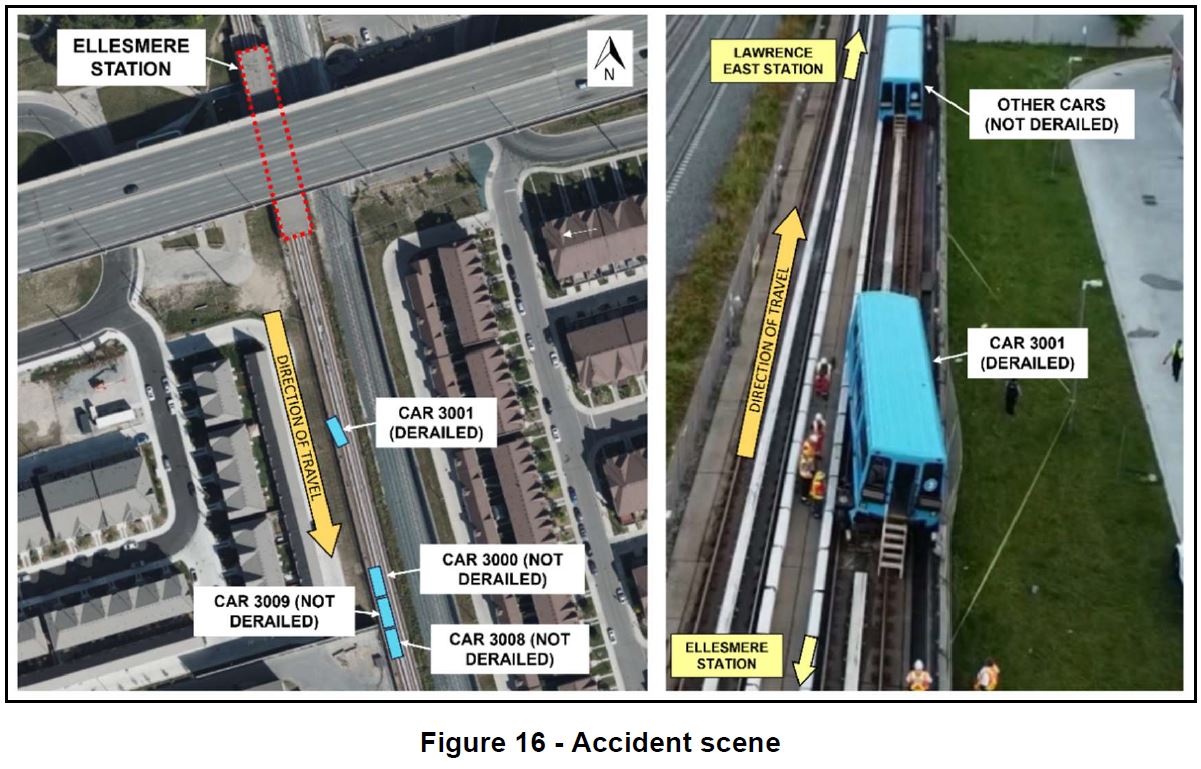
Back in September 2023, TTC management presented an overview of the investigation into the July 24, 2023 accident that marked the end of the SRT’s life. See also my article Line 3 SRT Replacement Service and Derailment Investigation.
At the time, detailed reports from the technical investigation were supposed to appear in “a few weeks”, but there has not been any public presentation of this material to the TTC Board.
To my surprise while hunting down reports about the Scarborough RT busway, I found the derailment investigation reports well hidden on the TTC’s site. To see them, you have to:
- Go to the Projects and Plans page which is accessed through a footer menu on every TTC page. Yes, right down at the bottom.
- Scroll down to The Future of of TTC’s Line 3 Scarborough (SRT).
- Click on View Details.
- Scroll down within that page to News Releases, Reports & Community Updates
- Open that section and scroll down to November 16, 2023 (there is also one report listed under December 11, 2023)
Here you will find links to the following reports (which I provide here to save you the bother of chasing through the path above). The dates of the reports are shown together with those for earlier drafts in the change logs, where present.
- Consultant Report – Gannett Fleming SRT Derailment – Ellesmere Station – Forensic Assessment Report
- Dated October 12, 2023 (First Draft was dated July 26)
- Also includes a report on concrete testing and metallurgical analysis of track bolts
- Consultant Report – Hatch LTK, Scarborough Rapid Transit (SRT) Vehicle Accident Investigation Report
- Dated September 28, 2023
- Consultant Report – Network Rail Consulting, Car Derailment Investigation on the SRT System within the TTC Network
- Dated August 23, 2023
- Consultant Report – Systra Canada – Independent Review – Report SRT Line 3 Incident
- Dated November 30, 2023 (Original version was dated October 10)
There is a lot of reading here, but the reports are more thorough and informative than the brief TTC overview since the accident. An important distinction the reports reveal is the degree to which identified issues were not at the single derailment site, but common to other parts of the line and to TTC maintenance practices.
Various reviews concluded that the problem lay with the reaction rail mounts and the ability of segments of this rail to move due to forces from the linear induction motors (LIM) on the SRT trains. Several factors contributed to this including:
- The inherent tight clearances of the LIM design,
- variations and errors in the selection and installation of reaction rail supports and rail components,
- an inspection scheme that underrated the severity of problems and the necessity for prompt repairs,
- the difficulty of inspecting reaction rail mounting hardware, and
- the need for training of inspection and maintenance staff so that they understand the behaviour of track systems and the failure modes that they must prevent.
Of particular concern is that a reaction rail defect was reported two weeks before the accident at the derailment site, but it was assigned a low priority in the maintenance hierarchy likely because the severity of the problem was not understood.
There are lessons here for maintenance practices in general and I cannot help thinking that the recent detailed review of subway track geometry, resulting slow orders and repairs is partly in response to the problems discovered on the SRT.
I know that readers will not have time to plough through the full reports, but they contain details beyond what I have included here for those who are interested. This article is a summary of the main points together with an introduction to the SRT propulsion technology to put the other material into context.
 Steve Munro