
Budget season brings some of the more extreme and ill-informed statements from the Poo-Bahs who govern our fair city. For the benefit of those unfamiliar with the Gilbert & Sullivan operatta “The Mikado”, the Oxford Dictionary defines the name/term thus:
A person having much influence or holding many offices at the same time, especially one perceived as pompously self-important.
Throughout the development of the TTC Operating Budget, a central question has been that of projected ridership and the service it will require. The accept wisdom goes roughly like this:
- We expected lots and lots of new riders in 2016, but we aimed rather high, a “stretch target” as CEO Andy Byford described it.
- They didn’t all show up. This led to a shortfall both in ridership and in revenue compared to the original 2016 budget.
- Service improvements were planned for fall 2016 based on the target numbers, but as there are fewer riders, the improvements were not required.
- Ridership for 2017 is projected to be only barely above 2016 levels, and the service operating in fall 2016 is adequate to handle the demand.
- There is no provision in the 2017 budget for service increases beyond the full-year effect of changes made partway through 2016.
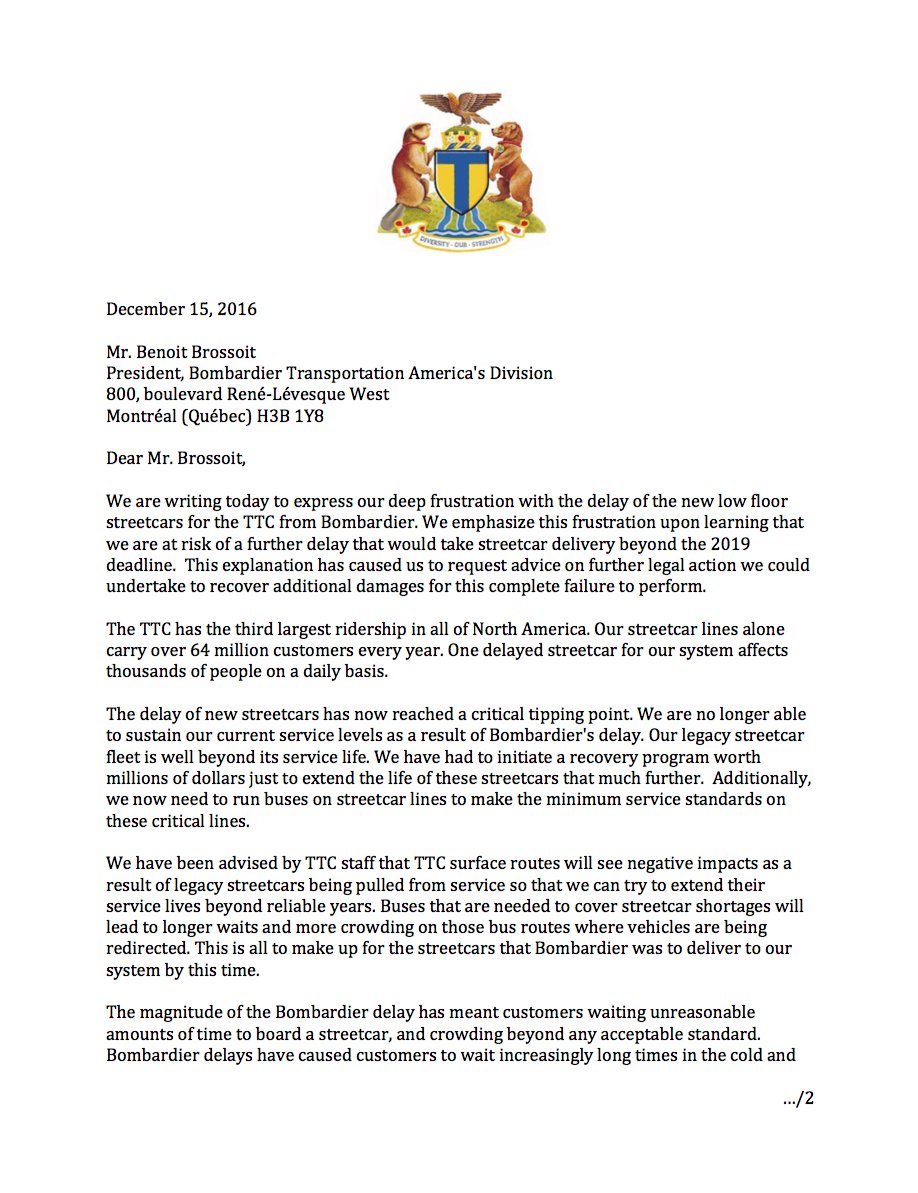
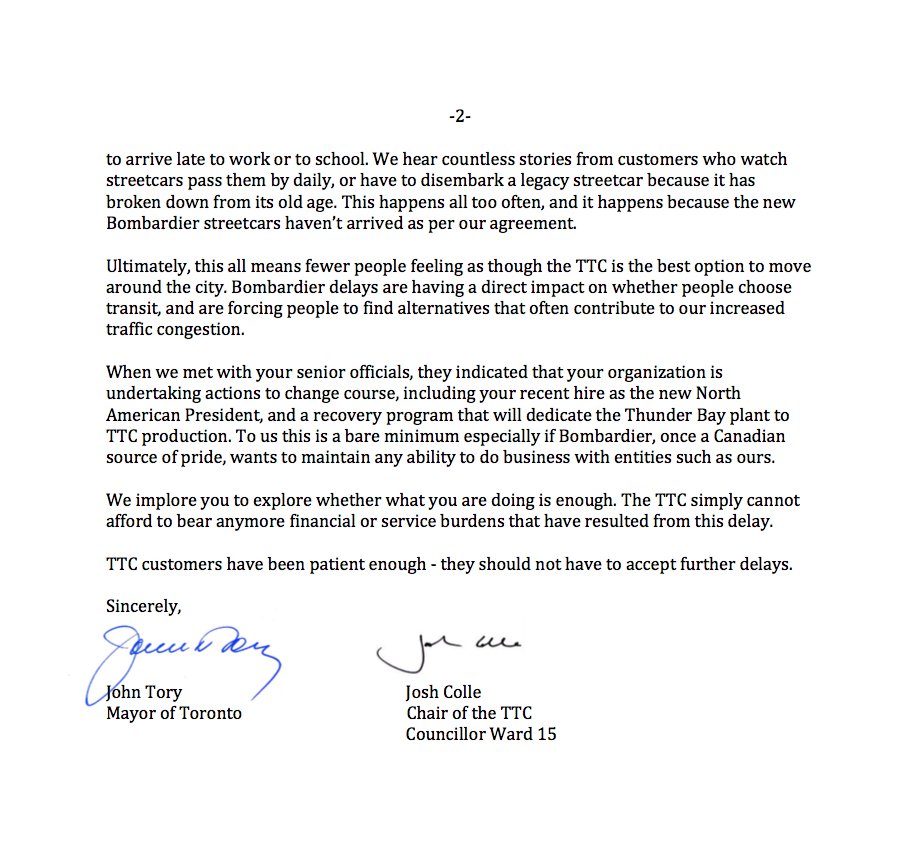
All of this is quite plausible, but it runs headlong into conflicts with other factors. The most recent of these is a letter from Mayor Tory and TTC Chair Josh Colle to Bombardier complaining about the late delivery of streetcars.
Crowding, What Crowding?
This letter informs us that the quality of TTC service is affected by the availability of the streetcar fleet, and in turn, of the bus fleet which has been partly diverted to serve streetcar routes. The letter is quite clear in saying that crowding results from diversion of buses to the streetcar routes, and from a lack of reliable streetcars.
That is not the same thing as “we don’t need any more service because there isn’t enough demand”. Indeed, even if the TTC had a larger reliable fleet, it would have no money in the 2017 budget, nor available headcount (i.e. authority to hire more drivers) to bring these vehicles out onto the street. The vehicle shortage and Bombardier’s late deliveries are actually helping the TTC and Mayor Tory impose his limits on service expansion. Without them, he would have an embarrassment of idle vehicles.
We have seen this problem at the TTC before where attempts to improve service (the Ridership Growth Strategy under Mayor Miller) were thwarted by a shortage of vehicles and operators. TTC management plans to bring an updated RGS to their Board in January 2017, but unless both the Board and City Council approve funding and staff, nothing can happen during 2017 except by shuffling service from one route or time period to another. This is “fine tuning”, an exercise in “efficiencies”, not a commitment to a broad-based improvement in service.
If routes are overcrowded, the first thing the TTC owes everyone is a detailed list of when and where this is taking place. How many buses and streetcars are we really short of requirements, and if they were available, what would be the budgetary effect simply of getting up to the service standard set by the Board? If we are already at this standard, how can Tory and Colle claim that crowding is the result of a vehicle shortage?
One big problem with crowding is that, beyond a certain point, it does not really measure demand. How many people could not get on because a bus was full? How many people gave up and walked or hailed a cab because their streetcar never showed up?
Budget hawks whose attitude to transit roughly equates to “there’s always room for one more on the roof” ignore this problem of latent demand and abandoned attempts to ride the TTC. They would rather talk about how there must be even more money the TTC can wring from its operations to avoid higher subsidies. They don’t see the taxicabs trolling major routes for fares whenever there is a gap in service (they’re not hard to find) and picking off would-be TTC customers.
How Is The Bus Fleet Used?
An important starting point is an understanding of the way the bus fleet provides supplementary service for a variety of reasons. First and most obvious in this context is the use of buses to replace streetcars. In January 2017, the peak number of buses operating on streetcar routes will be:
- 501 Queen: 23
- 502 Downtowner: 9
- 503 Kingston Road Tripper: 7
- 504 King: 12
- 511 Bathurst: 17
- Total: 68
In the case of 501 Queen, the number of buses is driven by the need to break the line at Roncesvalles for construction. If not for this project, it is unclear just how many streetcars would actually have to come off of the route to fit with maintenance needs of the old cars.
By comparison, the number of extra buses required to deal with construction delays for the Eglinton-Crosstown project are:
- 34 Eglinton East & 100 Flemingdon Park: 4 (net due to route reconfiguration)
- 51 Leslie: 1
- 54 Lawrence East: 2
- 56 Leaside: 1
- 32 Eglinton West: 3
- 33 Forest Hill: 1
- 90 Vaughan: -1
- Service Relief Buses: 3
- Total: 14
Many other routes such as 7 Bathurst and 29 Dufferin are affected by Crosstown construction, but the schedule adjustments have simply stretched the existing service over longer trip times (and hence wider headways between buses). This increases crowding because the number of buses per hour past any point is reduced.
Other projects such as the Spadina subway extension, the Renforth Gateway, the Six Points, not to mention the shortage of working trains for the SRT also contribute to the total of extra buses on various routes, but not at the scale caused by the streetcar shortage.
Another way that the available bus fleet is reduced is a change in maintenance requirements. For the January 2017 schedules, 20 buses have been cut from peak service to increase the pool available for maintenance. Affected routes are:
- Bay – 2
- Eglinton W – 2
- Glencairn – 1
- Highland Creek – 1
- Leslie – 1
- Markham Rd – 2
- Martin Grove – 1
- McCowan – 1
- McCowan N – 1
- Scarborough Rocket – 1
- Service Relief – 1
- Sheppard E – 3
- Shorncliffe – 1
- West Mall – 2
According to the TTC, all of these routes will remain within the official crowding standards even with fewer buses. I leave it to riders to comment on whether there actually is any room to spare on these routes today.
Another matter is the question of service reliability which has been examined many times on this site. Vehicles commonly operate in pairs (or only a few minutes apart) with the result that the average condition seen by most riders is the crowded first vehicle, not its roomy follower. TTC stats might report that service meets standards on average, but most riders are not on an “average” bus or streetcar. This is a long-standing problem with Toronto’s transit service about which the TTC does next to nothing if actual conditions on major routes are any indication.
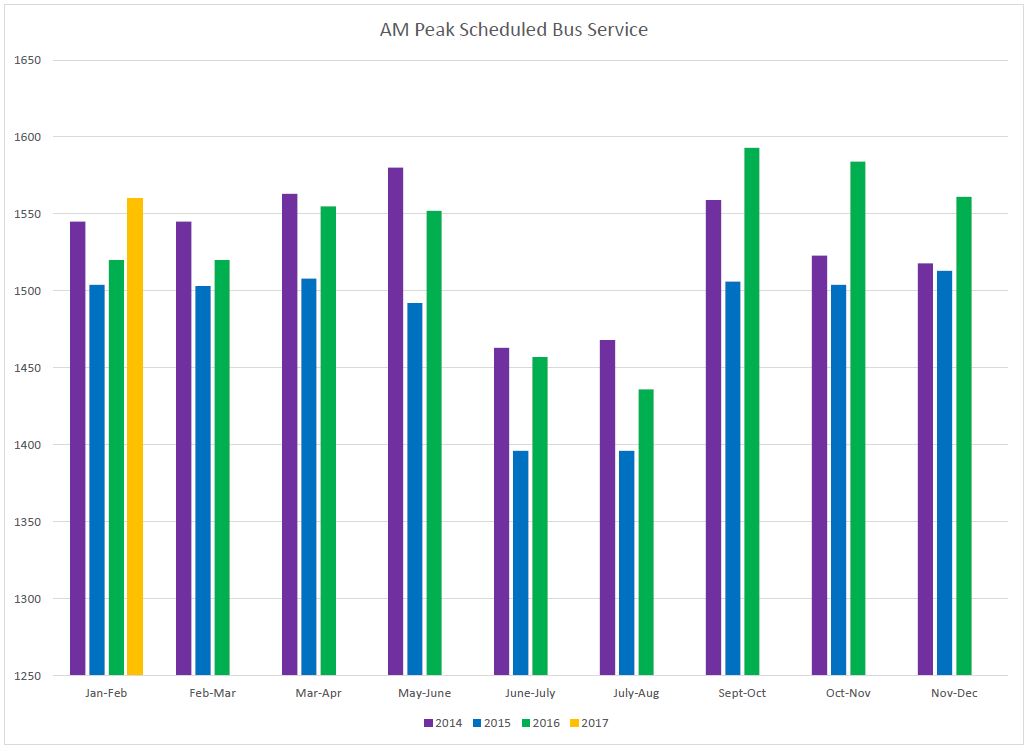
Finally, it is worth looking at the scheduled service over recent years.
- The drop in scheduled buses between 2014 and 2015 results from the introduction of larger 18m vehicles which displaced the regular 12m buses on a 3:2 ratio on affected routes (roughly equivalent to a 60 bus reduction). The effect had largely worked its way into the schedules by fall 2014, and so the difference between 2014 and 2015 is not as marked later in the year.
- 2016 saw the introduction of vehicles from the order delivered in 2015, although the rise in scheduled vehicles is considerably lower than the size of the order. Based on a 105 bus order, one would expect about 88 more scheduled vehicles for 20% spares. This level of change is visible only in fall 2016, and service cuts plus redirection of buses to streetcar routes have undone much of the benefit. These are the new buses announced in the Tory/Colle press conference early in 2015.
- The peak scheduled bus count in January 2017 is the same as in November-December 2016. It is only 3.7% higher (56 buses) than the count in January 2015.
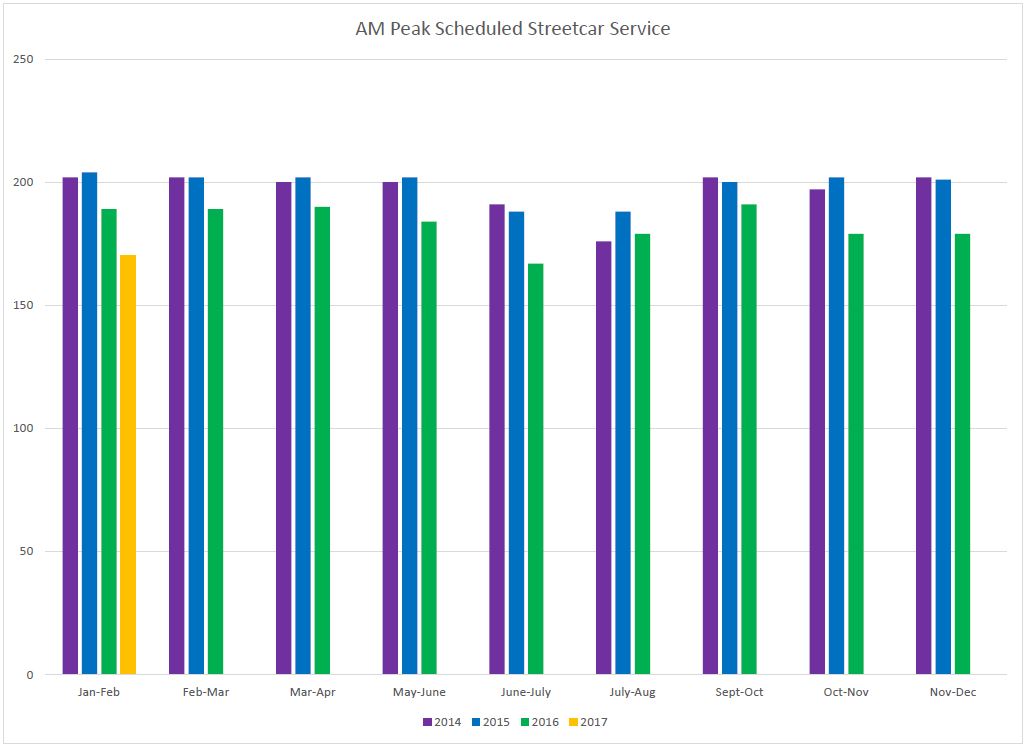
As for the streetcar service, the number of peak vehicles stayed fairly constant until 2016 when it began to drop. A small part of this is due to the introduction of larger vehicles on 510 Spadina which now has fewer new Flexitys serving it than in its days with CLRVs. The main reason for the drop is withdrawal of streetcars from service for maintenance and reliability.
In summary, yes, the TTC bought new buses early in the Tory administration, but the full increase in fleet was only briefly seen on the street, and this has now been reduced by a combination of service cutbacks and redeployment of buses to streetcar lines.
John Tory Discovers Service Shortage
During his election campaign, John Tory’s position was that everything was just fine with transit service, that more buses or streetcars were not a solution to anything, and that his SmartTrack plan would solve every problem. It was a very big chicken that would fill every available pot.
Today, SmartTrack consists of six new GO Transit stations that will be built on the City’s dime, plus the western extension of the Eglinton-Crosstown LRT to Renforth Gateway and, maybe, to Pearson Airport if someone else will pay for that part of the route. Gone is the surface-subway frequency of trains from Markham to Mississauga and all that this would imply for a transformation of the rapid transit network. Gone is a service that might carry hundreds of thousands of riders daily. All that remains is election souvenirs and the signature SmartTrack colours.
Shortly after taking office, Mayor Tory and Chair Josh Colle held a press conference to announce that, goodness gracious, the “previous administration” had made unconscionable cuts to the TTC and taken service away from people who really needed it. This about-face compared to his election stance was a pleasant surprise, but it brought nowhere near the resources one might expect to see on the transit system. A promised investment of $95 million turned out to be roughly half that amount once other cuts to the TTC’s budget were taken into account. The TTC is buying new buses ostensibly for more service, but does not have the budgeted resources to operate them.
On the heaviest streetcar line, 504 King, the TTC talks about adding more capacity by running buses on the route, but in fact the buses only barely offset the capacity lost because streetcars have been removed. The capacity actually provided on King has not changed in years, and even this is subject to periodic disruption for events where transit takes a back seat to other civic priorities.
Meanwhile in Thunder Bay
Lest all of this appear to be an anti-Tory rant, Bombardier is no saint in this story either. They have been promising new cars but failing to deliver for a long time, and as TTC CEO Andy Byford says, “we have more schedules than streetcars”. The mess with fleet availability can be traced directly to the delays in manufacturing the new cars thanks to quality control problems that have been well documented elsewhere. The fact that the TTC is now seeing several new cars in a short period is good news (the planned 30th car is enroute to Toronto as I write this), and Bombardier will hit its oft-revised target for the end of 2016. We will, however, still be 70 cars short of where we expected to be by this time. Forty more cars are expected in 2017, but the system will still depend overwhelmingly on the remaining fleet of old cars.
The CLRV fleet (the single section cars) dates from 1977-81 while the ALRV fleet (two-section cars) were delivered in 1987-89. The CLRVs are well beyond the normal 30-year retirement age for a rail vehicle, and the ALRVs would wave their farewells in the next few years. Instead, the TTC shops are working to rebuild enough cars to keep some of the fleet in reliable shape while awaiting the rest of the Bombardier Flexitys.
According to CTV News:
In 2018, Bombardier says it will provide 76 new streetcars to the TTC and 58 in 2019. TTC staff says that works out to a rate of approximately one car every 3.3 days in 2018 and one every 4.4 days in 2019.
In his response, Bombardier Transportation Americas President Benoît Brossoit says the company has “doubled our production output over the last three months.”
“Based on these results we are fully confident that we will meet our commitment to deliver an additional 40 new streetcars in 2017 and all 204 by the end of 2019.”
He said that understand the company “may have failed to meet your expectations” but added that the slow delivery of streetcars “does not reflect the type of company Bombardier is around the world.”
That is a stunning understatement. Bombardier Transportation is headquartered in Berlin, and grew by amassing various European carbuilders along with their designs and expertise. The new Toronto streetcars are an offshoot of a design first unveiled for Berlin’s system. (Yes, gentle reader, they do have streetcars in Europe despite the best efforts of trolls on this side of the pond to claim otherwise.)
When Toronto first looked at replacement streetcars a decade ago, their first target was a vehicle with a low centre section (about 70% of the car) and two high-floor end sections. (A mockup based on Bombardier’s design for Minneapolis was displayed at Dundas Square in mid-2007.) This would have provided accessibility to a limited part of the car, but at the expense of internal circulation problems thanks to having two separate floor heights. When the Berlin 100% low floor design came along, the TTC switched direction. That change cost some time early in the project, and this was compounded by the failure to get an acceptable bid in the first round.
By the time a second round was in, only two bidders remained (Bombardier and Siemens), and Bombardier’s price was much lower than Siemens’. The contract went to Bombardier in mid-2009, and at that point completion was scheduled for mid-2018. After three prototypes, the first production vehicle was to arrive in 2012. This would allow a comparatively relaxed production rate over six years, but production delays have compressed this to a much shorter period even with the end date now in 2019. Even the 40 cars for 2017 is a rate only one third above the originally planned 30/year and this will leave 134 to be delivered in 2018 and 2019, more than double the originally planned rate.
Bombardier builds a range of vehicles over the entire rail spectrum, and wouldn’t have arrived at this position by failing to deliver on their contracts. Indeed, even in Toronto, Bombardier has churned out subway cars for years with some teething problems, but no reason to expect they were incapable of delivery. This history makes the streetcar problems even more troublesome because they were so unexpected, and they came at a time when the company was preoccupied with the survival of its aircraft business.
Bombardier has reorganized its production capacity not just for the TTC order, but for cars destined to Metrolinx LRT lines as well as Kitchener-Waterloo’s ION LRT. Plants in both Kingston, Ontario and La Pocatière, Québec have become part of the LRV manufacturing process. The overall status of delivery schedules for orders beyond the TTC remains a mystery.
Will Huffing and Puffing Get Toronto More Service?
Mayor Tory’s letter to Bombardier is timed intriguingly to land just before the City’s Budget Committee will review TTC financial plans for 2017, and during a period when demands for better service are commonly heard. If anything, this is a diversionary tactic to say “we couldn’t run more service even if we wanted to” and thereby avoid any debate over funding transit improvements. This could well pre-empt even a discussion of what might be needed and what could be done, a typical Toronto transit situation where any real discussion of improvements is sandbagged. Meanwhile, fantasies of new subway lines dance in Councillors’ heads at a cost both directly in borrowing and debt service, and indirectly in the works that never get off of the drawing board for lack of funding.
Holding down property taxes is a holy grail to the Mayor who insists on across the board cuts to spending even when the effect is to undo many of his own promises.
All of Toronto’s (and Ontario’s) capital spending on transit puts the City and the TTC on the verge of substantial increases in operating costs for day-to-day service. Rapid transit is more expensive to operate than the bus routes it replaces, and higher frequency trunk lines attract more riding on feeder routes. Any fare consolidation with GO Transit under the rubric of “SmartTrack” or “Regional Integration” will almost certainly mean additional subsidies for Toronto’s riders. Will these costs be borne from City revenues, or will riders pay for them with higher fares and service cuts? This is vital financial planning, but the area has been utterly ignored by Toronto’s politicians for years.
Recently, Mayor Tory has taken a new, combative position saying, in effect, that nobody before him on Council lifted a finger to improve transit. This is a remnant of “SmartTrack as cure-all” from his campaign days, and it does much disservice to those who fought through the Ford years to limit the damage to the transit system. Those who fight the good fight do not always win, but that failure is far different from inaction, and just keeping issues in the public eye has long-term benefits when political winds change.
The real issue before Council with the 2017 budget is that transit needs better funding, and that there are serious questions about the adequacy of transit service. Trying to shift all of the blame to Bombardier denies the very real problem that service out there on the street is not meeting riders’ expectations and needs.
A productive discussion would find out just how badly behind those needs the TTC really is and work out a way to solve this problem. That would make a great start for a re-election campaign in 2018. Making transit work better now, not in a decade’s time.
But instead, we will hear all about saving precious taxpayers dollars, building new subway lines, and nothing about improving the transit service riders face every day.
 Steve Munro
With the TTC being underfunded for decades, we get the result from that. Breakdowns, vehicle shortages, overcrowding, and very long delays in constructing the needed transit infrastructures (plural).
LikeLike
I noticed something in the last 2-3 months not previously evident. Almost every day I see people, often more than one, who don’t know where the bus goes, where some big place is etc. It is therefore obvious they are new riders.
I also see heavily loaded, often SOR (Standing Room Only) on routes I use regularly.
So much for lost ridership.
Dry roads with no construction or other causes for delay, between rush hours and STILL the TTC cannot run buses On Time. Erratic service is often “normal”. Lack of On Street supervision adds to the problem.
Don’t even get me started on Dumb Track”.
LikeLike
That may be true but I don’t think that we can afford to spend more on transit when we have so many other pressing issues. We have too much crime, too few police officers, our police officers are not paid enough, Status of Women Canada is chronically underfunded, Women’s College Hospital is underfunded and there is only one women’s hospital in all of Ontario which is unacceptable given that there are over seven million women in Ontario, our native reserves don’t have clean drinking water, etc. I think that more money should go to our brave police officers, to promote gender equality and women’s health causes, and to improve the conditions of our native people rather than giving more money to the TTC which will always keep asking for more and more handouts.
Steve: The issue here is that Tory talks a good line about supporting transit, but does not deliver. Some of the organizations you list, notably in health care and in native affairs, have nothing to do with the Toronto budget, although they likely share the same problem of hearing more announcements than real funding.
If you really don’t want to spend more on transit, fine, that’s your position, but don’t complain when the bus doesn’t show up, or is too crowded.
LikeLiked by 1 person
Speaking of that Minneapolis order, were there not also delays in the project with roots in the Mexican plant?
LikeLike
Steve, a simple question … with the shortage of streetcars, closing of sections of lines 1, 2, 3, or 4 on many weekends over the year, and emergency closing of the subway (due to just about anything), buses have been used in all situations to ease the passenger flow problems. This has got to bring down the life term of the vehicles involved!! What can be done to help this situation and have I got this right???
Steve: Those events will run up more mileage, but relative to the fleet overall not a huge amount. In the case of streetcar substitutions, these are buses that, in theory anyhow, would otherwise be running on bus routes.
LikeLike
Hope the TTC ridership will regain after the 501 Queen watermain diversion ended.
LikeLike
Toronto’s Achilles’ Heel is the inability of politicians to persuade the owners of single family houses that a sharp increase in property taxes is needed to allow Toronto to function in a sustainable fashion. Toronto taxes are significantly lower than those in other parts of the GTA.
LikeLike
In other words, even if TTC got another bus garage or a temp garage, it wouldn’t be a good enough justification to increase service. TTC can cross the temp garage off the list and just wait for McNicoll garage.
If ridership goes up in 2017, will the service improvement that was suppose to kick in Sept 2016, be funded for or available in 2017? Or is that not even in the budget anymore? I’m sure the stretch target in 2016 will be reached in 2017.
I guess that means the new buses coming in will be the one-to-one replacement, due to the lack of yard space.
Steve: There are no plans for service improvements in 2017, although some may come right at the end of the year concurrently with the Spadina extension opening. The TTC has just purchased land adjacent to Malvern Garage and so they will be able to store more buses there.
LikeLike
I agree with StefanM that Toronto needs a Property Tax increase and that the current amounts are too low. However, I would like to add some comments about this complex issue. A background paper that is really helpful is the excellent presentation prepared by Torontoist called “How Property Taxes Work”.
This is a far more detailed and accurate presentation than the simplistic and inaccurate Toronto Star “Feature” stories that have done so much to spread misinformation and misunderstanding.
When looking at whether Toronto Taxes really are too low there are several points that have to be examined.
1. Tax increases were frozen for four years (three times by Lastman, once by Ford) since the inception of the megacity. Since there was inflation in those years of between 2 and 3%, the effective property tax rate in Toronto in now 8-12% below the level at the start of the mega-city.
2. Dense urban cities are more efficient than sprawling suburbs. For a given number of residents the cost of services such as snow clearing, road maintenance, water, sewers and others are cheaper due to a denser population. On the other hand, social services such as homeless shelters may be more expensive as those who need these supports tend to gravitate towards the City. The net effect may be that living in the City has an efficiency that naturally results in lower rates.
3. The big misunderstanding – perpetuated by The Star – is that the mil (multiplier) rate is a valid way to compare tax rates. It is not at all accurate to compare mil rates to determine who has the highest property tax, though this is what is often done. Property tax is a tax for services and capital assets needed to run the City. It most definitely is not a wealth tax. For the most part, comparing the tax paid for a $500,000 house in Toronto and elsewhere is a meaningless exercise. There are exceptions at Toronto’s borders – if for example two more or less identical houses are on either side Steeles. However, in most cases the comparison is misleading.
The mil rate is a calculated result of the the amount that politicians wish to raise from property tax divided by the assessed value of the collective property in a community. Toronto’s mil rate is lower primarily because of two circumstances. The general value of similar properties is higher in the City and there are a large number of very high value properties. (e.g.. Rosedale, Forest Hill, Bridal Path etc.) and very high value commercial property (TD Centre, Eaton Centre etc.) However, the Commercial Property contribution was historically unfair and is changing – and I will comment below.
When comparing two properties in different jurisdictions, it is important to compare two properties with similar characteristics (i.e. two bedroom townhouse) rather than two properties that are different but have similar assessed value. (I.e. $500,000 2 bedroom townhouse vs. $500,000 three bedroom bungalow).
3. Toronto residential Property Taxes have been historically too low because there was an unfair distribution of the burden between Commercial Property Tax and Residential Property Tax. Toronto Council has recognised this inequity and we are most of the way through a rebalancing. However, what will not be corrected is the fact that rental properties – of which there are a lot in Toronto – are considered to be Commercial Properties. Landlords aren’t stupid – they simply pass the inflated cost per dwelling unit along to the tenants. Toronto is a landlord’s (seller’s) market) and tenants have no power to resist. This is unfair and won’t change.
However, gradually, the inequity between Commercial and Residential rates is diminishing. This will help with another of our City issues – maintaining employment in the 416. (It is another issue, but we must not let Toronto become a “playground for the 905” and force those of us who live here to commute to the 905 for a job.)
Steve: Queen’s Park has just imposed a freeze on Residential Commercial taxes so the effect will be that these start to drop in 2017 relative to other property classes. It will take some time for them to fall to the same rate as single family housing, and there will still be the question of the assessed value of, say, a two-bedoom apartment vs a comparable condo or house. The inherent value of a commercial building is the rental revenue stream less the cost of operation and upkeep.
4. The Province continues to monopolise tax headroom not available to Toronto through the education tax. Mike Harris – as part of his war on Toronto – rejigged the education taxes across the province. He uploaded top level management for education to the Provincial level and appropriated the education portion of the Property Tax. That has not been changed despite the fact that two Liberal Regimes have intervened.
The Province imposed a Mil Rate that is the same for all of Ontario. This means that a Toronto Property (with a high value) pays much more for education than a similar Windsor or Kingston property (with a lower value). By similar property I mean for example, two three bedroom bungalows. To a lesser extent it also means that Toronto taxpayers are paying education tax at a higher rate than those of Oshawa or Burlington – but it must also be pointed out that Oshawa and Burlington are paying more than their counterparts in Windsor or Kingston. The inequity applies in varying degrees to the whole GTAH (and Ottawa).
Education is also supposed to be a “service” tax, but it has been transformed into a “wealth” tax. However, Assessed value is not a genuine measure of wealth. GTAH families devote more of their disposable income to paying for their homes – because these homes cost relatively more. The Province rewards these same families with a higher level of taxation – despite the fact that these families have relatively less income outside of housing costs.
The Province then imposed a funding formula on schools so that old urban schools would be relatively penalised compare to more modern suburban schools. Coupled with increased costs for special urban educational needs, the net effect was that Toronto schools receive much less. The Province sends the “excess” Education Taxes that it collects in Toronto elsewhere.
This whole problem ties back to the municipal tax rate. When Toronto citizens are paying excess education taxes that are used to subsidise other communities as part of their property tax burden, the opportunity for the City to raise the municipal portion of the property tax is diminished.
Once the education overpayment portion of a total Toronto property tax is factored in, the overall tax is significantly increased and not as far under the tax for other municipalities.
LikeLiked by 1 person
There’s no photo ops with the operational budgets. Especially, if the streetcar just arriving is short-turning.
We need more operational subsidies from the city, province, and feds, especially year-to-year sustained subsidies.
LikeLike
I think the letter to Bombardier is intended to keep pressure on Bombardier so that they don’t divert resources to the Metrolinx LRT order. The TTC doesn’t have a choice: they need those streetcars and Bombardier is the only company that can produce them because they’re the only company with the parts and designs readily available for building TTC gauge vehicles. Metrolinx’s order is for standard gauge vehicles, so they can potentially buy their vehicles off-the-shelf from other companies or even use used vehicles temporarily. As such, it is in Bombardier’s best interest to divert their resources from TTC’s vehicles to Metrolinx’s vehicles because Metrolinx is most able to walk away (in fact, they probably should. I don’t think low-floor vehicles are necessarily the best choice for the new LRT lines anyway). The letter is just a warning to Bombardier not to do that by suggesting there are grounds for suing for financial losses.
Steve: But if the claim of losses is based on something that is not true, or even an argument that contradicts claims by the speaker, it won’t get very far.
LikeLike
Hi Steve,
In light of these budget considerations, what is your opinion on the newly approved expressway tolls? Do you actually think those will make any difference to transit funding? Or, even assuming the whole story pans out as promised (which I sincerely doubt), will this revenue just be used an excuse to cut City funding to the TTC even further?
I think the tolls are a terrible idea because
1) The tolling system will take longer and more money to implement than advertised, and will probably cost more to operate than is claimed (one doesn’t need to be a fortune teller to conclude that this is probable – it’s the case with something like 80% of such City projects).
2) No new transit has been built to provide a further alternative to the expressways, nor will any be available once the tolls are implemented, nor will any come online in the immediate future after that – meanwhile existing transit is running at – or over – full capacity during rush hour.
3) The amount of money that it will bring in will likely be lower than advertised, as some % of drivers choose local streets and trunk roads instead of the expressways.
4) That brings us to what I think is the major sticking point – since this is not a congestion charge for an entire part of the city, but only a highway toll, all we will really see (considering there is no new transit) is shifting of traffic – e.g. more congestion on Lakeshore Blvd. Also, some people will try to move to transit, creating more congestion (if that’s even possible) at peak hours. I presume most of those who try transit as an alternative will then go back to sitting in traffic on Lakeshore, because at least you’re not overcrowded in your car.
5) There is no guarantee that the money will be used to funding transit. OK, Tory might do it, but some next mayor may use the money for some pet project of his.
6) As noted in an article in the Torontoist, once the Gardiner is a “profit centre”, no city administration will ever get rid of it i.e. vote to tear it down. In fact, some people might get the idea that building more toll expressways is an attractive proposition.
7) If tolls prove unpopular (they will with % of the population, so depending on how big and vocal that % is), some future administration might reduce the toll to the level needed to maintain the expressways and put a small profit in the city coffers, effectively killing any idea that tolls will fund transit.
8) Even if there is no “voter uprising” over tolls, future mayors may use the toll revenue as an excuse to reduce/not increase the subsidy to the TTC. I can already imagine councillors yelling “you get XYZ million per year from the Gardiner and the DVP, what else do you want??”
Am I missing some silver lining, somewhere?
Steve: I agree with a lot of what you’re talking about here. There are a few big ticket items that will always compete with transit for funding even though, in theory, funding expressway capital projects through tolls would free up money for transit. What we still don’t see is a move away from parochial transit projects and especially we don’t see better funding for day-to-day operations.
Your distinction between tolls as proposed and congestion charges is a good one because a real attempt to address congestion would involve provision of significant improvements to transit overall.
LikeLike
I suspect that a better message to Bombardier than sending them a letter would be to call for bids on the 60 additional streetcars that the TTC will need.
I suspect that nobody can match the price from Bombardier to add on this option to the current order, but the chance at snatching this and future orders away from Bombardier may be enough to have other suppliers offer as good a price as is possible.
Given that adding 60 to the current order from Bombardier will not see the first of these until the current 204 are completed and delivered, I would be willing to bet that the time needed for another supplier to bid, the city to choose and sign, and production to begin, would have us taking delivery of some of the first few of the 60 even BEFORE we see the last of the 204 arrive on TTC property.
LikeLike
Steve, do you think an increase in the sales tax may be better than property tax since a significant number of TTC riders live outside of the city of Toronto?
Steve: If the City had the power to levy a sales tax, yes, definitely, but Queen’s Park has repeatedly (and recently) said that allowing Toronto to collect a sales tax is not happening.
LikeLike
Steve, this may seem like a stupid position politically, but given that Toronto, regularly acts like it cannot afford many things, would it not make the most sense to focus street cars on the routes that are most likely to yield the largest increase in development, and with the fewest transferring riders? Thus would not moving say 10 of the new cars to King not make the most sense, and run as many of the balance of the ALRVs as possible there?
Steve: Frankly, yes, it would make more sense to run the larger cars as soon as possible on King. However, to really have an effect they would have to replace existing vehicles 1:1 to increase capacity. Meanwhile, if Queen reverted officially to CLRVs, it would require more scheduled cars than at present, and that cost money the TTC does not want to spend.
Also in terms of route development, would not the idea of the East Bayfront LRT on this logic also make the most sense as the next large capital project for transit. This providing a substantial growth in tax base, for a relatively small capital outlay, create a relatively inexpensive to serve ridership, relatively small transferring ridership, a large portion of the small transferring ridership, being counter peak commuters? Also, given current services nearby, would these not also be relatively inexpensive additions for the city, in terms of all others services (road, sewer, recreation etc)? Should these not be at the core considerations for a city, that acts like it cannot afford required services to meet current demands?
Steve: The EBF LRT is long overdue, but has been screwed up by problems with the TTC’s underestimation of the cost to expand capacity at Union Station Loop, compounded with disappointment over the effective capacity of “LRT” in the new configuration on Queens Quay.
LikeLike
Is it possible that Bombardier stands to lose money on every Flexity they build for the TTC? Yes it is: They seem to have underbid in the first place; the Mexican problems must have been costly; and now inflation and higher interest rates appear on the horizon.
If that is the case, there is no capitalistic reason for Bombardier to build the 60, or, for that matter the remainder of the 204. Yes, there would be penalties and loss of face; but they may be considered the lesser evils at some point. Perhaps the TTC is already being victimized by The Stall.
Steve: Looking at Bombardier in a larger context, if they were to default on this contract they would effectively kill the future of their Thunder Bay operations and of government handouts to prop up the company generally.
LikeLike
Well said.
I never understood this mentality when the infrastructure is so far behind. Politicians in this City have choose to fight amongst each other over the scraps on the table rather than fight for a better future.
Tory as the “Leader” seems to be dipping his toe in the water, but if he isn’t strong enough to raise property taxes immediately then issue still remains. I’m not sold on the road tolls for many reasons but lets just hypothetically say it does became a successful revenue generator, when will that money even start to come in? The Political estimate is 2024 for so in reality we are at least 10 years away from any revenue whatsoever.
The extreme polarizing bickering and design corner cutting chaos is sure to continue.
Steve: Buried in the budget and not discussed at all thanks to the furor over tolls is a proposal to add 0.5% to the property tax annually for five years to go into Tory’s new capital fund. City staff have recommended that this be bumped to 1% annually for five years. The single family residential tax rate is proposed to go up 3.6% in 2017, not the 2% the Mayor claims. The reason is that 2% is only the basic property tax, not the add-ons and the effects of rebalancing residential and commercial property classes.
LikeLiked by 1 person
One solution for “not enough transit ” is to live closer to work. City planning should be based on that. Car pooling would also reduce the need for more roads and less transit.
Steve: Living close to work is an option that requires the income to support the choice. This is not available to many people, especially if they change jobs relatively often, or if their family holds multiple jobs in different locations.
LikeLike
Yes but it would also be a service improvement, and the question becomes are the cars packed on Queen with the existing service interval? Does the current service make Queen as desirable a place to build or own, and hence increase the tax base? This again goes back to being a skin flint to the point of cutting off your nose to spite your face.
PS – that is the city should be looking to be looking to provide services in areas where it is relatively inexpensive to do, and where it creates highly desirable neighborhoods, and funding the TTC accordingly. Create an increased tax take with minimum pain.
Steve: But you are assuming that the official story today is that we actually need more service. That only gets trotted out when complaining about late deliveries. If they were actually here, we wouldn’t be able to “justify” running them. Budget pressures, don’t ya know?
LikeLike
Thanks for this, and much else, Steven and commenters. It is a Big Mess; and how funny to hear about delays in service, when the west-end core has been waiting for decades for a real transit upgrade, and in Unbuilt Toronto there was a reference to the province thinking of doing transit in the Don Valley to alleviate Bloor/Yonge pressures only in the 1970s! (Maybe this was the GO line, but then why aren’t we thinking of doing more with this line for Yonge Relief?? If the answer is flooding, let’s start the work on the storm surges – 70% of peak Don flow is storm – by having driveway/asphalt taxes and raise money while helping solve a problem? Oh, that’s where lots of money lives, ably represented of course.
With the bold moves to think about tolling, the Province also ruled it out at the time of the Gardiner construction, correct? And the point about providing better transit ahead of tolls is absolutely relevant, which gets me back to a Front St. transitway, that I’d been harping on thru the years of anti-Front St. Extension fussings, only discovering c. year 4 that the DRL west of 1985 not only had the same general route, but the WWLRT EA had modelled out the time savings of a direct route vs. the milk run on the waterfront that gets so touted as “the Transit”. And now Gord and Mike are set on doing a new road (called new Liberty vs. Front St. to avoid the piecemealing charge), between Strachan and Dufferin on the same land the DRL West was to use. At least for the core area, it seems to make sense to me to focus on providing much better transit in to the dense core from the west end first, given the pinch point at the base of High Park, and the high volume of vehicles coming in from the west. And to be very out there, could we manage to provide enough superior transit that we could do away with the Gardiner as a corridor/freeway? Convert it to a large greenhouse or bikeway or housing as it’s the continual application of destructive salts that is the Main Problem for deterioration, and maybe it could be adaptively re-used with a less-intensive usage. The main supports are very good…
We alas, are lacking in both imagination and political will. The private cars are well taken care of, and we can’t even do a tiny token of user pay for their existences, which would be a larger sum, and readily done. Yes, the cars are at times costly to run and are very useful in lower-density areas especially, but having even half of the user pay of the transit could be a billion.
LikeLike
As Michael Greason pointed out in great detail, it’s not so simple. I can give you a very basic and common counter-argument: my 1900 sq ft, 3 bedroom house in East York cost me $500,000 in 2008. At that time, similarly sized houses in Pickering or Ajax were selling for around $300,000. So while it is true that I pay about $2000 less per year in property tax than a similar house in Durham, I had to shell out $200,000 more to buy my East York house. We may have lower property tax bills in Toronto, but our mortgage payments are much higher.
Steve: Also what you paid for the house has nothing to do with its assessed value today. Toronto housing may be assessed much higher than it once was, but is taxed to generate the same revenue before annual increases are taken into account.
LikeLike
To comment on Steve’s comment on comment by Malcolm N.
Attempting to rework the Union Loop, irrespective of cost, will shut the loop and 509 and 510 for years, as it did recently to reconstruct the Waterfront. A shut service is no service, no matter how attractive it might one day be.
Even now the loop bungs up, cars backed up, or too many riders. Why make it worse?
A better way is to route the EBF on the surface up Bay, and turn on King York Queen and Bay, or Front (in front of station) York Queen and Bay. This is much simpler than fiddling with the loop, is much less money, does not overwhelm the loop, and shuts down nothing.
Expanding the loop might be the prettiest solution, but placing EBF on the surface of Bay is far and away the most pragmatic. And looping It around the core reduces the numbers changing at Union.
And traffic – tell me, which flows faster – one congested lane or two congested lanes?
Steve: Putting the EBF on the surface would be a disaster for transit as there is no capacity in the surface streets.
LikeLike
The Flexity tram delivery delays can be traced to several themes. I am not saying who is right or wrong. One of them is that Canada do not represent a large transit market. If Canada orders say 100 trams per year, we could have the suppliers here instead of going to Mexico. We do not order enough transit vehicles to have a large supplier base here.
The Toronto contract has a x% Canadian content clause and stipulations on how much assembly must be done in Canada. Even if Mexican suppliers are not able to meet the standards, it is not like Bombardier can do to Derby, England to get parts. Bombardier has many facilities in Europe where Flexity trams are made in larger numbers. But, it would breach contract conditions if European parts were substituted. If there was no Canadian related clauses, they could have shipped parts from somewhere else or even assemble them in England for the matter to meet deadlines.
Finally, all products with international participation is subject to delay. The Boeing 787 Dreamliner used parts from many different countries and delivery was delayed by a minimum of 2 years. Companies do that to get R&D grants, location subsidies and tax breaks. But, it is getting ridiculous that a simple tram has so many parts from different parts of the world with different standards. It is a miracle that they all work together to make a functioning tram.
Bombardier did not handle the situation well. What they should have done for goodwill is to at least assist the TTC while deliveries are being delayed. They should have leased some other Flexities to the TTC so at least we have vehicles on the street. Sure, they have to be re gauged and the specs will not meet TTC standards, but it would be something. When the 787 was delayed, Boeing gave sweet lease deals on the 777 to affected customers. They should at least refurbished the CLRVs to save their image.
My wish is that Ontario will continue to invest in transit. This way, we will have production lines for EMUs, DMUs, coaches, trams and metros in Ontario all the time. It creates jobs and it is a good industrial policy to have.
Steve: An “off the shelf” Flexity will not work in TO even if regauged because they cannot handle the tight turns. Also, their electronics are engineered for higher voltage in general (750DC) than is available on the TTC. Substituting cars like this just to “help out” would be a major problem. Bombardier’s real screwup was their failure to deal with the issues in Mexico quickly and reliably.
LikeLike
RE MARK EARLEY’S SURFACE IDEA. In principle, I think he makes perfect sense! His loop doesn’t have to follow the streets he suggested, there are alternatives: eg. Wellington, Church, Victoria and Adelaide. As for the traffic in that area; at least some of it would be replaced, if there was consistent streetcar service on those streets. Or, we can all wait 25 years for a rebuilt loop.
LikeLike
Steve said: : Putting the EBF on the surface would be a disaster for transit as there is no capacity in the surface streets.
So me being a bit of a ‘roadical’, there is actually a partial surface option, the Gardiner! We could think of doing transit atop the Gardiner and it’d be possible to both insert stops (with some engineering/new uprights and cabling to carve out stops that are still above Lakeshore) and it just grazes the Union Staton area too. Another carve-through (some support) for an exit to EBF.
The other surface option is the Lakeshore. The bulk of the cars come from points west of High Park I think, so if we finally do superior/robust transit from the pinch point at High Park to the core, it’d be far far easier to really squeeze the car traffic, which takes a lot of space for the #s of people moved I think. It’d be nice to see a people-movement chart of Queen transit/cars, and King transit/cars, and GO trains and Gardiner cars/people and Lakeshore cars/people. As I don’t trust almost everyone around Caronto/Moronto now, maybe APTA could provide the integrity to data collection – no Webster effect or risk. With the Gardiner repair, how does it jibe with the Places to Grow Act 3.2.2 and 3.2.3??
https://www.placestogrow.ca/index.php?option=com_content&task=view&id=359&Itemid=12
Tunnelling through the soggy lakefill for stability and dryness in horizontal infrastructure ain’t smart, but why learn from our first effort? We need to bankrupt the system to fix it, and if the SSE doesn’t do it, plus Smart Trick, plus Gardiner (no transit), we could have yet another dog.
LikeLike
A corollary to this statement is “Once the road toll funding goes to transit, the subsidy from general funds will decrease to a level such that road toll revenue + new subsidy = old subsidy” That is, no overall benefit except to some other (non-transit) project.
There are a number of problems with a sales tax in Toronto only. (1) How do you handle on-line sales? (2) You could potentially drive bricks & mortar customers to neighbouring jurisdictions, especially for high cost items.(3) Potential high costs to business to implement an additional tax in some, but not all jurisdictions (4) Small business with locations in and out of the zone may not be able to cope with the cost and close the location in the zone (Toronto). (5) Is this a GST-style tax (charge at every step, but get rebates) or a PST-style (charge only enduser with exemptions for “middle men”). Either way it’s a headache.
LikeLike
Speaking of “not enough transit” and the 504 specifically, I have noticed services like the infamous San Francisco “tech buses” are cropping up in Toronto. We have had condo shuttles for some time, and the hospitals got in on this too. Now I see private office towers are doing it.
The SAS campus at King and Berkeley has a shuttle to ferry people to and from Union station. Today I noticed that the new Globe and Mail Centre across the street has a brand new shuttle doing the same thing. It is advertised on their website as a service running every 10 minutes all through the work day.
What is the limit of the legality of this? Can other office buildings do this? For example, could the TD Centre setup a shuttle running around downtown, or out from the Distillery back to Cityplace?
Steve: Anybody can run a bus provided it charges no fare and is for their own building’s occupants/clients.
LikeLiked by 1 person
Just to play devil’s advocate, and to further the premise that comparing property taxes is not a simple thing, don’t forget that if we assume both the East York and Durham residents are working in downtown Toronto, it is necessary to add the cost of the longer commute for the Durham resident to the equation.
For the sake of simplicity, let us assume that the added hard cost of travel is $10 per day and an extra 45 minutes each way, and let us assume a salary of $50k (which is just over $24 per hour), and 3 weeks vacation per year. I’ll also assume a leisure time value of 100%, though most of us value our leisure time more than our working time. This makes the extra cost per day for the Durham resident of $46, making the weekly cost $230, or $11,270 per 49 weeks of commuting.
The cost of saving $200,000 on a home in Durham is now at least $13,270 per year. With no accounting for inflation, the savings is used up in 15 years. Less, if one makes more, or the hard costs exceed $10 per day, or if one values their leisure time more.
Not a simple comparison, to be sure, especially when so many of us forget to put a value on the time we spend outside of work.
While I agree with point 5 about it being a headache, I’m not so sure about the doom and gloom predictions. I’m not saying that none of the other things mentioned would ever occur, but there is a distinct element of what I call “Ontario-itice” in these. This is the need to re-invent the wheel in Ontario (e.g.: ICTS), and if we actually decide not to re-invent the wheel, then we should at least act as if we are the first in the world to do something even though it’s been done before (e.g.: scramble pedestrian signals, HOT lanes).
Varying sales taxes is not a new thing, and occurs in many of the states. I have done shopping in the Greater Denver area where I found that shopping in a particular mall had me paying 7.5% sales tax and shopping at a store across the road resulted in 8.25%. That area can have three or four different sales taxes apply (state, county, transit region, and some other regionally-defined tax). It’s the county tax that tends to vary, but step outside the area covered by the transit tax, or the other one I can’t remember, and those (usually only 0.5%-1%) disappear.
As a vendor doing a hobby show in New York state, I had to sift my way through NYS’s tax department website to find out just how much sales tax I was to charge for the location of the show.
All I am saying here is that some sort of regional tax for transit is a complexity, but not likely to result in retail Armageddon. The stats are out there.
LikeLike
I had noticed this too. It’s quite obvious where the highest transit demand corridor is in the downtown and shoulder areas which again questions the city’s choices with respect to rapid transit planning in the core.
LikeLike
I think what we should be really concerned about, however, is that this represents a real expense to those office towers, and hence their tenants and the businesses running shuttles. This has a direct impact on the cost of doing business in Toronto. It is also important to note that congestion itself is a cost of doing business. Taxes are only one among very many costs, and when you focus too much on one, well you allow the others to run out of control.
Employers also locate on the ease of attracting employees, and ability to do business with suppliers and customers, and the amount of time lost doing so. The region and province need to get this front of mind. We clearly cannot serve the region by adding roads (because we could never build enough) but well, careful, focused and clear investments in transit can make a huge difference. These need to be such that transit can be most greatly improved for the broadest access, for the least relative cost. Ideally these investments should also reduce the cost per trip of transit. However invest the region must, or the cost of congestion will bury any tax saving we can hope to achieve. Delivering the biggest bang for the smallest buck, to keep the region as a whole moving forward.
The issue around private buses should not be a concern about them representing competition, but that any private provider feels them necessary. When a condo complex or office building feels they need a shuttle bus, in an area that is close to what would normally be a densely served transit area, there should be concern with regards to levels of service.
Steve: At the risk of sounding anti-transit, a shuttle from Union to the Globe’s building has the following advantage for people using it who, presumably, arrive at Union via GO Transit. (1) No need to transfer to and pay a TTC fare. (2) A direct run from Union to the Globe without having to walk up to King or use the subway for one stop, followed by the quixotic service on the 504 itself.
LikeLike
What I am really assuming, is that better service in areas, that are ready for redevelopment except the pesky issue of low service levels, where it would be relatively easy to increase said service, would be a substantial net positive for the city. That is, providing the service, in a relatively short period, would help with those pesky budget pressures.
Steve: Actually providing any new service will increase costs and will also raise the dreaded issue of added headcount. You are dealing with a Mayor and Councillors for whom rational arguments about transit as a “service” simply don’t hold water.
LikeLike
While I believe a local sales tax may be new in Canada (not totally sure), American states have had them for years. In California, for example, you have the state sales tax, and then counties can levy different sales taxes (or choose not to), and then cities can levy different sales taxes (or choose not to). In the computer age it would be easy to have a look-up table that would automatically apply the correct sales tax to online orders, for example. A 0.5% -1% increase would not be enough to divert much sales to other places except for cars, and in the US sales tax is assessed based on the registered location of the car and not the purchase place.
While it may not be an option at this time, I believe the many worthy competitors for property tax money and increasing public unrest from rapidly increasing rates (just reading about insane increases in Mississauga, for example) suggests that increasing property taxes will not be an option to get more funding for the TTC. Political question: why should residents of Toronto be forced to increase their subsidization of 905 and tourist TTC trips?
LikeLiked by 1 person
Yes, and why I am trying to couch them in terms of growing revenue and tax base. It is not that it would not increase cost, but the increase in tax base, and fares would more than offset. However, I get your point. If you refuse to see it as a service, you will not see how growth can be helped by it, and encouraged to areas that are cheaper to service.
LikeLike
The quixotic nature of service on 504, being the real issue in my mind. With really good service, the shuttle may or may not be required.
LikeLiked by 1 person
A few notes here. The Globe and Mail Centre is 17 floors and advertises 500,000 sq ft. of office space. Let’s make a ridiculously high estimate that this shuttle bus costs $250,000 per year, including capital costs, to operate. That’s only 4 cents per square foot per month. It’s a trivial amount to the tenants.
Also, I am not certain if you have seen it, but this is not like a school bus or something. It’s a high end vehicle, with very comfortable seats, and no doubt has free wi-fi and other amenities like overhead lights and charging ports. This is luxury transit. Even a 100% Flexity 504 won’t replace those creature comforts beyond the annoyance of transfers from Union.
LikeLike
In addition to the economic reality Steve mentioned, a static job is very rare these days. It’s not very easy for a family who may have more than one parent working in different areas and the children who grow up also need to start in the workforce and require effective access to the main job areas of the City as well. We need very well connected public transit.
If a parent living in the City’s lower income suburban area doesn’t carry a high paying job and lives close to their job that shouldn’t mean their kids should have to suffer through insufferable commutes to gain access to City’s main job areas. This City needs to build bridges and open up congestion for all residents. There is a strong myth based on “facts” that residents of our public transit desert suburbs don’t come downtown. It’s because the commute is unreasonable by all modes and most people can’t just move for many reason.
Carpooling is never going to take off with the majority as it’s not practical in reality. Hard to find more than one person on the exact same schedule working in the exact same area who leaves at the exact same time. And then you have to trust, rely on and like that person as well. Car pooling is nice in theory but is over advertised as an effective way for people to travel.
LikeLike
About TTC service to the new Globe and Mail building — I’d like to put in a plug for the humble 121 bus. G & M workers who are GO service riders could take the 121 bus from Union Station (southwest corner of Front and Bay) along the Esplanade to Front and Berkeley — the very doorstep of the Globe building! The service is good and it is never overcrowded. But how can it compete with a free private shuttle bus?
LikeLiked by 1 person
I like the 121 Front/Esplanade bus as a concept, and I’ve taken it a few times, mostly west of Yonge. Unfortunately the service can get erratic due to traffic around Skydome/ACC. The last time I took the 121 east from Bathurst, it was a long wait and we passed three westbound 121 buses before we got to Spadina.
LikeLike
Merry Christmas from Mississauga – it’s that time of the year again when we can already smell Spring just around the corner. I just wanted to say that we don’t care whether you build LRT or not but don’t expect Mississauga to pay for it. Toronto suggested that Mississauga pay for Eglinton Crosstown West LRT in Toronto – I will just say ‘Don’t build it if you don’t have the money to pay for it’ but don’t expect us to pay for YOUR projects.
Steve: The portion of the LRT Toronto is asking Mississauga to pay for is the chunk that is actually in Mississauga. You may recall that the original idea of SmartTrack was to improve transit access to the office district south of the Airport and, wait for it, in Mississauga. All that said, if we get substantial money from Ottawa via PTIF, who knows what may happen especially with a line serving a big federal property.
LikeLike
Yes, but the same system needs to offer them access to nearer options as well. It also needs to have the capacity to get them to the downtown, especially core. Hence there is a need to continue to increase the capacity into the core. However there is a need to build a grid, to make most of the job areas available from most of the city. Areas like the north east of Scarborough and the north west of Etobicoke should be accessible easily. The reason, I still think that something like Transit City (including the BRTs and not just the LRTs ) is a general direction required. The airport must be accessible, and the college and University Campuses, and hospitals, and not just from one direction. York needs to be accessible without going down to Bloor to get on Spadina, from say Lawrence and Vic Park, or Sheppard and Kipling. There needs to be lots of low, and mid capacity rapid transit along with subway. However in order to get the network we need we need (1) to tax intelligently, and (2) build what is required, not massively more capacity than needed and (3) be smart about the impacts at choke points of what we build.
LikeLike