
In a previous article, I wrote at length about the City of Toronto’s reports on the status of SmartTrack to be discussed at the October 20, 2015 meeting of the Executive Committee.
Two related items also deserve comment.
First up is an article in the Star by Tess Kalinowski in which she reveals that Metrolinx CEO, Bruce McCuaig, wrote to City Manager, Peter Wallace on October 6, over a week before the reports were posted on the Executive Committee Agenda. His letter said quite clearly that SmartTrack would only be an incremental upgrade of GO service, not a separate operation running on GO’s trackage.
“Metrolinx and the province believe that the (city report) should reflect the scenario where SmartTrack is an incremental increase in RER (regional express rail) service, rather than an independent and parallel service that co-exists with RER,” he wrote.
“The risk of creating unmet expectations is too great,” said McCuaig.
The letter also suggests the city stop referring to SmartTrack as a “surface subway” since federal rail regulations would prohibit TTC-style subway trains from operating on GO tracks.
The full text of the letter is not yet online, and it is notably absent from the Executive Committee agenda.
Updated October 19, 2015 at 11:45 am:
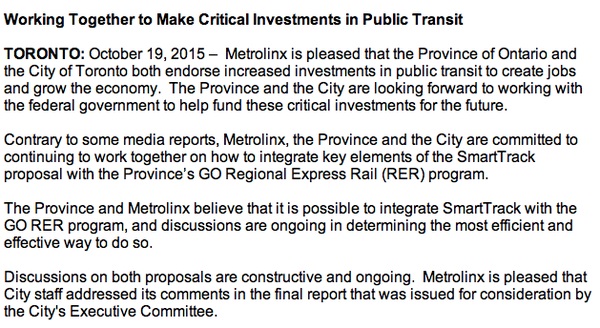
Metrolinx has issued a statement pledging its continued support for “key elements” of SmartTrack, whatever that means.
Second is the appearance of an “advocacy group” called FAST (Friends and Allies of SmartTrack) which appeared to spring out of nowhere earlier this week. This is no ordinary citizens’ group plotting in someone’s kitchen how to get some new transit line built, but a well-financed group with close ties to Mayor Tory. Their website reproduces the Tory campaign colours and links to SmartTrack material from that era.
Although the domain name was only registered a few days ago, on October 9, efforts to solicit support by the organization have been underway since at least April 2015 as revealed by Councillor Gord Perks from SmartTrack lobbying information. Minutes of the Toronto Financial District BIA (Business Improvement Area) meeting on April 22, 2015 show that they received presentations from Iain Dobson (a principal of the SRRA consulting firm working on SmartTrack related real estate studies, and a member of the Metrolinx Board), and from John Duffy of Strategy Corp., someone who was closely involved with Tory’s campaign and the SmartTrack proposal.
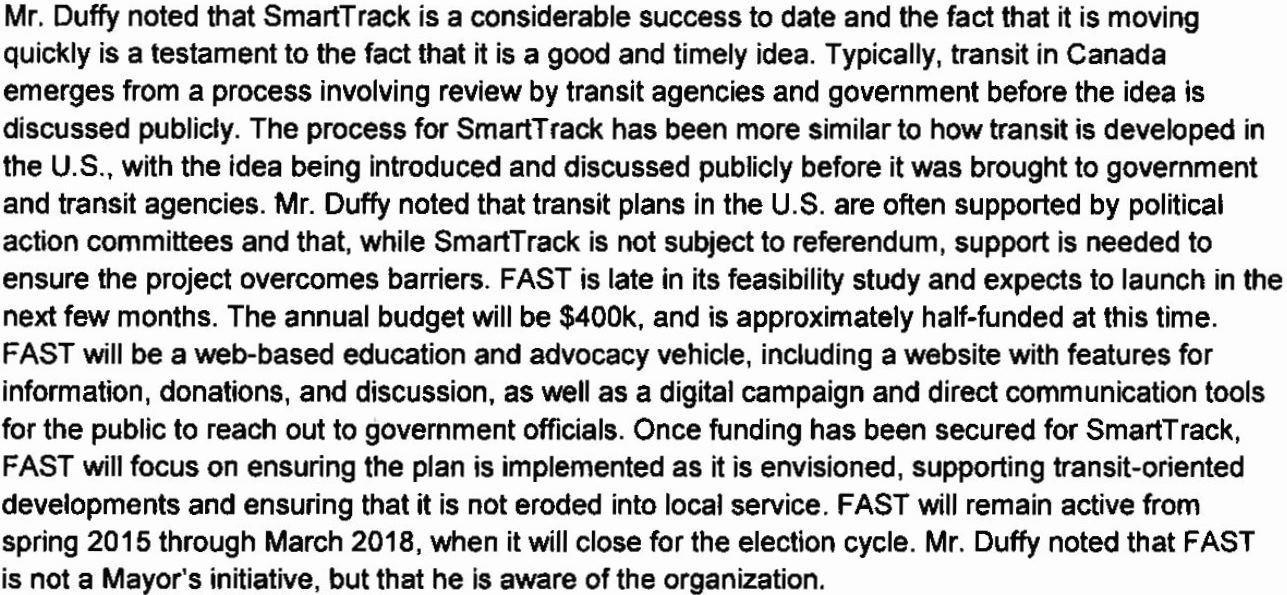
The critical phrase here is “supporting transit-oriented developments”, a polite way of saying “make somebody’s land more valuable”. People do not launch $400k campaigns just because they like streetcars, for example.
The comment about SmartTrack not being “eroded into local service” is particularly striking considering that if nothing else, “local” would characterize the proposed ST route and its stations by contrast to the “regional” GO/RER. Local access, particularly in Scarborough, was a major selling point of this scheme.

Quite clearly, a lobbyist known to be connected with the Mayor was trying to hit up a business association to help fund a campaign aimed at getting SmartTrack built. This is a gross distortion of transit and city planning principles, and mocks the whole idea that we have professional staff, not to mention an informed public debate about alternatives. To be fair, it is not exactly unknown that private groups lobby for transit schemes, but this has the combined problem of being as blatant as possible and of touching the Mayor’s office in a way he cannot avoid.
As for the FAST website, it has been a comedy of errors including a signup page that was clearly cribbed from another campaign (ironically, No Jets TO) and had all the earmarks of hasty assembly. This page has been (mostly) fixed now, but this doesn’t speak to care in their launch.
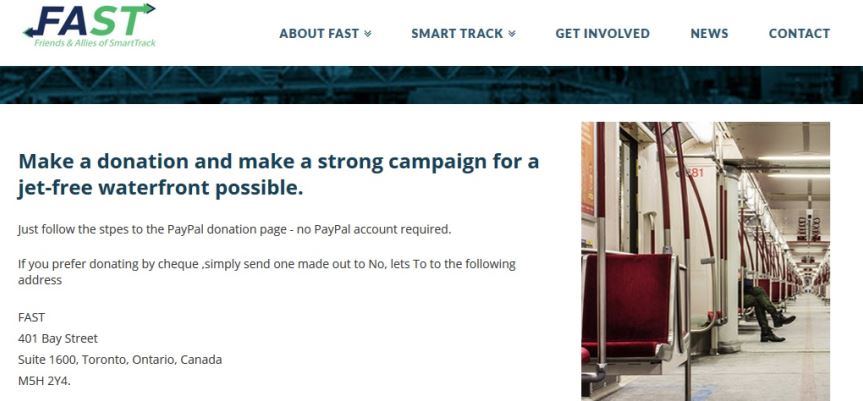
The site richly deserves to be torn apart because, if nothing else, it shows that SmartTrack boosters have learned absolutely nothing since last year’s election campaign and they continue to spout the same bilge about their project after extensive criticism. This is the mark of an organization whose only goal is that its message drown out all others. Facts have nothing to do with it. Is this how we elected a mayor whose primary attribute was that his name was not “Ford”?
About FAST
The organization describes itself as non-profit, but don’t expect a tax receipt from any donations. There is a Public Advisory Board which includes the former legal counsel to John Tory’s mayoral campaign and others close to the Mayor. The “lead organizer” (as described by the Sun) was Tory’s campaign manager.
A number of principles supposedly inform FAST’s work, but there is some confusion about what is a “principle” and what is a supposed “fact”:
FAST exists to EDUCATE and ADVOCATE
We seek to inform the people of the GTA on the benefits of SmartTrack:
- To build awareness and understanding of Regional Express Rail and how it could quickly and dramatically improve Toronto’s transit
- Much of the needed infrastructure is already in place
- SmartTrack can be built much more quickly than the other proposed lines
- Substantial funding from Ottawa and Queen’s Park is already promised
- Analysts believe SmartTrack’s operating costs can be covered by fares from Day 1
- Regional Express Rail is an important transit option in cities like London and Paris
“Much of the needed infrastructure” is, in fact, not already in place as is clear from the City’s status update and from comments by GO Transit. There may be corridors and tracks, but these are already spoken for for GO’s own services. Planned upgrades are to support GO/RER service and there will not necessarily be capacity left over for SmartTrack trains.
The statement is rather like talking of a BRT network on roads that are only four lanes wide including parking. The roads do exist, but putting a BRT structure on them would be “challenging”, to be polite.
As to the relative speed of construction, a great deal depends on the scope of what will be needed (that “existing infrastructure” issue again) and the degree of urgency with which any alternative project might be undertaken.
I am sure that any proposal can find an analyst who will claim day 1 break even, but this depends on a very high ridership number that is not attainable with the planned service. In a few decades after all of the SmartTrack-related property developments are completed, and enough track time is available to run very frequent service, maybe. Day one? Not a chance.
As for “Regional Express Rail”, this term means different things in different cities (service levels, degree of integration with other levels of transit, fare structures), and SmartTrack advocates conflate RER with SmartTrack for their convenience.
We seek to advocate not only that SmartTrack is built, but built properly:
- Decisions must be based on sound data, on costs, financing, routes, infrastructure and operations
- Affected communities and neighbourhoods must be thoroughly engaged, consulted and respected
- Critical feedback, detailed analysis and wide input are welcomed
- There must by independent, third-party analysis and verification of financing, cost estimates and timelines
- Issues of concern such as Tax Increment Financing, the proposed new Eglinton corridor, and Union Station capacity, must all be properly analyzed and resolved based upon sound planning and engineering principles, coupled with community input
- SmartTrack must be appropriately integrated with broader transit planning to ensure it is a complement to other proposed projects
That’s all very well, but it is quite clear from Duffy’s presentation that the real goal is to sell SmartTrack “as it is envisioned”. All of the issues listed above have been raised over the past year, but criticism has been sloughed off first by the campaign, later by the Mayor, as naysaying attempts to derail a vital part of the city’s future. Wrapping yourself in the flag is no way to advance an argument for billions in public transit spending. None of the “built properly” principles listed above has been seen in any of the SmartTrack advocacy to date, especially including an acknowledgement that the scheme, as proposed, might be unworkable.
Would new track have to be built for SmartTrack?
Yes. 90% of the corridors are already in public hands. But some new lines would be needed.
In the original version of the FAQ, FAST confused “corridors” and “track”. As already mentioned, having a corridor does not necessarily mean that one has available track capacity. The statement was corrected in the version now online (above). So much for accuracy.
How long would it take to build?
Understanding that most of the lines are already in place, Mayor Tory’s campaign estimated SmartTrack would take 7 years. By comparison, the Relief Line is a minimum of 20 years away and would involve construction of a completely new line underneath downtown neighbourhoods.
Having fixed the “corridors” and “track” problem, they persist in saying that it will be quick to build because the “lines” are already in place. Also, the statement about the construction period for the Relief Line exceeds by quite a margin the 12-15 year period cited by Toronto’s Chief Planner. The issue is with the will to undertake the project which delays its ever getting started, and could strangle funding for quick execution.
Also, the original time estimates for SmartTrack ignored the need for tunneling in northwest Toronto, and the additional infrastructure needed to operate both GO/RER and ST in the same corridors.
How much would it cost?
The Tory campaign estimated $8 billion cost, shared 1/3 each by city, province and federal government.
The $8b cost was estimated on the back of an envelope as follows:
- Take the average cost of “overground” construction in Berlin and in London, UK.
- Adjust for inflation and Toronto conditions.
- Multiply by the proposed length of SmartTrack.
No engineering. No estimation of the complexity of integration with existing lines. This is what passes for budgeting in political campaigns.
Is any money committed?
Prime Minister Harper has promised $2.6 Billion for SmartTrack. Liberal Leader Justin Trudeau has also promised $2.6 Billion for SmartTrack, as well as $2 Billion for electrifying GO lines. NDP Leader Thomas Mulcair promises billions for municipal infrastructure, including transit. Premier Kathleen Wynne’s government promises to fund electrification of GO lines, a key element of SmartTrack.
Harper’s promise will be little better than toilet paper in a few days, and in any event is a promise of money far down the road to pay off a debt that will be run up through a P3 scheme. Trudeau was foolishly pulled into an explicit SmartTrack commitment, while Mulcair’s money has a more general application. By the way, the NDP transit funding is about 2/3 existing money with only a top-up from new spending. All of the existing capital subsidy (from gas tax) is already spoken for in existing City/TTC capital budgets.
As for the Ontario commitment, it is unclear what the actual “value” will be out of that $8b total, and Ontario intends to count whatever it spends on GO/RER and electrification as its share. Until we see an actual cost estimate for the marginal cost of adding SmartTrack on top of the GO/RER system, we will not actually know what the scheme would cost Toronto.
What route would it take?
Mayor Tory proposed 53 kilometres of track from Markham through centre of downtown, northwest to the Airport Corporate Centre in Mississauga.
To save you doing the math, that’s about $150m/km. We have no way of knowing how this would break down between new infrastructure and rolling stock, both of which depend on the final alignment and on the service plan. There has also been no discussion of a yard and maintenance facility for all of the added SmartTrack fleet.
Are there complications in building the remaining 10%?
Yes. There are issues to overcome along Eglinton West in the Mount Dennis area. They require sensitivity to the residents and careful planning.
This has to be the understatement of the century, but the answer shows an assumption that a route along Eglinton will happen. It is just a question of appeasing the locals rather than looking at an alternative route, something that is an integral part of current studies.
This page cites the usual stats about congestion and its cost, but does not break this down by those areas and trips which SmartTrack would address and all others.
33% of Toronto jobs are in the downtown
Without relief of some sort the Yonge Subway line (Line 1) is expected to be over capacity by 2031
Yonge-Bloor interchange is already over capacity
That’s all very well, but what does SmartTrack do about this? Metrolinx projections indicate that the results will be quite small, much less than the benefits of a Relief Line via Don Mills to Sheppard.
“SmartTrack could make a huge difference for working people in parts of the city that don’t have great transit options right now”
FAST Public Advisory Board Chair, Alvin Curling.“The great thing about SmartTrack is that so much of the infrastructure is already in place, and billions of dollars in funding already promised by the federal government and Queen’s Park”
FAST Public Advisory Board Member, Kyle Rae.
Well, yes, if you live in the areas SmartTrack will serve and want to go to the central area, it’s a great line, but there are many more commuting patterns that ST does not address. As for the “infrastructure is already in place” argument, someone should take Kyle Ray aside and explain the whole “corridor/track/lines” business to him. His quote is parroting an out-of-date argument. Moreover, Queen’s Park hasn’t promised a penny beyond what they would otherwise spend on GO/RER and electrification. We do not yet know what the marginal cost of adding SmartTrack will be.
From Unionville to Union Station the current commute is about 134 minutes. On the SmartTrack line: 42 minutes. Less than half the time!
They don’t get out much, those SmartTrack folks. There is already a GO train that runs from Unionville to Union and it takes 41 minutes to make the trip. By the time ST opens, there will be frequent all-day, two-way service under the RER plan.
Approximately 90% of SmartTrack would run along corridors that are already in public hands, so it will not displace any existing roadways.
This is true as far as it goes, but oh that 10% (Eglinton West) where clearly the FAST folks think the line will still run down the middle of the street.
SmartTrack will have a conservatively estimated ridership of 200,000 per day. That is the equivalent of about half the daily ridership of the existing Bloor-Danforth line.
Let us assume a 15 minute headway, the value used in almost all of the city reports on the subject. If these are 10-car GO trains, that’s 8,000 passengers per hour. We can reasonably expect full trains inbound from east and west, so that’s 16k plus, say, another 4k in counterpeak travel for a total of 20k in the peak hour, or maybe 80k for the four peak hours over the day. Getting from there to 200k (or more) is a huge leap and cannot be achieved with the likely service level SmartTrack will provide. This ridership estimate was based on much more frequent service that simply is not possible in the corridor co-existing with other services. The number was, to use parliamentary language, misleading when it was cited in the election campaign, and yet it continues to be used in spite of repeated criticism that it is grossly in error.
SmartTrack will connect northwest Etobicoke and northeast Scarborough to downtown and the job hubs in the outskirts of our city
Some, yes, but not all. Much also depends on good TTC feeder services and integrated fares. It is far from clear whether this will actually happen or how much subsidy it will require. Remember that Mayor Tory wants to flat line TTC operating subsidies for 2016.
SmartTrack will slash commute times for suburban passengers. Estimates indicate that riders can expect a less than 30-minute commute from Kennedy subway to Union Station. Today, that same commute takes approximately 40 minutes on the current subway network.
As with the folks in Unionville, riders will have the option of using GO/RER to make the same trip in 19 minutes.
SmartTrack will use clean and fast electric multiple unit vehicles (EMUs) – not diesel locomotives. Better for riders, better for the environment.
So will GO/RER.
SmartTrack will be a regional transportation system, delivered by Metrolinx.
You might want to check with Josh Colle who thinks that this will be a TTC operation. Metrolinx, of course, knows that anything running on their tracks will be a Metrolinx show.
SmartTrack will strategically link economic clusters throughout the GTA, including the Markham Employment Cluster in the east, the Airport Centre Employment Cluster in the west, and the downtown Core. More importantly, though, it will connect people to jobs.
Again, will someone please explain why Toronto will pay to make employment clusters in Markham and Mississauga more accessible without a financial contribution by these municipalities. While we’re on the subject of contributions, will Tax Increment Financing recoup the benefits to landowners in these municipalities from the SmartTrack investment?
By now, you may have noticed that beyond promises of money from Ottawa and Queen’s Park, there is no mention of how Toronto will finance its share of the project. The magic of Tax Increment Financing, quite evident during the mayoral campaign, has vanished into the mist.
 Steve Munro
One question and one only.
When did Mr. Dobson become a member of the Metrolinx board?
I know he recused himself from discussions about Smart Track on the board, but if he was a board member while making this presentation to the Financial BIA … well.
Cheers, Moaz
Steve: He was appointed just before Glen Murray ceased to be Minister of Transportation. Dobson was part of Murray’s “Kitchen Cabinet” on transit to which I was also invited during its brief life in Murray’s pre-cabinet days. It was clear at the time that Murray and Dobson had close connections.
With SmartTrack and GO/RER now described by Metrolinx CEO McCuaig as essentially variants of the same service, it is hard to see how Dobson (who is consulting to the City on SmartTrack) can participate in any Metrolinx Board discussions without having a conflict of interest.
LikeLiked by 1 person
Just made a donation to FAST because Smartrack is the FASTest way to provide relief to the overcrowded subway system.
Steve: A fool and his money are soon parted.
LikeLiked by 1 person
The only thing that surprises me is it has taken a year to figure that the city isn’t going to run their own trains on GO tracks. Mayor Tory said he was going to deliver Smart Track in 7 years. One year down and all the City Report to Executive Committee says is they are still studying it LOL.
LikeLike
Is all this a prelude to a Tory announcement that they are merging ST/RER? The original scope of RER will stand but Tory will get his name on it for bragging rights, ostensibly as having “pushed it forward, ” made it more (less) Toronto-centric, or more frequent?
Steve: For a while, I thought that’s what was going on. However, the degree to which he and his supporters have dug in on the original SmartTrack suggests that Tory is not taking a graceful way out by simply allowing the services to merge. The frequent service which is essential to his plan’s credibility triggers large infrastructure upgrades that will almost certainly blow his budget, not to mention timelines. Then there is the small matter of operating subsidies which were fudged during the election by saying the line would be self-sustaining, even at TTC fares.
LikeLike
Metrolinx envision two RER services on each line, an inner electric all stops frequent service starting at say Bramalea, and an outer diesel service starting at Kitchener or Mt Pleasan,t and running non stop in inner territory. Smart track would be a third service, an inner electric all stops; strikingly similar to the RER inner service. So Bruce McQuaig’s ‘one and the same thing’ comment really applies to RER inner and SmartTrack. There is no need for two inner services since demand can be met by increasing frequency and extending train length. In the end we are likely to have a blue inner EMU service carrying SmartTrack branding with Metrolinx as subtext, and a green GO branded outer service, all operated as one by GO.
The SmartTrack activity sounds like an attempt to create a private for profit transit development agency, who would take on the non rail aspects such as station site development and station building in return for steering major chunks of the already committed monies to them. For decades to come. Metrolinx then would build the infrastructure now envisioned – extra tracks, grade separations, etc
And as for MECC, is not their insistence of pursuing such ridiculous plan good only until they get some of what they want, at which point they will willingly drop it leaving the rest of us to pay for all the studies. I’m sure that like the rest of us, they believe, but won’t say of course, that the LRT is by far the best option.
So arguing about the trains is a ploy to entrench themselves commercially in future line developments.
LikeLike
IMO, the general public / voters do not care much if SmartTrack is a separate service or merged with RER. As long as the downtown-bound riders see a modest improvement in their commute, and the fare is reasonable (either standard TTC or a small premiun over that), they will give John Tory a passing grade.
The western (Eglinton) segment of SmartTrack should be replaced with the extension of Eglinton LRT. That will both reduce the cost and improve the connectivity.
It is not certain at this point that Tory and his team will accept such change, but I do not see why they wouldn’t. LRT can serve all stated goals of this line, and currently there is no community group that would insist on using heavy rail, or on avoiding LRT.
The LRT extension will cost around 1 billion. Even if that billion has to come from the SmartTrack budget, there are several more billions on the table (federal promises, plus the funding that the province gives anyway for RER / rail upgrades, plus some money from the city hopefully) to enhance the existing rail corridors, widen them where necessary, and add tracks.
It may not be enough to provide a long-term relieve for the Yonge subway, or bring the commuter rail frequency to the best European and East Asian standards. But it should be enough for a meaningful improvement over our current situation (the mainline rail is virtually no help at all for trips within the city).
SmartTrack is not a magic solution to all problems, but I expect it to be a moderately successful project.
LikeLike
Maybe we should set up a lobby group of our own: Citizens Opposing SmartTrack — or COST, for short.
LikeLiked by 2 people
From FAST’s bullets:
Are these the same analysts that said Blue 22 (UPE’s predecessor) would make money for its investors?
and much of it is not in place, especially stations and needed tracks.
then why do you not follow your own advice and learn the difference between heavy rail and heavy rapid transit operations.
I would suggest CAST, Citizens Against Stupid Transit, but I can live with COST.
LikeLike
Thanks for this Steve; on guard when some are trying to pull some, uh, Fast ones.
And Exec gets to have a look at this on Tuesday – not too much time for absorbing complex info, with gaping holes in it too ie. the strong sense from McQuaig it’s NOT a separate new service but an “incremental upgrade”, this news arriving close to a year after election. I guess it was too political for a well-paid civil servant to engage in politics at a needed time.
At times, I’ve thought this layering is almost a re-branding of RER, done with the tacit blessing of the Liberals as it does have a semblance of basic planning and sense given the existing rail lines and past decades of thinking of faster travel to the core on the diagonal. They kept mum as there was a strong antipathy to Mr. Ford – and Fordwards was backwards. Mr. Tory’s mathemagics of financing was less important as the basic RER was provincial money. So maybe we should call this effort “Smart Trick”? – and it worked, though it’s still all a very ‘carservative’ council, (at times Clowncil).
When will we see sounder planning based on origin/destination data and densities? After this greenhouse century?
Steve: I was a bit surprised by the appearance of FAST, especially as they had clearly been “in the works” since April, but only chose to go public last week. Tory had a perfectly good option to say “let’s see how we can make the best of the infrastructure we have, maybe with some enhancements” but instead he is bulling ahead as if his original scheme is still intact rather than in tatters. A lost chance to correct the mistakes of an overenthusiastic campaign.
LikeLike
This is going to be just my opinion. I do not want the facts to get in the way!
The Toronto Star write-up in Saturday’s paper shows one major development in the SmartTrack saga, that the Ontario government is not going along with the whole SmartTrack scenario. In Metrolinx’s view, ST is only an incremental enhancement of Metrolinx’s Regional Express Rail project. Metrolinx CEO Bruce McCuaig is not spouting off on his own, this is government policy. Furthermore, it means that additional funding above what has already been earmarked for RER is not going to be there from Queens Park. And the $2.6 billion promised to ST by prime minister-to-be Justin Trudeau is going to RER.
It seems that this policy clarification from Queens Park has not yet sunk in to either John Tory’s team or the folks at FAST.
Though, to be fair, the FAST website’s News tab posts the article by the Star’s Transportation reporter Tess Kalinowski, and the opinion piece by Royson James in the same issue of the Star.
And further, the Eglinton West “surface subway” heavy rail line is not happening, either, because there will never be funding for that.
A little bit of common sense is filtering through.
It is been pointed out on this blog that SmartTrack is not going to divert enough riders from the Yonge line to provide meaningful relief. It is a shame that this folly, as Royson James calls it (and I do, too), has diverted time and effort away from the urgently-needed Relief Line project. Not the diversion needed.
LikeLike
Hey, lottery winnings aside, how do you think we should spend OUR $8 billion?
There are two proposals in the table. Would you spend it on SmartTrack or on the Relief Line from downtown to Sheppard?
All kinda hypothetical, there is no $8 billion.
We haven’t won the lottery yet.
LikeLike
Setting up for political suicide in this climate. Tory will likely never get away with this unless there’s more to it … the aroma here is far too strong. I had really hoped ST was just a ploy to get into office & would be gracefully dropped back to RER soon after.
He’s just playing into the Fords’ “elitist” narrative. Next election should be bonkers at this rate.
Although should be comical to hear the upcoming propaganda campaign these snakes are about to launch. It will be hard to make sheeple out of the majority of voters even with the most sinister add campaigns. The Fords’ politics already set the stage to prevent this crap.
Steve: The only way I can understand what Tory is up to is that he feels “backing down” on SmartTrack would be playing into Ford’s hands, and set up a major attack for the next election. What should have happened was a gracious folding together of the RER and ST plans as a first step with a clear understanding that there could be a second round of improvements. Going for broke with the original plan guarantees failure.
LikeLike
I agree with the last, and pushing as hard as he does, undermines how many people saw him – a pragmatist. This meant that proposing something that broke the political logjam worked, backing away from it – which also works – are equally pragmatic. I firmly believe that people voted for him, to get things moving, and if ST is impractical, either because it is excessively hard to carry out or ineffective (or both), the people who voted for pragmatic, just fix it, will be upset if he pushes anyway.
If you really want to be an effective pragmatist, push the entire thing over to City Planning (where it belongs) and then see what they say (pretty sure they already have a plan – that would really work). Make a strong public point of keeping yourself and everybody else at arms lengths, so when you push you really can say you are doing what a Mayor should – acting on best expert advice to move the city forward in the city and its residents interest. Mr Tory’s job should be to move quickly to get the province to build what makes sense in terms of transit – not politics, and Mr Tory needs to use his ability to make politics fit transit planning (not the current which is the inverse).
LikeLike
I’ll bet one “key element” Metrolinx supports is Tory’s crazy TIF scheme to pay the City’s 1/3 share.
Steve: Metrolinx doesn’t care where Toronto gets the money from, only that they pay up.
LikeLike
Yeah, but Tory promised a “surface subway”. I suggest that, for a regular rider, the experience of riding a subway, frequent enough you don’t bother with a schedule, compared with a service that does run on a schedule, is quite different.
Even if that scheduled service is at about ten minutes apart, the rider used to genuine subway frequency will resent the wait; will resent the times they missed a scheduled run; and will not give Tory that passing grade.
The existing GO Train departures aren’t always regular. The schedules have odd gaps, and odd clumps, which I presume are due to non-GO uses of the shared tracks. FAST says the benefit of SmartTrack is that it will use existing infrastructure. And an irregular, thus hard to memorize schedule, due to sharing that existing infrastructure, is an unacknowledged weakness of claiming cheapness through the use of existing infrastructure.
LikeLike
While RER is a big improvement over what we have now, does anyone think that Metrolinx would willingly provide even the modest local improvements (frequency and more stops in the city) that they now say they can possibly do without a massive competing/parallel plan to have to try to avoid. Sometimes Metrolinx need a huge hammer hanging over them.
Smart Track was a good idea not well thought out.
Bill Strain
LikeLike
It’s not that simple to determine what would be a pass or failure from the subway mindset crowd. The longer wait times may be offset by quicker travel times due to the fewer number of station stops. The real pass/fail will be determined when you also factor in the reliability of the service combined with just how comfortable the wait will be. (Think GO Transit’s unheated bus shelters at their original stations for an idea of failure in the comfort department.)
Steve: To this I would add the actual convenience of any transfer connection. In many cases we are not talking the simplicity of two stacked platforms like St. George Station, but of considerable walks during which there is a good chance one would see one’s intended train pull out of the station. Metrolinx still has the Oriole/Leslie connection as a perfect example of inaction. Being as it is on a non-RER corridor, I suspect nothing will change there in the near future.
LikeLike
I realize that a 10-min or 15-min frequency is not as appealing as the YUS subway that runs every 2-3 min during the rush. However, even a service that runs every 15 min will be a big improvement for many riders whose bus trip to high-order transit will become much shorter and less crowded. Some voters will feel they got less than what was promised, but the majority will be happy enough to give Tory another term.
Anyway, Tory can’t get SmartTrack to run every 3 min, nor every 5 min. He has a choice between accepting what’s possible or getting nothing at all, and I don’t expect him to chose the latter.
LikeLike
We should have clued in when Tory evoked the London Overground which is not the aboveground portion of the Underground but a separate system whose trains run every 15 minutes.
Steve: I very much doubt Tory understood that distinction during his campaign.
LikeLiked by 1 person
Yes, but I seem to remember a very active discussion on your blog with regards to a very long list of reasons it would not and could not do what he was suggesting. Even people like me who no longer live in Toronto, knew the Eglinton west portion would not be buildable, and of course the conflict with GO was equally self evident. My comment at the time – that was mirrored in various ways by many was – RER and ST are really only one service. Mr Wightman – as I recall was somewhat harsher! I believe Steve did his best to be nice – with his scathing critique.
However, it was well understood, by those who cared to think that the benefits would not be those described by the Tory campaign. I think people did clue in, and expected Mr Tory to be pragmatic, not dogmatic – he could easily save himself – by simply conceding there are better ideas, and moving quickly on those and living up to the expectation of being pragmatic.
LikeLike
Happily, my memory of the improprieties that shook the Rofo mayoralty prior to the Crack-smoking earthquake are fading. Wasn’t he strongly criticized for sending out solicitations for donations to the Don Bosco Football club — on his official Mayor of Toronto letterhead?
If people get the impression that Tory or his cronies are using FAST to engage in real estate speculation, wouldn’t this be at least an order of magnitude worse than Ford’s misuse of his office? At least Ford could point out that his impropriety was for a legitimate charity.
LikeLike
Thanks for posting the latest update Steve.
“…..continued support for “key elements”…” is Metorolinx way of saying that anything outside of the original RER plan is a stretch. And Mayor Tory is a giant blowhard playing with fire.
LikeLike
Moi, harsh? I would never be harsh in my comments about such a well thought out practical transit plan. Unfortunately it is not a well thought out practical transit plan.
LikeLike
Yes, and really, even RER should be rolled out with a careful eye on what is really doable, and preserving capacity for where other projects really cannot serve. While I think real effort should be made to serve Scarborough and Etobicoke stations much better using GO, this should be about all current trains stopping there. The local support to these stations, and parallel capacity is still required. I believe that there is 8 trains in the peak hour on Lakeshore west – very nearly 10 (8 trains 7:29-8:25 with another at 8:32 and another again at 8:33 – 3 trains in 8 minutes – but then a breather is taken 19 minutes until the next). While clearly this is a mix of local and express, I am under the impression sneaking many more trains in here or Lakeshore East will be hard (7 trains 7:30 – 8:42 but having to make room for 3 Stouffville trains as well).
While I would dearly like to see more support & flexibility using GO, we also need to be aware that capacity will be an issue in these corridors if we try to push too much onto them. 416 growth will compete for space with 905 growth. To my mind we will still need to serve the riders that would go from inside say Guildwood or Mimico, to core with other meaningful capacity, as the limits to these GO lines at peak hour are not that far from being hit – even with RER. We are adding at best 2-4 trains even with RER assuming an extra track in the east. Viewed in terms of a 15-20 year time horizon, that is not really all that much – unless there is other capacity also added on the alternate inside 416 routes.
GO RER in 416 should be almost as much about making other destinations reachable using GO through better LRT (&BRT) integration (and keeping more of those 905 drivers off 416 roads) as about getting 416 riders to the core. The province should be supporting LRT on Kingston road and service to Guildwood for getting Lakeshore East GO riders to Markham, STC and midtown locations as much as anything else. This would also make those seats used from Oshawa to get to say the STC or mid-town usable from Eglinton to core for an inside 416 rider. Trying to hijack RER rails for local service is in my mind misguided.
LikeLike
Robert – I am somewhat taken aback by such thinly applied sarcasm. Were you afraid you might be misinterpreted – without the second bit?
LikeLike
With regard to Smart Track’s utilization of “existing infrastructure”… Some commentators, including, if I recall correctly, some respondents here, have suggested Smart Track could be more practical if the existing rail corridors were enhanced — if additional rail lines were laid within the corridor.
Is the Georgetown rail corridor the same width everywhere, or does it have narrow choke-points? Existing stations would have to be rebuilt if additional rail-lines ran through them — particularly if new services on those lines will also need to use those stations.
So, Steve, am I correct that any talk of laying new additional rail erodes the claim of using “existing infrastructure”, right off the bat?
Steve: Yes, although the situation varies from place to place along the corridor. With all the trackage that has been added for UPX and service expansion on GO, there are places where things are very tight. Even more track, let alone platforms, are out of the question at some points. Another issue here is that the consultants (to Tory) who assumed we could run very frequent service were using European operations as their point of reference. The problem, as has been discussed here, is that the rules affecting train operation on the GO network are not the same, in particular the requirement to co-exist with freight due to legacy running requirements (CN would never have sold the corridors without this condition). As for the Eglinton West portion of SmartTrack, that has been discussed at length elsewhere. The important point on that one is that the consultants had no idea of the gradients involved between the Weston sub and Eglinton Avenue, nor of the fact that the Richview Expressway lands (visible in out of date Google images) were (a) sold and (b) occupied by new buildings in some locations. For some of the locations along the alternate route through North Etobicoke, I have my doubts about curve radii implied by maps of alignments south through/around the airport depending on the type of equipment that would operate here.
Are there places in the world where a narrow choke-point on a key rail corridor prompted stacking additional rail lines on a deck above the original rail lines. Since the size of rail vehicles has grown, as with GO’s bilevel coaches, that second deck would be almost a high as the Gardiner expressway. It seems to me that the cost of laying a kilometre of additional rail on a second deck would be close to the cost of laying a kilometre of elevated expressway. It might be narrower, but the on-off ramps would have to be much longer.
Steve: Yes, it would be very expensive, not to mention the problem of access as you note. These details should come out in the detailed engineering review of the various alignments, but I don’t think Tory will like what he hears because his own “experts” have said differently.
LikeLike
@383onthetree,
First off, maximum design speeds are 90mph on the Kingston subdivision. Second, GO has been moving to a 12-car standard consists length.
Third, it’s a heavy rail corridor, so they are very high crash standards.
@Bill Strain,
RER has been in the works for at least a decade, and really is just a bunch of expansion programs coming together under one label and a consistent policy. As it has evolved from a political promise into a sensible reality, it’s commitments have been trimmed (core network vs fringe, 15-minute vs better than 15).
@Steve,
Oriole/Leslie isn’t even as bad as Bloor/Dundas West. Metrolinx has built a knock-out wall for the connection, but there is no desire from the City to pay to complete the connection in the Crossways Building parking garage. It’s a “SmartTrack” station, so why not start putting City money where Tory’s mouth is?
@Michael Forest,
GO trains are pretty full at their high prices, why do you think they’d be less crowded than the buses if it were faster and the same price?
@arcticredriver,
The difference is that Ford did it with the City title, time, supplies, and authority. While Tory is connected to FAST, it’s at least an arm’s length organization.
@Malcolm N,
The issue with service levels to the East is that there are higher ridership numbers to the West, and limited Union spots. What’s likely to happen is that the Don Yard will be converted into a satellite station and provide “Downtown” service without actually going into Union. Once the Union bottleneck is resolved, there is space on the corridor for an additional track, you can get down into the range of 3-5 minute (combined) headways. The one station, track, and signal changes would be $1-2B and in the 10-15 year timeframe.
LikeLike
I will believe 5 minute mark per service, however – that is 12 trains per hour, and represents only 5 trains. Also I would note to support a Don Yard station, requires a subway or some other substantial link – with available capacity. I would presume that this would be the DRL, however, I have 2 issues here:
1. While Metrolinx has moved this into the 15 year program list – I am hard pressed to see this by a 2030 time frame, given the political nature of the games now being played.
2. Assuming it is in place – if you assume we are looking at stopping say 5 trains per hour there, requires open capacity on the subway of 10 k/hour which to me means you are filling the line to a total of 30k in 15 years. Also there is a service quality issue that would result. If I assume there are 33 trains per hour and a load of 20k without this station – there would be about 470 spaces available on a subway train. This would mean as the 2k passengers go to board the subway, there would be a notable queue requiring several minutes of overloaded platforms to clear (say 4 trains worth). The pulse nature of the load would result in transitory overloads on a subway link, and frankly a much poorer service as a result – unless you are indicating that at this point whatever subway would be empty.
I actually have much higher confidence in a west side station for this reason, as I can imagine a DRL ending not that far past the Bathurst Yard – thus having lots of space on every train core bound. If this same train ran as far as say the CNE or Roncesvalles, it would likely have 870 spots per train open, and would likely be able to take people nearly as fast as they arrived at the station.
However, I am actually arguing for parallel capacity – which to support a Don Yard station would be required in the form of a DRL anyway. Thus you are in effect pre-supposing that the capacity that I argue for will exist.
LikeLike
Given some of the people who frequent this site and the web in general the answer is YES.
A question to regular GO users. Since the UPX comes in on track 1 from the west are there any west end GO or VIA trains that use track 1, if not what does use it. One would think that they could have put a switch in that would have allowed trains to come and go to/from the west by switching to/from track 2.
The problem at Union is still one of passenger-pedestrian access to the platforms more than one of train capacity. Someone has already been killed when their back pack was caught by a passing train and it will happen again.
Is this 3-5 minutes per track or per corridor?
LikeLike
@articeredriver,
Metrolinx is looking at all the options to resolve the USRC chokepoint, including elevated/depressed corridors. A depressed corridor (rail tunnel) is almost a non-starter as you need 800m clear for your vertical transition. One large factor is that Metrolinx doesn’t own the air rights to the USRC, they only own up to 8.3m, so there would be a property acquisition cost of at least $250M to $750M.
@Malcolm N,
The vast majority of riders from Union actually walk to their destinations. Part of the Don Station conceptual scheme includes a high-speed enclosed walkway (like at Pearson) to Union Station. If there is a subway or other transit service, this could be dropped, but it’s included in the cost estimates as a baseline minimum. It would actually be faster for people on the walkway than sitting on the train in the USRC.
There are two possibilities for west-side stations, and all three are being included the various scenario modelling. A Bathurst North Yard/Spadina Station is the likelier of the two, but would only have 3-4 tracks.
LikeLike
GO transit has been studying electrification from the late 60’s. The summer I worked at CN they were making an inventory of every bridge and signal gantry that did not meet clearances for electrification so that whenever they were replaced they would change. RER is not a recent development but rather finally a commitment to spend the money.
While it would be nice if GO could provide more coverage in the 416 there is not much room on the existing service to do so. Even with RER and better rush service there would be little room for more passengers. Metrolinx might be able to put in 1 or 2 new stations in the 416 on the lines they are looking at but there is no way they can put in all of those stations and have all trains stop at them. It would slow GO down to slightly better than streetcar speeds.
The Kitchener lines has a severe choke point at Bloor station as the Milton, Kitchener and UPE trains all pass through there. One extra track could be added but beyond that it would require using the rail trail and or taking out a lot of buildings. Trying to add a third track through downtown Brampton would require the removal or relocation of a number of buildings and the closing of a couple of streets and the elimination of one or two level crossings. Signal heads are in place for a third track south of the current tracks from Georgetown to Mt. Pleasant. All that is needed are the tracks and another deck on the bridge across the Credit.
LikeLike
Yes, I was thinking that adding either a huge extension of walk, or a subway ride was a major inconvenience. However, as it is a high speed walkway, makes this seem more of a station – extension. This would however, make for a very substantial one in terms of its length. Begs the question in terms of its capacity though, I would assume that a meter wide bit of walkway would have similar capacity to an escalator (ie 60-100 persons per minute) and would this not require a much wider version than that in an airport. Would this not need to be the equivalent of 3-5 times the capacity.
LikeLike
Could not a depressed corridor work in a single-ended station setup? Obviously there’s no room on the east (short of heroic engineering) for a ramp down to a second level, but if ramps from the west started down at the distance of the existing cross-over (or maybe even used that as one of the ramps) then there should be enough distance to descend low enough to pass under Lower Simcoe, no?
Obviously that’s a lot of expensive tunnel, and I’m sure there are any number of sewer, water high voltage lines, etc. in the way, but since the west side has heavier use anyway it seems that it would be at least minimally feasible.
Steve: Metrolinx already looked at ramps down from either side of Union as part of the USRC capacity study. The west ramp would have to start at about Bathurst and the east ramp at the Don to get below Union Station. Also this would be VERY messy construction (not in rock like Crossrail) because this is all old lake bed.
LikeLike
A mid afternoon train to Ottawa uses it. Can’t remember exactly what time but it’s on the board when my noontime to London is leaving.
LikeLike
A wildcard in all of this is the 407 Freight Bypass, the concept of removing freight trains from the Milton corridor and the North Toronto subdivision; this would allow a northern GO station.
A small study just got recently completed on this concept. It may not be for decades, but it mentions it would be cost-competitive to trying to RER-ify the Milton corridor (But gains so much more, including, conveniently, full track ownership through Brampton — which is needed anyway for electrification to Kitchener within a reasonable timescale, including, possibly, HSR service).
Steve: As has been discussed here in various comments before, the Milton bypass scheme is not as straightforward as it sounds. Something for the future maybe, but certainly not within the timeframe of RER phase 1.
LikeLike
@Mark Rejhon
The thing to remember about the missing link, the 407 freight by-pass is that it does not help trains going all the way to Milton as it starts near Trafalgar Road. Anything west of there, trains to Milton and Cambridge, would still interact with CP’s freights.
LikeLike
I’m not a regular GO user, but the USRC is my playground. Track 1 only really applies within Union Station (UPX uses Tracks A1/A2). To the west, it’s fouled from movements to/from Bathurst North Yard, but generally they have deticated tracks within the USRC though the fly-under. Platform 3 at Union would be occupied from the east.
I believe I may be very cynical on this topic, so I apologize in advance.
There has been 1 accidental pedestrian death at Union Station in the last decade. Even at a price of human life of $100M, it’s not worth adding Platform Edge Doors/Gates ($800M-$1200M). In fact, there have been several global cases of passengers killed by being trapped between the PED and train. Beyond that, the death in question was at least partially the responsibility of the deceased, as he stopped and knelt in the restricted yellow hatch area. Maybe we need new tearaway backpacks, like we do for the PPE vests.
If we are going to throw this much money at passenger safety, then I’d prefer it go to the TTC.
Passenger flow volumes have been an issue at Union, but they have been improving significantly with the East Bay Teamway being the latest project.
It’s assuming sufficient end terminal capacity, an additional track, and significant signal and switch reconfiguration.
Two track dedicated to each direction, 6-10 minutes per track (6-12 trains per hour). Of these GO has been looking at something in the range of 2:1 to 3:1 split between Stouffville/Lincolnville and Oshawa/Bowmanville.
Basically, there are four categories of projects after a successful BCA: Must Needs, Wants, Likes, and Quick Wins. For now, expansion is going to focus on the west with key needs being filled in the east. The Milton corridor falls under Likes due to the difficulties with CP.
The big issue nowadays is double-stack freight + electrification. This is relatively new, as the West Toronto Diamond Grade Separation has one tunnel set at 6.9m which is enough for DSF or electric GO, but not both.
This is the trickiest part of the line, but it will get done.
At the conceptual stage, it’s assumed according the manufacturer’s claims of 7.3K pax/hr with a system length of 1.5km. Two 1.2m-wide walkways would provide 243 pax/min.
There is a sewer running under Lower Simcoe, but it’s still on the edge of possibility. This idea is still alive mostly to say “if you’re doing a tunnel, do this”. Due to the ground conditions, it’d have to be cut and cover, meaning closing 1/2 or 1/3 of the USRC at a time. This idea is currently called Simcoe Station, being a west ramp starting in the middle of the fly-under, and a station straddling Lower Simcoe, stairs/elevators would be used to reach the GO concourse level and possible one set connecting to the paved area of the surface platforms.
This report makes SmartTrack planning look good by comparison. At the very least, CP doesn’t want to pay for expanding the Milton corridor/Galt subdivision and expanding tracks through the Greenbelt to Cambridge is prohibitively expensive.
LikeLike
If everyone is using the walkway, you would be looking at 8 or so minutes per full train arriving. I would be more comfortable if that 243 was something like 350-400 (I gather that would mean a 3rd walkway) that way the time to clear the train, and move the people would come close to handing a full bore Lakeshore east at a train every 5 minute. Does the plan in effect assume that 1/2 of the people will either not be Union bound – or elect to actually walk the 1.5-2km as part of their healthy morning routine (certainly something we could all use). I like the walkway concept, and I know in airports many people elect not to use them, even when there is 100s of meters to cover.
Steve: And dare I ask what happens when the inevitable shutdown for maintenance arrives?
LikeLike
What happens when they go to double berthing to maximize throughput of trains? Would they not want to be able to bring trains into each track from both directions? From what I have seen the UPX trains stops on the westbound entrance to track one. (Please use track and not platforms because I really don’t know Metrolinx’ new platform designation but the tracks number in a logical manner from 1 as the most northerly track. The current situation would mean that track one is only usable by trains going to or from the east but GO runs more trains to the west.
What are the chances of a double stack freight running up the Weston sub from the USRC to the Halton Sub with an electric locomotive? Theoretically it could happen but I remember reading that the power in the overhead can be turned off when a double stack train passed through or at least this was stated as possible for the tunnel on the CP line to Hunter Street Station; wouldn’t it also work here? Since the underpass went in I have not seen the surface alignment but I assume that there is no longer a north south through track that meets the North Toronto sub with a diamond.
This is true but as the loading and train frequency increase this will become more of a problem. I have been knocked off a platform and I am not a small person; fortunately no train was coming. Platform edge doors are not the solution. On some platforms, the ones that were for servicing the passenger trains, the area beside the stairs are so narrow that the entire area is a yellow hatch area. Who knows why he stopped but tying your shoe lace should result in a death sentence. If two trains unload onto the same platform at nearly the same time it gets very crowded and if one train leaves it also gets very dangerous.
The plan that I have heard about for the third track through Brampton calls for closing the John Street level crossing, depressing Mill street into an underpass which will making entrance into the GO lot and a couple of office buildings interesting as well as the connections to Church St. and Railroad Av. To build the third track they will need to either tear down the office building on the south side that is over the downtown bus terminal, no great loss, or move the old Grand Trunk Station north. If they go on the south side they will also need to close Railroad Av. as the track will need to run down the road space.
When they built the south platform and put in the elevators they extended them into them to the North of track 1 and the south of track 2 so that a new track would need to detour a long way from the existing tracks. There was not a lot of thought put into this plan for future development. The only saving grace is that all the houses on the south side of Railroad Av. are owned by developers so they could probably be bought off by giving them a couple of extra stories.
With respect to the 407 freight bypass, aka the missing link, it will not provide any ability to run more rains to Milton or to Cambridge. I think that the only way Cambridge will ever get a GO connection is to use the Fergus spur to Guelph. Whether they would run every other train to Kitchener or Cambridge of have a transfer at Guelph I don’t know but the difference is only about 3 miles.
LikeLike
I have to admit Steve, I was not prepared to go there, and this would represent another potent reason for additional walkways.
LikeLike