
Three major projects face approvals at Toronto Council and Queen’s Park in coming months.
- Should we replace the Gardiner Expressway with an at-grade boulevard between Jarvis and the Don River?
- Should “SmartTrack”, John Tory’s signature campaign plank, form a U-shaped line from Markham to Pearson Airport providing both regional and local service in parallel with GO Transit?
- Should the Bloor-Danforth subway be extended through Scarborough in place of the once-proposed LRT network, via which route and at what cost?
None of these is a simple problem, and they are linked by a combination of forces: polarized political views of what Toronto’s future transportation network should look like, very substantial present and future capital and operating costs, and competing claims of transportation planning models regarding the behaviour of a new network.
On the political front, Mayor Tory is playing for a trifecta against considerable odds. Winning on all three would cement his influence at Council, but it is far from clear that he will win on any of them. Council is split on the expressway options, SmartTrack has already sprouted an alternative western alignment, and the Scarborough Subway fights for its life with alternative route proposals and the threat of demand canibalized by the Mayor’s own SmartTrack plans.
Financing
The financial front is particularly troublesome, and it has yet to come up for serious debate at Council. For years, Toronto grappled with the combination of falling transfer payments from Ottawa and Queen’s Park, a rising backlog of infrastructure spending, the revenue constraint of tax freezes or barely inflationary increases, and a cap on debt costs as a percentage of tax revenues. These three projects threaten to blow Toronto’s financial model apart.
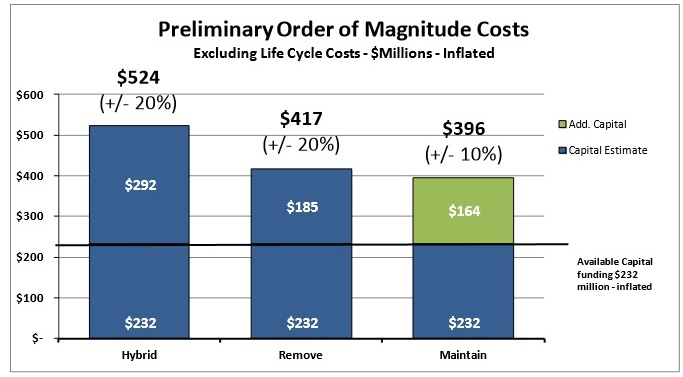
Council’s financing plans include $232-million (in inflated, as-spent dollars) for remedial work on the eastern portion of the Gardiner. This was established as part of an overall plan to renovate the expressway in place, work that is now underway on the expressway west from Jarvis to the Humber River. However, even to maintain the existing structure is now projected to cost $396m (±10%) while the Remove or Boulevard option comes in at $417m (±20%) and the so-called Hybrid option at $524m (±20%). These are only capital costs for repair and/or construction, not for long-term maintenance. The City faces an initial shortfall of roughly $200m at least, and there is no headroom in the long-term capital borrowing plans to handle this.
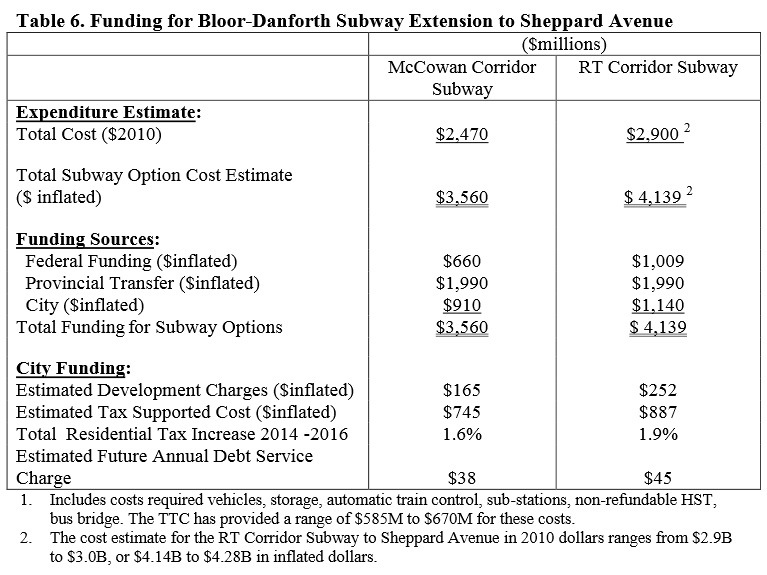
The Scarborough Subway Extension (SSE) as approved by Council requires Toronto to contribute $910m to the project’s estimated $3.56b total cost (including inflation). Of this, $745m would be financed through an additional property tax which has ramped up to 1.0% in 2015 and will increase to 1.6% in 2016. The remaining $165m would come from development charges.
Two problems face Council here.
First, there are proposals to shift the location of the SSE and to add one or more stops to the route to improve its attractiveness. Any increase in cost – typically $300m/km plus $150m for a modest station – must be funded 100% with City money as both Queen’s Park and Ottawa have capped their contributions based on the original LRT network plans. The proportional increase to that $745m base would be substantial, and it would require a significant increase above the current tax level.
Second, although the SSE tax finances the capital cost, the city’s debt model looks at borrowing costs as they occur relative to current-day revenues. Yes, there is a tax in place to pay down the SSE debt eventually, but this does little to offset the short-term bulge in total borrowing as the City’s contribution to the project is paid out, mainly in the early 2020s.
As proposed by Mayor Tory, the SmartTrack scheme would cost $8-billion of which the City would pay 1/3, or $2.7b. This would paid through “Tax Increment Financing” as described in Tory’s campaign literature:
To fund the SmartTrack line, Tax Increment Financing revenue will be leveraged over 30 years as development activity and assessed values increase along a new transit route. It is estimated that $2.5 billion in present value dollars can be raised over that time. All revenue estimates are based only on projected new office development in three precincts within the following districts along the SmartTrack line: the Central Core; the East Don Lands site; and Liberty Village. Tax Increment Financing revenue will likely prove higher than $2.5 billion once development near other stations and residential development are added. This requires provincial approval, including a change to the 1 per cent legislative cap.
This paragraph is breathtaking in its assumptions. TIF is intended for “brownfields” developments where only the presence of major public investment allows an area to rejuvenate and a true tax increment (relative to what would otherwise occur) to be available for capture. This is far from the situation in the core or in Liberty Village, and a good deal of the East Don Lands is proposed for or under development even before SmartTrack comes into existence. Tory’s campaign provided no supporting material to justify its claim, nor is there any discussion of the net new taxes actually available after paying for improvements needed to serve any new developments beyond paying for SmartTrack.
A further oddity is that there is no mention of TIF benefits in the areas in York Region and in Mississauga that were first mooted as the real targets of what is now called SmartTrack.
If Toronto is unable to finance its share of SmartTrack through TIF, or if senior governments do not come to the table at the projected level, then either Toronto must find more money for its share, or recognize that SmartTrack, as proposed, is unworkable.
The combined value of Toronto’s capital needs for the three projects could push the city well beyond its target debt limit. Even if we shrug and say “so what”, we would be left with a city with no remaining borrowing room, constrained in launching any other projects without offsetting revenues. There is a point at which simply spending more money will not solve every problem.
Picking a Route: Maps and Crayons at the Ready
The Gardiner options have been described at length elsewhere and I am not going to rehash them here. The core issue is whether an elevated section will remain between Jarvis and the west side of the Don River, and how its alignment would affect neighbourhood development along the Keating Channel.
On SmartTrack, the original plan was for the western leg to run along Eglinton to the business centre south of Pearson Airport. However, the surface alignment originally thought to be available by SmartTrack’s planners does not actually exist. Moreover, a difficult tunnel under Mount Dennis to link the Weston rail corridor to Eglinton Avenue would make connection with the Crosstown LRT station difficult. Recently, another alignment has cropped up in an illustration posted by Chief City Planner Jennifer Keesmaat. (The soft resolution on this image is from the original on Twitter.)
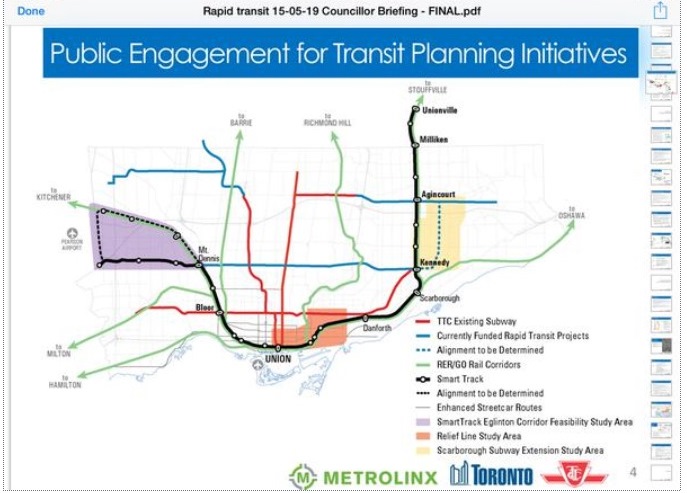
An alternative alignment for SmartTrack would avoid the significant problems of the Eglinton West leg and would add stops in Weston northern Etobicoke. It is unclear how this would relate to the recently opened UPX service that shares much of the same corridor.
In Scarborough, there were many competing alternative routes in response to a concern that the approved McCowan alignment is too close to SmartTrack and that ridership would suffer. This has been whittled down to three options: Bellamy, McCowan and a Midland. Whether any of these is actually viable will depend on key issues such as the frequency and fare level of SmartTrack as compared to the TTC subway. Other options have been proposed but are not in the City/TTC evaluation including a branch off of SmartTrack along the SRT corridor east to McCowan and possibly beyond to Malvern. An important issue that has not been discussed is the question of where, exactly, the “Scarborough Town Centre” station on any of the subway proposals would actually be – within STC itself, or at McCowan – and how these options will serve existing and planned developments, not to mention bus feeder services.
If additional costs become a problem for Council, it would not be surprising to see the leg north of STC lopped off (or made into a “Phase 2”) to stay within the $3.6b overall budget.
An issue for the entire network is that Metrolinx now speaks of the electrification of GO, a prerequisite for very frequent service, as starting in 2023. It is unclear what service levels, not to mention fare integration schemes, will exist on GO by the time various other projects plan to begin operations.
Competing Projections of Ridership and Travel Time
Projections of future conditions – ridership, travel times, road congestion – are central to all three projects. In the case of the Gardiner, there are competing views of how the boulevard option might affect travel times for various trips and types of road users. “Fighting congestion”, a major goal for Mayor Tory, underpins his support for the so-called “Hybrid” option that would leave much of the elevated expressway intact.
SmartTrack was sold to Toronto voters on the basis that it would speed trips into downtown from outer parts of Toronto. What is not yet known is how SmartTrack would relate to GO services in the same corridors, or what sort of fare integration there would be between various transit systems. “Fare integration” is too often used synonymously with “fare media integration” which is far from the same thing. If the UPX cannot break even with fares in the $20 range, what will be needed to support SmartTrack? What size of trains and frequency of service will be required to make SmartTrack a truly attractive option?
The Scarborough Subway evolved from an earlier LRT plan buttressed by claims that demand would be in the range for which subway technology is suitable. However, that demand projection brought in riders from the north (much as regional trips come to Finch Station). These riders quite reasonably should be assigned to improved GO and/or SmartTrack services, not to the subway.
A fundamental problem with all projections is that the set of assumptions built into them is usually far too complex to be articulated in public summaries. Motorists see charts showing a five minute extra trip time, but this has no context including the underlying assumptions, and the behaviour of the wider network. We know that the model presumed many transit improvements, but we are not told how the transit network’s demand will look in 2031, only the expressway. If money is scarce, we should know where the greatest need will be rather than deciding on a Gardiner option separate from the future of SmartTrack and the SSE, not to mention the Downtown Relief Line. This information is supposed to be available later in 2015, and it could significantly change the debate about options and relative priorities.
A further technical issue with demand models is that they generally don’t do well at distinguishing flows between multiple nearby options. Moreover, some modelling has been done without capacity constraints so that projected demands greatly exceed the actual available capacity. This in turn might be used as an excuse for massive expansion rather than evaluation of network alternatives (the Yonge Subway capacity expansion vs the DRL is a classic case).
The Politics of Decision Making
Although Mayor Tory speaks of the need for consensus in Toronto, the Gardiner vote is surely one he wants to win both to show his leadership as Mayor and set the stage for other debates to come. The Star reported that Tory’s office is lobbying for votes:
… his senior staff are lobbying councillors to back the mayor.
“It wasn’t an intense as the (former mayor) Rob Ford strangleholds, but it was a heated discussion,” Councillor Paul Ainslie — a member of Tory’s executive who has decided to vote for the boulevard — said of a visit by Tory’s principal secretary.
“He said, ‘You’re part of the team, it’s got to be a team effort.’ I’m happy to be part of a team, but I’m not going to support bad city planning when we could spend $500 million on transit, housing and other projects.”
Tory might win on the Gardiner at Council only to face the problem of getting provincial approval for the Environment Assessment as John Lorinc details in a spacing.ca article today. Would Queen’s Park block the Gardiner East project just as the Davis government did so many years ago? Do Kathleen Wynne and her Environment Minister Glen Murray (whose riding includes the Gardiner East) want to engage in this question? Evading the issue isn’t an option because either approval or rejection of the Environmental Assessment sends a strong message about the government’s real priorities.
John Tory has shown that he can change his mind with his position on funding TTC operating subsidies (not enough, by far, and threatened with cuts next year), and on the extremely divisive issue of “carding” by Toronto Police. What other changes might be in store? Does Tory want to govern protecting his right flank from a 2018 election attack by the Ford brothers, or should he aim for a centre-left coalition?
Toronto cannot debate major transportation and financial issues as if each exists as a discrete, isolated decision. What we choose to do affects the transportation network and the city as a whole. That’s a much more complex debate, not an easy path, and pleasing everyone simply is not possible. Telling people what they want to hear might work in an election campaign, but actually running a city and making choices for its future are the challenges facing our city.
 Steve Munro
The issue here is that they’re debating the wrong questions: If there is any infrastructure money to spend on Toronto, it should go into the King/Front-Don Mills subway (a.k.a Downtown Relief line). If there is infrastructure money to be spent getting people into Toronto from the suburbs and exurbs, it should be spent on electrifying the GO, starting from the innermost stops, focusing on the most underserved areas first, filling in areas far from the GO with express buses. Then when we have more infrastructure money to spend, we can keep on building ridiculous subways in Vaughan or whatever BS the politicians decide they want to do then. The Scarborough RT? Raze it and put in a dedicated bus lane for an express shuttle service. I don’t like buses, but we can’t afford to piss away billions on politicians’ pet projects where not much demand exists, when the downtown system is overloaded and demand grows every month.
LikeLiked by 2 people
Excellent piece! I despair of Toronto ever getting a transit decision right. Look at the history: Scarborough RT — wrong technology used for political reasons; Sheppard subway — political pressure from Mel Lastman et al — remember how the original council decision was to build it but not actually operate it?; subway to Vaughan — against the advice of city’s own planners; UP express — as built makes almost no sense at all. What is wrong with these people???
LikeLiked by 1 person
Good article Steve. I would argue that one of the reasons Toronto is in this situation, is that it has grossly underestimated its long term needs, and the voters have focused too narrowly on taxes, and not wanted to hear much about planning.
I would hope that his target would be to be a soft right, managerial conservative. Lay-out what is absolutely required, lay out the cost and tax implications, and then go for a traditional Red Tory approach. Leave the fear of Chow in the hearts of the would be Ford voters, and the fear of Ford in the would be Chow voters, and do his level best at seeming as reasonable as he can.
He should be saying “Sorry I cannot justify saving you few 2-5 minutes here, at the costs of reducing the tax base that much and expending that much extra.” “Sorry, we simply cannot justify 2 heavy rail lines focused mostly on getting people to the core, when most of the demand in the area is local.” He should look to his still popular / revered friend Mr. Crombie for some guidance, and look to the now published studies for cover as to why he is doing so.
He has been elected mayor, and now needs to focus on governing for the city, and hope that people will realize that this means looking to best outcome for the most, not themselves personally. He needs to driving a huge improvement in transit in Scarborough, and the in the shoulder areas of downtown, and in northern and southern Etobicoke, and capacity into the core. To do this he needs a plan that looks reasonable, can be afforded, not half baked. He needs to not sell fantasy, and push for real, achievable plans. ST+SSE+Gardiner Hybrid, is a spending level in the fantasy zone, that would frankly do little overall for the city.
LikeLiked by 1 person
Umm… the other alignment comes from the Council motion (as amended) directing that SmartTrack be studied. It’s item 8 on the motion as passed.
Steve: Thanks for clarifying that. I knew it was on the table, but forgot that it actually came in the City’s motion.
LikeLike
Whatever Metrolinx or others may have you believe, elctrifcation is *not* a prequisite for very frequent service. The frequency of GO’s service is constrained by (1) lack of double track on some lines, (2) signalling and (3) turnaround times/tracks at the service termini. The current signalling system is good for 5-minute headways; the existing turnaround arrangements could probably support 15-minute service already. The main upgrade required is double-tracking the relevant single-track lines.
Electrification does not enable or change the potential service frequency.
Steve: Certainly at 15 minute headways, they don’t strictly need to electrify and can make service improvements simply with more track and trains. If they want to get down to the levels spoken of in The Big Move with 10 to 12 trains/hour, the savings from electrification requiring fewer trainsets and/or allowing stops to be inserted without a schedule penalty relative to today’s operation cannot be ignored. Also there’s an issue with train spacing related to acceleration performance.
But for what’s on the table as “RER”? No.
LikeLiked by 1 person
This to me is the real issue, are we rushing electrification where it may make only a small difference. Does it make sense on Stouffville, Richmond Hill, or even Kitchener yet? It would appear to make sense to me on Lakeshore west, and East, where additional trains are a bit of an issue at peak. However, I would hope that we would then push the locomotives, and any cars that might be freed up in conversion (depending on the increase in frequency and train size) to the other lines, where electrification was not yet required.
I would love to see 15 minute all day service, however where we will not fill that at peak with even 8 or 10 car trains, and do not need a train every 10 minutes let alone every 5 does electrification make sense? Or will fare integration have a larger impact for a fewer dollars? I agree that electrification is required for very frequent service, especially where there are a large number of stops, however, I do not believe that trains every 15 minutes qualifies as “very frequent” from an operating limits perspective.
LikeLike
Tear down the Gardiner East. ASAP. If the fancy “upgrade” to Lake Shore Boulevard can’t be afforded… then don’t do it. Just tear down the highway and see what happens. Based on the traffic estimates so far, it would work out OK.
LikeLike
Steve’s mentioned Metrolinx starting electrification in 2023 twice now. Can anyone point out a reference? My impression from the RER documents was that the first tranche of electrification would be completed in 2022-23.
Steve: There was an interview with Bruce McCuaig, Metrolinx CEO, in the Star last week. It included this exchange:
I think we are running into nuances of meaning here. I read McCuaig’s comments as saying that there will be no electric operations until 2023, and that will only be the start of the rollout. You are talking about completion of works leading to electrification by 2022-23. The common point here is that earlier assurances that UPX would be electrified within about two years of starting service clearly will not be met. I don’t think it was a realistic promise to begin with, and the UPX project should not be allowed to skew network plans any more that it has already. But the promise was made, and now is broken.
LikeLike
If electrification is in the plan anyways, it’d make sense not to invest twice in rolling stock. Mind you, there is a market for second hand commuter rail stock in North America that GO has used before that could be used to cushion at least part of a long-term overcapacity in diesel locomotives and carriages. I’m not sure how much that market is now constrained by the Buy America Act.
LikeLike
Hi Steve
I believe Toronto is at the crossaroads in its development. This summer will be crucial to see if Toronto keeps going forward or its lack of transit will finally catch up to it. I don’t believe the Scarborough subway should be built and the Gardiner should be torn down. The western leg of SmartTrack should become the western leg of the Crosstown. But those in power want votes. We will see how this plays out.
Is there anyway we can tear the whole Gardiner down?
Steve: There is no point in trying to tear the whole Gardiner down. For one thing, that ship sailed years ago in the political sense and we are now spending a bundle fixing up what’s there. For another, the road is now hemmed in for goodly chunks that assume they can turn their back on the expressway. This would hardly make an attractive at-grade road. The travel time and congestion effects to the west would also be greater than to the east because there is more usage of the western portion.
LikeLike
Yes, thanks Steve.
You wrote something that surprised me:
Maybe I wasn’t paying attention, but I thought John Tory promised a SmartTrack “surface subway” that TTC riders got to board just by paying a TTC fare, or showing a TTC transfer.
Did John Tory ever advise voters that his plan called for riders to pay an additional fare? If other voters also missed that part of the plan, I think that will come as as very unpleasant surprise — if it ever gets built.
Steve: I don’t think that even John Tory knows exactly what he promised, and he may get a rude shock when he finds out what that “TTC fare” will cost the city. I flg this issue because any demand projections are very sensitive to the fare structure and free transfer privileges.
LikeLike
Tory has no choice but to lean be pro car & pro subway otherwise a Ford is coming back. People commuting into the City will have their already sickening daily commute extended by construction, growth & possible tear down of the Gardiner without improved transit leading into the core. Certain areas of the City have already been fenced out enough.
The real problem is no Politician wants to tell the residents about the higher property taxes coming since we haven’t been planning properly in previous generations.
The Liberals talk big on transit but refuse to raise taxes so what are we really receiving?. The Big Mirage. They even hide behind the sale of assets to warm hearted private corporations to salvage some change to help extend this charade.
Not saying the Cons are better whatsoever. But I will say oddly enough it was under the lone wolf Ford’s politics that we raised taxes to pay for a much needed subway extension. Just think if we did the same for the DRL, & burying of the Eastern Gardiner how much better we would be as a City down the road. It’s worth the pain that could have been avoided by proper planning.
Steve: Council raised taxes for the Scarborough Subway at a rate three times higher than Ford claimed was necessary. He wanted only 0.5%, but Council set the rate at 1.6% on the advice of city staff. Ford like everyone else pushing the no new taxes mantra was unwilling to accept just what the scheme would actually cost.
The Province could then continue to toy with voters with their LRT’s, BRT’s & Electrification games. And If they are even half serious maybe they could fill out the other areas & Toronto to feed into the great system we would have.
I don’t like the Ford’s personally & don’t like the lies about getting things for free. But what Politician isn’t lying? In the end they are only ones to correctly raise taxes for the greater future of the City.
Pressure should also be put on the Feds to step up an election year but that no guarantee. Keep in mind the economy is likely headed for the next cyclical dive over the next few years & transit infrastructure may be heavy on the agenda to help create jobs.
LikeLike
Yes the subway should be extended to Scarborough, any of those routes is fine except the RT right of way – we want underground and not an on-surface route in the middle of nowhere. Whatever the cost, the subway should be extended to Scarborough for Steve never asked the following question: Should the streetcar network be kept alive by purchasing new streetcars and at what cost? If the streetcar network has to kept alive no matter what the cost, then why should cost be an issue for when it comes to anything Scarborough?
Steve: This question has been asked before, and the issue is that growth in population and demand in the central city cannot be handled by buses. We would have more people riding streetcars today if it were not for the artificial limit on growth caused by the fleet being too small for almost twenty years.
The question in my list are the questions before council.
LikeLike
For the Scarborough Subway, I’m starting to think the best solution is to go back to the LRT for service to the north and west of Scarborough, with a subway extension along Eglinton from Kennedy to Bellamy (and Eglinton GO station) for south Scarborough.
As for Smart Track…now that the “Smart Spur” in the east and this alternative western alignment are being shopped around, I have only one question: Can anyone point to any data that say a 1 seat trip across Toronto (via Union) is somehow better/more worth the additional costs than building RER+LRT?
I haven’t heard it from Tory or Keesmat or Metrolinx yet. I worry this analysis may not even make it into the “independent” Eglinton West corridor study that we are all supposed to trust.
Cheers, Moaz
LikeLike
I think the question could easily be reversed, if you were to do try and replace Streetcar service with buses, what would it actually cost to provide the capacity required. What is the per rider cost here, versus bus elsewhere in the city? I would remind all that with the new cars – which will be full on routes like King, you would be talking about running 3 buses with 3 drivers for every Streetcar in service. This would imply 1 a bus on King about every 40 seconds, or more to the point processions of 3 – 4 at every signal.
Given the system is currently capacity constrained, I would strongly suspect that this is an area that requires little operating subsidy, and the capital requirement – per rider is likely no higher here than elsewhere – when you factor in the cost of roads being used – and damage by buses. Yes a streetcar costs, what, 5-6 times what a bus does? However carries 3 times as many riders and lasts more than twice as long. Added buses would also have required a massive new garage etc. What would the fully loaded cost of buying the alternative – including new garages of what would have been 600 additional buses? What would the additional cost have been to the TTC of adding a net 400 drivers for each of 2 peak shifts (beyond what is required for streetcars). I think if we look at the overall costs when factoring in all requirements – the Streetcar is likely on a loaded basis – less expensive than the alternative of bus, even before we look at the the further disruptions from the massive number of buses that this would imply.
I believe that downtown – with the Streetcars, and massive tax base is the one area that requires the lowest operating subsidy, and streetcars are required to make this work, why would anyone want to undermine this and thus further increase the cost structure of the TTC?
LikeLike
I really wish all could get back to basics. I believe that we can actually afford the transit that is required – assuming that we stop with the BS of constantly ignoring the basics of planning, and delaying things so that they are completely out of hand before they are addressed.
We need to start looking at how people would choose to ride, if the fares were not so out of whack between GO and TTC, and areas where capacity on GO can reasonably be created to avoid truly massive capital expenditures -this needs to be done. However, for the most part this means more service, and better integration of both systems and fares, not more stations. GO needs to drop its farebox recovery goals, and start looking to relieve the pressure on the balance of the transit system. What would the effect of having say the Sheppard LRT provide a real link at Agincourt where there was GO service on the 10 minutes and a free transfer ? BRT in Gatineau from Morningside to Kennedy GO with the same deal?
In the northwest what would the impact be of just the Crosstown to the airport and MiWay – with a free transfer to GO-RER at Mt Dennis and Finch west to the airport grounds through – Malton GO?
This type of thing would clearly not be the answer, just a stepping stone, but well, we need to start with reasonable steps that can actually be achieved. As a Quiet Guy from Oakville said – “I believe Toronto is at the crossroads in its development.” If we stop swinging for the fences, we might just get somewhere.
LikeLike
More (U of T) experts calling for removal.
Of course, amateur planners like Councillors/Mayors know best and have a track-record to prove it. Sigh!
LikeLike
What are you suggesting – and we should follow expert advice, and not polls? Next you will be saying that planners should plan! Or that transit should not be planned at the council table or the ballot box! If we were to follow this course we might (against all our best intentions) end up with that city that actually worked – lord forbid.
LikeLike
Don’t distort the capacity issue. An articulated bus carries more people than the CLRV streetcars and yet not one of you streetcar addicts ever recommend replacing CLRV streetcars with articulated buses.
Steve: Yes and no. Service design capacity of 18m artic is 77 vs 74 for a CLRV. However, CLRV has greater capacity for surge/crush loads. Point of comparison is Flexity streetcar.
Why you did not bring the new streetcar barn cost issue, changes to the present ones, etc when the new streetcar order was being discussed (prior to it being approved)? The new streetcar barn for the new streetcar is way being schedule and way over cost. Also you fail to mention that buses provide much faster transit and that streetcars cause gridlock. Many cities including New York City have successfully made the transition from streetcars to buses without the end of the world scenario that you predict should streetcars be abandoned.
Steve: NYC also has a huge subway system carrying the lion’s share of the demand. Streetcars do not “cause gridlock”. Just look at any of the non-streetcar streets downtown to see how well they perform. NYC got rid of streetcars as a political move, not as a planning move. Remember also that Robert Moses was going to demolish large chunks of the city for an expressway network.
LikeLike
Certainly a decent option given the current climate. I would prefer a similar option:
1. 2 stop subway extension ending at STC
2. Loop the LRT from Eglinton up Kingston rd and around Sheppard.
Scarborough would then be sufficiently served with local & Core transit options, cover “Priority areas”, post secondary schools & serve STC as the main business hub. Of course it not “perfect” but in my opinion is the best plan to serve all interests in a fair manor.
Extending the subway alone or patching LRT lines and call it an effective local network is absurd.
LikeLike
Steve, I support removing the Gardiner East but if the other option is decided by a democratically elected Council, then I hope that you will stop crying and relentlessly attacking it the way you continue to do with the already repeatedly approved (by all levels of government) Scarborough subway. As you know that there was heavy opposition to the new streetcar order but once democracy decided to order them, you could not find a single person in Scarborough or elsewhere continuing to cry about the new streetcars and trying to cancel the order.
Steve: Actually, Council is not the last stage on the approval process for the Gardiner. That rests with Queen’s Park who must approve the EA. The process is part of that democratic process whether we like it or not.
As for Scarborough, the problem is that we will likely see a bait-and-switch. What Council approved and what may actually be proposed are two different things. Either the line will cost much more than Council and some important swing votes are willing to support, or the line will be cut back to STC to save on the cost of going to Sheppard. In either case, the “approval” now in place will be for a different version of the project.
I look forward to a robust debate when the options finally land at Council.
LikeLike
None of what you say is on the table and a lot of pro-Downtown people are deliberately trying to change the Scarborough subway route, etc as an excuse to delay the project and to eventually cancel it but none of it will work and I am extremely satisfied that the Scarborough subway can no longer be derailed by Downtown. Scarborough subway is inevitable followed by the Richmond Hill subway. The odds of an eastward extension of Sheppard subway is 50-50; I would say at this point. A westward extension of the Sheppard subway makes sense too but is unlikely. The poorer areas of the Eglinton Crosstown (i.e. Scarborough) are extremely unlikely to see their portion buried or even elevated as the will to spend money in poorer areas is simply not there. A westward extension of the Eglinton Crosstown will NEVER happen as SmartTrack makes more sense. SmartTrack and RER together with UPX is also the right answer for the extremely expensive DRL which is unlikely to be built before 2050 but then again it won’t be needed until then.
Steve: I hate to say this, but the move to shift the SSE further east came from its supporters who are worried that SmartTrack will prove too attractive as an alternative for riders originally projected to be on the subway. It’s not a downtown plot. You are going to have to stop blaming everyone west of Victoria Park and south of St. Clair for your problems.
LikeLike
Sure the problem is not that simple.
But you really don’t get our frustration … Every week it’s 1, 2 even 3 new articles from the left media about:
1. A new “cheaper alternative” back of a napkin plan for Scarborough.
2. How the proposed LRT was some magical fully integrated network.
3. A reporter that found a small pocket of Scarborough which prefers LRT as they found a supporter to be interviewed and bless their agenda.
4. How the Spadina line is clear evidence Scarborough should not get a subway.
5. It’s Rob Ford’s fault. (Ever think this nonsense is possibly the reason this nut is around?)
6. Or just plain slanted facts i.e. current travel patterns showing many Scaroborough citizens don’t travel downtown. Well No Crap. This should actually be used a support for the subway instead as it shows many of us have given up or moved as getting to the “economic” core on TTC is hell.
But hey don’t listen to us. You have all the “facts” … I could go on with more common propaganda articles but you either get it by now or you never will or care to.
Seriously how can we fight to build anything worthwhile? There’s clearly an agenda to sell voters to want to give Scarborough the “cheapest option”. Although many of you here think these articles are very genuine & full of factual information. It’s purely skewed slant.
If it’s going to be all LRT, make it a useful network not the crap proposed. The alignments suck, the transfer on Sheppard to a subway stub is absurd, & the network is severely cut short of anything useful due to funding.
Let’s shut up, find some middle ground and pay for a fair network across this City.
Our “supporters” are just trying to get past another obstruction in SmartTrack as even this will be used as a tool by the pro downtown political machine. It’s certainly a major problem.
Steve: Regarding travel plans, it is a fact that there is a large amount of travel within Scarborough and to places that are not served by the SSE, notably between “north” and “south” Scarborough across the 401. This argues for a network serving more than core-bound trips, but does not by itself argue against a subway. Advocates for the SSE should be careful that the link across the 401 to Sheppard is not sacrificed as a cost saving because that is an important connection regardless of which technology is used. Moreover, there could be a situation where SmartTrack, as part of John Tory’s campaign, elbows aside the subway. Despite Tory’s attempt to portray ST as a local service, the train frequency and capacity are likely to be a poor substitute for even the LRT network you despise.
LikeLike
Steve, when were you going to tell us that the TTC had restored the North Yonge Railways? And here I was under the impression that the gridlock on Yonge was due to too many private vehicles and insufficient transit alternatives.
Steve: Motorists are terrified by those 97 Yonge buses every half hour, and become catatonic from Glen Echo to Davisville with a bus every 15 minutes.
LikeLike
What is your evidence for these statements?
As I understand it, when Bay and Dufferin switched from streetcar to bus, TTC had to increase the run time because the buses were not able to make the time the streetcars did.
Also, while drivers complain a lot about streetcars, I have seen studies that indicate that streetcars introduce a control to the street, making things flow better overall and thus actually reducing gridlock.
Steve: While it’s a nice argument, and true for Bay Street, there were never streetcars on Dufferin.
LikeLike
OK, I’ll bite.
Cite the three, two, or even one article published last week by the `left media’ about each of those.
Internet blogs, Twitter and Facebook, and online comments don’t count as media. (If they do, I get to cite a much longer list of things that are mentioned a dozen times a week by what I can if I like designate `right-wing media.’)
Steve: To be fair, the Star has run some long articles on the subject recently.
LikeLike
Steve – I know you have already answered Jeff’s previous reply to my comment – however, I wanted to clarify a little myself – if I could.
Ok when compared to artics – Flexities can carry twice as many, however, I would note Steve’s previous commentary and article on how artics perform on routes with very high turn over. The shoulder area has both large ridership, and very high rates of turnover on the car – to which Artics do not seem adapted. Artics will likely be great for routes with high ridership, longer runs with lower turnover – ie ones with a terminus at a subway line, where most riders are actually headed to the subway.
I would remind you – I was replying to a previous comment, and the barn is always one of the things that is rolled in to the high cost of streetcars. The point I was making is that a large increase in the bus fleet would also require a massive expenditure, in garage space. Also I would not make the argument that the TTC is particularly good at either bringing things in on budget, or being straightforward initially with what the final scope will be. This however, will also be the case with a garage.
Steve: It is also self-evident that the problems with the new carhouse were not known when the streetcars were ordered.
I would also note I am not addicted to Streetcars, but believe they have their space. I would have preferred it if there was a little more space in the downtown (ie an extra 25-30 feet in the road allowance) so that the streetcars could reasonably have their own lanes. The demand on some routes is so high that this would make a huge difference in how the system operates. However, it would appear that the planners of the 1840s did not have that much vision. If Toronto had developed like NYC – I suspect we would have a subway under Queen, however, we do not – and while I do not believe the world would end without streetcars in the downtown, I do think we would either need a real LRT (closed ROW) or a subway if we did get rid of them.
LikeLike
I think this is really the issue. QP, and City Hall, need to stop following, and start leading. I think a real LRT+BRT solution, which really addressed most of Scarborough’s transit needs, could easily be sold. However, it requires getting the planners to lay it out in detail, and then actually implement, and stop playing politics with it. Personally I have no issue with a rollout plan – that has credibility. However, that would mean having real credibility – put the 3.8 billion in a lock box now.
Lines on the map are meaningless; discussion, and study are as well. Waterfront West LRT was being discussed in the 1990s – and all that has happened since is the possible ROW options have been closed with construction. Why would anybody believe this would not be the case in Scarborough? I do not believe the current RT route is as useless as some say, as clearly it would attract many more than the 4k peak riders the current line does (as it is capacity constrained), and likely 6K in the here an now, if it was more frequent and had the capacity. There is a need to actually bring all of Scarborough within a short ride, of service that will not be subject to congestion (ie some form of rapid transit). There needs to be linking services, that are frequent and reliable enough that a transfer will not be seen to an issue. If for instance the Morningside bus, had a transfer to an LRT or BRT that ran on a frequency of 2 minutes (and the worst gaps were under 4), had a real shelters, and made a run to the subway & GO in say 15 minutes, and through the other major North South routes in Scarborough, the perception by those people that subway was a requirement, would likely be significantly less.
The debate needs to shift to service, and there is a real need to move the needle on the perception that the only frequent and reliable service is subway. However, that would require actually leading a debate, rather than following polls, explaining to voters and users, how this will work, not pandering.
LikeLike
Interesting footnote: Transit Toronto recently added the history of the Dufferin streetcar. It was a bizarrely short route from Springhurst loop to the crossover by King that ran on and off from 1915 to 1950.
Steve: Somehow I don’t think that’s the part of Dufferin in question.
LikeLike
Hi Steve
I have a couple of issues with Jeff’s comments concerning streetcars and gridlock. The Star reported on a paper that the city did in 2010 on the most congested streets in Toronto. Not one of them has a streetcar route on it. They also did a slightly more recent one on the most congested intersections. Again, not one of them has a streetcar route on it.
Streetcars do not cause gridlock. Too many cars with one occupant do.
LikeLike
Um, no…. Huge numbers of single-occupant vehicles that are crowded onto city and suburban streets during and outside rush hours cause gridlock.
However, if you are an impatient automobile driver, then you *could* claim that both streetcars *and* buses “get in the way”: streetcars block curb lanes (outside of dedicated rights-of-way, a la St. Clair Avenue) when they open their doors to let passengers board or alight and buses too, “get in the way” as they either “block” live curb lanes when picking up passengers or have to pull back into a live lane from a bus bay after having done so.
What conveniently gets forgotten in this type of comment, however, is that the automobiles – which make up a large proportion of rush-hour traffic – are composed of single-occupant vehicles, carrying only ONE passenger, while streetcars and buses carry MORE THAN ONE. So if you were to immediately remove half of the cars carrying only one person from the roadways at any given time, either a bus OR a streetcar would provide much faster transit because the actual cause of the gridlock – single-occupant vehicles – wouldn’t be there!
LikeLike
Some studies, huh?
I have seen studies that indicate [INSERT YOUR FAVOURITE CLAIMS HERE (NO MATTER HOW OUTRAGEOUS)].
LikeLike
On a serious note, why hasn’t there been any real improvements to the 97 even though there has been a significant jump in the population along the route north of York Mills? Is it just the result of “who needs surface transportation when you have subways” myopia?
Steve: Yup. Meanwhile we talk a great line about accessibility.
LikeLike
It’s all a Big Mess, eh? Kinda sad, but hopefully, at least the rest of the world will be seeing how messed up we really are this summer – Panamonium on the streets maybe… A bit more seriously, we really do need to get good origin-destination data out there, or collect it first, and then share it including those car trips.
I’m remaining firm in thinking that even in Scarborough terms, using the wide Gatineau hydro for some busways would be smart and an inducement of fast transit to potentially several key destinations (or environs) to help us reverse away from the SSE, and squeeze the billions.
There are plenty of other needs for the millions too. The roads are in rather rough shape, there’s a batch of decay in our housing, and it seems we can’t even manage putting in a pair of stop signs in timely enough ways to save a life eg. Roger du Toit.
Maybe it’s time for a development freeze in the core till we get real transit improvement? And within the WWLRT, there was fascinating modelling of a Front St. transit service out to Etobicoke that would have surpassed the WWLRT in terms of actually moving people quickly on a longer haul, something that we really need ie. semi-express and sub-regional.
LikeLike
Thanks for the response Norman. You can google Scarborough subway & go to the news feed where you surely can’t miss the recent assault of articles from the Star, Metroland media, InsideToronto etc. If you have any trouble I’ll gladly send you more than 10 links from the last two weeks & I’ll even go back six months & send you the most disturbing ones.
I don’t advocate for “right wing” propaganda whatsoever & to be honest these jabronies seem to take a step back approach on transit issues right now. Being proactive would result in using the “T” word & even the Liberals have buried their head in the sand instead of telling voters the truth. The Cons seem to be content watching the Liberals lie & fumble the ball as they attempt not to raise taxes a provide some form efficient transit is likely an implosion they are waiting to jump on down the line for political gain.
So when a large area’s complex needs are being ignored, obstructed, & trolled by a one sided political media giant it only fuels the need for a polarizing figure like a Ford who at-least acknowledges the problem.
To be clear I don’t despise as LRT network whatsoever. I despise the current funded LRT hack job being disguised as a “network”
This is also the unfortunate simpleton “either-or” arguments we are forced to fight over. No one should have to be careful. There are 2 issues required to serve Scarborough effectively.
1. Effective TTC transit to the core
2. A quality local transit system
If we have to choose & prioritize it will certainly be extending the subway to get as many people closer to the better paying jobs downtown over local transit patches which could be served by buses & the future BRT/LRT’s when traffic no longer allows for reliable service.
LikeLike
The big problem is the one that keeps coming up, every election cycle they come up with a complete new plan, that will take a decade to discuss and cost Millions in consulting fees, but hardly anything ever gets done. They have been discussing what to do with the Gardner since before I moved to Toronto more then 25 years ago.
As for subways, we know they are the heavy lifter in the transit world, they are expensive, until you consider the number of people they carry over the life of the route. Yet that drops fast on a route that isn’t heavily used. I think the problem though is that it’s always the massive megaproject. There really isn’t much to do with Yonge anymore, and Spadina should have turned left at Steeles and headed over to a stop at Jane and Steeles then head South to Sheppard,
LikeLike
To be fair Steve, this has been the on-going refrain from Joe. It is not entirely clear to me what he perceives as a complete LRT network. However, it is very clear he does not like the RT alignment, and the transfer proposed for either Kennedy or Don Mills (for the Sheppard LRT).
While I may differ – given how most transit riders seem to view transfers – and the current ridiculous transfer at Kennedy – I can understand a certain mistrust. Also the degree to which a transfer would be an issue might depend on the service on offer. If we are to presume a 2 car train every 2 minutes – I would see a cross platform transfer as a non issue, a 4 car train every 5 minutes at peak – and off peak headway at 10, I would see differently.
I cannot help but wonder if a lack of clarity on this is a major issue in the political viability of LRT. The voter/rider, may well assume that the proposal is in effect to increase capacity while maintaining or even reducing current service frequency. If there was a commitment to say doubling frequency – it might perhaps be more acceptable. I cannot help but see a lot of the issue in Scarborough is a lack of clarity, certainty, and credibility. I think many would feel differently (proponents from either side) if the service levels really on offer were clear and credible, and the actual extent of build was such that it was really understood.
To me – as I assume service design will end up being – would think LRT would be better, however, in the back of my mind, I expect this to be based around the shortest headway to make signal priority work on Sheppard – likely something like 6 minutes, and the shortest train feasible to make a 2-3 minute headway work on the RT route. I see this as better than what I suspect the subway will be – 5 minute on peak service past Kennedy with 10+ minute off peak service, and the required link to Sheppard being in deep question.
I also make the assumption that political pressure would be enough to keep LRT construction underway, in a long series of micro commitments going forward, however, it will be important that the LRT carhouse be over-sized for the initial projects -and would see this as key to whether the government is really committed to future service expansion or not.
I believe getting small extensions to subway going forward will be very hard to extract, and whatever political solution is found, that will be that for a long time. You can make real headway on a LRT network – with 100-300 million dollar commitments – as long as the car house is their, whereas with subway, well this gets you nowhere. I would worry more about the hack job in building subway – largely because it is unlikely to be revisited, whereas an LRT network extension is a very easy way of buying a riding or two (yes that is cynical).
LikeLike
If you compare the average speed of buses to streetcars in the old city of Toronto you will find that the street cars are faster. On every street that was converted from street cars to buses the average speed of service decreased. If you are going to compare buses on wide streets in the outer 416 to street cars inner city streets then yes buses are faster. Check the TTC service summaries as they give the average speed of each route and compare routes that operate on similar streets. You will find that the streetcars are faster than buses.
Please explain how streetcars cause gridlock.
LikeLike
@Wogster
I would call buses the “heavy lifters” of the transit world here in Toronto. More daily trips are taken by bus than subway/RT combined. The bus networks is an often ignored, extremely important part of Toronto’s transit landscape. The system doesn’t work without them.
(2013 data)
LikeLike
I can’t help but note that certain individuals aren’t decrying the suburban councillors who are about to impose 30 years of more Gardiner on the downtown. (All Toronto councillors are voting for tearing the east Gardiner down)
In the interest of fairness and against the scourge of double standards, this means the SSE should be back in play.
LikeLike