
At its meeting of January 22, 2015, Toronto’s Executive Committee will consider a report (SmartTrack Work Plan 2015-2016) recommending a work plan for the study of Mayor Tory’s SmartTrack proposal together with other related transit projects. This is intended to dovetail with Metrolinx’ work on their Regional Express Rail (RER) network, and will have spillover effects on studies of both the Downtown Relief Line (DRL) and the Scarborough Subway Extension.
The most important aspect of this report is that, at long last, a study is reviewing transit options for Toronto on a network basis rather than one line at a time. Factors such as alternative land use schemes, fare structures and service levels will be considered to determine which future scenarios best support investment in transit. Rather than starting with a “solution”, the studies are intended to evaluate alternatives.
If this outlook actually survives, and the studies are not gerrymandered before they can properly evaluate all strategies, then the process will be worthwhile and set the stage for decisions on what might actually be built. The challenge will be to avoid a scenario where every pet project on the map is untouchable rather than making the best of the network as a whole. The term “best” will be open to much debate.
The report goes out of its way not to prejudge the study’s outcome because several difficult questions must be addressed:
- How does SmartTrack relate to the RER plan, and how will these services co-exist on the GO rail corridors?
- How will SmartTrack affect GO’s electrification plans including timing and location of maintenance facilities, and fleet planning?
- Does SmartTrack trigger the need for additional infrastructure and how will this affect GO operations, the Union-Pearson express (UPX) and the neighbourhoods through which SmartTrack will pass?
- What is the feasibility of the proposed Eglinton West branch of SmartTrack including a link to other services at Mount Dennis?
This is not to say SmartTrack is impossible, but that the vague relationship between this scheme, other plans for the same corridors and existing operations have never been explored beyond the level of simplistic campaign literature. Toronto has passed the point where simply drawing lines on a map constitutes “planning”.
The specific recommendations include:
- That the City Manager “in partnership with the Province” conduct the study described by the report.
- That Council request that several elements of SmartTrack be included in the RER studies: more frequent two-way service, more stops, “accelerated” electrification, service and fare integration with the TTC.
- That the City Manager, Metrolinx and the TTC study the feasibility of options for the Eglinton West corridor from Mount Dennis to the Airport Corporate Centre.
- That the City Manager prepare a strategy for cost sharing of the RER enhancements and for financing the City’s share of capital costs.
- That funding be provided in the 2015 and 2016 Capital Budget for studies.
- That Council request the Province and Metrolinx to work with Toronto and other affected municipalities on “an outreach and engagement strategy” for RER including SmartTrack.
- That various reports arising from this work come to Executive Committee in fall 2015.
Funding for the studies in 2015-2016 amounts to $1.65-million of which $750k was approved by Council when it launched this process in December (Request for Report on Review of SmartTrack and Regional Express Rail Plans). The remaining $900k relates to the Eglinton West corridor including a Transit Project Assessment for whatever scheme (if any) proves workable. That assessment would run into 2016.
The work plan proposes, if required, a second report to City Council early in 2016 to provide the final business case, funding strategy and implementation plan for the Eglinton West Corridor, subject to further Council direction. [p. 2]
Metrolinx is already working on a detailed review of RER plans for all of its corridors, and will present a consolidated request to Queen’s Park in 2Q15 regarding the priorities for RER and other “Next Wave” projects that, collectively, will draw on the $15-billion provincial commitment for GTA transit over the next decade. According to the city’s report, the province is expected to respond to this request in 3Q15. Obviously the position and scope of SmartTrack needs to figure in this review, and the level of funding required from Toronto for the incremental cost above the RER project is a key question.
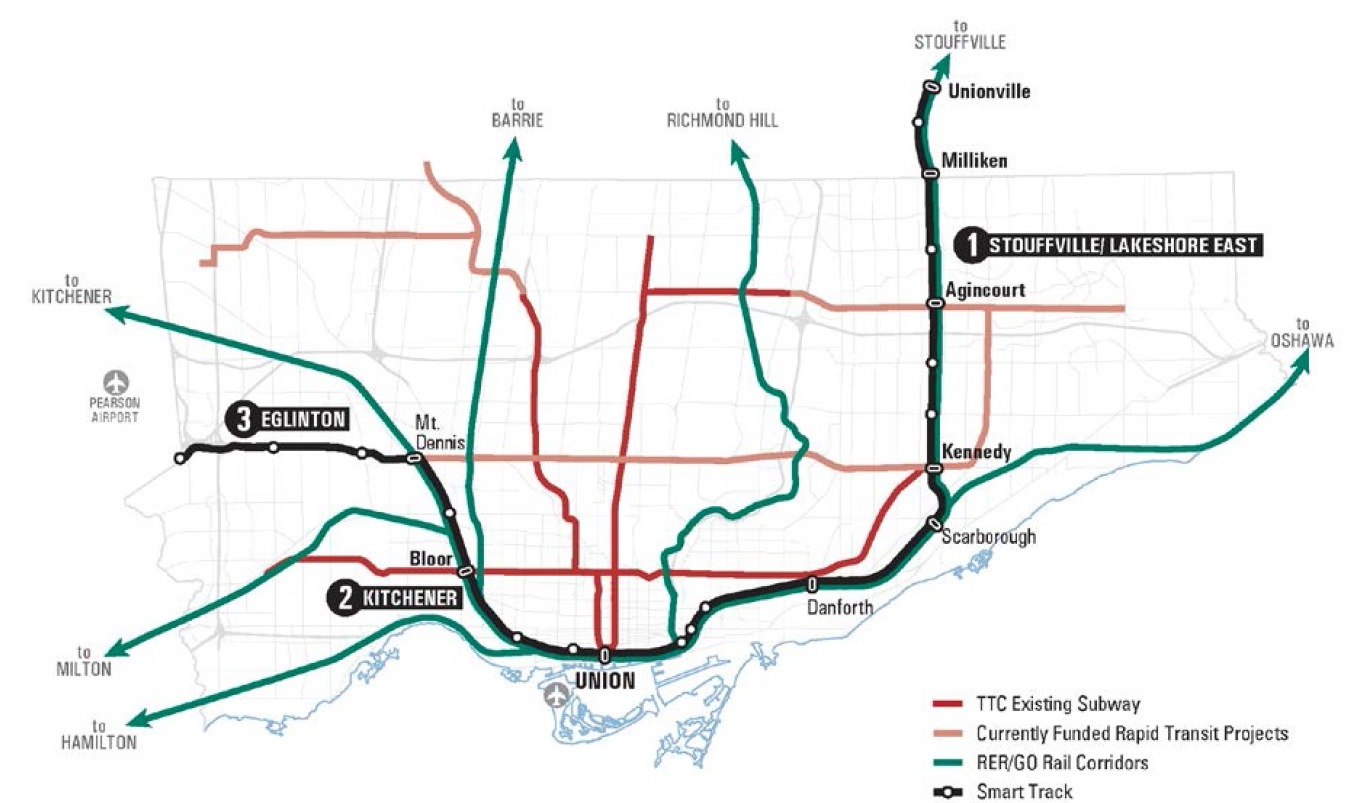
There are key differences between SmartTrack and the Metrolinx RER scheme notably the service frequency, the number of stops, and the inclusion of a “TTC fare option”. Exactly what this means is unclear because phrases such as “fare integration” mean different things to different people. In Mayor Tory’s campaign, it was clear that he intended SmartTrack to operate as an integral part of the TTC fare system. Whether this would be as part of the base fare, or with some sort of “premium” will depend a lot on the generosity of both Metrolinx (as operator) and Toronto Council (as potential funder) of this service.
Financial Issues
The current study does not include any discussion of operating costs nor of the financial implications of various fare structures, although service level, integration with TTC routes and fares will play a major role in the attractiveness of SmartTrack as transit corridor. Metrolinx will include fare options in its RER studies, but to what extent this will include SmartTrack is unclear.
The financial arrangements should prove interesting:
The capital cost sharing and City financing strategy will be developed for consideration with the fall 2015 report to Council. The strategy is dependent on key elements of the business case such as the incremental capital cost estimates for SmartTrack, and the development potential identified along the SmartTrack corridors. High-level cost estimates for all SmartTrack corridors will be available in the fall. An update to the financing strategy will be provided in the winter 2016 staff report, if required.
Ongoing negotiations regarding project governance, financing, and project delivery are underway among the City and funding partners. It is expected that these negotiations will produce agreements or letters of intent for review and approval by City Council. [pg.10]
The report completely sidesteps the fact that “development potential” along the corridors includes lands outside the City of Toronto, and yet there is no mention of participation by the affected municipalities in funding the incremental cost of bringing improved transit service to them.
Rail Corridor Capacity and Infrastructure
Anyone familiar with the rail corridors in Toronto will know that in some locations, the provision of additional tracks, let alone station structures, will not be a simple matter. The service levels proposed will tax some existing junctions (such as Scarborough Junction where Stouffville and Lakeshore East services merge), not to mention the combined requirements for track time and routing of the many services in the Weston corridor (Milton, Kitchener, UPX, SmartTrack and a future HSR to London).
On the Stouffville corridor, GO Transit has already completed an Environmental Assessment for double-tracking the line between Scarborough Junction and Unionville. This study did not review station options except where GO stations already existed (Kennedy, Agincourt, etc.). Even at Kennedy, a proposed new platform would conflict with the existing SRT corridor, and it is unclear whether new SmartTrack stations could be inserted at Lawrence and Ellesmere while the SRT remains in operation. Construction of the “Glen Murray” route for the Scarborough Subway Extension (SSE) would also pose conflicts with infrastructure work for SmartTrack.
On the Kitchener corridor, there has already been a substantial upgrade in the corridor’s capacity, although the city report suggests that more may be required. Of note is a long-awaited change at Bloor Station:
Metrolinx anticipates constructing a direct connection between Bloor GO Station and the TTC Dundas West Subway Station by 2016. [pg. 14]
Whether this is a true, direct connection to the station proposed long ago by the TTC but stymied by the owners of the Crossways development, or simply a walkway along what used to be Vincent Street to link Bloor Station and Dundas Street opposite the subway entrance, is unclear. The Mobility Hub page for Bloor-Dundas claims that Metrolinx is working to provide a connection into the subway station:
In tandem with the redevelopment of Bloor GO/UnionPearson Express Station in time for the 2015 Pan Am Games, Metrolinx will pursue partnerships to create a pedestrian tunnel connecting the GO and TTC stations. [Public presentation December 10, 2012, pg. 24]
If SmartTrack is to make a meaningful connection to the subway, it must have a direct connection, not a roundabout walk.
Eglinton West Corridor
The Eglinton West corridor poses the greatest problems because it is a major new component within a larger plan (RER) that is much more fully developed. Until SmartTrack came along, this corridor might have been an extension of the Eglinton Crosstown LRT, or maybe a BRT route, or simply the 32 Eglinton West bus.
Additional analysis is required to accelerate the review of the Eglinton West corridor for integration into the overall RER review underway for the Kitchener GO and Stouffville/Lakeshore East GO corridors. An expedited feasibility study will be jointly undertaken, to assess options for implementing a SmartTrack heavy rail transit operation along the Eglinton West Corridor to the Mississauga Airport Corporate Centre. Critical in this phase of work is the assessment of the interchange between the proposed Eglinton West Corridor with the Kitchener GO Rail corridor in the vicinity of Mount Dennis. [pg. 9]
In an earlier article I wrote about the challenges of getting from the Weston rail corridor to Eglinton Avenue including an interchange with both the LRT line and a future Mount Dennis GO/RER station (That Pesky Curve in Mount Dennis). The Eglinton West link is the weakest part of the SmartTrack proposal, and it is essential that we move beyond the inevitable political debates amounting to little more than “my consultant knows more than those pesky transit bloggers”.
Totally absent from the city’s proposal is any study of westward extension of the LRT line, no doubt because in its current planned state as a surface operation, this would arouse the wrath of Etobicoke politicians who would lie in the path of bulldozers before an LRT was allowed across the Humber River. If, however, we are prepared to bury SmartTrack on Eglinton West, why should this be the only option? This is a glaring omission.
The proposed study includes a detailed review:
The Eglinton West Corridor of the SmartTrack plan envisions a new separate heavy rail corridor, that is not a part of the existing GO Rail network. The proposal outlines a continuation of the SmartTrack line at Mount Dennis west toward Mississauga Airport Corporate Centre along Eglinton Avenue West. Analysis is required to examine the technical feasibility, community impacts, and cost implications of a heavy rail line including:
- Availability of right-of-way;
- Feasibility of any required tunnels and bridges;
- Station locations;
- Crossings, grade separations;
- Operational and infrastructure implications on the Kitchener GO rail corridor, including the interchange between corridors; and
- Transit network connectivity and access to service.
It is recommended that the initial review of SmartTrack on the Eglinton West Corridor be addressed in an expedited feasibility study. The study will consider the issues identified above and assess rapid transit options for SmartTrack along the corridor. The feasibility study will recommend the type of transit service to be provided on the Eglinton West Corridor, and how best to serve the study objectives of providing transit access from downtown Toronto to the Mississauga Airport Corporate Centre. [pp. 14-15]
This leaves many options open and I can only hope that alternatives will not be precluded before staff have a chance to review what might be possible.
Electrification
Among the requests from Toronto Council is that the SmartTrack corridor be electrified on an “acelerated” basis. The report notes that Metrolinx priorities are also affected by maintenance requirements:
[…] electrically powered trains will need to access maintenance and storage facilities. Metrolinx is constructing a new facility in Whitby, designed to accommodate electrification. The location of the facility requires Metrolinx to electrify the Lakeshore East corridor as an early priority. [pg. 14]
Although a small maintenance facility is planned for the UPX trains, this will not be sufficient for the scale of operation SmartTrack entails. The staging of electrification on GO’s network will be driven by many considerations including the amount of opposition to electrification on line still owned by the freight railways. This may require a rethink of how GO services are now operated to optimize the use of electrified territory. That is an issue for the RER studies, but the service level implied by RER plus SmartTrack operations will certainly shift priorities among the corridors.
The Planning Context
An important part of this study will be a review of how SmartTrack and other proposals will affect and work together with each other and with development plans.
The analysis of the SmartTrack proposal’s potential ridership will be undertaken by City Planning and the University of Toronto in consultation with Metrolinx and the TTC. A key input to the City’s and University of Toronto’s Regional Travel Demand Model is the distribution of population and employment. Projections of population and employment for 2021, 2031 and 2041 will be produced by City Planning and Strategic Regional Research Associates (SRRA). The projections will be based on the small area projections developed by City Planning as well as readily available projections for the GTHA area, augmented by a more up-to-date assessment of residential and commercial development potential along the SmartTrack corridor.
After the initial round of ridership modelling, the projections will be revised to reflect a more intensive assessment of development potential in the SmartTrack corridor. The revised projections will support the second phase of the ridership analysis, which will identify how the various options advance the goals and objectives of the City. It’s anticipated the options will include variations on:
- station locations;
- frequency of service;
- fare structure; and
- population and employment distributions
The impact of SmartTrack on the projected ridership of other planned rapid transit facilities will also be assessed. The review of SmartTrack will also be integrated with a number of related planning studies, such as the Official Plan Review (Feeling Congested?), Relief Line, and Scarborough Subway Extension. The results of these reviews will provide important data and findings and enable staff to assess results across a network analysis. [pg. 16]
SmartTrack has often been touted as a replacement for the Relief Line subway, although it more likely would only defer, not eliminate the need for additional capacity into the core area. Rather than debate this question as a matter of suburbs-vs-downtown fervour, Toronto could finally see updated numbers to show how all of the potential additions to the network might fit together and who they will serve.
An important related question is that of real estate development and intensification of residential and work-based populations. Do the many proposals require additional development to make them financially worthwhile? What is the potential benefit for land owners, and for municipalities who will reap higher taxes? Will additional revenue actually be used to offset transit investment costs, or would it be needed for other improvements?
Conclusion
The studies of SmartTrack, RER and other transit proposals provide an opportunity for a unified view of rapid transit improvements rather than the piecemeal approach taken by individual agencies and politicians. When the work plan report comes to Executive and then to Council, it is vital that this process not be gerrymandered in advance to favour specific schemes or outcomes. Indeed, a study which is seen to be fair and unbiased is the best possible support any project could have.
With unusual speed, Toronto will have specifics to consider, real options to digest, and this should lead to an agreed plan, not simply more rounds of debate. Whether the outcome will be to everyone’s liking is another matter. What Toronto needs is the best elements of the many proposals now on the table, with no sense that “my line” or “your line” takes precedence.
 Steve Munro
Not before we spend another $1.65 million to be sure!
[This comment has been moved from another thread.]
LikeLike
There is nothing to plan. Let’s not waste taxpayer dollars and time in planning. Let’s start building.
Steve: Actually there is a huge amount to plan. You can’t start building until you know where and if the line will fit, how it will operate and who will pay for it.
LikeLike
Apparently the city is only willing to consider ‘surface (underground?) subway’ or bus.
In addition to anti-LRT politicians, there’s also the complication that the LRT extension was to serve Pearson. Tory seemed aware of some of the Province’s wishes when he included (dubious) one third city funding, and ignored the airport link alternative in Smart Track’s original incarnation.
I don’t think the Province would have been pleased to see TO’s mayor upstaging the expensive UPX with an airport line with TTC fares, subsidized by the Province. For some reason, perhaps privatization, they remain determined to charge premium fares aimed towards breaking even operationally or preferably profitability. The GTAA also would not be amused and possibly uncooperative.
Depending on whether ST actually provided the campaign’s promised huge fare advantage over GO, the line might end up carrying 150,000 or 30,000 daily passengers. The city should probably know how many riders will realistically use the Eglinton segment, before committing to expensive underground construction. The city needs to figure out who will pay to operate it and how much the jurisdiction(s) will pay. What are the results of certain operating subsidies under various scenarios, assuming various parts of the network were built?
Steve: Extremely high projections of ST riding during the campaign (250k daily) came from a background paper that assumed extremely frequent service (far more than ST will ever operate) and high speed operation on a route that had fewer stops than ST. The campaign picked up the demand number without acknowledging (probably without even knowing) that it was totally off the mark for the ST service that was being proposed.
LikeLike
I realize that this is speculation on top of layers of speculation, but, presuming that both SmartTrack and the Scarborough subway extension are built, would it be possible to adapt the existing SRT stations at Lawrence and Ellesmere to serve SmartTrack?
Steve: The short answer is “no” because they are too small, and at a different elevation than the rail corridor. There is room for only one mainline rail track through the station structures.
I can see about a billion variables here regarding construction even if both projects are actually built, but it just seems such a shame to abandon perfectly good infrastructure if it could be adapted to serve a new purpose. Particularly at Lawrence East, where the station offers a direct connection to the bus lines.
Steve: The connection to the bus loop could remain with the rail station.
On the Eglinton West side of things, I would hope that now that the campaigning is over, Tory would be open to hearing that an LRT extension makes the most sense. Once these lines are built, they will presumably lose their political branding anyway and just become a part of the network, so if it can accomplish essentially the same function at a lower cost, why not? He still gets to say he got it built, and Toronto gets the best value.
LikeLike
Kevin’s comment:
Mr. Tory’s consultant published a report advocating the feasibility of trains running every 90 seconds at 160 km/hr carrying 70,000 passengers per hour with zero operating subsidies.
So yes, the pesky transit bloggers seem to know more than the profoundly delusional consultants.
And the fact that these consultants were rewarded with more City of Toronto money to do additional work boggles the mind. This is far, far beyond an issue of competence. Anyone with the most basic knowledge of the industry and two brain cells to rub together knows that what these consultants recommended is impossible.
Steve: Yes, but when the “consultant” is a pal of the former Minister of Transportation, it’s amazing how “good” his ideas can be.
LikeLike
Definitely this needs to be amended to include the options of BRT, LRT, Burried LRT and Heavy Rail on Eglington … to limit it to heavy rail right from the beginning is dumb … hopefully some councillor will amend it when it comes up.
LikeLike
I’m quite interested in seeing what the ridership numbers of the Scarborough subway will look like when modeled alongside smart track. Surely they’ll hurt each other and hopefully decision makers can finally bring actual numbers and projections to debate. Similar problem would occur on Eglinton West and the effects on UPX. How many people would simply be shifted off UPX onto the much cheaper smart track? It would be good to see how it compared with an Eglinton LRT extension.
LikeLike
Overall, we are definitely better off with this new Mayor, than our last one. But I do wonder how much of the Smart Track was simply “borrowed” from the RER that the province was going to fund anyways? And if it doesn’t pan out quite like Mr. Tory promised, but here’s the RER, but he’s Mayor – well – Smart Trick.
That said, this exercise will show just how precious that corridor land really is, and not that too many will denounce the UPX as a relative waste, but it should be, and sadly, it’s unlikely to be readily modified at this point, correct? Not just the money, nor the hardware, but the politics.
A further fear for some is that in order to ensure Mr. Tory keeps his word, if the Weston corridor is too tight, well, there’s a bike trail beside it, and it’s already owned by the City…. Given the paucity of west-end safer cycling, there’d be outrage.
Another aspect of all this is the long-range with its relatively powerful support, will elbow out a badly needed option in the core to improve Parkdale/Etobicoke to core service by making some TTC transit go into the core by following the rail tracks to Front St., starting just east of Dufferin. This might be the way to finally get a faster, and long overdue fix to the east-west core trans*it that has been on the books/shelves for many decades. Even a one-way busway somehow is an improvement, though the buses would have to come from somewhere.
LikeLike
So, according to your line of thinking which puts a priority on lower construction costs and minimum building time, it’s alright to just close all lanes of the 401 between Kennedy and McCowan to quickly build a new bridge to allow the twining of the tracks between Ellesmere and Sheppard for SmartTrack. I mean, we could sit down and come up with a plan that may allow for all lanes to remain open. However, it’s just easier to just start building and flood the streets of Scarborough with all the traffic that passes that segment of the 401 every day.
LikeLike
The $250,000 Eglinton West corridor study that will examine the best transit mode for Eglinton West….will it reference the earlier study that decided LRT was the best choice for said corridor?
But really there is an even bigger question is my mind…this might be naive but If Metrolinx is already studying the RER network and Smart Track, why does the city need to study it as well? Even the misalignment of the studies (the City Manager wanting more stations while the double tracking EA did not consider adding stations) could be resolved if the different parties talked to each other regularly.
Cheers, Moaz
Steve: This is all a direct result of John Tory’s campaign. Don’t try to make sense of it. At least we are getting a study of multiple options rather than only looking at SmartTrack, although I fear that too much ego is already invested in that proposal, especially the madness of the Eglinton West leg which arises directly from the incompetence of Tory’s advisors.
LikeLike
I thought Eglinton didn’t make sense, but I found out Tory is smarter than I thought: The Eglinton West spur makes a lot of sense because it makes a Downtown Mississauga Square One SmartTrack station. It would be a great pair-up with the Hurontario LRT.
The route of SmartTrack (on a real-geometry map) curves southwards and tantalizingly points in the direction of Mississauga downtown. Perfectly tailor-made for future politics. A future SmartTrack extension (shorter extension than Scarborough subway) from Airport Corporate, theoretically puts an underground SmartTrack station at Square One, for a nonstop ride to downtown Toronto. Mississauga residents can even go to the future Mt. Dennis interchange and change to UPX for airport, catch a GOTrain (Kitchener line), do the Eglinton Crosstown, or continue on the SmartTrack to Union, or even a nonstop single-seat ride to Scarborough and Markham (making it possible for Markham-Scarborough-Mississauga to be bedroom communties for each other!). Many options would be opened up by a downtown Mississauga SmartTrack station. Many cities with less population density than downtown Mississauga, have subways with reasonable farebox recovery, far better than Sheppard, so it’s economically feasible, at least in theory.
In this point of view, Eglinton isn’t as white elephant as I originally thought it was.
Steve: But this is an excellent example of a basic question: why should Toronto pay for a line whose purpose is to improve access to the 905 at both ends of SmartTrack?
LikeLike
From the perspective of SmartTrack needs, that’s not a problem anymore. Metrolinx now owns all the track that needs to be electrified. Metrolinx owns 80% of the track in the entire GO train network. In 1998, it was only 6%, but Metrolinx has purchased corridors and track over the years, and now owns the entire Lakeshore East line, as well as the entire SmartTrack corridor (except Eglinton).
LikeLike
Steve, this your most optimistic post about Smart Track yet. Good to see that you’ve moved on from your complete anti-smart track stance during the election.
We now see the shift in approach from election campaign Tory to Mayor Tory. As we all expected, he is doing his diligence and getting the facts before making a firm commitment. This was something he couldn’t have done during the campaign without “dithering”.
Steve: The difference lies in the move from “I have one plan that will do everything, and anyone who criticizes it is simply a nay-sayer” to “we need to figure out how all of this fits together to make the best network”. Tory could have adopted the latter tone during the election, but bulled ahead with a plan that could have been stronger. It’s worth noting that I always supported what is now called “RER”, and SmartTrack looked poised to divert or disrupt work on that vital component of the network.
LikeLike
Ditto Mr Munro, your most optimistic post on this. Nice to see you have an open mind.
Now, as you said
is unrealistic as you well know, in politics at any level, you propose some plan and you STICK with it . Why should Tory have adapted the latter tone as you note? Really ‘smart’ people as yourself, realize things may need changing, but to the other 95% of the population, changing or amending, or clarifying any plan mid-election shows huge weakness and could lead to voters changing their minds.
Steve: Really “smart” candidates have people vet their platforms before making stupid promises that they have to walk back after the election. Tory chose his advisors poorly.
LikeLike
Joe M says:
Not sure this can be considered an issue at this time. It likely hasn’t been hashed out since RER is under the Province I would be amazed if Toronto was stuck footing any unnecessary bills.
Anyhow I have no problem paying for studies that are intelligent enough to leave the door open for future seamless connections to the 905.
But again “Old 416” currently takes issue with the idea that they need to assist with the bill for quality infrastructure growth & maintenance in other areas of the 416 that have been left out. So I can only imagine the anger we may see now that the 905 being discussed in these designs.
Steve: As the report reads, Toronto would be on the hook for the marginal cost of ST vs RER and this would include all of the Eglinton West branch plus whatever is needed to handle the extra stations and fleet for ST service. There is also the non-trivial question of operating cost. Don’t forget that Toronto will be paying all of the operating subsidy to run the TYSSE extension to Vaughan which is expected to operate at a loss.
LikeLike
A legitimate question. The question of contribution by Mississauga may very well be raised.
I should mention it also benefits 416 who wants to go to 905. Going to a 905 job while living in 416 would be more practical. Liberty village with a job in Scarborough. Downtown with a job in Mississauga. Etc.
Steve: Yes, but the primary benefits flow to inbound commuters who will head to a concentrated job location. Getting to jobs in Markham or at the ACC still requires “last mile” transit on the local system.
LikeLike
What is Tory thinking about the west end of SmartTrack? The only way I can think of building this is to build entirely underground at a cost much higher than subway. I suspect that a partly elevated subway between Pearson and Kennedy (elevated west of Weston and east of Brentcliffe) would have been less costly than the weird LRT + GO trains Tory is proposing now.
LikeLike
The last election campaign in Mississauga saw both of the lead candidates supporting Smart Track but neither mentioned extending it to Square One. Steve Mahoney did mention a possible extension along the 401 to the Meadowvale Financial/Corporate Centre while Bonnie Combine preferred an LRT extension on Derry Road.
In any case, while the idea looks good in theory, Mississauga has already invested money into their Transitway designed to bring MiWay and GO buses across the city and bypass highway congestion on the 403. It is very unlikely that Mississauga or GO Transit would have any interest in re purposing the infrastructure to allow SmartTrack or even an Eglinton LRT to run in that corridor. If Mississauga wanted a heavy rail connection to Toronto they would be more likely to build a spur line off the CP railway just north of Erindale Station or east of Cooksville Station.
And to be frank, Mississauga residents bound for Pearson Airport via transit (and let’s be honest, the vast majority would drive) would be far more likely to take the 107 City Centre-Malton Express bus than to travel via Smart Track to Mount Dennis for a rail connection.
Cheers, Moaz
LikeLike
Mississauga is in no position to contribute to its own necessary transit infrastructure projects let alone something like this. The approval for the Hurontario-Main LRT is predicated on the idea that the province and federal government would share 100% of the capital costs and Mississauga and Brampton would pay nothing except the costs of the preliminary design and Transit Project Assessment Process (currently $15 million…which may be high or low relative to other LRT projects…I cannot say).
Cheers, Moaz
LikeLike
If we reverted back to Scarborough LRT from Scarborough Subway, would the corridor be wide enough for both the LRT and SmartTrack?
My understanding is that 4 tracks can fit, but 4 tracks plus 2 platforms may be problematic.
Steve: The LRT plan takes that line underground north of the station so that the new platform is on the 1-below level (fare concourse). This would eliminate the conflict at the surface level.
LikeLike
An express connection between the Toronto and Mississauga downtowns is appealing. However, such service does not have to be routed via Eglinton West; cheaper options might exist.
I would consider a line that stays in the Weston Sub corridor until the Etobicoke North station, then veers off it and runs south-west along with Hwy 401. That line can, hopefully, be built mostly on surface and partly elevated, and arrive to the Airport Corporate Centre (just as the Eglinton spur would).
Eglinton West proper can then be served by the LRT. I hope that the LRT and the above heavy rail line together will cost less than the tunneled Eglinton SmartTrack alone.
LikeLike
All this talk of heavy rail to the centre of Mississauga is kinda missing the point that if they build the Hurontario LRT, and just extended the Eglinton LRT to the airport, and potentially along the BRT route (you can still run buses in a dedicated LRT RoW) that you essentially get the same thing, for way less cost … and you don’t need to tunnel the Eglinton portion, unless there is demand for it at some later point … there are lots of other quick routes from Union to Mississauga City Centre if the Hurontario LRT is built (Port Credit and then LRT up to the City Centre, or just directly across Eglinton, or to Cooksville and then LRT to City Centre, or to airport and then back down the BRT/LRT route) … so many options already exist if you want to go from Union.
But most people going to the center of Mississauga are not coming from Union, they are coming from random places in Mississauga and Etobicoke … and LRT is going to be way better of an option for that, because there is no way you are building heavy rail up Mississauga Rd, or Winston Churchill, or Burnhamthorpe … but long term, all of these should and could be LRT.
LikeLike
@George Bell: the express line between Union and MCC is not so much for commuters; but rather for the business types. It would let them travel to their clients in one downtown from their base in another, or attend project meetings in the other location. I think that both downtowns will benefit from such option.
The indirect routes you mentioned will not cut it; those people either will keep driving, or will avoid visiting both locations on the same date.
Another question is how to create such express service. The Milton GO line would be a natural candidate. With an good frequency, and a spur to MCC (or even redirected via MCC entirely), it would require a modest amount of tunneling and still do the job.
However, if CP cannot / would not allow more frequent service, then Plan B is to utilize the western leg of SmartTrack.
LikeLike
Isn’t RER and SmartTrack one and the same thing, with two authors who each collected many votes because of it?
Given the difficulties and costs of the Eglinton bit, I suspect it will quietly wither, with Bramalea becoming the obvious end point. Cost differences between a new SmartTrack and Crosstown extension, given all the tunnels and other difficulties, must be enormous? Extending CrossTown to fill gaps from Mount Dennis to the airport, the Airport Corporate Centre, and Mississauga’s MiWay BRT (and through it to the Hurontario LRT), looks like an attractive proposition to be explored down the road a little.
The RER/SmartTrack hype talks of a fast, high capacity, and intensive electric service with stations about every 2km. Presumably this requirement would be met with trains of similar size to the current 12 car GO consists. If that service is not to be a snail pace affair it needs a lot of power for acceleration. Of interest is the new 12car x 20m single level EMU’s for Thameslink in UK (a good comparison), which boast 5mW traction power. Transpose that to our longer and higher capacity 12car x25m bi-level rakes, and over 7mW would be required to match the Thameslink acceleration. 7mW is 10,000hp, a rating only achievable with MU configuration unless two locomotives are considered.
(Something we do not pay much heed to is the sheer size of GO’s trains, 12 bi-levels that seat 140 each and more than that again standing if need be. Few jurisdictions operate such long commuter trains. It takes a lot of power to accelerate such a behemoth to anything close to that of an EMU).
Stations at Spadina and East Don would I would think, be alternate downtown destinations for those coming from further afield, and not for short trips to Union. It also high lights the importance of pairing GO’s east and west lines, as RER/SmartTrack intends, so each train can service all three downtown stations.
LikeLike
The problem with your statement is that it is not power that accelerates trains but force know as TRACTIVE EFFORT. Tractive effort is determined by “weight on drive wheels” and with locomotive hauled trains that is about 72,000 pounds per locomotive for those with DC motors (25% of total weight in ideal conditions.) When GO lengthened their trains to 12 cars they had to lengthen the schedules because even though they increased the horsepower by 1/3 they did not increase the tractive effort so the trains accelerated more slowly.
Higher power rating allows the train to reach a higher speed before acceleration starts to drop off. This is called the constant power point. If GO were to use AC motors they could increase the tractive effort, and initial acceleration by 50% or more.
As you say the only way to run efficient service is to use multiple unit and preferably electric ones. With AC motors and the grades normally found on railways they only need to have 1/2 of the axles powered to achieve maximum acceleration rates. Leaving half the axles unpowered means that maintenance costs and capital costs are reduced and only 1/2 of the cars are subject to the 92 day inspection rules. By the way 7mW is equal to 0.010 hp not 10,000 hp. I believe you meant 7MW.
Mega which means 1000 is capital M,; milli which means one one thousandth is small m. Nit picking I know but this country has been metric since 1975 and we should use the correct terms, you too Malcolm.
LikeLike
The question I am looking forward to seeing answered in the entire thing, is that of the space along the Lakeshore East portion west of the Scarborough Junction. This of course along with the issues around Union Station, platform space and track space in the USRC. I hope their is the track space, to run frequent trains, although I think at peak this needs to be more than every 15 minutes in order to make it really attractive. I of course would argue strongly that similar service inside the 416 should be offered on the Lakeshore East and West lines as well, inside the 416. Why 6 trains per hour to Pickering, but only 2 to Guildwood or Mimico?
Steve are there not currently areas where there are only 3 rails between Union at the Junction? Can we run enough service to satisfy both lines long term? Given the trains are full now on Lakeshore, does not providing better service mean adding trains, and pushing the rail corridor rather hard? If we run 8 trains per hour on Lakeshore east (so 4 can stop in the 416) and even per hour in Stouffville that is a train every 5 minutes, go to 6 in Stouffville, and that is one every 4 and a little. With only 3 sets of tracks, would we not require TC exclusions (assuming that similar numbers need to run the other way for the west side)?
Steve: GO/Metrolinx has already flagged the need for more track on Lakeshore East. Scarborough Junction will probably have to be grade separated unless they can come up with an operating plan that avoids the need for eastbound Stouffville and westbound Lakeshore trains to cross paths. Separating the two routes has downstream effects at stations current or proposed.
LikeLike
Thank you to Robert Wightman for the helpful comment. Yes it should be MW not mW, I do know the difference! While I acknowledge limitations to power delivery with only 4 axles; in the MU context with distributed power the 5MW drawn down and used for traction is a measure of performance.
Changing the subject slightly, and looking at UK developments, the new Inter City Express program (IEP) trains (MU’s) are mostly all electric but some are bi-mode — electric and diesel-electric, This allows a diesel-electric train to do most of its journey in electric mode, but to continue as diesel-electric into non electrified routes. This might apply well to GO’s RER plans, as the Unionville train might be all electric, and the Stouffville train could be bi-mode running electric to Unionville and then diesel-electric to Stouffville.
LikeLike
Metrolinx says there is room for four tracks all the way to the UPX cut off and their picture of the Humber River bridge shows 4 tracks. They have built the underpass through Weston for 4 tracks but are only building 3 in the last report I saw. One of their proposals for the inner end of the Weston line showed 2 tracks that would branch off to Milton and the CP North Toronto – Galt sub corridor, one track for the Barrie line, four tracks for the Kitchener UPX line and possible a line to go to Bolton on the MacTier Sub. The capacity limiting factor is, and always will be, Union Station. It cannot handle the number of passengers that RER and/or SmartTrack could deliver.
Too many people, unfortunately, think that if you double the power you double the acceleration. MUs, as you say, are the only way to get a system that has the capacity and the acceleration to handle the demands of RER/Smart Track. Unfortunately I doubt that Union can handle it so there will have to be a line under Wellington to handle a lot of these trains. It is time that the politicians acknowledged the fact that the status quo will not work for GO and that the UPX line is going to have a huge, NEGATIVE, impact on GO train service and capacity.
LikeLike
Is there space along the Lakeshore East line for 4 tracks + platforms for stations at the Distillery, Queen, and Gerrard? Only 3 tracks exist today (with no stations) and the right of way doesn’t look like it would be wide enough for it. There’s also the question of how the two different GO services would share tracks and platforms if service were as frequent as we would hope. Three platforms?
Steve: I don’t think that stations and more tracks are feasible at Queen or Gerrard. The Distillery stop would be possible by taking some lands now used for the Don Yard.
LikeLike
Moaz: I’m going to pass this along to Mississauga Ward 5 councilor Carolyn Parrish, who recently expressed her preference for a subway rather than the Hurontario-Main LRT. Not that the city can afford to build it but to let people know that there might be options.
Bonnie Crombie in her transport plan called for the addition of a Mississauga Express along the CP Rail corridor. At this time there is no indication CP will change their minds on expanded passenger service on their railway … but who knows.
Cheers, Moaz
LikeLike
Since CN, when it was under Hunter Harrison, had more Amtrak complaints against it than any other rail road, for lousy, though Chicago is a nightmare of its own, timing of trains through Chicago I would not hold much hope that CP will be easy to get along with when it comes to running more trains on the line to Milton and Cambridge, unless Metrolinx is willing to triple track the line to the US border and the MacTier Sub to Vancouver.
LikeLike
It’s interesting because so many people are hoping that CP will somehow change their mind and let the Milton Line upgrade take place at the same time as the Lakeshore and Kitchener line upgrades. Perhaps under those circumstances an extension of Smart Track to the Mississauga City Centre might be less of a hassle to plan and build.
Cheers, Moaz
LikeLike
I wonder if they would let one of these services run express in both directions from the Scarborough Junction to Union Station. How sure is Metrolinx that there is space for that 4th set of rails? (It looks good, but I wonder?) Pretty comfortable in terms of the UPX, and of course Robert’s commentary in the past strongly reinforced my sense of this. However in the east, there always seemed there were a couple of spots this felt tight. Is there anywhere much tighter than around Pape and the Gerrard Square Mall?
Of course it begs the question, how soon is what level of service required?
What are you saying Robert, would Watt not consider a sliding horse to be doing work?
LikeLike
Steve, I just really wish that we could get to the point where the city, and Mayor would agree this really was a tweak on RER, allow that RER is a provincial project. He ran on the dream of better transit really, with a proposal that ran close enough to everybody to excite them. I hope that the study has been quietly given direction to find some unexpected conflict.
It should now be about delivering on the notion, better transit access for a very large chunk of the city, not on the specific proposal. I suspect that the mass of the city wants transit that has space to board, and that gets them to their destination reasonably quickly and comfortably. I suspect in the end the mode is a moot point beyond what they currently believe are the limits of that mode. I would love to see a real push on the tools required to make basic transit work a lot better, a resolved enough transit vehicle tracking system, to permit predictive conditional signal priority to work. The start he has already made with enforcement is a step in the right direction. If he can continue on with changing the culture of the traffic management department to moving people not vehicles and making best use of city assets (ie its buses and streetcars) that would go a long ways.
A real study, that was politically neutral, without preconditions, that actually looked at the universe of opportunities for transit and the intended trips likely development, and how the various selected routes would actually interact. I would prefer to just get the RER with TTC fare, and integrate TTC service into fewer stations.
LikeLike
GEEK WARNING. The following is a basic lesson in the Physics of motion and will probably put many of you to sleep.
I don’t really understand your question. If a force is being applied in the direction an object is moving then work is being done but why is the horse sliding? If the horse is sliding because it is trying to stop or slipping down a hill then work is not being done BY the horse but rather TO the horse. If the horse is trying to start but can’t because it lacks traction then NO it is not doing WORK be cause there is no movement.
If an object’s speed is zero then it is not doing any useful work. When any object starts moving the amount of power needed is very small, much less than than the power of the engine. The force that can be applied is limited by the maximum force that can be exerted between the driving wheels and the rails, the more driving wheels the greater the force and the higher the acceleration.
EMU equipment is capable of accelerating at a rate much greater than is comfortable so it is limited to about 1.0 to 1.2 m/s^2. The actual power used is equal to tractive effort times speed in the appropriate units. As the speed goes up so does the useful power output. This section of the acceleration is the constant acceleration region.
Friction also increases with speed until the point where tractive effort times speed equals the power rating of the unit. This is the constant power point. When this happens the tractive effort starts to drop and the acceleration rate decreases until the friction force balances the tractive effort and acceleration reaches zero. This is the “balance” speed.
Increasing power does nothing to improve your initial acceleration but it does increase the constant power speed so you can maintain the initial acceleration rate to a higher speed. If you are running a service with a lot of stops, like rapid transit, you want high tractive effort so MUs are best. If you want a high speed service with few stops then locomotives are better because they simplify maintenance and can still reach a higher speed and the slightly extra time to accelerate is not a major component of total trip time.
LikeLike
Steve I wish we could just settle on the idea that what he ran on really was fixing transit, as opposed to the specifics of his promise. If we just get RER on the Stouffville, UPX, Lakeshore East and West corridors, at trains every 15 minutes at all current stops inside Toronto, and greatly improve the TTC service to these stations, he will have materially delivered on what he ran on (or perhaps rather allowed the province to do so) and then some in terms of routes.
The city and province both have limited resources, and we need to work to fix the most with the least. I do not see this really addressing the Don Mills Subway need, or even buying a lot of time. A combination of a Steeles extension re-signalling on Yonge, and really good service in Richmond Hill might buy some time (keeping York region off Yonge would be good).
The city needs to have a serious look at how it fixes headway management issues at dispatch, and how a new signal control systems and new transit vehicle priority can help transit everywhere. Toronto needs to spend some serious time looking at basic service and how to integrate it with the plans that had been previously approved, not how to spend large amounts of additional dollars on mega projects.
LikeLike
Anybody who has driven all wheel drive vs 2 wheel drive vehicle (especially a light in the ass pick-up truck) in the snow and ice can attest to the reality of this. We should be using and discussing ratings of deliverable torque force from the motor or traction limit whichever is less. Watt would say, that the slipping horse is doing no work (so the power don’t really count).
Steve: A slight correction. The horse is doing work, but only in exercising its own muscles. Much heat, sweat and maybe even steam, but no movement.
LikeLike
Sorry Robert, I assume you know, but for clarity the question was tongue in cheek.
LikeLike
Yes I have always kind of figured that while you could change signalling and use multiple platforms, get the train loads of passengers onto platforms in 4 minutes etc, the actual space, and its physical connections to the area around it still form a natural limit. I am not sure exactly what it is, but at 48 trains per hour (from all lines & directions) which I think is doable with improved signalling and better track use etc, you are not clearing the 1600 passenger per minute out of Union Station with any sort of ease. If you sustained this for any period you would be hard pressed to get a train unloaded onto the platform as they would not clear fast enough, due to the back up in the rest of the station. I suspect much above 32 full sized trains or so it will be a substantial issue (that sounds like a lot, but really not).
If we want the UPX, Stouffville and/or Richmond Hill lines to have a reasonably high frequency and were to increase service at peak to 6 full sized trains in each we would be pressing our luck. I suspect this would be an issue even without substantial service improvements on any of the other lines. You add the notion of increasing service in Lakeshore East and West by even a couple of trains each in order to offer 15 minute service within the 416 and you would likely have a huge issue at that point, regardless of track space made available.
Steve: This is an issue Metrolinx is well aware of, although they see the problem in the 2030 timeframe. Far enough away that we don’t have to spend money today, but close enough that we must understand what the next logical steps in capacity relief might be. With the move to much improved service in RER and other plans, the clock is ticking faster now than it was when works now in progress were planned.
LikeLike
Yes, SmartTrack eastern side, and the service I suspect needs to be offered in Richmond Hill (if we are going to keep the central York Region to core riders from overwhelming the Yonge subway), alone will represent a very substantial potential load for Union. If we want to really improve other service, something has to go soon.
LikeLike