
Updated October 17, 2014 at 4:15pm: Information from Metrolinx about the revised design for the Air Rail Link spur line from the Weston subdivision to Pearson Airport has been added.
John Tory’s SmartTrack proposal has been roundly criticized by various people, including me, on a number of counts. When one looks at the scheme, it is the technical issues — the degree to which SmartTrack will crowd out the Metrolinx RER scheme (or simply take over its function), the question of capacity at Union Station, the route along Eglinton from the Weston rail corridor to the airport. But the biggest challenge is the link from the rail corridor to Eglinton itself.
Let’s get one issue out of the way up front. Writing in the Star on October 6, Eric Miller states:
And it’s interesting to note that very little criticism deals with the basic merit of the proposal as an addition to Toronto’s transit network. The design logic to address major commuting problems is self-evident; analysis to date indicates high ridership and cost-recovery potential that is expected to be confirmed by more detailed post-election studies; and it is modelled on successful international best practice.
Criticisms have, instead, focused on the line’s “constructability” where it meets Eglinton Avenue W. and on Tory’s proposed financing scheme. As already briefly discussed, however, the constructability issue is truly a tempest in a teapot. And with respect to financing I would suggest that all three mayoral candidates and most of the popular press still have this wrong.
In fact, constructability and the technical issues are precisely what could sink this proposal. Dismissing this as a “tempest in a teapot” is a neat dodge, but it is the academic equivalent of “you’re wrong because I say so”. Many who support Tory’s campaign see criticism of SmartTrack as the work of naysayers who, like so many before us, doom Toronto to inaction.
This is tantamount to saying we cannot criticize the plan because doing so is disloyal to the city’s future. Never mind whether the plan is valid, just don’t criticize it.
Miller’s comments in his op-ed piece (linked above) also don’t line up with statements in the “Four Experts” article of October 9 where he and others talk about what SmartTrack might do. Miller is much less in agreement that SmartTrack could achieve what is claimed for it. Should we dismiss his comments as being irrelevant or counterproductive? Of course not.
This article deals with the challenge of getting from the rail corridor to a point under Eglinton Avenue West at Jane Street, the first stop on the journey west to the airport. To put all of this in context, it is vital to look at the details of both the Eglinton Crosstown LRT (including amendments) and at the Metrolinx Georgetown South project in the rail corridor.
The Eglinton Crosstown’s Difficult History in Mount Dennis
Documents related to the Crosstown’s original design can be found on the project’s website in a page dedicated to the Environmental Project Report. The file of interest is in Chapter 3, Plates, Part 1 which gives details from the airport east to roughly the Allen Expressway.
The portion of interest here is from plate 27 to plate 34 covering the Humber River east to Black Creek. Illustrations here are reduced from their size and level of detail in the linked reports.
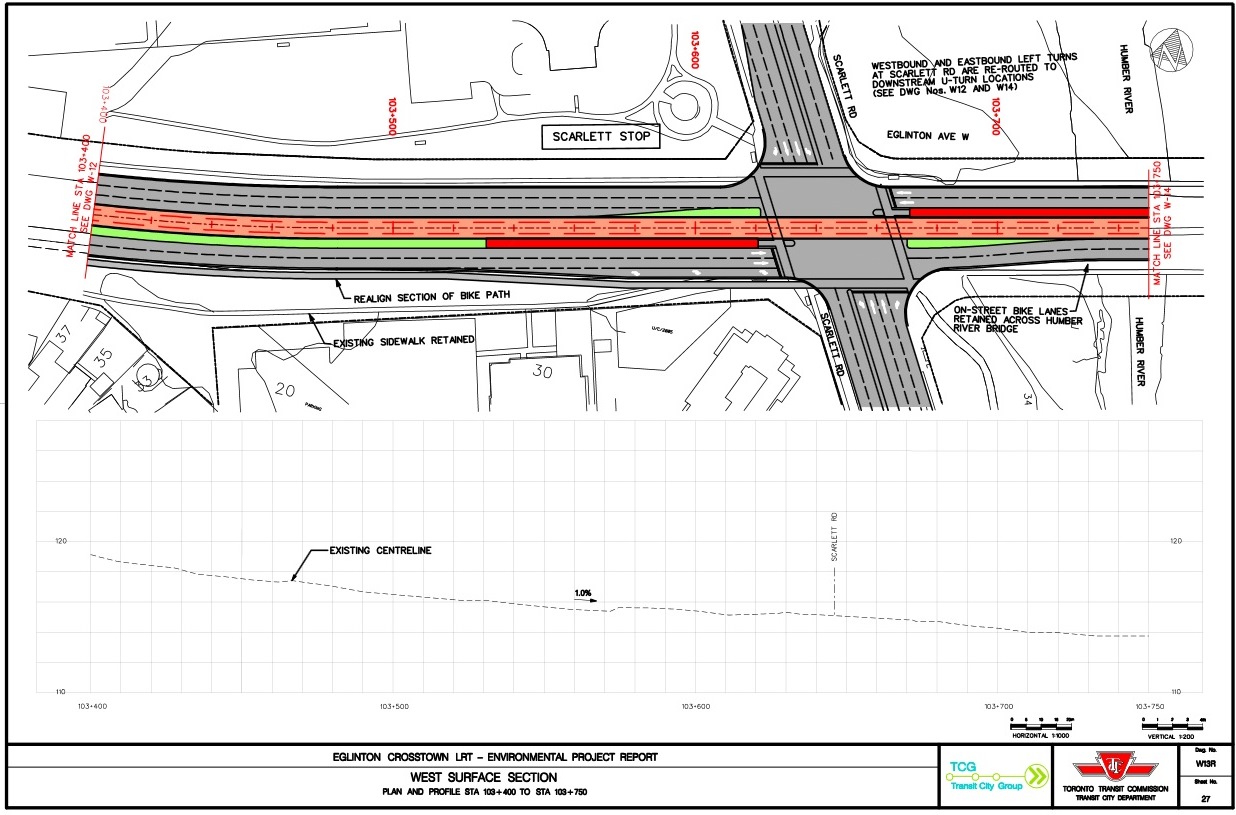
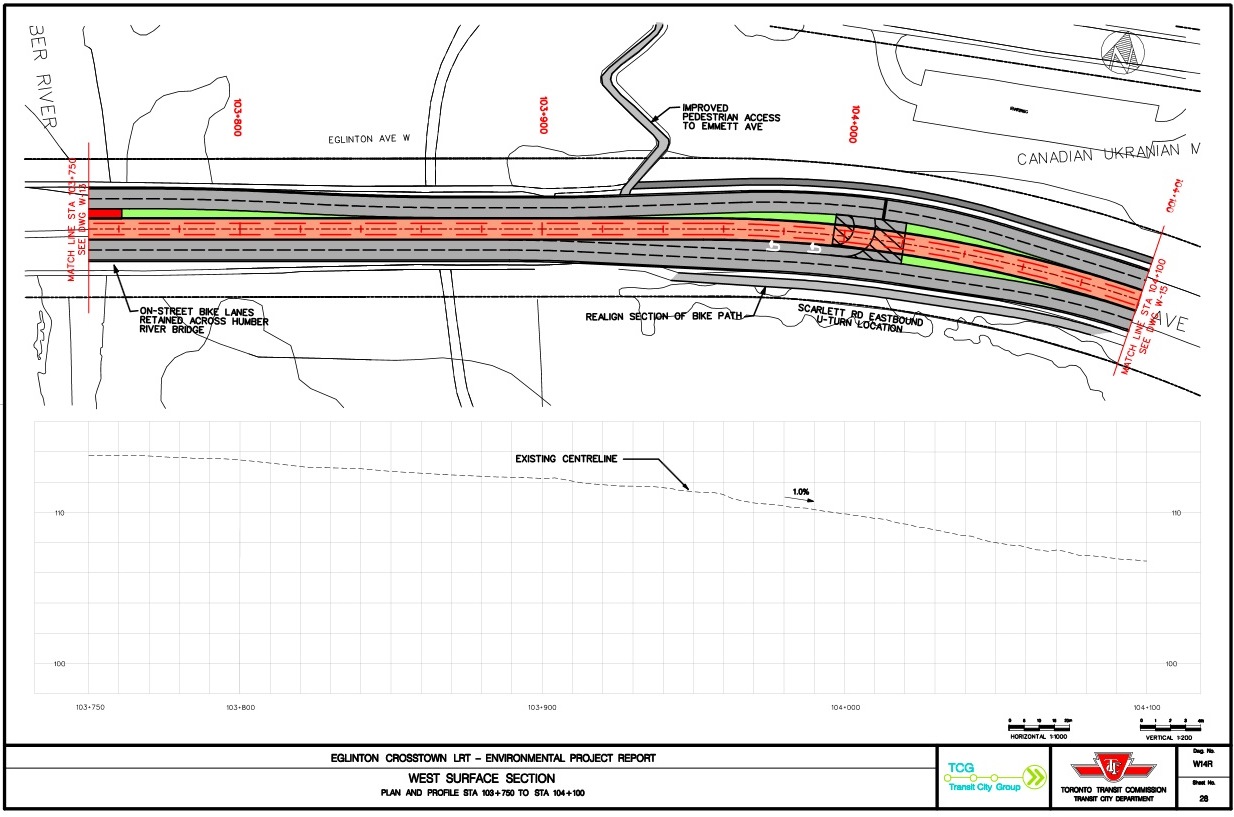


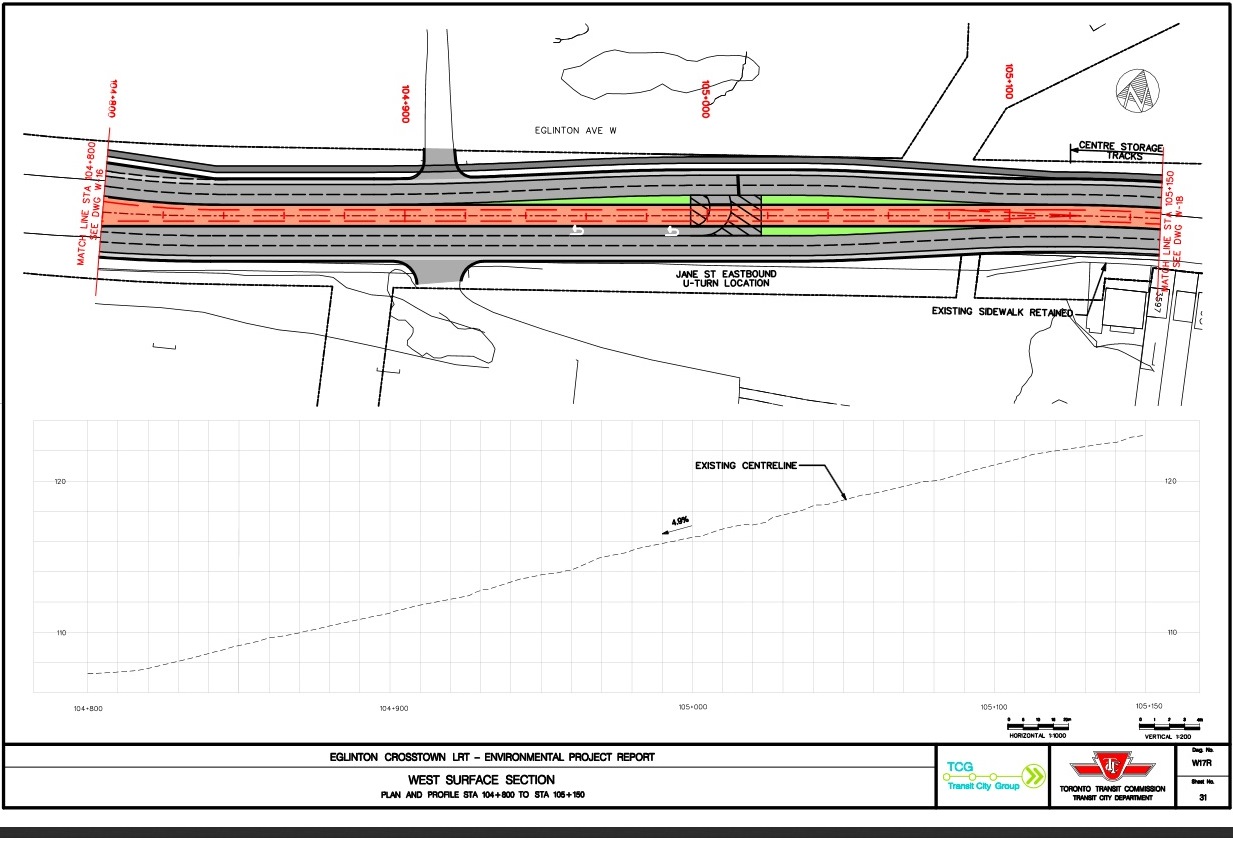
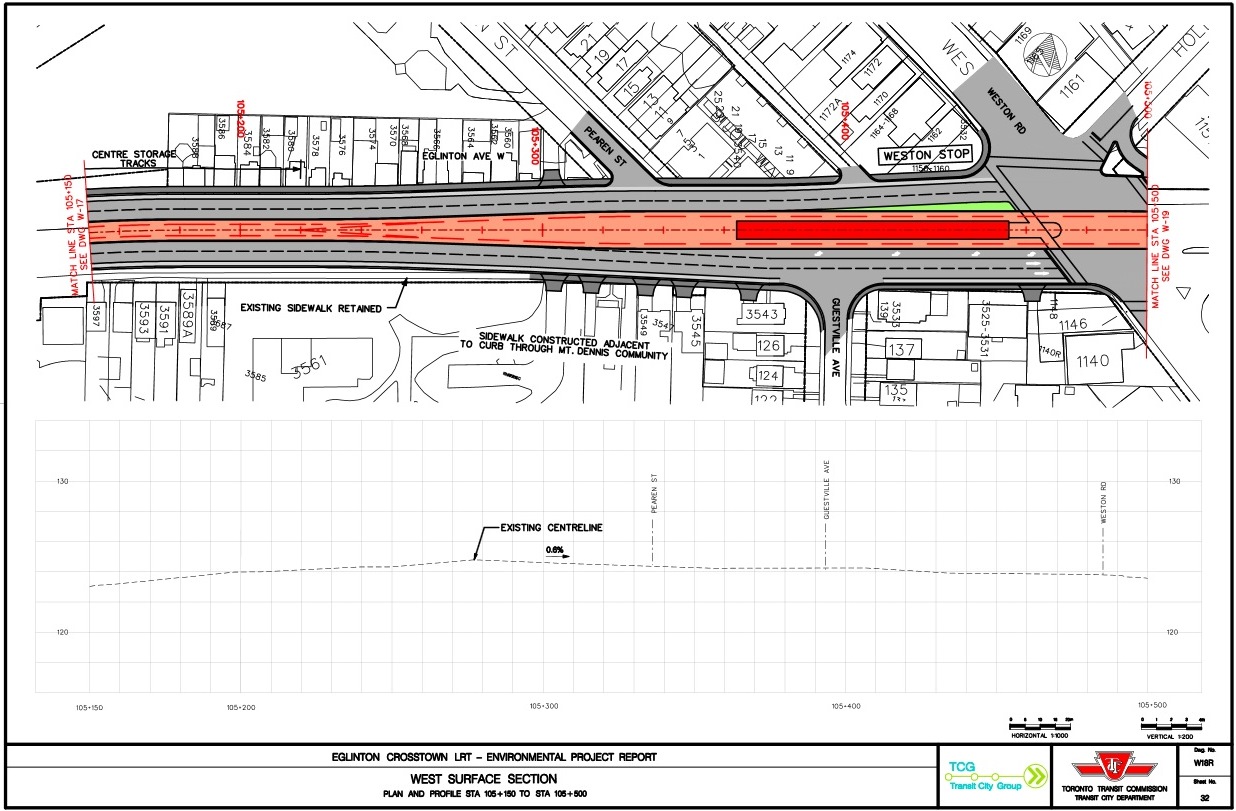
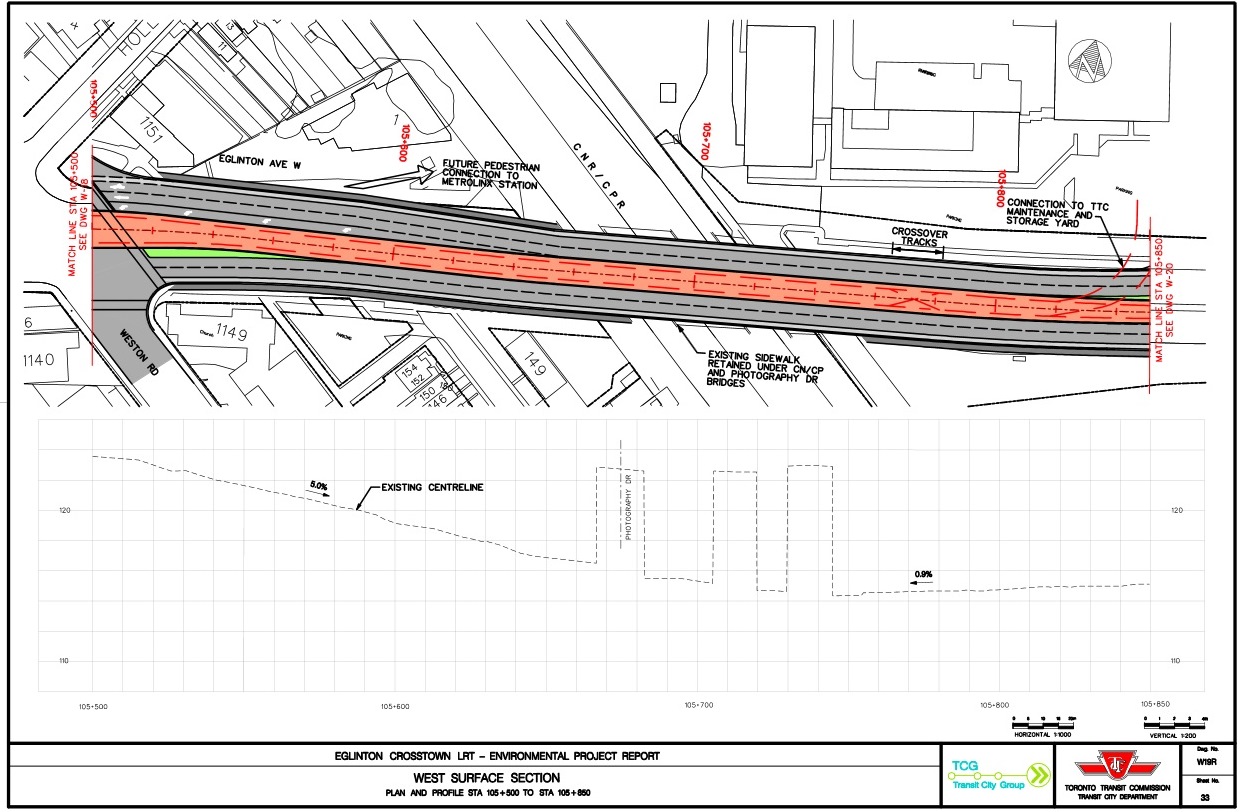

In the original scheme, the LRT line was to stay in the middle of the street all the way from the portal east of Black Creek, under the rail corridor, through the intersection at Weston Road, down the hill to Jane Street and points west. The difference in elevation is substantial with a 4.9% grade down into the valley (see the vertical profile at the bottom of plate 31). This is almost double the maximum gradient for any conventional GO equipment, although there is a comparable grade on the spur line from the rail corridor into the airport (see discussion of the Georgetown corridor later in the article).
Correction: In the original design of the airport spur, there was a steep grade required to drop the line to a level appropriate for access to a maintenance facility. Because this has been moved to another location, the steep grades on the airport spur were removed, and it now is built to a maximum 2% grade, the standard for GO’s passenger operations.
This defines the type of equipment that must operate on SmartTrack, and it would almost certainly be trains of Electric Multiple Units (EMUs), not full-sized GO trains as has been claimed on occasion. If something less able to handle this grade is intended, then the path from the rail corridor down to Jane Street must take a longer descent, and this affects issues such as station placement and the location of a curve between the rail line and Eglinton itself.
Plate 32 shows the original scheme for Mt. Dennis Station with a centre platform on the street west of Weston Road. This would have included not only the extra width for the platform, but for a storage track west of the station. All of this would not fit in the existing roadway. Houses built to the sidewalk line on the north side of Eglinton would have to be demolished, a scheme that did not endear the original LRT proposal to the Mt. Dennis citizens.
The TTC and Metrolinx were quite adamant through the project’s review that no alternative was possible, although what was really going on was that Queen’s Park refused to up the ante on project funding. Various alternatives were studied (see Appendix K), and of interest in today’s context were the difficulties with underground structures at or near Mt. Dennis Station. (See Appendixes A/B to Appendix K.) A common problem was that the station structure and/or a three-track section for turnbacks affected properties above the line on both the east and west sides of Weston Road, including the houses mentioned above.
The at grade scheme didn’t get very far, and continued political pressure forced Metrolinx to reconsider its options. In an addendum, a completely revised setup for Mt. Dennis Station became the preferred option. For details of the alignment see Plates E-3a to E-3g of the Executive Summary PDF.

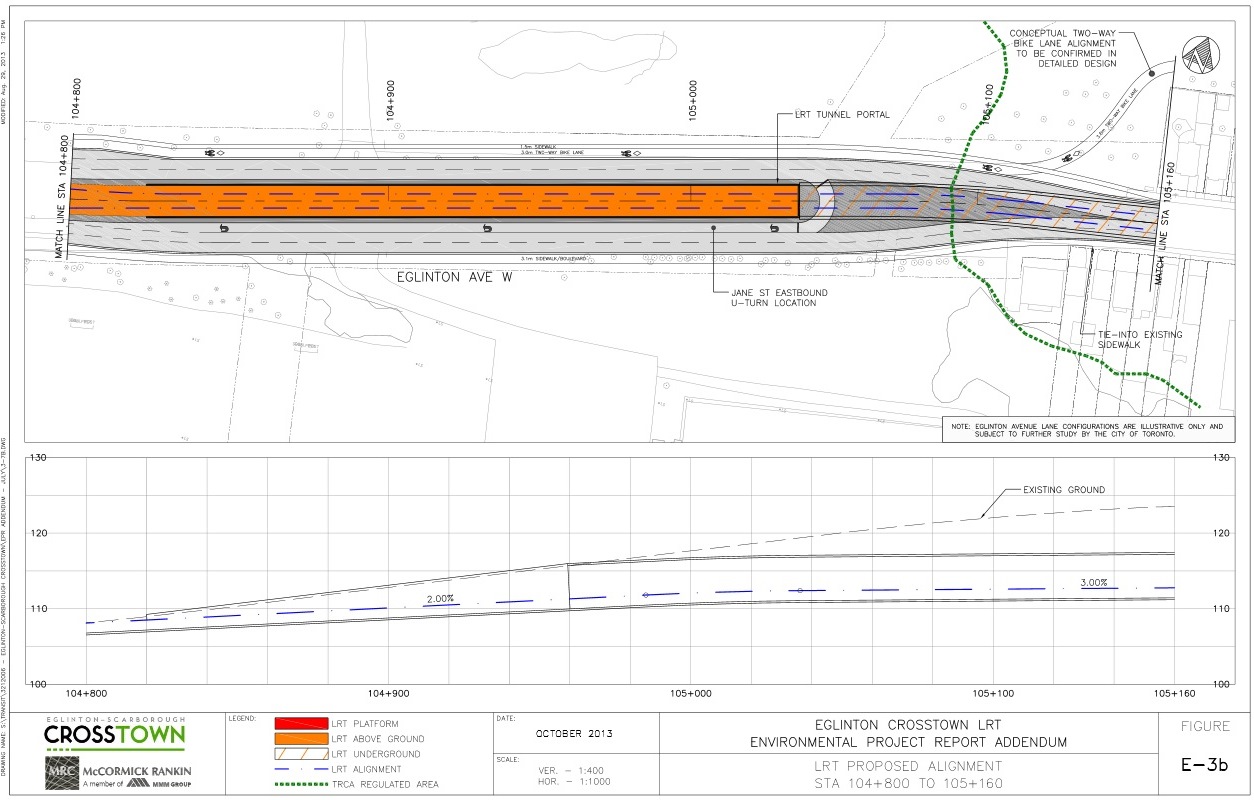
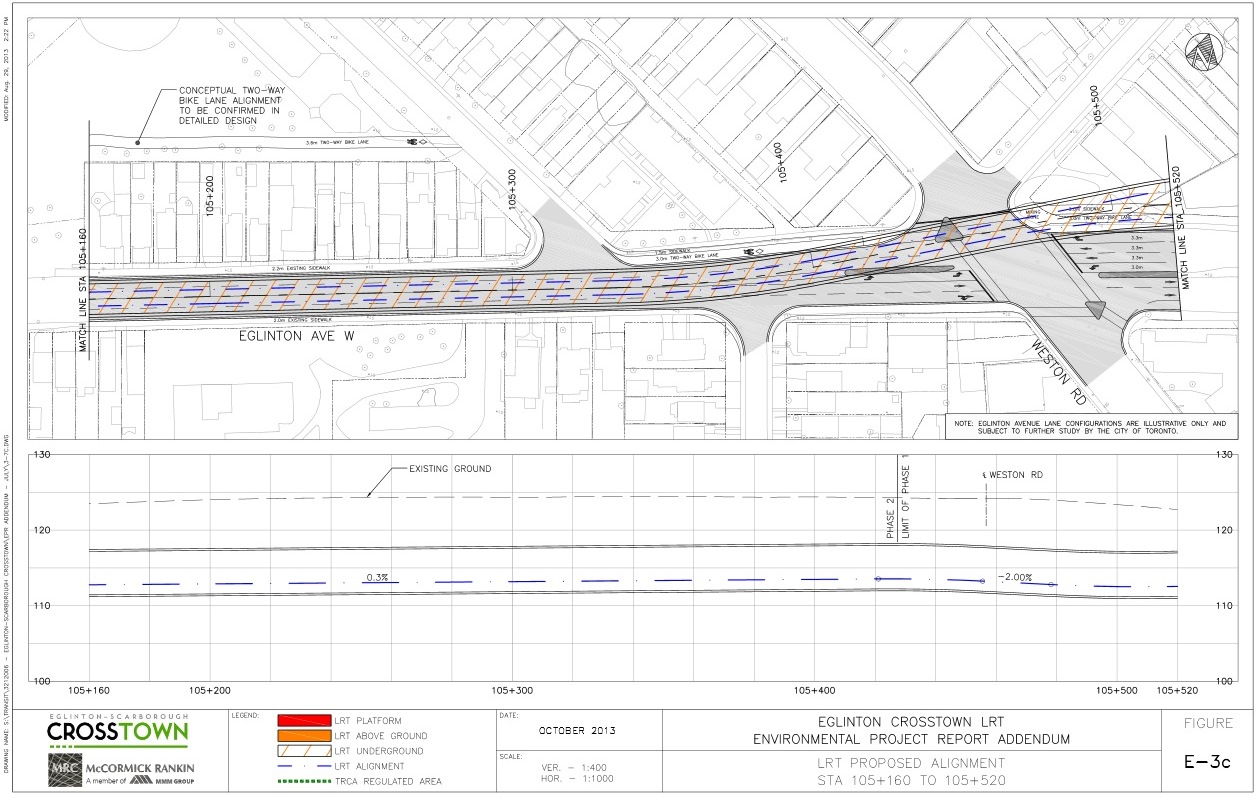


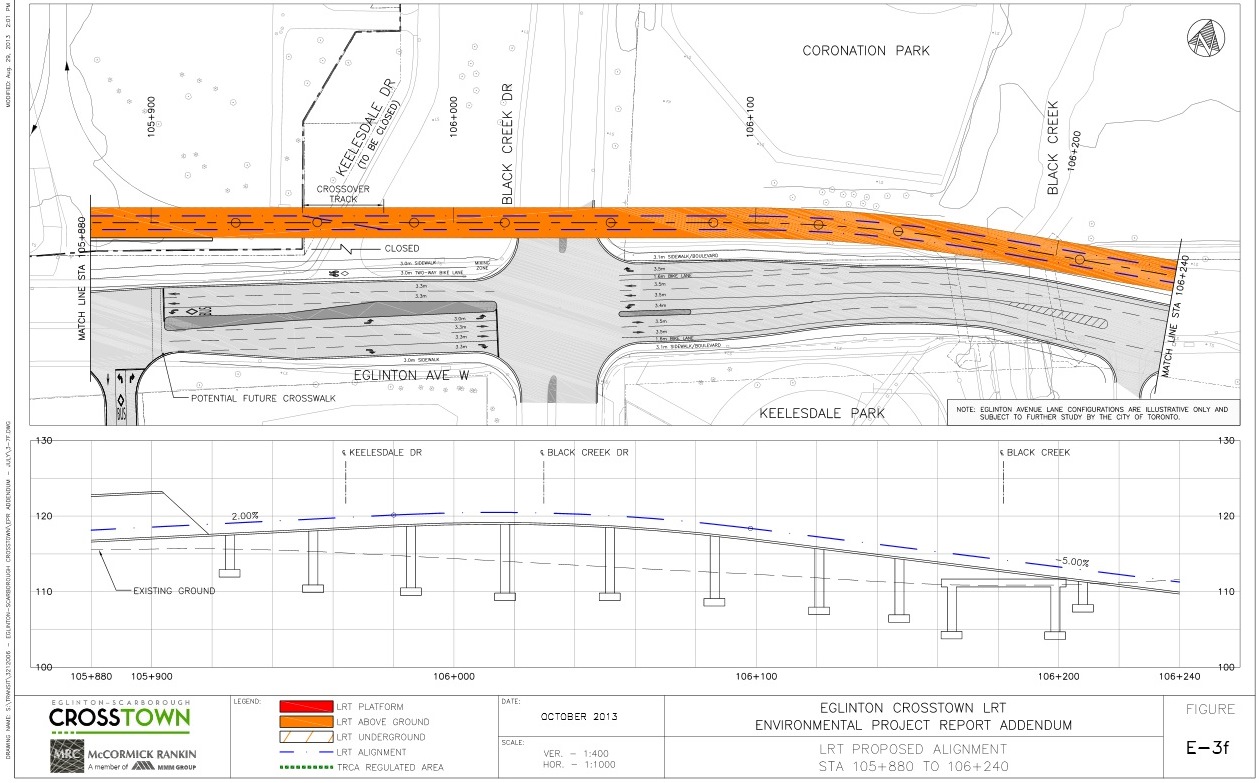

This scheme shifts the platform east under the rail corridor and avoids the requirement for a wider structure west of the station. The grade for a future extension westward is less onerous because the line is already underground at Weston Road and does not have to descend as far to reach the level of Jane Street. However, this is still a higher elevation than SmartTrack would use because it would tunnel under Jane and under the Humber River further west.
The design of this station and alignment was a hard-fought battle in Mt. Dennis, and it cannot be wished away by treating objections to construction hurdles as simple problems to be overcome. This is a neighbourhood already sensitized to the tender mercies of planners who don’t care about local effects.
Now let us look at the rail corridor.
The Georgetown South Project
Like the Eglinton line, the Georgetown South project encountered stiff community opposition because of effects along the rail corridor. This has required GO/Metrolinx to completely rethink the section around Weston Station north of Lawrence Avenue West and to provide more grade separation than originally planned.
Further south, there is provision for a future interchange with the Eglinton Crosstown line whose station (see above) is now directly under the rail corridor.
This project produced its own Environmental Report complete with drawings in Appendix I. Plates 16 to 20 cover the section from Eglinton south to St. Clair.
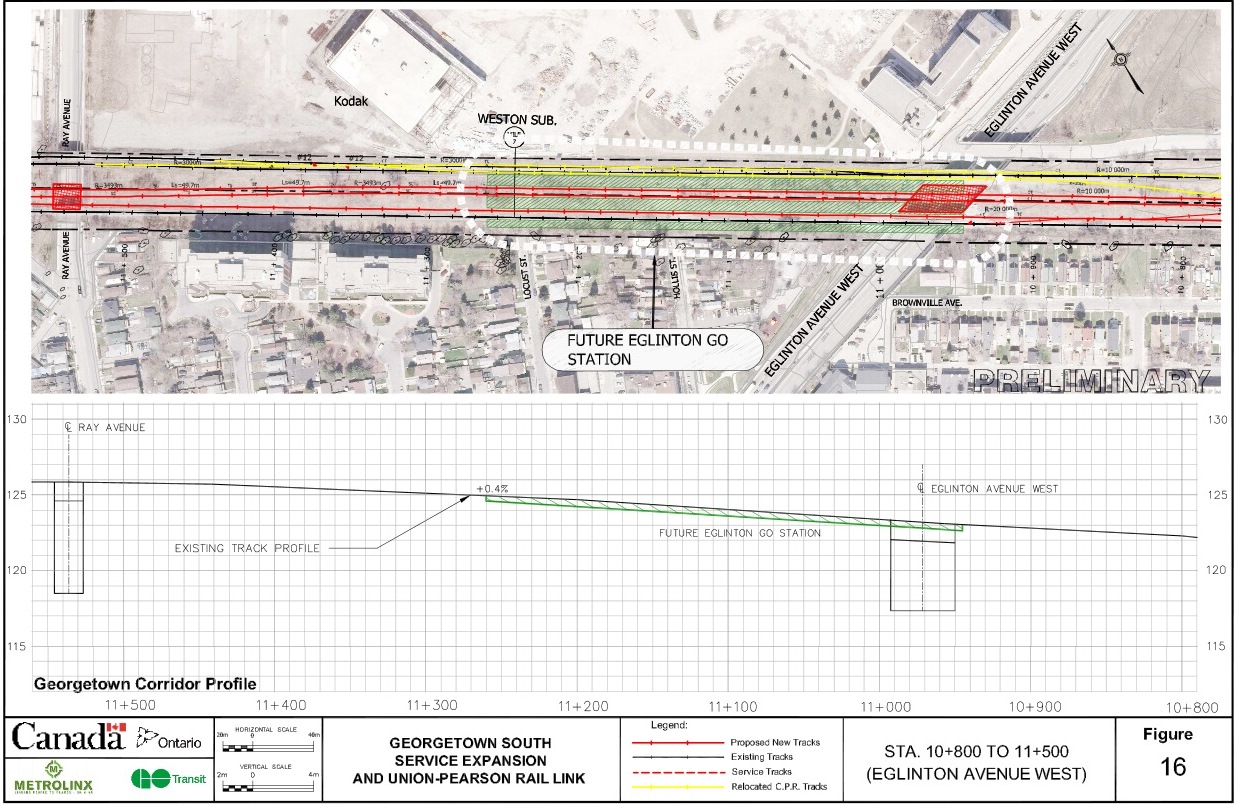
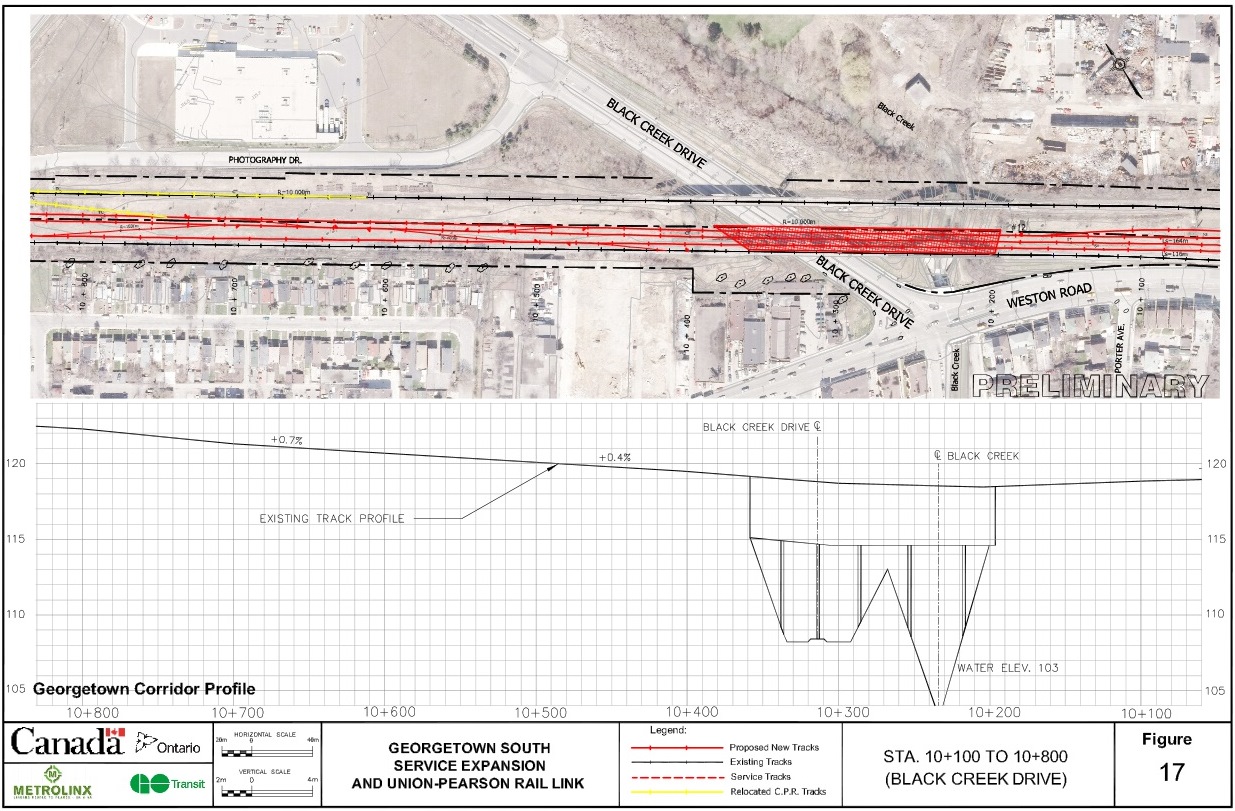
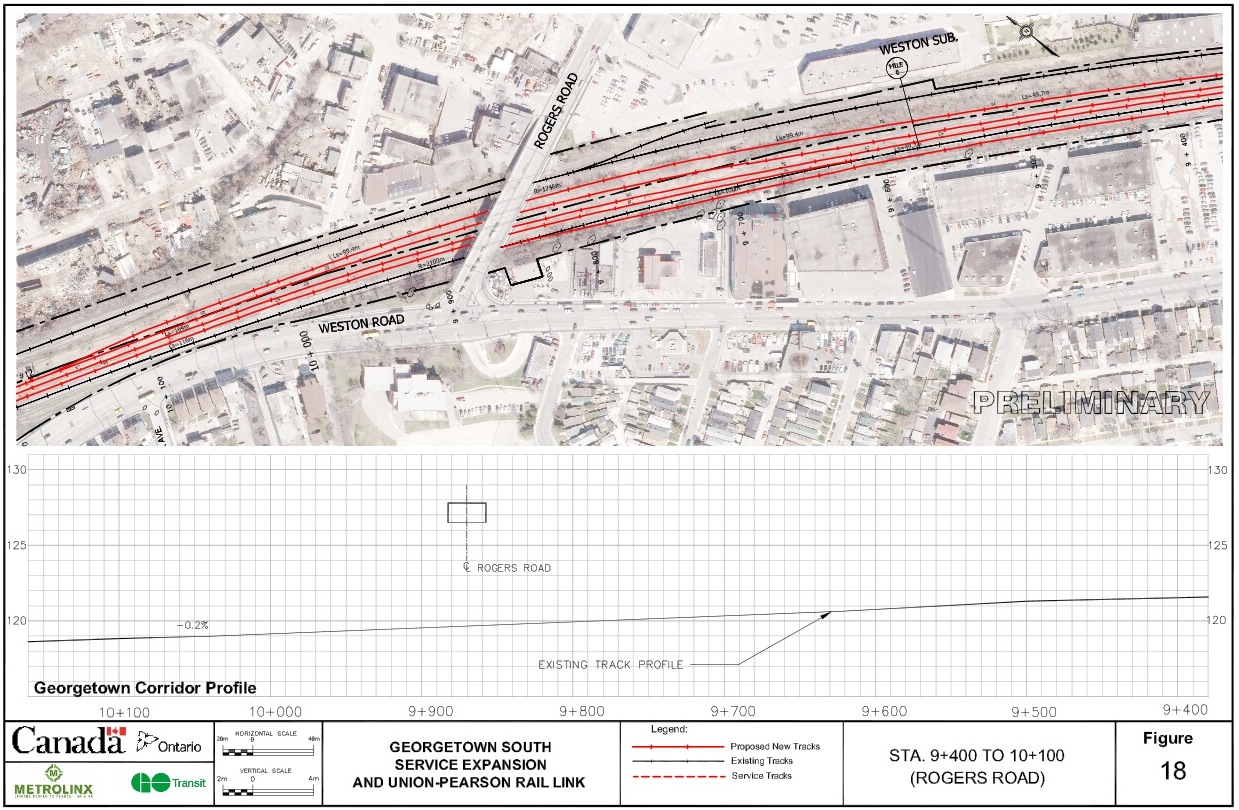
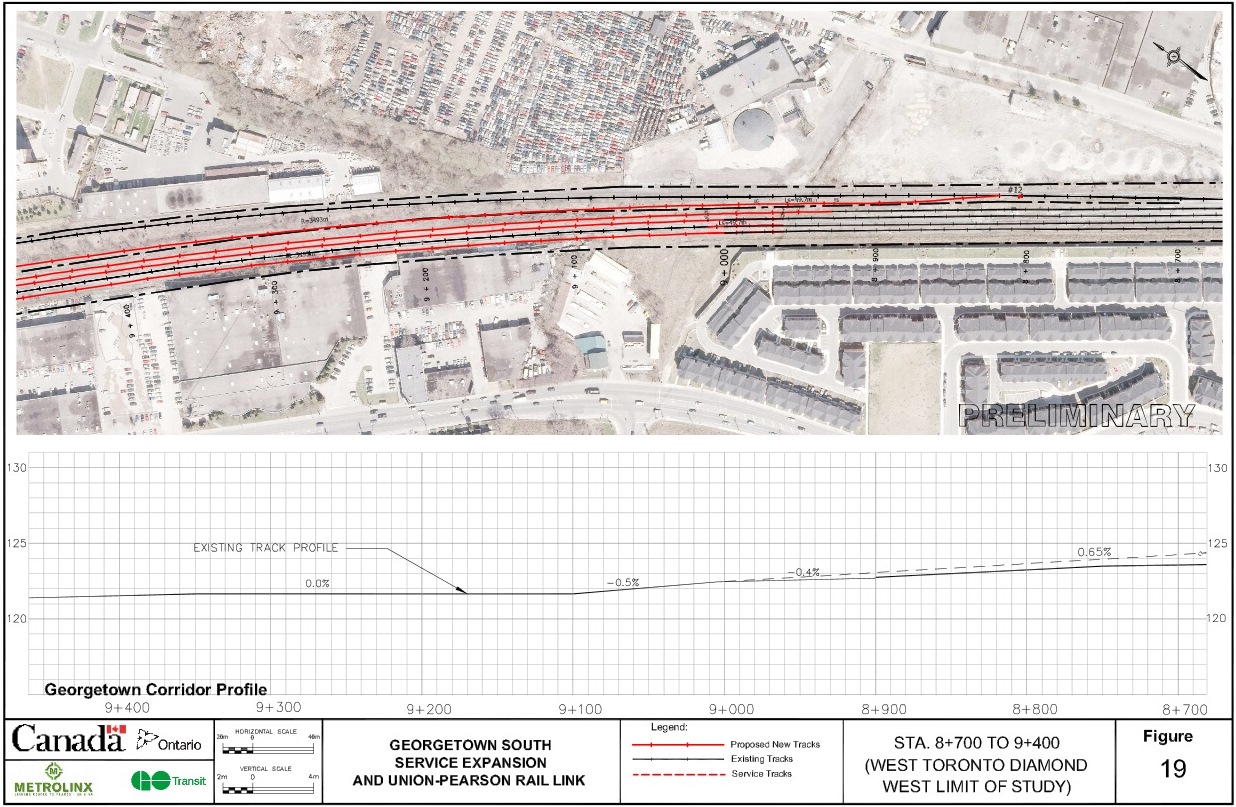
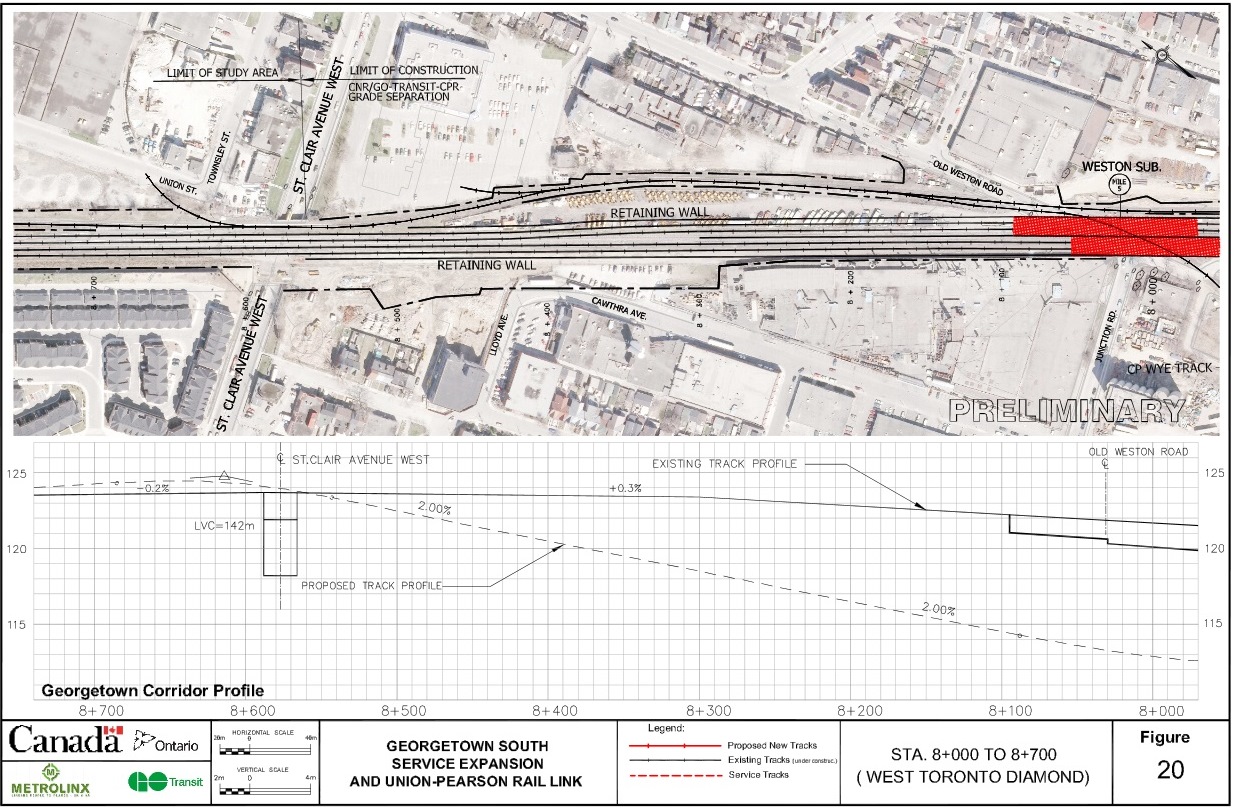
A curve linking the rail corridor to Eglinton has a number of obstacles to deal with. It is self-evident that the SmartTrack station cannot be beside the LRT station which is north of Eglinton and under the rail line. There are three possible locations for a station, each with its problems:
- Under Eglinton Avenue west of Weston Road. This location is the easiest to fit in, but it brings up again the issue of the effect on buildings above the station structure just as the proposed Mt. Dennis Station on the LRT line did.
- On the rail corridor south of Eglinton before the turn west. This location is constrained by the presence of Black Creek drive (not to mention Black Creek itself) not far south of Eglinton. The station would have to be underground so that the turn under the residential community could be executed underneath it as a bored tunnel rather than by cut-and-cover construction. In turn, that would require the SmartTrack line to begin dropping into its tunnel further south somewhere between St. Clair and Black Creek. This location would certainly not be an easy one to build in, and the station would not be close by the LRT (or a future GO Eglinton West station).
- On the curve between the rail corridor and Eglinton. For this to work, the curve would have to be in two segments so that the station itself could occupy a straight section of track. This is essential for alignment between the platform and the car doorways. Whether this is physically possible is dubious, and depends on the minimum curve radius that equipment operating on this line could handle and the maximum length of the trains. The station itself would be under the residential neighbourhood, an obviously unworkable location.
In summary, any tunnel at Mt. Dennis must quickly drop from the rail corridor’s elevation to get under the residential community southeast of Eglinton/Weston, pause in its descent and curvature for a station (whose size is in turn dictated by the type of equipment that might be operated), and then resume dropping both to get under Jane Street and, further west, the Humber River.
The Airport Spur
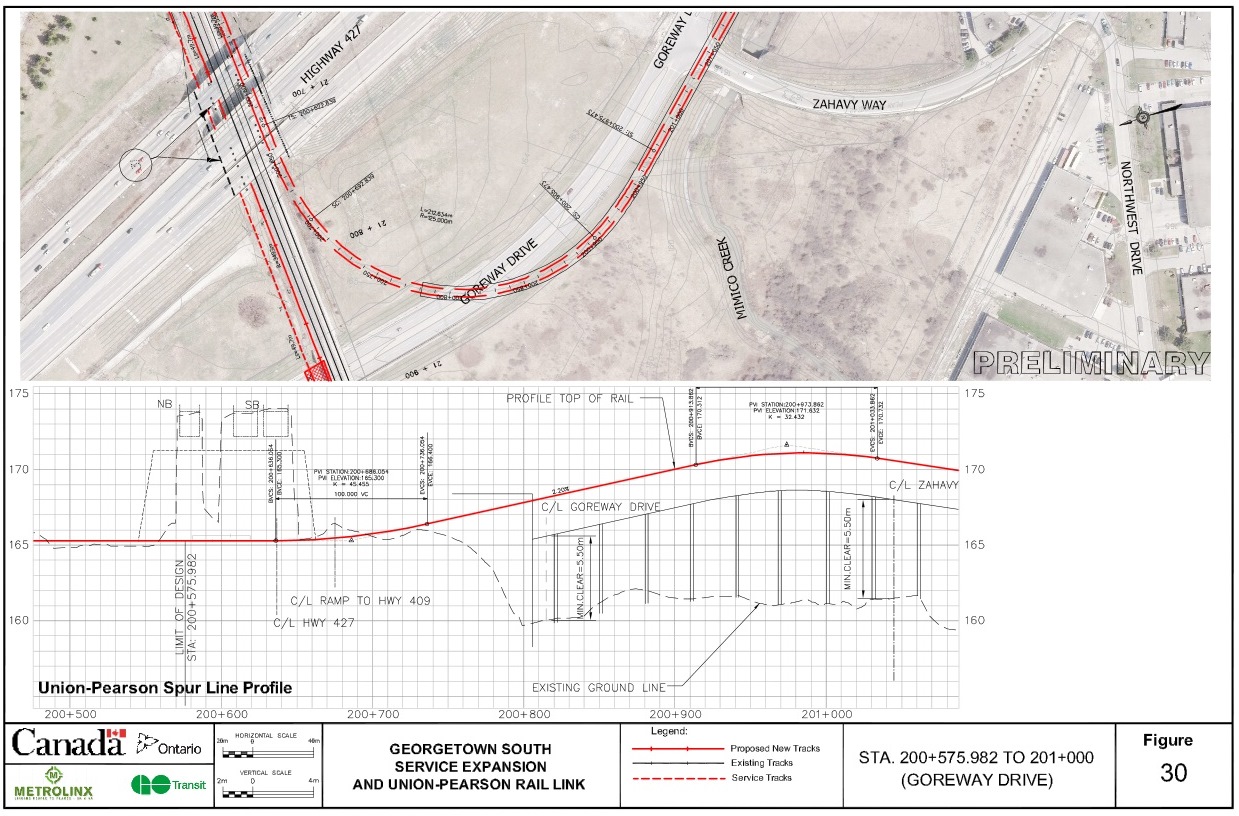
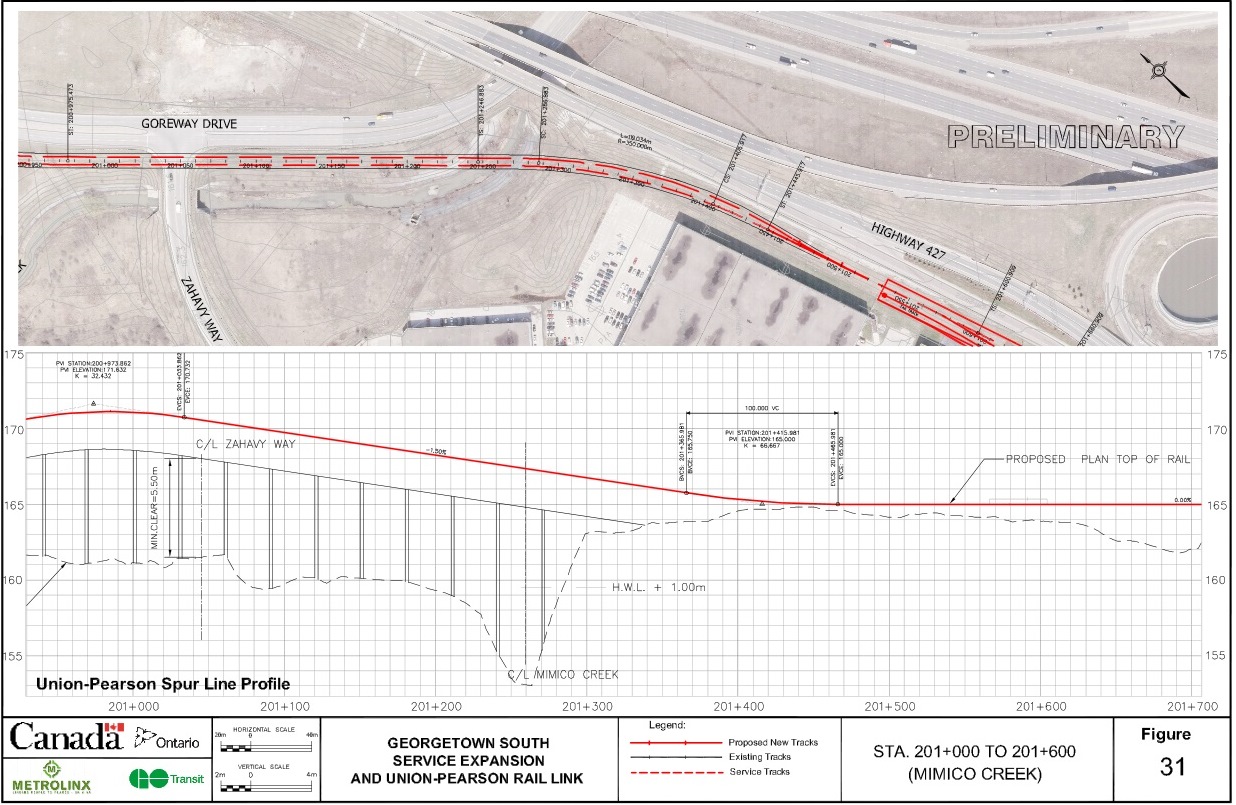
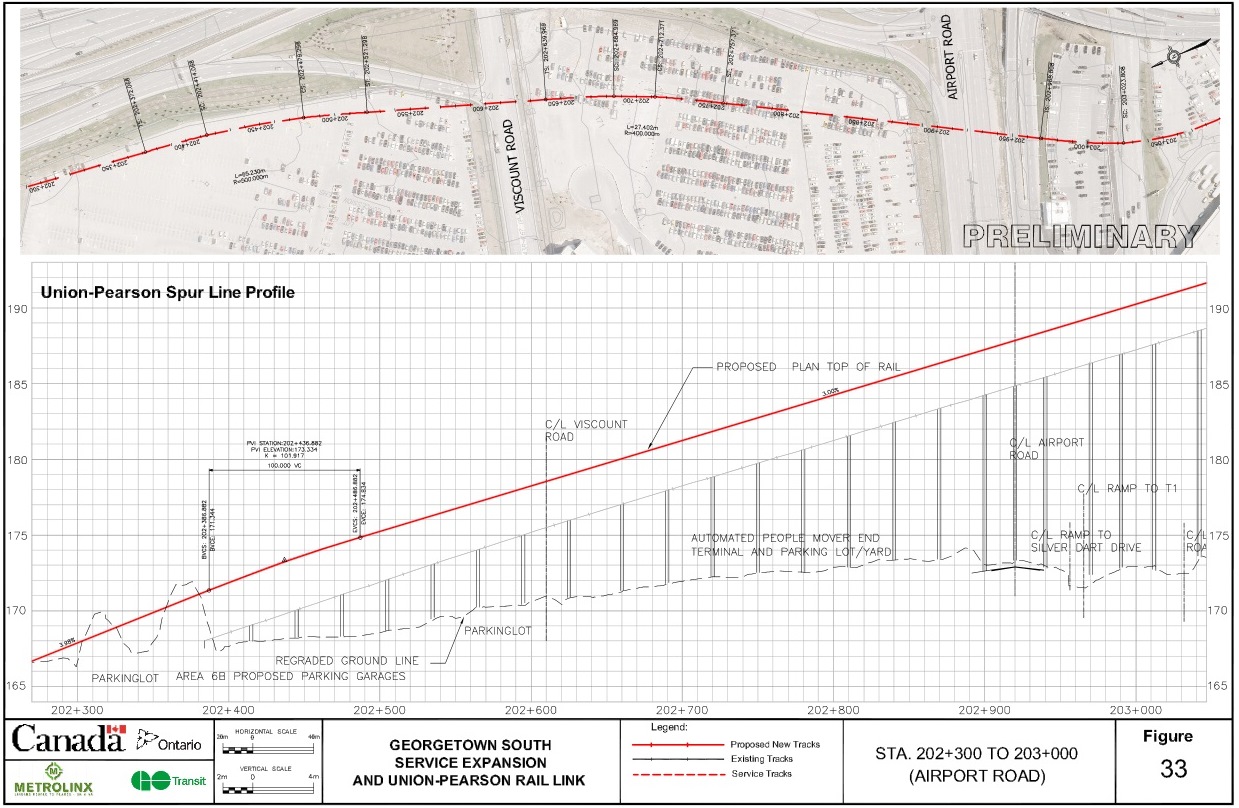
This material is included here for reference although it is not part of SmartTrack per se. Here are the alignment drawings for the route from the Weston corridor south to the airport.
The points to note here are:
- The curve radius of 125m for the turn from the main rail corridor into the spur.
The grades of almost 4%.- The length of the station at the airport (less than 100m).
All of these dictate that something other than conventional GO trains serve this spur. The platform size places an upper bound on the capacity of any train serving this location.
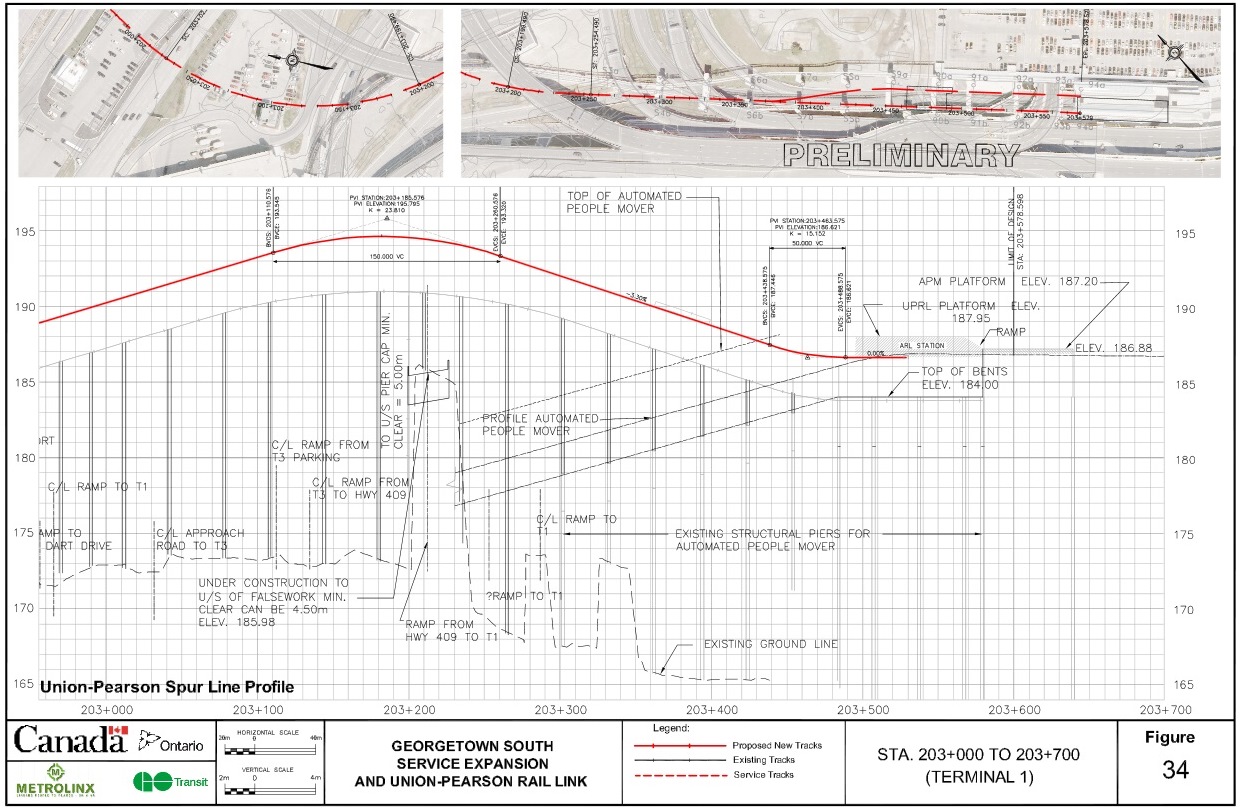
Correction: Karl Junkin has pointed out to me that the design actually under construction is not the same as the one shown in the Georgetown South EA, and that there is a video giving an animated tour of the new alignment. The 4% grades originally planned are no longer necessary because a descent to a proposed maintenance yard has been eliminated thanks to relocation of the yard. Notwithstanding this change, the spur could not accommodate regular sized GO equipment.
The RER belongs in the rail corridor at least as far as Brampton if not beyond, and the airport will always be a low-volume spur operation. Taking the RER west along Eglinton is a foolish modification to an otherwise defensible plan.

Updated October 17, 2014
Metrolinx has provided additional information about the revised alignment of the spur line:
In February 2010, at the time of filing of the Statement of Completion of the Environmental Project Report (EPR) for the Georgetown South Service Expansion and Union-Pearson Rail Link, the Union-Pearson Airlink Group was responsible for the design, construction and operation of the Union-Pearson Rail Link Service (now known as UP Express). When the responsibility of the design, construction and operation of the UP Express was assigned to Metrolinx following the EA, a review of the project, including the vertical and horizontal alignment of the Spur Line, was completed to identify improvements to the design. The potential for changes during the detailed design phase of a project, following approval of the EPR, is anticipated during the Transit Project Assessment Project process.
During the detailed design phase, Metrolinx determined that maintenance and other activities contemplated at the Operations Management Centre (OMC), proposed in the EPR at a location along the spur, could be accommodated elsewhere within the Metrolinx – GO Transit rail network. Environmental impacts associated with construction and operation of this facility were then avoided.
In addition, the decision not to design and construct the OMC also provided an opportunity to reassess the vertical profile of the approved project, as the need to return to grade to access the OMC was no longer under consideration. Under the original project, the transition grade from the OMC towards the Terminal Station was projected to be 3.98 percent, significantly steep for rail operations. The re-alignment of the vertical profile of the Spur Line reduced this grade to approximately 2.00 percent, and resulted in two fewer grade transitions along the Spur Line. This grade reduction will significantly improve the operation of the UP Express service with respect to safety and energy efficiency, as well as the level of customer comfort along this portion of the route . The resulting cost savings enabled double-tracking of the spur which also improves safety and reliability. The environmental impacts of this change in vertical alignment were determined to be negligible.
Metrolinx also investigated opportunities for improvement of the Spur Line horizontal alignment. From this assessment, it was determined that the alignment of the Spur Line could be shifted eastwards to be further from existing and future development. This resulted in an alignment in closer proximity to the interchange of Highway 409 and Airport Road, and through the multileveled road and highway network approaching the Airport, and further from more sensitive receptors. Again, the environmental impacts of this change were determined to be negligible. The change in horizontal alignment also reduced the distance that the UP Express Service operates in parallel with the Greater Toronto Airport Authority’s (GTAA) People Mover Service, which is also of benefit. [Email from Anne Marie Aikens at Metrolinx, October 17, 2014]
Here is a drawing comparing the original and revised alignments (the resolution is that provided by Metrolinx).
Concluding Thoughts
It is unclear whether SmartTrack is really a “new” service at all or simply a rebranding of something Metrolinx was planning to do all along. As such, SmartTrack cannot make up its mind whether to be a local or a regional service, and attempts to serve two purposes in one facility.
SmartTrack started out as an all-surface proposal, but eventually gained an underground component once the difficulties of the alignment from Mt. Dennis westward became apparent. If the line had stayed in the rail corridor, this would not have been an issue.
Fixing this requires more than a wave of the hand dismissing objections as negative thinking. We already know that Tory’s “experts” depended on out-of-date Google Street View images of Eglinton where recent developments built in the former Richview Expressway lands were not visible. Have they looked at the terrain, or the relationship between various streets and rail corridors as shown in the drawings included here (all easily found in the public domain)? One might wonder.
There is nothing wrong with supporting expansion of regional rail services to provide added capacity into the core area and even to support counter-peak commuting where the rail services actually connect with job centres in the 905, but this has to be done in a realistic manner.
Raising challenges to SmartTrack does not mean that I or anyone else of like mind is opposed to the RER scheme. Indeed, I support it quite strongly and don’t want to see Try distort the rollout plan to suit his own pet project. Even worse, I don’t want the provincial government (which does not have any by-elections requiring voter bribery in the near future) to screw up RER either.
If John Tory becomes mayor, he will need to learn flexibility, to learn that his precious plan can and should be modified, and that it is not the answer to every problem afflicting southern Ontario. That would be the collegial John Tory many hope to see after the election. If only his campaign sounded as if that’s what he’s selling Toronto.
 Steve Munro
The Eglinton portion of Smart Track will end up being a western extension of the Eglinton LRT. That is, not connected with the EMU / railway portion.
I feel like John Tory realized this a while ago, but he doesn’t want to unleash the LRT boogeyman during an election.
Regardless, reality will get in the way of this eventually.
LikeLike
I’m not great fan of SmartTrack which I’m taking as purely RER with explicit through running and an ill conceived Eglinton spur but one thing does jump out at me in the talk of a new airport connection. Would any major issues pop out at you off hand with a spur intended for through running diverging from Weston around Etobicoke North station (either the 401 or Hydro corridor) and broadly following Dixon and Airport Roads back to the existing corridor just west of Malton station. Assuming it’s largely elevated (though this looks like it might be problematic in terms of runway 05/23 and the terminal area) this seems like something that would do everything SmartTrack wants to, have real potential to allow direct VIA service to the airport from the west and actually manages to through route airport and Brampton services while being considerable more constructable.
Steve: There are problems at various points along your proposed route with the curve radii needed to follow the rights of way and/or roads. Also, if this is an elevated structure, threading it through existing highway ramps would be challenging. Then there’s that runway …
LikeLike
Steve in terms of relieving Yonge, would not greatly increasing the capacity of another closer parallel line not make more sense?
I understand that GO does not control the line North of the CN mainline, but would not RER or even LRT (or even a couple more trains) in Richmond Hill GO make a larger difference?
If to help Yonge would it not be easier to start here? Currently this line seems lightly used (in terms of number of trains). Would it not make sense to make this the initial centre of study? Even an LRT so you could run on Bayview and beside 7 North of the CN main, and run as many trains as you need. Here I can see running 18k ++ per day.
Also in Stouffville, and UPX, has anybody done a real ridership forecast? Would Stouffville or the west side be beyond say 10K? Has there been an actual forecast of ridership in terms of origine and destination for these proposals, beyond John Tory’s campaign? Is there a significant difference beyond trying to do the Eglinton BS and staying in UPX? Is this John Tory’s campaigns way of suggesting that really UPX needs to be LRT so it can make that hard west turn at Mount Dennis?
Steve: For all the problems of the Bala subdivision in the Don Valley, it could provide Yonge relief provided that it ran more frequent service (GO is already contemplating double-tracking plus flood protection) and had a competitive fare with the TTC. As for the Uxbridge sub (Stouffville line), the problem with ridership forecasts (as with the parallel Scarborough subway) is that these are heavily influenced by presumed service levels and fare structures.
The study of Yonge relief now underway by Metrolinx and the City is looking at all options. I just hope that SmartTrack does not derail the whole process by creating a political imperative to choose ST as the “preferred” solution. It’s not as if Mayors and Premiers have never meddled in professional studies.
LikeLike
Kenny, I agree completely: chances are that the stretch along Eglinton will turn out to be far better suited to an extension of the Crosstown LRT, complete with a much simpler interchange station with the RER / GO service at the rail corridor. That Tory is afraid to be associated with the letters ‘LRT’ pre-election is sad but not a shock. In any case, the existence of reliable express service from Eglinton/Weston to downtown via Bloor would add tremendous value to the future western stretch of (hopefully surface) LRT on Eglinton, because it would allow LRT to do what it does best – be a high-capacity complement to both local and longer-distance services.
Steve, if I read you correctly, you feel that the Smart Track proposal, which is mainly a repackaging of the RER scheme with a few more stations in Toronto itself, has merit without the Eglinton spur? If so, I would generally agree, but I do feel that there is some benefit to Tory’s version in promoting a desire for longer-distance non-subway options in Toronto itself, where the bulk of all-day two-way ridership already exists. The addition and enhancement of GO stations within the inner suburbs, combined with some sort of TTC fare and transfer integration, would I think be more than welcome, helpful to the city’s faithful transit users, and helpful in keeping subways for where they are best suited, on corridors with existing high demand and no surface room.
Steve: I like the general idea, but it is in the specifics that Tory’s plan gets bogged down.
First off, it is unclear from various statements made by the campaign, whether ST is an add-on service on top of the Metrolinx RER, or simply RER with a few more stations, TTC fares and an Eglinton West spur. This has huge implications for track capacity and the amount of infrastructure needed. On a related point, it is also unclear how much residual capacity there would be for SmartTrack-specific riders in the inner ends of the RER corridors.
Second, ST is trying to be a local service in Scarborough with more stops that the Scarborough subway. That’s not what RER is supposed to do. This also puts in question Tory’s unwavering support for the subway from which his ST line will pull substantial demand. The “need” for the subway was justified by ridership projections that included a lot of new traffic from Markham, exactly the location where ST will get a lot of customers.
Third, the whole financial scheme is suspect. Tax Increment Financing is supposed to be used for rejuvenation zones where development would not otherwise occur. It’s a local improvement project on a grand scale where the cost of new infrastructure to serve development is paid off by proceeds from that development. That’s not what Tory proposes, however, and he would scoop all future new revenues in the core as if they were generated thanks to the ST line’s construction. This is just shuffling money between accounts because he will then have to backfill all of the services those new buildings will require, including transit. If ST is simply RER repackaged, I don’t understand how it could possibly cost $8-billion in new money, or why Toronto should be contributing almost $3-billion to a project Ontario is going to fund anyhow.
I support RER. The problem is that we don’t know if ST is simply RER by another name, in which case Tory really does not have a plan and has simply cribbed the idea from Metrolinx. If ST really is a separate service overlaid on top of RER, then there are major problems with network capacity.
LikeLike
On Metro Morning this morning, Eric Miller graded SmartTrack as “A+” and said that it would function as a DRL, in addition to presumably being a floor wax and a dessert topping, all in one!
Steve: And as I tweeted recently, I would give SmartTrack an “F” for plagiarism of the Metrolinx plan. RER is a great scheme, and Tory simply wants to appropriate and rebrand it for his own political ends.
LikeLike
“I would give it an F”….you really do sound upset that the Tory camp did not ask your ‘expert’ advice sir! I say give it a chance, of course things will evolve.
No one is stupid enough to think that we are ahead if we save a billion dollars, the long arm of either City or QP will always keep their paws deep in our pocket.
Let’s just get something new started!
Until the DRL is built, most people will still stay crammed on subways as crosstown LRT will not help their situation.
I like Chow DRL priority BUT if she still stands a chance at all, Olivia should lose that ‘pout’ . She looks like she is muttering “you promised me if I gave up Ottawa and ran for Mayor that I would easily win!”
Steve: I don’t care whether Tory’s folks asked my advice or not. They were quite happy to chat with me at their media launch of SmartTrack, and even happier to misquote me as endorsing their plan. They read my blog. And, by the way, even if they had asked, I would not publicize this unless circumstances demand it. I have talked to other campaigns (and not just Olivia Chow’s), but what they use (or not) is their own business.
It has been quite annoying, however, that Tory trots out ST every chance he gets and in cases where it simply is not an appropriate answer. This speaks to a candidate who has a one-track program, rather like a mayor we are about to get rid of, but with better social graces.
LikeLike
I am an ESL and I have to admit, that I do not know too much of English transit-o-terminology. However – there is a huge difference between streetcars, LRT and real trains. This difference is amplified when it comes to multitrack operation, especially in the curves. In other words – it is impossible to take a stencil and a map of a city/region and dream of transit projects.
For example – designers of streetcar/LRT routes can count on curves with minimum of 18 or 19m radii, whereas designers of real train routes can go only as low as 300m radius. If you are designing multi-track operation, then the toggling effect must accounted for. Then there is a question of “conversion” from straight section to curve, which takes place on its own.
Similar arguments can be made about an incline. Streetcars/LRT can talk about 8% as maximum, whereas real railways can use only 3% as maximum.
Streetcars/LRT can talk about pantographs being pushed right down to the roof of the vehicles – railways will not allow such a low ceiling.
Then there is this hidden-in-plain-sight stuff – available space for wider ROW. 4-track or 5-track corridor would effectively destroy Riverdale shopping mall and so on and so on, especially if a designer would like to build some sort of platforms/concourses.
I am saddened by Prof. Miller’s remarks, but their overall tone does not surprise me at all. I have found in the past, that people living and existing for too long within the walls of academia can really lose a connection with the outside world and then they make a colossal blunder.
LikeLike
Great article and commentary,
It’s straight forward, the Tory Plan is NOT STRAIGHT, and does not work, and the finance plan also does not work. Toronto just needs more GO Trains, and simply fill them, since each train actually holds about 4,300 if you include standees. Toronto needs to scrap the two tier system, one for the elite, and one for the poor person. Simply fill them both and equalize the cost, voila……….. gridlock fixed. More GO Trains, More Subway Trains, More Buses………. you don’t need multiple billion dollar plans to fix gridlock, but do add ATC on lines 1 and lines 2. Hope you can do an article on the “end of the lines” plan TTC did today. It is horrible TTC did not do this 30 years ago. This is called lazy and irresponsible management. Why would you have 15 second dwells and 60 second dwells at the end of the lines. Match your dwells maximizes full line delivery, the thing I’ve preached about since May 2008. I still claim I hold the full solution for Y/B Station. TTC hate it, when “outsiders solve their problems”. It is my belief TTC is in for another shake down. Time will tell.
Steve: Actually, no, a full GO train does not hold 4300 people, even with very friendly standees.
LikeLike
I believe that the grade of the nearly-flat alignment in plate E3-b of the Executive Summary is 0.3%, not the labelled 3.0%. The grade on the adjoining plate E3-c is 0.3%.
The revised route under the Georgetown corridor and Weston Rd. therefore reduces the maximum grade from 5.0% to 2.0%, which is the preferred maximum for heavy rail. However, as Steve mentions, SmartTrack would need to pass under Jane Street rather than cross it at grade, increasing the max grade beyond 2.0%.
Steve: Yes, the adjoining plate E3-c shows the grade as 0.3%.
This means that if Smart Track is to have an interchange station with the Crosstown, it will have to go below it. If this is below the Mount Dennis station, SmartTrack will need a long underground jug-handle tunnel proceeding either well east of the Georgetown corridor, or well north of Eglinton. This seems implausible.
Alternatively, SmartTrack curves west south of Eglinton, meeting Crosstown underground at a station near Jane.
This is some mighty expensive through-running. My conclusion is the same as other commenters: SmartTrack west of Georgetown is going to be the westward extension of the Crosstown LRT. This is good – it makes extending to the airport cheaper and more likely in future.
Were Crosstown phase II to the airport ever to get built, does the Mount Dennis MSF have enough spare capacity to handle the additional vehicles required?
Steve: The MSF was sized for the full buildout of the Eglinton line plus, I believe some of Jane and St. Clair, originally. I would have to review current plans to see how many cars they are allowing now and how much growth potential there is. Of course the loss of access to the Sheppard line via the Scarborough route in the east end does not help the situation.
LikeLike
CN and CP will not allow any new grades in the metro GTHA area to be over 1%, Metrolinx will go as high as 2 for their locomotive hauled trains. Multiple units can get up to 5% for short stretches but you do not want a long grade that steep.
I think that if you check the right of way there are 4 tracks, 2 ex CN and 2 ex CP, plus a a couple of abandoned switching tracks. There is a lot of right of way width there for 4 tracks plus platforms but there would not be much room on the trains for the people from Liberty Village. The problem on the west side is one of capacity on the trains for the numbers of passengers needed to make it beneficial for the Spadina Subway.
His line in the east end would not make much of an impact on Yonge subway loading but would probably make the Scarborough extension a bigger white elephant than the Sheppard Stubway. Every time you add stops to a line you increase its running times. IIRC GO added 4 minutes when it added the stop at Mount Pleasant and about the same amount on other lines. Part of this is for dwell time and part is for acceleration and deceleration. EMUs would reduce the latter while more doors would reduce the dwell time, but at the cost of reduced seating. Tory’s plan seems to pick the worst aspect of each plan.
LikeLike
I have to believe that SmartTrack is RER, or at least that was my first reaction. It is a copy of a promise made by somebody else. I think this can be done at a train every 15 minutes or so however, beyond that, does it not run into substantial ROW issues within the Lakeshore East ROW. Will 3 tracks or even 4 be enough to support this and substantial improvements in the Lakeshore GO.
Would not RER in Lakeshore, so it can have all trains stop within Toronto be just as important to Transit in Scarborough? If this route actually does pull Markham load, and it can only run say 4 or even 6 trains would it not be pushing capacity from day 1? If you assume this and Lakeshore both need capacity increases, so you say add 2 here and 2 in Lakeshore, so you have only 4 here and 8 in Lakeshore, can the tracks approaching Union hand 12 trains (one every 5 minutes) if you really push it could you get 6 and 8?
He suggests a loading of 200k/day if you assume that Stouffville (Uxbridge) is half of this does it not imply loading closer to 18k at peak? Even if you were to make a substantial assumption that this is RER using 2 high cars and trains of 12 cars and 6 trains per hour at peak does that not still leave you say 6k short?
If you assume 4 trains per hour would you not be way short? While I think getting additional 4k off the roads would be important, I like to understand. To deal reasonably with the Lakeshore issue, and have this achieve what Tory is suggesting, do you not need 5 tracks in Lakeshore (given the continued freight space obligations) ?
If you are going to actually have as many stops in Scarborough as suggested, would not another service in the ROW say, LRT not make as much or more sense, designed to serve the need ? It would then not force the RER to stop so frequently as to discourage 905 riders.
Steve: These are all perfectly reasonable questions. Tory’s experts seem to be better at drawing lines on maps than considering operational details. After all, by their standard, simply by asking them you are being a negative, backward-thinking opponent of change and the greater glory of Toronto.
LikeLike
Two sayings come to mind in our transit planning:
Residents were demanding grade-separated rapid transit and it was not given to them. Eglinton is a great example, where the central 12km is buried, and the remainder is in the median. In the East, the result of that “on-street” decision became the “Scarborough Subway”. Instead of spending an extra $1.4B to bury the line through Scarborough, or improving that plan and spending an extra $500M to elevate it, the Scarborough subway was born. By saving $500M on elevating Eglinton, we forced ourselves into adding an extra $1.5B for the B-D subway extension.
Then consider Eglinton West, where again a (future) on-street LRT was planned. Spending an extra $500M would have elevated the line from Weston to Pearson. Instead, the on-street LRT opens the door for alternative rapid transit to be proposed (SmartTrack) at a cost of about $1.5B? (I have not seen a good cost breakdown, but it seems a reasonably conservative guess to make the curve, tunnel under the Humber, and make it beyond the (under construction) developments to Martin Grove).
If Eglinton LRT was elevated through Etobicoke and Scarborough, and connected to the SRT/LRT, then the B-D subway extension would not have been demanded and “SmartTrack” would have been GO-RER entirely within current ROWs (using the Stouville GO line, through Union and up the Brampton line).
It is apparent that Tory’s SmartTrack proposal is directly the result of the ECLRT being in the median through Scarborough and Etobicoke. It is also apparent that saving $1B by not elevating ECLRT, has added a cost of about $3B to serve those areas.
Steve: You really do try to find every possible excuse for burying an LRT line where this is not needed. It’s a nicely constructed argument within your world view, but I don’t happen to agree with it. At some point we have to stop assuming that every transit service must be underground. Eglinton was to be part of a network, not the one and only line across the city, and the projected demand was nowhere near subway levels. You will claim that it is self evident that the demand projection follows from the use of a surface alignment, but if we go down that route, we would never consider surface for anything.
Scarborough’s subway is a combination of blatant pandering and of manipulating public opinion to think that a surface LRT from Kennedy to STC is somehow an inferior mode of transport. It has nothing to do with whether Eglinton west of Kennedy is underground.
As for the west side, demand projections there have always been light going back to the days when this might have been LRT, BRT or a full subway. The surface treatment of intersections on Eglinton with the hook turns was almost guaranteed to make the proposal unacceptable, and I put the blame squarely on the TTC for this mess, in effect sabotaging their own project.
LikeLike
As always, the analysis presented here is spot on, but does it really matter? I do like the conclusions that Steve comes to in the end, which I am happy to see… but I think the anger with SmartTrack specifically is misplaced.
I also agree with Kenny and others, that I highly doubt that ST will ever go past Mt Dennis, and we are more likely to see support for the X-town extended west, which should mitigate all of these concerns.
All of this is unfortunately the sad state of current headline/slogan politics. The 2014 election was never going to be about the best ideas or the best candidate, but the most charasmatic “big-tent” person that could unite the majority of the city and remove the division and chaos of the Ford years. I believe this is what has happened to the Soknacki and the Chow campaigns. In JT’s case, he was a long-time Tory, but his recent work with CivicAction and his radio show has bought him progressive “credibility”, hence his polling results.
I hated ST when it was released, knowing the issues with the GO-RER idea stealing and the Mt Dennis alignment, and I still hate it now, but we have to remember that the people on this blog know and care about the details more than 90% (my guesstimate) of the voter base.
One thing about ST, is I don’t understand why TIF is being promised to pay for the entire line?! If this is a provincial project, than my hunch and guess is that Toronto may put a bit into the project to accelerate the work of these lines, but maybe the city portion to be paid for by TIF is <25% of the project??? (I may have missed something). I guess I in no way expect the entire 8B amount to be paid for by TIF, and the fact that project costs get perpetually revised upwards after initial study, then the EA, then the Eng work, then the construction overruns, means that the numbers don't mean much to me or anyone else.
Steve: Tory proposes only that TIF pay for 1/3 of the funding, or $2.7b if you assume an $8b total. The flaw here is that this is revenue the city will have to replace through other tax increases or cutbacks. Tory has fundamentally misrepresented the concept of TIF.
I think where the misplaced anger of the progressives/transportation experts of this city comes from, is that those of us who like the details and evidence, are annoyed that the rest of the city just doesn't care about this. We are angry because no matter how long we've been beating the drum about ST's flaws, Tory continues to lead the race. I think we are angry because our FPTP system means that Olivia can't win. I think we are angry because we feel betrayed that JT's CivicAction policies are not showing up in the campaign. I think we are angry and conflicted because we are scared of Doug Ford winning (who would be way worse than Rob), and we are angry that so many people will vote defensively/strategically.
Case-and-point, my experience (in ward 30), and speaking to many people is that they are going to vote ABF, for the top polling/favoured candidate on election day. So, the big push is for John Tory by people who would never normally vote for him. Hopefully this is the last Toronto election without Ranked Ballots, which should mean that the future will be about ideas and details and inclusivity.
This is not an endorsement for JT at all, but even with all the flaws I see in JT's platform, I am still likely to vote for him. In a RaBIT scenario, I would probably vote my top 3 as a mix of Soknacki/Chow/Baskin/Goldkind (maybe), but I'm too scared of a Doug win and so I hate myself for it, but it is what it is.
LikeLike
Why do we need another transit line to the airport? I doubt there is enough traffic for the U-P trains.
Steve: The distinctions are that (a) the Eglinton LRT would go into the airport, not stop at the Renforth Gateway, and that (b) it would be a regular fare service that would be much more accessible to riders across the city than a line originating at Union Station.
LikeLike
I’ve looked at the SmartTrack curve near Mt Dennis in the proposals and I can only see one possible way to fit it in…
Move SmartTrack underground immediately north of crossing Rogers Rd at about a 2% downward grade.
Going northbound start a curve NORTHWARDS so that the line is under or slightly west of Black Creek south of Eglinton, place the station for interchange there centered at Eglinton, 2% grade ending at the south end of the station.
The line then starts a tight curve west to come to an alignment roughly under Bartonville Ave on a downward grade.
Line would skirt the south side of the large apartment towers along Emmet Ave and north of most of the park/sports fields, then return to the Eglinton alignment just at the river crossing… all below grade.
It still requires a fairly sharp curve radius of approx 150m by my rough calculation and a 3% grade after the “Eglinton Station”, IF there is no station at Jane. And would still require going under existing houses along Bartonville or that area. Increasing the grade between the railway corridor at Eglinton might reduce the grade after slightly admittedly but if access to the “Kodak” site is needed for whatever reason might make a connection unworkable? Also probably increases the cost of the station significantly due to a greater depth. I also don’t know that there is sufficient clearance to clear any existing utilities as it stands at 2% at Eglinton, or anything planned for the crosstown station/yard access.
The only way to reduce the grade significantly would be a bridge over the river starting near Emmet and a significant amount of cut and/or fill for the line at grade for some of the length, none of which will be popular with any local residents, and would still leave the rather sharp curve.
Also does not address any of the glaring issues using the Eglinton corridor, getting the line back to grade (at 2% would come to grade somewhere between Royal York and Islington, by guesstimated measurment and depending how deep they have to go to clear the Humber, a Royal York Station, ect?). Also kills any possibility of a Jane station serving the high density residential pocket there along Emmet (not that an alignment along Eglinton is going to be any easier for that).
Steve: I was originally going to include some alignment details in the article, but stripped them out as (a) we get into the weeds with engineering assumptions rather quickly, (b) every permutation has problems and (c) I am not conducting an Environmental Assessment.
LikeLike
What I hear from your comments is not the need for underground or elevated transit. The Scarborough LRT was fully grade separated for the portion that will be covered by the subway. I think what the process lacks is something that looks vaguely like political leadership. We are using polling data which can be easily manipulated, by simply phrasing the question properly. Further this is being done in an environment where the question is being framed by a “leader” who chooses to confuse streetcars in mixed traffic, with LRT in separated rights of way.
People talk about being stuck in traffic with LRT, and how you cannot equate Calgary’s LRT with Toronto’s proposed LRTs. Yes Calgary has spots where it run fully grade separated, however, it also runs in the median of major roads, there are surface crossings, and the issue becomes that of signal priority, and the LRT getting that priority. No you cannot run unlimited LRTs down such a ROW, however, if they are coordinated properly you can run a very substantial service that way, without undue delay.
I would put to you when their LRTs were built, Calgary had much stronger leadership than Edmonton. As a result they were able to push past the notion of burying everything right away. They were able to push through the closure of 7th Avenue, push through the use of rail right of ways for transit, they were able to push through the idea of crossing arms along a couple of major arteries. The result of this is an LRT system that serves much of the city built quite quickly. Calgary may soon need to look at the issue of a tunnel, however this will likely be a short one, and 20 years in, because the system has succeeded wildly.
Toronto’s issue on transit is primarily one of leadership (or a lack thereof) and an understanding of basic transit issues. It is also a failure of the electorate to appreciate that you cannot have your cake and eat it too. There is a basic need for Toronto to accept that it cannot afford underground all over the place, nor does it need it. There may be a need in a couple of places where road allowances are too tight and alternate rights of way are not to be had that tunnelling or elevation cannot be avoided, however, this should be done sparingly.
The Sheppard subway was ill considered. Ideally it should have been placed where there existed more demand, and should have been done as an LRT with an underground section. If Toronto wants to keep growing, then its transit polity needs to grow up now. Otherwise it will be a laundry list of aborted ill conceived, and only partially built transit initiatives.
LikeLike
Out of curiosity Steve, just to ask for a little napkin doodling, how far could the Crosstown line be extended with Tory’s estimated budget if the SmartTrack Terminus was changed to Weston GO or Weston Road and the Eglinton portion was built as an extension of the Crosstown? I wouldn’t be surprised if how much would be left over turns out to be the better question.
Steve: When you consider that the underground portion of ST would probably be about 9km, we’re probably looking at about $2.5b just for that stretch of the line, although less if the portion from Jane westward is built cut-and-cover. That’s more than the combined values of the Sheppard and Finch LRT lines. It is a horrendous additional expense just to have his very own (albeit flawed) plan for a line that would run every 15 minutes.
LikeLike
Thank you Steve for pointing out numerous problems with John Tory’s plans and that is exactly why Mr Ford’s subway plan is best suited to lead Toronto in the 21st century. I encourage everyone to look at the transit maps of the 3 major candidates, compare them, and then vote for the candidate with the best plan.
Steve: Ford’s plan is full of holes too, mainly financial ones. It’s worth noting he only costs his “Phase 1″, and there is no sense when “Phase 2″ would be started or how much it would cost.
LikeLike
ST is a silly idea that I doubt will ever be built as proposed. However it seems to have caught the imagination of the voters. For that and other reasons John Tory leads the polls.
Tonight I did an awful thing. I voted for JT as the best and most likely candidate to beat Doug Ford. I sat in the booth and mentally said a silent apology to Olivia. (I did vote for Mike Layton, so maybe my progressive membership is not completely voided).
However, as Steve and all the wise commenters who know a lot more about rail transport than I ever will, spend so much energy in analyzing this sorry plan, I am sad that such an insubstantial plan could decide an election. (Apparently)
However, Olivia also has to bear the blame for playing Rob Ford’s game by endorsing the concept that not spending is what leadership is about. Olivia has always stood for spending in a good cause. Her demise is, sadly, her own fault.
LikeLike
I think that John Tory is basically trying to address (in a really strange way) the fact that LRT is poorly suited for lines that are mostly underground, because of the extremely high cost of the underground sections and their low capacity. The airport area has very large amounts of employment that result in unacceptable levels of traffic congestion on the 401, so if the LRT is the only reasonably priced line serving this area it risks being extremely overcrowded. It would have made far more sense to build a partially elevated line like Vancouver (with longer platforms than the Canada Line) then capacity is unlikely to be an issue. The whole Eglinton LRT is bizarre, very few other cities are building anything similar for a good reason and it will probably be the most expensive LRT line ever built. Somehow I wonder whether John Tory really wants a SRT-like technology change to subway, assuming that it is still possible to do this. GO trains on Eglinton certainly don’t make sense though, subways can handle steeper grades.
LikeLike
Steve,
Bombardier Numbers for Go Trains
Each car holds 136 to 162 (seated)
Each car holds 276 (standees)
12 times 276 = 3,312
136 times 2 = 252 seated at end cars
162 times 10 middle trains = 1,620
Technically, a 12 car GO Train can deliver 5,184 for EACH TRAIN.
Fixing Gridlock is about moving people, affordability, convenience and speed.
Fixing Gridloock is EASY if trains are more full, and cost is cut is half.
It more important to move twice as many for 1/2 price cost transit, than it is to move 1/2 as many people, for twice the cost.
As an environmentalist, I feel it’s always about how do you move more?
One day, I hope to share the full y/b solution. My goal is to let TTC live without the solution as long as possible, until TTC reaches out to the one, who started that y/b pilot process. This has been an almost 7 year strategy. My new claim is, I have a plan to increase subway capacity by 50% in just 1 day. I’ve just gone public with it with the 3 Mayoral Candidates, but not with the TTC.
Streetcars and buses, can’t get less full, unless the GO system is used as part of Toronto ‘s Transit System. Go transit, need to be not for the “elite”, but simply to move people. cut the prices in half and let Toronto people board for a buck or less.
Steve: Bombardier routinely quotes capacities based on crush loading conditions that GO Transit’s passengers simply would not put up with. They did the same thing with estimates of capacities for the new streetcars, but the TTC wisely uses a lower number for service planning purposes. I’m frankly fed up with Bombardier overstating the capacity of its equipment.
LikeLike
Part of the job of a transit expert, or any expert, is to speak the language of the common person, not just their own technical language. Anyone who was paying attention realized that the public’s demand for “subways” was really a cry for 2 things – grade-separated transit and no transfer at Kennedy. All the other information was just a non-technical public using the wrong terminology to express their needs. It seems that some experts were so closed minded that they refused to accept that small modifications West of Kennedy would solve the problems North-East of Kennedy for much less cost.
LikeLike
Moaz: Despite the comments from Eric Miller and puff pieces like this one the underlying question no one seems to be asking is why Tory thinks the people of Toronto need to spend up to $2.7 billion (along with money sourced from Ontario and Canadian taxpayers) in order to build a line that would be paid for by Metrolinx anyways.
The cost of building RER and the Eglinton Crosstown are to be covered by the province (possibly with some federal money for the RER depending on the election). I expect the operating costs will be covered by the province for a very long time as well.
Is the difference between SmartTrack & RER+Crosstown Phase 2 worth $2.7 billion dollars?
The short answer is no. It simply is not … but our fiscally conservative and socially liberal front running mayoralty candidate will not back away from the idea of spending $8 billion total (including the $2.7 billion) for a transit connection that is just not needed.
I am confident that the “Big U” phase of the RER and the Eglinton Crosstown extension can both be built by 2021 when the Crosstown is slated to open. Let’s do it now, do it right, and redirect the achievable & available money from TIF to help get the Don Mills and City Line north of Danforth Avenue and across the Don Valley into Leaside (city owned land just west of Overlea & Millwood) in Phase 1.
Cheers, Moaz
LikeLike
The public demand for “subways” is the result of an irresponsible demagogue telling them that it is necessary to waste money on unneeded subways in order to show “respect” for areas that are unsuitable for subways. Urban planning should not be about meeting every “wish” of every citizen – and since there is not enough money to do that for everyone – meeting every wish of Scarborough residents. Urban planning should be about providing the best possible solutions for the City as a whole that best meets the needs of all the citizens.
LikeLike
“Build it and they will come!”
“But sir, we’re not sure we can build it.”
“Details! Details!”
LikeLike
Whatever. Ford’s plan is nothing compared to my plan, so clearly everybody should vote for me. My plan is as follows: take a map of Toronto; highlight every four-lane road. That’s my proposed subway network. Way better than Ford’s measly couple of lines here and there.
What’s that I hear from the back of the room? Something about Toronto not having half a trillion dollars for construction? TIF! PPP! Casino!
Anybody can play that game. Actually trading off cost vs. benefit is much harder.
LikeLike
As Steve notes these numbers seem wildly high. I have a hard time thinking that it would be reasonable to be able to move through the cabin with more than say 80 standees in a train, that would mean 2 per row of seats. Targetting numbers that high is courting trouble. Also I think in terms of the terminus. How would 5000 people alighting a train look at Union, especially on one of those narrow platforms.
If you had two trains arrive at the station at essentially the same time, what does that look like. Ultimately there is a max in the capacity of Union to safely manage the foot traffic, even were the train to be able to carry this kind of load. I have quite a hard enough time with 2800 arriving at Union at a single time – that would be a standee for every 2 seated.
I suspect that renovations can be done to the platforms to make if possible to handle more trains, I suspect that the electrification, exclusion of freight from some tracks, the changing of train control systems etc, should all permit additional passengers to Union. There is still an ultimate maximum number of passengers that can be handle by Union, even if the platforms can clear, and track and platform time available. I would love to see a study, but ultimately, how wide are the corridors that lead away from Union in PATH, and how much surface pedestrian traffic can safely move north.
LikeLike
Go Transit today have a loading standard “to keep a certain percentage of empty seats” as a customer comfort standard. I am not suggesting trains be filled to Bombardier fully stuffed standard. Merely that GO Trains, can operate more “like a subway”, with holding bars for standees. Existing Infrastructure Efficiencies serves fixing gridlock the most. Instead of 5,300 per train, even 4,000 persons per Go Train, would be better than just 2,000 per train.
LikeLike
That is beyond absurd. Is that what you see with your own eyes on crush-loaded GO Trains? There’s always more sitting than standing – and yet no more can squeeze in the door. How can crush load have more standing than sitting?
What’s the point of presenting numbers which anyone can see are grossly wrong.
LikeLike
Because everyone knows that Metrolinx’s priority along the GO lines is not Toronto based commuters. To put it another way to illustrate the old bias, there is no Toronto in the name GO Transit.
Not to mention that Doug’s recently discovered first priority in the DRL would easily wipe out most, if not all, of his 9 billion dollar budget.
LikeLike
Moaz: The “airport” is more than just the airport itself, but also the major employment areas to the north east and south. Because of the design of the lands around the airport, plus the presence of three 400-series highways (the 401, 409 & 427), the only way to effectively serve the “airport” area is with multiple lines, something like:
Short Term
* UPEx for direct express train service
* A GO bus shuttle from Malton GO station (to allow passengers from north and west of the GTA to access the airport, plus those who don’t want to pay UPEx fares)
* Four TTC Rocket buses (The 192 from Kipling, and the Eglinton West and Lawrence West Rocket buses that TTC proposed on September 19th, and a Finch West Rocket running via Humber College)
Medium Term
* The Eglinton Crosstown extended west to the Airport Corporate Centre and Pearson Airport
* A “Woodbine” Station on the Kitchener GO line
* Construction of the Finch West LRT
Long Term
* A Finch West LRT extension to the Airport.
Will all of that happen? Probably not, but there are strong cases for each one to be built.
Moaz: As bizarre as two stubways (the Eglinton West line running out to Black Creek Drive and the Sheppard line running out to Don Mills) that would feed more passengers onto an already overcrowded Yonge-University-Spadina line? As bizarre as the idea of the tiny City of York and Borough of East York each getting a subway to their own “Centre”? As bizarre as a Sheppard corridor that involves 3 possibly 4 transfers to get across town?
Eglinton may be the most expensive LRT ever built but if it was built as a fully underground subway it would not go as far as it is going. Nor would there be an option of a continuous 1-seat trip (a concept which seems so important that John Tory created SmartTrack and the Ford Family created subway extensions around it).
I see no reason why Phase 2 (Mount Dennis to Pearson or at least the Renforth Gateway) cannot be started now and completed by 2021 when Phase 1 (Mount Dennis to Kennedy) opens. Compare and contrast that to the Sheppard subway line that will cost way too much to extend. If the Sheppard line had been built as the Eglinton Crosstown LRT line is being built, an LRT with an underground tunnel (running an ever shorter distance, from Allen to Bayview), it would be running to Jane and McCowan today.
Cheers, Moaz
LikeLike
Well, technically, the Sheppard LRT would already be running to McCowan today if McGuinty (and Council) hadn’t let Ford “cancel” Transit City.
LikeLike
Have you ever timed how long it takes to clear a GO train at Union Station with just 1600 people on board, a fully seated 10 car train? I have and it is often more than 4 minutes. If you put 4000 on board the train will take 8 minutes to load and unload at Union with the current platform configuration. It would also add at least one minute to the average station dwell time which would negate part of the advantage of EMU service.
GO studies use an average seated capacity of 154 passengers per car or 1504 passengers per 10 car train. Their goal is to have almost all passengers seated, not just 40% to 50%. (Page 23 of the October 20, 2008 electrification report by Hatch Mott MacDonald.) The existing door configuration and the platforms at Union cannot handle trains with 2000 passengers let alone 4,000 or 5,300. Dwell time would double or triple to allow the trains to empty and the platforms to clear. You would get no increase in capacity, just an increase in spite of all the passengers crowded into your “efficient trains.”
All coach design is a compromise between door capacity, seat or space for standees. Increasing the number of doors means that you can load and unload faster but at the expense of fewer seats though people can stand in the doorways. Having the doors on the lower level of the GO bi-levels is not the optimum location. After the lower level has emptied there are still a lot of people coming down from the intermediate and upper levels. The best location would be on the intermediate level over the trucks but this would require high level platforms which are extraordinarily expense on lines that might see a freight train.
The findings of the April 12, 2008 report by Hatch Mott MacDonald on page 1-1 state that:
The main area, as you note, where station platforms are a problem are at Union Station. They are the narrowest platforms on the system and are the ones with the greatest passenger load as 95 % of all GO train passengers use Union Station. There are a couple of other reports for GO that mentioned the problem with the narrow platforms at Union Station but Metrolinx in its infinite wisdom decided to rebuild the plats exactly as they were instead of using the construction to remove 2 or 3 tracks and widen the rest of the platforms. I guess that this means we will will be building satellite stations or deep underneath Union.
LikeLike
Sharon probably got her numbers from this page or Wikipedia, which uses this article as its source. I’d love to see the actual origin of those numbers, since “276 (standees)” simply doesn’t make sense. 276 standees would require at least 70m^2 of free floor space (assuming everyone’s willing to be friendly), plus at least 2/3 that many hand-holds. Instead, I’d estimate there’s no more than 40 linear metres of corridor (between the 2 levels, flattening out the stairs) plus about 4.5m^2 each for the vestibules. At that same 4 people/m^2 packing standard, that’s room for about 120 people standing.
In practice, I’d estimate that a coach is highly unlikely to accommodate more than about 60 standees, since the aisles, especially the stairs and upstairs, aren’t wide enough for people to circulate past one another. So what happens is that someone stops on the stairs, or just above, and things jam up behind them – even the centre of the coach downstairs will have free space after the point at which it is no longer possible to fit in the doors.
The only cars that had 162 seats were the original series I (and maybe II) cars – and at least 6 pairs of those seats (adjacent to the stairs) were narrower than normal, such that I’ve never seen 2 adults sitting together in them. The newer coaches have, IIRC, about 154-6 seats, and fewer than that in the cab cars and accessibility coaches. And there are rather more new coaches than old, the way GO has been purchasing them recently.
150 seated per coach would be a reasonable overall average given the current mix. Add a maximum of 60 standing to that, and you get 210/coach or 2520/train. Of course trains don’t load evenly, and once you have standing passengers it becomes difficult to redistribute through the train, so I’d say even that is optimistically high.
But there’s absolutely no way that any number near 4000 people/train is possible without Tokyo-style packers shoving people into the coaches.
LikeLike
I would like to point out that when compared to LRT the 401 is also low capacity.
If you assume that the westbound 401 is 6 lanes towards the airport and 1.25 occupants per vehicle you still only get a capacity of around 13,500. That assumes that you actually have 6, if you assume 8 only 17,000 passengers.
However, at least the 13,500 can be put on a single LRT (3 car 2 minute headway). I believe the longer term plans should include the Finch West LRT running there as well, (for network reasons) even this would represent an additional couple of lanes equivalent. Also you would need to allow for the idea that a BRT from Mississauga threatens to run there as well, possibly delivering another 3500 riders capacity. Also likely something more reasonable in UPX.
I think you are trying too hard to paint scenarios that might perhaps occur 50 years into the future. We need to remember there is more than 1 way to the airport, and building additional LRT is not out of the question, but why spend the equivalent of that money on something that might be (but likely not) in the very long term.
LikeLike
Could it be 276 including standees? Still seems high, but perhaps not completely out of the realm of possibility?
Of course, I’m not inclined to take particularly seriously anybody who claims to have an awesome plan to make some minor adjustments resulting in a 50% capacity increase, but who hasn’t yet gotten around to making a web page or article to explain it.
Steve: Before you launch Ms. Yetman down that path, please be advised that I will not print it here.
LikeLike
Each of you Rail Geeks, (of which I am one)…. even though I am female. Will be happy to know that “end of the lines” solutions did not come from TTC. I believe Steve have touched on the end of the lines in some of your articles, but this is one of the first things I stated in a meeting I had while Andy, was Operating Chief. “You can’t fix the centre of your city, unless you fix the end of the lines”. In this meeting I shared the complex components, too complex for Andy, and left out the simple pieces. Well TTC has messed up their latest improvement, which is still not optimized.
My question to Steve, Whey didn’t TTC do this solution, such as it is decades ago. TTC claim it gains almost 20% capacity without costing a thing.
Steve: Well first off, the TTC didn’t get 20% capacity because the line was already scheduled at 24+ trains/hour and they regular achieved this or slightly better by the insertion of “gap” trains. They will not get down to 30 trains/hour because of the physical geometry of the crossovers even with ideal crew procedures at terminals. The only way they can get to 30 is to insert a few trains further south from, say, York Mills pocket track and at Davisville. The same approach cannot be as conveniently implemented on the BD line because of the location of potential insertion points relative to the locations of demand.
Obviously it would be nice to insert trains from the terminals, but the signals screw them up on that account. If there is a train in a tail track, the entry speed of trains to platforms is much reduced and is controlled by a series of “blind trips” (trip arms without associated signal heads). The result is slower entry and longer turnaround for trains. They screw themselves up routinely by stashing bad-order trains in tail tracks and then not being able to maintain the throughput of the terminal.
LikeLike
In the original design for the Eglinton LRT, there was to be demolition of houses and buildings in the options for underground station and in the aboveground stop for Weston Road. In the amended design, Weston Road station was merged with the Black Creek stop and located under the railway tracks, east of Weston Road and west of Black Creek Drive, and renamed Mount Dennis.
With SmartTrack, there could be buildings and homes demolished to fit in the tracks curving from east-west to north-south. Demolishing buildings and homes is not what the residents of Mount Dennis desired. A light rail vehicle may accept a tighter curve and inclines than a heavy rail vehicle, but a GO/UPX train can’t make that tight curve. Don’t take that turn, let the Eglinton Crosstown LRT serve all of Eglinton West to the airport.
Steve: What is truly appalling is that Tory’s plan has been put together by people who just don’t bother to look at the “on the ground” conditions. Great at drawing lines on maps and looking at Google, but real engineers do site surveys.
LikeLike
I have been of the mind that Metrolinx needs to rethink at least a portion of Union to be essentially a rapid transit hub. Correct me if I am wrong here Robert, but in a perfect world would you not
1. Create a couple of pairs a from your high frequency services.
2. You could then have each pair share a much wider platform.
To me this would mean for instance that Lakeshore East and West would be a pair, and if you could actually squeeze 5 tracks into the Lakeshore East ROW to Stouffville you could then pair UPX ROW and Stouffville.
For the platforms however, to do what is suggested for the big U in both I think you would be looking at something on the order of 10+ meters wide, and 24 escalator sets (one per door). One of my issues with the idea of much more crowded trains is that even here is that even with this massively improved escalator set up, if you have 220 people on a car, you are looking at a 2 full minute escalator surge with every arrival. This would mean even if you have 6 trains per hour per direction, you are looking at the escalators being full 1/2 the time (ignoring stragglers in the car).
I think we also need to ask ourselves, assuming that we do all these things inside Union, does the Big U represent all of the traffic growth that should be going to the core, on GO ROW. What about Yonge relief from Richmond Hill ROW? Lakeshore Growth beyond 6 trains /hour.
If you are to assume more reasonable loadings of 2000 per trains, peak trains for SmartTracks alone would likely need to be 9 or 10 trains. If you assume the same in Lakeshore each side, your trains start to need to be moving more quickly within the station, and loading and unloading very quickly.
LikeLike
Kevin’s comment:
I wonder how much a competitive fare price actually matters. I see from CAA that typical car ownership costs are about $10,000 per year.
People are obviously willing to pay a lot for transportation. TTC and GO are not going to be anywhere near $10,000 per year. So the question is “what does the supply/demand curve for transportation in Toronto look like?” For all the barrels of ink spilled over the years on the subject of fare increases, I’ve never seen any good answer to that question.
Suppose Metrolinx were to implement all-day two-way service on the Richmond Hill line in accordance with their plans?
I strongly suspect that if the Oriole GO station was co-located with the Leslie subway station to make an easy transfer, a lot of people would be willing to use it. This would save time, by providing non-stop service to Union Station. And passengers would have their own seat, and not be on the Yonge line experiencing conditions that look like this.
LikeLike