
Suddenly London Ontario is the place to be if you’re looking for a high speed rail line. Glen Murray, Ontario’s Minister of Transportation & Infrastructure, has announced plans to have a high speed connection between Toronto downtown, Pearson airport, Kitchener-Waterloo and London up and running in 10 years.
Not just that, but the trains will run half-hourly with 28 trips each way daily on the line carrying, eventually, 20,000 riders per day.
I am not making this up. You can read more details on the CBC’s Kitchener-Waterloo site.
An extremely superficial document titled “Moving Ontario Forward” came my way recently, and I could not help thinking back to the early days of “GO Urban”, the technology that eventually became ICTS and Skytrain, with similarly vacuous presentations for public consumption.
The first nine pages contain:
- Cover: St. Pancras Station in London, UK.
- Page 2: Same shot with the report title superimposed.
- Page 3: Beauty shot of London, Ont.
- Page 4: Shot of a badly decayed steel mill in Pittsburgh, PA.
- Page 5: Beauty shot of downtown, revitalized Pittsburgh today.
- Page 6: Historical photo of construction of the CPR.
- Page 7: “The Dawning of a New London”: London, Ontario, presumably just before dawn.
- Page 8: Back to St. Pancras with the title “Our Plan to Move Ontario Forward”
- Page 9: “Preface” with the text:
- “FirstClassPartnerships, Inc. (FCP), a well-respected leader in transportation planning, was contracted by the Ministry of Transportation to develop a business case for transit in the Greater Toronto and Hamilton Area, and a pre-feasibility study on High Speed Rail from Toronto to London.”
Readers will remember First Class Partnerships for their work on the review of Metrolinx plans published by the Neptis Foundation. FCP’s website presents the company as having significant influence in the GTHA’s transit plans.
Now we finally get into the meat, although it’s a scrawny bird.
Page 10: Summary: Concept
- 17 million intercity trips per year in Toronto – London corridor, and demand keeps growing
- Today, travel is overwhelmingly by car, on 401
- Bus and rail each have only 3% – 5 %
- In corridors with similar population, density, car ownership and incomes, High Speed Rail is commercially viable
Page 11 asks: “Has the time come to bring High Speed Rail to Ontario?”
Page 12 answers in large, red, boldface letters: “YES!”
Page 13 has a map.
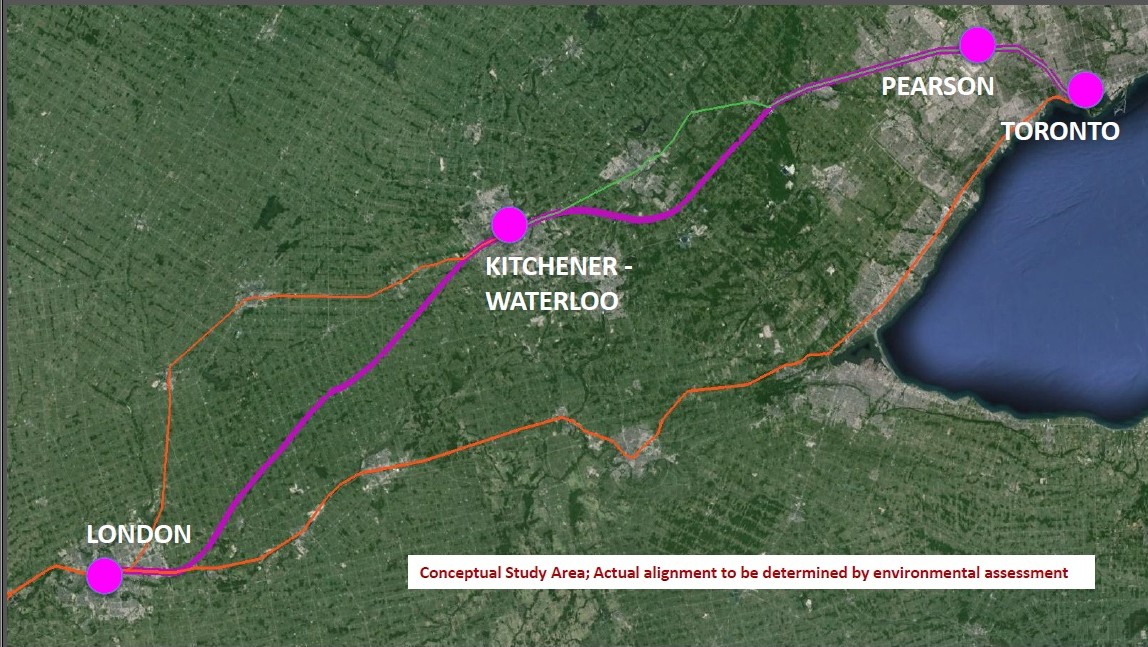
Note that from about Georgetown to east of Kitchener, and for most of the distance between KW and London, the line would run in a new corridor (pink) while the existing route (green east of KW, orange to the west) would be left as is.
Page 14: Summary: Key Findings
By 2025, it would attract about 6 million passengers per year
- About three-quarters of passengers would be “diverted”, with 20,000 car trips taken off 401 each day
- Fare revenues would repay most capital investment with a net cost to government of about $500m
- While High Speed Rail would directly serve only London and Kitchener, GO riders from Guelph, and communities across south western Ontario would see benefits
Page 15 has a table of scenarios:
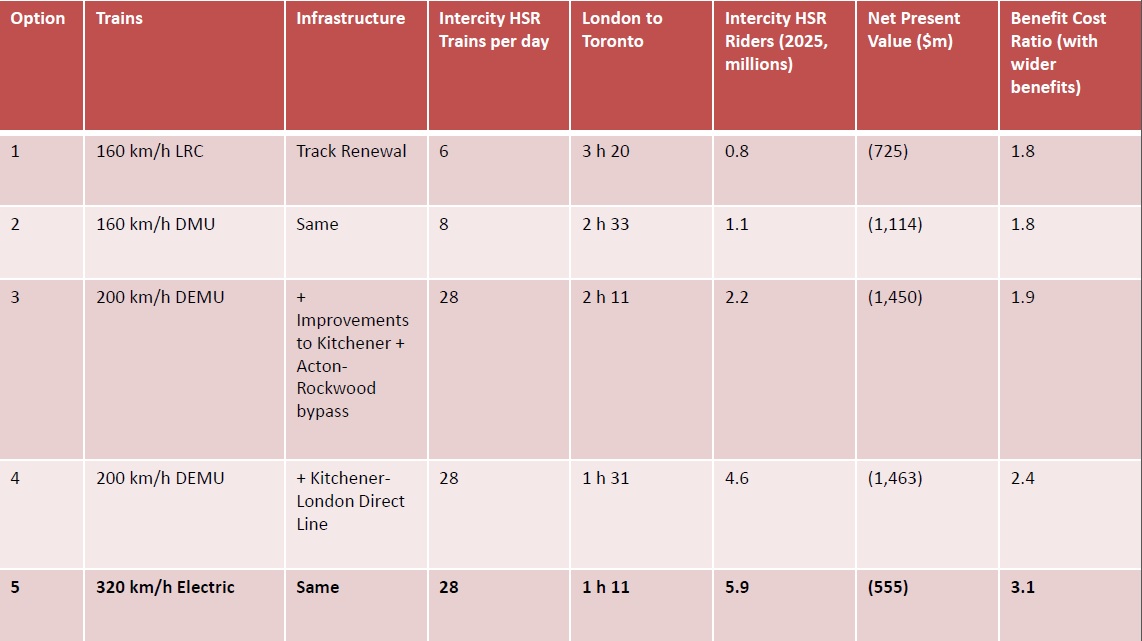
This table is the entire public description of the “study” and “business case” for the proposal. What is noteworthy is that it purports to show a rising demand and, eventually, a falling cost for this service. This only happens if we go for the most expensive, highest speed option, and almost certainly shows a demand and benefits model that assigns a high value to the shortest travel time.
The “Benefit Cost Ratio” is highest for the 320km/h electric option, but this includes unspecified “wider benefits” that cannot be directly plugged into a purely financial model, thinks like time savings and road capacity released by diverted trips.
The net cost of this most aggressive of schemes is shown as a mere $555m, but this is over the long haul presuming that ridership actually builds up to nearly 6-million annually, or 20,000 daily. That will be something of a challenge. Profit from fares is supposed to pay off most of the $2-3b pricetag over 10-15 years, but that will be a challenge considering the bargain basement fares Murray is touting.
In his CBC interview, Murray claimed that fares would average $40, but that frequent riders could see them as low as $10-20. It is not clear whether this refers to full length London-Toronto trips, or shorter hops from KW. In any event, GO fares to KW today are $16.10 for a full fare adult, and 40 fares on Presto (the equivalent of a monthly pass) would cost $516.90, or $12.93 each.
The proposed fare for the Union-Pearson Express is over $20, and even at that, the line won’t be profitable according to the provincial auditor especially if capital costs are taken into account. According to Murray, the UPX service would be merged with the high speed line to save on operating costs. (This would also relieve pressure on track time which will be at a premium between UPX and GO requirements, both operating at 15 minute headways.) How the high speed service would link to Pearson Airport is unclear given that Metrolinx is just finishing up a spur from the main corridor that is decidedly not “high speed”, does not serve trains arriving from the west, and serves a terminal only large enough for comparatively short trains.
It is a mystery how the high speed rail is going to recoup at least 3/4 of its capital cost from operating profits when no other rail operation in the GTHA comes close to breaking even.
With 28 trains each way, or 56 one-way trips, the average patronage of every single train will have to be 357. However, those pesky riders insist on travelling when it is convenient for them, not for the railway, and they will concentrate in peak periods. Indeed, the whole idea that the high speed service will make commuiting easier implies concentration of ridership in a comparatively small number of those 56 trips. How are the peak loads supposed to fit on that half-hour headway in anything less than GO Transit size coaches.
To put it another way, taking 20,000 trips off of Highway 401 is a nice idea, but the benefit is greatest if this happens when the road is busy. The number of trips that can be diverted at peak periods is constrained by the size of the trains and the service frequency.
In his interview with CBC, Murray clarified that of the 20k trips shifted from Highway 401, 15k are existing commuters and by implication the remaining 5k represent growth that would occur without the rail service.
Those trips also represent people who started somewhere, probably not next door to the train station. Without robust feeder/distributor services in London and KW, those customers won’t be able to reach the trains. This is the same problem faced by GO Transit’s planned service expansion into two-way all-day service. Far too often, we hear about shiny new trunk services in transit networks, but little discussion of how people will access them or the degree to which the local access leg of a trip compromises time savings on the express rail portion.
Page 16: Summary: Proposed Services
Intercity High Speed Rail
- 2 trains per hour all day, 320 km/h + electrified
- 71 minutes from London to Union Station, Toronto, and 48 minutes from Kitchener to Union Station, Toronto.
- Business and Economy Class
- Affordable fares competitive with other transportation options
GO Regional Express Rail
- Regional Express Rail
- GTHA Transit Fund To Build Fully Electric Regional Rail Network
- 15 minute two-way electric service on all lines within 10 years
- Will serve Guelph and Kitchener
- Interim subway relief for Toronto
Pre-feasibility numbers demonstrate that RER investments in Toronto fundamentally change the numbers and present a strong case to run HSR to London.
The 10 year timeline for 15-minute service to KW is directly contradicted by the Minister’s interview in which he claims this is only 5 years away. Meanwhile, there are Liberal promises of two more GO trips each way (doubling the present service) to KW by 2016.
Page 17: We’re back at St. Pancras Station.
Somewhere there is a detailed report with more information, but this is not public:
- According to Minister Murray (on Twitter) because the election writ has been dropped and he cannot make the document public, but
- According to the Ministry, the document contains commercially confidential information.
“One of the first things we want to do if we’re re-elected is get those studies out there,” said Murray. [From the CBC article]
Well, if they contain “commercially confidential information”, those reports are not going anywhere, and Murray should start thinking about how to either strip such info out of the reports, or tell the Ministry (assuming he is still its Minister) to stop hiding information behind that catch-all phrase, one that is used far too often to hamper public access to documents.
At this threadbare stage of the proposal, what can possibly be confidential unless Murray has proceeded much further down the path of shopping around a commercial proposal than he is telling anyone? This project would take a goodly chunk out of Ontario’s transportation spending in the next decade or so, but we can’t see the report? This is precisely the sort of arrogance that got the Liberals in trouble over Gas Plants, among other things.
Talking to the CBC, Murray claimed that the high speed line would not be operated by Metrolinx, and CBC confirmed that Metrolinx is not involved in the study. Murray suggested that possibly the Ministry of Transportation would run the service, and of course there is always the possibility of private sector involvement.
Yet again, we hear that the “private sector” (which might actually be a very large public sector pension fund) might be interested. That only works if there is a profit to be made, and that profit depends on a secret study, not to mention investing up to 10% of the new Liberal transportation fund. Other cities and regions in Ontario might well wonder when their turns will come.
Open, transparent government? No. Election goodies? Definitely.
 Steve Munro
My firm, FCP (www.fcpworld.net) prepared the pre-feasibility study for High Speed Rail in the London – Kitchener – Toronto corridor. Costs are relatively low because the line from Toronto to Kitchener is being upgraded anyway for GO, and the new line from Kitchener direct to London can be built quite cheaply because it is mostly open farmland. Distance and traffic demand are comparable to London – Reading – Bristol, a very profitable route. This is not a pipe dream. With luck, Canada will be the 19th or 20th country to join the “high speed” club, behind Turkey and Morocco. London – Toronto can be the first step towards developing HSR all the way to Quebec City. Rail fans should be happy!
Steve: I would be more impressed if this didn’t have the flavour of so many other announcements that are all sizzle and no steak, and if the Kitchener-London corridor were not so important in the electoral math for the Liberals.
I am troubled by the demand figures because we cannot see the details in the background material. 20k per day implies a decent load per train even if they are spread out over 14 hours of service, but the real problem comes if the primary use will be for “commuting” as the service is pitched by the Minister. How big are these trains going to be, and how are they going to serve Pearson Airport and the small-scale UPX terminal? (Or does the UPX become an airport shuttle to the main line?)
Finally there is the question of financial returns versus wider benefits, a conversation we have had before. From an investment point of view, one cannot count the soft benefits because they cannot be monetized, at least not as revenue an investor can count on. With the Minister talking about fares on a par with or lower than GO Transit or the proposed UPX, it is hard to believe this is viable as anything other than a government investment to improve service.
LikeLike
As for fares, as with airlines, they will bear only a vague relation to the distance travelled. You can fly to Vancouver for less than the last-minute fare from Toronto to Montreal.
The London – Heathrow Airport rail express charges £22 for a one way trip, distance about 18 miles. If you book in advance, you can travel London – Bristol, on the same route, but 112 miles (6 times as far) for £15, one-tenth the fare per passenger mile.
Learn about market pricing and you will understand how railways can, and are, profitable in other parts of the world. Is it “fair”? Who’s to say? Does it mean more and better trains, carrying more passengers, on more railways? Definitely.
UP express will probably be $20 – $ 30 – comparable to the express bus it will replace. Toronto – London (Ontario) will probably cost $20 – $200 depending on when you travel, how far in advance you book, etc. Read this report which is based on research I did for the World Bank.
Steve: The obvious difference with airlines is that they have a high fixed cost for their fleets and for use of airports regardless of how far they travel, and so the marginal cost of taking someone further relates to crew, fuel, possibly greater luggage capacity, and more salubrious accommodations onboard.
You say that Toronto-London will be $20-200, but that’s a huge difference from the impression left by Glen Murray’s interview which implies that the typical number will be at the low end of the scale, possibly even lower. I can believe your range (with the profitability to match), but not Murray’s. The problem here is that if the scheme is sold on a different premise from the one used by the “experts” (to borrow Murray’s term), then the conclusions of the study cannot be supported by the salesman’s claims. It would be like buying a car from someone who claimed it only needed to be fuelled once a year, but omitted the fine print about occasional usage.
LikeLike
There’s much here to be concerned with, yes, but if you’re worried about a feeder service to the Kitchener station, it starts construction next month: the Ion LRT. It will pass under a very nice new intercity station set to go in at Victoria and King streets, which Waterloo Region plans to build whether we get high-speed or not.
Steve: My concern with feeders is part of a more general issue I have with Metrolinx, GO and The Big Move in that they have yet to shift away from the model of gigantic parking lots as their “feeder” system. This works only if (a) you have the land and (b) you are serving only one-way commuter trips. The importance of good local transit to making regional services work better cannot be overstated.
LikeLike
Leave it to Canadians to do things bass ackwards.
High Speed Rail makes the most sense between Toronto and Montreal via Ottawa with eventual extensions east to Quebec City and West to Windsor and/or Niagara Falls to connect to the US.
Instead the Ontario Government wants to extend the Union Pearson Rail westward.
However, if you look beyond the Canadian Border you may understand why a High Speed Railway makes any sense between London and Toronto.
Look at The United States High Speed Rail Network Map…
With a tip of the hat to Alain Morrier on facebook for posting this article.
This would be a part of the American network.
It’s Chicago to New York City via the north shore of Lake Erie that I see. Like the Canadian Southern Railway except that it would be through London instead of St. Thomas. It’s a gambit for Canadian Government to foot the bill for this portion by throwing in a link to Toronto.
LikeLike
Too late to change the design of the LRT, unfortunately. May need to be rebuilt before the concrete has set. 2-way all day GO service, with 15 minute frequencies, will make feeder buses and LRT much more viable.
LikeLike
To me this entire proposal seems ludicrous. I have a very hard time believing that this service would attract the type of ridership that is being reported without having multiple points of pick-up and drop at either end, which of course would mean it would not really be all that fast.
The existing London train station is in the London core and is a longer trip for many potential users than accessing the 401 would be. There are also many of potential riders who would not be destined to the core in Toronto.
You are not realistically cutting the trip time in half from what could be reasonably achieved with an express train, running even at 140 km/h. If I am destined from the South side of London (where I presumably would live if I travel very frequently to Toronto) and destined to Mississauga or western Etobicoke, the car will still be considerably faster.
Ontario, has bigger fish to fry, better for the province to campaign for greatly improved Via service.
Higher frequency GO service along the Milton line to and beyond Cambridge would likely have a more meaningful impact. Make this trip 45 minutes and you are cooking with gas, and this would likely attract a good number of these core bound London drivers. A GO station on Cedar Creek Road would place this west of most of the real traffic.
People drive to places like Aldershot if they want to use the GO (401 to lightly used 403, but do not have to deal with much of the QEW. Pushing high frequency service close to the 403, west of Hamilton (say Brantford near 403), would also serve those traveling from Windsor, London, Sarnia, well without creating a lot of service for periodic users. You can more effectively improve the lot of those traveling from Southwestern Ontario into and through the Toronto area, by better addressing the issues of more regular commuters in the GTHA, and simply placing some of that service close to a 401 or 403 exit just beyond the current insanity that is Toronto traffic.
I would not expect somebody going anywhere but the core to be prepared to use public transit unless they are very regular users.
LikeLike
This corridor is much more suitable for medium speed 200km/h electric rail, as it is only a distance of roughly 200km from London to Toronto. High speed rail is too costly for the current government’s fiscal situation. However, this would definitely make sense as London-Kitchener-Toronto is by far the busiest intercity car route in Canada; those sections of 401 and 403 have much higher traffic volumes than 401 between Toronto and Montreal. Also it sounds like the brand new Pearson Airport spur will have to be totally rebuilt so longer trains can serve the airport if this actually happens.
LikeLike
Er…. It’s St. Pancras
Not an internal organ
Steve: Fixed. Thanks.
LikeLike
You can’t tell where high speed rail makes sense just by looking at a map. It depends on the costs, which depend on how easy or hard it is to build the route (e.g. do you need to dig a tunnel under the English Channel), how big are the cities, and what is their social and economic relation. Toronto – Buffalo looks good if you ignore the US border, the Niagara River. London – Kitchener Toronto is actually very attractive, because the line will be relatively easy to build and the traffic high – if you are in London, where are you going to go for a meeting/airport/visit friends/theatre/shopping? Toronto, obviously. The same reason why Intercity works so well in the UK, to and from London.
As someone who does occasionally use HSR from London to Cologne, it is barely competitive with air even for trips of 600km. Look at the numbers, not just the maps, please.
Steve: I would look at the numbers if only the report were public. A one page summary (included with this article) does not constitute a thorough analysis.
And as for “Toronto, obviously”, well, no. A lot of “Toronto” is remote from the core and more easily accessed by car.
LikeLike
Steve, while the pancreas is a wonderful organ, it’s not so wonderful they’re naming train stations after it just yet. Pancras of Rome, the beheaded Roman convert-saint, however, does have that honor in London.
Steve: Yes, I know. Don’t know where that came from (three times) considering that I was looking right at a caption with the correct spelling.
LikeLike
It’s a nice to have, but I really don’t see the mass demand for this.
The best case is some business travelers who might make the trip once or twice a week.
As a tech person, a tempting idea is that maybe you could travel from Toronto to Waterloo. But even that is pretty flat.
1. Getting to the airport in rush hour would be a mission on its own for most in the GTA. I have had coworkers who found it quicker to drive from Milton to Waterloo than travel from Milton to Mississauga.
2. What to do once you’re in Waterloo. Is there reasonable transit to get you from the high speed hub to the where you need to go in a reasonable time. Most of the companies are located in your standard suburban lots.
It would take substantial planning and local transit changes to make this worthwhile.
As it is right now, there are big missing links with transit to the airport. Mississauga BRT, Eglinton Crosstown … are both still in the TODO list for connections to the airport.
It’s a nice idea, but getting the local transit and focusing commercial development along the transit lines is a huge priority.
LikeLike
London wants an underground railway, underground railway, underground railway!
Sorry, couldn’t resist.
😄
LikeLike
“St Pancras”, not “St Pancreas” 😉
Steve: Fixed, or should I say “fixd”. Thanks.
LikeLike
Remember GO ALRT? Another dream that went nowhere. This is more of the same.
LikeLike
The map seems to show the proposed line detouring south of Guelph. I guess no one in Guelph would ever want to use High Speed Rail and there is no research going on at Guelph University that would benefit from better access to the rest of southern Ontario.
His table of services shows a 160 km/h LRC train doing the Toronto to London run in 3h20 while a 160 km/h DMU can do it in 2h33. These numbers do not make sense because the difference in the acceleration rates of the 2 services would not cause a 47 minute increase in running time. CN used to run a Friday and Sunday Budd train to London and back that did the trip in about 2 hours but it did use the Oakville and Dundas subs not the back line through Kitchener.
Option 3 using 200 km/h DEMU would get the trip time down to 2h11, almost as good as the old Budd service but it only stopped at Brantford. This improved service would only cost $1.45 million. This looks like a plan that is searching for a problem. Are they going to bring back the UTDC or create a newer boondoggle to build something where it is not needed. Is this PLAN available on line or elsewhere to peruse.
LikeLike
I thought Ontario and Quebec just finished a high speed rail study on this a few years ago that specifically recommended NOT building high speed rail west of Toronto. The study suggested that the only viable line was Toronto-Montreal via Ottawa. I specifically remember south-west Ontario being sour about the conclusions of the study.
Although I am sympathetic to the idea of connecting to future US high speed rail lines, the reality is that there isn’t enough traffic right now to even support a Detroit-Windsor passenger rail link, so that doesn’t seem like a promising high speed rail corridor. The more realistic high speed connection to the US will be through Niagara (assuming New York finally gets around to upgrading its upper New York rail lines).
LikeLike
Instinctively, one might think it is more suitable for 200 km/h. And plenty of routes of this length work with 200 km/h trains. I myself founded Hull Trains which operates with 200 km/h diesels, profitable, without subsidy. For TKL (nice acronym, eh?) we did look at 200km/h, and found that the extra revenue easily paid the extra cost. Intercity rail is about time, and every minute saved can mean another $20m or more in revenue (capitalized). You can’t design these things by “feel”, you need to do the numbers. Since you need to build a new line anyway around Guelph and from Kitchener to London, you might as well build it for 400 km/h as the extra cost is very small, although above 320 km/h operating costs start to rise sharply. No point building a new line with curves in it if you can keep it pretty straight. Read the recent UIC report on this.
LikeLike
We benchmarked our forecasts against actual intercity rail traffic to places like Bristol, Doncaster, Nottingham etc. which have similarly dispersed activity and high car usage. Many people in London making day trips to Toronto will drive and park at the station as they do in the UK. Try driving from London into Toronto for a 9AM (or even a 10AM) meeting. Not fun.
Yes, the rest of the Ontario passenger rail network needs to be fixed up, but it is not a zero-sum game. Many routes can be improved if, as on TKL, the passenger revenues will pay operating costs and also a large share of capital costs. You are being too pessimistic.
LikeLike
GO ALRT had no business case. It would cost a lot of money, with unclear benefits. It was too expensive, because it required all-new alignments, mostly elevated structures. And it was 20 years too soon.
LikeLike
Read the Ecotrain study. Some major flaws:
1. no sharing of infrastructure with regional services. GO trains and HSR can share tracks to Kitchener, as Intercity and Regional trains do in the UK
2. No HSR service to Kitchener, because it is “too close”. WRONG. HSR makes money on many shorter routes in the UK and Europe.
We used the Ecotrain costs and revenues, but re-designed the service. It depends how you put the pieces together.
LikeLike
Another HSR dream scheme at election time based on the eternal fantasy of passenger train profitability in the face of excessive subsidization of the other modes. Perhaps this is a good time to repeat a couple of the myths about passenger train profitability that Amtrak president David Gunn exploded in one of his first appearances before a congressional committee more than a decade ago.
Myth: “Amtrak can be profitable.”
No national rail passenger system in the world is profitable. Without public subsidy, there will be no passenger rail transportation systems in the United States.
Myth: “The private sector is dying to take over our services.”
Remember why we were formed. We are what is left of a once privately run enterprise.
Myth: “The Northeast Corridor (NEC) is profitable.”
The NEC may cover most of its above-the-rail costs, but it is an extremely costly piece of railroad to maintain. The NEC is not profitable and never will be. Sure, private groups might be interested in having it, but they would take it only with the promise of massive capital infusions.
I’ve been waiting all my life to learn the magic formula that will result in profitable passenger trains that pay their full cost of capital and operations. I’m so glad Glen Murray & Co. are going to provide that — after the election.
Meanwhile, I’ll bet the residents of Stratford and St. Marys are thrilled by that tangent connecting Kitchener with London, which misses both towns by miles. But those folks elected a Conservative the last time around, didn’t they? And this is a Liberal vote catcher, if there ever was one. Hmm.
LikeLike
While not optimal for high-speed operation, there are typically reasons for the existing railway taking the existing routes. For example, the climb up the Niagara Escarpment through Acton is a much lower grade than is possible by straightening out the curve at Limehouse – at least without extensive blasting of the ecologically sensitive escarpment.
Perhaps they know this, and that’s why the map is captioned with a note about an EA.
But also the alignment out of Kitchener through New Hamburg is far easier for crossing the Nith River than running further south. (I know, it’s just lines on a map. But still, the indicated alignment across the Nith River – right by the Holiday Beach trailer park – is possibly one of the worst possible places they could pick. Further south by Plattsville would be better, but then you might just as well keep the existing alignment. If they use that alignment they’ll also have fun with the old valley of the branch/tributary of the Thames that runs through Thamesford, which the line actually runs along for about 10km from the northeast of Thamesford.)
I’m not really trying to say that I know better than the experts about designing a rail line, or claim that the idea is broken or won’t work. It’s just that if I – in 10 minutes, using only Google maps – can find 3 issues with the proposal, then it doesn’t seem like it was very well thought out. Like maybe someone spent _less_ than 10 minutes putting it together.
Steve: Maybe Michael Schabas can comment here on whether anything more sophisticated than Google Maps was used to plot the route.
The existing line has been there for a long time, and there are reasons it follows the path it does.
LikeLike
My question would be where are they driving to in London to connect with rail. Are they proposing to build a new station? The existing station in the London core has a small parking lot just to the west. The larger residential areas are mostly decently north, west or south by decent amounts. Most of the arterial faster north south roads in London either access the 401 or 402, and it is faster anywhere mid town and south east of Highbury or close to Wonderland to get down to the 402 or 401 than to get to the train station and park.
Also why 3 hours to get from London to Toronto on current service, there is currently Via service that does this in 2 hours, 10 minutes, this is Via on existing tracks.
Steve: For the benefit of Michael Schabas and others: Via train 79 leaves TO at 1905 and arrives in London at 2112. What other basic facts are wrong in the study we are not allowed to see?
I would argue that the real problem with the Via service now is that it is only 6 trains per day, and they vary in travel time from 2:10 to 3:42. However, the reason for the existing service is that it is not now near full.
To build ridership from London, I suspect that you would need much more parking, or much improved city of London transit (15-30 minute bus only depending on time and location as I recall). Also the train runs through the city of London itself for some distance, close to the Western Fair grounds etc and this has considerable rail traffic. It also passes directly beside the very popular and new BMO indoor soccer facility, where in the winter there are frequently hundreds of kids coming and going.
LikeLike
Crazy idea: maybe try running more than four (FOUR!) regular trains per day to these cities to build up ridership a bit and test the waters before spending billions on a HSR service.
Of course, this is Ontario. We can’t afford to run good regular service. But we have billions to spend on unnecessary projects in swing ridings.
LikeLike
“The Minister Muses on High Speed Rail” This is all just campaign rhetoric just like the Scarborough subway was during the by-election. We all know the Liberals never had any intention of building the Scarborough subway (it was promised just to get the Subway Champion (Liberal Mitzie Hunter) elected which she was based on the very false Scarborough subway promise).
Anyways, this crazy high speed service project will cost tens of billions of dollars and so that will eat up all the transit money and there will be no Scarborough subway, no Downtown Relief Line, no Sheppard subway extension, no eventual burial of the Eglinton Line, no conversion to electric for all GO train lines, no money for more streetcars, and no money for anything else transit. So, I guess Steve that given your support for the DRL, you will not be able to voting Liberal as the Liberals intend to spend all the DRL money on high speed long distance frequent rail service.
Steve: I live in an NDP riding and will vote NDP even though they don’t have much money for transit in their budget, and are evasive about how they would fund transit expansion. If I lived in a swing riding where the Liberals needed my vote, they would get it rather than letting the Visigoths take control of Queen’s Park.
Your political analysis is far too trite.
LikeLike
I hate to offer corrections but it’s St Pancras, not the body organ pancreas.
Steve: That was fixed a long time ago. You are reading an elderly copy of the article. I have already been flayed with a wet noodle several times by other readers.
All this sounds as though the Conservative Feds are about to download Via to Ontario and Quebec!
If the minister is concerned about relieving the 401, then finding a way to support CP’s Expressway truck trailer service, originally Montreal-Windsor, but now cut back to Montreal-Toronto. It appears demand is very inconsistent, due to fuel costs, keeping truck drivers employed and economic health of the moment. Although a private company, the minister should be able to find ways of working with CP to expand the service and relieve the highway.
I am surprised a new line to London Ontario is seen as necessary when the existing line is largely flat and straight, and, it would appear, upgradeable quite easily to 160km, at far less cost, and do-able in short order.
If an express service from London is to serve the airport, then the inevitable Woodbine Station, lets call it Pearson Connect, (near the race track and where the new airport spur diverges), would be needed, for reasons Steve states, together with a shuttle of some sort from Pearson Connect into the airport proper. Then, since a shuttle and the UPX DMU’s would be incompatible, the UPX would need to terminate at Pearson Connect, and passengers transfer to the shuttle. But then if Pearson Connect exists, GO could stop as well, and passengers use the shuttle into the airport proper; why not? Then UPX and GO would duplicate service so we might ask why have UPX at all since GO could serve the purpose, one train instead of two. To maintain the UPX as a brand for marketing purposes, three coaches of each 15 minute scheduled GO train could be called UPX with different paint colors, luggage racks and TV’s. Go trains would then stop at Pearson Connect with those three coaches adjacent to the shuttle terminus area.
And what of the shuttle? Well, what better than some of those Transit City LRV’s, that we just happen to have on order, to provide a dedicated, say 3 minute, shuttle service!
LikeLike
I presume that the study knows the price of farmland in the area. Not cheap at all! Goes for $20,000 an acre for a commercial transaction. When they developed the 401 (a long time ago) and a farm was split into 2, the province had to buy the back half of the farm (and looking at the route, they do not follow lot lines).
With or without purchasing the back half of the farm, this is some of the best yielding land in Ontario. Does the Minister of Agriculture even know what this will do to the families who have farmed this land for generations? And the reduction in the areable land? Oh wait … the Minister of Agriculture thinks farmers wear shiny red rubber boots.
Finally, there is a signficant amount of wildlife that has to be protected. There will have to be a fence for the entire length of the corridor. This includes the Escarpment and other very important wildilfe corridors. Quite a few wildlife bridges will have to be created throughout the entire length to allow the animals to freely traverse this fence.
I wonder what the study had for the expropriation and corridor build costs (and what they actually could be).
LikeLike
Do you mean the K-W LRT? What is wrong with the design as it relates to high-speed rail? In the context of a proposed passenger service through K-W, my impression is that the transit hub should provide a very convenient connection between LRT and intercity. But I’m aware that subtle details can make a big difference in usability.
LikeLike
Another country to perhaps compare things to is perhaps Spain. The Madrid–Barcelona would compare very closely to a Toronto-Montreal line, and it is quite popular.
However HSR visits relatively small communities as well, such as Madrid to Toledo (pop. 84,00), which is 75 km away (and has it’s own ‘dead-end’ line), and medium-sized cities Seville (pop. 700,00), with Córdoba (pop. 325,000) along the way. There’s even a dedicated line between Córdoba and Málaga (580,000), with stops in small-ish villages (<50,000). According to Wikipedia, the Córdoba–Málaga cost €2.1 billion.
I do think that Montreal-Toronto would make the most sense, with at least a stop-over in Kingston (123,000), my second choice would be Toronto-Ottawa (880,000) (via Peterborough (116,000) perhaps?).
London (pop. 350,000) isn't unreasonable, though some harder numbers would be nice.
LikeLike
How many platforms are there in Union Station?
There may be a bit of overcrowding in the near future.
Presently there are the:
7 Go Lines
Via Rail
The AirPort Express
John Tory’s SmartTrack proposal
and the HSR to London.
Steve: If it’s any consolation, some of the GO lines will be consolidated by through operation between western and eastern routes, and Glen Murray has already said that the HSR would take over the function of the UPX. But it’s still going to be a challenge finding room for the GO KW service, the HSR and Tory’s train in the Weston corridor from Eglinton to Union.
LikeLike
Is Murray not aware of the opposition of high speed rail in California, HS2 (UK), and the one in Alberta?
Steve: A lot of opposition stems from the idea that HSR is an expensive toy that doesn’t address real neads. I have yet to be convinced we are not in the same situation here.
LikeLike
Murray should be lauded for his vision – something that has been lacking in recent years in politics.
HSR should be planned in a national, nay – continental context. We are inextricably integrated with the US in the largest economy the world has ever seen. Let’s keep it that way.
LikeLike
When I last took the train to London it took nowhere near three hours plus, I went through Brantford and it was just over 2 hours – roughly the same as driving. Returning, there was a problem on the tracks and we went through St. Marys and, if I recall correctly, Brampton. This was very bumpy track and I think it took 3 hours or more. However, most days, there is not a problem on the track and using over three hours plus as a base for conventional service is simply misleading.
I paid VIA Rail a discounted fare in the range of $35 return from Toronto to London. It cost me $33 each way in cab fare to get from the train station to the office. This was OK, but ironic for me in terms of distance traveled. OK because I expensed both charges. However, a commuter, not on expenses, needs (as Steve points out) to include the cost of getting to and from the rail stations at start and destination. When I went to London, using local transit was not even in the possible solutions. In Toronto, I live near Union Station.
LikeLike
Lots of comments on HSR, which is great. Disappointing that there is such skepticism, and such little understanding it seems of the economics and finance of high speed an intercity rail in other countries. I thought this column was read by people who liked trains, and like to learn positive lessons.
SUBSIDY: I know without subsidy, VIA would cease to operate. But many passenger rail services are profitable, in the UK, Europe, and Asia. I know. I have been an owner/investor in a few. That passenger rail always loses money is a myth. Go to the websites for the UK office of rail regulation or the Department for Transport. You will see that most intercity rail operators, and most London regional operators, are not subsidized, and actually pay “Premiums” to government for the right to operate their services. And this is AFTER paying commercial rates to lease the trains, which are almost all now privately owned. French Railways makes very large operating profits on its TGV Services, as does Deutsche Bahn. Their annual reports are available on the web, Of course, they also operate many local and regional services, many of which are “social services”; even on potentially profitable routes, fares are kept low for social reasons.
Take a look at UK rail fares. Try buying a ticket, a few weeks in advance, for London – Bristol, on http://www.thetrainline.co.uk You will see that fares range from £17 to £180. Just the way prices vary on Air Canada and indeed VIA. Gas is cheaper in Canada, and we actually assume fares significantly lower than in the UK.
London Ontario is not the biggest city in the world, but the corridor population is comparable to London (UK) – Reading – Bristol, which actually supports 4 high speed trains each hour. The First Great Western franchise pays premiums of £100m per year. Train size is assumed to match demand growth with similar load factors to those achieved on other HSR routes.
One reason passenger rail doesn’t make money in North America is because it is that it is not designed to do so. Would a state-run telephone company have developed a phone that would cost $500, so people could send each other pictures and play games? Rail in Europe is still partly subsidized, but to a great degree it is profit-driven. If you are against profit for religious reasons, you won’t like that. But the experience in the UK is that profit-driven rail are better railways, that attract more people, offer better services, and are even safer. Go the the ATOC website and read the paper “Growth and Prosperity”. Check the numbers. Make up your own mind.
As the minister disclosed in the summary table, we looked at incremental options for Toronto – London: upgrading the existing route via Stratford, faster trains on the shorter route via Brantford, and high speed diesels over new track. The numbers were pretty clear. Over 25 years, the lowest cost to the taxpayer and also the greatest benefits come with a 320 km/h high speed service. Actually, this is not so hard to believe. Recently the UIC published research that showed that, for new passenger lines, it makes sense to run as fast as possible up to about 300km/h, because the additional costs are outweighed by the savings in crew and train hours. Building a 200km/h line would make as much sense as Air Canada flying planes more slowly across the Atlantic. They would save a bit on fuel, but would need to buy more planes and hire more crew – so the cost would go up, and the profits down.
UNION STATION CAPACITY: Take a look at Cologne Main Station and see how many trains operate through it with a 13 platforms. 1200 departures per day, including 14 intercity routes, most hourly or 2-hourly, 7 regional routes (many double deck), and 4 s-bahn (RER). I am a part-owner of Hamburg Koeln Express (HKX) and we operate 3 times each day. And we get no subsidy. Paris Chatelet-les-Halles has more trains with only 7 platforms, but only RER trains.
TRAFFIC FORECAST The minister did in fact disclose the traffic forecast in his briefing which is available on the web. Current VIA traffic is about 0.5m (hardly a state secret – you can figure this out by counting seats and looking at the timetable, and taking a guess at load factors). You can also guess the traffic on Greyhound, Air Canada, and in cars on 401. And you can look in the Federal Provincial EcoTrain study which gives lots of data. I think they point to a total of about 20m trips per year between Toronto, Kitchener and London. Our forecast, as presented was 5.9m HSR passengers in 2025. Essentially about 20% of car passengers, plus all existing rail and bus passengers, would switch to HSR. In addition., about 20% would be “generated”, new or more frequent trips made because the faster, cheaper, more convenient service is offered. This matches international experience.
We wouldn’t expect large number of daily commuters from London. It’s too far. But my Anglia Railways business, which I was part owner of from 1996 to 2003, had a couple of hundred “season ticket” passengers who travelled from Norwich to London 2 or 3 times per week. The Season Ticket is about $10,000, I think, a lot of money, but if it means you can live with your family in London rather than relocate for a job in London, well worth it.
Paying $40 on average (actually fares would probably range from $15 to $150) the revenue would be $240m per year. Don’t really need a computer to do this – do they still teach mental arithmetic? Operating cost, including lease charges, will be less than half this much, with the “margin” enough to pay off most of the capital cost. The net subsidy, about $555m NPV, is probably less than will be needed to continue subsidizing the existing VIA services.
Some HSR lines, for example in Spain, indeed seem to be expensive toys. The jury is still out on Los Angeles – San Francisco. It’s really too far to appeal to the business travellers who will pay high fares. Without them, it may be hard to cover the costs. But for a corridor like Toronto – London, the numbers work very nicely actually. How does a business traveller, living in London, get to Toronto for a 9AM meeting? Driving is pretty painful, and likely to take 3 hours or more. Air Canada will fly you to Pearson, but the fare is $650 and you still need to get downtown!
I think the Minister got a bit confused on UP express, or was mis-reported. UP express would be integrated with TKL, the same way that Heathrow Express is integrated with London – Bristol HSR. They share the same tracks, and you can buy a single ticket from Bristol to Heathrow. But Pearson – Union would continue to operate every 15 minutes, using small trains. Passengers from Kitchener and London going to the airport would need to change, probably at a station near the airport. Not ideal, but the same arrangement as in London England, and indeed Dusseldorf and Newark.
Some other points: NPV figures are millions, so Option 3, with DEMUs (like the Voyager or Meridian trains operating in the UK, which I bought for Hull Trains) would require $1,450,000,000 in subsidy, not $1.45m as one comment thought. sorry about the confusion.
Most passengers will hopefully use public transport to get to the station in London and Kitchener. Both will be at the same location as the existing stations. Early morning business travellers tend to arrive by car or taxi, but leisure passengers will be more likely to use bus or LRT.
Some people ask what problem this is trying to solve. I think that is the wrong way to look at it. Better to ask, can it be justified in terms of revenues and benefits? I think it can. It will relieve traffic on 401, and make it easier for businesses in London and Kitchener to connect with business in Toronto. It will make it possible for families to stay in one city, when a member has work or study in another city. And, best of all, it will cost the taxpayer very little – probably less than it would cost to keep running the existing VIA service, and much less than it would cost to add a lane to 401.
Steve: Insulting readers is no way to make up for the flagrant errors in some of your own work. The “I am right, and you therefore cannot be” attitude doesn’t play very well here.
As it has already been pointed out in the comment thread, the existing trip time from London to Toronto is only two hours, not three, and so the delta in travel time is considerably less than you show. To this must be added access times at both ends of the journey. You have still not answered the basic question of time of travel versus available line and train capacity.
Your claims about the viability of this line are all well and good (even if you do come off sounding like a cigar puffing railway magnate at times), but they are not published in a form that anyone can review. In the Neptis study (which makes good points about the role of GO Transit), there is the question of invalid assumptions about how the network could be improved in Toronto and some wonky use of soft benefits as payback for hard investments. It is impossible to review the HSR proposal without thinking of the Neptis report, especially considering how you present both studies on your website as if FCP has become the saviour of transit in Toronto.
LikeLike
Passenger train profitability in Britain? It is to laugh. The taxpayers spend more on the franchised U.K. rail system through Network Rail — the infrastructure provider on which those “profitable” private concessions are dependent — than they did when it was run as a unified system under British Railways.
LikeLike
The rail industry would truly have a dismal future if it could never make any money. Fortunately that is not the case.
See this report.
As in Canada, rail is highly political, and also very complicated. Few journalists can understand the complexities of rail finance – probably the only one is Roger Fort at Modern Railways. Many others either cannot be bothered, or bring their own political agendas. So read the ORR data, not the newspapers.
The UK rail industry gets about £4bn from Government, net. It pays grant of about £4bn to Network Rail. It pays a , [there appears to be text missing from the comment here] and the other half goes to subsidise loss-making operators, mostly in the north. Most of the routes into London pay premiums to the Government, even though they too are encumbered with various social obligations, fares regulation etc. Without these obligations, most of these would be profitable. And note that the franchises all pay lease charges for their trains.
If Scotland secedes, UK rail financials will improve a lot. Even better if we could get rid of Wales too.
Look at Figure 6. You will see that for East Coast, SouthWest Trains, First Capital Connect (Thameslink), the blue line goes as far to the left (premiums to Government) as the red line goes to the right (Government funding of infrastructure). So yes these three very large franchises, each turning over about $1bn per year, actually make money. Net government funding is zero or negative. Wow, the rail industry has a future. And ridership has doubled over the last 20 years, while average fares have actually stayed pretty constant. So yes I do laugh, and cry, because people who want rail to have a future should learn the lessons of what works.
Yes, government funding has gone up, in part because Government is happy to pay more when it knows it is getting value for its money. Funding for schools and hospitals has also increased . . . .
Steve: It will take a while to digest the full report, but Figure 6 shows quite clearly that many parts of the network, the ones you do not mention, are not profitable. It is a big jump from profits on part of the network to saying that the “rail industry has a future” in the general case. It is entirely possible that an HSR implementation here might perform similarly to the best of what you cite in the UK, but we have no way of knowing whether your demand projections are valid without seeing the background paper. This is not just a case of saying “we expect to get x% of the market”, but of looking at both the temporal distribution of demand vs the trains you would run, and the access issues created by the origin/destination of trips at a finer grained level than just “Toronto” and “London” (as detailed in other comments here).
At the end of the day, there is a £4bn annual subsidy to a network that costs £12.ebn to operate (see Figure 1).
I wouldn’t go into any Welsh or Scottish bars in the near future if I were you.
LikeLike
For those interested in Higher and High Speed Rail, take a look at:
High Speed Rail Canada
Join the High Speed Rail Canada facebook page
LikeLike
We have GO service to Kitchener. We have VIA service to London. Can’t we just make incremental improvements to those, rather than wasting breath on yet another pie-in-the-sky “plan” that we all know will never happen?
LikeLike
Sorry, Steve, I did not mean to insult anyone. You did use some rather insulting language about the Neptis report. Let’s move on to make the railways in Canada better. As for the TKL HSR report, it was commissioned by MTO. you can ask them for it – it is not for me to release it. I do think you should welcome the enthusiasm and positive approach to HSR and RER that is emerging from all parties, it seems. No, I am not the saviour of rail in Canada, but I am disappointed that, despite the availability of information in the internet, there seems so little understanding of how passenger rail can work without massive ongoing subsidies.
Steve: Both the Minister and the Ministry will not release the report. The Minister says it’s because of the election, while the Ministry says it is contains “commercial confidential” information. Ontario has too long a history of listening to consultants behind closed doors and refusing to publish the information underlying significant public policies.
LikeLike
There are a number of issues here:
1. What are you assuming in terms of accessing the stations at both ends? My limited experience in Europe (including the UK) was that transit was much more frequent and extensive. The bigger problem in transit in the Toronto-London corridor is at the London end. This makes sense in that London, while similar in population has less than 60% of the population density of Bristol. I would have to assume much lower transit service levels as well (in that I can’t believe public transit in Bristol would be that poor).
2. Toronto has a much greater sprawl issue than London, England, and I suspect that the destination of those London Ontario based commuters would not be nearly as focused on subway or high frequency accessible locations as you are effectively indicating in your usage rates. Also you have also previously pointed out serious issues in existing transit.
I think in general terms HSR will make more sense once the primary transit issue of the Toronto region are fixed. That would still leave access issue to the London. The parking is adequate for current usage, but what you are suggesting in terms of usage would require a massive increase in available parking, or a very high usage of what is now very thin transit.
It should make sense, however we need to fix the roof before we renovate the living room. I will not care about a 1-10 hour train to London, when it takes me 2 hours in transit within the cities of London, and Toronto to use it. The service currently makes sense only from the London core to the Toronto core. Also, please refer to current travel times as 2 hours 10 minutes.
LikeLike