
When I talk about taking a Downtown Relief Line north to Eglinton, some people, including some at the TTC, look at me as if I had at least two heads. That’s a shame, considering that the TTC itself did a preliminary design for this 35 years ago.
I offer these tidbits from my archives not to reignite a discussion we have had here extensively before, but to put to rest any claims that this line was only ever intended to stop at the Danforth.
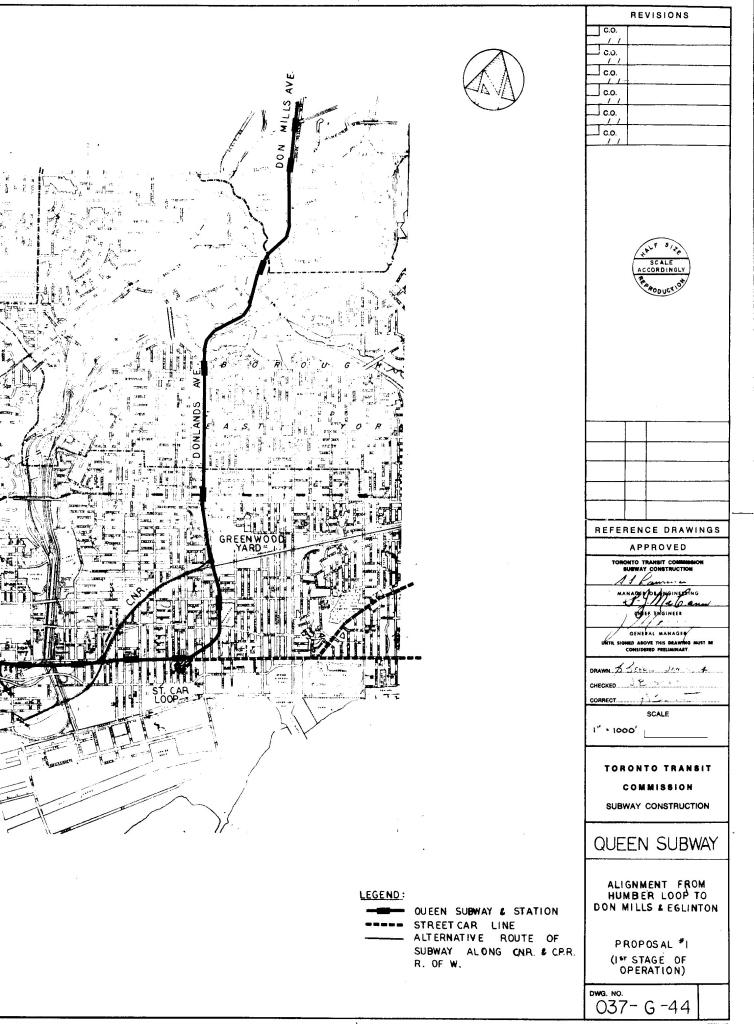 Back in October 1974, the TTC was considering various proposals for new rapid transit lines, one of which was the Queen Street subway. This line would have run from Roncesvalles and Queen east to somewhere beyond Broadview, then turned north past Greenwood yard and continued via Donlands to O’Connor. At that point, the line would cross the Don River to serve Thorncliffe and Flemingdon Parks winding up at the CPR crossing north of Eglinton. The map linked here is a bit fuzzy in places because the original is not clear, but it shows the alignment (including an alternative via the CNR corridor) quite clearly.
 Ten years later, the TTC was working on the Downtown Rapid Transit Study, and the route had morphed into an ICTS line to Union Station.
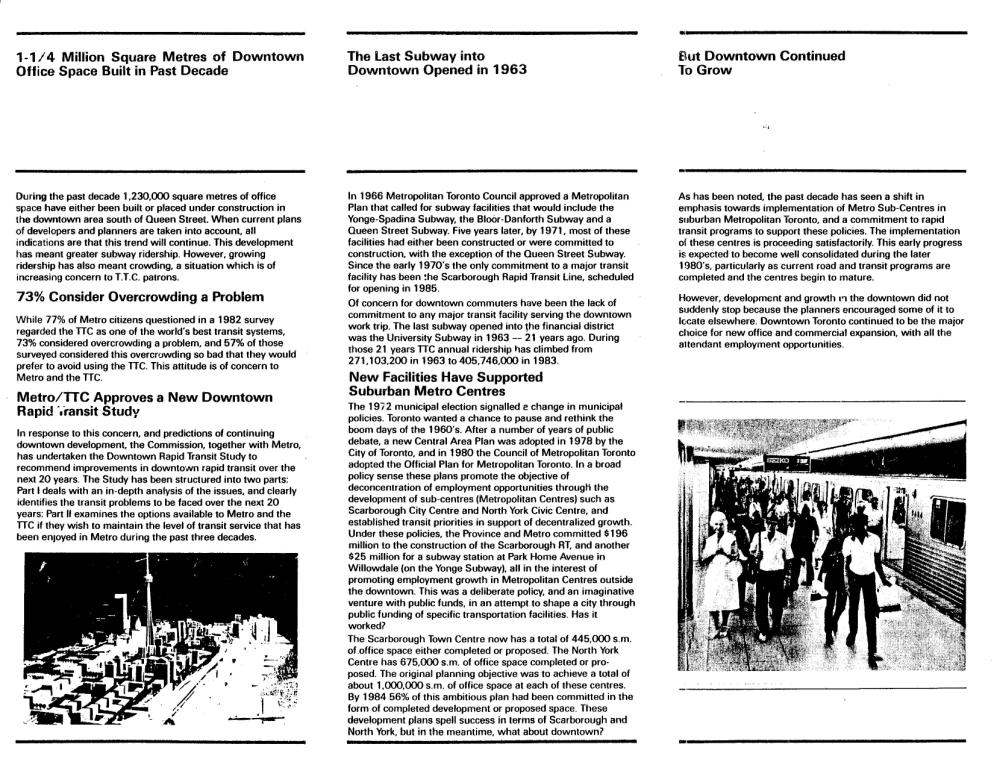 A brochure advertised this study and explained the growing problem of central area subway congestion complete with a suggestion that passengers transfer at St. George rather than Bloor-Yonge.
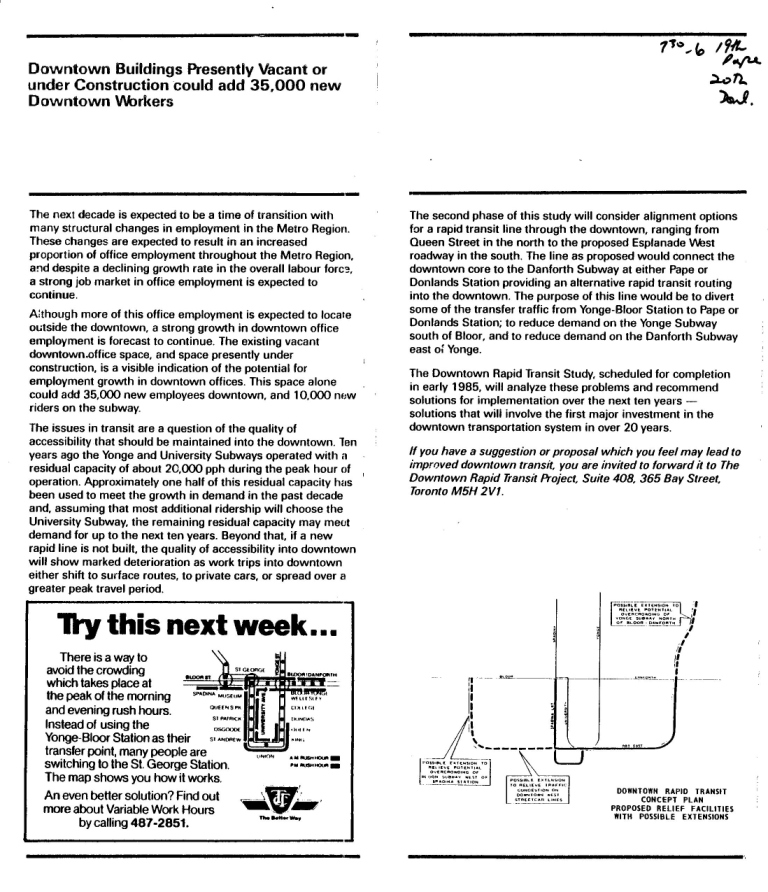 The DRL was never built because politics of the day favoured suburban projects, and instead we got the Sheppard Subway.
 Steve Munro
Steve
There is no such thing as a Sheppard subway, there is however a Sheppard STUBway……..
I am all for extending Darryl (Dowtown Relief Line) north of Bloor/Danforth, but…
1) Would it still be the DOWNTOWN relief line…? there are many variations of what is downtown, the west/east borders change with each variation, but Bloor tends to be most of their northern boundary. This would be like keeping the SPADINA part of the YUS subway even though that line is on Spadina for only about 1km.
Steve: The relief is downtown even if the line isn’t. The idea is to divert riding that would otherwise be on the bottom end of the Yonge subway.
2) A Darryl extending to Eglinton would kill the Don Mills LRT.
Think about it, let’s say the Finch LRT gets extended to Don Mills station and Darryl goes up to Eglinton, so the part between Sheppard (DM stn) and Eglinton on Don Mills is 6.2 km. That part north of Sheppard would have double service…and what if to save money in the future they cut down the DMLRT service to go only to Sheppard and north you have to use Finch LRT…?
Steve: There are proposals for the DM LRT to go north of Steeles, and also for the Finch East LRT to be extended to the east. Both of these suggest a single north-south line in the Don Mills corridor.
3) However if the Finch LRT does not get extended, Eglinton and Don Mills will become another Kennedy station (DM LRT, Darryl and the Eggie all meeting there), could the intersection handle the transit hub there? I passed through the area many times overnight but never during the day, maybe you know this. But I am sure it would be better to make the connection here than at Pape/Coxwell/Broadview.
Steve: The likely recommendation of the Eglinton LRT project is for an underground station for both LRT lines. If the DRL ends here, it would be underground as well. There is a lot of easily accessible land (the Science Centre’s parking lot, for example) under which construction would be fairly simple. The problem of pedestrian congestion on the surface has already been recognized by the TTC.
LikeLike
Well, if the TTC looks at you like you have two heads, it’s because they don’t have one to share amongst them. It’s also a sad demonstration of the lack of corporate historical knowledge. If they had even bothered to check, not only with yourself, but with the Website Transit Toronto, they would have known that this has already been written about, and that you weren’t making it up. Scarier still, does the TTC not have an archival section? Do they not have an archivist who could find this material in their own vaults? Shame on them.
Steve: The problem with the DRL is that its most recent incarnation was an ICTS line from Pape Station to Union, and that’s the one most people remember.
They have an archivist now, but their corporate memory is rather selective. I won’t say anything about the stuff they threw out that had to be rescued by fans years ago. That’s how I got the subway station paintings that are on display on Transit Toronto’s site.
LikeLike
I hope this idea gets revived — the Thorncliffe Park area and Flemington Park areas are both heavy transit areas. I think if you add the 25 Don Mills, 100 Flemington Park and 81 Thorncliffe Park that the numbers using these routes plus some other routes using Broadview, Pape and Don Mills stations would be numbers that would justify investing in some form of rapid transit for this area of Toronto. The Downtown Core along King or Queen definitly could use some rapid transit without a question. I really hope that our governments start heavily investing in transit for all of Canada’s major urban areas and Toronto needs this DRL. Now only if we can sell this project to the federal and provincial goverments maybe this line will become reality.
Steve: First, they have to understand that even though the line is deep within the 416, it would benefit riders for the entire region by dispersing demand on the network.
LikeLike
Thanks Jack Layton.
Steve: For those who don’t know the background, we got the Sheppard Subway thanks to a deal-with-the-devil between Layton and Mel Lastman. Layton wanted to kill any new downtown subway construction, and he agreed to support Lastman’s Sheppard line instead.
Downtown continued to grow, of course, with GO taking up the slack, and we encouraged long-haul travel rather than providing more capacity closer to the core.
LikeLike
The Bloor subway is, and always has been, fundamentally flawed. If the DRL goes north of B-D to Eglinton, eventually we’ll be back to Square 1. That’s because the line will creep further and further north, and before you know it, it will be standing room only by the time it reaches B-D.
Ridership growth on B-D has always been stunted because of the transfers. Riders head to YUS on E-W surface routes to avoid St. George and B-Y (when they could head N-S to B-D).
B-D really needs its own exclusive downtown branch.
LikeLike
It is hard to see how the DRL could extend farther north than Eglinton without serious development occuring in otherwise undesirable (relative to downtown) areas. The CP mainline links Eglinton/Don Mills to Agincourt, Malvern and even Markham/Morningside Heights, all of which will likely be served by GO Transit who would provide in a perfect world the short connecting trip to the subway. Don Mills will probably be served by an LRT quite nicely, as it would seem that the trip from Don Mills/Sheppard to points on the Yonge line downtown would be faster via Sheppard than via Don Mills.
LikeLike
Steve wrote, “There are proposals for the DM LRT to go north of Steeles, …”
Not just proposals, but the first-round open house for the EA was held on June 10 (see http://lrt.daxack.ca/blog/?p=102 for details). Watch for the next round in the fall.
LikeLike
This project suffers because of its name, which is a misnomer.
This project isn’t about getting people from their condos on Avenue Road up to shop at Holt Renfrew in a quicker time. But, that’s what the name Downtown Relief implies. No politician is going to support that.
Its really about getting everybody across Toronto quicker; but, if you sell it as helping people from Scarborough and Markham and Pickering, which it does do, then maybe there is an interest.
Maybe the name Downtown Relief Line needs to be changed to something like North East Regional Relief Line. If the proposal’s main benifit is to relieve crowding for transit riders coming from the North East of downtown providing a name that actually means something to them might be a bit more palateable. Giving this the name of where the relief happens isn’t the point of the exercise and hurts the project’s ability to be sold to taxpayers and politicans.
LikeLike
Where can one read up on this pact?
Steve: You had to be there at the time.
LikeLike
“Maybe the name Downtown Relief Line needs to be changed to something like North East Regional Relief Line.”
When City Council requested TTC to proceed with the studies necessary to construct the Downtown Relief Line in January 2009 – they also voted that “The Toronto Transit Commission be requested to come up with a more inspiring name for the Downtown Rapid Transit Line that reflects the communities and neighbourhoods it will serve.”
Hopefully it will also be more inspiring that “North East” something … haven’t we got enough transit plans for the North East already? Sheppard East LRT, Scarborough-Malvern LRT, SRT rebuild, and the SRT extension?
LikeLike
Has it really come down to this. Changing the names of lines just to get funding for transit projects.
Steve: Politicians are not too bright on the best of days, with few exceptions.
LikeLike
Providing relief to the northeast doesn’t mean the DRL itself would go to the northeast. The fact remains that other projects in the northeast, perhaps most notably the Eglinton LRT, through-routed with either the SRT or Malvern LRT (or both, alternating), will connect to the DRL if it goes to Eglinton (or Overlea… whichever they settle on, as long as it isn’t Danforth).
What will be interesting in future evaluations of the line will be what the provisions would be for its future extension… something that all subways have built-in with their tail track alignments (although this doesn’t necessarily prevent changes of plan, as is evident at Downsview with TYSSE).
LikeLike
Jonathon Markowski wrote “It is hard to see how the DRL could extend farther north than Eglinton without serious development occuring in otherwise undesirable (relative to downtown) areas. ”
Chicken/egg, really. If there was a subway along Don Mills to Sheppard, I think that corridor would become a prime candidate for intensive condo development as happened between Bayview and Leslie on Sheppard. I can’t imagine that as a bad thing, obviously not a matter of a return, but certainly one way to provoke more high-density development in the 416 (which is _needed_ for reasons other than transit).
LikeLike
Don Mills runs through some land that would be tricky to develop between those points, and I still don’t see it justifying a subway, because LRTs can spur more development by stopping more often than every km, whereas subways create little nodes of high-density as opposed to a real liveable strip.
LikeLike
Whether it is the DRL or the Don Mills LRT, or some combination of the two, I will be surprised if anything is built. However, not being a part of the first phase of Transit City might be a benefit. Yes, there will be an uphill battle to persuade governments to guarantee funding, but there is also a better possibility that the line(s) will not be designed on the fly.
Consider the underground portion of the Eglinton Line: The planning staff is technically qualified of course, but they have made a poor trade-off between operational efficiency (i.e. travel time) and the accessibility of the service (door-to-door convenience). An average of 850 meters between stops is hard to justify as pedestrian-friendly station spacing, whether in good weather or bad, especially when bus service has been removed or severely curtailed. Although, it does wonders for reducing upfront capital construction costs. Never mind that the actual distance between Bayview and Brentcliffe, the latter a debatable station relative to Laird, is well over one kilometer.
The same could easily occur toward the northern terminus of a Don Mills LRT or DRL, whichever gains traction, particularly in the neighbourhoods of Thorncliffe Park and Flemington Park. Multiple LRT stops, three currently proposed for each community I believe, could give way to one needlessly large and expensive station in each community that is poorly placed not only for walking traffic, but for the truncated connecting bus routes that remain (i.e. 81, 88, and 100). Communities south of the Danforth and into downtown might be skipped entirely to avoid purchasing relatively expensive property and/or to expedite travel time from the northeast.
A better moniker for all of this, one that is more specifically tied to geography, is probably in order, both to engage the communities that the line(s) will serve and, hopefully as an end result, to allow our elected officials to better identify with, and rally for, their constituents.
The Don Valley seems to be the best common reference point north of, and to some extent south of, Danforth Avenue, and “the core” of the downtown core, in my opinion, is really King Street. As a result, I will suggest, with lots of humility, the “Don Valley – King Line.”
LikeLike
Its not just politicians. The name issue underscores a lack of trust between neighbourhoods. This is exampled in various blogs by John Sewell where anything north of Eglinton is a no man’s land and the equally odious disgust for Toronto itself shown on almost every newsblog comment section when some money is being spent in the 416.
We also see this inability to see the whole of Toronto in the occassional snipe by downtown residents about zone fares, which would be a tax on the poor who come downtown to clean their offices and cook their lunches, and in the “attack on cars” rhetoric of the suburban councillors over bike lanes, which was driven by certain media outlets and lobby groups.
The politicans arn’t the only one guilty of pettiness on transit issues. Its become a mindset in this city to only care about where you live and where you work and where you play, and maybe about where you stop in between.
LikeLike
M. Briganti said:
Ridership growth on B-D has always been stunted because of the transfers. Riders head to YUS on E-W surface routes to avoid St. George and B-Y (when they could head N-S to B-D).
B-D really needs its own exclusive downtown branch.
I agree with that statement Steve, Ideally what I would like to see is a branch line, an offshoot of the Bloor-Danforth line. Something like Kennedy to Kipling via Queen Street branching off Main Street and returning to the Bloor- Danforth line at Jane perhaps. This would give people the option to go downtown just by catching a train on a line they normally would have to transfer from and it would also satisfy the people in the beaches who would not get as good service if it remained streetcars. I would say branch off at Victoria Park but then you would have to go through engineering impossibilities at and around Queen Street in the beaches near RC Harris. It would not be that hard for people to figure out where the trains are going I mean the trains all have roll-signs.
LikeLike
Something to keep in mind with branch service and roll signs, it is very common for a service running every 3 minutes or less to have people arriving at the platform after the train has pulled in. At that point, they cannot check the roll sign. Every station would need working “Next Train” signs like the Solaris.
Steve: The Solari signs have not worked (where they still exist) in many stations for ages. This begs the question of the usefulness of platform video screens that are supposed to provide one-stop shopping for info. However, when there is only one sign per platform, they’re not very useful to most riders. The next train info will have to take over the entire screen so that it can actually be read at a reasonable distance like the time display, but staying on screen much longer.
There are side destination signs too.
Roll signs? How quaint! I have several, but I suspect that the new TC cars will use digital displays.
LikeLike
The T1s still use roll signs. The T1s also don’t have side signs. Nor is it known if even the TRs will have side signs. So if there is going to be branching subway network service with a DRL, something would need to be done about that.
Steve: Considering that the DRL is years away from being built, I can’t help thinking this fits in my category of “fans discussing the colour of the tiles”. If there is any decision about some sort of integrated BD-DRL service, it will not rest on the presence or absence of roll signs or whatever the trains have by then.
Some advocates do themselves a great disservice by spending a lot of time talking about minutiae.
LikeLike
“three currently proposed for each community I believe, could give way to one needlessly large and expensive station in each community that is poorly placed not only for walking traffic, but for the truncated connecting bus routes that remain”
If the DRL had a stop at Eglinton/Don Mills, the LRT from Don Mills could provide local service south of Eglinton through flemo and thorncliff, possibly ending somehwere near overlea/laird at another DRL station. LRT is great for high capacity local routes filling in gaps in the heavy rail network.
Steve: Depending on the alignment, a station serving Flemingdon and Thorncliffe is possible, but the likely route would not go through Overlea/Laird. Just because the buses have done this for 80 years doesn’t mean a subway has to duplicate the route. A station, say, in the middle of Thorncliffe Park would be in walking distance for many, and short bus shuttle distance for many more.
LikeLike
What shall we do? Well, optimally the DRL should run further along Queen Street East before turning northwards to Don Mills and Eglinton. The trade-off of about 1,000 walk-ins per day from a high-rise cluster at Pape/Cosburn isn’t really worth throwing away the close to 100,000 potential transfer customers from Toronto’s east end and southwest Scarborough (based the TTC’s 2008 ridership stats). If all Kingston Rd and Beaches traffic were redirected into a Queen-Coxwell Stn, the need to use N-S feeder buses to the Bloor-Danforth Line disspates, in effect alleviating that subway line. Ditto feeds into Gerrard and O’Connor Stns, and perhaps even extending 20 Cliffside west along Danforth to Coxwell-Danforth Stn to serve customers within the widely-spaced gaps between Coxwell and Woodbine, Woodbine and Main St.
An effective DRL needs to provide relief to the Bloor-Yonge interchange from both angles as B-D will soon have the same overcapacity issues as Yonge presently does. Nodally, it’d also bring mass transit to the up-and-coming BIAs of Gerrard India Bazaar, Danforth Mosiac and Olde Town East York @O’Connor. Toronto East General and East York Civic Centre also would be a major trip-generator for the line. I also fail to see how Pape residents would lose out in this deal. That whole corridor essentially would be encircled by the subway system, a condition many may find advantageous. And even Thorncliffe Park residents would be a stones throw away from an Overlea-Don Mills Stn (Overlea Blvd itself on average has 12 bus trips per direction routing along it every 10 minutes meaning Thorncliffe residents would in no way be wronged via a more easternly alignment).
Given the high costs of subway building, the DRL may be our last and only chance to manufacture some semblance of a Queen subway line to enable fast, reliable crosstown travel at the downtown/innercity level. BOTH Queen and King, even 506 Carlton are becoming overtaxed and perhaps building a more square-shaped U-line for the DRL- while lengthening the overall width of the line somewhat and perhaps having a couple more stations en route- still accomplishes the task of getting long-haul commuters from the deep suburbs into the city core without need for either B-D or YUS.
LikeLike
I want to make a confession here. What I’m about to do here is to admit that I have this tendency to experience a siren call about sending the DRL to University and Queen. But I’ll also be the first one to concede that Queen may well NOT be the best place to route it. It does seem to me, however, that if it it goes anywhere between Queen and Union Station it should be King because if it goes under Wellington, Adelaide, or Richmond Streets what’s it going to connect to? I’ve read of proposals to send it under one of those streets and none of them seems right to me simply because no matter where the best place is to run it i really don’t think connectivity should be sacrificed.
Steve: It’s important to remember that subway stations are 500 feet long. The south end of Queen Station is a bit south of Queen Street (the platform entrances are right under Queen, and the station continues for a bit to the south. Similarly Osgoode Station straddles Queen Street and the south end of that station is between Queen and Richmond. Down at King, the north end of the station is a bit north of King Street itself, but not much. The south end is a block south (look at where the Melinda Street exit comes out) and is close to Wellington. Over at St. Andrew, the south end of the station is south of King. All in all, I don’t think there would be problems with a Richmond or a Wellington alignment. Adelaide would be more of a stretch .
LikeLike
Steve says: It’s important to remember that subway stations are 500 feet long. The south end of Queen Station is a bit south of Queen Street (the platform entrances are right under Queen, and the station continues for a bit to the south. Similarly Osgoode Station straddles Queen Street and the south end of that station is between Queen and Richmond. Down at King, the north end of the station is a bit north of King Street itself, but not much. The south end is a block south (look at where the Melinda Street exit comes out) and is close to Wellington. Over at St. Andrew, the south end of the station is south of King. All in all, I don’t think there would be problems with a Richmond or a Wellington alignment. Adelaide would be more of a stretch .
These T-Bone shaped subway interchange stations will make future generation of Torontonians wonder what the heck were they thinking. At these stations, to go from one subway line to another, all those transferring passengers will have to travel all the way to one end of the plateform creating a bottle-neck of passengers,…. a-la Bloor-Yonge station from Yonge line to Bloor-Danforth line. Of course, now what`s needed is if these new interchange station on the DRL gets only a single centre platforms like at the Yonge Station on the Bloor-Danforth line.
LikeLike
I think it is inevitable that some “T-Bone” shaped connection will result in the core regardless of which street it runs under. The existing Yonge-University line stations on King and Queen are not centered on them to be 50% south & 50% north of the street. There is no point in trying to avoid it, because it’s not realistic. There will have to be other answers to capacity for transfers. Remember though that the DRL should significantly reduce the amount of subway-subway transfers in the core. It would be more prudent to direct concern towards the connection of the DRL to Bloor-Danforth.
LikeLike
Not only is it unrealistic to try to avoid a “T-Bone” connection, I don’t think it’s necessary to avoid it either. The world has plenty of busy subway interchanges that work just fine even though the platforms are not smack-dab on top of each other.
LikeLike
King would give better subway connections than Wellington, but has the also large problem of ruining the connection to Union. Whatever happens, the connection between the subway and GO is going to get very important, and that east end line is going to be the default route to Union if its anywhere south of Queen. My impression is the damage to the subway – Union link is a lot bigger than the subway – subway improvement given by shifting to King. Union really does seem like the theoretically ideal downtown destination for the DRL, but there are real capacity problems, and bringing it further north certainly won’t hurt ridership.
LikeLike
I know this is just more minute, but regarding the roll signs discussion above… consider that signs of any kind, on their own, would likely not meet the TTC’s obligations in the wake of the station announcement lawsuit(s). There would need to be an audible announcement in conjunction with any visual indication of where the train is headed.
LikeLike
Further proof of Steve not having two heads, and of the TTC thinking of a Downtown Relief Line c. 1959.
Steve: Ah those wonderful City Archives!
LikeLike
Its amazing to think how the intersection of Don Mills and Eglinton could be transformed in the next decade or so when it becomes the intersection of two major new transit lines (whether one is a subway or not). Currently it is one of the most car oriented areas of the city (thanks to the DVP, and the near expressway Eglinton), which is amazing given that it is less than 10 km from downtown. Probably a good place to invest in real estate, though there aren’t too many condo buildings there now.
LikeLike
Those City Archives are just further proof that perhaps prior generations had more foresight than today’s crop of planners do. Queen Subway should have been built, and while today I can concede that perhaps Wellington/Front through the central downtown core- from Strachan to around Parliament- should be the preferred east-west ROW; beyond these points were a more box-shaped alignment for the DRL chosen (i.e. going up Roncesvalles and Coxwell Avenues instead of up the rail corrdidors and Pape) Queen East and King West should make for optimal ROW. South Parkdale, Riverdale and Leslieville are teeming with brownstone real estate that’s a huge draw for developers and gentrification. To overlook these nodes and the short feeder streetcar ride away the Beaches, Swansea and Mimico’s waterfront would be from stations at Queen-Roncesvalles and Queen-Coxwell would be a travesty. If we can’t have a full Queen Line, then let’s at least be a little more altruistic with the one line the downtown’s guaranteed to receive, no?
LikeLike
I agree with J. Johnson that city planners of yore had more foresight. Perhaps, from our viewpoint, it was tainted with the automobile, but at least there was thought of what the city would look like for future generations, which is a far cry from most modern city politicians, in many cities, that only care what it gets them in the short term in order to ensure their tenure on Council.
I strongly recommend transit fans to check out the City Archives Images search screen
http://gencat4.eloquent-systems.com/webcat/request/DoMenuRequest?SystemName=City+of+Toronto+Archives&UserName=RH+public&Password=123&TemplateProcessID=6000_11222_11222&MenuName=Image+search+screen
In the KEYWORD field, enter TTC (but not T.T.C.). Hit Search, and Hey Presto! 775 photos of transit nirvana. You’re welcome.
Steve: There are many photos that don’t have transit vehicles, but are also worth looking at. You will find that the indexing is a bit odd depending on how the original catalog entry was written.
LikeLike
I would be reluctant to shower too much praise on the planners of the 50s and 60s. These are the same people that tried to throw 101 freeways through the city. They also would have made the TTC so debt-ridden, I can’t imagine how high the fares would be.
LikeLike
Dear SM;
why can there not be a DRT that loops north of Bloor rather than south.
Would land not be cheaper? More people would benefit.
It could be added to Eglinton line ezasier.
Why must we cram all into CBD to keep it alive?
Can it survive without Don Mills line?
Steve: The whole point of the DRT is that many people want to go to the CBD. Not going there with a DRT would almost make the “D” in the title a misnomer.
Why must we keep the CBD alive? In case you haven’t noticed, this area has a huge concentration of jobs and economic activity beside which any of the suburban nodes pales by comparison.
yours, Jeffrey
LikeLike
Jason says:
August 13, 2009 at 2:45 am
“Whether it is the DRL or the Don Mills LRT, or some combination of the two, I will be surprised if anything is built. However, not being a part of the first phase of Transit City might be a benefit. Yes, there will be an uphill battle to persuade governments to guarantee funding, but there is also a better possibility that the line(s) will not be designed on the fly. …
“The Don Valley seems to be the best common reference point north of, and to some extent south of, Danforth Avenue, and “the core” of the downtown core, in my opinion, is really King Street. As a result, I will suggest, with lots of humility, the “Don Valley – King Line.””
Why not just the Don-King line. Maybe the boxing fans would like it.
LikeLike
If an aim of picking a name for the DRL is to increase the chances of it being built, the obvious choice would be “York Region Relief Line”. While it may be difficult explaining how a YRRL doesn’t actually go into York Region, with that name I bet we’d be seeing ribbons cuttings before the year is out.
Steve: Some people have such cynicism about the political process. Of course we could continue to the logical conclusion and call it the Ottawa relief line, but then it would be built as a busway.
LikeLike
Karl Junkin said:
“I would be reluctant to shower too much praise on the planners of the 50s and 60s. These are the same people that tried to throw 101 freeways through the city. They also would have made the TTC so debt-ridden, I can’t imagine how high the fares would be.”
Better to have been debt-ridden (which we are anyway!) than hopelessly stuck trying to play catch-up today on all the transit projects we never got around to building back in the day, when construction costs for the slightest little thing wouldn’t have cost us a mint. A time before mass politicized NIMBYism. And certainly well in advance of innercity real estate becoming so overly appraised in value we dare not propose a crosstown subway line along an established urban corridor such as King, Queen or Dundas Streets where ridership would be highest. Or even build a subway tapestry that dissects the street grid, interconnecting various points of interest outbound from Union e.g. CBD Station then Metro Hall Stn then John-Queen Stn then Chinatown Stn, etc. It’s a pity we’re being forced to contemplate a DRT on the fringes of the downtown core where it’ll be of least use to the existing customer base when better value-for-money options might have flown in the past.
LikeLike
Well, it’s your choice to support the idea of Queen St. re-built to match the Allen Expressway model. You can find drawings in the Toronto Archives from the 1940s that show such streetcar subway design. I, for one, am relieved that we didn’t get that.
Steve: I wrote an article some time ago on the Queen Street streetcar subway, and a copy of the report describing it with illustrations is linked from the article.
LikeLike
Your article for the Queen streetcar subway shows 9,000 per hour. Can you comment on the viability of this approach if it was adapted as follows: (1) central section is bored tunnel, perhaps doublestacked if horizontal space is tight, (2) it used TransitCity type vehicles, (3) the eastern connection past the Don River joined into the Don Mills Route from Eglinton.
Steve: The projected demand for a Don Mills to downtown route is something like 14K per hour. While this can be handled with LRT trains, it would be very difficult to do any through-routing of service onto a surface section of the line (ie Don Mills Road or Queen West) because that capacity simply would not fit. For comparison, 9,000 per hour is roughly the level of riding on the Bloor-Danforth streetcar before the conversion to subway operation, and this was handled with two-car PCC trains on one-minute headways.
For all the problems, it is likely easier to build a single box tunnel than a doublestacked bored tunnel through downtown.
LikeLike
“Steve: I wrote an article some time ago on the Queen Street streetcar subway, and a copy of the report describing it with illustrations is linked from the article.”
That’s one of the three options I saw in the package I stumbled across in the archives. There were 3 design variations on the same proposal, and one of them was turning Queen into an Allen. The date on those drawings was 1944 as I recall, so a final decision hadn’t been made on design approach until the following year (as per your article quoting a 1945 piece). Still, I am taken aback that people were seriously studying turning Queen Street into an expressway back then.
LikeLike
Hi Steve,
I was wondering if you could please comment on the comments made in the National Post article about the DRL.
Steve: As you can see, I was one of many contacted by Allison Hanes for her article. In brief, my take on this line is that we have to remember its function — relief — and not try to overlay on this every other subway project and alignment.
That relief function requires that demand be intercepted north and east of the Bloor-Yonge interchange. If the line is pushed further east in the name of serving the Beach, we will build miles of subway to serve a comparatively small demand, especially if we give it frequent stops to be a quasi-local service as a replacement for the Queen streetcar service. The purpose of this project is not to correct problems with the 501.
My proposal that the line extend north to Eglinton and Don Mills rests on a desire to intercept more trips, including those on the future Eglinton LRT (and possibly GO service on the CP line crossing Don Mills north of Eglinton) with a convenient alternate route into downtown. Moreover, if the DRL starts at Danforth, whatever station is the new junction will have to accommodate the transfer traffic not just from the BD line, but from any feeders coming in from the north. If the DRL connects to the BD line far to the east, there’s a good chance it won’t connect with the Don Mills LRT, and this defeats the connectivity of a new north-south route broadly speaking in the Don Mills corridor.
Personally, I prefer Donlands as the connection point because this simplifies yard access further south, but a case can be made for Pape as well. Much of the decision rests on how closely spaced the stations are and where they will be. If the DRL stops only at O’Connor and Danforth, then it really doesn’t matter which route it takes from the viewpoint of local service. At most, there will be one stop at, say, Mortimer and everyone else will have to walk to reach the DRL stations.
The rail corridor may not be as “available” as it was decades ago both for safety concerns (co-existence of transit vehicles on a busy mainline railway) and because of plans to add tracks to the rail corridor. This section will almost certainly have to be tunnelled.
I agree that Wellington is probably the best route through downtown, but this only gets us to Church Street. From there east, the line would be under Front and will have to thread its way through the ramp structures at the Don River to reach whatever route it would take from there east and north.
The situation at Union may be a travesty to some, but there simply is no place to put another east-west line in the Front Street corridor. As I have written in other posts, the space between the Royal York Hotel and the railway station will be completely occupied by the subway, various underground passages and utilities. The 1985 study cited in the article proposed that the DRL be built with ICTS technology and run on an elevated structure across the front of Union Station (above the moat). That design was a classic “screw the heritage, screw the architecture” attitude to one of the finest buildings in downtown Toronto, one on which we are about to spend millions. That ICTS scheme only had currency because it was the “flavour of the day” technology being pushed by Queen’s Park, and the future of Union Station itself was not certain.
As you can see from my comments in the Post, I believe too much has been made of a future service to the west. There is (or will be) a large amount of service in that corridor, and by the time it really matters, we may even have some sort of GO/TTC integration that would make yet another service (on top of the many planned) in the Weston corridor unnecessary. It is a travesty that we are reserving space for the Air Rail Link to Pearson in that corridor when the space and track time could be put to much better use with a frequent EMU service stopping at communities along the way. That’s a mess Queen’s Park has yet to unscramble because nobody seems willing to recognize that the deal with SNC-Lavalin is the worst possible use of the available space and track time.
LikeLike