Metrolinx Board Meeting September 12, 2019

The Metrolinx Board met on September 12, 2019, but there was not much of substance on the public agenda. Presentations consisted as much of rehashing old news (including he oft-announced service improvements on GO Transit), but almost no substantive policy discussions.

Links here to the Agenda and Video for the meeting.

Ontario Line Initial Business Case (Video at 23:35)

This report was presented by a team of four from Metrolinx:

  • Mathieu Goetzke, Chief Planning Officer (Acting)
  • Malcolm Mackay, Project Sponsor for the Ontario Line, and until 13 days ago an engineer at TTC with 13 years experience, now transferred to Metrolinx. His previous major TTC projects included the Relief Line and the Union Station second platform.
  • Duncan Law, Head Sponsor for the subway program
  • Becca Nagorsky, Director for Project Planning

As I have already reviewed the Initial Business Case (IBC) in some detail, I will not dwell on that here, but will flag comments during the presentation and discussion of particular interest.

There were two threads on which nobody remarked, but which were significant given the way that the Ontario Line was announced:

  • The project details are far less advanced than the bluster of the original announcement might have indicated, and Metrolinx acknowledges that significant technical challenges remain for the design.
  • Language implying the general incompetence of the TTC to build a “modern” rapid transit line is much reduced if not eliminated from the discussion.

These are welcome changes, but we now face the need to build something because the Premier announced it.

Mathieu Goetzke introduced the presentation saying that although the Initial Business Case (IBC) was published in July, they are now going into more details. The Preliminary Business Case (PBC), the next step in the process, must resolve some issues and Metrolinx needs to “activate all possible levels” to address project costs. (See video at 27:00.)

Duncan Law continued in this vein saying that it was important to recognize that the IBC is an early stage of the project. Both the Relief and Ontario Lines are underpinned by the recognition that more capacity is needed. With roughly 50 per cent of the Ontario Line being at or above grade, there would be cost savings. Moreover, with the line separate from the existing subway system, there is an opportunity for technology change that would not otherwise be possible. There is a big difference in this outlook from saying that the TTC uses out of date technology.

Becca Nagorsky echoed the remark that the IBC is a first phase saying that its purpose is to define the project’s goals that must be preserved through the life cycle of more detailed design. She continued what has become a standard Metrolinx comparison of the original Relief Line project to the Ontario Line considering only the Relief Line South. This works from the assumption that the Ontario Line’s technology change will save so much money that the Relief Line North, as a conventional subway, does not even come into the discussion. This precludes the possibility that future design work might discover that the Ontario Line could be more expensive than originally thought, but by then the idea of going back to a subway project will be difficult, if only for political reasons. (There are parallels with the now-entrenched concept of a Scarborough Subway.)

The capital cost projections include anticipated savings due to “risk transfer” to a private sector partner in a Design-Build-Finance-Maintain (DBFM) P3 arrangement, but as with so many P3 schemes, there is little explanation of how exactly this is achieved. In particular, there is always the possibility that circumstances and designs will change, and the private sector “partner” will not assume this risk.
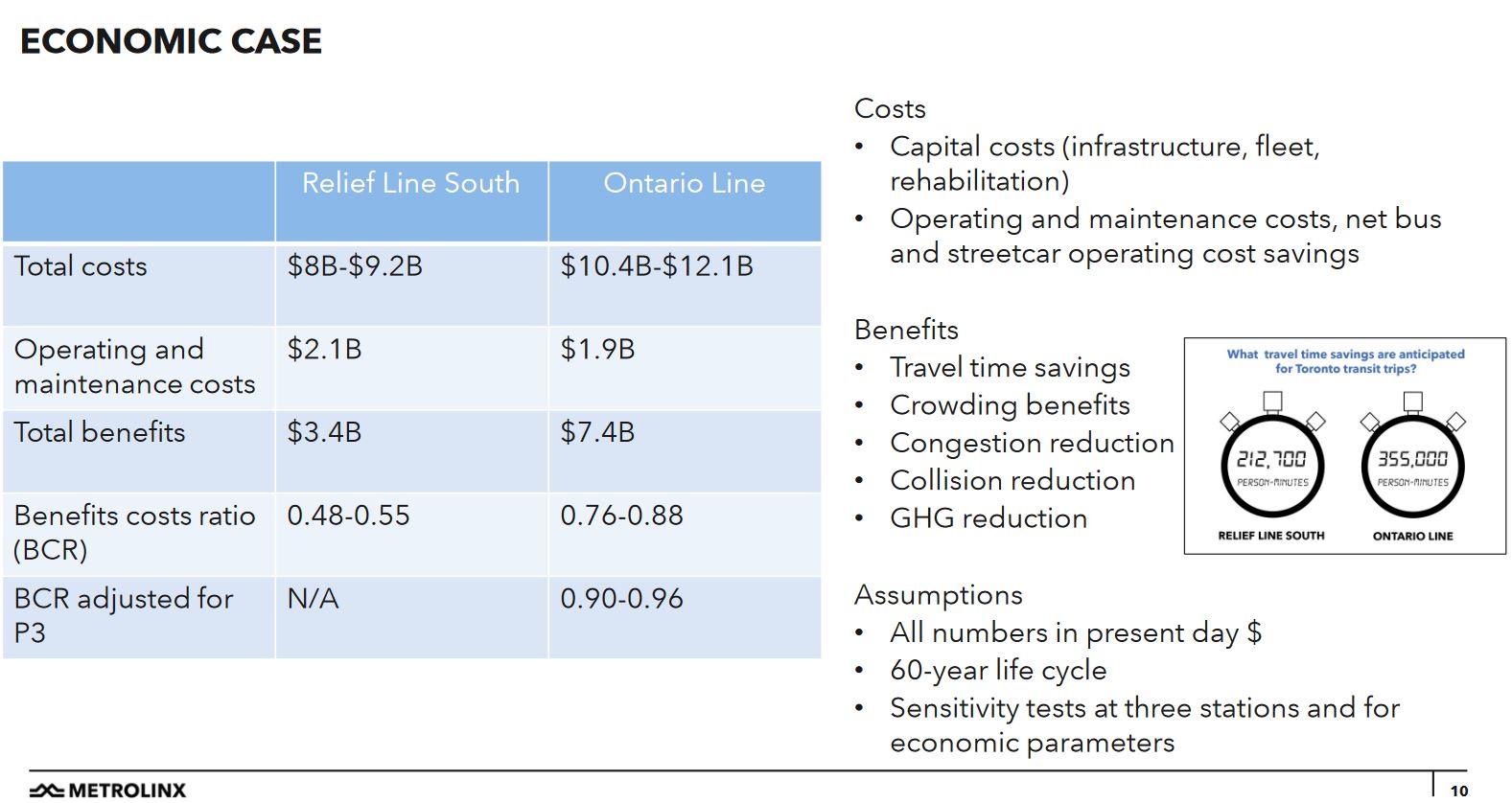
Note that none of the Benefit-Cost ratios exceeds “1” indicating that any version of the project does not produce a “profit” within the Metrolinx benefit-cost methodology. This came up in discussion a bit later (see below). The important issue here is that a large project such as the Ontario or Relief Line has benefits (and possibly costs) that the methodology does not capture notably the value of increasing resiliency in the rapid transit network by provision of alternate routes, and the enabling of projects such as the Richmond Hill extension that would otherwise overload the system.

A new addition to the discussion is a map showing the supposed benefit of the Ontario Line to residents of low income areas. It is no surprise that the OL (and the full RL to Eglinton that preceded it) benefit low income areas such as Thorncliffe Park and Moss Park, but there is a bizarre problem with the map which shows a reduced access to low-income jobs for residents between the Spadina Subway and the Barrie GO corridor south of Eglinton, far from the Ontario Line, not to mention Flemingdon Park north of Eglinton. There is something wrong here with the underlying model, but nobody at the meeting picked up on this.

Duncan Law bravely observed that “we are trained to challenge how things have been done” and this will lead to cost avoidance in the design (video at 38:00). He noted that early works on the route would be accelerated, although this is a tactic already in place (after much political fighting with Mayor Tory who eventually embraced it) for the Relief Line. At this point, Metrolinx is considering what their options for the OL design are before they take them to the public for comment, and they are still at an early stage.

In other words, they have a line on a map, but even that may change, and they fear alarming the locals with designs that are not yet definitive.

Malcolm Mackay spoke about the early works and the importance of co-ordination with large programs in the corridor to “leverage” contracts and consultants for other projects such as delivery of the (now) six track structure from East Harbour to Gerrard (four GO tracks plus two for the OL). There is also the potential role of Transit Oriented Development (TOD) works where some OL work could be combined with private development. However, it is not clear whether the likely construction timeframes of East Harbour and other projects would mesh with the schedule for construction of the OL.

In a marvellous piece of bafflegab, the presentation notes:

To demonstrate visible progress and to de-risk the schedule, a progressive works program is being contemplated with a ground breaking target of 2020 – 2021. [p 20 of the PDF]

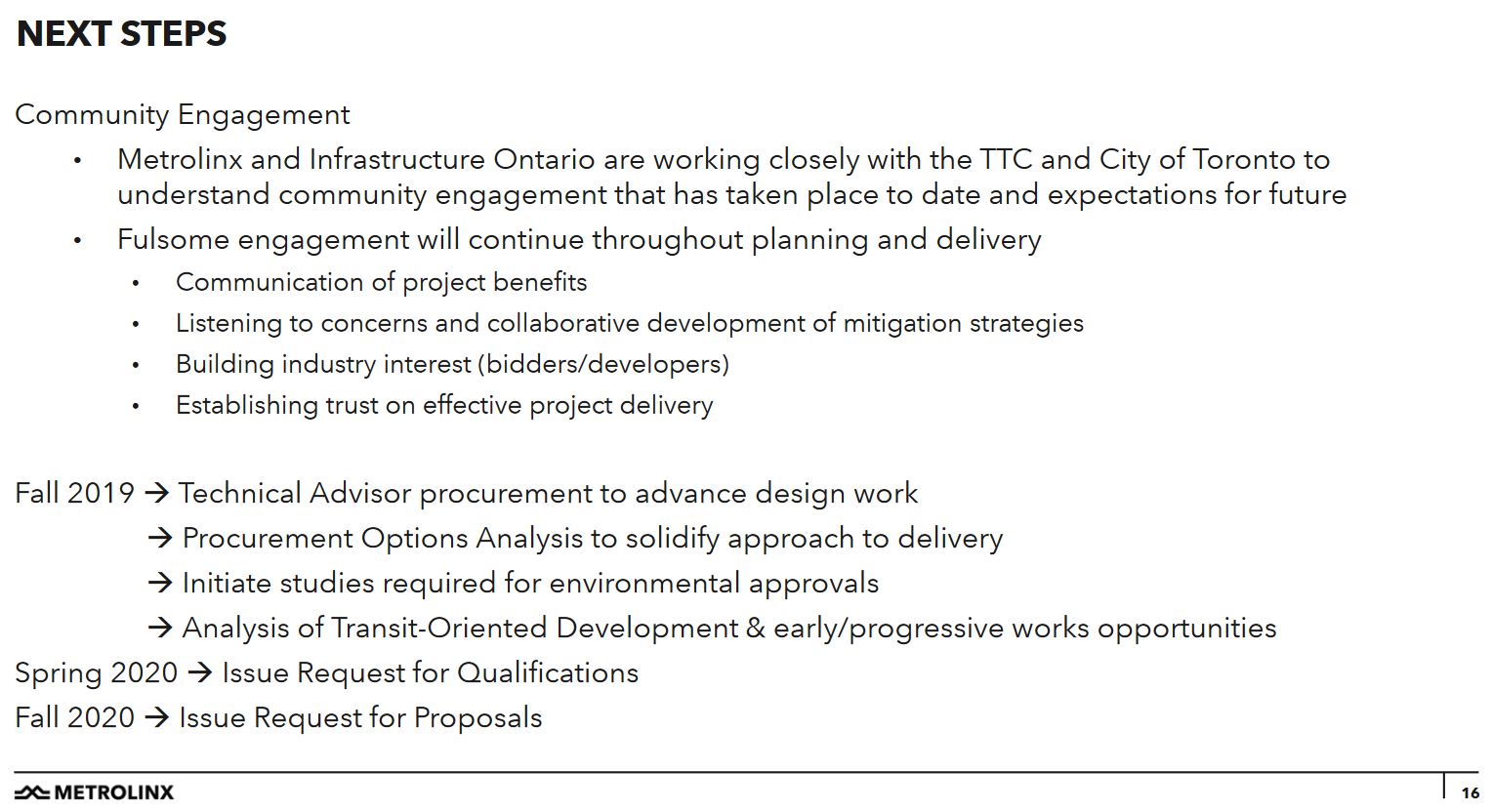
What this means is that if Metrolinx actually undertakes some work soon, there will be political benefits of “progress” (shovels in the ground) and would-be bidders for the larger project will see that it has progressed beyond a political slogan and a line on a map. It is unclear just how much will actually be achieved by 2020 when the requests for qualifications and proposals (see chart below) occur.

Among the potential early works is design work the Don Valley crossing and possible launch sites for tunnel boring machines (TBMs). The decision to place some of the OL at or above grade means that there are more transitions in and out of tunnels than would be the case with an all-underground line, and launch sites at the transitions are required. These have significant effects on their locations as recent experience on the Eglinton Crosstown shows.

Mathieu Goetzke observed that the Queen Street corridor has challenges, but of course that would also have applied to the RL at least as far west as Osgoode Station. There is the larger question of the choice by the RL project of Queen versus a route further south, and again that is both a technical and political decision that is now set in stone.

The Next Steps slide below contains the troubling observation that Metrolinx will work to “understand community engagement” as if somehow Metrolinx has been operating in the dark while the Relief Line project went through its assessment and consultation stages. In a telling, but common, misuse, Metrolinx describes what they will undertake as “fulsome” intending to imply “copious” or “substantial”, but the word can also mean “excessive and insincere”, the fawning behaviour of one who insults by being overly complimentary. Metrolinx and GO before them have a long history of insincere public participation.
Discussion by the Board raised various questions starting with one from Michael Kraljevic who asked how much of the work already done on the Relief Line can be used for the Ontario Line? Mathieu Goetzke replied that work on the Queen Street corridor “feeds in” to the OL project, and Queen is “incredibly complicated”. The northern branch of the OL was built in part on the Relief Line North study. Malcolm Mackay stated that all of the work done so far will still be used giving the example of an underground station where geological information would inform design for a nearby structure. Some strategies that were “not successful” will not be pursued for the OL.

Regarding the construction challenges listed in the IBC, Vice-Chair Bryan Davies asked about “showstoppers” in the project. Duncan Law stated that there are none in the project “at this stage”, and he claimed that the benefit is that we see the risks now. Undoubtedly there will be several challenges, but the team will work through them, he said. The objective is to get people to jobs and home. Integration with GO for local and regional travel is important, Low continued. Environmental Assessment amendments will be required including a review of technical options for the OL. There is a “significant mountain to climb”.

Consultants have been engaged for the EA process, but subways tend to be environmentally positive, said Mackay, Metrolinx claims, and challenges with the elevated sections will be overcome.

These comments really are a dodge of the main question about the ability to reuse work already completed. The basic fact is that the OL alignment diverges considerably from the RL in places, and the detailed RL work, including public consultation, does not reflect the OL plan as it now stands. Again, we hear that this is a complex, challenging project, a rather different characterization than the self-confidence of the line’s announcement.

Director Paul Tsparis asked how the OL project helps to alleviate pressure on Line 1, and how is the TTC helping on that front.

Malcolm Mackay trotted out the usual list of TTC efforts including:

  • Larger trains
  • Painted tiles on the platforms at St. George and Bloor-Yonge to channel waiting passengers
  • Automatic Train Control
  • Bloor-Yonge Station expansion

The reference to larger trains is getting tiresome whoever cites it because the “new” Toronto Rocket (TR) equipment has been operating for some time now, and their extra capacity was long-ago consumed by latent demand. The painted floor directions may have some effect, but the big problem at busy stations is that platforms become totally filled even with a slight delay and this prevents easy exchange of passengers with trains. As for ATC, Mackay despite his years working at TTC, was unsure of the dates when it will be implemented. He also neglected to mention that more service requires more trains and, eventually, more train storage when the TTC exhausts what it now has. If the province takes ownership of the subway, this problem will land in their lap.

This was capped off with an observation that going north to meet the Eglinton Crosstown is a “beautiful addition to relief” to Line 1. Well, yes, many advocates have been saying this for a very long time while others downplayed the importance of continuing north of Danforth. Even Metrolinx flagged the added relief of the northern extension, and this informed support for work on it by the previous provincial government.

Michael Kraljevic asked about the benefit cost ratio where the value is less than one, although the P3 arrangement is alleged to improve that factor. How does this line up against other subway projects?

Mathieu Goetzke replied that it is hard to get a ratio beyond 1 with brand new infrastructure. GO improvements have good numbers because they build on legacy infrastructure. Moreover other modelling techniques would pick up economic development issues that are not included in the Metrolinx model. Phil Verster explained that Metrolinx does not consider benefits outside of purely transit ones, and the wider economic benefits would make every transit business case a good one. A case will always be touch-and-go for tunnels to get to a ratio of 1. Goetzke added that the OL can enable other works [e.g. the Richmond Hill extension].

This is quite an admission for Metrolinx who have wrestled with their business case analysis for some time. In a political climate where projects must at least break even, the benefits that are balanced against costs have a huge influence on the results. This can include both the scope of benefits (how wide a net is cast to capture benefits) and what payback period is used in the calculation. If the scope is too wide, there is a risk that presumed benefits are not entirely due to the project itself. If the timeframe is too long (Metrolinx uses 60 years), there is a financial problem of substantial expenditure in the short term for savings that might or might not accrue over the very long haul. Moreover, a large proportion of the “benefits” do not capture revenue that can be used to pay off project debt, but rather accrue to transit riders in reduced travel time and increased mobility.

These approaches can be defended on the grounds of “city building” and the long term, cumulative effect of having more transit infrastructure. However, the attempt to make any one project “pay its way” can distort how it is evaluated for political reasons.

Footnote: The Metrolinx Blog includes an article which emphasizes that the Ontario Line will not be built on unproven technology. The ghost of the UTDC and the Scarborough RT still haunts provincial decisions.

Ridership Initiatives (Video at 1:13:19)

Metrolinx ridership for the second quarter of 2019 is up 4.1% over the same period in 2018. However, children did not ride free a year ago, and when they are removed from the “before” numbers, the remaining ridership rose by 5.2%. It is worth noting that the TTC attempts to count children even though they ride free on the system, and so ridership numbers for the two systems are not directly comparable, at least on that basis. There is also the challenge of defining a “ride” when trips can involve a series of transfers and the benefit of the two-hour fare on Presto. The whole question of reporting demand on the GTA network needs work, including granularity about when and where people actually travel.

Statistics reported by APTA show commuter rail up 2.1% among reporting agencies, and bus ridership down 1.0%. GO bus ridership is up 4.5%.

A detailed map (PDF) shows the ridership by station across the rail network. There is no data for the bus network where there has been some controversy about which services should be maintained and which should be cut. Moreover the rail network counts do not distinguish by time of day to break out growth, if any, in off-peak travel as GO moves beyond peak period, peak direction commuting service to downtown Toronto.

Ridership growth varies by corridor and station. The high roller is Barrie with a 10.6% growth in the corridor. Kitchener us up 5.6% and Lakeshore East is up 4.8%.

GO is doing a lot of online marketing which they report as being quite successful, and there is an uptake of e-Tickets as a way of purchasing fares. Many of the promotions are for attractions in the off-peak period and for casual users who would be new to the system.

GO regards riders in Toronto as “transit natives”, people familiar with what transit can offer, and markets to them differently than to potential riders in the 905. Whether this is valid all the way out to the 416/905 boundary is hard to say.

The lower base GO fares are driving ridership within Toronto, but there was no discussion of the effect that will occur if the GO-TTC co-fare arrangement ends thanks to lack of funding from Queen’s Park. This has already affected riders on the UPX who no longer get a UPX+TTC discount. All the marketing efforts in the world can be undone by fiscal policies that affect fares and service.

Presto Quarterly Report (Video at 1:28:08)

Director Janet Ecker asked about efforts to minimize TTC criticisms of Presto. From what she is reading, criticisms of the system way off base. She asked how Metrolinx is trying to deal with this.

Phil Verster replied that it is illuminating to see how some comments get headline status and do not reflect what’s happening on the ground. Things are challenging, he said, and Metrolinx continues to work closely with TTC. There are claims that Metrolinx feels are not valid, and they have encouraged the TTC “to put this behind us”, not to go to dispute resolution.

Annaliese Czerny, Executive VP, PRESTO, felt that it was a shame the story is not about new products and better experiences. Verster was optimistic about making progress with TTC to move to a better future – new devices, open payments – and that this will be the story rather than problems. Czerny noted that TTC is an active and positive partner in the process for future developments.

This was the usual positive Metrolinx spin on PRESTO, but it was undone by the TTC when they released their agenda for the Board Meeting to be held on September 24. In it, the CEO’s Report is quite clear that the TTC will pursue arbitration under their PRESTO contract in an attempt to obtain payment of lost revenue due to non-delivery of a working fare system.

With PRESTO readers on every bus, streetcar and fare gate, and with PRESTO fare vending machines and self-serve reload machines at every station, the provincially-led fare card system has given our customers many benefits, but also many challenges.

Over the summer, I met with Metrolinx President and CEO, Phil Verster, to discuss the outstanding claims between the parties and the status of the outstanding deliverables of the contract for the implementation of PRESTO on the TTC. It is clear from our discussions that Metrolinx considers the contract deliverables complete.

So, while these discussions were informative about the positions of each organization, we were not able to reach a common understanding and agreement. We did agree that the next step is to proceed with arbitration, which is the dispute resolution process provided in the contract.

We are working with external counsel to review the process and finalize material and submissions. As we outlined in our report to the Board in June, the TTC does not consider the contract closed. Rather, there are significant deliverables outstanding, including open payment and account-based technology (which includes equipment), equipment to provide PRESTO Tickets on buses and streetcars, an acceptable third-party distribution network and Service Level Agreements for all equipment.

[TTC CEO’s Report at p. 14]

A major problem with Metrolinx’ perception of a “working” system is that they assume that any rider who encounters a fare machine that is out of service will use an alternate just as they would at a GO station. However, on crowded transit vehicles getting to another reader, let alone another fare machine for tokens or cash, can be very difficult and many riders do not bother to try. If they have a Metropass on their card (or a two-hour fare from a previous tap), this really does not matter because they have already paid, but for other riders this represents lost revenue to the TTC. Credit card holders cannot pay at all because this function rarely if ever worked.

Regular riders are familiar with the situation and just shrug when their tap does not register. I personally encounter this problem at least once a week, and see others having the same problems with unresponsive machines even more often. Things may be improving, but perfection is some distance off and Metrolinx has a lot to answer for from the earlier days of their PRESTO implementation.

Metrolinx tests the availability of fare equipment by “pinging” each device (sending a signal to a machine that elicits a response simply saying “I am here”). However, that function takes place at a low level within the hardware and the application software could be hung even though the “ping” gets a positive response.

Metrolinx measures of PRESTO access are likely too rosy because of assumptions about how easily riders can access the machines and about what constitutes a “working” box when tested remotely.

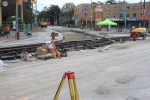
Kingston Road & Queen Reconstruction (Updated October 10, 2019)

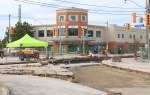
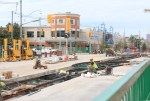
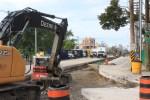
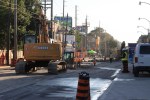
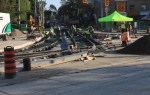
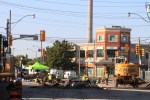
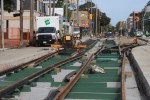
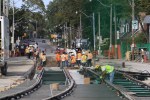
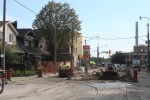
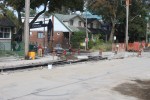
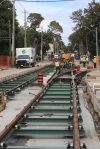
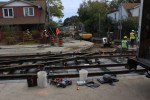
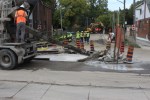
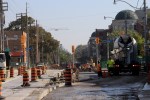
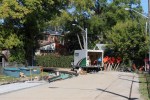
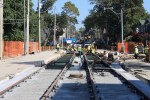
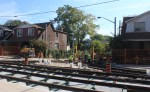
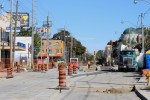
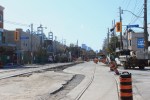
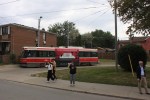
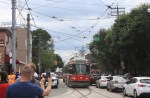
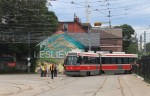
The junction at Kingston Road and Queen, including Woodbine Loop, is getting a total rebuild in September 2019. The main part of the track work on Queen will be completed in a few weeks, but other works will stretch into November. Buses now diverting around the construction zone are expected to return to standard routings before streetcar service resumes on November 24, 2019.

For those unfamiliar with the intersection, it is unusual in two respects. The roads involved cross at an angle rather than at 90 degrees, and there are separate tracks for through streetcars headed to Neville Loop and for those turning northeast onto Kingston Road.

As part of this project, the geometry of the intersection is changing slightly.
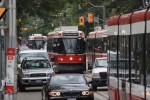
  • The eastbound safety island for users of the 502/503 Kingston Road services and the 22A Coxwell bus will be widened to meet standards for accessibility. This requires that the space occupied by the three-track section is widened to make room for the expanded island.
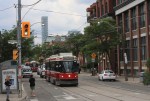
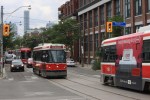
  • The north sidewalk of Queen Street will be widened by taking space from the existing very generous westbound curb lane.

Most of the special work, including two rarely-used curves (west on Queen to northeast on Kingston Road, west on Kingston Road into Woodbine Loop) will be retained. Only the switch within Woodbine Loop that once led to a tail track on which no car would fit since the retirement of PCCs will be removed.

All of the overhead has been taken down for replacement with new pantograph-friendly hardware.

This post will be updated periodically as work progresses.

Sunday, September 15, 2019

Wednesday, September 18, 2019

Friday, September 20, 2019

Friday, September 27, 2019

The TTC, bless their hearts, has restored the curves westbound from Kingston Road into Woodbine Loop, and westbound from Queen to eastbound on Kingston Road. These were last used in revenue service in 1933 by a peak period Kingston Road shuttle service.

Considering how often the TTC has missed the opportunity to add curves the system actually needs, claiming either that they “forgot” or that it would be “too expensive”, this is one of the odder examples of TTC “planning” in recent memory.


Tuesday, October 1, 2019

Wednesday, October 9, 2019

Service Changes Coming to 506 Carlton in October 2019

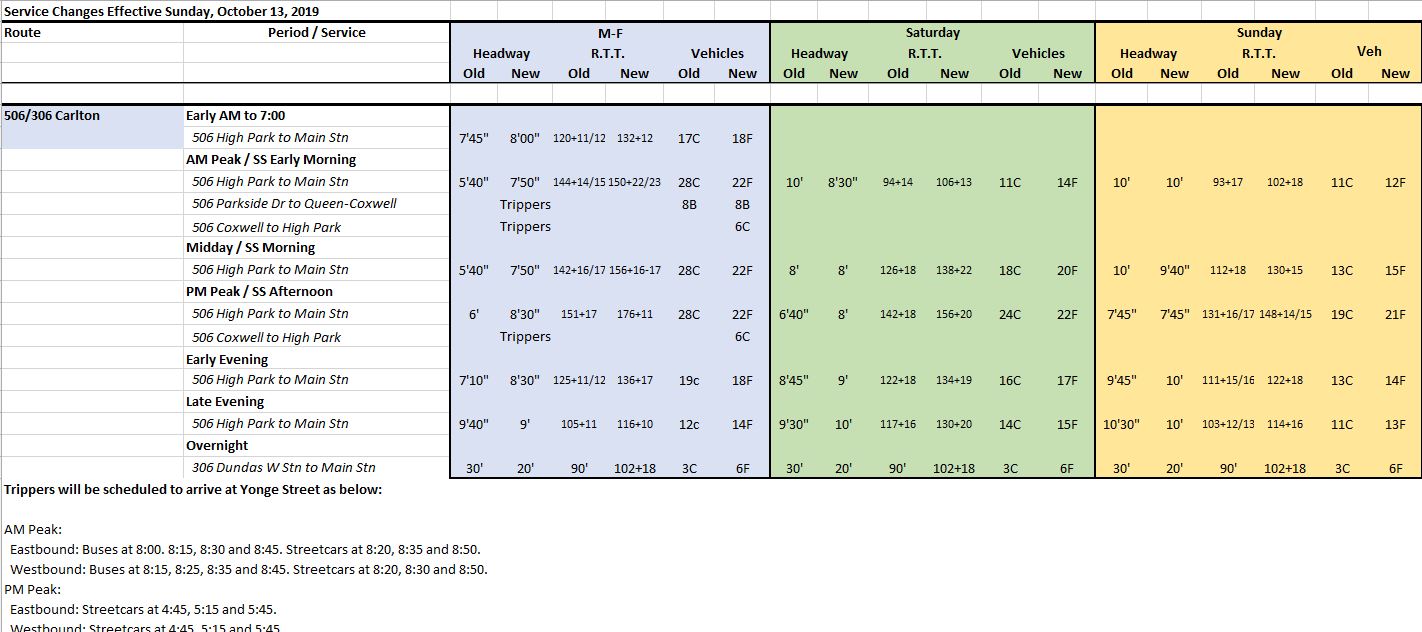
With the shift to the larger low-floor streetcars, the TTC will begin schedule changes on Sunday October 13 (Thanksgiving weekend) for route 506 Carlton. In many periods of operation, the headways will widen in recognition of the capacity of the new cars, although the change will also bring a capacity increase.

The schedules are designed on the basis that most service will be provided by Flexitys, especially in the off-peak period. This could lead to problems such as those seen on other routes where CLRVs operate on headways designed for larger cars and are badly overloaded as a result. A lot depends on there being enough new cars to fully populate the route.

On the schedules, the only CLRVs remaining in operation will be the 506 Carlton trippers and 511 Bathurst (which is planned to start conversion late in 2019).

The TTC Service Standards set design capacities for vehicles which in theory dictate the level of service a route received. The standard is more generous for off-peak than for peak service.

Peak Off-Peak
CLRV 74 42
Flexity 130 70
Ratio Flexity:CLRV 1.76 1.67
Ratio CLRV:Flexity 0.57 0.60

If service were replaced purely on the basis of scheduled capacity, then there would be about 60% as many Flexitys/hour as on a schedule for CLRVs.

The new service design (click to enlarge, or retrieve PDF version) is shown below.

The change in AM peak and midday headways is from 5’40” (340 seconds, 10.6 cars/hour) to 7’50” (470 seconds, 7.7 cars/hour), a decrease in cars per hour to 72% of current service. This will be partly offset by the larger capacity of the new cars plus the benefit of trippers scheduled during the height of the peak period.

The change in PM peak headways is from 6’00” (360 seconds, 10 cars/hour) to 8’30” (510 seconds, 7.1 cars/hour), a decrease in cars/hour of to 71% of current service.

This change comes on top of wider headways introduced in August in an attempt to improve route reliability by giving streetcars more running time and longer terminal layovers in a bid to cut down on short turns.

The capacity goes up, but the service frequency worsens. This will almost certainly be compounded by the TTC’s inability to maintain even spacing of vehicles as they move across the route. Even though they might leave their terminals somewhat “on time”, this situation quickly deteriorates into bunches and gaps.

There is always a challenge when the TTC substitutes larger vehicles on a route and widens the headway. Laissez-faire route management that might work tolerably on shorter headways falls apart when headways are wider. If two vehicles nominally ten minutes apart actually operate as a pair, then there is a twenty minute gap and the service might as well not exist at all. Equally, the short-turn stats might look wonderful because both cars have time to reach their terminal, but riders see the same gap they would have if one of the cars short-turned.

The TTC has a huge challenge in this regard, but shows little sign of trying to fix the problem preferring to assume that more running time and longer layovers will do the trick.

Continue reading

The Last (Official) Trip of the ALRVs

Today the TTC officially retired the last of the ARLV (Articulated Light Rail Vehicle) fleet with 4204 and 4207 doing the honours running a 501 Queen shuttle between Russell Carhouse (east of Greenwood) and Wolseley Loop (at Bathurst Street).

In what has become a tradition with the TTC’s older cars, there was an emergency truck and a “pusher” CLRV whose job would be to push its partner ALRV back to the carhouse (or at least off of a main route) if something went wrong. 4117 shadowed 4204 while 4156 partnered 4207.

Nothing went amiss, and the ALRVs ran their three hours of service without incident. Indeed, 4207 did double duty making an early trip as part of the Labour Day Parade before making the first eastbound trip on the 501 ALRV shuttle from Bathurst Street.

Many people are posting photos from the day on Twitter and Facebook. Here are the best of my own.

TTC CEO’s Report: August 2019

Although the TTC Board takes a long siesta through the summer, the CEO produces a monthly report even in months when the Board does not meet. The August 2019 edition was recently posted on the TTC’s site.

This report continues a format established some time ago by CEO Rick Leary in which the focus is on measures of system performance. There is no financial information here, and only summary ridership numbers with no sense of the associated revenue. All of the financial reporting was hived off of the CEO’s report into a quarterly CFO’s report, but we have not seen one of those since April 2019, and that covered the year ending December 2018. One might have expected an update at the July Board meeting, but the abrupt and unexpected departure of CFO Dan Wright in early June appears to have iced the short-lived report.

I spoke with Wright at the Audit & Risk Management Committee meeting the day before he left the TTC, and he gave no indication of his impending departure. We spoke about the problems of counting “rides” in an environment where there is only a tenuous link between fare payment and the actual number of trips (or trip segments) taken.

The TTC has been wrestling with the possibility that ridership has been over-reported for some time, and the situation is further complicated by Metropasses, the move to Presto and the two-hour fare. Just what is a “ride” for statistical purposes? I had planned to follow this up with Wright for an article here, but alas he vanished like so many other senior TTC staff in the past year. The problem is summarized in the CEO’s Report:

Higher PRESTO adoption appears to have affected measured ridership in two ways. First, we now have more precise ridership data compared to counting tokens and weighing paper tickets. Second, more than 25% of our former monthly pass customers have converted to PRESTO pay-as-you-go e-purse each month in 2019, likely to take advantage of the two hour transfer and for some, the TTC/GO discounted co-fare. This would affect measured ridership to the extent that these customers may ride less often than the monthly average of 71 rides per adult monthly pass. [p 25]

Josie La Vita, the Executive Director of Financial Planning for the City of Toronto, replaced Wright on an acting basis pending recruitment of a new CFO, a process expected to take 12-24 months.

The CEO no longer reports financial data on operations or capital projects, and the absence of a CFO’s report leaves a major gap in information available to the TTC Board and Council on the system’s actual performance.

Moreover, riding counts (i.e. vehicle occupancy) are only rarely reported at a route level, and a “crowding report” has not recently seen the light of day. When crowding data are released, they are averaged and this gives no indication of the effects of bunching and gapping on individual vehicle loads. Performance metrics that do appear in the CEO’s Report do not fully describe the service quality actually experienced by riders particularly on surface routes.

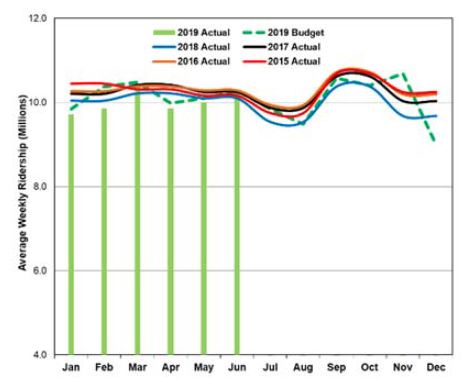
Ridership for 2019 to the end of June is reported as 267.8 million as against a target of 271.9m and a 2018 figure of 270.3m (down 1.5% and 0.9% respectively). For the month of June itself, ridership is on target. As the chart below shows, the shortfall in 2019 came primarily in the winter months which were unusually cold. June’s ridership was boosted by the Toronto Raptors Championship Parade without which the number would have been down 0.6% compared to 2018.

Weekend ridership is down, and this is thought to be due to various factors including the number of subway shutdowns. These are not going to end any time soon with the ongoing signalling projects and other infrastructure upgrades, and at some point the TTC cannot treat their effects as unexpected. A follow-on problem for the TTC is the perception by riders that “the subway is always closed” and this can affect ridership as much as the actual shutdowns.

Presto fare card usage continues to increase and by June 2019 the adoption rate reached about 80%. Presto ridership for the first half of 2019 was 214.2 million out of the total reported ridership of 267.8m.

Vehicle Reliability

The fleet benefits from improved preventative maintenance and from the retirement of older vehicles. Before the onset of hot weather, there was a concerted effort to get air conditioning systems in good order, and AC failures were rare even with the particularly hot weather in 2019. (Personally, I never encountered a “hot car” on the subway, a first for several years running.)

On the streetcar fleet, the decline in the proportion of service provided by the nearly 40-year old CLRVs and the disappearance of their ALRV cousins (of which a few are still officially active but never seen in revenue service) contributes to a reduction of in service failures. The Flexity fleet has its ups and downs for reliability, but even running below its target, these cars are much more reliable than those they replace.

On the bus fleet, the retirement of old buses and the recent purchases of hundreds of new vehicles has substantially lowered the average age of a bus and increased the proportion of buses that are “spare” relative to service needs. The fleet is over 2,000 vehicles, but the peak requirement in June was 1,641 including buses used on streetcar lines. This generous spare ratio has benefits in service reliability but also a cost in both capital and in garaging.

Continue reading

TIFF 2019 To Demolish Downtown Transit Service, Again

Updated Aug. 22, 2019 at 8:05 pm: The TTC has advised that temporary stops for the diversions are still to be finalized. Also, there will be Paid Duty Officers to manage traffic at Spadina, York and Church Streets. Thanks to Stuart Green for the update.

The City of Toronto and TTC have announced various road closures and service diversions associated with the 2019 edition of the Toronto International Film Festival (TIFF).

As in past years, King Street will be completely closed to traffic including transit operations from University Avenue to Spadina Avenue. This will begin at 5 am on Thursday, September 5 and continue through to 5 am on Monday, September 9.

Additional ad hoc diversions might occur on both Monday and Tuesday, September 9-10, for “red carpet events” from 3:30 pm onward.

Service arrangements this year are somewhat different from 2018 because there is now the split 504A/504B King service and the soon-to-be-restored 508 Lake Shore.

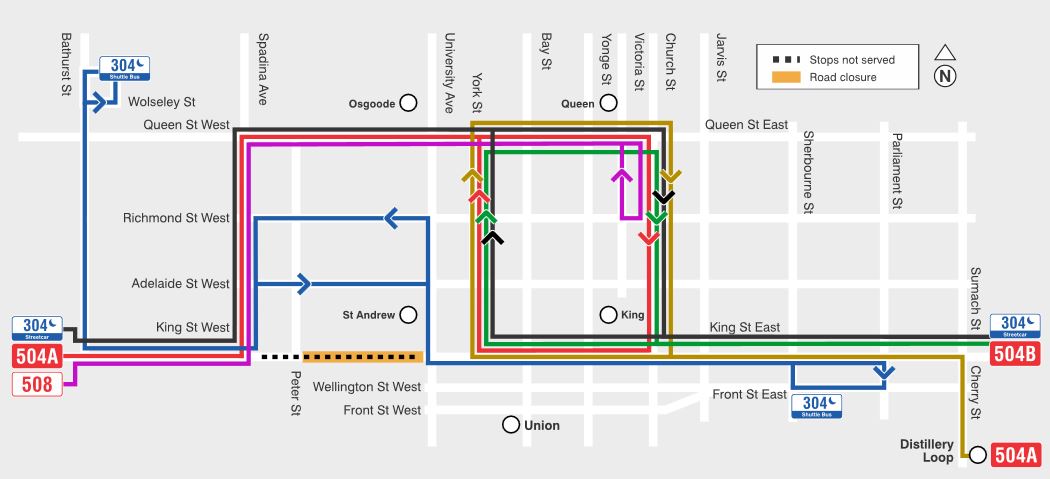
The primary diversion for almost all services will be:

  • From King to Queen on Spadina, both ways
  • From King to Queen on York, northbound/westbound
  • From Queen to King on Church, southbound/eastbound

Riders wishing to transfer from the subway to an eastbound King car to Broadview Station or to the Distillery should do so at Queen, not at King, or they will have to walk from Yonge to Church from King Station. There will be no eastbound King cars at Osgoode Station. It is not yet confirmed whether the TTC will establish a stop at Queen and York for a walking transfer.

Riders wishing to transfer from the subway to a westbound King car must do so at King or Osgoode Stations. There will be no streetcar service at St. Andrew Station, although there will be plenty of King cars nearby at York Street. Whether a temporary stop will be created at King and York is still to be confirmed.

This service design will see ALL of the King Street services, both ways, operating northbound on York Street giving an extremely frequent service, not to mention the potential for a total bottleneck making the turns east and west at Queen Street.

504A Dundas West to Distillery Service

This service will be broken into two segments:

  • From the west, 504A cars to/from Dundas West will operate downtown via Spadina and Queen east to Church, then loop via Church, King and York.
  • From the east, 504A cars to/from the Distillery will loop downtown via King, York, Queen and Church.

504B Broadview Station Service

The Broadview Station service will use the same loop downtown as the 504A Distillery cars:

  • Westbound on King to York, then north to Queen, east to Church and south to King.

There will be no replacement bus service parallel to King as has been attempted in some past years. Anyone destined for the area between University and Spadina on King will have to walk in from the bounds of the closed area or south from Queen Street. This is of particular concern for anyone going to screenings at TIFF Bell Lightbox which will have no transit service during the diversions.

508 Lake Shore Service

The new 508 Lake Shore trippers will loop downtown via:

  • Eastbound via Spadina, Queen and Church
  • Returning westbound via Richmond and Victoria to Queen, then west to Spadina

304 Night Service

The 304 night cars will divert via Spadina, Queen, Church/York both ways.

A shuttle night bus will operate between Wolseley Loop and Parliament/King bypassing the TIFF district via Adelaide and Richmond Streets.

503 Kingston Road Bus

Not mentioned in the TTC’s announcement is the 503 bus service which consolidates the 502/503 Kingston Road services in September. These buses are supposed to loop via York, Richmond, and University to King including a layover point on York north of King. That area will be thick with streetcar service. It is ironic that the only service that will stop eastbound at St. Andrew Station will be the 503 bus on what is sure to be a “now and then” schedule.

I am a TIFF supporter as a member and donor, and have attended the festival for over three decades. That said, I am disgusted by the gorilla-like behaviour of TIFF in elbowing aside vital transit services on weekdays in Toronto.

These diversions produce severe effects on service not just downtown, but on parts of the King and Queen routes far from the TIFF district. Riders across the city suffer so that TIFF can have its street fair.

Every year we hear that “next year will be different”, but nothing happens.

From the TTC’s diversion announcement:

We encourage you to plan your trip in advance. We thank you for your patience during this important event benefitting Toronto’s economy and international reputation as a world-class city.

A “world class city” would figure out how to integrate its transit service into a major cultural festival.

Metrolinx Shifts Responsibility for Improvements to Future 3P

In the comment thread on the article about GO Transit Service Changes, two readers asked about the status of expansion projects that were supposed to be “in the works” – the addition of track capacity from Don to Scarborough Junction and from Guildwood to Pickering, as well as a contract for signalling upgrades.

I wrote to Metrolinx for comment on these issues, and have received a reply from Matt Llewellyn in Media Relations.

1. Someone left a comment on my blog today claiming that the projects to add a fourth track from Don to Scarborough, and a third track from Guildwood to Pickering, have been cancelled. Is this true, and if so, why?

Through our new rigorous analysis of potential investments we are prioritizing the infrastructure needed right now, giving communities the transit system they need and deserve, while making taxpayer dollars go further.

As part of that process, it was determined it is possible to reduce the entire three-mile three track section while still achieving the current service levels needed between Rouge Hill GO Station and Durham Junction. We’re able to delay these major improvements now thanks to a stronger working relationship we’ve developed with our Railway partners. By finding smarter and better ways to work together, we’re significantly accelerating service improvements to these areas.

Any future infrastructure needed in this area will be determined through the OnCorridor Program that is currently in procurement.

We will continue to work closely with the impacted stakeholders and community as we work towards upgrading transit and adding essential regional transportation capacity to our network.

On a related note, has the scheme to build the “Ontario Line” above grade, possibly in the rail corridor from Gerrard west to Parliament, had any effect on the four-track plans for that section of the corridor?

Metrolinx Initial Business Case indicates the Ontario Line will have a portal east of Cherry Street, crossing over the Don River and continuing along the GO Rail corridor, along a widened embankment or elevated structure.

We are currently reviewing the work that is needed to advance the infrastructure necessary to provide more GO service on this stretch of the corridor, alongside the infrastructure needs for the Ontario Line.

What is the status of a project to re-signal GO corridors to allow more frequent headways and better safety control? There was a consulting contract let to Parsons in late 2017 but is the project actually progressing?

Parsons is supporting Metrolinx as a technical advisor for the Signal and Train Control program under Go Expansion.

The signaling and train control program, which will allow for more trains at a lower headway and improved safety, is progressing under Go Expansion.

The Go Expansion program is currently in the procurement phase.

Through the GO Expansion program, we will be leveraging the worldwide expertise of the private sector to drive contractor accountability for delivering on the required service outcomes.

From these answers it is clear that Metrolinx has decided to shift responsibility for any infrastructure upgrades to whichever consortium wins the GO Expansion program bid and takes over responsibility for this work. This could bring a level of expertise to GO not seen before (if the comment above is to be believed), but this could also add yet another layer of opacity and frustration to any meaningful public participation in a review of what might or might not be built.

GO Transit Service Changes Effective September 3, 2019

After the flurry of activity about rumoured widespread cuts to GO Transit’s bus service, the changes announced for September 3 are all “good news”. Whether there is “another shoe to drop” later in the fall remains to be seen. So far, these are not the moves of an agency about to make widespread route cuts.

Bus Routes

Seasonal bus service will end on 12 Niagara Falls. Effective Labour Day weekend, weekday express service will end, and weekend express service will be cut back to every two hours. The weekend express service will end at Thanksgiving.

School trips will be restored on the following routes:

  • 15 Brantford/Burlington
  • 25 Waterloo/Mississauga
  • 29 Guelph/Mississauga
  • 45-46-47-48 Highway 407 West
  • 51-52-54 Highway 407 East
  • 88 Peterborough/Oshawa
  • 93 UOIT/Scarborough

The 60 Canada’s Wonderland route will not return, and riders are encouraged to use TTC or GO services to reach York Region Transit Route 20.

In the announcement of restored and extended service on the Stouffville corridor, there is a note:

Evening bus service will continue to help you transition back to the train.

This implies that the bus service will disappear after the transition is complete, but there is no effective date for this.

Rail Corridors

On the rail network, there are many changes with new trips and hours of service on five corridors.

Lakeshore West

  • Service at West Harbour Station in Hamilton will be doubled to four trips each way from the current two.
    • In the morning peak, two trains that now originate at Aldershot will begin at West Harbour departing at 7:09 and 7:49 am. These are added to departures at 6:09 and 6:39 am.
    • In the afternoon peak, a new train will leave Union at 4:45 pm, run express to Clarkson and then local to West Harbour arriving at 5:57 pm.
    • The 6:30 pm train from Union which now ends at Aldershot will be extended to West Harbour arriving at 7:42 pm.
    • The other two PM peak trips to West Harbour leave Union at 4:00 and 5:15 pm.
  • Two Oakville trips will be extended to Aldershot leaving Union at 3:13 and 6:15 pm.
  • The 8:32 am eastbound train from Oakville will be extended from 10 to 12 cars to add capacity.

In what must be the most over-hyped part of the entire announcement, train service to Niagara Falls will run every day all year. However, weekday service remains one train each way, and otherwise travel between the Falls and Toronto will use buses for the portion of the trip beyond Burlington GO. The weekday trains serve West Harbour Station in Hamilton.

  • The morning commuter train leaves Niagara Falls GO (VIA) Station at 5:19 am arriving at Union at 7:50 am.
  • The afternoon train leaves Union at 5:15 pm arriving at Niagara Falls at 7:47 pm.

Weekend service that is now seasonal will become permanent. Note that these trains do not serve West Harbour, but run express between St. Catharines and Burlington.

  • Trains to Niagara Falls from Union depart at 9:00 am, 4:18 pm and 8:10 pm.
  • Trains to Union from Niagara Falls depart at 8:30 am, 11:30 am, 7:20 pm and 11:00 pm.

Lakeshore East

There are small changes to the Lakeshore East schedule:

  • New eastbound trips will leave Union at 2:58 and 3:28 pm running local to Oshawa arriving there at 3:56 and 4:26 pm.
  • A new westbound trip will leave Oshawa at 4:48 pm running local to Union arriving there at 5:50 pm.
  • The train which now leaves Oshawa westbound at 1:52 pm running express to Union will now depart at 1:53 and will stop at Whitby, Ajax and Pickering, then express to Union.

Kitchener

  • The train which formerly started eastbound from Mount Pleasant at 9:00 am will now originate in Kitchener at 7:57 am.
  • The 12:53 pm train westbound from Union will now run through to Kitchener arriving at 2:47 pm.
  • The train which formerly started eastbound from Mount Pleasant at 3:52 pm will now originate in Kitchener at 2:57 pm.
  • The 6:00 pm Kitchener train will now run express to Bramalea then local to Kitchener arriving there at 7:47 pm.
  • A new 5:45 pm train from Union will make all local stops to Bramalea.
  • From 6:53 pm hourly westbound trains run at least to Mount Pleasant with some continuing to Guelph or Kitchener.
    • The 6:53 train will run to Kitchener arriving at 8:47 pm.
    • A new train at 9:53 pm will run to Kitchener arriving at 11:47 pm.
    • A new train at 10:53 pm will run to Guelph arriving at 12:22 am.
  • A new train from Kitchener at 8:57 pm will arrive at Union at 10:51 pm.

Other schedule changes will reflect actual operating conditions and will adjust departure times earlier or later. Consult the schedule for details.

Finally, some train lengths will be adjusted to 6 cars:

  • The 9:48 am westbound train from Union
  • The 11:00 am eastbound train from Mount Pleasant
  • The 2:57 pm eastbound train from Kitchener

As a result of the new schedule, eastbound trains originating at Kitchener will run at:

  • 5:20 am, 5:45, 6:10, 6:50, 7:15, 7:57 (new), 2:57 pm (new), 8:57 (new)

Westbound trains running beyond Georgetown will leave Union bound for Kitchener (except as noted) at:

  • 12:53 pm (new), 3:35, 4:50, 5:27, 6:00, 6:53, 9:53 (new), 10:53 (Guelph, new)

Stouffville

On the current schedule, train service southbound to Union ends with the 3:31 pm trip from Mount Joy Station. The last northbound trip to Lincolnville leaves Union at 7:10 pm and the last Mount Joy trip leaves at 8:00 pm.

On the new schedule, southbound train service continues to end at 3:31 pm, but it resumes at 9:31 pm for three trips (hourly to 11:31 pm). The last northbound Lincolnville train remains at 7:10 pm, but train service to Mount Joy at 8:15 pm and hourly thereafter. The 11:15 pm train runs through to Lincolnville.

While this is some improvement, it is still a far cry from frequent, bi-directional all day rail service.

Two trains will be changed to six-car consists:

  • The 12:15 pm trip northbound from Union
  • The 1:31 pm trip southbound from Mount Joy

Barrie

The schedule for this corridor will not change, but some train lengths will be modified to better match demand.

  • The weekday 7:05 pm train from Union will be extended from six to ten cars.

The following trains will only be six cars long:

  • Weekdays:
    • 7:40, 8:40, 9:40 and 10:40 pm northbound from Union
    • 8:41, 9:41 and 10:41 pm southbound from Aurora
  • Weekends:
    • 11:40 am, 2:00 pm and 6:20 pm northbound from Union
    • 3:01 and 7:21 pm southbound from Aurora
    • 4:20 pm southbound from Allandale Waterfront

The full set of current and future schedules is available on the GO Transit website.

TTC Service Changes Effective Sunday, September 1, 2019

On September 1, TTC routes that had summer service cuts in May and June will revert to their regular service levels.

Several routes will have “reliability improvements”, a catch-all term for a variety of changes.

  • Most commonly, the buses assigned to a route are stretched further apart on wider headways with additional driving and/or recovery time in the hope that the service will stay more on time than it is now. Whether this actually happens is a matter of conjecture because the TTC does not regular report on route performance at a granular enough level to judge the effect of schedule changes.
  • In a few cases, running times are trimmed in recognition that the current schedules are excessive. This usually frees up buses that are either assigned to another branch of the same route, or which go into the pool for improvements on other routes.
  • In a few cases, there are adjustments between the local and express services on a route.

The TTC has not published crowding statistics since March 2019, although this was supposed to happen quarterly.

There will be major changes on the streetcar network, notably on 501 Queen and related routes, due to construction at Kingston Road and Queen, as well as the conversion of service west of Humber Loop to 100% low-floor cars. See my previous article for more information. The service plan for the restructured routes is included in the spreadsheet linked below.

Other changes of note:

  • Construction changes to 34 Eglinton East, 51 Leslie, 54 Lawrence East and 91 Woodbine related to the Crosstown project will end and these routes will resume their normal configuration.
  • Running times on 36 Finch West are extended to compensate for the effects of the Finch West LRT project.
  • Construction at Sheppard West Station will affect many routes there.
    • The 84/984 Sheppard services will not enter the station, but will serve on-street stops.
    • 101 Downsview Park, 106 Sentinel, 107 St. Regis, 108 Driftwood and the Wheel-Trans services will move to new bus bays as the work progresses.
    • A temporary loop will be provided in the passenger pick-up area for use by 104 Faywood, 105 Dufferin North, 117 Alness-Chesswood and YRT services.
  • With the return to fall service levels on Line 2 Bloor-Danforth, the second gap train recently introduced on that line will be removed.

Details of the service plans are in the spreadsheet here:

2019.09.01_Service_Changes

Various construction projects that have required buses to be added to several routes are scheduled to wind down in the coming months. Whether the buses released from construction service will actually shift to service improvements on the network as a whole remains to be seen. A basic budgetary problem for the TTC is that at least some of the extra construction service is paid for in capital project budgets, but this money is not available on an ongoing basis to run the same vehicles in day-to-day operations.

Streetcar Network Changes Coming in September 2019

Several streetcar routes will be affected by construction, schedule changes and the continuing shift from CLRVs to the low-floor Flexitys effective September 1, 2019. I will publish the detailed service plans with my overview of all schedule changes taking effect on that date, but here is a preview of the route changes.

Kingston Road & Queen Construction

Two projects will block streetcar service from The Beach from September 1 until mid-November:

  • Watermain replacement
  • Special trackwork replacement at Kingston Road including Woodbine Loop

501 Queen Service

The 501 Queen route will be operated with several overlapping services:

  • Regular 501A Queen cars will operate between Humber Loop and Russell Carhouse.
  • Buses on 501R will operate between River Street and Neville Loop diverting via Woodbine, Lake Shore and Coxwell.
  • Service to Long Branch on 501L will be provided by low-floor cars running from Humber to Long Branch on ten-minute headways at all times.
  • Late evening service will run through from Long Branch to Russell Carhouse.

Tripper services will operate including the restoration of 508 Lake Shore:

  • Bus trippers on 501 Queen will operate westbound from Coxwell rather than from Kingston Road. In the PM peak, eastbound trippers will run through to Neville using the same diversion as the 501R.
  • Streetcar trippers will operate on 508 Lake Shore with five trippers in each peak period.
    • In the AM peak cars will follow the Queen route from Long Branch to Roncesvalles, then run east to Parliament via King Street. They will return to Roncesvalles Carhouse via Parliament and Carlton/College, a route used by Long Branch trippers years ago to provide supplementary westbound service on Carlton to the University of Toronto. Cars will leave Long Branch Loop between 6:40 and 8:10 am.
    • In the PM peak, the trippers will run east from Roncesvalles to Broadview via King, then loop via Broadview, Dundas and Parliament running west from King and Parliament to Long Branch. Cars will leave Church Street westbound between 4:20 and 5:40 pm.

Overnight service on 301 Queen will terminate at Russell Carhouse, and it will continue to operate on the recently-established 15 minute headway. A 301B bus shuttle will operate from Russell Carhouse east to Neville diverting around the construction zone.

502/503 Downtowner/Kingston Road

For the duration of this project, the 502 and 503 services will be consolidated as 503 Kingston Road, and this route will operate from Bingham Loop to York Street. There will be no 502 bus service to McCaul Loop.

Service will divert around the construction site via Dundas and Coxwell both ways.

The downtown loop will be changed from the usual 503 arrangement. Buses will not operate on Wellington, but will continue on King to York Street. They will then turn north on York to Richmond, west to University and south to King Street. The layover point will be on York Street north of King.

22/322 Coxwell

During weekday daytime, the 22B Coxwell service will use Coxwell-Queen Loop rather than the longer route via Eastern Avenue which will be blocked by construction.

Evening and weekend service on the 22A and 322 services to Victoria Park will divert both ways via Dundas Street but will loop south to Queen via Coxwell-Queen Loop.

512 St. Clair

With the addition of low-floor service to Long Branch operating from Roncesvalles Carhouse, the 512 St. Clair route will move back to Leslie Barns. The carhouse routing will be via Queen, King and Bathurst, and cars will operate with pantographs up over these trips. This will mark the first scheduled pantograph operation over portions of these streets.

The operator relief point will be moved east from Lansdowne to St. Clair Station.

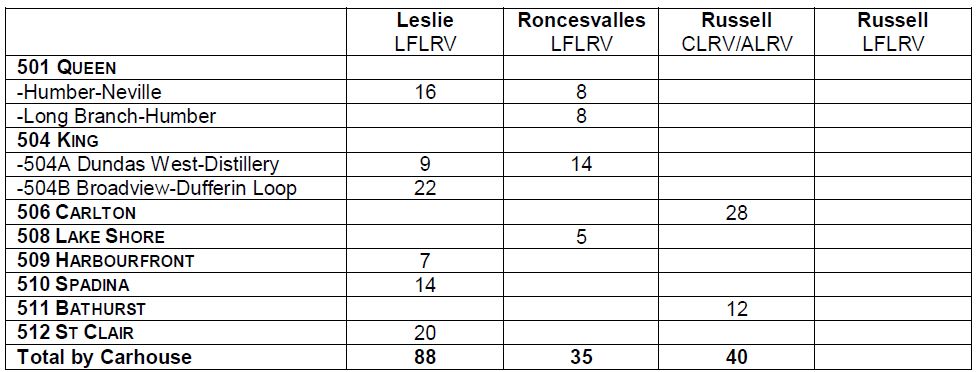
Carhouse Allocations

The routes and vehicles will be allocated to carhouses as shown below. Note that these are the scheduled service numbers, not the total fleet including spares.

Current plans are to begin conversion of 506 Carlton to Flexity operation later in the fall, but the details of this have not yet been published.