TTC Discovers Fiscal Conservatism

On September 4, 2025, the TTC’s Strategic Planning Committee met to debate several reports. I will deal with them in a separate article, but one thread in the meeting deserves comment on its own.

The order of the agenda was changed to put an item updating the budget situation first up for debate. On a preliminary basis, the TTC faces a shortfall of $232.3-million, but the City’s budget target allows only an increase of $91-million with a parallel target of $17-million in “efficiencies”.

These amounts do not make any provision for new and enhanced services beyond plans already in the works and “investments that are demonstrating results”.

There is no mention of the fiscal sleight-of-hand that happens every year with various reserve funds where the TTC typically budgets to take money out at the start of the year, and puts money back at the end. The City often contributes to these reserves with left overs discovered in the year-end reconciliation of actual versus budgeted spending.

Much hand wringing and predictions of fiscal disaster met this report and a related one on the large shortfall in the State of Good Repair Capital Budget. More on that in my main article.

The big item, indeed the supposed primary reason for the meeting, was a report on possible 2026 implementation of six items from a proposed Ridership Growth Strategy. Many public deputants, mostly members of TTCRiders, spoke in support of various items notably the proposed capping of fares, a fare freeze, and improved service. This is precisely what one would expect from an advocacy group.

However, Chair Jamaal Myers lit into one of the speakers asking why they kept asking for things the TTC cannot afford. Those of us with long enough memories recall the tactic of harassing deputations as a classic trick from the Tory and Ford eras. It is not the role of a deputant to accept that nothing they ask for can be done, and meekly thank the Board for listening to their whispered requests.

Myers should remember his days as a community activist and know better than to berate a deputant for having the temerity to ask for better service from the City.

The debate became even more bizarre in consideration of Fare Capping and the idea that TTC should not be losing money on fare initiatives. One Board Member, Councillor Saxe, actually suggested that new riders who pay for their trip are more important than those who get additional free rides. She is woefully unaware that it is almost impossible to gain any new riders at a profit, even more so now that farebox revenue covers a much lower portion of total costs than it did before 2020.

This position does not prevent Saxe from pushing her hobby horse of free rides for groups of high school students on field trips. The premise is that this cost will build a future desire to use transit. Subsidy today, more fares, maybe, tomorrow, although the same students are likely to be unimpressed by indifferent service.

In this debate, two Board members one might think of as “progressive” went out of their way to downplay any proposals that might cost money even though they could make the transit system more attractive. Myers even toyed with the idea of service cuts downtown so that bus service could be improved in Scarborough. (I will turn to that nonsense in a separate article.)

The other members present offered little. Commissioner Jagdeo is a fiscal hawk from the Tory era, and predictably worried about how the TTC is effectively bankrupt. Commissioner Mihevc added little beyond concern for the size of the deficit in a way reminiscent of his days as a Councillor who also sat on the Budget Committee and was happy to limit TTC spending.

It is the TTC Board’s job to set policy and advocate for better transit. This might not always be possible in one go, but the Board should not start from an assumption that nothing can be done. Indeed, a spokesman for the mayor is quoted in the Star:

Mayor Olivia Chow said she “will not reduce service levels or raise fares,” adding the mayor “believes that improving service, reliability and safety is key to attracting riders back to the TTC.”

Committee Chair Alejandra Bravo strove to keep the discussion at a policy level, bouncing ideas around for strategic planning which is the purpose of her committee, while other members seemed intent on fixing the budget options today and closing off debate. How successful she will be in the long run remains to be seen given a clear desire to avoid such discussions by the Board’s Chair and others.

This was not the TTC’s finest day, and the blame must rest primarily with Chair Myers who seemed to hijack the agenda to preclude debate.

Solving the TTC’s problems will not be easy, but an attitude that nothing can be done runs counter to Council’s policy of improving use of transit. That’s not going to be cheap, and funders other than Toronto taxpayers and riders should contribute. Simply pushing discussion of what might be done off of the table is a backward move.
Reduced Speed Zone Tracking: Update to August 2025

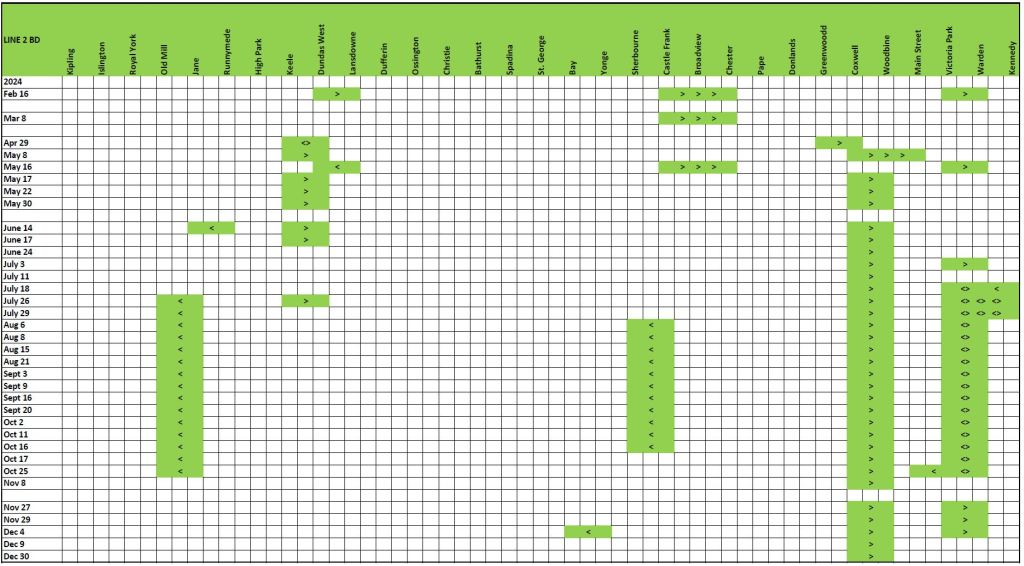
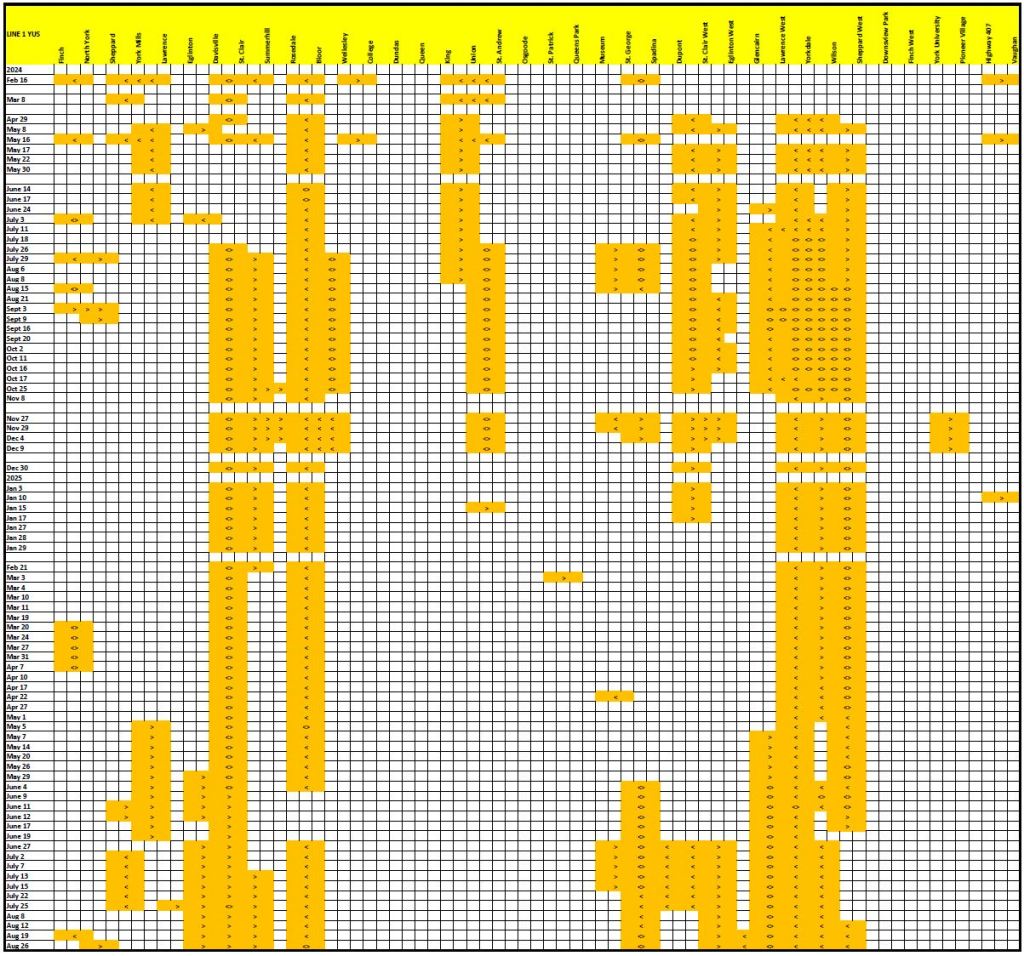
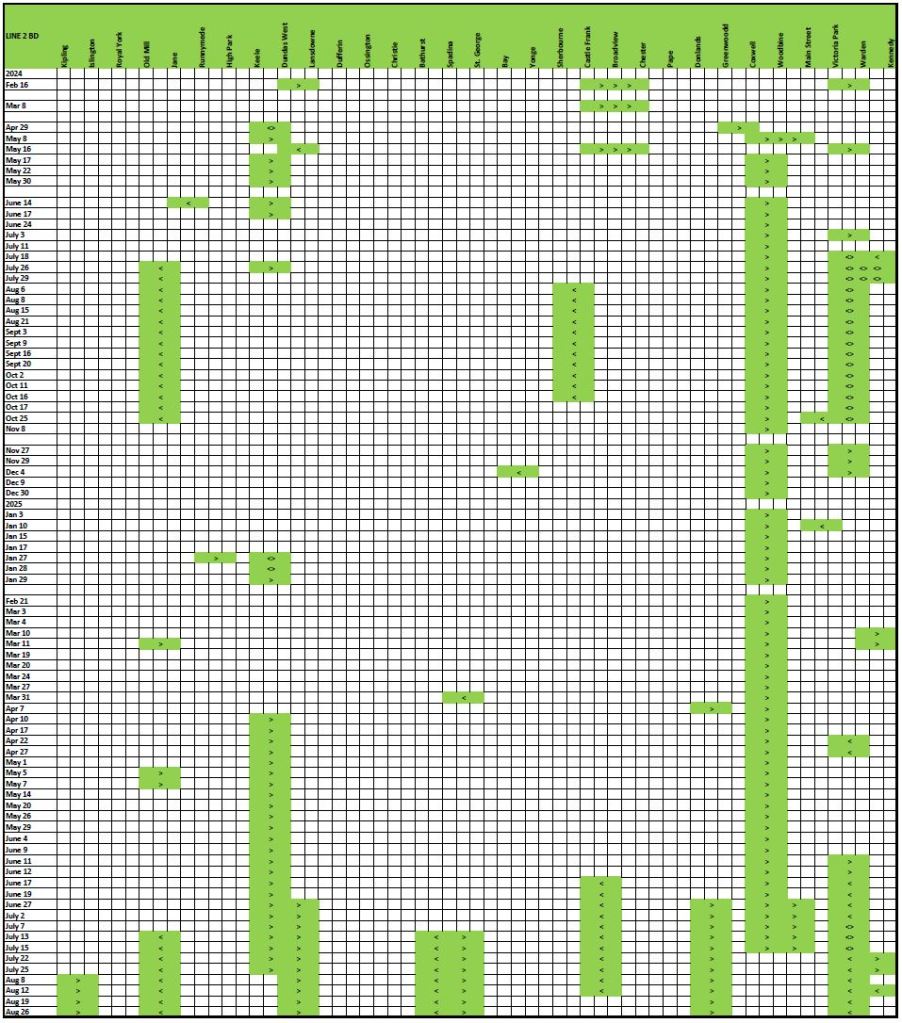
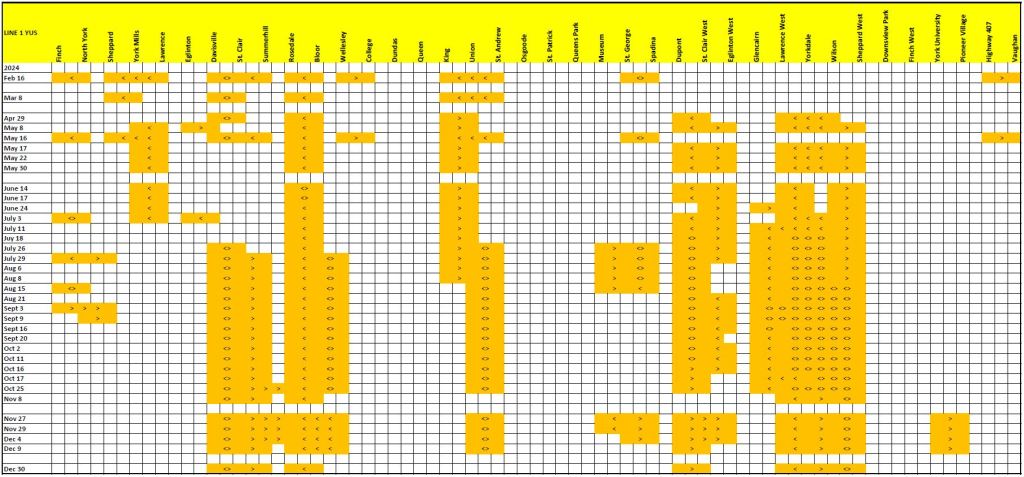
In previous articles, I have tracked the evolution of subway segments where Reduced Speed Zones (RSZs) are in place since February 2024. Recent comments in other articles suggest that readers have not been following this.

Here are updated charts showing areas where speeds are or have been restricted on Lines 1 and 2.

The charts on the left are for 2024, while those on the right show 2025 with a gap at the top where I did not check for about a month. The longevity of the RSZs can be clearly seen in the length of more or less continuous coloured vertical bars notably on Line 1 between Eglinton and Bloor, and north from Eglinton West to Sheppard West.

The coloured areas show where RSZs were located, and the arrows show the direction with “<>” meaning “both ways”.

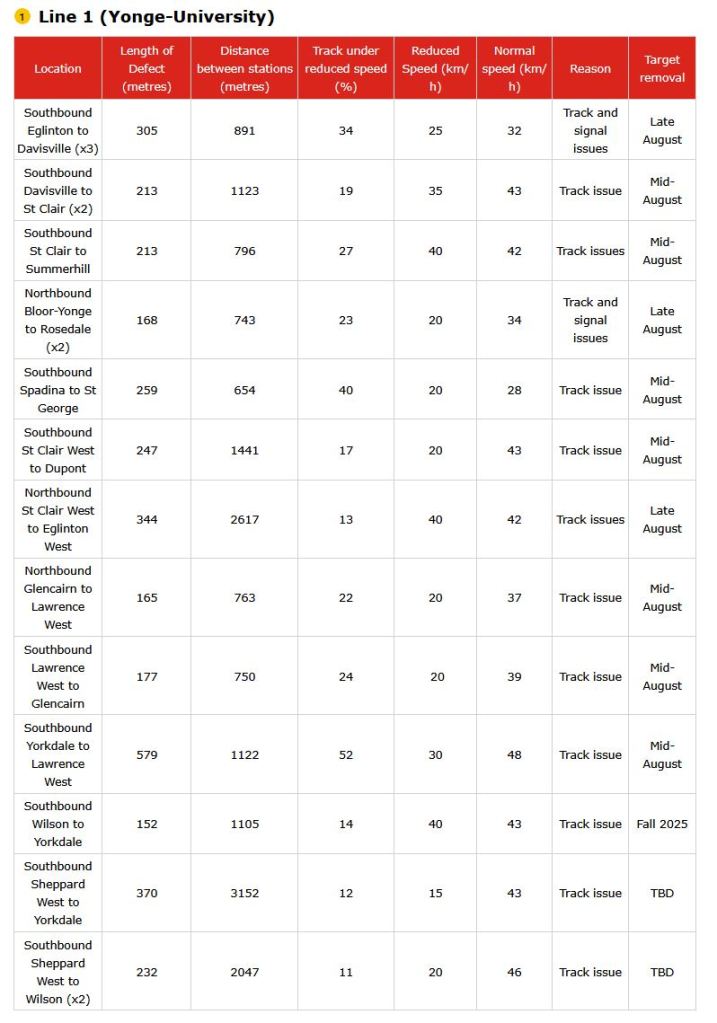
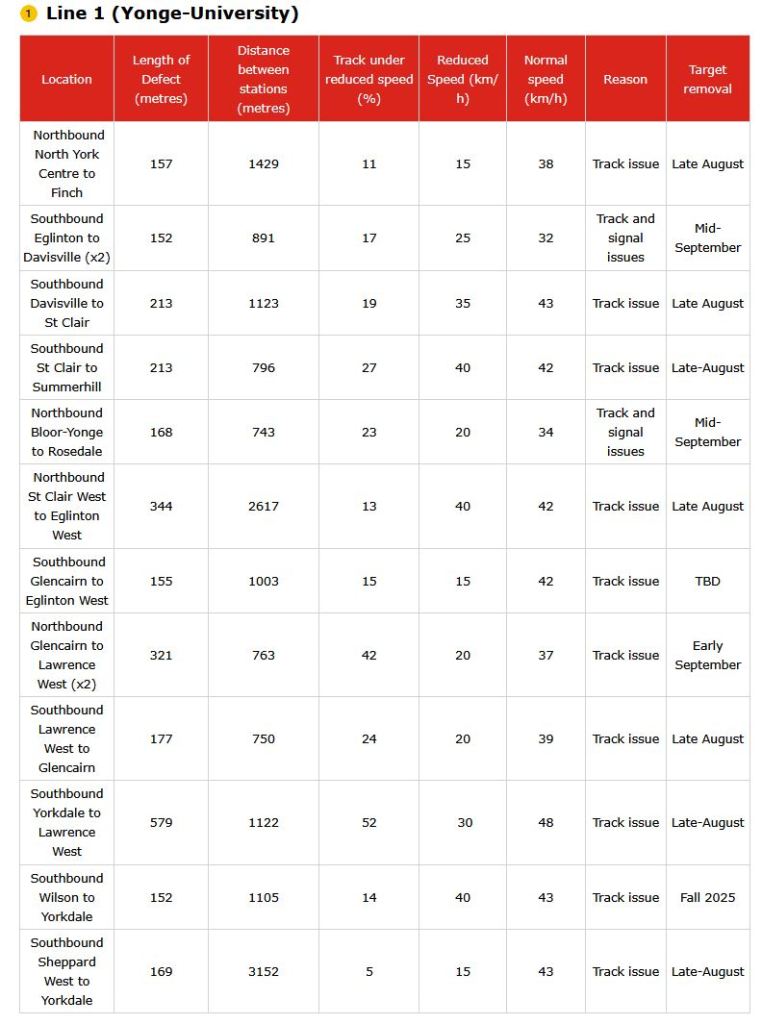
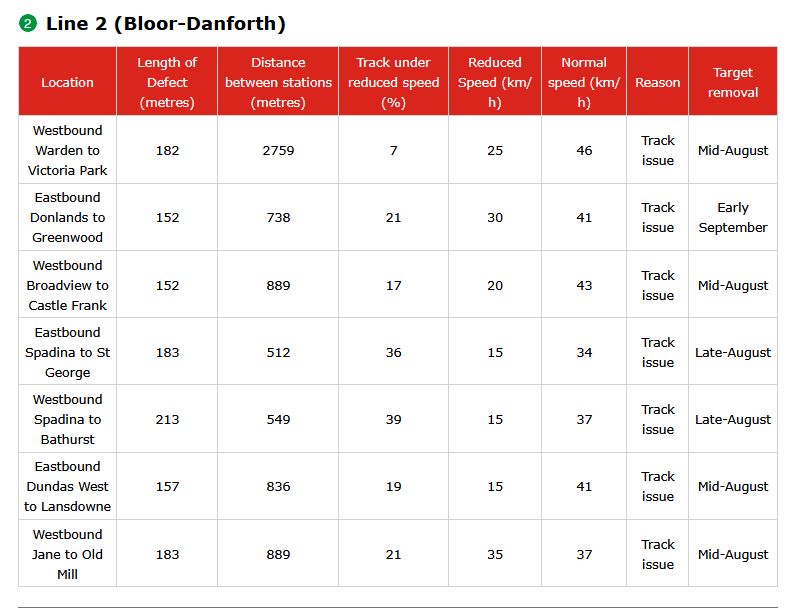
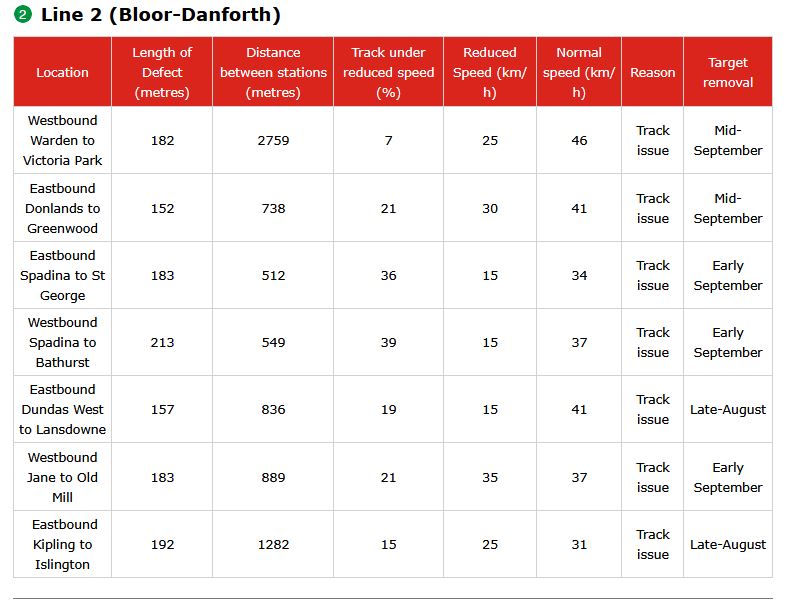
Tables with location details and expected times to repair taken from the TTC’s site are below. Note that in previous versions, many of these sites were expected to be repaired in August, but the target dates have been adjusted.

At the request of a reader, here are the Line 1 and 2 charts condensed onto a single page for each line so that the year-to-year continuity of problem areas is more obvious.

TTC Ridership Growth and Fare Options Update

The TTC’s Strategic Planning Committee will meet on September 4 at 10:00am in the Board Room at 1900 Yonge Street, TTC headquarters. Among the items on the agenda is a report titled 2026-2028 Ridership Growth Strategy: 2026 Budget Considerations.

This report proposes implementation of six initiatives through the 2026 Budget which is now in preparation:

  • Fare capping (limiting the accumulated charge for trips within a month) as a replacement for monthly passes.
  • Year 1 of the TTC’s Wayfinding Strategy
  • Support growth from changing work-from-home practices
  • Improve service reliability
  • Implement outstanding proposals from the 2024 and 2025 Annual Plans
  • Bring service to the standards for crowding, express network routes, and the 10-minute network

There are many other possible tactics for building ridership. These are not included in the report, but the intent is to report back to the Board following budget approval in early 2026 with an updated RGS.

Updated September 1 at 10:40pm: The list of additional RGS options has been added to the end of this article.

A related issue is the question of a fare increase, the revenue it might generate and the likely reaction to such a proposal. A variety of increases from 5 to 35 cents on various fare classes are presented for discussion, but there is no recommendation.

Full disclosure: I participated in a meeting of the TTC’s Planning Advisory Group to discuss the proposed RGS along with other interested parties. There is a summary of our comments in the report [pp 6-7].

Updated September 4 at 9:00 pm: The Presentation Deck for this item is now available. I will add commentary to the article in coming days.

Continue reading

Three Challenges

As a long-time transit activist, issues accumulate over the years and decades. Attempts to discuss “what needs to be done” quickly become a tangle of interlocking subjects. There is no simple solution to many problems.

Advocates for better transit run into comments like “you’re so smart, what would you do?” The intent is usually to shut down debate and prove that armchair criticism is a lot easier than the hard professional work of running a city and its transit system.

Recently, after a wide-ranging conversation about Toronto’s transit and the political history of the city, I was asked to boil down my feelings into three key issues about the TTC. This is the sort of question one might encounter in an interview to see how well a candidate knows their material and can focus on core items without rambling. I wasn’t interviewing for anything, but did not hesitate in my reply. This article grew from that discussion.

The intent is not to be exhaustive, but to sharpen debate to key issues. For every question there would be dozens of subsidiary issues, and always a chance that something would be missed. However, senior managers and politicians have limited attention spans, and they cannot deal with every issue at once. Neither can the organizations they lead. There is a “trees and forest” problem where many small details deserving of attention can obscure the larger picture.

Here are my three issues as a launching pad for debate about where the TTC should focus. There is a common theme: if you don’t know what’s broken, you cannot possibly fix it.

  • Honesty and transparency about service
  • The state of infrastructure
  • Headroom for short-term growth

I have not discussed transit funding, a perennial topic at the TTC and City Hall, and one we will hear much about as the 2026 budget season unfolds. This is a deliberate choice.

Funding debates consume vast amounts of time, usually to address a handful of key problems. The most recent example was the new Line 2 subway fleet, but there are many, many more budget lines both for state of good repair and system expansion, and many of these are interlinked. We rarely hear about any of them.

Even modest growth, a “business as usual” approach, has challenges, but aggressive transit growth as foreseen in Toronto’s TransformTO strategy adds very substantially to an already difficult situation. Council has not yet endorsed this plan fully, and the TTC has only produced an incomplete estimate of its implications.

If we hope to build a more robust transit system, we need to understand both the shortcomings of the existing one as a base and the challenges of accelerated growth. Toronto came through the Covid era with its transit system more-or-less intact, but we face a decision. Will we just muddle through, content with small improvements and a handful of future rapid transit lines, or will we launch into an era of real growth in transit across the entire system? Will we really make the TTC “The Better Way”?

Continue reading

TTC Service Changes: August 31, 2025

The Labour Day weekend sees the TTC return to fall schedules on several routes, the end of some construction diversions, and the beginning of another.

Subway Service

There is no change in subway service

Streetcar Services

A plan to improve streetcar service to a six minute standard daytime headway begins with 512 St. Clair, and is expected to continue with 511 Bathurst and 505 Dundas at dates yet to be announced.

The construction work at King & Church finished recently. With the new schedules, streetcar service returns to King through downtown, but the west end of the line will divert around reconstruction of King & Dufferin until Thanksgiving weekend.

The 503 Kingston Road car will become a bus with the route shortened to Joe Shuster Way east of Dufferin. The 303 night service will be suspended. On Kingston Road the 322 Coxwell night bus will remain.

The eastern terminus of 508 Lake Shore will be shortened from Broadview Station to Distillery Loop.

Bus Services

Lawrence Station will reopen to bus service allowing restoration of regular bus services. The 52/952 Lawrence service will no longer operate via Avenue Road to Eglinton Station. Routes 124 Sunnybrook and 162 Lawrence-Donway will terminate at Lawrence Station rather than running west to Roe Loop on Avenue Road.

The south end of 325 Don Mills night bus will be extended east from Carlaw via Commissioners to Lake Shore Garage. The east end of 385 Sheppard East night bus will extended from Meadowvale Road to Rouge Hill GO Station.

Some of the seasonal services will end on Labour Day including:

  • The weekend service to Biidaasige Park on 72D Pape will end, and buses will return to the 72C terminus at Commissioners and Saulter Streets.
  • Weekday service on 200 Toronto Zoo and 201 Bluffer’s Park will end. Weekend service continues.
  • Service on 203 High Park will end.

Many routes see restoration of services reduced for the summer lull in riding, although there are a few cuts scattered around the system. A large number of school trippers are also back, but these are not listed here.

The remainder of this article details various aspects of the changes and includes a link to a spreadsheet with the operating plans for all modified routes.

Continue reading

Where is my Streetcar? Fall 2025 Edition.

There are many diversions coming up in the Fall for streetcar routes. Information on these appears in various places on the TTC site, mainly but not exclusively under Service Advisories. As an aid to riders, this article consolidates the available information in one place.

Updated November 28, 2025

***** This article is only for archival purposes. It has been replaced by a new one picking up from mid-November 2025. *****

Major events pending and in progress include:

  • Construction on Queen between Davies (just east of the Don Bridge) and Broadview.
  • Reconstruction of the intersection of College and McCaul, and of overhead in the vicinity.
  • Reconstruction of track and overhead at and near Parliament and Carlton.

Other short term diversions will last only overnight or for a weekend.

Many of these are complicated by the ongoing Ontario Line work at Queen & Yonge forcing some diversions to be more complex than they might be otherwise.

This article will be updated when changes are announced.

  • November 21: The 501 diversion via Broadview, Dundas and Parliament around water main and track work west of Broadview will begin on November 22.
  • November 20: Equipment and material mobilization is underway on Queen west of Broadview.
  • November 17: The 506 diversion has been changed today to avoid the intersection of Church & Dundas where construction blocks the northeast corner. Maps have been added from the TTC’s site.
  • Effective November 16: The 503 Kingston Road bus will be cut back from Dufferin, and will now loop at York Street via Richmond and University.
  • November 15: Diversions announced for two projects on 506 Carlton at Parliament & Carlton, and on Gerrard east of Broadview.
  • November 9: King & Dufferin reopened for streetcar service. 503, 504, 508 will operate via their normal routes.
  • October 30: King & Dufferin reopens for general traffic and buses. Streetcars to return following track testing.
  • October 20: Water main reconstruction on Queen west of Broadview has been delayed until early November. 501 Queen streetcars will continue to operate on Queen Street until further notice.
  • October 13: 504 King is operating with streetcars today over its full route except for the King/Dufferin diversion.
  • October 9: Maps for 504 King and 506 Carlton diversions added.
  • October 8: Construction at Queen & Broadview will not start on October 12, and so some diversions will not be required immediately. Information for 501 Queen and 503 Kingston Road has been updated.
  • October 5: Nuit Blanch & Run For the Cure info moved to the archive section.
  • October 1: Diversions of 505/305 Dundas and 506/306 Carlton for Nuit Blance and for the Run For The Cure added for October 3/4/5.
  • September 23: The King/Dufferin start date has been changed to Sunday, September 28.
  • September 12: King/Dufferin start date pushed back to September 29 or later. The project will now extend to mid-November.
  • September 9: College/McCaul and Queen East details added.
  • August 26: King/Dufferin Project
    • The start date for this project has been changed to mid-September with the exact date to be confirmed. Although new schedules will be in place providing for diversions, service will continue to operate through on King Street until construction actually begins. This likely means that the project will extend further into October than the originally planned Thanksgiving weekend end date. The delay also means that the Tiff diversions will end before the King/Dufferin diversions begin.
    • Branch lettering for 504 King A/B corrected.
  • August 25: King/Dufferin Project
    • Information about Kingston Road night service added.
    • 304 King and 329 Dufferin confirmed to be diverted on the same routes as the 504A and 29 daytime services.
Continue reading

Subway Reduced Speed Zone Update

Recently, the TTC added tables to its page mapping all reduced speed zones indicating the nature of each problem and the anticipated time to repair. Many of the dates were in August, and we’re well into that month already. Given past history, this seemed optimistic.

The table has now been revised with a number of dates pushed into September. A few items have vanished, but there are new entries too.

When Artics Aren’t Artics

Several routes in the TTC network are scheduled to operate partly or completely with 18m articulated buses in place of the standard 12m varieties seen on most of the system. A problem commonly found on some of these routes is that although the schedule assumes an 18m bus, what actually shows up is a 12m bus with less capacity.

On some routes, the proportion of shorter buses grows later in the day suggesting that for some reason the longer buses were replaced. The number of buses per hour is fairly consistent from day-to-day, and generally matches the scheduled level of service. This means that few extras (or “run as directed” buses) served these routes even though the capacity was reduced by substitution of smaller buses.

This post looks at how often this problem arises on several routes through the month of July 2025.

Continue reading

TTC Subway Car Contract Goes to Alstom

Despite the premise of an open, competitive bid among potential carbuilders for new subway trains, various politicians have openly argued that the work should go to the historical provider, the Alstom (formerly Bombardier) plant in Thunder Bay.

On August 15, all three funding governments, Canada, Ontario and Toronto announced that a sole-source contract will be awarded to Alstom Transport Canada. This is intended to support Canadian jobs and an existing manufacturing facility. All bidders have been notified that the former bid process has been cancelled.

According to the news release:

To ensure that Alstom delivers state-of-the-art trains at a fair market price, maximizes the creation of Canadian jobs, and benefits Toronto, Alstom must:

• deliver a product that is compliant with the TTC’s original requirements;
• maximize Canadian content and create Canadian jobs;
• have its pricing subject to an independent third-party market price assessment.

It is expected that negotiations will occur over the next few months with a report back to the TTC Board on the status of negotiations by the end of the year.

The proposed contract would provide 70 new trains

  • 55 trains to replace the existing Line 2 fleet
  • 15 trains for the North Yonge and Scarborough extensions

There is also provision for future train orders that would support expansion of service on both Lines 1 and 2. The 55 trains are sufficient to operate Line 2 at the capacity supported by its existing signal system, but more trains would be needed to exploit the capabilities of CBTC (Computer Based Train Control) which will be installed in coming years. Similarly, the existing Line 1 fleet will support the pre-CBTC service level of 140 seconds (25.7 trains/hour), but more trains are needed to go beyond that level. There is no funding for the additional trains in current budgets, nor for the added maintenance facilities a larger fleet will require.

The award of additional trains to Alstom is dependent on their performance on the 70-train order.

The new release states:

The TTC is working diligently to ensure the aging Line 2 fleet operates safely and reliably until new trains arrive.

Originally, the TTC had planned to replace the Line 2 trains by 2026, but that scheme was shelved by former CEO Rick Leary who claimed the trains could be life-extended to 2040. That solved a budget pressure for funding, including the proposed new maintenance yard at Kipling, but created a potential crisis in subway reliability and fleet availability.

The TTC has more than 55 of the current T-1 stock used on Line 2 due to changes over the years in the scope of automatic train control implementation on Line 1. These would, if all trains were working, have allowed the Scarborough extension to open using the existing fleet, but only barely. The delay in the Scarborough project bought the TTC time to procure new trains.

The challenge now is to keep the T-1 fleet operating reliably until new cars arrive. TTC management reported at a Board meeting earlier this year that some cars are being used as a source of spare parts. There are obvious limits to how far this practice can go, and if carried too far will limit the TTC’s ability to restore full pre-pandemic service on Line 2.

See also:

TTC Service to the CNE for 2025

The TTC has announced its services for the CNE for 2025 to operate from Friday, August 15 to Monday, September 1.

  • CNE Express buses will operate non-stop between Bathurst Station and Exhibition Loop, and between Dufferin Station and Dufferin Loop.
  • Extra service will operate on the 29 Dufferin and 929 Dufferin Express bus routes, and on the 509 Harbourfront and 511 Bathurst streetcar routes.

Other routes will change to accommodate the CNE services and traffic conditions.

  • 63 Ossington buses normally loop at King via Strachan, East Liberty, Liberty and Atlantic. This will change so that buses loop via Fraser, Liberty and Atlantic.
  • 503 Kingston Road streetcars will be extended west from Dufferin to Sunnyside Loop between 2pm-1am weekdays and 9am-1am on weekends.
  • 510 Spadina streetcars will terminate at Queens Quay Loop until 7:30pm daily, and will run to Union Station afterward.