The Varying Strength of Ridership Recovery (2)

In a recent article, I reviewed route-level ridership data cited in the 2023 Annual Service Plan as well as the 2019-2021 numbers posted on the TTC’s Planning web page.

During debate at the July 14 TTC Board meeting, an issue came up about the unexpectedly poor performance during the pandemic era of 25 Don Mills. This got me thinking about how the “results” could be influenced by when counts were done and particularly on routes that have both express and local branches under different route numbers.

To explore this, I recast the 2019-2021 stats in tables with and without the express 9xx routes consolidated into their local equivalents.

First, here are the stats with the local and express routes separate. The gallery below contains the first set of routes, but the complete list is in the following pdf. The data here are the same as presented in the previous article, but reformatted for easier browsing.

Here are the stats with the 9xx routes’ data rolled into their local equivalents.

The three express/local routes on these sample pages show the differing effects.

Route201920202021% Recov 2020% Recov 2021
Victoria Park
24 local22,75112,23314,07754%62%
924 express6,4723,66357%
24/924 local+express29,23312,23317,74042%61%
Don Mills
25 local27,98816,48118,71959%67%
925 express16,6249,07455%
25/925 local+express44,61216,48127,79337%62%
Dufferin
29 local27,48723,02122,08784%80%
929 express15,72213,23884%
29/929 local+express43,20923,02135.32553%82%

In all three cases, the express service did not operate in 2020, and so all of the riding, such as it was, occurred on the local route number. This inflated the apparent ridership retention of the local route over the actual level on the corridor considering the two routes as one operation.

The effect was so strong on Dufferin that its local recovery rate went down slightly in 2021 because growing demand on the corridor was not enough to offset the shift of riders back to the express service.

The moral of the story here is that looking at stats in isolation can lead to incorrect conclusions if the underlying network and service plan are not taken into account. This applies to simplistic rankings such as “top 20” and “bottom 20” that can exclude routes with almost identical performance. A better metric would be the collection of all routes above or below a certain recovery rate.

Politicians who fund and, nominally, direct transit systems love easy-to-understand metrics that often hide or even distort what is going on. I will turn to TTC measurement indices and standards in a future article.
Toronto Transit Funding and Development Charges

The real estate industry, their acolytes and even the affordable housing advocates went into meltdown when the 2022 update to the Development Charges landed at Toronto’s Executive Committee. This proposal was approved recently by City Council, but with a few carve outs such as exempting certain types of housing (up to 4 dwellings on a lot) from these charges.

The main trigger for the uproar was that the new DCs are much higher than those they replaced. With transit being the primary driver of this increase, it is worth understanding how DCs work and what the new charges will and won’t fund.

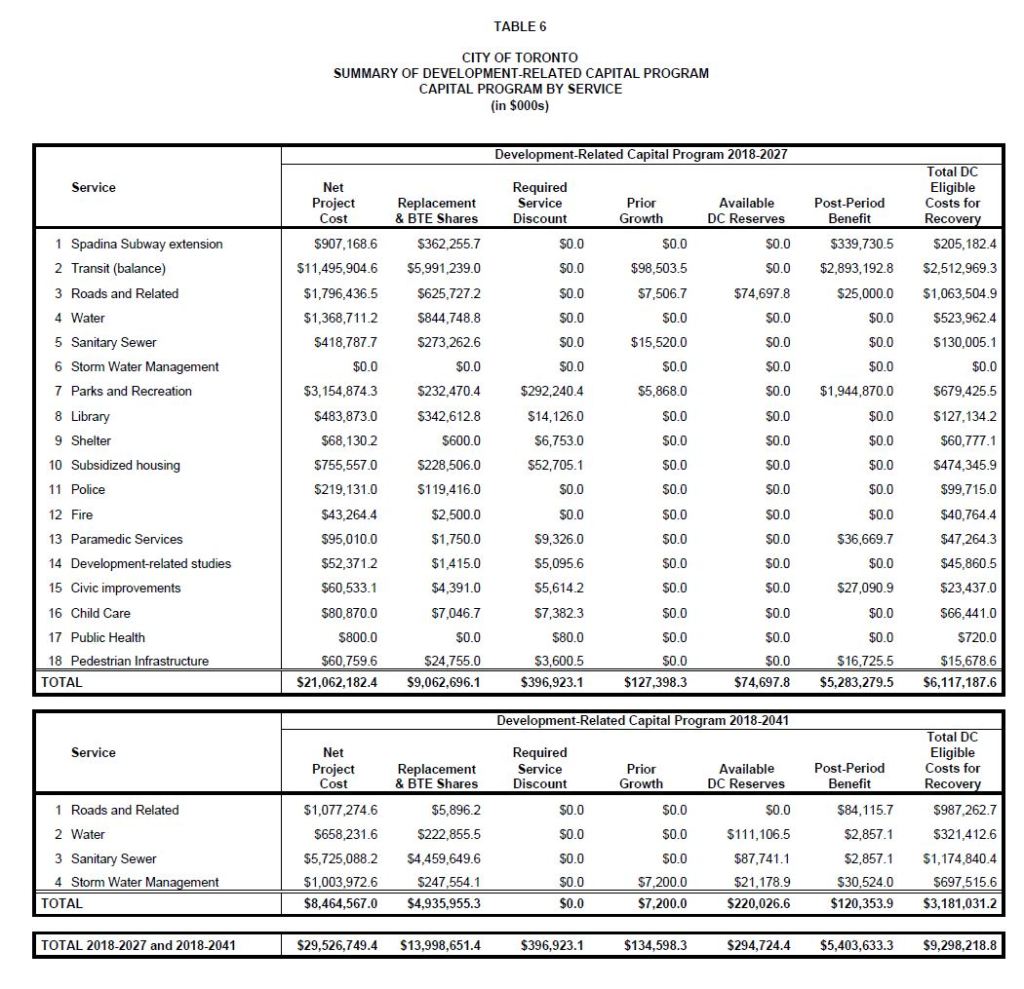
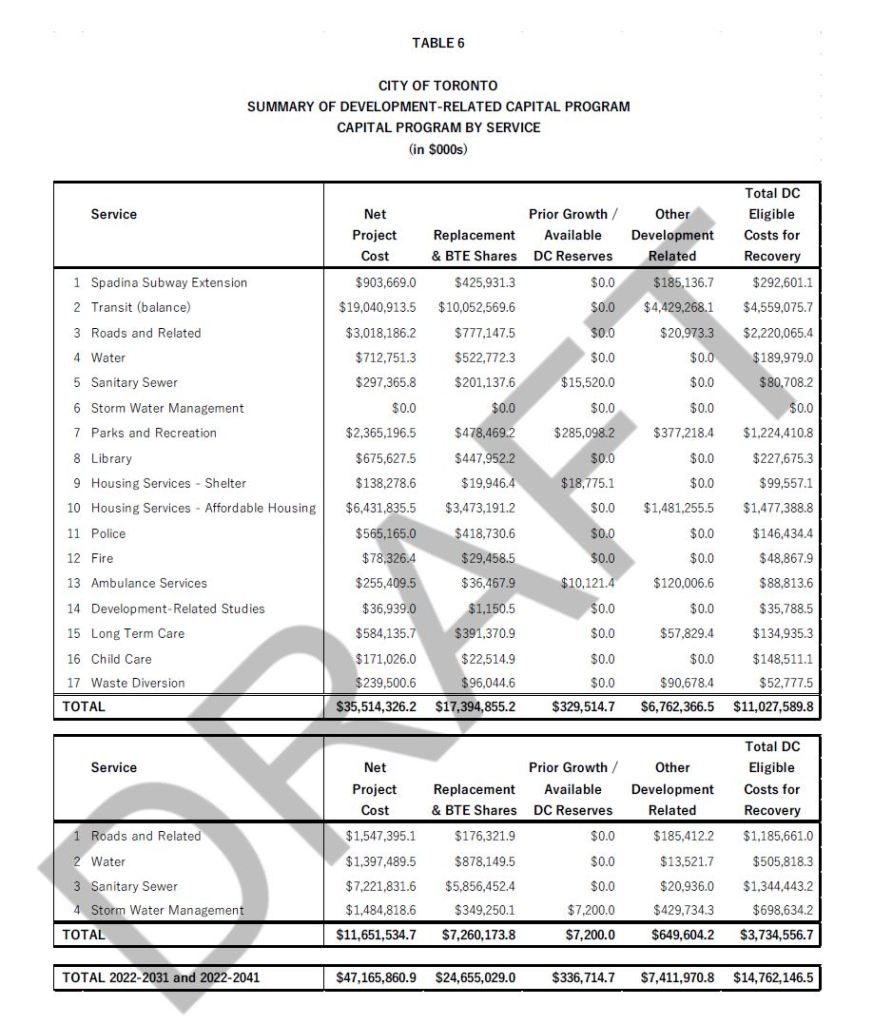
First, a comparison of the base data for the 2018 and 2022 reports. The tables below are in almost the same format making comparison easy.

The important column is on the right end of both charts “Total DC Eligible Costs for Recovery”. The total in 2018 was $9.3 billion while in 2022 it is $14.7 billion.

Yes, we are still paying for the Spadina Subway which gets its very own line in the table, and the Sheppard line shows up in the details under “Transit (Balance)”. Large increases lie in:

  • Transit, about $2 billion
  • Roads, about $1.2 billion
  • Housing Services, about $1 billion
  • Parks & Recreation, about $550 million

Some lines go up by a lot proportionately, but the dollar amount is comparatively low. For example, Pedestrian Infrastructure went from $15.7 million to $52.8 million, over triple, but the actual dollars pale by comparison with transit.

A major difference between 2018 and 2022 is the proportion of total costs recovered from subsidies and contributions from other parties.

In the 2018 DC calculation a grand total of $43.5 billion gross was reduced by $14.1 billion to a net value of $29.4 billion.

In the 2022 DC calculation, a grand total of $66.9 billion gross is reduced by $19.8 billion to a net value of $47.2 billion.

The increase in gross figures, 54 percent, is much higher than the increase in recoveries through subsidies and other revenue, 40 percent. This causes a disproportionate growth in the net of 61 percent.

Where Do Those Numbers Come From?

The background study that recommends new Development Charges starts with a list of every capital project in the City. The TTC has the biggest capital budget, even with some major projects taken over by the province, and it therefore generates the biggest part of the DC tithe.

For each project some costs are included and others are excluded. The headings on the charts above show the breakdown:

  • Net Project Cost: The cost of the project borne by the City after deducting provincial and federal subsidies and contributions by others (for example, York Region’s contribution to the Spadina Subway). (The gross costs for those who are interested are in the detailed tables.)
  • Replacement: Costs to replace existing infrastructure (such as new buses that replace old ones) are not eligible for DCs because this cost does not address growth, only worn out assets.
  • Benefit to Existing (BTE) Share: Demand that would rise if the improvements were already in place determines the portion of the benefit that is not due to new development.
  • DC Reserves: Some groups of projects did not manage to spend all of the money collected for them, and this sits in a carry over reserve offsetting new charges.
  • Other Development Related: Some costs are deferred to future rounds of DCs as reflecting the value of a project like a new subway line well beyond the five year cycle of DC updates.

The BTE share is calculated from existing and projected ridership (see below).

Looking at the 2022 chart above, of the $47.2 billion in net project costs, only $14.8 billion will be recovered in the current period from DCs. (The gross cost, by the way, is $66.9 billion.) This does not include provincial projects like the Ontario Line and Scarborough Subway which are no longer on the TTC’s books. It also does not include much of the Green Bus plan because that is mostly replacing existing buses, not adding to the fleet for ridership growth.

Continue reading

TTC Board Meeting: July 14, 2022

The TTC Board held its last scheduled meeting of the current term on July 14. Barring an emergency requiring a special meeting, the next regular meeting will follow reconstitution of the Board after the municipal election in the Fall.

Some items on the agenda have already been covered in previous articles:

This article covers:

  • The CEO’s Report
  • Outsourcing of non-revenue automotive vehicle and equipment maintenance
  • Automatic Train Control for Line 1 Yonge-University
  • Five and ten year service plans
  • Transit network expansion update

I will review the Green Bus program update in a separate article.

CEO’s Report

The CEO’s Report contains many charts purporting to show the operation of the system. Unfortunately some of these hide as much as they tell by giving a simplistic view of the system.

I have already written about the wide discrepancy between actual short turning of vehicles and the reported number. A distortion this major calls into question the accuracy and honesty of other metrics in the report.

In a future article, I will turn to the appropriateness of various metrics, but here are some key areas:

  • Averages do not represent conditions riders experience. Data that are consolidated across hours, days, locations and routes hide the prevalence of disruptions. Service that is fairly good on average can be terrible for riders who try to use it at the wrong time.
  • Values for some metrics are reported with capped charts that show only that a target is met, but not by how much it was exceeded. This gives no indication of the room to improve the target value, nor of the variation that could make a higher target difficult to achieve consistently.
  • Reliability is shown only for vehicles that actually operate in service, but there is no measure of actual fleet utilization and the headroom for service growth using available buses, streetcars and subway trains.

In discussion of the report, Commissioner Carroll noted that the TTC still has a problem with on time performance for streetcars. CEO Rick Leary replied that there is an On Time Performance team who are looking at details including recognition that there are three types of routes: those that run well, those affected by construction and those with other problems.

Carroll replied that people are quick to complain about King Street and wondering why they are still waiting for the 504. The TTC says that construction is the reason, but do they have a strategy to deal with bunching and communicate with riders. Management replied that they have strategies for keeping riders informed during planned diversions, but for unplanned emergencies there are service alerts. Changes are coming and service should improve.

This discussion was frustrating to hear because, first off, the central part of 504 King between Dufferin and Parliament is not affected by construction. Only the outer ends in Parkdale/Roncesvalles and on Broadview have (or had until recently) bus shuttles. As for keeping riders informed, irregular service plagues all routes in the system as I have documented in articles here many times. The problem is line management, or the absence of it.

On another topic, Carroll noted that the TTC seems to have a lower standard for the condition of stations than it does for vehicles, or at least tracks the latter at more detail. Leary replied that a summer blitz using student workers will scrub down all stations to bring the system back to a better quality for riders returning in the Fall.

Continue reading

Adelaide Street Reconstruction Open House

The City of Toronto will hold an online open house for the Adelaide Street project on Thursday, July 21 from 6:30 to 8:00 pm.

A link to register for this session is on the project page.

Track on Adelaide has been inactive for many years thanks to various cuts for utility projects and the high level of building construction along the street. The TTC contemplated reactivating the track as a bypass for, among other things, the Tiff street fair, but the opportunity did not present itself until now.

The Ontario Line open cut construction at Queen Station will require diversion of streetcar service around Queen and Yonge for several years. Cars will operate westbound via existing track on Church, Richmond and York. Eastbound service will run via York, Adelaide and Church.

This requires reconstruction of the Adelaide Street trackage as well as installation of new tracks southbound on York from Queen to Adelaide. Although only the track east from York is required for the Ontario Line diversion, the TTC will restore the track between Spadina and York making provision for a longer diversion. York will become two-way from Queen to Adelaide.

It is not yet clear which special work will be added at intersections, notably Adelaide and York where a north-to-east curve would be useful, especially if the TTC adds an east-to-north at King and York when this is rebuilt in a pending King Street project. Unfortunately, with the lead time between planning and execution, the TTC has forgotten on occasion (or chosen for budgetary reasons) to include missing curves that would make their operations more flexible notably at Broadview and Gerrard and, this year at Church and Carlton. These opportunities only come along every 25-30 years.

The project also includes water main reconstruction from York to Church, and repaving. Parts of the street are in very bad condition after years of condo construction trucks pounding the pavement.

From Bathurst to Parliament, the bike lane will shift to the north side of the street where there will be less conflict with the streetcars and with vehicles stopped in the eastbound curb lane.

I will update this article with more info after the open house.

Metrolinx! The Musical!

Updated July 15, 2022 with monthly Metrolinx ridership recovery stats.

Metrolinx Board meetings are rather quiet affairs devoid of controversy, not to mention substance. They are pro-forma efforts at public meetings by an organization that does everything it can in private.

The breakdown of the agenda tells the tale. Contrast this with the openness demanded by legislation in municipal proceedings.

This is not new. In the pre-covid era, I would attend the meetings along with a dwindling band of reporters from the City Hall or Queen’s Park press galleries who eventually decided that it was not worth wasting their time unless there was some burning issue where an interview ambush might yield a juicy quote.

For two years, the Board meetings have been online with all of the technical foul-ups we have come to love through Zoom and its relatives. This month, in a grand return, the Board met in person. It was almost like the lights coming back to Broadway.

Metrolinx just loves to tell everyone how wonderful they are, how everything is going so swimmingly well. This time they even had celebratory video.

The meeting video is available for those who just must watch, although as a show it should have died on the out-of-town tryouts.

There are two common themes:

  • The overwhelming emphasis is on marketing and communications with as much “good news” as possible.
  • There is no discussion of policy. Anything substantive, if the Board discussed it at all, was handled in committee or in a private Board session.

I could not help thinking of how “In here life is beautiful” in Cabaret, or “Everything is beautiful at the ballet” in A Chorus Line. Alas, Metrolinx has not (yet) recruited the likes of Kander & Ebb, or Michael Bennett & Marvin Hamlisch to its burgeoning communications team.

Considering the years of debate over regional fare integration and the number of virtual trees felled for reports on the subject, Metrolinx is skipping over the complexities by simply offering a free transfer between GO and 905 area transit systems. Toronto/TTC? No.

It is hard to understand why we have excruciating debates about things like zone boundaries, time-based transfers or differing classes of service when the main agency, GO/Metrolinx, simply gives free transfers and deeper discounts to encourage ridership. If a municipal system tried this, they would be pilloried for wasting precious tax dollars on people who are not motorists.

The debate on all fare schemes is whether the marginal revenue is worth the complexity and the cost of administration, although the latter is much simpler with fare cards rather than conductors and paper transfers.

The related context is that we learn in the Annual Report for 2021-22 that the operating subsidy for GO Transit doubled to almost $1-billion thanks to the combined effect of lost ridership and continued, albeit reduced, scale of operation during the pandemic.

Operating expenses have declined little, despite service cuts, through the pandemic era.

The operating subsidy, however, has grown because of lost fare and other revenues.

The degree of belt-tightening at Metrolinx will be an interesting contrast to what might be forced on municipal agencies as special pandemic financial supports wind down.

There was no public discussion of how this situation can be sustained in coming years depending on the rate of ridership recovery.

The report on community relations was particularly galling because it pitched Metrolinx’ work as listening to communities as a positive contribution to projects. In fact, Metrolinx’ common strategy is to bull through their proposals and then “involve” the community in making the best of a bad situation with things like design competitions for decoration of new, unwanted structures. Even the canard about parks getting bigger thanks to Metrolinx continues to ignore (a) the relatively small amount of land involved, and (b) the much more extensive effect of the associated project on a neighbourhood.

The Board laps this up as if staff are doing such a wonderful job.

Updated: There was some discrepancy between ridership recovery numbers presented in reports and verbally at the meeting. Here are the definitive monthly numbers from Metrolinx.

MonthGO TransitUP Express
January ’2211.8%16.1%
February ’2220.3%22.6%
March ’2232.4%33.3%
April ’2233.5%41.0%
May ’2239.4%47.3%
June ’2249.5%59.5%
Continue reading

TTC Service Changes: July 31, 2022

There will be a small number of changes on July 31 for the schedule period running through to the Labour Day weekend.

Line 2 Service Improvement

Service on Line 2 Bloor-Danforth will be improved during all operating periods, notably off-peak and weekends. This will not fully restore pre-pandemic levels on the route, but should reduce crowding that has become a problem over past weeks.

King & Sumach Track Repairs

The intersection of King and Sumach (the point where the Distillery line branches off) will be rebuilt in an attempt to reduce noise and vibration.

During this work, all 504 King service will operate to Broadview Station via Parliament and Queen Streets. The 503 Kingston Road route will also use this diversion.

A shuttle bus will operate to provide access to the Distllery, and it will also provide coverage for the 506 Carlton line during construction at Church Street (see below).

Church & Carlton Track Repairs

The intersection of Carlton and Church will be rebuilt as part of the regular maintenance program. This work will not include the addition of missing curves in the southeast quadrant.

506 Carlton service will divert around construction via Parliament, Dundas and Bay both ways. A replacement bus service will operate from Spadina Station to the Distillery District. The map below shows a proposed alignment for this service. This is subject to change depending on possible modifications to turn restrictions due to construction at College & Yonge.

Updated July 28, 2022: This diversion has been changed. See Revised 506 Carlton Diversion Effective July 31, 2022.

Other Changes

Running times on 32 Eglinton West will be adjusted to provide for delays due to the Line 5 Crosstown Extension construction, as well as to restore covid-era service cuts.

A planned reconstruction of the terminal at Kipling Station will require consolidation of loading areas and move of some routes to stops outside of the station. This project has been deferred to 2023, but a schedule change to support this work was already in the pipeline for the coming period. The 40 Junction and 49 Bloor West routes will be interlined.

Route 172 Cherry Beach will shift from “Old” Cherry Street to the “New” street across the future path of the Don River between Commissioners Street and the Ship Channel. Buses will use Old Cherry Street north of Commissioners Street, then jog west to New Cherry Street to cross the new river course.

Route 174 Ontario Place weekend and holiday service was dropped in June due to conflicting activities at the CNE and Ontario Place grounds. This change is now officially in the schedules.

Details of the new service levels are in the spreadsheet linked below.

Major Construction at Russell Carhouse

Reconstruction of Russell Carhouse will begin both to make it fully compatible with the Flexity fleet, to improve the quality of yard paving and convert the overhead system for pantograph operation.

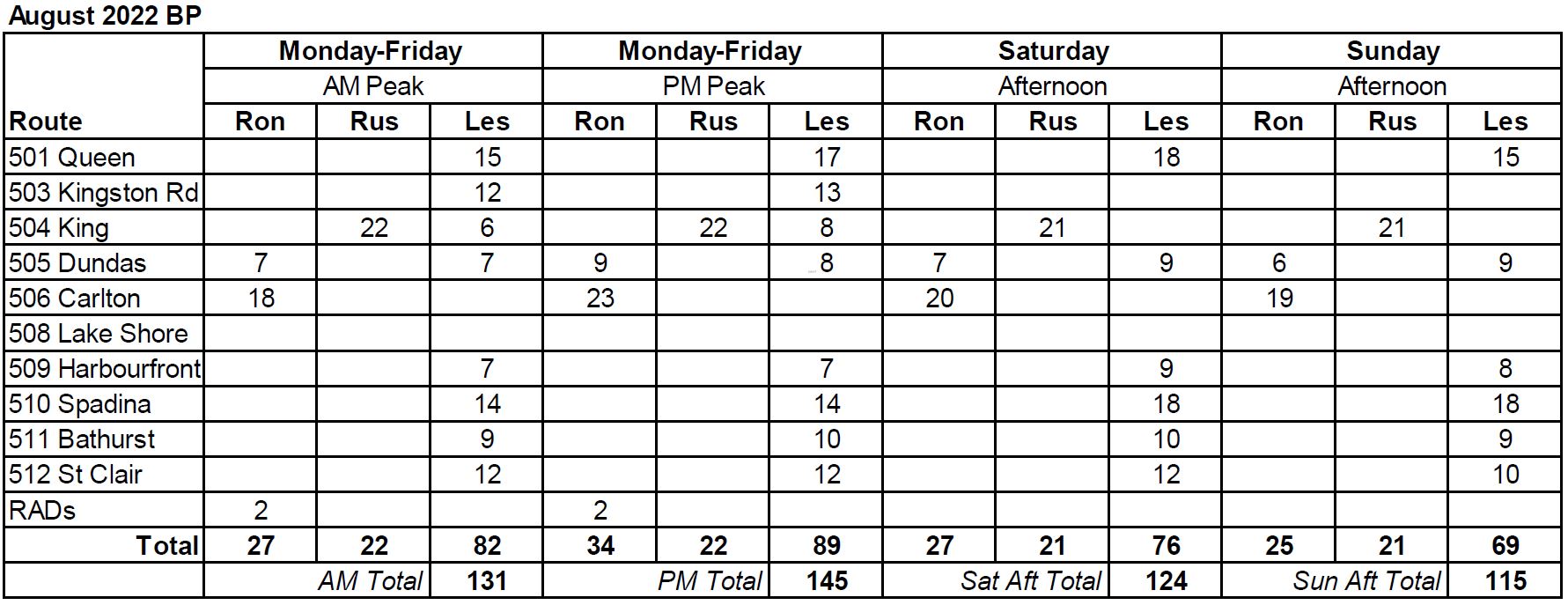
In the first phase of this work, the site’s capacity will be reduced to 28 cars including spares. Only the 504 King service will operate from the yard. Here is the new allocation of routes to the three carhouses.

Note that the maximum number of cars in service is well below the fleet of 204. Bus substitutions on portions of 501 Queen, 504 King and 506 Carlton will continue through the balance of 2022.

As the work at Russell progresses, the capacity of the site will change.

TTC 2023 Service Plan Survey

The TTC’s online survey for their 2023 Service Plan is now available.

It contains three sections, and you can submit answers to any or all of them.

  • Lessons learned from the Covid-19 era
  • Route changes associated with the shutdown of Line 3 SRT (November 2023)
  • Route changes associated with the opening of Line 6 Finch West

There may be added route changes proposed in a second consultation round later this year.

This consultation is for 2023 changes. A separate 2024-2028 Service Plan and Ten-Year Outlook is under development.

Note that the route arrangement for Line 5 Eglinton Crosstown’s opening is already settled from previous consultation in the 2022 Service Plan.

The Varying Strength of Ridership Recovery

This article continues and enlarges on information in TTC 2023 Annual Service Plan Preview with additional material from a report on the July TTC Board agenda Advancing the 5-Year Service Plan (2024-2028) & 10-Year Outlook Reset. That is a long report with several components, and I have pulled chunks of it out as they relate directly to information in the earlier article.

Of particular interest in the restoration of service to the transit network is the fact that recovery has been underway in some locations and times much more strongly than others. This corresponds to the difference in areas where work or study-from-home replaced commuting to an office or school. Maps in the previous article showed the top and bottom 20 routes for ridership relative to pre-pandemic levels in Spring 2020 (the point of lowest ridership) and in Fall 2021. For convenience, they are repeated here.

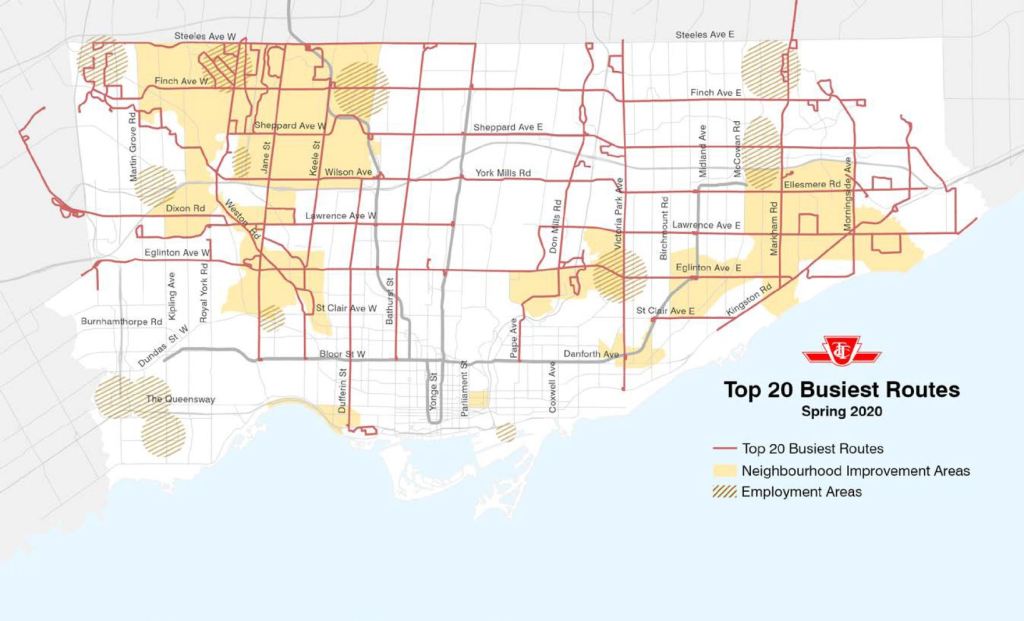
These ranking are by percentage of pre-pandemic ridership with no reference to absolute numbers. The busiest routes by ridership are shown in the maps below. This presentation inevitably displays the long routes which have a large number of boardings. Short routes like 65 Parliament may have recovered a large proportion of their demand, but the base number is necessarily small because of their smaller service territory.

This shows the danger of looking at absolute numbers out of a context such as riders per route kilometre (in effect, the density of demand), not to mention possible variations in the level of demand and boarding patterns along a long route.

Continue reading

The Myth of “No Short Turns” (Revised)

Note: Calculations behind the charts in the original version of this article include a methodology problem. Short turn counts for vehicles crossing two screenlines (such as eastbound on Queen at Coxwell and at Woodbine) were distorted when these events did not occur in the same hour. Other problems included double counting of cars that looped twice at a short turn point (e.g. College Loop), and cars that were entering service via a loop being counted as short turns.

Changes in the text are shown by highlighting of the new version. All charts have been replaced.

My apologies for any confusion, but the charts used here avoid the potential confusion of values shown originally.

One of the many annoyances of trying to use transit service is to discover that your bus or streetcar has been “short turned”, that is to say, will not reach the destination advertised. This might happen before you board so that an arrival prediction turns out to be for a streetcar you can’t use, or as a “surprise” when the operator gets on the PA to announce that Transit Control wants to short turn the car.

This has been a problem for as long as I have been involved in advocacy for better transit service.

TTC Board members and Councillors hear about this problem a lot, and they in turn beat on management to eliminate the practice. This can produce unwanted side effects, notably the padding of schedules so that it is almost impossible, at least in theory, for a car to be late and, therefore, short turns should not be required.

Alas it is not quite that simple. Short turns occur for various reasons including schedule issues, crew change timing, major delays/diversions and “operational problems”, that catch-all phrase covering everything from a stuck door to a plague of locusts. (Some explanations for transit service problems have been with us so long they have taken on an almost Biblical character.)

Meanwhile, the CEO’s Report happily tells us every month that short turns are a thing of the past, that they are so rare that it might not even be worth tracking them as a service metric.

Source: June 2022 CEO’s Report

The big drop in the metric in spring 2019 coincides with a point where a “no short turn” edict was issued by the CEO. This is not really practical as there are many bona fide reasons for short turning vehicles, but the numbers obediently went down and have stayed down.

Regular riders, however, might choose to differ in their day-to-day observations.

Since 2019, we have come through the pandemic era when a great deal of traffic congestion and ridership disappeared. For a time, the type of event that would disrupt service was comparatively rare. However, with “normal” conditions returning, service is no longer insulated by these effects.

In my own travels, I routinely encounter streetcars that are not going to their scheduled destinations. Let me be the first to say that I understand the need for short turns, but am rather amazed that the reported counts stay very close to zero. This simply does not match actual experience. A short turn is a short turn, regardless of why it is required.

The question, then, is how to count these events reasonably easily without standing on street corners clipboard in hand. Vehicle tracking data that I already receive from the TTC’s Vision system (and which drives the many arrival prediction apps) provides a simple mechanism.

In this article I will review several common streetcar short turn locations to see what is actually happening.

If readers have specific bus routes and locations they would like to see, please leave your request in the comments.

Continue reading

The Myth of “No Short Turns”

Note: The charts in this article include a methodology problem. Short turn counts for vehicles crossing two screenlines (such as eastbound on Queen at Coxwell and at Woodbine) are distorted when these events do not occur in the same hour. This article has been replaced with a revised version, but I am leaving the original here for reference.

Continue reading