Analysis of 501 Queen: Part V — Neville to Yonge (Updated)

[My apologies in advance if you are getting tired of reading about the Queen car. In anticipation of the public meeting on this subject on Tuesday, December 4, I am trying to push a lot of material out the door.

[Updated at 7:45 pm December 2:  Full-month charts for headways at Woodbine bothways have been added to show the range of values over the entire month.]

This post concerns link times, something I didn’t go into in the previous series on the King Car (I will be adding a post on King link times soon).

First, a bit of background to explain why anyone should care about these charts.

If we break a route up into segments, we can look at the time taken by each vehicle to tavel from “A” to “B”, the beginning and end of the segment. If these times stay fairly steady over an entire day, then it follows that conditions at all times match those at the best of times. In other words there is no improvement to be achieved by relieving “congestion” or any other source of delay unless we can prove that it’s there all day, every day.

A related issue is the degree of scatter in the values. Even if the average stays constant, we could have widely varying individual times for each car. This would indicate something was happening to randomly delay cars over this segment of the line.

In many areas, we will see increases and decreases in the average time, as well as changes in the scatter of times showing conditions as they evolve over the day. Put multiple days’ data together on one chart, and we can see whether there are events on specific days that are out of the ordinary behaviour of the line. Such events cannot reasonably be planned for, although it would be helpful to have a routine strategy to deal with the common types of events (e.g. major events in The Beach, at City Hall, at the CHUM/City building).

This series of posts will look at the line from end to end to review the way each segment actually operated in December 2006. Continue reading

“Alternative Financing” and the GTTA

At its November meeting, the GTTA approved a report on “Alternative Financing and Procurement” together with a list of projects that will be studied for this approach. For those who seek to understand Queen’s Park’s schemes for transit infrastructure funding, their report provides interesting reading.

In brief, Ontario seeks to have private sector partners undertake financing and possibly construction of new infrastructure up to the point that they go into service.  At that point, the accumulated cost becomes, in effect, a mortgage on the infrastructure to be paid off over an extended period.  This gives the private sector partner (ironically, possibly a large public sector pension plan) a guaranteed long-term return while nothing appears as a charge on the Province’s books.

In the short term, this keeps the budget looking rosy, but as any reputable accountant will tell you, future commitments must appear in your long-term budget plans.  Someone has to pay for all that infrastructure eventually.  In the past, the cost of transit infrastructure (i.e. the interest on capital debt) was buried in the municipal and provincial budgets rather than appearing as a line item in the transit operating budgets.

Long term, we risk having a future government whose support for transit is, at best, tenuous who might point to all the debt servicing costs and say “don’t ask us for operating subsidies, we’re already paying a bundle for your capital debt”.  This sort of remark has already shown up in some budget papers in past years at the municipal level in Toronto.  It’s the invisible part of the iceberg of transit financing.

The projects to be studied for alternative financing fall into two groups diagrammed on maps on the GTTA site.  As I mentioned in my accompanying post on the “Quick Wins, Phase 2”, the concept of “regional” transit has become rather expansive.  Projects are included that might, in the past, have been treated as “local” and outside of the GTTA’s purview.  This comes partly from a recognition that transit anywhere helps the region as a whole, and partly from the desire to move as many projects off of local budgets as possible.

The projects that will be evaluated for AFP include:

  • SuperGo electrification of the Lake Shore corridor.
  • GO rail expansions include using the CPR North Toronto subdivision and, possibly, the station at Summerhill to serve new routes on CPR branch lines.
  • LRT expansions include the Transit City lines as well as the Hurontario and Dundas lines proposed for Mississauga.
  • Converting the SRT to use Mark II RT cars and extending it north to Malvern.
  • Richmond Hill subway extension
  • VIVA extensions in various corridors and conversion to exclusive lane operation.
  • Circumferential  GO/GTTA BRT network

This is a very large bundle of projects.   As usual, Ontario plans to call on Ottawa for 1/3 funding.  Whether they would provide anything, either directly or through their own AFP scheme, remains to be seen.  The problem remains that any current spending creates a future debt service charge, and Ottawa has always been loathe to fund what are, in effect, ongoing operating costs.

None of these facilities will begin operations, and therefore become charges on various operating budgets, until after the next provincial election in 2011.  In the short term, the creative accounting allows us to launch into a rosy transit future, but this must be sustained with solid, ongoing funding for operations.  A problem for politicians still in their infancy, but a serious concern for those observers who, like me, take the long view of transit’s financing and growth as a major part of the GTTA.

Union Station Revitalization Update (Part II)

In Part I of this thread (immediately following), I described some of th details of the proposed layout of the station in the Recommended Plan for revitalization.

The entire project is complex and there are many issues surrounding it.  The Union Station Revitalization Public Advisory Group, of which I am a member, gave a deputation at the Executive Committee meeting on November 26.  Our proposed changes to the process now underway were not accepted by the Committee, although we hope to get more exposure for and attention to them as time goes on.

Although we support the Recommended Plan, we were concerned that:

  • The implementation plan, which will now come back directly to the upcoming Council Meeting, will not be subject to public discussion before that meeting.
  • There is no governance plan in place, and it appears that the City is heading down a path to managing the building directly rather than through a board such as those that manage other City properties.

Here are the texts of the deputations by our Chair, Janice Etter, and Vice-Chair, Derek Boles and a letter sent to both the Globe & Mail (in response to their story about the station) and Lawrence Cannon, Minister of Transport for Canada. Continue reading

Union Station Revitalization Update (Part I) (Updated)

The Union Station Revitalization proposal, described here in another post, was approved by Toronto’s Executive Committee on Monday, November 26.  Press coverage of this event appeared in The Star and The Globe & Mail here and here.

The Union Station Revitalization Public Advisory Group (USRPAG), of which I am a member, presented a deputation to the Executive Committee which will appear in Part II of this thread.

Since the current scheme surfaced, so to speak, I have had various comments here (not all published) asking about the viability of the proposed retail concourse and the links between it and the rail concourse above.  So that readers can better understand the proposal, I have included below a number of illustrations taken from a virtual tour of the redesign scheme.

[Updated:  Views of the proposed atrium in the GO Trainshed have been added.] 

Continue reading

Transit Service in Ottawa

For those who have been following my analyses of problems with TTC streetcar operations, David Cavlovic has sent along an article from today’s Ottawa Citizen

Toronto may have its problems, but Ottawa sounds even worse, including a lacklustre attitude by senior management.  At least here, there is a glimmer of recognition that service could be better.

One comment from the article struck a chord with me:

The company has spent a lot of money on a GPS system, but it lacks the software to analyse where service problems actually lie.

TTC’s signpost-based CIS has been in place for over two decades, but analysis of its data waited until I undertook it and started publishing results here.  CIS will be updated to use GPS information from vehicles where this is now available thanks to the stop announcement system, but we have yet to see whether the TTC will actually analyze its operations with all of the data at its disposal.

Analysis of 501 Queen: Part IV — Saturday & Sunday December 9 & 10, 2006

Weekend operations on Queen have some problems in common with the weekday service, but these show up at different times and locations.  In place of rush hour effects, the line is affected by shopping and entertainment-related congestion that builds and ebbs over longer periods.

On Saturday, the service is reasonably well behaved until early afternoon, but at that point, bunching sets in.  As on weekdays, there appears to be no effort to space out the service and pairs of cars travel across the city together.  This is difficult to justify especially considering the long layovers most cars get at Humber and Long Branch. Continue reading

Swan Power in L.A.

A reader, Vic, remembering my fondness for Swan Boats as the only possible solution to our transit woes, sent along a link to an article in the Long Beach (California) Press-Telegram. 

I know that many people who read this blog don’t use an RSS feed to see recent comments on old threads, and since the last post about Swan Boats was last July, I thought that you wouldn’t want to miss this.

The article details (with lovely photos) the seven-week project by Sierra Brown to commute to class once a week by  different human powered forms of transport.  The grand finale was an 11-mile paddle by Swan Boat.

TTC 2008 Capital Budget and Long Term Funding Issues

[For those who are wondering where their comments are:  Several of these touch on the question of Transit City project costs.  I plan a separate post on that topic and am holding your comments until that is ready.

[The many comments about the future of the RT have been moved to their own thread.] 

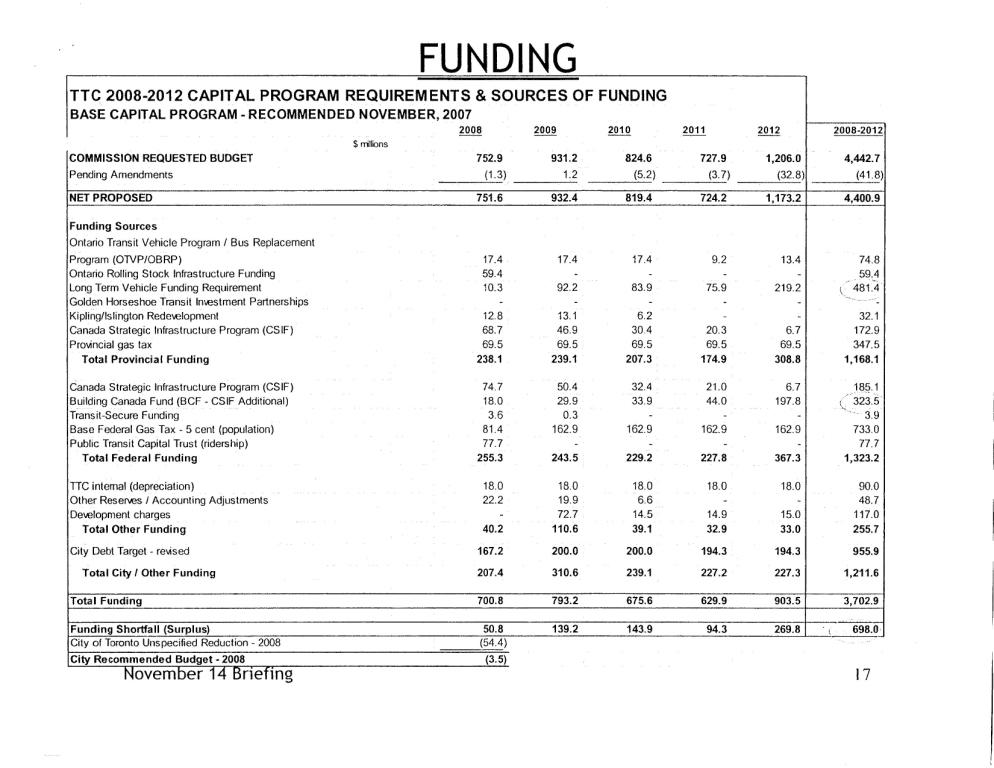
On November 14, the TTC considered its 2008 Capital Budget.  Although there are major issues with funding of many projects, especially on a long term basis, the budget has been passed on to Council. 

One important approval, made with the concurrence of the City Budget Committee, is that work can begin on the three top-priority Environmental Assessments for Transit City:  Eglinton-Crosstown, Sheppard East and Finch West-Etobicoke.  This work will stop Queen’s Park does not make funding available as part of their budget announcement for the fiscal year starting in April 2008.

The Capital Budget presentation at the meeting is not available on the TTC site, nor are several tables and charts from the main report.

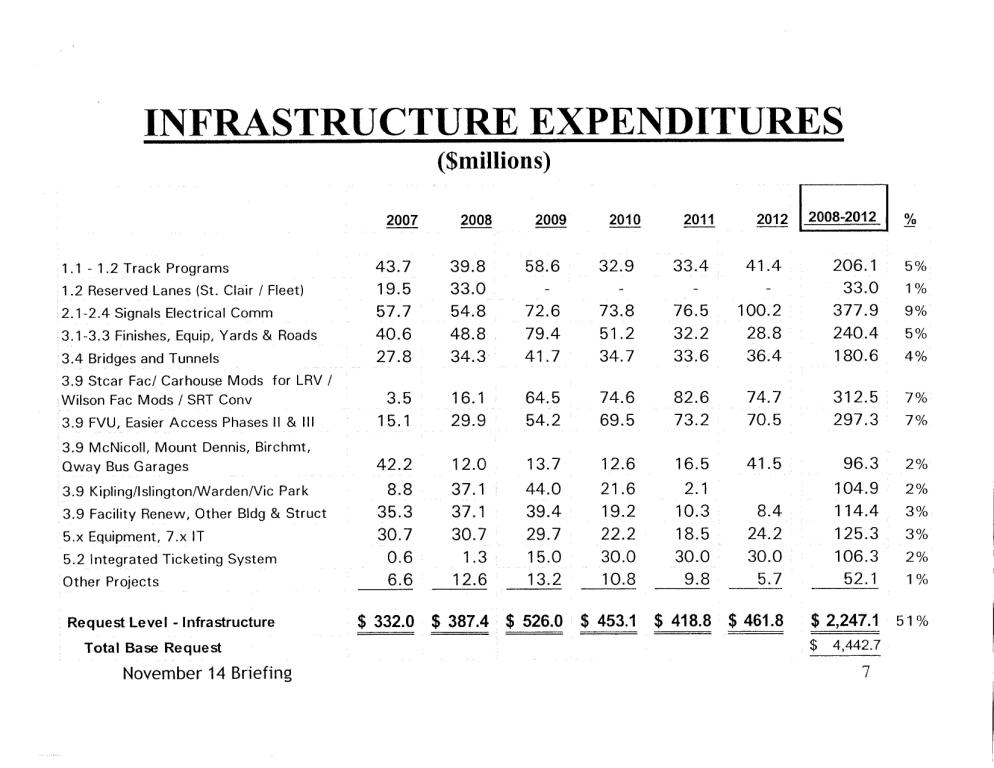
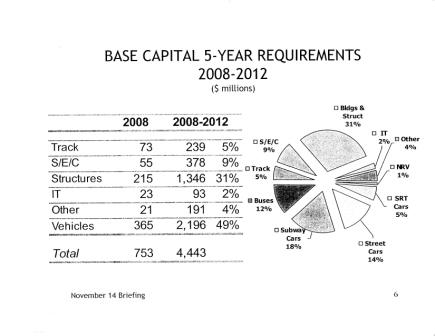
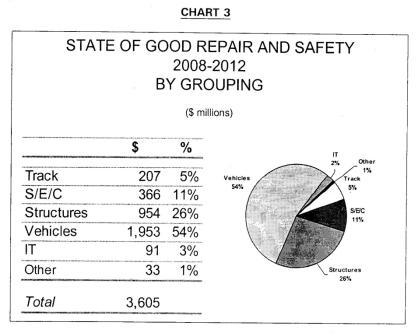
The 2008 Capital Budget Summary gives a broad overview of the five and ten year projections.  The 2008 Capital Infrastructure and 2008 Capital Vehicles tables give some break downs.

The same information is subdivided in a different ways:

Growth and system renewal drive many aspects of the budget.

  • Peak period riding increases the fleet and garage space requirements.
  • The shift to low-floor buses reduces vehicle capacity and increases the size of the fleet needed to handle demand.  This changeover will be completed by 2010.
  • Replacement and expansion of the streetcar fleet for the existing base system plus planned additions such as the Waterfront lines.
  • Replacement and expansion of the SRT fleet both for capacity and for the proposed extension to Sheppard & Markham Road.
  • Expansion of the subway fleet and partial replacement with new cars to increase capacity on the Yonge-University line.
  • Transit City will add seven new LRT routes to the network.
  • Subway expansion on both the Spadina/York and North Yonge lines.

The Base Budget of $4.4-billion for 2008-2012 (detailed in the links above) covers only State of Good Repair projects.  At present, there is a $0.7-billion funding shortfall for this work.  Later in this article, I will return to this issue. Continue reading