This year I will maintain a list of films I have seen with ratings and brief descriptions, and will add to this on a daily basis including pointers to items of special note. Full reviews will appear as I have time to write them out from my notes, mainly after the festival ends. The titles below are hotlinked to the TIFF website.
The Discovery of a Transit Agenda
The Toronto Board of Trade recently issued a press release calling for a permanent national transit funding strategy. Included in the release is a list of Ottawa’s spending promises in the GTA, although notable by its absence is comparable information for Provincial or Municipal shares in these projects.
As regular readers here will know, I have my doubts about the viability of a national funding scheme specifically because of this unpredictability and the inevitable three-way fights that arise over funding and eligibility. If Ottawa is to be part of transit funding, I agree that this needs to be on a permanent basis and with a formula that transit agencies can rely upon to plan their long-range budgets. Project-based funding is at the whim of day-to-day policy and politics.
Later this month, the Board of Trade has a session about Vancouver’s Transit Revolution and the wonders that innovative financing can bring. For a more jaundiced view of the Vancouver situation, visit Stephen Rees’ blog.
Meanwhile, the Canadian Urban Institute will present Designing Transit Cities on November 19-20, 2009. This will include a free public session in City Council Chamber on the evening of November 19, and a number of paid-entry sessions on November 20.
This program is co-sponsored by the City of Toronto, the Toronto Society of Architects, the Cities Centre at UofT, the TTC and Metrolinx.
Oddly, these “Canadian” organizations have assembled guest speakers all from the United States. What does this say about their perception of Canadian planning?
There is supposed to be a separate website at www.transitcities.org, but it leads right back to the main CUI page with no additional info.
With two major organizations publicising the importance of transit to urban areas, I can’t help wondering how their programs, not to mention those of would-be mayoral candidates, would differ from and improve on transit plans already in place.
Barcelona By Tram
A Q&A at TIFF tonight took me to Europa Film Treasures, an archival collection of film. By sheer luck, it has a 7-minute tour of Barcelona shot from a tram in 1908 when, judging by the pedestrians, cyclists and horse-drawn vehicles on the tracks, the tram was quite new. A real delight.
Eglinton LRT: Martin Grove to Pearson Airport
On September 2, the TTC held an open house to present designs for the section of the proposed Eglinton LRT west of Martin Grove. The display panels and an updated FAQ are available on the project’s website.
The display starts with introductory materials for the project and shows the current schedule for the overall study. By November 2009 when the next round of public meetings occurs, the design options should be settled in preparation for the formal Transit Project Assessment. However, the length and complexity of the line may interfere with this schedule depending on how the project team reacts to comments at the neighbourhood and political levels.
The TTC needs to “get it right” before the TPA starts because that process runs to a fixed timetable and does not offer much opportunity for significant change. Any “alternatives analysis” is presumed to be completed before the TPA itself.
Stratford August 2009 Reviews
Once again, I spent three days at the theatre in Stratford, travelling by train. VIA was on time both ways again, and the trains were busy. If only they had more equipment, they could carry more passengers.
Anyhow, this is supposed to be the “Reviews” section.
Reviewed here:
Phèdre (**)
Cyrano de Bergerac (***)
A Midsummer Night’s Dream (****)
The Importance of Being Earnest (***)
A Funny Thing Happened on the Way to the Forum (***)
I will be back in Stratford at the end of October for West Side Story, a show with rave reviews from anyone I know who has seen it. Continue reading
Service Changes for September 2009 (Updated)
Many service changes are coming this fall to the TTC network and they fall into a number of broad categories.
Seasonal Changes
The summer service changes are, for the most part, reversed in September as tourist/amusement traffic falls off and school traffic returns. Subway and RT services return to normal “winter” levels.
Construction Changes (streetcar lines only)
The Dundas Street watermain work between Bathurst and Dovercourt is supposed to complete by the end of August, and both the 505 Dundas and 506 Carlton routes will revert to their May 2009 routings and service levels.
Updated September 4: The 505 Dundas car will operate via Spadina and College west to Lansdowne and thence to Dundas West Station. A bus service will operate from Dundas West Station to Beverley Street (the west side of the Art Gallery of Ontario).
Work at Bingham Loop will continue, and the 502/503 services on Kingston Road will continue to operate with buses until the October schedule change.
Work at Queen & Church on watermains and track will continue, and the diversion of Queen and Downtowner routes around this area remains until the roads are open for traffic, possibly in late September.
Updated September 4: The Queen and Downtowner routes will revert to their standard routing.
Work on Roncesvalles will continue until late 2010.
Fleet Availability
In February 2009, there were many service cuts in response to the poor availability of hybrid buses. This situation continues to some extent, but some of the February cuts have been restored with a few service improvements added.
I have formatted the information in my usual manner for this site, boiling down a much longer TTC document to show service and riding levels, headways, and the rationale for changes (or lack of them). In this case, I have colour coded the chart to make it easier to see the types of change applicable to each route.
- Blue: A service restoration and/or improvement
- Orange Italics: A service cut that was made in February 2009 and remains in place. Note that the headway changes shown for these cases took place in February and are simply continuing into September. In some cases, the before and after ridership has been updated by the TTC with recent counts.
- Red Italics Underscored: A service cut that was made in February has been confirmed as permanent in response to lower ridership.
In theory, when bus availability improves later in 2009, the “orange” list here will see service restored at least to pre-February levels.
Service Changes for October 18, 2009 (Updated)
Updated August 31, 2009 at 4:10 pm:
In response to questions in the comment thread, I checked with the TTC about two items:
- The elimination of premium fares on some express routes has been moved back to June 2010.
- Construction of Park Lawn Streetcar Loop is on hold indefinitely due to funding constraints.
Original post:
The following service changes will be implemented, except as noted, for the schedule period beginning Sunday, October 18, 2009.
Of note here are new express bus services, the split of the 501 Queen car into two separate routes (covered in detail in a separate post), and the restoration of service cuts implemented in February 2009. Continue reading
Weston Community Coalition Slams Metrolinx Corridor Study
The Weston Community Coalition today released an extensive critique of the recently completed Metrolinx study of the Georgetown South corridor. This document, a letter to the Minister of the Environment, urges the Minister to reject the Metrolinx study, demand a full review and require that the project be designed and operated as an electrified service from the outset.
I will not repeat the WCC’s arguments in detail here, but they include documentation of a long history of misleading and contradictory statements by project proponents, serious concerns about emissions, noise and vibration studies, and an overall sense that the process of public consultation has been window dressing around an already-decided outcome.
In the interests of full disclosure, please note that I have worked with the WCC in preparation of this and other materials, and helped to review and edit this critique. While there are individual comments with which I may disagree, the overall document is quite good.
This is not, as so often has been claimed, a case of NIMBYs standing in the way of progress, but of government agencies bent on ignoring the effects of their work and thwarting the spirit of “environmental” assessments.
The decision now rests with Queen’s Park. Will they bravely move into a future of electrified commuter rail on GO Transit, or will they obfuscate issues and avoid real debate? What record does this government want to have in the history books?
Sometimes Repairs Take Longer Than Expected
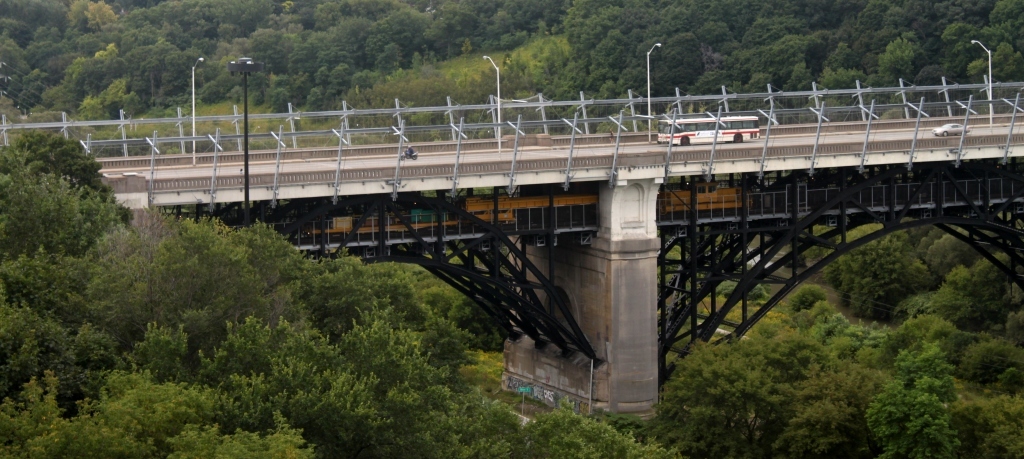
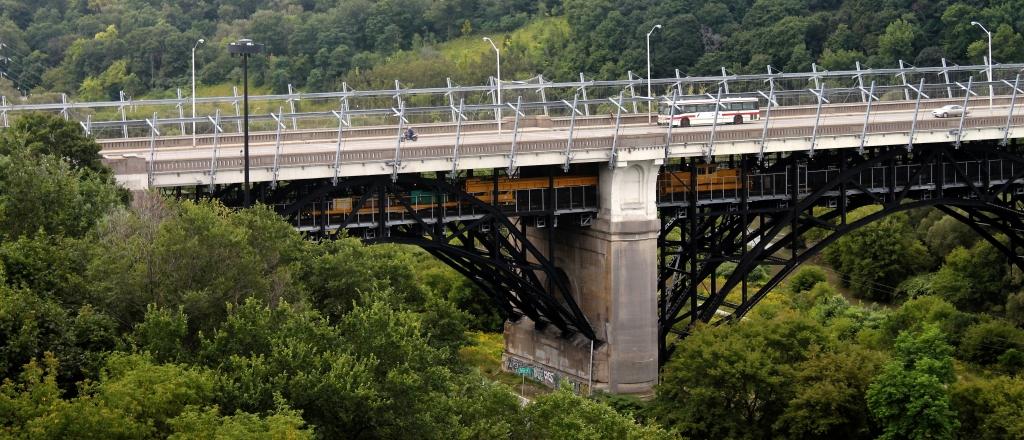
This morning, I was happily working away when what should I hear, but the familiar blast of the horn on the work train that maintains the Prince Edward Viaduct. One small problem. It’s 9:50 am and the subway should be running by now.
Was there a service interruption notice? No.
Memo to Brad Ross at the TTC: We keep hearing about the new staff and all the wonderful things that will happen with notices regarding service. When?
Queen Car Route Split Effective October 19, 2009
Starting on October 19, 2009, the TTC will experiment with splitting the 501 Queen route into two segments on weekdays only. The intention is to decouple the outer ends of the line from events that occur on the opposite side of the city, and to provide sufficient flexibility that short turns should not interfere with riders’ ability to use the service.
This will be a trial operation lasting only for the October schedule period (roughly six weeks). Seven cars will be added to the route during peak periods, with between five and eight additional at other times. Weekend service is not affected, nor is the operation of the 502/503 routes on Kingston Road.
Two separate services will operate:
- Neville Loop to Dufferin, looping in the west via Shaw, King and Dufferin.
- Long Branch Loop and Humber Loop to Broadview, looping in the east via Parliament, Dundas and Broadview.
The eastern route will operate from Russell Division, and the western one from Roncesvalles. This will eliminate crewing complexities with cars and operators switching between divisions.
Overnight service on the 301 Queen car will be split in the same manner, but cars will be scheduled to connect. This arrangement will result in scheduled pairs of cars on the common section, a rather odd configuration.
The Neville-Dufferin branch will operate with the following headways:
- AM Peak: 7’15”
- Midday: 7’30”
- PM Peak: 7’15”
- Early Evening: 8’00”
- Late Evening: 9’30”
The Humber-Broadview branch will operate with the following headways (service to Long Branch in parentheses):
- AM Peak: 5’30” (11′)
- Midday: 6’15” (12’30”)
- PM Peak: 6’30” (13′)
- Early Evening: 7’30” (15′)
- Late Evening: 9’30” (19′)
By comparison, scheduled service for September 2009 is:
- AM Peak: 5’10” (10’20”)
- Midday: 5’53” (11’45”)
- PM Peak: 5’40” (11’20”)
- Early Evening: 6’45” (13’30”)
- Late Evening: 10′ (20′)
If the new service is closer to schedule than the old one, then service should be improved even though scheduled headways on the outer ends of the route are slightly wider.
Headways on the two halves of the route are, except for the overnight operation, different and there is no attempt to produce a blended operation in the central part of the route. It will be interesting to see how many cars run in pairs by coming out of Dufferin or Broadview immediately behind a through car. This is a challenge for TTC line management, and could defeat the benefit of the overlapped service between Broadview and Dufferin.
The considerable overlap of the two routes provides continuity even if either of them needs to be short turned. Westbound cars from Neville could short turn at Bathurst or at McCaul while still serving downtown and connecting with the through service to the west end. Eastbound cars from Humber could short turn at Church. A shorter overlap would have almost guaranteed that many cars would never serve the major downtown stops or connect with their counterparts for through service.
Although all cars will pass through the congested section between University and Bathurst, short turns will be possible without eliminating connections, and the need for short turns at the outer ends of the line should be reduced. This will bear watching.
 Steve Munro