S(L)RT Open Houses Announced

Two open houses for the conversion of the SRT to LRT and its extension to Malvern have been announced:

March 8, 2010  6:30pm – 9:00pm

Jean Vanier Catholic Secondary School, 959 Midland Avenue (north of Eglinton)

March 11, 2010  6:30pm – 9:00pm

Chinese Cultural Centre, 5183 Sheppard Avenue East (at Progress Ave)

These meetings will discuss the conversion and extension plans, as well as the Kennedy Station changes needed to accommodate all of the new LRT lines.

GO Transit To Raise and Standardize Fares (Updated)

Updated February 22 at 4:00 pm

As expected, the Metrolinx Board approved the proposed increase in GO Transit fares at its recent meeting.  The contrast with the debates about TTC budgets and fares was quite striking.  The greatest potential for discord came with the presentation of an anti-increase petition.

The bottom line for this increase is “to ensure fiscal responsibility and meet the needs of a growing market of commuters” (presentation to the Board, page 2).  That’s shorthand for keeping the subsidy requirement under control, paying for the operations we have now and giving us some headroom to do more.

GO customers are, after all, from a very different market than the TTC.  Their median family income is $100k, they live well outside the core, and auto travel is already an established part of their lifestyle.  85% are fully employed, 9% are students and 1% are seniors.  They are travelling on GO overwhelmingly by choice and good service, in all aspects, matters.

40% of GO riders use monthly passes and another 40% use 10-trip tickets.  This is not unlike the TTC where the monthly pass accounts for over half of the adult trips, and a large majority of those remaining use token fares.

The purpose of the fare increase was to raise revenue by $14.6m in fiscal 2010.  Provincial subsidy will also jump for 2010 from $52.6m to $72.1m, but over half of this changes adjusts for one-time revenue in 2009/10 that allowed for a lower subsidy in that year.  GO’s total operating budget is $386.7m, and they expect to carry 56m rides.

By comparison, the TTC’s fare increase is project to raise somewhere between $36m and $50m depending on which figures you believe.  In 2010, the City will carry the entire $430m TTC subsidy while Queen’s Park spends its way through this budget cycle propping up Ontario’s economy.  The TTC’s proposed total operating budget is $1.37b, and they expect to carry 462m rides.

GO’s workforce, including contract staff, is 1,938.  The TTC’s proposed “conventional system” workforce for 2010 (as discussed in another thread), excluding contractors, is 10,491.  This number omits Wheel Trans, Capital Projects and Toronto Coach Terminal.

The TTC’s budget is only 3.5 times GO’s, but there are far more staff (5.4:1) and riders (8.2:1).  The subsidy per rider on GO is $1.29.  On the TTC it is about $0.93.

Earlier, I mentioned the potential for discord at the Metrolinx meeting.  The protocols for these meetings accept the public’s presence only grudgingly, unlike meetings for municipal agencies such as the TTC where in camera discussions are allowed on only a handful of grounds.  There are no deputations at Metrolinx, unlike the City of Toronto where a long history of public involvement would be impossible to silence.

The Directors, with few exceptions, ask no questions in the public session, and everything has clearly been worked out beforehand.  They’re just one big happy family.

Alas, thanks to an email slip-up, Metrolinx’ attitude slipped into view.  An internal email from Rob Prichard, Metrolinx CEO, was cc:ed to the petion’s originator in error.  From this, the clear intent was to give the petition as little exposure at the meeting as possible and assume that the Board would ignore it.  They did.

The original article from February 12 follows the break.

Continue reading

How Many People Work For The TTC? (Update 2)

Updated February 21 at 8:20 pm:

I have now assembled data on the TTC workforce going back from 2007 to 1990 and have, I believe, created as good a presentation of this as we are likely to see.  Some readers may not agree.  That’s their option.

There are two problems in going back over a long series of data like this:

  1. There were fundamental changes in the way the TTC reported its staffing over the period 1990-1996.  Some of this arose from structural reorganization, some from changes in accounting practices.  The numbers must be adjusted to place them on an equal footing.
  2. Many people worked on capital projects on a contract basis either directly for the TTC or for companies engaged by them.  This is particularly the case for major design projects such as subways and new buildings.  These people do not show up in TTC headcounts.

I have produced two charts which show the relationship of staff, budget allocation area and riding over the period 1990-2007.  (2008 and 2009 will be added when I dig out details for those years.)

TTC Workforce and Riding 1990-2007

The first chart shows the major groups of employees:

  • Operations:  These departments are responsible for running service and maintaining vehicles and infrastructure.  For 1990-91, the engineering staff are included in this number.
  • Wheel Trans (W/T):  There is an anomalous drop in 1995 which I suspect is an error, but the value used comes from the budget for that year.  The staff reappear in 1996.
  • Administration:  These departments are a separate branch only until 1993.  Thereafter, they are rolled into the respective branches which they support.  The jump in “operations” in 1994 reflects the assignment of most of “administration” to that group.
  • Capital:  Starting in 1992, the engineering staff were reported separately from plant maintenance, and I have assigned them to “capital”.  A few years later, the capital staff for all departments were identified explicitly in the budgets.
  •  Toronto Coach Terminal Inc. (TCTI):  This is the Bay Street bus terminal whose staff were formerly reported separately.  TCTI is all that remains of the old Gray Coach Lines Ltd.

The second chart shows the annual ridership and the ratio of riders to “operations” staff.  A few important points:

  • For the years when “administration” was a separate branch (until 1993), the headcount is included pro-rata in “operations” for the purpose of calculating the ratio.  (The “pro-rata” allocation is based on the apparent redistribution of the admin staff in 1994, a year when nothing else changed much.)
  • Ridership follows a long decline to its nadir in 1996 by which time the TTC had managed to lose 100m riders relative to its high point in 1988.  Reports from the early 90s when management talks about stopping the downward spiral make sobering reading when we consider what actually happened.
  • The ratio of rides to operations staff followed the same trend from 1990-92.  This indicates that riding was falling, but staffing was not on a proportionate basis.  Thereafter, due to staff cuts, the ratio rose until 2,000.  From 2003 onward, both ridership and rides/staff have grown indicating that staff is not increasing as fast as ridership.
  • The ratio of rides to operations staff in 2007 is slightly higher than in 1990.

During this period, new groups were formed to deal with a number of safety issues and transit policing.  Moreover, there was a recognition after the 1995 subway crash at Russell Hill that “state of good repair” needed serious attention.  This corresponds to the point where the capital workforce begins to grow.  More recently, other projects such as the subway extensions, Transit City and station renewal have come into play.

Another issue is the distribution of increases between management and front line staff.  A 2007 TTC report on workforce history gives this breakdown for 1997-2007.  It also includes a description of the additions to salaried positions (broadly speaking management and administration) over the decade.  (The report in question is part of the TTC meeting agenda for September 12, 2007.  However, these appendices are not included with the online version.)

1997-2007 Workforce

1997-2007 Salaried Staff Increases

In the Operations group, the number of salaried staff rose from 1,553 to 1,805, or 16%.  During the same period, the number of hourly-paid staff (union positions, almost all operators and maintenance workers) rose from 6,963 to 8,030, or 15%. 

The proportionate increases in the Capital group were larger (55% in management/admin, 249% in hourly).  Some may argue that “operations” staff and costs are being hidden in the Capital budget.  Some shift may be happening, but I don’t believe that is the entire explanation.  Without a detailed review of TTC staff allocations over many years and the assignment of projects as “operations” or “capital”, this is a very difficult question to answer.  Certainly, it is worthwhile understanding how these numbers evolve for future years’ budgets.

The original material in this post follows the break.  It should be read with care in light of the more detailed figures I have presented above. Continue reading

Eglinton LRT: Trouble Brewing in Mt. Dennis (Update 2)

Updated February 17 at 11:00 pm:  At today’s TTC meeting, despite a very long series of deputations from residents of the Mt. Dennis area and a number of local political representatives, the Commission decided to proceed with the staff’s recommended alignment for the Eglinton LRT.

Although I have supported this project and Transit City, today’s meeting ranks among the worst travesties of “public participation” I have ever seen.  This fell on the same day as the launch of the TTC’s vaunted “Customer Service” project showing just how threadbare that scheme already is.

Deputations at the TTC are to begin at 2 pm, but there were many presentations early in the meeting, and the Eglinton item didn’t really get underway until nearly 3.  Staff began with a presentation that completely ignored the specifics of the objections raised by the community, and presented the situation as a choice between two options:

  1. An all-surface option with a station at the intersection of Black Creek Drive, and an island-platform station west of the Weston/Eglinton intersection.
  2. An all-underground option with a station under Eglinton west of Black Creek, and a station under Eglinton west of Weston Road.

One critical point about both designs is that they require a wide tunnel structure around Weston Station and the demolition of a row of houses at Pearen Road.  The TTC did not address the question of moving the station east of Weston Road to reduce or possibly eliminate conflict with the houses and to improve a future connection to GO Transit at the rail corridor.

After the deputations, during which Chair Giambrone had to be reminded by one speaker to pay attention to the public and stop playing with his Blackberry, came a brief discussion between Commissioners and staff.  A few amendments were proposed to the recommendations including a scheme to seek supplementary funding (this might be called the “faint hope clause” for transit projects), but these failed.

In his concluding remarks Giambrone told the assembled crowd, many of whom had been in the meeting room for well over four hours, that in fact the TTC could not change the selected alignment because it had already been approved by Council and was sitting at Queen’s Park for review.  In effect, Giambrone said that all of the public consultation since early December, 2009, when Council approved the Transit Project Assessment, was for naught because the decision had already been taken.

In fact, the TPA process includes an option for amendment, and the TTC plans to use this once they finalize the alignment at Pearson Airport.  Why isn’t this option available for a change elsewhere in the design?  Why was the TTC still holding public meetings on details of project design when there was no intention of entertaining changes?

Some speakers addressed the use of the Kodak lands for the proposed carhouse, and asked that alternative schemes be considered.  Part of this relates to a proposed “big box” development on the land.  However, Council approved the acquisition of this property, by expropriation if necessary, in December.

I could understand the TTC simply saying “look, Council has decided, there’s only enough money for the recommended option, sorry, but that’s how it’s going to be”.  At least that would be honest.  It would not string the community and their Councillors along with the idea that the design might be altered.

This is a classic abuse of process by a public organization, and shows all too clearly the problems introduced by the new “speedy” TPA.  Although there is an appeal mechanism, the grounds for an appeal are very limited.  This is not Transit City’s finest hour, and it damages the credibility of the TPA process generally.

Councillors would be well-advised to be less quick in granting approval to TPA reports lest they give away their last chance to modify a project proposal.

The earlier information in this article follows the break.

Continue reading

City Finds Rabbit in Hat: Balances Budget and Funds TTC (Updated)

Updated February 17:

The City’s Budget Analyst report on the TTC is now available online.  I will comment on it in more detail when I have time, but a few points warrant immediate attention.

The big issue in TTC budgeting is always the ridership projection and the anticipated revenue from fares.  This number has been jumping around a bit.

In the February 15 Budget Presentation, the City shows increased fare revenue from the TTC as providing $50m reduction in the original estimate of the City’s shortfall (see page 15).  However, in the Analyst’s notes, a value of $48.4m is cited on page 29 as a gross number.  From this, the Analyst deducts a charge of $12.125m to account for fare revenue “lost” to Metropass users giving a net figure of $36.805m.

The reason for this is that the Analyst uses budget numbers, not real numbers.  Therefore, to get from 2009 to 2010, one must first remove the $12.125m from 2009 to get an adjusted base, and then add in whatever benefit a fare change will bring.

On page 3 of the Analyst’s report, we learn that the TTC’s preliminary year-end report showed that the 2009 revenue shortfall was almost exactly matched by underexpenditures due to lower energy costs and an accounting change in treatment of future accident claims.

Today, TTC Chair Adam Giambrone updated his Facebook page with this information:

It has just come up that ridership is up 1% over last year despite the fare increase in January. And we reviewed the point that TTC actually recorded a SURPLUS of $300,000…amazing especially that at one point we were $23 million behind. It took a lot of work, but we did it. [Posted at about noon on February 17]

The TTC has not yet published stats for December 2009, but based on strong results in January, one might expect that December was a good month also, relative to budget expectations. 

The 1% increase in ridership (which applies to the first three weeks of January) is quite different from the expected riding drop after the fare increase.  Whether this will be sustained through the year remains to be seen, but it is a pleasant sign.  Having said that, a sustained increase would give full year results of about 476m riders, not the budgeted 462m.  Whether the service budget based on the lower ridership can handle more riders will depend on where the increases come and whether they can be absorbed into the service actually operated.

On the budget side, 14m more rides than budget translates to a tidy pot of unexpected revenue.  We do not yet know how many of these new rides are full adult fares, increased use of passes or greater riding at concession rates (students, seniors, children).  By the end of April, when the City budget comes to Council, the TTC should be required to provide an updated projection of its ridership, revenue and funding needs so that the subsidy level can be adjusted accordingly.

When TTC staff proposed the fare increase last November, they projected that there would be a $106m shortfall in 2010 before any budget adjustements in the new year.  Various scenarios were presented, and the one recommended included a 25-cent adult fare increase (pro-rated to concession fares) and a two-trip increase in the Metropass multiple.  This scheme was projected to bring in $50m net of the effect of lost riding.  (see page 8.)

However, the Commission actually improved a 25-cent adult increase, but no change in the Metropass multiple.  This is clearly shown in the staff report as generating only $38.9m in revenue net of losses in ridership, and this does not include the cost of an adult student pass rate starting in September 2010. 

Neither of figures includes the net effect of the $12m in “lost” Metropass revenue.  The Budget Analyst has flagged this in the “Issues for Discussion”, but the City’s budget does not reflect the lower net figure for new revenue compared to the 2009 budget.

Much of the confusion arises from the comparison of budget-to-budget figures, rather than using probable actuals as a base reference, and of citing gross effects of proposed changes such as new fares rather than net effects.

In summary, the TTC (and the City) appear to be overstating the net revenue benefit of the fare increase at the budgetary level, but may be rescued from their errors by stronger than projected ridership.

The original February 16 article follows the break.

Continue reading

LRT For Hamilton, Maybe

The Metrolinx Board Meeting agenda for February 19 includes the Draft Benefits Case Analysis for Hamilton’s King-Main LRT corridor.

The route would link McMaster University with Eastgate Square, and the alignment would be the same for either an LRT or a BRT implementation.

East Section – turning from a segregated terminus adjacent to Eastgate Square the alignment travels westward in a median transitway via Queenston Road to the Main Street / Ottawa Street Intersection.

Downtown Section – the alignment continues westward from the Main Street/Ottawa Street Intersection along a median of King Street East across John Street and James Street through downtown. The alignment continues along King Street West across Highway 403 to Longwood Road South where it provides convenient access to Westdale Village and the McMaster Community. At Longwood Road South the alignment runs southbound to Main Street.

West Section – From Longwood Road South the alignment transitions into the centre of Main Street and continues westward towards the McMaster University Medical Centre before turning north towards the terminus station on the McMaster University campus. (Page 24)

The BCA examines three options: 

  1. all BRT,
  2. all LRT, or
  3. a staged implementation of LRT on the heavier western part of the route connecting at King and Ottawa to BRT for the remainder.  The LRT would be extended to Eastgate Square at a future date.

Common to all designs would be the reintroduction of two-way traffic on what is now the one-way pair of King and Main Streets in downtown Hamilton.

The BCA considers but rejects the option of diverting the route south to link with Hunter Street Station, now the site of GO Transit’s Hamilton rail service.  A GO connection will be important, but to which station?  The recently announced extension of service to Niagara Falls will return train service to the old James Street Station on the north side of downtown.  Indeed, more trains may run through James Street than to Hunter Street.  The rapid transit line cannot connect with both of them.

GO Transit unveiled a plan last night in which it aims to extend all-day train service — that now goes to Aldershot — to a proposed station on the CN line at James Street North. That would involve 10 trains each way between the proposed new Hamilton station and Union Station in Toronto. Niagara would see four trains each way between Union Station and Niagara Falls. Hamilton would keep its eight trains — four each way — that now run between Union Station and the former Toronto, Hamilton & Buffalo Railway station on Hunter Street.

Source: Canadian Pacific Daily News Scan from the Hamilton Spectator and the Niagara Falls Review, January 27, 2010

After a great deal of number crunching (which I will leave to my readers’ copious spare time), the report concludes:

Overall, the results indicate that an investment in LRT in Hamilton will generate significant benefits and support the City’s broader objectives to revitalize, redevelop and reshape its most significant east-west corridor. While the lowest cost option, Option 1, produces the highest benefit-cost ratio of 1.4, both LRT options generated benefit-cost ratios that are greater than 1.0. The highest cost option, Option 2, also produced the greatest benefits in all accounts, all of which make an important contribution towards achieving the objectives and goals of both the City and the Province.  (Page 51)

This is a straightforward, unambiguous conclusion.  However, there is a covering report on the Metrolinx agenda, and it is not quite so clear in supporting LRT.

Although full LRT is the highest-cost option, it also generates the highest transportation user benefits in terms of travel time savings, ridership attraction and overall “qualitative” travel experience. LRT also carries a stronger potential to reduce greenhouse gas emissions and generate more significant economic development impacts such as employment, income and Gross Domestic Product (GDP) growth for the city and region. The BCA also identifies LRT as having greater potential to shape land uses and uplift land values along the King-Main corridor.

BRT is considerably less expensive to build and thus generates a strong benefits-cost ratio. At the same time, however, BRT delivers less total benefits and its secondary benefits are less extensive.

On the other hand, the significantly higher investment required for the full LRT option will require careful attention to the partial LRT option to increase affordability – and even to the BRT option if sufficient funding is unavailable for either LRT option. (Page 2, italics added)

This is an astounding statement.  “Sufficient funding unavailable”?  Whatever happened to the brave new world of The Big Move where transit investments would flow like water from Queen’s Park?  Are we suddenly feeling poor, and cutting back on transit options?  This rapid transit line is the second in the “top 15” priority list.

If the BCA had shown LRT to be a poor choice, one might understand taking the least cost option, but that is not the case here.

Metrolinx has some explaining to do, especially in regard to the many other top priority projects in its hopper.  Maybe transit isn’t quite as important as Dalton McGuinty claimed it was back on that sunny day in June 2007 when he announced MoveOntario 2020.

Service Changes For February 2010 (Updated)

The following service changes will occur effective Sunday, February 14, 2010.

Updated to include a table comparing service levels on 512 St. Clair.

305 Eglinton East Night Bus & 354 Lawrence East Night Bus

These routes now operate separately from each other, with three vehicles on each route, and have difficulty maintaining schedules.  To give both routes more running time, one bus will be added, and the routes will be interlined to give each route an additional 15 minutes for a round trip.

Buses will alternate trips on each route.

44 Kipling South

Saturday afternoon running times will be increased, and service will be improved, to counteract reliability problems.  The existing 15 minute headway with 2 buses will change to a 12 minute headway with 3 buses.

116 Morningside & 86 Scarborough Service Blending

Midday headways on the 116 will be widened from 8’30” to 9’00” to provide extra running time.  No buses will be added to the route.  Midday headways on the 86 will be widened from 8’00” to 9’00”.  One less bus will be needed on the 86.

In both cases, the average load will rise from 36 to 38, within the offpeak service standards.

Early evening headways on the 116 will be changed from 7’45” to 7’30” to match the existing 86 headway.

512 St. Clair

Running times will be increased during many periods to reflect actual requirements for this route.  No cars will be added, but scheduled headways will be widened.  The affected periods are:

  • Weekdays afternoon, pm peak, early evening
  • Weekends morning and afternoon

The table linked below compares the April 2007 schedule (just before the west end of the line closed for construction), the original January 2010 schedule, and the revised February version. 

2010 vs 2007 Service Comparison

Zoo Services

The 85 Sheppard East and 86 Scarborough schedules will be adjusted so that the last trip from the Zoo matches its later closing time (7 pm) beginning in mid March.

Driving Time vs Recovery Time

One of the oddities of TTC schedules is that many routes have “recovery time” that is, in fact, little more than a rounding factor so that the headway will work out to an exact integer.  For example, on the 44 Kipling South change above, the new schedule has a 12 minute headway, but this is achieved with 34 minutes of driving time and 2 minutes of recovery per round trip.

A few routes have schedule adjustments that consist of nothing more than reallocating time from recovery to driving.  This means that the actual time provided for a vehicle to make a round trip is unchanged, but the “recovery” which might be used for a break at a terminal is squeezed.

This affects:

  • 34 Eglinton East (peak)
  • 16 McCowan (weekday early evening)
  • 116 Morningside (peak)
  • 224 Victoria Park North

Adam Giambrone Withdraws From Mayoral Race

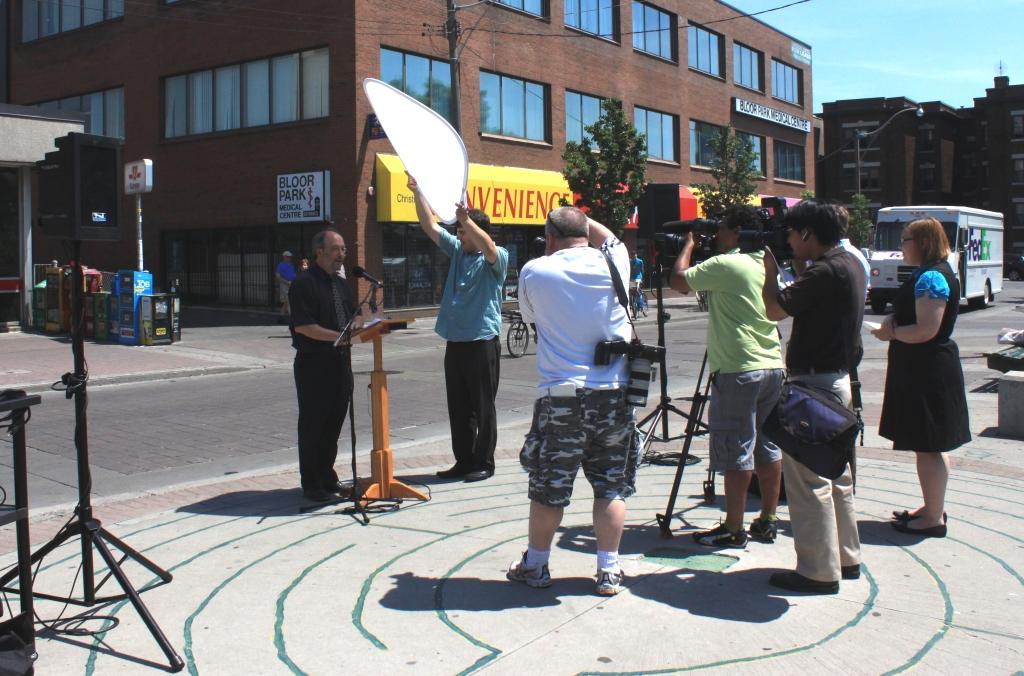
At 11:00 am today, Adam Giambrone held a press conference at which he profusely apologised to his supporters, to his personal partner, and to his fellow Councillors for the recent revelations about his personal life and his mishandling of the response.  Then he left the podium.

A few minutes later, his Executive Assistant, Kevin Beaulieu, return to read the full statement in which Giambrone announced that he was withdrawing from the mayoralty race, but would remain as Councillor for Ward 18 and Chair of the TTC.  He wants to address the renaissance of the TTC and the building of Transit City.

Whether he actually gets to do this remains to be seen.  The Commission will meet next week, and it is possible that a vote of non-confidence will end Giambrone’s role as Chair.  His opponents may use this opportunity to tar much of what he and others in Mayor Miller’s camp have achieved with transit, and that would be a terrible mistake.  Those changes, those policies exist not just because of Giambrone, but because many Councillors, the Mayor, Queen’s Park and countless members of the public recognize that transit in Toronto must improve.  The Chair may pass to another Councillor, but the organization and the goals remain.

The TTC is in desperate need of clear, unambiguous leadership from someone who inspires confidence and trust, from someone whose word can be believed, whose announcements are not second-guessed as photo ops for a political campaign.

I have been a long-time supporter and advisor to Adam Giambrone, but my view is that he must step down.

Walking the Talk (2)

Today (February 9), Bob Kinnear, the President of Amalgamated Transit Union Local 113, held a press conference to present the union’s response to recent events and statements on the TTC, in the media and from TTC management.

Note that the text linked here was scanned from the version distributed to the media before the briefing, and it may not exactly match Kinnear’s presentation.  However, the text doesn’t appear to be in a convenient online location and so I am posting it here.

The text reads fairly well and while it takes a firm stance, it does acknowledge that things need to change.  To that end, the ATU plans to organize a series of Town Halls where the public and union members can discuss issues related to the TTC and how they might be addressed.  Whether such events will be at all cordial I don’t know given the comments on various blogs and media sites, but at least the union is trying to go to the public with its story.

I wasn’t at the press conference, but received news of it later and saw a few clips on the evening news.  Unfortunately, what I saw showed Kinnear in the more familiar, combative mode that is the union’s public face.  Some of this was selective editing.  For example, there was a line “Who made you God?” which was directed at the TTC’s Brad Ross for implying that it is possible to take a washroom break in only 3 minutes, including the time it takes to get between the vehicle and the washroom.  This was forcefully (more than necessary) delivered, and used as a free-standing clip by Global TV.

Later, I was interviewed by Global, but they used only a snippet out of a longer conversation.  In that clip, I said, in effect, that the problem of rude staff isn’t a one-or-two-of thing because there are simply too many separate reports coming from reasonably credible sources.  I didn’t mention that I (and I’m sure anyone else who is even vaguely connected with the TTC) am getting notes and reports from friends about their experiences.

The larger context of the interview was first my pleasure that the union took the high road even though, as I understood things, Kinnear’s delivery of the message used a hard line that might have been counterproductive.  I talked about “TTC culture” and a management where, for anything that happens, the first reaction is to find something external to blame rather than looking inside for improvement.

I also talked about the need for some labour discussions to take place in public, and unusual move I know.  One of the big issues through the past weeks is the question of breaks — how long, how often, where.  Some operating shifts have breaks built in, but not all of them, and even the scheduled breaks can be thrown awry if service is always badly off kilter.  Fixing this will take much negotiation and probably changes in the way operators’ work is defined and scheduled.

Recent events are so public that at least the broad outline of the issues, positions and possible fixes must be visible so that even if everyone can’t agree (and I use a very broad definition of “everyone”), at least they will understand the options on the table.

(I am not going to get into a debate about the level of operators’ wages here as we have pounded that topic to death before.)

The joys of media coverage, whether you’re a union president, a politician or just a transit advocate, involve the chances one takes in the editing.  I said what I said, and I stand by that, but wanted those who might only see the five second clip to know the larger story.

Please note that comments on this item will be strongly monitored for intemperate language.  This is a complex issue and it deserves an informed, detailed discussion, not rants from either side of the political spectrum.

The Mythology of Benefits Case Analyses

Among my many “things to do” on this site is an evisceration of the concept of the “Benefits Case Analysis” as practised by Metrolinx.  These analyses purport to judge the value of project options by reducing many aspects of the process to a monetary value.

This scheme is born of an era when nobody cared about the soft, social benefits and costs of doing or not doing something, when “businesslike” behaviour was the goal for all right-minded public enterprise.  Sadly, we never had a discussion about what “businesslike” actually means.  Recent private sector examples appear to involve raiding not only your own cookie jar, but getting the government (ie: you and me and our descendents beyond count) to keep refilling that cookie jar to save the starving plutocrats.  I will generously assume that this is not the sort of behaviour Metrolinx has in mind.

[The above paragraph is for the benefit of readers who decry my left-leaning stance on many issues.  Now and then I have to throw them a bone, a quote they can use to prove their point.]

In a future post, I plan to review one or two of the Metrolinx BCAs.  Their most glaring failure lies in the scope of the analysis.  The Big Move is a network, but each BCA considers only an individual component of that network, not its role in the overall picture.  Moreover, construction spending is actually treated as a benefit because of the employment and other economic effects it would generate.  This completely misses the larger picture of public sector spending (might a hospital be more valuable than a new transit line), not to mention the future implications of the public debt (however it might be hidden in public or private sector accounts) for the viability of transit systems and governments.

Jarrett Walker’s Human Transit blog has an interesting article on the evolution of Benefit Case Analysis and the flawed philosophy underpinning the methodology.