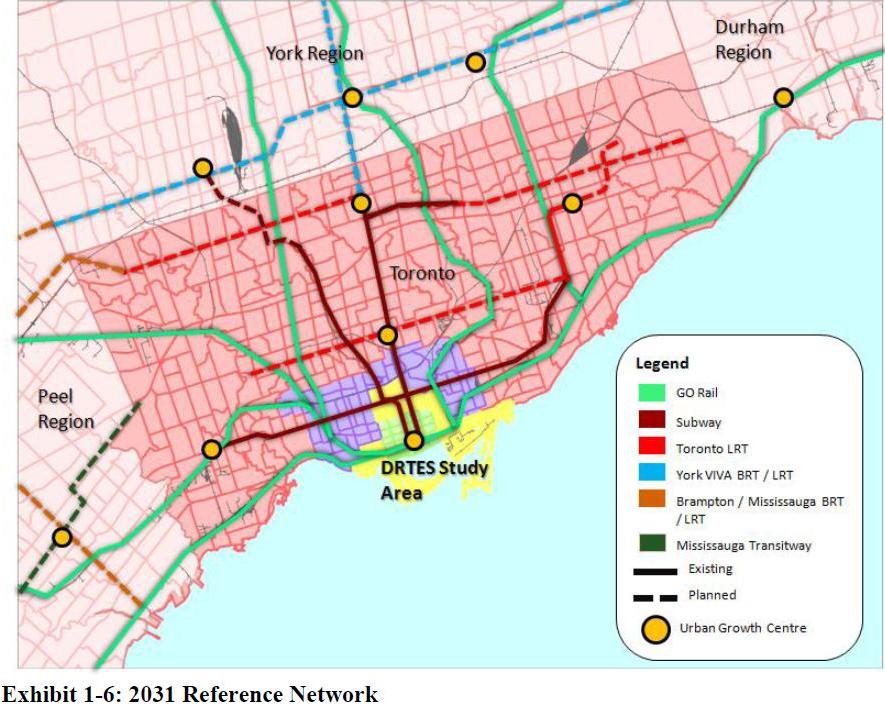
Today’s meeting of the transit commission was expected to be a modest affair with approval of the Downtown Relief Line study’s recommendations, and a few other housekeeping items. What happened was a complete upending of the transit expansion policies we thought were put in place by the Karen Stintz coup d’état that bounced Rob Ford’s crew off of the TTC board back in the spring. Stintz herself didn’t even have the nerve to stand up to the runaway proposals from her fellow members preferring to keep peace, for now at least.
To make sense of this debacle, I have to recount some of the earlier events.
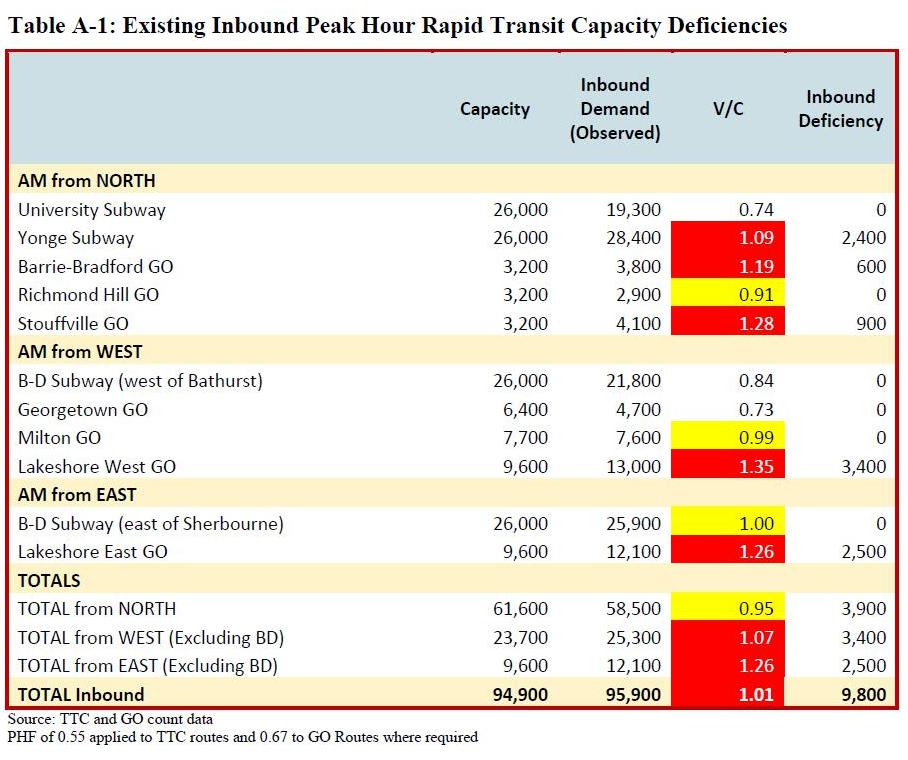
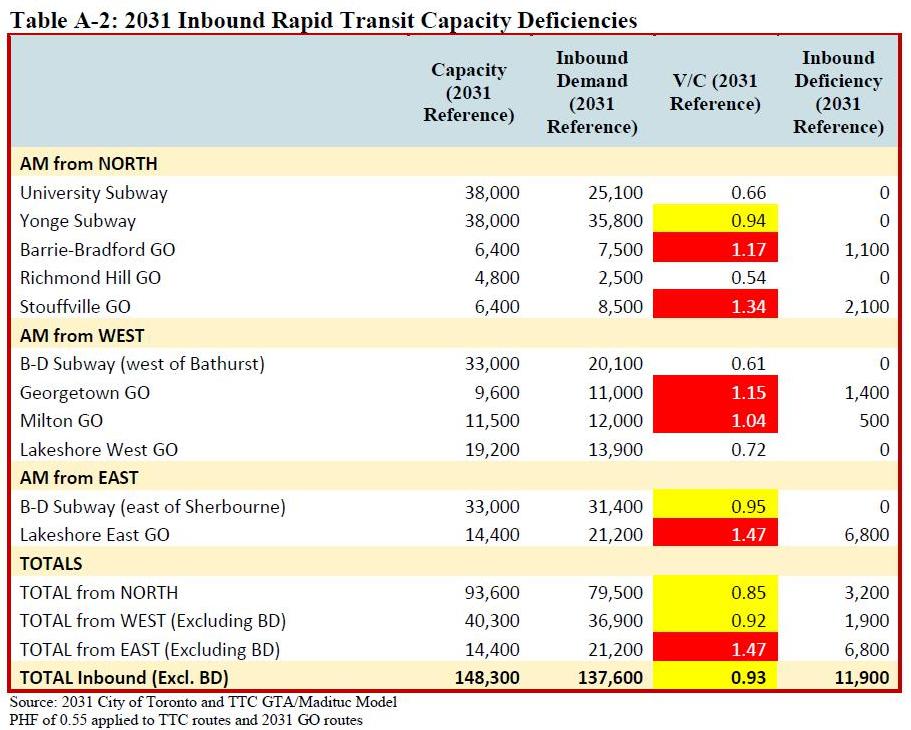
The main act was a presentation by TTC staff of the DRL Study, and it contained few surprises relative to coverage we have already seen in the press and on this blog. One comment caused attentive ears to prick up, namely that spending $1-billion expanding Bloor-Yonge station might be less cost-effective than providing additional capacity with a new line. Would that the TTC would look at all components of its subway plans that way (a topic for another article), but it’s a refreshing point of view.
The study and presentation make explicit reference to potential shortfalls in GO Transit capacity as part of the problem. Although these will no doubt annoy Metrolinx (is there a TTC meeting that doesn’t anger Metrolinx?), that agency’s basic problem is that long-term secrecy about what it might actually build forces assumptions to be made. That said, nothing prevented the TTC from modelling improved service on the GO northern corridors just to see what this would do to demand flows on a “what if” basis. After all, the whole DRL study is a “what if” exercise.
Councillor Parker asked about Main Station as an alternative DRL/Danforth subway connection. Staff’s position is that there are advantages to a north-south connection further west that would potentially serve Thorncliffe and Flemingdon Parks, and line up with the Don Mills corridor. (I will address DRL options in a separate article.) There were humourous remarks about how staff were trying to buy Parker off with a subway to his ward.
Parker moved that the Danforth to Eglinton section of the DRL be included in the next phase of the study, but the motion fell short of actually committing to this segment as a top priority.
Councillor Milczyn asked about eliminating parking on King or Queen Streets. Staff replied that this would be important for improved surface transit, and the idea would be part of a separate Downtown Traffic Operations Study now underway by the City, but that this would not avoid the need for a DRL.
Milczyn also asked about a Lakeshore West LRT and seemed to be mixing the proposal that was one option in the DRL study (an LRT or subway line in the rail corridor) with the Waterfront West LRT (that would run on Lakeshore Blvd.).
Councillor Colle asked about capacity on the Bloor-Danforth line east of Yonge, and staff replied that with the DRL, this would not be an issue. However, that remark misses the fact that the Danforth subway regularly passes up riders today east of Pape, the point where capacity would be freed up. More service will be needed on the BD line even with the DRL in place.
Colle went on to ask whether extending the BD line to Scarborough Town Centre would affect the DRL’s alignment by shifting the logical point for “relief” further east. Staff replied that the demand model already has the extra ridership that the replaced and extended SRT will bring to Kennedy Station built into projected Danforth subway demand.
Councillor De Baeremaeker observed than an overall city plan needs to include subways, LRT and buses, that the DRL is a “good subway”, and that the problems of inadequate GO service and fare structure forcing riders onto the TTC need to be addressed. We will hear more from De Baeremaeker later.
The staff recommendations with a few minor amendments were passed, and the meeting turned to other matters including a presentation on Transit Oriented Development. This was something of a Trojan Horse brought in by Build Toronto. An L.A. based consultant who has done a lot of work on redevelopments around station sites talked about the importance of putting good development (including attractive amenities) around transit stations. This is the classic transit model which looks nice, but ignores the degree of neighbourhood upheaval that the level of development implies. When you have a greenfield site, or your client is a totalitarian government, pesky problems with local activists and zoning are rarely encountered.
The moral was that if we are going to build many new stations, we should ensure that development occurs around them. On the Spadina Extension, this is easier said than done at some sites, and development plans are already in place at others. On the Eglinton line, many stations are in existing low density areas, and there would be a challenge on threecounts having them all upzoned for development at the scale shown in the presentation. First, the locals would get a tad upset, and public meetings featuring a liberal assortment of pitchforks, torches and rotten tomatoes would be on order. Second, developers have to believe that these sites are a market for development. Third, the transit line’s role in the network must be strong enough relative to other nearby facilities (notably highways) that the new development would actually feed the transit stations. See Sheppard Avenue for a counterexample.
The main discussion turned on the issue of taxation and the L.A. experience with Measure “R” passed in 2008, and Measure “J” expected to pass in the upcoming elections. “R” levied a 30-year, 0.5% sales tax on Los Angeles County to generate dedicated funds for transit. “J” extends this for a further 30 years. This funding will be used to underwrite debt that will be undertaken during the early period (the next 10 years or so) to build out many new transit facilities.
Unlike Metrolinx, whose Investment Strategy seems to be discussed on a pay-as-you-play basis, L.A. appears ready to take on long term debt with matching long-term funding. This is not unlike buying a house — you buy and live in the entire house at one go rather than adding a room at a time for 30 years.
By this time, the Commission clearly had a taste for spending money. The DRL was not enough, and the suburban councillors needed to jump in with their projects.
The opportunity came unexpectedly by way of a public presentation by Alan Yule who often deputes at TTC meetings. He proposed that the Scarborough RT/LRT conversion could be shortened as follows:
- Since most of the traffic is between STC and Kennedy, all other stations would be closed, and SRT service would run express between the two points.
- The intermediate stations would be boarded off (much like what is now happening at the Union Station 2nd platform project) while their reconstruction for LRT proceeded behind the walls.
- Eventually, the work would have to turn to the right-of-way itself, and the line would close, but presumably for a shorter period.
I won’t go into details, but believe that the really time-consuming parts of the project would not be affected by this scheme, notably the underground work north of Ellesmere and the changes at Kennedy Station. Alan does good, entertaining presentations. The Commission thanked him for his work, and then the wheels came off the debate.
Councillor De Baeremaeker (he of the we need all modes in the network comment above) moved that staff report on the merits of a subway extension from Kennedy to Sheppard & McCowan. De Baeremaeker’s position, following on from the One City Plan that briefly surfaced in June 2012, is that the difference in construction cost for a subway is only $500m greater than the cost of the LRT project, and this makes the subway option a great deal. What he misses is that the comparator subway estimate is only for a line to STC, not to Sheppard.
That extra 3.6 km will cost roughly $1b and push the delta for the subway/LRT comparison much further apart.
Correction: The extra 1.7km will cost $700-million more than the LRT project according to a 2010 estimate. Moreover, the LRT runs further going east to Sheppard and Progress where extension to Malvern is possible.
(The question of comparative costs was discussed back in December 2010 in this article.)
De Baeremaeker should know this already, but it suits his role as the Superman of Scarborough transit to continue the charade that we can have a subway replacement for LRT at only a modest additional cost. He also does not address the much higher operating cost of a subway line, especially given that it would be on a new, underground alignment, not at grade as the RT/LRT would be.
TTC CEO Andy Byford stayed clear of this debate, but recently in an interview on CBC he expressed guarded support for extending the Danforth subway. This sends a mixed signal to the politicians and suggests that staff are not firm in their support of the LRT network.
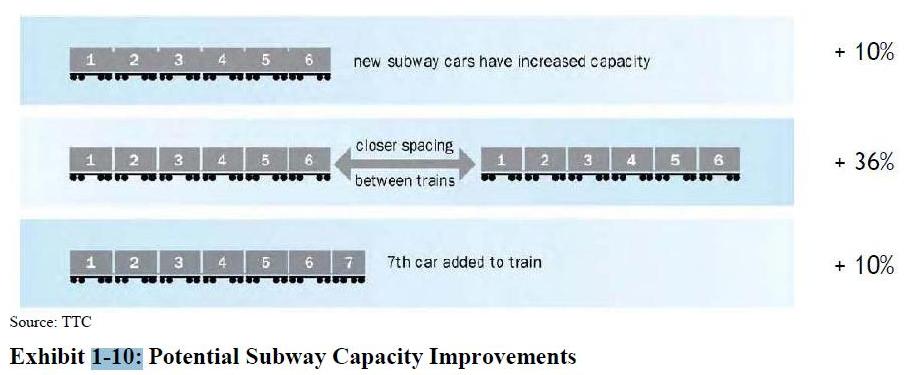
Oddly enough, the staff position on the DRL continues to paint this as something for the medium to long term, at least 15 years away, with the option of adding capacity elsewhere in the interim. This provides a window into which other subway construction projects might try to slip, an idea clearly on de Baeremaeker’s mind.
Not to be outdone, Councillor Milczyn asked that staff also report on looping this extended subway west from Sheppard & McCowan to Don Mills Station. This is the Sheppard East subway, but reborn at least entirely on Sheppard itself rather than going through an industrial district to STC. Such a line would obviously replace the Sheppard LRT.
Need I remind Commissioners of a phrase we heard a lot back during the subway/LRT debates: Council’s will is supreme. Council has voted, with not a little blood on the floor, for an LRT network which the province is supporting (to the degree that is possible in the current political climate). Indeed, the Commission voted today to give CEO Andy Byford the authority to sign the operating agreement form the four-line LRT network.
Metrolinx’ hands are not completely clean in this on a few counts. Most importantly, as recently as two days ago (Oct. 22), a representative presented an LRT project overview at a public meeting that includes a five-year shutdown for the SRT rebuilding. However, Metrolinx own VP of Rapid Transit Implementation, Jack Collins, has said that during the contracting stage, Metrolinx hopes to get proposals from bidders that will be under 3 years, maybe only 2.5. However, such a change has not been blessed by a Ministerial statement, and so we still hear “5” which scares the hell out of Scarborough transit users. Toronto is ill-served by Metrolinx’ lack of accurate details in its public statements, of which this is only one example.
As if all this isn’t bad enough, the Commission has asked for these analyses to be available for its January 2013 meeting even though staff will be pre-occupied with major work on the 2013 budget for the next few months. The date may slip, but what is clearly going on is that somebody wants information for use in a coming provincial election campaign.
What we see here is a Commission that claims to understand the limits of spending, that claims it should focus on subways where they are really needed, but which insists on revisiting LRT proposals over and over in the hope that they can be upgraded. Saying “no” is very hard for a politician to do, especially when constituents have been convinced that LRT is a distant second class option.
The Star reports Councillor Parker’s reaction to the vote:
TTC commissioner John Parker, who was out of the room praising the decision on a downtown relief line, confronted his commission colleagues afterwards, telling them that voting in favour of subway studies was “a stupid, stupid, irresponsible thing.”
“Irresponsible” does not begin to describe my feeling about this vote, one which proved that the current Commission, given half a chance, will be just as irresponsible about the subway/LRT debate as the Ford-friendly crew they replaced. It is not enough to say that we are getting more information for a better debate. We have had this debate, and only people with a distaste for the hard truths about subway costs can pretend that this option is viable.