Board of Trade Advocates New Revenue For Transit

The Toronto Region Board of Trade has announced its support for new revenue streams that could fund the Metrolinx “Big Move” Investment Strategy and more.

Matt Elliott (aka @GraphicMatt) has produced a chart showing the contribution of each of four recommended sources and the range of possible incomes.

The Board of Trade has launched a new website under the name letsbreakthegridlock, and this includes a background paper on the evolution of their recommendations.

Most striking about the proposed revenues is that even the “low end” total is close to $3-billion per year with the high end over $4b.  The Board of Trade is not recommending specific levels for the new revenue stream, but the Toronto Region and Queen’s Park need to aim high.  The Metrolinx Big Move plan was priced at $2b/year, but that estimate is several years out of date and does not include inflation.  It also does not include any money for local transportation improvements that was recently announced as part of the “Next Wave”, and which would increase the total needs by one third.

This is not some wild-eyed, pinko-commie, downtown bunch of granola-eating, pot-smoking, tree hugging, tax-and-spend radicals — it’s the Board of Trade, and they claim wide support from their members.  Congestion and the lack of good transportation options within the GTHA are strangling business and making the region uncompetitive.  That’s the kind of effect businesses notice, and they recognize the effect of decades of disinvestment in the transportation network.

Continue reading

Ed Levy Writes About Rapid Transit in Toronto

Being around long enough to see the way things really work is a huge advantage both for a blogger like me, and for professionals who have a long, if somewhat jaundiced, view of the evolution of transit plans in Toronto.

Ed Levy has just released “Rapid Transit in Toronto”, a webbook tracing the history of a century of transit schemes for our city.  This was produced with the support of the Neptis Foundation.

The online version of the book covers a wide range of topics and is filled with maps, history and observations about the evolution of transit plans (much more so than actual construction) in Toronto.  The book is downloadable in chapters sized either for email circulation or full resolution (see the PDF page).

I have only quickly browsed the chapter outlines so far, but there is a lot of material here, and it is so good, finally to see all of this in one place.  If nothing else, it will save those of us with shelves full of studies having to actually pull out the hard copies whenever we need to check something!

Congratulations to Ed, a fellow advocate for better public transit, on publishing such a major overview of our history.

Past and Future Streetcar Service Capacity

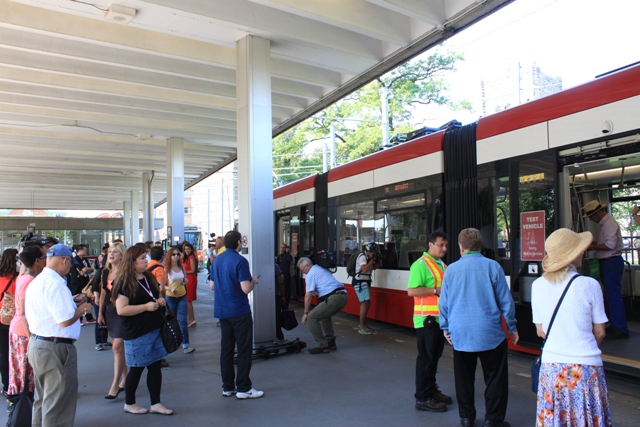
Now that the first Low Floor Light Rail Vehicle (LFLRV) is rolling through Toronto streets on test runs, the question of service quality and capacity for streetcar routes is once again an issue.

The most recent TTC document setting out their intended use of the new fleet appeared in the 2013 Capital Budget Blue Books.  These are not available online, but I presented the TTC’s fleet plan in an article last fall.  From the numbers of vehicles to be assigned to each route, one can work back to the service frequency and capacity numbers.  In general, peak period headways get a bit wider, but the capacity goes up, in some cases dramatically.

The TTC faces two challenges: one on the budget, and one in operations.

Toronto Council has been extremely stingy with operating subsidies and “flat lined” the TTC over the past two budget cycles.  Hard liners will want the TTC to simply replace service on an equivalent capacity basis and maximize the savings in operator costs.  This would be a disaster for service quality even if the TTC actually ran cars on the headways they advertise.

On the operational side, any increase in headways brings even wider gaps when the service is upset by weather, random delays and short turns.  It is already a matter of record that the largest drop in riding over the past two decades came on the lines where 50-foot long CLRVs (the standard Toronto cars) were replaced by 75-foot long ALRVs (the articulated version) on an equivalent capacity basis.  Falling riding led to reduced service and the familiar downward spiral.  This must not happen when the new fleet rolls out across the system.

Since at least the mid-1990s, the TTC has told us that they cannot improve streetcar service because they have no spare cars.  In part, they are the victims of their own fleet planning.  The TTC originally rebuilt some of its old PCC cars (the fleet preceding the current one) in order to have enough to expand operations on the Harbourfront and Spadina lines.  However, by the mid-1990s, service cuts on many routes thanks to the economic downturn in that decade and the subsidy cuts by the Harris government, reduced the fleet requirements to the point where the PCCs could be retired and the Spadina line opened without buying any new cars.  When riding started to grow again, the TTC had no spare vehicles to improve service, and to make matters worse, the fleet was entering a period of lower reliability thanks, in part, to poor design.

Toronto waited a long time for new cars to be ordered, and this process was delayed both by the decision to go with all low-floor cars, and by political meddling at City Hall.  New residential construction along the streetcar lines pushes up demand, but the TTC cannot respond with better service until they have more cars.

Recent discussions about the new cars have included comments about how we cannot possibly have more streetcars on the road.  What many people forget is that the streetcar services were once much better than today.  In this article, I will look back at service levels once operated in Toronto, and at the service that we might see if the TTC actually operates the new fleet in the manner their Fleet Plan claims.

Continue reading

A Chat With Minister Murray

Glen Murray has only been sitting in his new office as Minister of Transportation and Minister of Infrastructure for Ontario for about 2½ weeks, but already his comments in the mainstream media (Globe Star) and on Twitter (@Glen4ONT) show that business as usual will not be the style of his office.  We chatted for about 45 minutes earlier today.

I began by asking about the change of his Twitter handle from the suffix “TC” (for his riding’s name, Toronto Centre) to “ONT” and his recent comments about transportation in northern Ontario.  Murray’s focus there is on economic development, and the need for transportation facilities to support investment, especially in mining.  On the question of passenger services, it was a bit harder to nail down the Minister’s position.

Murray is a big fan of High Speed Rail, and feels that the Windsor-Quebec corridor needs that sort of investment as an important first step, followed by improved rail and bus feeder services.  Yes, but what does this do for the north?  Murray sees the need for a spine rail service linking Toronto to the north with bus routes feeding into that spine, but neither details nor any sense of timing emerged.

Two important dollar figures, however, came out.  First, in southern Ontario, current spending on the 400-series highways is about $2.4-billion annually, and there is an argument to be made for upping spending on transit.  Second, mining now brings in about $1-billion annually, and the industry’s primary complaint is the lack of infrastructure, not their tax burden, according to Murray.

Continue reading

4400 Makes Inaugural Run to Bathurst Station (Update 2)

Early on March 14, the TTC’s first new LFLRV (low floor light rail vehicle) made its inaugural test trip out of Hillcrest Yard to Bathurst Station and return.  The TTC’s Brad Ross posted photos of the event.  (Three photos were added at about 4:00 pm on March 14.)

Owly ImagesLeaving Hillcrest Yard

Owly ImagesSB on Bathurst at the CPR underpass

Owly ImagesUnder the CPR underpass

Owly ImagesAt Bathurst Station

Owly ImagesLeaving Bathurst Station

Owly ImagesNB north of Bathurst Station

Owly ImagesReturning to Hillcrest

Another test run is tentatively planned for the morning of March 15 leaving Hillcrest after the last 512 St. Clair car has passed enroute back to Roncesvalles carhouse at about 2:30am.  Car 4400 will make a round trip to Exhibition Loop.

Updated March 15, 2013 at 11:20 am:

Photos from the run to Exhibition Loop are in a gallery on the Torontoist’s website.

Feeling Congested: Does Toronto Suffer From “The Moscow Syndrome”? (Updated)

The City of Toronto’s consultations about transportation plans and financing continued on the evening of March 4, 2013, with a panel discussion at the St. Lawrence Centre.  The 500-seat Jane Mallett Theatre was packed for the event, and had been sold out for several days in advance.

The participants were:

  • Matt Galloway, host of CBC’s “Metro Morning”, as moderator
  • Jennifer Keesmaat, Chief Planner of Toronto
  • Larry Beasley, retired Chief Planner for Vancouver, keynote speaker
  • Carol Wilding, president and CEO of the Toronto Board of Trade
  • Councillor Peter Milczyn, chair of Toronto’s Planning & Growth Management Committee and member of the Toronto Transit Commission
  • Councillor Michael Thompson, chair of Toronto’s Economic Development Committee
  • John Howe, Vice-President, Investment Strategy and Project Evaluation at Metrolinx

The most newsworthy comments of the evening were a clear break by the two Councillors, both members of Mayor Ford’s Executive Committee, with the Mayor’s position on financing transit.  Michael Thompson stated that getting rid of the Vehicle Registration Tax was “a mistake”, and Peter Milczyn stated that Council (by implication with or without the Mayor) would approve “a suite” of tools to generate the needed revenue.

The message that “the people are ahead of the politicians” on transit financing, first raised by Carol Wilding, was a consistent theme.

Updated Mar. 5, 2013 at 11:10 am:

Although Larry Beasley’s thesis was that Moscow was trapped in an inescapable hole caused by decades of inaction on transit investment, this information appears to be out of date.  As one commenter here has noted, since the arrival of a new mayor and the availability of petrodollars, a lot has been happening.  This can also be seen by a cursory trip around the internet looking at the Moscow system.

Yes, the hole they have to dig out of was very deep, but they’re trying.  Toronto has not yet really acknowledged the effort needed not just to arrest the decline, but to make up for decades when transit wasn’t “important enough” beyond fighting over a vanity subway line or two.

Continue reading

TTC Announces a Customer Charter

With a modest fanfare (but no flourishing of trumpets), the TTC proclaimed its Customer Service Charter on February 28, 2013, at a press conference held at the busy Bloor-Yonge Station. This is a “good news” story, at least for the TTC for whom “customer service” is the new mantra. Senior management at the TTC seem to be headed in the right direction, but I couldn’t help feeling that I had been offered a banquet and found, instead, a snack.

The question of customer service reaches back into the days of the Miller/Giambrone administration. I have written at some length on this issue before.

Although the earlier exercises were well-meaning, this process has been underway for over three years.  In August 2010, an advisory panel produced a report that included more recommendations for ways TTC passengers could improve their behaviour than ways the TTC could provide better service to riders.  The effort had all the earmarks of a self-serving justification for inaction from an organization far too set in its ways.  Indeed, a panel member confirmed to me that TTC management had a large influence in the report, an obvious conflict where the customer viewpoint should be paramount.

In October 2011, TTC Chair Karen Stintz said that “it would take some time” to implement recommendations as “culture change” is not an overnight thing in an old organization.  That’s a fair comment, but this argument cannot be trotted out forever to imply that some changes will come eventually, just not now.  “TTC culture” is a phrase I have heard for years well back into Adam Giambrone’s term as chair, and it is wearing rather thin after so long.

Those of us who have a long history of TTC watching are inevitably suspicious of this process, and it is with that background I approached the announcement.

Continue reading

Analysis of 29 Dufferin for March 2012 — Part I: Headway Reliability

[Apologies to those of you who are pining for even more articles on the Queen car.  They will show up in due course.  I have been diverted onto Dufferin by recent events.]

Service on the 29 Dufferin bus has been a burning issue for decades.  Buses run in packs, they arrive full of passengers, and the advertised service bears little resemblance to what riders see  on the street.

Recently, this was the subject of an article in The Grid by David Topping.  In it, the TTC’s Brad Ross trots out many of the usual explanations of why service is unreliable.  In deference to Brad (who is really a nice guy), I don’t want to spend an article eviscerating his comments line by line.  I will leave readers to contemplate information in this and following articles and make up their minds.

What riders see is “headways”, the time between vehicles, as well as the degree of variation in that time.  If the TTC says a bus will appear every 5 minutes, and the service manages to achieve this, more or less, most of the time, then a rider will consider this “reliable”.  Even on a wider advertised headway, if buses appear at roughly the expected interval, riders know what to expect.

However, if the headways vary widely from the scheduled value, this makes a service unreliable and riders must, at a minimum, build in additional travel time to account for the possibility of a long wait.  Moreover, at the end of the wait, they may be faced with a jammed bus they cannot board.  There might be another one (or two) right behind, but that makes no difference to the length of the wait, and those buses might not be going to the rider’s destination.  Providing frequent service “on average” is not what riders want to see.

In this article, I will review the actual headways provided by the Dufferin bus at various locations during the month of March 2012.  Although this is technically “winter” (most of it), 2012 was a balmy year and the route operated without the kind of severe weather delays we have seen in 2013.

In future articles I will turn to running times and the effects of congestion on the route’s ability to maintain regular service.  I will also look at a few days’ operation in detail to see exactly what was going on.

The information used for this analysis comes from the TTC’s GPS-based vehicle tracking system which reports the position of every vehicle every 20 seconds allowing fine-grained resolution of movements at any location.

Continue reading

New Stop Poles and Maps for TTC Surface Routes

The TTC is experimenting with changes to its signage for surface stops with trial installations on the 94 Wellesley bus route.

TTC’s Chris Upfold presented the new designs at the February 25th Commission meeting using a short PowerPoint which I have excerpted here.

The rationale for the new design is that existing stop poles are inconsistent in their display of information and format.  This is no surprise given the evolution of stop treatment over the years, and the application of overlay stickers as needed to reflect changing services.

Continue reading

TTC Meeting Preview: February 25, 2013 (Update 2)

Update 2 on Tuesday, February 26, 2013 at 10:00 am:

Additional information from presentations and debates at the Commission meeting has be added to this article.

The Toronto Transit Commission will meet on Monday February 25, 2013.  This month’s agenda is a tad on the thin side, but there are some reports of interest.

  • CEO’s Report (updated)
  • Status Report on TTC Accessible Services
  • Second exit planning & consultation / Response to Ombusman’s report
  • Leslie Barns connection to Queen Street
  • Accommodating strollers
  • Purchase of 126 articulated buses (updated)
  • Amending the Automatic Train Control System contract to include Spadina/Vaughan extension (updated)
  • Update on Bus Servicing and Cleaning Contract (new)
  • Deputation by Merit OpenShop Contractors Association of Ontario (new)

There was also a presentation on new shelter maps and stop poles.  This item is likely to generate a strong response in the comment thread, and I will create a separate article for it.

Continue reading