Mayor Tory Discovers We Don’t Have Enough Transit Service

Budget season brings some of the more extreme and ill-informed statements from the Poo-Bahs who govern our fair city. For the benefit of those unfamiliar with the Gilbert & Sullivan operatta “The Mikado”, the Oxford Dictionary defines the name/term thus:

A person having much influence or holding many offices at the same time, especially one perceived as pompously self-important.

Throughout the development of the TTC Operating Budget, a central question has been that of projected ridership and the service it will require. The accept wisdom goes roughly like this:

  • We expected lots and lots of new riders in 2016, but we aimed rather high, a “stretch target” as CEO Andy Byford described it.
  • They didn’t all show up. This led to a shortfall both in ridership and in revenue compared to the original 2016 budget.
  • Service improvements were planned for fall 2016 based on the target numbers, but as there are fewer riders, the improvements were not required.
  • Ridership for 2017 is projected to be only barely above 2016 levels, and the service operating in fall 2016 is adequate to handle the demand.
  • There is no provision in the 2017 budget for service increases beyond the full-year effect of changes made partway through 2016.

All of this is quite plausible, but it runs headlong into conflicts with other factors. The most recent of these is a letter from Mayor Tory and TTC Chair Josh Colle to Bombardier complaining about the late delivery of streetcars.

Continue reading

The Evolution of the TTC 2017 Budget (Updated)

Updated December 16, 2016:  A reconciliation of the City and TTC versions of the budget has been added at the end of the article.

Following numbers in the development of budgets can be like a game of Three Card Monte on a grand scale. Information is presented in various ways, at times in ways that obscure understanding, and at others where the path from “version a” to “b” is missing a crucial step. This article is an attempt to reconcile what has been presented to date. As and when further revisions occur, I will add updates here.

The Process

TTC management begin work on the following year’s operating budget midway through the calendar year. At that point, the actual results that will come out by year-end are unknown, and only some trends may be apparent. The starting point is the current budget which may or may not reflect the actuals by year end, but they have to start somewhere.

Budgets in Toronto are typically presented in terms of year-over-year “pressures” so that, for example, if there is a known increase in costs such as fuel or electricity, this translates to an amount by which this budget line will increase. Basic cost changes can be compounded if there is a substantial change in TTC operations such as the expansion of bus service or the opening of a new subway line. This is a fundamental issue in transit budgets – they must absorb not only changes in costs related to inflation, market rates, and labour contracts, but also the change in scale of operations. Typically the gross cost of the system goes up greater than the rate of inflation, although this can be offset by cost reductions and that favourite target of budget hawks, “efficiencies”.

The TTC’s Budget Committee was supposed to meet in June, but this was cancelled and a chance to get an early look at the 2017 situation was, therefore, lost by the Board (at least to the extent of any public discussion). In September, there were two separate meetings for the Capital and Operating budgets respectively. Finally in late November, the Board approved its Preliminary Budget for 2017. This went into the City’s budget process, and further refinements proposed by the City Manager await actions by the City Budget Committee on December 19, followed by Council in the new year. The TTC Board will then have to deal with the difference, if any, between the requested subsidy and what they actually will receive from Council.

Continue reading

TTC Service Changes Effective Sunday, January 8, 2017 (Updated)

Updated December 12, 2016 at 3:00 pm and at 4:25 pm: Details of the works planned for the west end of the Queen line during 2017 have been added to this article.

The planned service changes for January 2017 bring major restructuring of two routes, and a troubling indicator about the general availability of vehicles for TTC service.

Bus Availability

Several routes will have AM peak service cuts because there are not enough buses to operate the service. None of these will push the service over the loading standards, and these could be thought of of “trimming” excessive service. However, the explicit reason given is the lack of buses.

This is partly due to the slow delivery of new streetcars and to the operation of buses on many streetcar routes either to make up for missing fleet, or to cover for construction projects, but also because of additional demands for spare buses for maintenance.

Streetcar Availability

At the time of writing this article, car 4429 is about to leave Thunder Bay. This leaves Bombardier on track if they push out one more car to hit their much-revised delivery target for 2016. However, the rate of deliveries is not expected to speed up until the second quarter of 2017 and so it will be some time before we see streetcars return across the system.The shortage is partly due to late deliveries and partly to the increased need for cars in maintenance for rehabilitation pending receipt of more Flexitys.

As of January, the following routes or portions of routes are operating with buses:

  • 502 Downtowner and 503 Kingston Road
  • 501 Queen (bus operation west of Sunnyside Loop to Long Branch)
  • 504 King (bus trippers)
  • 511 Bathurst

Effective January 8, 2017, the 501 Queen service will operate with streetcars only between Sunnyside Loop and Neville Loop. A bus service will run from Long Branch Loop via Lake Shore, Windermere, The Queensway, Queen and Dufferin to Dufferin Loop. The same arrangement will be in place for night service, and so riders bound west of Roncesvalles will have to transfer to the night bus.

Beginning in the spring, The Queensway right-of-way will be rebuilt over its entire length including the bridge at the Humber River, the “Long Branch” side of Humber Loop will be rebuilt, as will the track from Humber Loop west to Dwight and Lake Shore (just at the point where Lake Shore straightens out). Streetcar service is not expected to resume until late in 2017 January 2018.

Update: The timing for various components of this project, tentatively, is:

  • Queensway track from Claude to Humber Loop will be rebuilt in concrete rather than with open ballast as at present. This work will occur over much of the construction season.
  • City work on the Humber River bridge will also run through the construction season.
  • Track on Lake Shore from Humber Loop to Dwight will be replaced in the spring.
  • A new substation will be installed at Humber Loop in the summer.
  • Track at Humber Loop and through the tunnel to Lake Shore will be replaced in the late summer and fall.
  • There are no plans at this point to change the stop at Parkside Drive which is not accessible.

Further to the above, the TTC advises that “most of the track work west of Humber Loop is the replacement of the rail and top layer of concrete only, and so the alignment does not change.”

[Thanks to Scott Haskill at the TTC for these details.]

A separate project to rebuild and reconfigure The Queensway east of Parkside to Roncesvalles, including replacement of the intersection and the junctions with the carhouse, is planned for 2019.

Concurrent with this change, some of the bus trippers on 504 King will revert to streetcar operation. Also, the 80A Queensway service to Keele Station will operate at all hours rather than cutting back to Humber Loop to preserve a connection with the 501 Queen bus service.

Metrolinx Construction on the Eglinton LRT

This project continues to affect more routes whose schedules have been adjusted mainly by giving more running time and stretching headways.

The major change in this regard is that the 25 Don Mills route will be split on weekdays at Don Mills Station into two separate routes so that construction delays on the south end of the line do not affect service north of Sheppard. The service levels on the 25 Don Mills local buses and 185 Don Mills Rockets have been slightly adjusted to reflect greater demand on the locals.

2017.01.08_Service_Changes

TTC 2017 Capital Budget Update

Update: This article has been updated with the TTC’s 2017 bus fleet plan and related comments.

Update 2 December 6, 2016: The TTC’s rationale for the choice of which Hybrid Buses are to be replaced first has been added.

A few weeks ago, the big TTC story was the Operating Budget and fare increase approved on November 21. However, the same agenda included the $9 billion 2017-26 Capital Budget as well as an update on proposed spending from Ottawa’s new Public Transit Infrastructure Fund (PTIF).

The major changes between the preliminary version discussed at TTC Budget Committee in September and the version presented to the Board for approval are:

  • Incorporation of additional PTIF funded projects raising their total value from $506 million in the preliminary budget to $1,160 million in the approved version.
  • Replacement of the “City debt target” values carried forward from the 2016 budget with a “funding request” including the City’s 50% PTIF share.
  • Reduction of the savings attributed to “Capacity to Spend” limitations.

Whether the TTC’s plans fit in with the City’s financing capability and debt target will be better known once the City Budget launches on December 6, and the question of new “revenue tools” is settled. Although there is some appetite, finally, to raise new revenues in support of capital projects, the amounts likely to flow remain well below the level needed to fund all of the City’s wish list.

PTIF Projects

Phase 1 of PTIF focuses on “state of good repair” projects that renew infrastructure and keep the system from falling apart. There are several reports including PTIF details, and the amounts vary between them:

  • The PTIF report from September 2016 contains $720m of TTC projects (gross) with assumed PTIF funding of $360m (50%).
  • The preliminary version of the 2017-2026 Capital Budget contains only $506m (gross) because some of the PTIF money will go toward the 2016 budget.
  • The final version of the 2017-2026 Capital Budget contains $1.160b (gross) for funding in 2017-2019.
  • The PTIF report from November 2016 includes $1.363b (gross) for the entire phase.

The list of TTC PTIF projects is shown below. Details for each of these are in the PTIF report.

ttcptiflist_201611

Note that the table above is organized in groups based on current funding status:

  • Unfunded projects have no prior Council approval, and so will require that Toronto fund 50% of their cost as “new money”. ($367m gross)
  • New projects added in 2017 were not previously in the capital plans, and so have no approved funding. They too will require new money from Council. ($166m gross)
  • Partly funded items in the 2016-2025 budget are ongoing maintenance projects such as the annual replacement of track on the streetcar and subway systems. These projects are not completely funded either because spending in the “out years” is not yet approved, or because there have been cuts to the “in years” to keep TTC spending within the City’s budget. PTIF money could top up budgets in the years 2016-19, or it could allow the city to repurpose some planned funding to other projects. ($237m gross)
  • Fully funded projects have been approved by Council in the 2016 round including all of their planned spending through the coming decade. PTIF money for these projects allows the city to redirect part of the 100% funding it had planned to other unfunded projects. ($594m gross)

Bus Fleet Plans

A major change in the final version of the list is the scope of the planned order for diesel buses.

  • The previous budget approval included two orders for 108 and 272 buses respectively, of which 173 vehicles would fall within the window of PTIF funding. If PTIF phase 1 is extended to allow projects running for three years, a further 85 buses would fall within its envelope.
  • The “unfunded” list above includes part of a proposed order for 99 “service improvement” buses, as well as over half of a planned 805 bus order that would accelerate the retirement of existing vehicles.

Updated: The TTC has provided its 2017 bus fleet plan which is included below for comparison with the 2016 version.

The last time a plan was published was in the 2016 budget.

busp001fp

The service improvement buses show up as a line item here with a total of 141 vehicles, 99 of them in 2017-19. How exactly the TTC plans to operate these considering that there is no budget to speak of for more service is another mystery of TTC planning. Of course, these vehicles were ordered when Mayor Tory was still in an expansive mood about transit service.

On November 30, the TTC Board approved the purchase of 285 buses to be delivered in 2017-18. This is the final exercise of an option on the Nova Bus contract under which new vehicles are now being delivered. In the plan above, the original level of procurement for 2017-18 was 221, and so this represents an increase in the 2017 plans.

For PTIF eligibility, the TTC wants to bring forward bus purchases originally planned beyond the scope of PTIF phase 1 so that part of this order will receive federal funding. Originally, planned bus purchases would have been 115 in 2019 and 120 annually thereafter.

Updated: Here is the 2017 plan. Note that planned purchases in 2022-26 have been reduced and shifted to 2017-19.

ttccapex17_busfleetplan

To put the accelerated order for new buses in context, here is the TTC’s fleet list (taken from the current Scheduled Service Summary).

ttcfleet_201611

The hybrid bus fleet has been no end of trouble for the TTC, and these vehicles date from 2006-2009. They were intended to last into the 2020s with some receiving overhauls in 2022-23 in the 2016 plan.

Updated:

  • The 2017 plan shows the retirement of some but not all of the Hybrid fleet, but makes no provision for overhauls of the remaining buses in the next decade. The majority of hybrid retirements are for the original Orion VII buses (1000-1149), and for the second batch of Orion VII “Next Gen” buses (1500-1689). A portion of third batch (1700-1829) would retire in 2019.
  • The other major retirement triggered by the additional buses are the 482 Orion VIIs (7400-7882).
  • Retirement of the 180 Orion VIIs (7900-7979, 8000-8099) has been moved forward to 2021-23.

Updated Dec. 6, 2016:

  • The TTC has clarified why the 223 Orion VIIs Next Gen Hybrids (1200-1423) have not been included in retirement plans. This set of buses is in the midst of an overhaul program and early replacement makes less sense that targeting the slightly newer vehicles that have not been overhauled.

These bus purchases are described in the PTIF project list as:

Buses to reduce passenger wait times and crowding and to provide more reliable and expanded services.

This is something of an exaggeration if the vehicles are intended only as replacements, not as net additions to the fleet. Allowing for better reliability of new buses versus the existing hybrids, this will make more vehicles available and reduce the in service failure rate. However, reduced crowding and wait times, not to mention expanded services only come with better operating funding that puts more vehicles on the road.

Among the new bus maintenance policies the TTC has considered would be the increase of the spare factor in the fleet to 18%. This means that for every 100 buses scheduled in peak service, there would be 18 buses in maintenance. That number does not include the “capital spares” required for warranty work and major overhauls. In the 2016 fleet plan, the scheduled requirement was for about 1,600 buses, but the total fleet was 27% higher.

TTC management, in presenting their budget, stated that if the large bus order goes through, they will be able to defer a move to a higher spare ratio.

Updated: In the fleet plan shown above, the move to an 18% maintenance spare ratio remains in the plan, implemented over two years.

In the short to medium term, a large order of new vehicles should increase overall reliability and availability, but there is a catch involved in this type of planning. All of the new vehicles will age at the same rate, and less than a decade out, the bus fleet will on average be “older” than is ideal driving up failure rates and lowering fleet reliability. Moreover, the fleet replacement will have a sharp peak much as TTC streetcar and subway orders now do, and this will be a strain on future budgets. Indeed, the City has repeatedly asked the TTC to flatten out its vehicle procurement cycle to reduce the effect on budget planning, but with the lure of a potload of PTIF money, the TTC and City appear to be headed in the opposite direction.

Finally, the ten-year budget contains only design funding for a new bus garage to follow after McNicoll Garage, but no money for construction. If the TTC plans to increase its fleet, even allowing for offsets from the opening of new rapid transit lines (Spadina, Eglinton, Scarborough), they need somewhere to put the vehicles.

ttccapex17_garageplan

PTIF Phase 2

Separately from the TTC’s “state of good repair” budget, there are many large infrastructure projects of which only some are for transit. These are in the City of Toronto’s list for the second phase of PTIF funding. The costs shown below are gross values, and the federal share of this would come to $12 billion on a 50% basis. In turn, that would require that Toronto commit an equal amount to most of these unless Queen’s Park feels the urge to contribute as well.

cityptifphase2list_201612

A notable change here is that the Eglinton East LRT is included as a PTIF project, not as part of the “bundle” of Scarborough projects used to make the subway extension palatable to a majority of Council. The next cost estimate for the extension is likely to be even higher than the current one.

Decisions to move forward with these projects are separate from the TTC budget, but influence it because there is only so much money to go around.

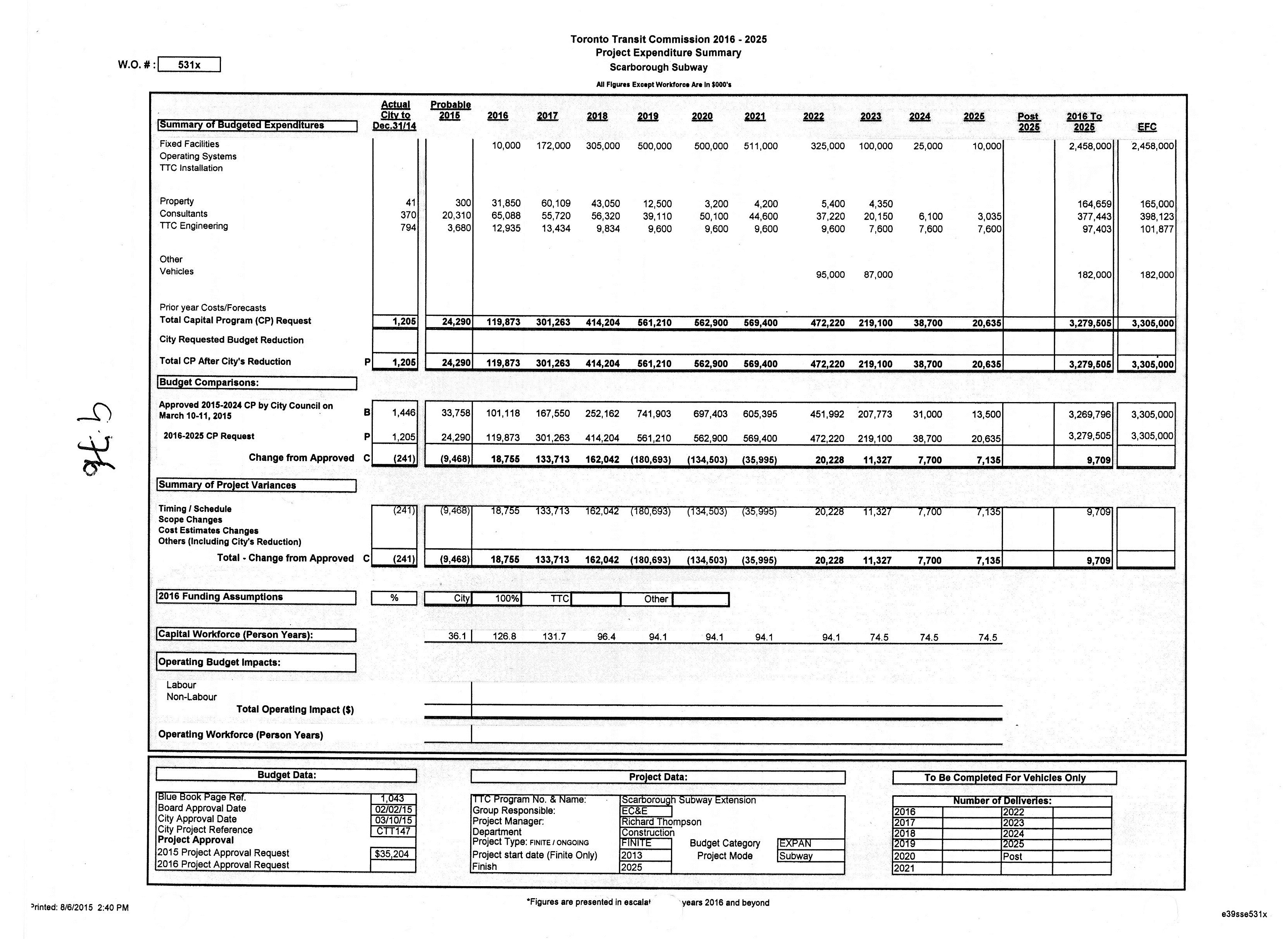
The Scarborough Subway Extension

Moreover, some of the new projects, notably the Scarborough Subway Extension (SSE) trigger the need to move projects on the TTC’s list from unfunded to funded status.

There are several projects related to the Scarborough Subway, but not included (or at least not fully) in its budget.

  • Replacement of the existing T1 subway car fleet with 372 new cars (62 new trainsets). The existing T1 fleet cannot be economically equipped for Automatic Train Control (ATC) which will be the signalling technology on the extension, and a new fleet must be in place before this opens.
  • 62 trainsets will be sufficient to operate the BD + SSE line with every other train running beyond Kennedy to STC, but not with full peak service. Moreover, there would be no spare trains to increase service on BD beyond its current level. The original version of the SSE budget included money for additional trains to bring the line up to full service, but whether this has been traded away to pay for increasing costs on the construction project remains to be seen.
  • A new fleet of subway cars in the style of the TRs now on Line 1 YUS will require a maintenance facility designed for this equipment, and the system will have to deal with an overlap when the new fleet is arriving before the old one is retired. Greenwood Shops was not designed for TR-style trains operated as a single unit. The TTC is contemplating a new subway yard near Kipling Station. Work is now underway to increase system storage capacity, but this will only allow for all of the existing T1 fleet to be stored along the Bloor-Danforth line, not for additional storage for co-existence with a new fleet. The 2017-26 budget contains money for design of a new facility (p 26), but not for its construction.
  • Conversion of the existing Line 2 Bloor Danforth subway to ATC. This work is not specific to the SSE, and it does not have to complete before the SSE opens (just as the Line 1 YUS conversion will not finish before the Spadina extension opens). This project is included in the 2017-26 Capital Budget (p 21), but the timeframe has been pushed back to end beyond 2026 when the SSE opens.

Commitment to the Scarborough extension with a 2026 opening date will require that the unfunded projects associated with a new BD fleet be brought forward. This has not been mentioned in financial plans for the SSE presented at the TTC or at Council.

“Capacity to Spend”

The preliminary version of the Capital Budget included a piece of creative accounting intended to make the TTC’s funding needs look a bit less severe than they might be. In the preliminary version, the TTC assumed that close to 10% ($858m out of $9.4b) of its planned spending would not actually occur. This was based on the premise that each year’s budget is underspent, and therefore they really didn’t need the entire $9.4b. That schemes falls apart because the overwhelming reason for underspending is not that the work is not done, merely that it occurs in a later year than originally planned.

In the final version of the budget, this adjustment is still present, but it has been reduced to $482m over 10 years, notably by excluding it from all of the PTIF projects. It really would not do to ask Ottawa for billions, only to turn around and say “we’re not really going to spend it all”. Moreover, treating deferred spending as if it were a permanent cost reduction creates a situation where the city understates its future capital needs. This may look good in the short term, but it catches up with us in the long term. By such devices are “cost overruns” created.

Comparing the Preliminary and Final Funding Plans

With the arrival of PTIF and other adjustments, there is considerable difference between the budgets presented in September and in late November. These changes are summarized in the attached table. My apologies for its size, but the two originals on which this is based are themselves densely packed with numbers.

2017_funding_prelim_vs_proposed

The chart is organized with three pages on which the years from 2017-26 run across the pages, and the sources of funding run down. The change for each item is shown to highlight what has shifted between the two budgets.

Note that some rows and columns do not add up due to rounding in the source documents from the TTC. Also note that this chart is for the “base” capital budget and does not include special projects such as the TYSSE or SSE for which funding comes from other governments, nor does it include any of the Metrolinx projects.

Items of interest include:

  • There is no change in anticipated provincial funding and this remains at a fixed level from the gas tax over the decade. Queen’s Park gives more to Toronto than is shown here, but the remainder is used as an Operating subsidy.
  • Similarly, the federal gas tax is assumed to remain unchanged over the decade.
  • The PTIF funding extends only to 2019 because this is Phase 1 money. Phase 2 projects will show up separately as and when they proceed just as the TYSSE is split out now.
  • CSIF (Canada Strategic Infrastructure Fund) has now run dry and is replaced by PTIF. It had some funding in past years, but not for 2017 and beyond.
  • The treatment of the City’s contribution has changed from the preliminary to the final version. In the preliminary version, the full headroom from the 2016 debt target was included even though the TTC did not actually require all of this funding. That treatment produced a “surplus” in years where TTC spending would have been lower than the City’s headroom. In the final version, only the actual requirement for City funding is included.
  • In 2017-18, the amounts expected from the City’s “Asset Monetization” have been replaced by the more generic “Capital Financing Strategy”. With the decision not to sell Toronto Hydro or the Toronto Parking Authority, funds available from “monetization” are lower than before. They have been offset by PTIF.
  • There remains a $275m shortfall in 2017 as I described early in this article. This is related to the proposed order for 60 more Flexitys whose future is uncertain. Whether this order will be placed, or placed in 2017 (and hence a matter for this year’s budget) remains to be seen.

Over the ten year plan, there is little change in proposed total spending, and not much increase in funding (note that about 40% of PTIF Phase 1 money was already included in the preliminary budget). Most PTIF money will go to new projects, and after the burst of support for state of good repair over the next few years, the City will be back to wrestling with shortfalls in available capital funding. This buys time for a few budget cycles, but does not address the structural problem in funding for the base budget.

Who Deserves a Fare Subsidy?

Updated: Further information on the history of seniors’ fares has been added at the end of this article.

With the never ending problems of balancing the TTC’s budget, the question of trimming or eliminating various forms of fare subsidy are back on the table. This shows up as a quick fix to revenue problems with the assumption that “if only riders paid more, there wouldn’t be a problem”. The target group varies from time to time, but the premise is the same – somebody is freeloading and “my tax dollars/fares” should not be paying their freight.

A basic problem with this argument is that it will not fix the revenue shortfall permanently, only increase the cost of using transit by whichever group is targeted. If, for example, all discount fares were eliminated in 2017, we would be right back at the same position in 2018 wondering how to deal with increased costs, but without that convenient list of scapegoats.

A quick review of the “concession fares” is in order to put the question in context.

  • Adults who are willing to purchase tokens up front (or preload their Presto cards) get a discount relative to riders who pay cash.
  • Adults who want to prepay even more can purchase daily, weekly or monthly passes which cap their costs within a time period.
  • Special passes and validation stickers are available to extend the range of services covered by adult passes to premium fare routes and to other transit systems.
  • Daily pass holders get a special “family” deal on weekends and holidays when up to six people, maximum two adults, can travel on the pass.
  • Monthly pass holders can obtain various extra discounts based on a commitment to buying 12 months’ worth of transit (the Metropass Discount Plan or MDP), and bulk-buy discounts are available to organizations that resell passes (the Volume Incentive Program or VIP).
  • A Convention Pass is available to allow for bulk purchase of transit service for large groups at a price considerably below the cost of a day pass.
  • Students and seniors have passes priced at a 20% discount from adult passes, and MDP pricing provides for a further discount. Cash and ticket fares are discounted about 33% from adult rates.
  • Children ride free.
  • A limited number of designated groups (the blind and war amputees) travel free.
  • WheelTrans users are entitled to be accompanied by a Support Person at no extra charge.

Some of the concession fares have been around for a very long time:

  • Children’s fares predate the TTC’s formation in 1921 and until recently floated between 1/3 and 1/2 of an adult fare. A “child” was defined by height with rings embossed on the stanchions at vehicle entrances to give operators an unambiguous measure. Older vehicles (PCCs and the Peter Witt) bear witness to how the standard was changed over years as the average height of children rose.
  • Scholars’ fares date from the 1950s, and they lie partway between the fare for children and adults.
  • Seniors’ fares came along by the 1970s in recognition of the then-new issue of a growing aged population and their relative poverty. The CPP was less than a decade old, and “house rich” oldsters benefiting from the real estate market were unknown.
  • The Metropass dates from May 1980, and its cost has fluctuated between 52 and 47 “token” fares depending on the prevailing political and fiscal mood.
  • Post-secondary student passes were added to the mix in 2010 after several years of lobbying by student groups.
  • Free rides for children were granted in early 2015 as a political move by then-new Mayor Tory to “do something” quickly on the transit and poverty files.

Continue reading

TTC Board Meeting: November 30, 2016

The TTC Board will meet on November 30, 2016 at 1 pm in the Council Chamber at City Hall. This is not a budget meeting, but the agenda contains a number of items of interest.

  • CEO’s Report for November 2016
  • Purchase of Air Conditioning Parts for T1 Subway Cars
  • Purchase of land to expand bus storage capacity
  • Reports related to the Hillcrest Complex including a review of property usage, approval of new equipment for Duncan Shops, and approval of a new Streetcar Way Building.
  • Expansion of Davisville Carhouse
  • St. Patrick Station Easier Access Elevators

Continue reading

TTC Approves 2017 Fare Increase, Punts Service Decision to Council

On November 21, the TTC Board approved the fare increase proposed by staff in their Operation Budget for 2017. Adult and Senior/Student token/ticket fares will rise by ten cents to $3.00 and $2.05 respectively. Metropasses for both fare classes will rise by $4.75 with the result that the “multiple” (the ratio between the pass price and the single token/ticket) for seniors/students drops slightly (by about 0.5) while for adults it is unchanged. Here is the full table of old and new fares.

ttcopex2017_fareincreasetencents

There was a long parade of deputants at the meeting who, despite a motion by Deputy Mayor Denzil Minnan-Wong to limit presentations to three minutes, mostly managed to push the envelope out to the normal five minutes simply by taking a rather long time to “wrap up” when Chair Josh Colle gave the three minute warning. Their comments overwhelmingly spoke to the effect of a fare increase, but also to the question of service quality. Despite the TTC’s claims that they are not limiting service growth and causing crowding, actual experience does not match these claims, a point echoed by Councillors who sit on the TTC Board and who receive many complaints about this from their constituents.

To soften the blow, the TTC Board voted to direct staff to prepare the 2018 budget on the basis of no fare increase so that, in effect, over a two year period fares would only have gone up five cents per year. This is a Catch-22 decision going into an election year because somehow Council will have to find the money to pay for the idea just when tax increases are regarded as political suicide, but service cuts would be equally unpalatable.

The most contentious part of the debate turned on Appendix C to the report which described various options for higher fares and lower service. Included on the list was the cost of free passes for the Blind and War Amps ($2.1 million), and even considering this shows a breathtaking insensitivity.

This was described by CEO Andy Byford as the “Armageddon Appendix” in an interview with CBC’s Metro Morning, an presents a menu of extremely unpleasant options to close the remaining gap between TTC’s planned revenue, including the fare increase, and projected costs. This amount has three components totaling $99 million:

  • A $35.1 million shortfall in the “conventional” system’s operating budget.
  • A $26.4 million shortfall in the WheelTrans operating budget.
  • A proposed transfer of $37.5 million from the TTC’s operating budget to the City’s capital budget. This scheme has not been endorsed by the City Manager, and is simply an accounting trick to bump the TTC subsidy without showing it as part of the annual increase. Either way, it would mean increased City spending whether as “operating expense” or “capital from current”.

Byford was at pains to emphasize that he would not recommend any of the changes, but produced the list because he was asked for it. What is missing, of course, is a sense of the effect of any of the changes at the individual level: how many riders benefit from which discounts, which services would be affected by changes to standards? It is easy for the budget hawks on Council to talk about “efficiencies” when they are single-line descriptions, a dollar amount, but with no specifics about what would happen.

For their part, members of the TTC Board seemed unable to grasp the difference between sending an unbalanced budget to Council without recommendations on how to fix it, as opposed to taking a strong stand saying “we oppose these cuts”. This evolved as the meeting wore on with some recognition of the need to take a stand, but this did not find its way into the final motions (see below).

The Board may have punted the issue over to Council, but nothing prevents Council from saying “TTC, you are only getting this much subsidy, you figure out how to deal with it”. Even a desire to save service improvements implemented at Mayor Tory’s behest will require someone to decide either on new revenues to fund transit, or on which of these improvements will die on the altar of “efficiency” and “saving taxpayer dollars”.

Continue reading

TTC Crowding Standards and Service (Updated)

Updated Nov. 19, 2016 at 10:10 am: The TTC has updated their comment on the status of the service improvements implemented in 2015-16.

Identifying the specific routes which would be affected would be done in 2017 following a review of the initiatives implemented in 2015-2016. [Email from Stuart Green]

The Star’s Ben Spurr had an article on November 18, 2016 about the degree to which the TTC fails to meet its own service standards for vehicle crowding.

The many debates about budget and service routinely ignore the question of whether the TTC actually meets the Board-mandated standards, and instead we are treated to complaints from the budget hawks about poorly performing services.

In my review of the proposed 2017 operating budget, I noted that the traditional targets of such complaints do not offer much latitude for savings, while much more money is on the table from potential reductions of service quality and reversal of the recent Tory service improvements such as the 10 minute network.

For reference, here are the current standards taken from the TTC’s website:

ttcopex2017_servicestandards

The TTC has provided the detailed list it sent to Ben Spurr, and here it is.

The list comes with various caveats from the TTC, notably that many of the routes that are “over” the standard are only slightly past the line by say a few passengers over the target.

In a nutshell, 43 of the TTC’s bus and streetcar routes exceed crowding standards at one or more periods during the week and on weekends. In most cases, though, the average number of passengers per vehicle is only slightly in excess of our crowding standards…one or two people in some cases.

The standards, as the chart in the PDF illustrates, vary between periods and vehicle type. Also, in off-peak periods, the standard is the number of seats on a vehicle. So if just one or two people are left standing, that would exceed the standard but is not overcrowded, per se. [Email from Stuart Green in TTC Communications]

As regular readers know, I have written extensively about service reliability on the TTC. This affects the actual quality and capacity of service in many ways:

  • Vehicles that are bunched often have extra space on the second (third, etc) vehicle because everyone boards the “gap” vehicle. A strong inventive for this behaviour is that dropping back to a following, less crowded vehicle may leave the rider turfed off when it short turns. Despite TTC claims that total short turn counts are down, this remains a problem and rider behaviour reflects their experience.
  • The number of vehicles per hour operated is not always the scheduled value. Therefore the actual capacity of the route could be less than advertised.
  • On routes with articulated streetcars or buses, regular single-section vehicles can often be found in place of artics. The result is a loss of capacity and greater than scheduled crowding.

Past observations by TTC planners have rather quaintly observed that the cheapest “new” capacity one can provide is to operate reliable service so that loads are evenly distributed. I leave it to readers to contemplate the degree to which the TTC achieves this, especially when it has a six-minute wide window within which vehicles are “on time”. For frequent routes, vehicles in pairs can be on time even though they provide gappy service. This is a very long-standing problem, compounded by the fact that the TTC does not even regularly meet its rather generous “targets” for headway reliability.

I asked the TTC how the average loads are calculated as reported in their tables. Specifically, is the average calculated based on the observed number of vehicles, or on the scheduled service, and is the percentage of load based on the scheduled vehicle type rather than what actually operates. The TTC replied that the capacity used to calculated the percentages is based on scheduled values and vehicle types, not on the service available to riders on the street.

This is an important distinction for routes with erratic service and frequent replacement of large vehicles by smaller ones, notably 501 Queen. It is quite possible that the actual average loads considerably exceed available capacity even though they may fall within theoretical values based on the schedules. What may look like a seated load on paper could well have a considerable number of standees because headways are wider and/or vehicles are smaller than planned.

One might reasonably ask for additional information that must be available from the underlying TTC data:

  • What is the actual capacity of the service operated against which the crowding values are calculated?
  • How variable is the headway (maximum and minimum values, percentage of vehicles close together, etc.)?

With respect to monitoring service for schedule changes, the TTC says:

The specific decisions on when and where to adjust service to these standards are made by TTC staff. In a typical year we make more than a hundred service changes. We regularly conduct reviews of ridership to assess needs across all routes. If there is a route that needs some additional service, we will try to balance that against a route that may have capacity to spare.

In a large, busy system such as the TTC’s there are always some routes at any point in time that have crowding that exceeds the crowding standards. And while we would obviously prefer our customers are not on crowded vehicles, we have to balance the availability of resources like vehicles and operators with delivering service to the entire city.

Through regular service reviews and with arrival of the new vehicles, there is an opportunity to increase capacity on some of the busier routes like the 504. In particular the TTC’s new high capacity low-floor streetcars will assist in reducing overcrowding on our streetcar routes.

There’s a bit more to things than this reply lets on. Every year there is a “Service Budget” (the one for 2017 was probably set a few months ago), and Service Planning works within this to allocate service to the available resources. However, a critical component is the number of available operators and this runs into the dreaded budgetary problem of “head count avoidance”. In off peak periods, routes may cry out for more service, but vehicles will sit in the yards if there is nobody to operate them.

Yes, the TTC’s new cars will help to reduce crowding when and if they actually arrive, and when they start operating on really busy routes like King. On 510 Spadina, the introduction of low-floor cars was accompanied by a cut in the number of vehicles in service, although the net change remained an increase in capacity. This has long been an issue in plans for fleets of larger vehicles because in some cases, notably the conversion of bus routes from regular to articulated vehicles, the “new” service has roughly the same capacity as the old by the simple expedient of running two artics where there previously had been three regular sized buses. Years ago, the same fate hit the 501 Queen car, and service quality (not to mention ridership) has never recovered.

The TTC’s first goal for many on Council is to reduce costs, not to increase service, and claims that there will be more capacity must be tempered with the observation that such an improvement may not be “affordable”. Just look at what happened with 514 Cherry which was supposed to be a net addition to service on King Street, but which the Commission refused to fund. The result was that service was reallocated between the 504 and 514 routes with only a modest improvement in the portion of the route where they overlap. (The question of how irregularly the 514s actually appear is another matter.)

Going into a year where the Service Budget is planned to rise only by 0.4%, there is not much headroom for more capacity, and anything added on one route will inevitably be taken from another. This may be “efficient”, but it runs headlong into policy objectives such as the core network of 10 minute services, all-day service on all routes and the existing crowding standards. As the budget report showed, there is not much available to trim from the lightly loaded routes when resources are needed on busy routes elsewhere, and the more likely situation will be to pack in more riders.

The problem is even worse if the TTC contemplates relaxing the standards so that average loads on vehicles will rise. We already know from experience that many routes are crowded, and the last thing they will need is less service and even worse travel conditions.

I asked whether the cost estimates for savings on these proposals included detailed lists of possible service changes. The TTC replied:

The table shows broad categories that generally would reflect the reversal of service initiatives implemented in 2015. The specific service changes within each category have not been identified.

This was further qualified in a separate email after this article was published:

Identifying the specific routes which would be affected would be done in 2017 following a review of the initiatives implemented in 2015-2016.

What a marvelous way to short-change debate – don’t tell people what the actual effects might be. This is precisely the sort of campaign one would expect from an anti-transit Council or Mayor who would say “this won’t hurt too much”, or so a Councillor could claim they never knew the details of what was planned before it happens. Will someone on the TTC Board please make an official request for the details before this goes to Council?

On a more general note, the primary function of the TTC is to provide transit service. The Board sets policy and sits back expecting that service actually operates within those parameters. However, there is always a Catch-22, the caveat in any policy “subject to budget availability”. This allows the Board to pass a policy promising the sun, moon and stars to transit riders, but it’s ok if staff only delivers a few minor planets in a far-off galaxy because they couldn’t afford to deliver more. Meanwhile, Council blithely approve billions in spending on capital projects.

This is not to say that those capital projects are unneeded (that pitched battle has been debated elsewhere), but it is a double standard to treat capital funding as something we must do as an integral part of city growth and prosperity while at the same time starving day-to-day service because keeping taxes down is the paramount goal.

Every month, we see a CEO’s report from Andy Byford full of beautiful pictures and graphs, but with very little commentary on the basic question: are we providing the service that Toronto needs, and if not, what do we have to do to achieve this?

It’s all very well to have customer surveys and indices of station cleanliness, but what about the actual service on the street? Is the plateau in ridership related to the system’s inability to carry more riders or to attract business?

TTC staff are supposed to be producing a new Ridership Growth Strategy for the TTC Board in January. It’s a shame this wasn’t produced as an integral part of the budget. How bad is the service today? Where can it improve? How much more would be possible and at what cost? Those are questions no penny-pinching Mayor wants asked let alone answered.

In a few days, the TTC Board will consider its 2017 budget, and we will see just how much appetite there is for forcing Council to cough up the money needed to run the transit system, to pay for all those photo ops a few years ago when John Tory claimed he would reduce the damage wrought by Rob Ford.


TTC’s 2017 Operating Budget: More Creative Accounting (Updated)

The TTC’s 2017 Operating Budget will be discussed at a special Board meeting on Monday, November 21, 2016. When work began on this round, the TTC stared at a $231 million hole in its potential 2017 funding, and it was apparent that the Mayor’s request for a 2.6% cut in subsidy was small change beside the TTC’s much larger problems.

Updated November 17, 2016 at 6:40 pm: Responses from the TTC clarifying the treatment of externally recovered costs have been added to this article.

The Budget Report is now public, and initial media comment suggested that the TTC had wrestled that huge potential deficit to the ground. However, a lot of that is spin and accounting trickery, not a real reduction in the TTC’s needs.

Still facing a gap of $61 million, TTC management list many unpalatable ways that operating costs could be trimmed. In effect, the message to Council, and especially to Mayor Tory is this: being a “transit mayor” costs money, and it’s time to pay up.

This article looks at the Operating Budget, the one that provides service and handles day-to-day maintenance activities. In a separate article, I will review the Capital Budget.

Understanding The Budget Mechanics

The TTC (and all City agencies and departments) begin work on their next year budget midway through the year. The 2017 budget has been “in the works” for months and in many ways is based on 2015 rather than 2016 results because the year was barely half-over when the 2017 budget cycle started. This can lead to problems when the “current” year does not turn out as expected as happened in 2016.

An important first step in looking at TTC budget numbers is to recognize that any year-to-year comparisons are relative to the 2016 budget, not to the probable actual results for the year. This has some important effects:

  • The fare revenue projection for 2017 is based on a lower projected ridership than was used, but not actually achieved, in 2016. Therefore, revenues go “down” in this budget (without allowing for effects of a fare increase) simply to get the estimated ridership back to a reasonable level. 2016 was described as a “stretch target” for ridership, and the budget elastic didn’t stretch as far as hoped.
  • Some 2016 costs are coming in under budget, notably for employee benefits but also for diesel fuel. These are savings in actual spending in 2016, but they also show up as “reductions” in 2017 when they are rolled into the budget. It is important to distinguish between reductions in costs that affect actual spending in 2017 as opposed to simply being a lower budget number.
  • The 2015 budget included a “capital from current” item for the purchase of new buses. This is not an “operating cost” in the traditional sense, but it avoided putting the item on the City’s Capital Budget. For this reason, 2015 is an odd year in any stats unless the capital portion is factored out (notably from the claimed subsidy per rider). There is no such payment in 2016, and so a direct comparison with 2017 is possible without adjustments, at least until some of the TTC’s new budget tricks are factored in. For 2017, the TTC proposes to shift some operating costs onto the Capital budget and, as a result items that were billed to “operations” and counted as part of the rider subsidy in past years would disappear. The City Manager’s Office does not concur with this tactic. The point here is that year-to-year budget and subsidy comparisons cannot always be made without adjusting the figures to a common basis.

Another important factor is that in the total numbers reported in the media, the “conventional” and Wheel-Trans (WT) budget numbers are often conflated. When demand for WT is growing quickly, as is now the case with improved eligibility criteria from Queen’s Park, costs for this service grow proportionately. This cannot be wished away by budget hawks who care only to limit tax increases, but worse it can create a situation where the conventional system is pillaged for dollars to handle the WT demand. That is not the sort of conflict we should be seeing in budget debates, but it is inevitable when the extra cost of WT for 2017 is almost equal to the revenue from a 1% property tax hike.

Finally, there is a distinction between true savings that represent lasting reductions in expenses, and one-time benefits from procedural changes or special accounting provisions. The impression can be given that a budget is in much better shape than reality by giving the impression that a large initial deficit can be whittled down.

Getting From $231 Million to $61 Million

The budget gap was “closed” by a number of measures, some of which are simply savings against the 2016 budget that are carried forward into 2017. On an “actual spending” basis, the savings have already happened. They are not the result of new, recent actions by TTC management.

ttcopex2017_closingthegap

As I reported previously when reviewing at the Budget Committee discussions, the reduced healthcare costs were actually achieved as a saving in 2016 against that year’s budget. They are a reduction in 2017 only on a budget-to-budget basis because the $10.3 million was part of the 2016 budget as a starting point.

The recommended savings in the current report are:

  • Reduced PRESTO fees due to the delay in rolling out Metropass support. With less of the TTC’s revenue flowing through PRESTO, the cost of serving this does not have to be included in the budget. Note that this treats PRESTO costs as a net addition and does not include an offsetting saving in handling costs for Metropasses likely because the two modes would co-exist during a transition period.
  • As in past years, energy costs are expected to be lower than the previous year’s budget level. The saving shown here is $12 million, but $5 million of that is already projected to be saved in 2016 actual results as per the October 2016 CEO’s Report, p. 50.
  • Capitalization of City construction impacts. When the city tears up a street (for example the Queen Street watermain project now underway), the TTC incurs extra cost to divert and supplement service. This has been borne out of the operating budget but without an explicit chargeback to the capital project for which this should rightly be a cost. This appears to be a new practice for 2017 and it is unclear whether the City and its agencies have agreed to pay these charges. (See update below)
  • Elsewhere in the budget, there is a section on cost recoveries from Metrolinx for its construction project effects on service. This would be done on a cost recovery basis as with City construction, but it is unclear why one of these has been included as a “saving” but not the other. (See update below)
  • Delays in Bus Reliability Centred Maintenance. TTC management had proposed a higher fleet spare ratio and maintenance practices to pro-actively get ahead of failures rather than doing predictable repair work after a vehicle had already passed the likely failure time and possibly actually broken down in service. In the Capital Budget, the TTC is proposing a very large order of buses to replace the Hybrid fleet before its due date, and this would reduce maintenance needs by substantially lowering the average age of the fleet. It would also place a large chunk of the fleet under warranty effectively transferring operating maintenance costs to the Capital budget. This tactic has a downside as the TTC has seen in the past when a homogeneous fleet reaches its non-warranty period, and later the higher cost of maintenance (and staffing requirement) of older vehicles. This is a time bomb built into the budget even though it could “solve” a short term problem.
  • Reduced contracted services. It is unclear what this refers to, and I have sought details from the TTC. The largest “contract service” the TTC has is the provision of service in York Region, but this is done on a full cost recovery basis. If YRT takes over a service the net change to TTC’s budget should be zero. (See update below)

Update: The TTC has clarified the handling of externally funded costs in an email from Vince Rodo via Brad Ross.

With respect to City construction projects:

It has been a long standing practice for the TTC to charge the incremental cost of service to TTC capital projects.  For example, when we tear up streetcar track, we run replacement bus service during the construction period.  We charge the difference between the regular streetcar service and the bus service to that project as part of the cost incurred because of the project.  In the past, we have not done that for City of Toronto construction projects.  The city has agreed that the practice for TTC projects can be used for city projects too.  So for example, if the city were closing an intersection for work and we had to re-route service round that, we will now be able to calculate that extra cost and bill it to the city, who will charge it to that project.  Since these costs had to be covered by the TTC operating budget in the past, they have been included in the TTC operating budget.  From now on, they will not show in our expenditures because there is no net cost to the TTC.

With respect to Metrolinx cost recoveries:

The Crosstown Master Agreement calls for Metrolinx to reimburse the TTC for incremental operating costs associated with the impact of Eglinton Crosstown construction on TTC service.  For 2015, we billed them and they reimbursed us for $5.2 million.  I don’t have a final figure for 2016, but I suspect it will be in that range.  That is not included in our budgets because there is no net cost to the TTC.  For 2017, it is similarly not included in our budgets because once again there will be no net cost to the TTC. So the treatment of this and the city construction above will be completely consistent on a go-forward basis: no net cost included in the TTC budget.  We flagged this in the 2017 budget report because: (i) the quantum is increasing substantially in concert with the ramping up of Crosstown construction, (ii) it stays high for at least the next 5 years and (iii) because we are hiring 169 TTC employees to provide this augmentation of our service.  If it were the same range as 2056 and 2016, we may not have highlighted it.

With respect to York Region cost recoveries:

The service the TTC operates in York Region under contract to YRT is included in the budget as both an expense and a revenue and that has been the case for decades.  It is the service they request us to operate on their behalf.

With respect to contracted services:

The “reduced contracted service” has nothing to do with any of the items mentioned above.  It has to do with reduced purchases of services such as IT, human resources, IT licenses, cell phones, etc.  No impact on service on the street.  It all about saving money everywhere we can.

The different treatment appears to arise from whether there is a net delta in the budget (i.e. a new condition, and therefore reported as a budget-to-budget change) or a continuation of an existing practice where costs and expenses always balance out. [End of update]

Four additional sources of revenue or savings are proposed:

  • A draw of $14.4 million from the Transit Stabilization Reserve. This money comes from “surpluses” (planned subsidies that were not needed in good years) that have been banked against lean years of which 2017 is most definitely one. This is not a “saving”, but rather one time revenue that can offset the budgetary pressure for 2017 only. The underlying costs will not disappear, and they will show up as part of the 2018 pressure.
  • A fare increase of 10 cents on the adult token rate, pro-rated through other types of fare (the details are discussed later in this article). The added revenue is net of the anticipated loss of riders. If pushback from the increase is less than expected, then the TTC could do better with new riders than planned, but many other factors will affect riders’ decisions about staying with transit.
  • The TTC proposes that the cost of new batteries for Hybrid buses of $8.5 million be transferred to the Capital budget. This is an interesting accounting debate because parts replaced during a major bus overhaul (typically at mid-life) are paid for from capital, while parts replaced in normal day-t0-day maintenance count against operations. However, the lifespan of these batteries is short enough that capitalization is an odd treatment.
  • Some TTC capital assets are not subsidized by the City in part because their lifespan is too short, and in some cases this is likely a holdover from the days of provincial subsidy when certain items were excluded from that funding. As an accounting mechanism, the TTC funds these purchases out of working capital, and recovers the money as a depreciation charge against the operating budget over their lifespan. The TTC proposes that this amount be treated by the City as a capital cost thereby shifting $29 million out of the operating budget.

The City’s response to the final two items is not exactly welcoming:

Both of these items were reviewed with City staff and not supported because they reflect a shift from the operating budget to capital, requiring City capital funding. Staff suggest these items be given further consideration by the City as they might help address the operating pressures while immunizing customers from service adjustments or further fare increases, to the extent possible. [pp. 5-6]

Fare Increase Options

TTC management recommend a ten cent increase in the adult token fare from $2.90 to $3.00 with proportional changes in all other fares except cash which would stay at $3.25. This is expected to bring in $27 million in new revenue, net of the loss of 1.2 million riders and the PRESTO fees that are a percentage of the revenue stream.

ttcopex2017_fareincreasetencents

There is no discussion of the issue of special fares as a social benefit, and that issue will get tangled up in proposals to deal with the (at least) $61 million remaining gap between projected revenues and expenditures.

One set of proposals involves larger fare increases. These would inevitably trigger higher ridership losses than the proposed ten cent level, but this is really uncharted territory for the TTC. Moreover, there is the question of perceived value, and whether riders feel they would actually be ripped off by a fare increase if service did not materially, and fairly quickly, change for the better. Paying more for what many perceive to be inferior and declining service is no recipe for retaining customers.

ttcopex2017_fareincreaseoptions

In addition to fare increases, there is the question of the many forms of discount fare. The table below shows the estimated “cost” to the TTC of these fares. This is the sort of issue where fare:ridership elasticity can get very tricky depending on the nature of each market and the extent to which elimination or reduction of a discount is considered to be “unfair”. A related problem is the TTC’s perennial treatment of these concession fares as a cost, as if giving people cheaper rides drives up the cost of service, or represents revenue that might be available if only we could get everyone to pay a higher fare. This is directly contrary to many City objectives to reduce barriers to travel among many groups of citizens, and the recognition that mobility has a value.

ttcopex2017_fareincreaseoptionsanddiscounts

Note: The 8 million lost rides by children does not incur a cost because they are travelling free today. However, it is an indication of how much more riding is done today by children, and the degree to which this unexpected bump in one rider class is masking declines in others, notably adults.

Service Cuts

Another way to trim the TTC’s budget gap is to roll back service improvements, possibly even to levels below those imposed by the Ford/Stintz regime. This would be a bitter pill for the “Transit Mayor” to swallow, and in the midst of such grandiose spending plans as we see on major capital projects, the idea that these services would not be funded should be deeply embarrassing.

ttcopex2017_serviceoptions

This table shows quite clearly that the usual poster children for “waste” in the transit budget will not yield a great deal of savings, notably the “low ridership, high subsidy routes” and the night services. The big money is to be found is reducing Service Standards, and rolling back both the 10 minute network and the full service 19-hours-a-day policy.

Here are the current loading standards for TTC vehicles. Note that these are based  on averages over a peak hour and some vehicles will have more passengers while others are half-empty either due to bunching, or because they are short-turned and are of little use to many riders. The TTC only reports averages, not max-min values nor standard deviations.

ttcopex2017_servicestandards

As things stand, the service budget for 2017 includes:

  • A 0.4% increase over the budget for 2016 for the target ridership level of 545 million, but no provision for ridership growth.
  • Annualization of improvements made in 2016 including express buses and earlier Sunday service.
  • Restoration of full streetcar operation on all routes including the conversion of 511 Bathurst and 514 Cherry to Flexity operation.
  • Opening of the Spadina extension (TYSSE) in December 2017 and concurrent reductions in contracted service for York Region.
  • Provision of new bus service to the Renforth Gateway.

Major Changes in Expenses

Several cost areas will contribute to the increase expense budget for 2017:

  • Collective bargaining agreement increases: $24.3m
  • PRESTO commissions and new faregate maintenance: $14.5m. This cost is almost entirely due to PRESTO fees because maintenance costs on the new faregates are largely offset by savings in maintenance on the old ones. At this point there is no offsetting saving shown for staff reductions due to PRESTO, but a discussion of this comes up later in the report.
  • TYSSE opening: $6m for 2017, projected at $30m for years following. Note that the extra cost of operating the extension is equivalent to revenue from a 1% property tax increase.
  • Cap & Trade: A $5.2m additional cost in fuel. According to the report “This is expected to increase the TTC’s diesel costs by 4.7 cents per litre and its natural gas costs by 3.3 cents per cubic meter.” The TTC has not produced consolidated figures showing the combined effect of price changes in fuel, the benefits of hedging, changes in consumption, and the new tax.
  • Hybrid bus battery modules: $8.5m. This is an operating cost that the TTC seeks to transfer to the Capital Budget as described earlier.
  • Accident claims: $6.2m. Actuarial evaluation of existing claims indicates a need to increase the provision for settlement. TTC self-insures except for disaster coverage.
  • Traction power and utilities: $5.5m. Again, it is clear that “lower energy costs” of $12m cited as savings earlier in the report have offsets elsewhere in the budget.

A full list with explanations is in Appendix D of the report.

Workforce Effects

A perennial issue at City budget time is the matter of “headcount”, to the point that some Councillors fetishize this to the exclusion of any other measure of a budget. Transit service, of course, requires people to operate and maintain it. If you buy a bus or a subway train, someone has to drive it, someone has to maintain it, and in the case of a subway, someone has to maintain the infrastructure the train runs on. The TTC projects changes in their workforce for 2017, but the big increases come in two areas: operators needed to provide service that will be paid for by others (Metrolinx) resulting from their construction projects, and additional staff needed to operate and maintain the subway extension net of savings on the surface network.

ttcopex2017_workforce

Of the 210 staff covered by 3rd party payments, 169 are for service operation in the Eglinton corridor where the TTC expects to receive $72.5 million from Metrolinx from 2017 to 2021. 36 are to provide frontline PRESTO support for which Metrolinx is responsible, but the TTC is acting as their agent. The remaining 5 are for vehicle repairs that are charged to others.

The staffing required to open a subway extension is considerable as shown in this breakdown for the TYSSE. Note that the saving in bus operators is considerably lower than the extra staff needed to operate and maintain the subway.

ttcopex2017_workforcetysse

As for the PRESTO rollout, the lion’s share of savings from elimination of Station Collectors will be offset by the new staffing model for subway stations. Something that the TTC has never made clear is the degree to which the value of the Collectors was included in the fare collection costs that PRESTO is supposed to offset. Whether the “evolution” of stations will “meet and exceed customer expectations” is difficult to say considering that we still do not know the actual function and service quality the new Customer Service Reps are expected to provide.

ttcopex2017_workforcepresto

A complete description of the purpose of all workforce changes is in Appendix G of the report.

Wheel-Trans

The Wheel-Trans budget is a major source of cost pressure for the City of Toronto. Demand is rising quickly due both to demographic changes and increased eligibility mandated by Queen’s Park. It should be noted that the TTC (and other municipalities) receive no provincial subsidy for their accessible services. Indeed, the cost of running WT in 2017 will be about 90% of the value of the operating and capital gas tax contribution Ontario makes to Toronto. This is not to suggest that increased WT service is bad, indeed it is long overdue, but to show the relative level of provincial support for transit generally against the cost of providing just this component.

Wheel-Trans expects to carry 28% more trips in 2017 than in 2016 which itself is expected to be 14% over 2015. WT has almost no revenues (fares cover a trivial amount of the total cost), and this rate of increase means a big jump in subsidy requirements from the City. The extra demand is projected to add $24m to the WT budget offset by only $1.5m in fares.

There is a very small increase in WT workforce because the additional trips will substantially be handled through contract services, not the TTC’s own fleet. Indeed, the TTC projects a reduction of trips carried on WT vehicles as trips shift to other modes and as the new “Family of Services” program diverts more trips to being partially served by the conventional system (i.e. WT handles the “last mile” portion of a trip between a subway station and the rider’s origin and/or destination).

How successful the TTC will be in shifting its WT demand between various types of service remains to be seen. This will involve not just a more complex booking system, but also the ability to ensure that connections between legs of mixed-mode trips actually work as planned.

Accessible transit is a fast-growing part of Toronto’s network, and City Council should ensure that it can be properly funded without endangering the base system used by all riders, including ambulatory WT passengers who can, in part, ride conventional transit if it is “there” and not crowded or erratic beyond their endurance.

Ridership Growth Strategy

At Budget Committee meetings, there has been talk of a new “Ridership Growth Strategy” to improve the TTC’s attractiveness and to return to an era of steady growth on the system. A report on this is supposed to be coming before the TTC Board early in 2017, although the rather grim situation painted by the budget report suggests this will be a wish list for the future. One might joke that it’s just the sort of thing someone might run on for re-election in 2018, if only there were a sense that there would be political support to pay for it.

Just keeping the TTC at the level it is now at in service and fares will be a huge political struggle with a Mayor and his supporters on Council who cannot get past their promise to limit tax increases and fund any growth or improvement from those mythical “efficiencies” we have heard about for years.

Anyone who looks through the list of “savings” in the TTC budget will realize that little of the reduction from that original $231 million gap for 2017 and the now-proposed $61m number is due to  management actually squeezing blood (or possibly gravy) out of a stone. Some is the luck of changing costs, some is a matter of accounting, and some is wishful thinking that the City will take on more costs without actually treating them as part of the “operating subsidy”.

The shell game continues.

Travel Times on Route 504 King (Updated)

Updated on January 28, 2017:

Changes include:

  • Addition of data for November and December 2016.
  • Reformattied chart pages so that data for years 2014, 2015 and 2016 appear on separate sheets.

With the launch of Toronto’s TOCore project, the city set in motion a complete rethink of what “Downtown” means and how it will evolve in coming decades. On some counts, one might argue that this work is long overdue as concentration of office and residential space in a very small area brings many problems for residents and businesses, not to mention a very competitive demand for a crucial resource – road space.

I will leave the debate on many of these issues to other people and forums, but as this is a transit blog, my focus is on understanding how transit works (or doesn’t) and what effects might result from various proposals.

In the Globe & Mail, Oliver Moore writes about “Complete Streets” and how this design philosophy could affect Toronto. Without question, better attention must be paid to improving the safety and usability of major streets by pedestrians (who are also transit riders) and cyclists who collectively outnumber the motor traffic.

King Street has long been the busiest of the downtown streetcar routes carrying about 65,000 riders every weekday. But these riders do not all travel to and from the business district at King & Bay, nor do they all travel in conventional am and pm peak commuting times. New demands on the shoulders of downtown such as Liberty Village and the St. Lawrence district include not only residents bound for jobs at Bay Street, but workers and students headed to offices and schools on counter-peak trips. Indeed, the term “counter peak” can seem odd when one looks at some of the demand patterns.

In 2014-15, I was retained by the City’s Transportation Department and the TTC to review the major streetcar routes with a view to identifying locations on the shoulders of peak periods where parking and turning restrictions should be extended beyond the traditional two hour window. As a result of this and other surveys conducted by the City, traffic regulations were changed in several areas. This brought some improvement, typically eliminating anomalies where the pm peak, for example, actually was worst for transit service in the hours just before and just after the “official” rush hour.

However, that review was considerably smaller than the goals of TOCore. A redesign of a street like King is an all-day effort, and one that could, depending on its scope, affect a great deal of the streetcar route. This is not a case of tweaking a few hours a day, but of reinventing the street.

Continue reading