The King Street Pilot has been a success in reducing travel times for streetcars through the core area with knock-on benefits to the outer parts of the route in reduced short turns and more reliable service especially outside of the peak period.
Headway (the space between vehicles measured in time, not distance) is a big issue for riders, and it also affects crowding levels.
If a service is scheduled to show up every 4 minutes, and actually does so, then on average each car will have a similar load (subject to surges that will upset this), and riders can expect an average waiting time of half a headway. Even if they just miss a car, they know fairly certainly that the next one will be along soon, and it might even be in sight.
A chronic problem on all transit services is the bunching of vehicles that can yield two (or more) cars or buses close together followed by a long gap. When cars bunch, riders inevitably pack onto the first one. This is not simply a lemming-like desire to rush the first car, but the effect of years of experience telling riders than when there is a bunch, some of the cars will be short turned. If they are on the first one, they can at least drop back one car when this happens. If they are on the second or third in the parade, they may get dumped off and face the next big gap.
Some transit systems implement time points along a route where vehicles will hold for a scheduled departure time. A more sophisticated version of this is to hold in order to space out service regardless of the schedule. Riders do not care if a car (and its driver) are “on time”, only that the headway is close to the advertised value. It is the transit system’s problem to sort out operator crewing with schedules that can be achieved most of the time, but which are not excessively padded to the point service dawdles along a street. The latter has been a problem on some TTC routes where extra running time overshot the mark leading to annoyingly slow service and congestion at terminals where vehicles arrive early.
With the removal of much of the downtown congestion, and hence the variability in travel times for that part of the route, there was hope that headway reliability would improve. Results to date leave a great deal to be desired. There has been some reduction in the most annoying of wide gaps, but bunching remains a problem.
To be fair, when the scheduled headway is under 4 minutes, some bunching is inevitable. Even if cars leave the termini like clockwork, demands at stops vary as does the traffic enroute, and cars will get slightly off schedule. The follower will catch up, in part because of the lighter load from its shorter headway.
The TTC has a service quality target that all vehicles will leave their termini no more than 1 minute early or up to 5 minutes late. This is the only point on the route where schedule reliability is measured. (Until early 2015, the value was measured at several points along the route to provide a blended score, but this practice was dropped.) There are three basic problems with this scheme:
A terminus is the simplest place to monitor and dispatch service, and headway variations should always be the lowest at these points.
When the scheduled headway is small, the allowed 6-minute window for being “on time” permits vehicles to depart in bunches and still be “on time” because they remain within the allowed variation.
A perfect four minute headway would depart a terminal at 0, 4, 8, 12, 16, 20, 24 … minutes past the hour.
The same vehicles operating in pairs at 0, 7, 8, 15, 16, 23, 24 … would be “on time” because the alternate cars in the sequence are only three minutes late.
This problem is worse for wider scheduled headway because until the “five minutes late” line is crossed, the service is on time.
0, 6, 12, 18, 24, 30, 36 … and 0, 11, 12, 23, 24, 35, 36 … are both “on time” but the latter actually provides a 12 minute headway of vehicles in pairs.
The TTC has, in effect, constructed a target for “on time performance” that considers bunched service to be acceptable even at a terminal. The problem with this is that as vehicles move along the route, the headway variations get bigger and bigger. It is ironic that even with this generous standard, actual service across the system does not achieve anywhere near the target on the streetcar or bus networks. The streetcar network itself went into a long slide through 2017 thanks to declining vehicle reliability and the proliferation of construction projects.
An important issue for the King Street Transit Priority pilot is the rising demand on that corridor. Previous TTC stats showed a total of 65,000 riders using the 504 King and 514 Cherry lines combined, but this has now been updated to 71,000 even before the pilot began. Further growth comes from riders attracted to the improved service, and the line is now crowded beyond capacity at some times and locations.
The TTC has announced “improvements” from time to time on the King route, but this masks declines in service capacity.
The service design for the am peak period uses a base service about every 4 minutes overlaid by peak “trippers” that bring the headway down to about 2 minutes. However, the number of trippers has fallen over the years and in practice, the “wave” of very frequent service now lasts only about half an hour. This comes eastbound on King at Dufferin 6:50 and 7:20 am, westbound at Broadview between 7:45 and 8:15 am, and eastbound again between 8:55 and 9:25 am.
There are now seven trippers where once there were sixteen, and for some time streetcars on the trippers were replaced by buses at a lower capacity. Recently, peak vehicles were swapped between 504 King and 505 Dundas so that the trippers could revert to streetcar operation.
When buses began operating on 504 King, the TTC claimed that this was a service improvement. This was true for a time when buses allowed the service to build back to its previous high point, but over time the number of bus trippers fell.
Using the TTC’s vehicle tracking data, one can plot the actual capacity operated at various points and times on King Street. These are actual, not scheduled, capacities, and they reflect the day-to-day fluctuations in service and vehicle types. For the purpose of the charts here, the Service Standards planning capacities are used. These are not the crush capacity of vehicles, but a target level in Board-approved TTC standards for an average level of crowding that should not overwhelm the service with loading delays and severely uncomfortable conditions. Whether the TTC actually achieves this is another matter, but the numbers give an indication of the relative levels of service operated over time.
The Service Standards for peak period vehicle capacity are:
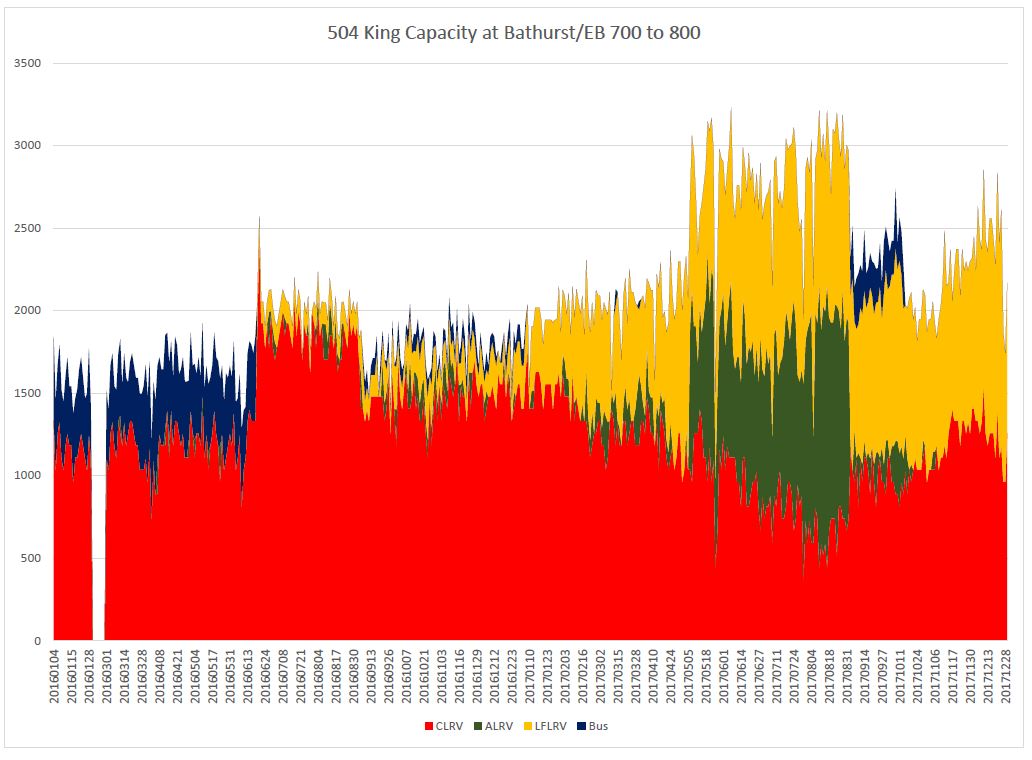
Here is an example of one chart showing capacity eastbound at Bathurst & King between 7:00 and 8:00 am from January 2016 to December 2017 (note that February 2016 data are missing).
The capacity provided here was at its height in the spring and summer of 2017 when ALRVs normally used on 501 Queen were redeployed to 504 King. In fall 2017, service levels were reduced because of the change in vehicle type.
Noteworthy in this chart is the growth in capacity provided by Flexitys first on 514 Cherry (building up to full low-floor operation by mid 2017) and more recently with the addition of the new cars to 504 King. Although they do not make up half of the vehicles operating on King, they account for half of the capacity in the central section.
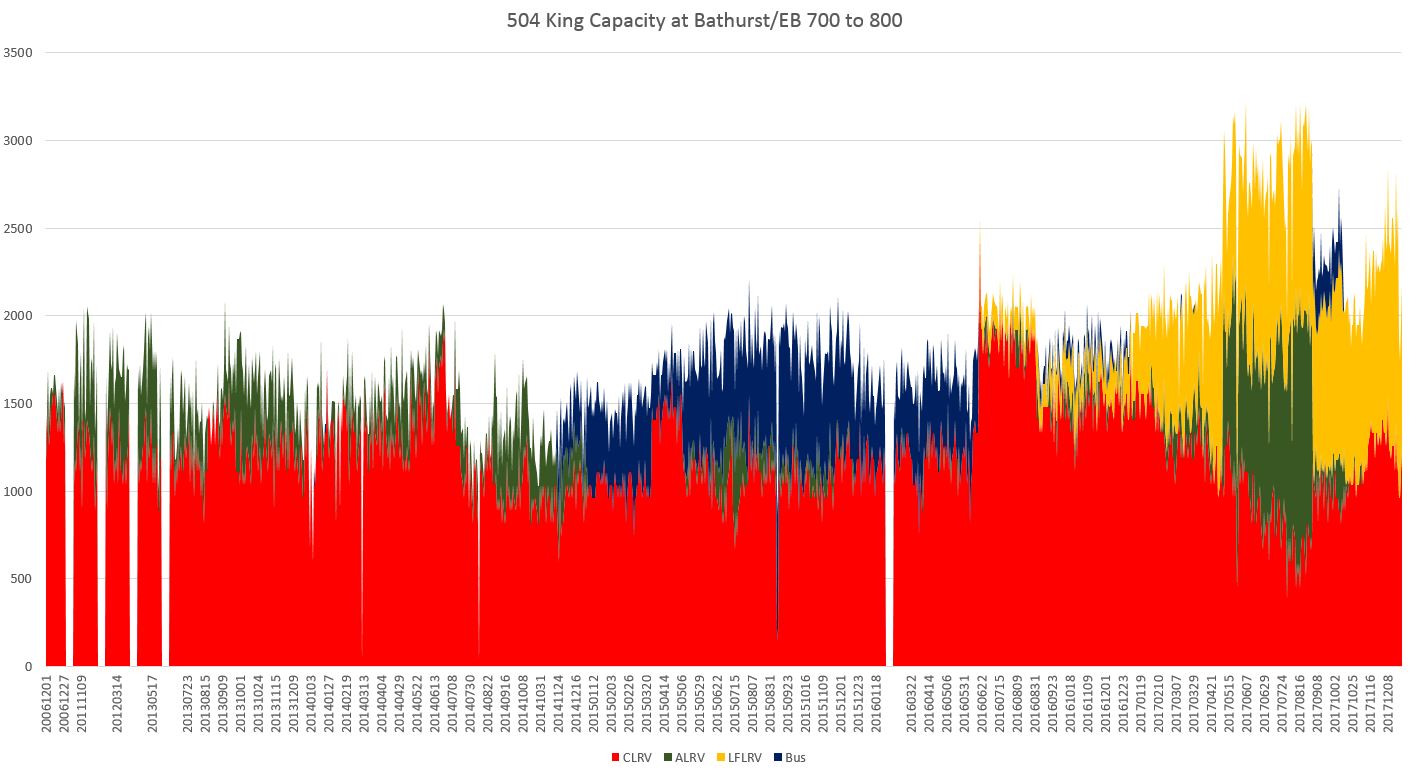
For a longer-range view of capacity, here is the same chart with data (where I have the details) going back to December 2006. This illustrates the long period during which the capacity provided on 504 King was static even as land along the route redeveloped. This is a chronic problem on the streetcar routes because an order for new cars and a larger fleet was delayed so long.
The sets of charts below illustrate capacities at five locations and times. Each set contains four charts covering the peak periods from 6-10 am and 3-7 pm depending on which period is illustrated.
Service eastbound at Jameson does not include the 514 Cherry cars which enter the route at Dufferin. Flexitys appear here only after their recent addition to 504 King. Note how the capacity provided here drops in the hour from 8-9 am compared to those on either side of it.
The PM peak service design is different from the AM in that there are few or no trippers (depending on which schedule one considers), and so this location has been less affected by cutbacks in that part of the service. However, service capacity has not changed much over the past two years especially during the peak 5-6 pm hour.
The situation at Bathurst is similar to that at Yonge, although it can be affected by cars short-turning at Spadina. After the 503 service is added in February, the capacity at Yonge will be slightly higher than at Bathurst.
The capacity of service outbound west of Dufferin is, if anything, lower now than it was in past years. This reflects the concentration of service east of Dufferin with the coming of the 514 Cherry route.
In summary, riders who believe that service, as measured by capacity, has been better in the past are in many cases correct. An important part of the King Street Pilot will be to determine how much latent demand can be attracted to the route through the combination of lower travel and wait times, and greater route capacity.
Updated January 19, 2017 1t 12:45 am: The TTC advises that the numbers that were included in the speaking notes of the Powerpoint presentation regarding Presto usage were incorrect. The info I used showed the change for both 504 King and 501 Queen to be about equal, begging the question of how this could show a King-specific ridership growth. Correct data now appear in the article.
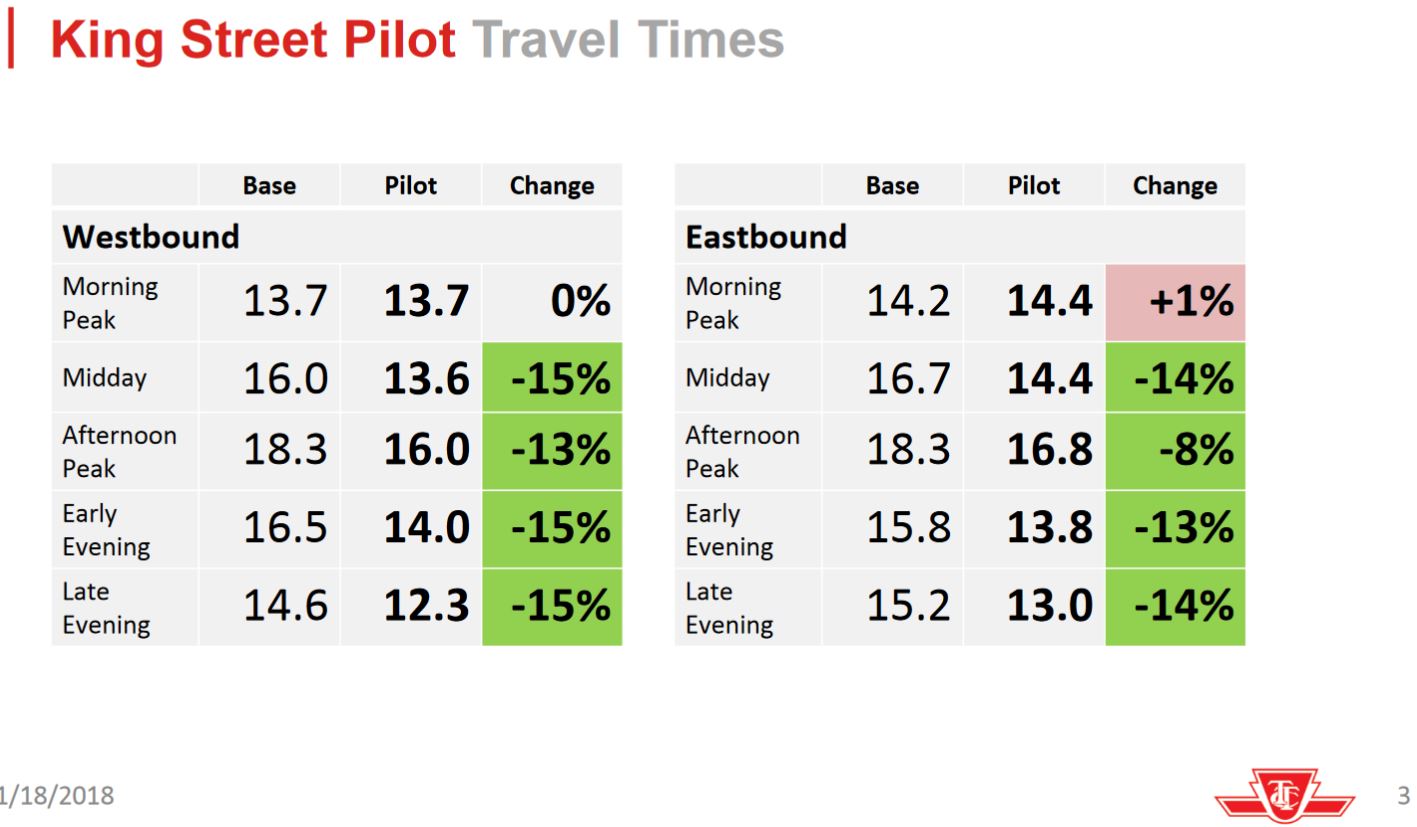
TTC Staff presented updated information on the King Street Pilot to the Board at its January 18, 2018 meeting.
The changes in travel times are shown for all periods during the day, not just for the peak periods as shown in the City’s December 2017 dashboard.
These numbers are different from those reported by the City because the TTC uses a different definition of the peak period (6-9 am, 3-6 pm) while the City’s figures cover begin and end one hour later in both cases. In either case, averaging over a three hour period reduces the benefit during the peak hour.
The TTC emphasizes that the benefits involve not just the pilot area, but the entire route through improved service reliability and reduced wait times.
Original reports of rididership growth cited only the peak eastbound hour at Spadina where demand rose from 2,100 to 2,600. Additional information about ridership growth based on Presto card usage shows that the improvement is more widespread. The table below compares the rise in Presto card usage on King and Queen streets from November 1 to January 8 with other routes. Both show higher figures than the balance of the system.
Correction: The following section includes figures that were taken from a TTC-supplied Powerpoint that had incorrect information in the speaking notes. Corrected info appears below..
It is unclear whether this simply represents a faster uptake of Presto by downtown riders than an increase specific to King Street. Indeed if Queen were showing similar riding growth, one would expect calls for much more service on that route too.
The original, incorrect, numbers for Queen were: AM Peak 32%, PM Peak 48%, Off Peak 44%, All day 43%
The corrected data shows that the change in Presto usage on Queen lies in the same range as on other routes while on King it has gone up substantially. This is not just an AM peak value, but an all-day one indicating a general rise in demand on King throughout its operating periods.
AM Peak
PM Peak
Off Peak
All Day
King
36%
48%
39%
41%
Queen
20%
27%
29%
26%
Other
26%
25%
25%
25%
[Source: Speaking notes to Powerpoint presentation, p. 4, corrected version for Queen from Stuart Green at the TTC]
Although an all-day ridership on the King corridor was previously cited as 65,000, a recent count was 10% higher at 71,000.
In mid-February, service on 514 Cherry will be improved during the off-peak. 503 Kingston Road will revert to streetcar operation between Kingston Road & Victoria Park and King & Spadina during weekday peak and midday periods. This will replace the 502 Downtowner bus which will now operate only during peak hours to Queen & University to shift some capacity to King Street.
Schedules will be adjusted to meet peak demand periods. Additional unspecified changes will occur in May based on updated ridership information.
Full operation of 504 King with low floor cars is planned for the end of 2018 with most of the route converted by the fall.
On the Torontoist, I wrote an article reviewing experience with the King Street Transit Pilot and some of the preliminary claims and reactions to it. This piece is the first of the technical follow-ups to that article with more detailed data about the behaviour of transit service on King.
Note that this analysis only covers the operation of transit vehicles, not of general traffic. For information on other data collected by the City of Toronto, please refer to the “data” page on the project’s site.
This article deals with travel times on various parts of the King route both inside and outside of the Bathurst-Jarvis pilot area. Following articles will address capacity and service reliability.
For a review of operations up to the end of November 2017, please see:
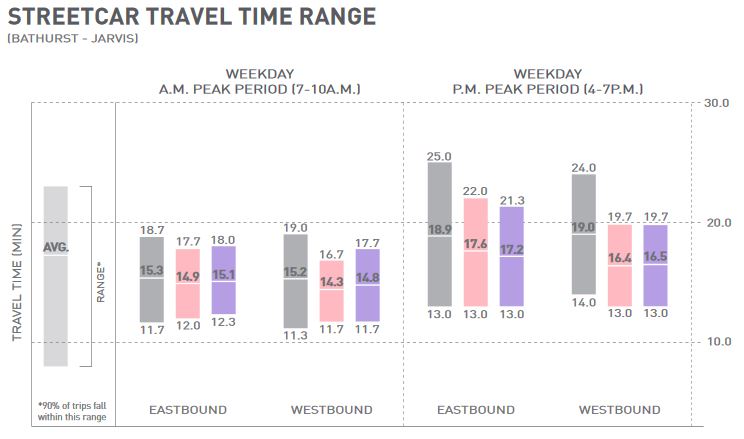
In reporting the change in travel times, the City of Toronto cites averages, maxima and minima for the “before” and “after” conditions. For example, in the chart below, eastbound trips in the PM peak before the pilot ranged in length from 13.0 to 25.0 minutes with an average of 18.9.
However, the “before” numbers omit some of the worse cases for travel times:
The period of the Toronto International Film Festival from September 7-17, 2017. During early days of TIFF, service was diverted via Spadina, Queen and Church adding greatly to travel times. Even after King Street nominally reopened, service was interrupted from time to time with unannounced diversions.
The period of track construction at Queen and McCaul Streets from October 16-27, 2017. This period saw 501 Queen streetcars shift south to King adding turning movements at Church eastbound and Spadina westbound that took place generally without any transit priority. Some traffic spillover from Queen to adjacent streets occurred, but this was not measured.
Gray: Pre-pilot Pink: November Mauve: December
Although omission of these two periods puts the best possible light on the “before” conditions and avoids criticism that the project is making a worst/best case comparison, it is a fact of life that service and travel times on King are routinely affected by various projects including construction and special events. A valid test for the pilot will be the street’s operation during a Queen Street shutdown for an event at City Hall or at Much Music. How will transit service and other traffic behave when part of the downtown network is taken “offline”? This remains to be seen.
The averages are the most commonly cited data in the press and in political comments. However, these averages hide a great deal.
Travel times vary considerably from hour to hour, and from day to day.
A three-hour average over the peak period includes many trips that occur under less-than-peak conditions, and this pulls down the averages.
Averaging data for several weeks smooths out the effect of daily variation.
Averaging over the entire pilot area merges data from areas where the pilot’s effect is small with those where it is large.
Averaging over only the peak periods misses the benefits, if any, of the pilot for off-peak operations.
The TTC has confirmed the following changes in the allocation of streetcars and buses to various routes effective with the February 18, 2018 schedules:
Streetcars will return to 511 Bathurst.
The 502 Downtowner bus will continue to operate, but only during peak periods (Bingham Loop to Queen & University).
The 503 Kingston Road car, normally a peak only tripper, will operate Monday to Friday peaks and midday (similar to the existing 502). The 503 car will run between Bingham Loop and Charlotte Loop (King & Spadina) to supplement service on King Street.
The 505 Dundas and 506 Carlton routes will be converted to bus operation.
Updated: The 514 Cherry service will be improved during the off-peak period.
The buses for 505/506 will come from a variety of sources:
Existing buses operating on 503 Kingston Road,
Tripper buses originally scheduled for 504 King but swapped to 505 Dundas since December, and
Buses that have been freed up from construction service and the route reorganization following opening of the Vaughan subway extension.
Both Dundas and Carlton will be affected by planned construction projects this year that would require partial replacement with buses even if there were no streetcar shortage.
Broadview Avenue track replacement from south of Dundas to Wolfrey (north end of Riverdale Park) including intersections at Dundas and Gerrard. This will also affect the east end of 504 King.
Updated:
The TTC has confirmed that they are reviewing stops on both routes for the need to remove adjacent parking spaces that would prevent vehicles from pulling in fully to the curb. Bus operation will use the same POP rules as on the streetcar routes.
At the TTC Board meeting on January 18, Acting CEO Rick Leary stated that although the bus conversion of 505/506 was originally announced for all of 2018, he hopes that with delivery of new streetcars this can be reversed sometime in the fall.
In other news:
Roncesvalles Carhouse will close for the remainder of 2018 for maintenance work, and operations will be centralized at Russell and Leslie.
501 Queen service to Humber Loop is planned to return with the schedule changes planned for May 13, 2018.
The King-Queen-Roncesvalles intersection replacement, the associated road reconfiguration and the extension of the right-of-way east from Parkside Drive to Roncesvalles remains in the 2019 schedule.
Even if buses were not filling in for streetcars, the TTC has no plans for bus service increases.
The bus replacement service is not preventing us from making bus improvements. In 2018, we do not have any budget for new improvements. Any improvements we make will be through reallocation. [Email from Stuart Green at the TTC]
More information is expected at the TTC Board Meeting on January 18, 2018. Also, the detailed memo of service changes for February should be out soon, and I will publish the usual condensed version when it is available.
Thanks to Stuart Green at the TTC for the information.
In my reporting of the September 2017 Metrolinx Board Meeting, I reviewed a presentation on Regional Fare Integration. At the time of writing, only the summary presentation to the Board was available, but the full Draft Business Case appeared some time later. This is the sort of timing problem that Metrolinx has vowed to correct.
A basic problem with such a delay is that one must take at face value the claims made by staff to the Board without recourse to the original document. This will mask the shortcomings of the study itself, not to mention any selective reinterpretation of its findings to support a staff position.
In the case of the Regional Fare Integration study, this is of particular concern because Metrolinx planners clearly prefer that the entire GTHA transit structure move to Fare By Distance. However, they keep running into problems that are a mix of organizational, technical and financial issues, not to mention the basic politics involved in setting fares and subsidies. If FBD is presented as the best possible outcome, this could help overcome some objections by “proving” that this is the ideal to which all systems should move.
At the outset, I should be clear about my own position here. The word “Bogus” is in the article’s title not just because it makes a nice literary device, but because I believe that the Fare Integration Study is an example where Metrolinx attempts to justify a predetermined position with a formal study, and even then only selectively reports on information from that study to buttress their preferred policy. The study itself is “professional” in the sense that it examines a range of options by an established methodology, but this does not automatically mean that it is thorough nor that it fully presents the implications of what is proposed.
The supposed economic benefit of a new fare scheme depends largely on replacement of home-to-station auto trips with some form of local transit (conventional, ride share, etc) whose cost is not included in the analysis. This fundamentally misrepresents the “benefit” of a revised fare structure that depends on absorption of new costs by entities outside of the study’s consideration (riders, local municipalities).
The set of possible fare structures Metrolinx has studied has not changed over the past two years, and notably the potential benefits of a two-hour universal fare are not considered at all. On previous occasions Metrolinx has treated this as a “local policy” rather than a potential regional option, not to mention the larger benefits of such fares for riders whose travel involves “trip chaining” of multiple short hops.
One must read well into the report to learn that the best case ridership improvement from any of the fare schemes is 2.15% over the long term to 2031, and this assumes investment in fare subsidies. Roughly the same investment would achieve two thirds of the same ridership gain simply by providing a 416/905 co-fare without tearing apart the entire regional tariff. In either case, this is a trivial change in ridership over such a long period suggesting that other factors beyond fare structure are more important in encouragement or limitation of new ridership. Moreover, it is self-evident that such a small change in ridership cannot make a large economic contribution to the regional economy.
Specifics of the Board Presentation
The Board Presentation gives a very high level overview of the draft study.
On page 2:
The consultant’s findings in the Draft Preliminary Business Case include:
All fare structure concepts examined perform better than the current state, offering significant economic value to the region
Making use of fare by distance on additional types of transit service better achieves the transformational strategic vision than just adding modifications to the existing structure, but implementation requires more change for customers and transit agencies
More limited modifications to the status quo have good potential over the short term
“Significant” is the key word here, and this is not supported by the study itself. Ridership gains due to any of the new fare structures, with or without added subsidies, are small, a few percent over the period to 2031. The primary economic benefit is, as the draft study itself explains, the imputed value of converting park-and-ride trips to home based transit trips thanks to the lower “integrated” fare for such services, encouraged possibly by charging for what is now free parking.
A large portion of automobile travel reduction benefits come from shift from park and ride trips to using transit for the whole trip – highlighting the importance of exploring paid parking to also encourage a shift from automobile for transit access. (p. xiv)
However, local transit (be it a conventional bus, a demand-responsive ride sharing service, or even a fleet of autonomous vehicles) does not now exist at the scale and quality needed, and this represents a substantial capital and operating cost that is not included to offset the notional savings from car trips.
Fare by distance does perform “better” than the alternatives, but none of them does much to affect ridership. Moreover, the fare structure, to the limited extent that the study gives us any information on this, remains strongly biased in favour of cheaper travel for longer trips. An unasked (and hence unanswered) question is whether true fare by distance and the sheer scale of the GTHA network can exist while attracting long-haul riders and replacing their auto trips with transit.
On page 3, the presentation includes recommendations for a step-by-step strategy:
Discounts on double fares (GO-TTC)
Discounts on double fares (905-TTC)
Adjustments to GO’s fare structure
Fare Policy Harmonization
This is only a modest set of goals compared to a wholesale restructuring of the regional tariff, and it includes much of what is proposed by “Concept 1” in the study – elimination of the remaining inter-operator fare boundaries, restructuring GO fares (especially those for short trips) to better reflect the distance travelled, and harmonization of policies such as concession fare structures and transfer rules.
Further consultation is to follow, although as we now know, the first of the four steps has already been approved by TTC and Metrolinx.
On page 6:
Without more co-ordinated inclusive decision making, agencies’ fare systems are continuing to evolve independently of one another leading to greater inconsistency and divergence.
This statement is not entirely true.
The GO-TTC co-fare is an indication of movement toward fare unification, although the level of discount offered on TTC fares is considerably smaller than the discount for 905-GO trips. That distinction is one made by the provincial government as a budget issue, and it cannot be pinned on foot-dragging at the local level.
Assuming that Toronto implements a two-hour transfer policy later in 2018 (and the constraint on its start date is a function of Presto, not TTC policy), there will be a common time-based approach to fares across the GTHA. All that remains is the will to fund cross-border acceptance of fares (actually Presto tap-ons) regardless of where a trip begins.
Without question, there should be a catalog of inconsistencies across the region, and agreement on how these might be addressed, but that will involve some hard political decisions. Would Toronto eliminate free children’s fares? Would low-cost rides to seniors and/or the poor now offered in parts of the 905 be extended across the system? Will GO Transit insist on playing by separate rules from every other operator as a “premium” service? These questions are independent of whether fares are flat, by distance, or by some other scheme as they reflect discount structures, not basic fare calculations.
Pages 6 and 7 rehash what has come before on pp. 2-3, but the emphasis on fare by distance remains:
Fare by distance should be a consideration in defining the long-term fare structure for the GTHA. [p. 7]
“A consideration” is less strong language than saying that FBD should be the target framework. If this is to be, then Metrolinx owes everyone with whom they will “consult” a much more thorough explanation of just how the tariff would work and how it would affect travel costs. The draft report is quite threadbare in that respect with only one “reference” tariff used as the basis for a few fare comparisons, along with a caveat that this should not be considered as definitive. That is hardly a thorough public airing of the effects of a new fare structure.
No convincing rationale has been advanced for moving to a full fare by distance system, including for all local travel, and it persists mainly because Metrolinx planners are like a dog unwilling to give up a favourite, long-chewed bone. At least the draft study recognizes that there are significant costs, complexities and disruptions involved with FBD, begging the question of why it should be the preferred end state.
On page 8:
Amend [GO Transit fares] to address short/medium trips and create a more logical fare by distance structure based on actual distance travelled instead of current system to encourage more ridership.
This is an odd statement on two counts:
Lowering fares for short trips will encourage demand on a part of the GO system that overlaps the local TTC system, and will require capacity on GO that might not be available, especially in the short term before full RER service builds out.
True FBD will increase long trip fares on GO and discourage the very long haul riders whose auto-based trips GO extensions were intended to capture. The reference tariff implied by sample fares in the draft report is most decidedly not FBD with short haul fares at a rate about four times that of long hauls.
In other words, the goal as presented to the Board does not match the actual sample fare structure used in the draft study.
On page 14:
GO/UP uses tap on/off, other agencies are tap on only. Emerging technological solutions may allow tap on-only customer experience while maintaining compatibility with fare-by-distance or –zone structures.
The technology in question, as described in the study, would require all Presto users to carry a GPS enabled device that could detect their exit from vehicles automatically without the need to physically tap off. This requires a naïve belief that all riders will carry smart mobile devices to eliminate the congestion caused by a physical tap on/off for all trip segments, and is is a middle-class, commuter-centric view of the transit market.
On page 15:
Completely missing from the discussion is any consideration of loyalty programs such as monthly passes or other “bulk buy” ways of paying fares. Already on the TTC, over half of all rides (as opposed to riders) are paid for in bulk, primarily through Metropasses. GO Transit itself has a monthly capping system which limits the number of fares charged per month, and software to implement the equivalent of a TTC Day Pass through fare capping is already in place on Presto. (It has not been turned on because of the possible hit to TTC revenues if riders were to start receiving capped fares without having to buy a pass up front.)
Several issues are listed here that reflect the complexity of a system where the lines between local and regional service have already started to blur, and where simplistic segmentation of classes of service simply do not work. The argument implicit in this is that only a zonal or distance based fare will eliminate many of the problems, but there is no discussion of the benefits obtained simply by a cross-boundary co-fare plus time-based transfer rules to benefit multiple short-hop trips. This demonstrates the blinkered vision at Metrolinx and a predisposition to distance-based “solutions”.
For those who will not read to the end of the detailed review, my concluding thoughts:
There are major gaps in the analysis and presentation of the Draft Report. By the end of the study, it is abundantly clear that the target scheme is FBD and future work will aim in that direction. Metrolinx’ FBD goal has not changed, and this begs the question of how any sort of “consultation” can or will affect the outcome.
The remainder of this article examines the 189-page Draft Report and highlights issues in the analysis.
Two months ago, I wrote about the Regional Transportation Plan that Metrolinx had put out for public comment, and that period for online feedback has now closed. In the interim, I had hoped to see more details in the new plan, more analysis that could inform debate and feedback, but very little has appeared on the website where one might expect to see a wealth of background. Instead, there are three studies:
The last of these drew my attention first both because of its size and because this would be the place one would expect to learn how the draft network came to be, and what the benefits are expected from its components. Alas, that information is not just missing, it is not even hinted at as if it might exist in some deeper background study. Metrolinx provides a very general overview of the anticipated effect of their network, but little sense of the relative value of its components.
The purpose of the regional network study is quite clear:
This will serve as one of several technical background reports that will provide a foundation for the RTP Update.
The purpose of this Phase 1 report is to describe the preliminary recommendations for a 2041 strategic transit network for the RTP Update. This includes the identification, analysis and evaluation of potential transit projects and the development of a regional transit network to effectively meet existing and future transit needs across the region. Together, these activities comprise Phase 1 of the Regional Transit Network Planning Study.
Phase 2 of the study will support the RTP implementation plan, and will include the preparation of refined alternatives, specific recommendations, potential roles for various service providers, and a preliminary phasing strategy for the proposed strategic transit network. [p. 1]
In other words, don’t look for specifics here because they’re still working on the details.
Only one paragraph later comes a vital comment under the heading of “Regionally Significant Transit”:
While the provision of effective transit is dependent upon a fully integrated system with local transit supporting regional routes, this study focuses on transit projects
that are considered regionally significant. The resulting regional network is intended to link seamlessly with municipal transit services that are planned and operated
by GTHA municipalities. [p. 2]
Local municipally-provided services are an integral part of any network, but they are assumed to “be there” and are not the focus of this study. However, the funding and expansion of local transit is essential to the “last mile” problem where most regional network users access it via park-and-ride lots, a mode that is not sustainable for an expanded system. This is particularly important for trips that are not anchored at one end by a major destination node, or very good local transit. There is no point in making a trip through a “regional” station if there is no “local” service to complete the journey.
14 Glencairn is the latest of many routes to get additional running time compensating for the Crosstown LRT construction. Oddly, the end date shown for this change is December 2022 where all other Crosstown-related end dates are in 2021.
Supplementary service on 32 Eglinton West is being reorganized. There are currently several Service Relief buses operating from Mt. Dennis during most operating periods. These will be replaced by peak-only buses from various garages.
75 Sherbourne trips at the start and end of service are being changed to begin/end at Sherbourne Station rather than at South Drive in Rosedale.
The official route and stopping arrangements for various lines serving Finch West and Pioneer Village Stations have been clarified for periods when these stations are closed.
The TTC has already confirmed through the media that due to the late delivery of Flexitys from Bombardier, there will be bus substitutions on 505 Dundas and 506 Carlton starting with the February 18, 2018 schedules. This is also related to service reorganization to boost capacity on King Street. I will report the details when they are available.
(Bus trippers originally planned for 504 King are now actually operating on 505 Dundas replacing CLRVs that have been redirected to King Street for extra capacity.)
It should be noted that due to track construction on Broadview planned in 2018, there will be effects on the Carlton, Dundas and King routes that will probably last two schedule periods.
Metrolinx held a Board meeting on December 7, followed on December 12 by a Town Hall.
Public questions to the Town Hall were submitted in advance and in real time during the Town Hall online, and in person by attendees. Metrolinx plans to put answers to all questions, including those that could not be handled during the Town Hall itself online in coming weeks. That record is now available at MetrolinxEngage.
My interest in both events was as much to see how the new CEO Phil Verster would handle himself especially during an open Q&A session which has not, to be kind, been part of the corporate culture at Metrolinx.
As a Christmas gift to all my readers here, this post is a gallery of the photos I put up on Twitter (@swanboatsteve) for “throwback Thursday” this year. I know that not everyone follows me on social media, and in any event, I wanted to assemble all of the photos in one convenient place.
There is no particular rhyme or reason to this collection beyond whatever happened to be a topic appropriate for the occasion.
Also, an apology to regular readers for the lack of updates, beyond promoting comments, recently. I have been distracted and many articles and ideas are marooned “in progress”. Over the holidays there should be no new political crises to attend to, and I hope to catch up.