Streetcar System News – February 2014 (Updated)

Updated February 11, 2014 at 10:00 am:  Questions & answers related to trackwork plans and new streetcars have been added.

Spadina / Queens Quay Update

To nobody’s great surprise, the restoration of streetcar service south of King Street on Spadina will not occur until June 21 rather than with the schedule change in late May as originally hoped. This is a direct result of the bad weather and poor construction conditions. The TTC’s position is:

Due to the delays in Waterfront Toronto’s work and the need for TTC work to follow in series (i.e. overhead), it is not anticipated that the loop will be available for service for the May Board Period. Once we have greater clarity, we will reflect that online.

Some preliminary work on suspension for the new overhead has already been done, but this cannot be completed until the track is in and overhead vans can drive on the new pavement at the loop.

As plans now stand, service will resume on both the 510 Spadina and 509 Harbourfront routes with the re-opening of new streetcar track on Queens Quay rather than in two stages as originally hoped.

I await detailed info from Waterfront Toronto on updates to their construction plans. Much of the utility work on the south side of Queens Quay is now completed, and traffic is shifting to that side of the road at least as far west as Rees Street. This move will allow work to begin on the new streetcar right-of-way in the middle of Queens Quay and the construction of the new permanent roadway on the north side.

Detailed construction news updated weekly is available on Waterfront Toronto’s Queens Quay project page.

No sooner will streetcar service resume on southern Spadina, but the route will convert to bus operation for two track projects likely in August. The intersection at Dundas will be rebuilt this year (the one at College has been deferred because of scheduling conflicts), and there will also be work at Spadina Station.

When the line reopens on August 31, service will be provided, at least in part, by the new low-floor streetcars.

Updated February 11, 2014:

Q: What work is planned at Spadina Station? Track? Platform – especially provision so that two new cars can be on the platform at once – one loading, one unloading. Only 3 CLRVs fit there today.

A: The TTC has placed two low floor streetcars at Spadina already. They can physically fit inside the station, although the lead module of the lead car would have to be positioned opposite the five pillars with glass curtains, and that the lead door would be on curved track with a wider gap between the vehicle and the platform. We are reviewing operating procedures and possible alterations that are necessary to allow two new cars to be on the platform at the same time if necessary.

This implies that the work to be done in August will be trackwork, not platform changes.

New Streetcars

Recently, I sent questions to the TTC about the status of new car production and the implementation of these vehicles. Here are the replies:

Q: What is the status of the order and when will production deliveries begin?

A: Production deliveries will begin in March.

Q: What will be the rate of deliveries?

A: As always planned, there will be a ramp up to the production rate of 3 per month (36 per year). Once stabilized at this rate there are opportunities to transition to a higher rate and this is currently under investigation.

Q: What effect will this have on planned retirement of the problem ALRVs before the next winter season?

A: ALRVs will begin retirement at the end of this year and throughout 2015 as more new streetcars enter service.

What is still unclear is how the TTC will adjust service on 504 King and 501 Queen as the ALRVs [the existing two-section streetcars] disappear from the fleet and these routes continue operation with the remaining CLRVs [the shorter, single-section cars].

Updated February 11, 2014:

Q: Are there outstanding issues still to be dealt with on the ramps in the new streetcars, or have whatever design tweaks were necessary been incorporated in the production versions we will receive?

A: There are still a number of outstanding issues to be resolved. The production vehicle will have the necessary structural changes made to receive the new ramps. However, there is a transition phase between cars going into revenue service and when the final version of the ramp is delivered. For a number of vehicles that will go into service, an interim ramp will be incorporated to improve on accessibility – with improved transition between the ramp, the door threshold and the interior car floor. The final production version will be lighter in weight, less demanding on the drive mechanism (hence more reliable), and will have faster deployment and retrieval times. Initial production cars that do not have the latest ramp configuration will be retrofitted with the final version as part of the configuration control process.

Capital Budget Cuts

Among the City-imposed cuts in the Capital Budget was a $10-million/year cut in surface track maintenance for 2014 to 2018 with an equal cut to subway track in 2019 to 2023. I asked about the effect of these cuts.

State of good repair, which track replacement is clearly part of, will not be affected. If we need to further cut the capital budget to do track work, we’ll find that money elsewhere.

Queen East Major Track Projects

Two major projects will affect streetcar service on Queen Street East this spring.

At Queen and Leslie, the new sewer line must be tied into existing infrastructure under Queen Street, and then the new special work for the track leading to Leslie Barns must be installed.   Tentative plans are for this work to begin in mid-May and run to the end of June.

While Queen Street is closed, service will operate with bus replacements and streetcar diversions:

  • A 501 Queen bus will run from McCaul Loop to Woodbine Loop (at Kingston Road) diverting around construction via Jones, Dundas and Greenwood.
  • 501 Queen, 502 Downtowner and 503 Kingston Road Tripper streetcars will divert via Broadview, Gerrard and Coxwell.
  • Carhouse trips for 504 King and 505 Dundas that now operate west from Russell Carhouse via Queen will use Coxwell and Gerrard.

Beginning at the end of June and running through July, the special work at Broadview and Queen will be replaced. This intersection is in poor condition with long-standing slow orders and one switch (west to north) permanently out of service due to a danger of derailments.

During this work, service will operate as below:

  • The 501 Queen bus will divert via River, Dundas and Carlaw.
  • 501 Queen, 502 Downtowner and 503 Kingston Road Tripper streetcars will divert via Parliament, Gerrard and Coxwell.
  • 504 King cars will divert via Parliament and Dundas.
  • Carhouse trips to Russell will continue to operate via Coxwell.

Normal service on all routes resumes in August.

King Street Diversion

New February 11, 2013:

Q:  The 504 King diversion around construction at the Don Bridge is now listed as running to August due to additional work in the area.  I understand that the track connection at Sumach to the new Cherry Street line is to go in this year.  Will this be done while the 504 is on diversion (ie before August), or will there be yet another shutdown for this trackwork too?

A:  The Sumach/King connection work is scheduled for March 30.

Transit Priority for Diversions:

Q:  With the extended period of various diversions, why has there been no change to implement transit priority or at least advance greens for left turns at various locations?

A: We continue to work with the City on transit priority signalling. There are no new installations to date; where there, they are in use. Advance greens and the like is a question better put to the City.

I am meeting with Stephen Buckley, Toronto’s General Manager of Transportation Services, on February 12 and will discuss this issue with him.

[TTC comments provided by Brad Ross via email on February 7, 2014.  Updates by email on February 11, 2014.]

Poor Frozen Streetcars

Over the past week, we have heard a lot about streetcars that were stuck in the yard or failed in service because of frozen air lines.

If the air isn’t dry, moisture condenses and freezes, blocking air movement.  Whatever system that air line runs – such as releasing the brakes – stops working, and the streetcar is stuck just as if it were frozen to the rails.  Think of this as sclerosis for streetcars.

Drying the air has been an issue for the streetcar fleet more or less since it was delivered 30 years ago, and the problem is worse on the long ALRVs than on the shorter, and older, CLRVs.  One can only wonder if this is yet another subsystem where the TTC gambled that things would keep running until new cars arrived.

They lost.

Record cold weather meant anything that was borderline temperature sensitive has failed, and riders have seen the effects.

The new cars are over a year late.  If the wait means they work perfectly “out of the box” I will be ecstatic – the Toronto Rocket subway trains have not exactly inspired confidence in Bombardier.

The partial replacement of streetcars by buses led inevitably to musing by Councillor Doug Ford that maybe we should just make this a permanent arrangement.  The Ford family is well known for looking for any excuse to rid Toronto of what they see as a nuisance.

This begs two very important sets of questions for the TTC and its current chair, Karen Stintz.  Will they rise to the streetcars’ defence not just for the short, post-deep-freeze, but for their long-term future?

Continue reading

TTC Capital Budget 2014-2023 Part II: Streetcar Infrastructure

The TTC 2014-2023 Capital Budget contains a great deal of streetcar infrastructure work over coming years.  Broadly, this can be subdivided into three types of project:

  • Catching up with inferior maintenance of past decades to bring the system to a “steady state” condition where each year’s work is commensurate to the scale of the network and industry norms for the lifespan of assets .
  • Changes to support the new low floor LRVs including Leslie Barns, conversion to pantograph power collection, and updating other infrastructure such as power supply and track switching.
  • System expansion.

Although some of this looks ambitious on paper, the plans are threatened by capital availability at a level well below what is needed.  The TTC has other demands on a shrinking capital pool, notably on the subway system.  Combined with the City of Toronto’s self-imposed limits on debt levels and taxes and the expiry of various provincial and federal funding programs, there is insufficient capital to maintain the system.  The streetcar network takes a hit from this, but the details are not yet known.

I will explore the shortfall in capital funding in the next article of this series.  Meanwhile, the plans discussed here should be read in the context that the City Budget, as now written, seeks a reduction in various line items of the TTC’s Capital Budget.  How this will fare at Council remains to be seen.  The two biggest problems are the lack of details of where cuts will fall and their effect, and the abdication of responsibility for advocacy by TTC Board members and senior management.  “We will muddle through somehow” is not an inspiring call to battle.

Continue reading

TTC Capital Budget 2014-23 Part I: Fleet Plans (Or, Where Will We Put The Riders?)

The past two years at TTC and Council have been all about the fight over LRT and subways, and the shifting loyalty to each mode especially when potential votes are to be gained.  While Toronto (and Queen’s Park) flailed about with expensive rapid transit plans, something more important, but more subtle, off the radar, was happening.

Discussion of the future of our transit fleet and service levels later this decade took a back seat in the triumph of ideology over planning.  We are now in a position where all three modes — subway, streetcar and bus — will strain to meet demands placed on them for the foreseeable future.  We will have very clean subway stations, but service and capacity are quite another matter.

The problems for each mode are different.

Continue reading

TTC Board Meeting Wrapup for July 24, 2013

The TTC Board met on July 24, 2013, with a rather threadbare agenda.  The most important item discussed — a proposal for a new Downtown Relief Line on GO corridors — wasn’t even on the agenda.  It was walked in by Chair Karen Stintz, proposed as a report request and voted on with almost no debate near the end of the meeting.

Included in this wrapup:

  • Steeles West Station gets a new name (again)
  • Evaluation of contract bids
  • Bixi and the TTC
  • CEO’s Report
  • Trial Service Changes on 53 Steeles East and 95 York Mills
  • Implementation of New Streetcars (update)

Continue reading

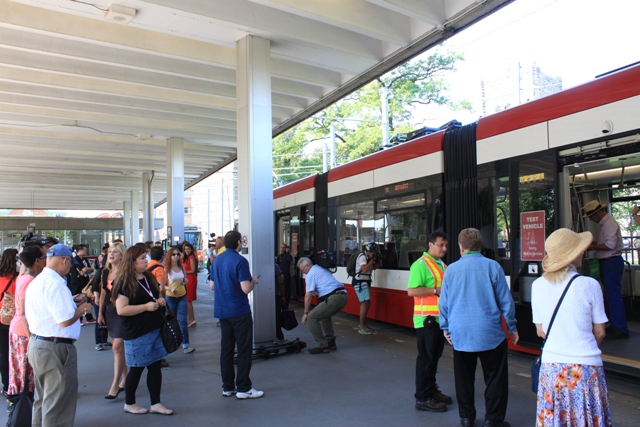
An Inaugural Ride on 4401

Today the TTC took the media on a short excursion with its new streetcar, 4401, from Hillcrest Yard to Bathurst Station and return.  I spent a good deal of the trip being interviewed by others, and so my photo coverage is limited.  However, over on the Torontoist site, there are lots.

Our journey was done at a leisurely pace.  This was the first daylight voyage for one of the new cars, and it attracted a lot of attention.  We seemed to arrive at Bathurst Station in almost no time, and this was in part due to the extremely smooth ride.  I made a point of sitting directly above one of the trucks (the point of where the carbody has the least ability to move independently), and even going through special work, the vibration was not annoying.

The curve into Bathurst Station from the north was more notable for the fun of seeing both ends of the five-section car at the same time (the turn is over 120 degrees) than for any sense of difficulty making the turn.

Air conditioning was quite pleasant onboard, and the car maintained a comfortable temperature even with the doors open at Hillcrest Yard.  The generously sized windows give a good view of the passing street, although it will remain until night operation to see just how much the tinted glass cuts external visibility.

Daytime test runs will become more common now that the TTC knows the vehicles work and won’t be the source of massive service tie-ups.

What I really look forward to is seeing and riding these cars in service.  How will loading times be improved?  Will the accessibility features work and be accepted as designed?  How easily will passengers adapt to the new fare collection scheme as it gradually rolls out across the system?  How long will it take for operators to drive these cars through Toronto streets with the same confidence and speed as they do with the CLRVs?

Car 4400 is about to move to Ottawa for climate testing at the National Research Council.  From there, it will return to Thunder Bay to be retrofitted with improvements developed during the test phase.  4401 and 4402 are still on the property, but they too will go back to Thunder Bay for retrofits.  The TTC is holding off giving the green light to the production vehicle run to get the greatest benefit from the testing that remains, but shipments will begin in fall 2013 for a spring 2014 rollout.

IMG_4011w

Sitting in the loop at Bathurst Station, there was (as operators of railfan charters would know it) a “brief photo stop”.  The media went crazy of course with everyone getting in each other’s shot.

No, there is nothing wrong with the destination sign.  The LEDs in the sign are not all lit at once, but the image “scans”.  We don’t see this effect (just as we don’t see flicker on a TV screen or computer monitor).  It will be almost impossible, except with a long exposure, to get a picture of these cars with all of the text in the signs readable.

A related issue is that during the daytime, glare on the side windows can make the signs above the doors difficult to read (in the photo below, the sign is in the shade).  The transit industry solved the problem of brightly-lit signs a long time ago, and I don’t understand why the TTC has taken a step back here.

IMG_4009w

More media at Bathurst Station with a few real customers mixed in.  We managed to create a minor gap in the 511 Bathurst service.

Continue reading

An Interminable Debate About Track Gauge

This post has been created for the sole purpose of being a repository for a string of comments in the “Feeling Congested 2” article that got into increasingly farfetched schemes for regauging the TTC to standard gauge or conversely arguing that TTC gauge should spread throughout the GTHA and beyond.

This issue has been debated, if that is the word, at great length here to no discernible benefit — Metrolinx is building a standard gauge network, while TTC gauge remains on the Toronto streetcar and subway networks.

Comments on this post are closed.  Any that attempt to sneak in on another thread will be deleted.

Development Charges and Transit Expansion

The City of Toronto Executive Committee will discuss the matter of a new Development Charges Bylaw at its meeting on July 3, 2013.  This is a statutory requirement as the current bylaw expires in April 2014, and it must be replaced in order for the city to continue collecting these charges.

Already press reports show a real estate industry apoplectic at the possibility that these charges will double.  With all the concern over a possible softening of the market for new units, the last thing they want is yet more cost added to the purchase price.  However, what we are seeing is a combined effect of the rising population and the exhaustion of surplus capacity in existing infrastructure, notably transit and water.  Much of the new development is concentrated in the central city in former industrial areas that do not possess the infrastructure needed to support their coming new populations.

(Chief Planner Jennifer Keesmaat observed at the “Feeling Congested” session earlier this week, about 70,000 people will call places like Liberty Village and the waterfront neighbourhoods their new home over the coming decade.)

There is bound to be lively debate, especially from the “no new taxes” brigade on Council, but the simple fact is that the city cannot have new development without some way to pay for the supporting infrastructure and services.  In this article, I will talk only about the transit component which is the single largest piece of the new DCs rising about 150% from the previous level for residential development.  (DCs overall will go up 86% because other categories have lower increases.)

Continue reading

TTC Meeting Wrapup for June 24, 2013

Aside from the King Street transit lanes and the new streetcar rollout plans (covered elsewhere), there wasn’t much else on the agenda for the TTC Board (as it now styles itself).

One procedural change was that there are no longer any printed agendas for the meeting — reports are available only online.  If you’re not carrying a device that can display them easily, you’re flying blind making sense of the meeting.

CEO’s Report

Ridership for reporting period 4 (mainly the month of April) was 1.1% below budget, but 2.2% above the corresponding period in 2012.  Poor April weather (an unusually cold early spring) was blamed for the shortfall.  For the last twelve months (May 2012 to April 2013), ridership is up 2.4%.

For the year 2013, ridership is expected to be at the budgeted level of 528-million.  However, the average fare is lower than projected because of higher pass usage, and the revenue projections are down by $2.0m.  This is offset net savings in expense lines.  On the entire budget, this is a variation of less than 1.5%.

Yonge subway reliability has fallen due to ongoing issues with TR train reliability, “workforce availability”, passenger-related delays and fires at track level.

There has been no update on problems with the TRs beyond “we’re working on it”, and the time is overdue to ask whether the goals for reliability have been set too high.  Without a detailed report on the situation, there is no way to know whether the trains have chronic, difficult-to-solve problems, or if we can expect some resolution.  (According to minutes of an Advisory Committee on Accessible Transit meeting (ACAT), TTC staff have no prognosis for correction of the TR platform leveling problem that makes trains inaccessible.)

36 of the 70 TR trainsets on order have been accepted for service.  This leaves 34 trains still in the pipeline to hit early 2014, although the last 10 of the trains are intended for the Spadina extension that will not open until 2016.

“Workforce availability” is an odd term to use considering that overall attendance rates at the TTC are supposed to be improving.  Punctuality is affected by a number of factors including the effect of many small delays, but also by extended times required for some crew changeovers.  The TTC needs to sort out which effects are strictly due to staff and which to other factors.

The reliability index for Bloor-Danforth is also dropping, but still runs at a higher level than the Yonge-University-Spadina line.  The TTC does not break out the various sources of delay by line to report which problems exist system wide and which are more prevalent in certain locations.

SRT performance has been quite good since October 2012 when schedules were changed to reflect the actual capabilities of the aging technology.

Surface route performance for both modes is above the rather generous target levels, but we know from the Quarterly Report published earlier in 2013 that overall headway adherence is quite bad on some routes.  This is no surprise to anyone who looks at vehicle monitoring data.

Elevator and escalator availability continues to get a high rating, although, as I understand things, this is based on a once-a-day report of status.  There is no report of the prevalence of outages or their duration.  This is rather like looking out the window, seeing one bus, and deciding that all is well with the transit system.

A few new Sunday shutdowns of the subway have been announced in this report:

  • June 29 from Wilson to Downsview for track installation.
  • July 7, 14 and 28 for beam installation on the Prince Edward Viaduct.  This work is normally done during the night-time shutdown, but a provision for opening the subway later than normal gives more time to complete planned work.

Details will be announced for each planned shutdown.

Change Orders for Design Costs on the Spadina Extension

Four reports requested substantial changes in the contracts for design work at Steeles West, Vaughan Corporate Centre, Highway 407 and York University stations.  The magnitude of the changes attracted questions from the Board.

According to staff, TTC practice is to award design contracts based on interim amounts with change orders issued along the way as required.  A contingency budget line provides funding for these changes.  Some of the costs will be recovered from third parties such as York Region and GO Transit/Metrolinx who asked for design changes in the originally completed plans.  Other costs were incurred to reduce construction expenses and keep stations within the project’s budget.  The degree to which this may have compromised the original designs is unknown.

Oddly, some of the extra costs cited by staff were for activities at Finch West and the new Downsview/Sheppard West stations (changes to suit GO and the Finch West LRT project).  Neither of these was the subject of the four reports on the agenda.

CEO Andy Byford wants to improve the reporting of large project budgets and costs, but does not expect to have a proposed scheme for doing so until fall 2013.

Steeles East Night Bus

The Board approved the proposed extension of the 353 Steeles East route from Middlefield Road to Markham Road effective August 4, 2013.  This extension uses up excess running time in the current schedule and requires no extra buses.

Ossington Bus / Hellenic Home for the Aged

The TTC has been requested to divert the 63 Ossington bus to a home for the aged which is north of Davenport up a steep hill on which seniors have difficulty walking to service on the main street (see map in report).  A decision on the matter has been put off to July 24 to allow for meetings between staff and those requesting the change.

The staff report recommends against this diversion which was requested through Councillors Mihevc and Fragedakis.  Mihevc should know better as a former member of the TTC Board.  Off-route diversions are the bane of transit operations and compromise the benefit of straight routes for passengers.

It is worth mention that this home was built off of the Ossington route some decades ago, but long after the route was established.  The policy decision is whether transit routes should be tweaked to serve such sites, and whether the Board has the political backbone to say “no” when the greater good of the route and the precedent for future requests are at stake.

Bicknell Loop

The property at which the Rogers Road car, originally part of York Township Railways, ended has been declared surplus to TTC requirements.  Buses on this route use the nearby Avon Loop on Weston Road.

TTC Low Floor LRV Roll Out Plan Released (Update 3)

Updated June 25, 2013:  At the June 24 Commission meeting, CEO Andy Byford presented further details of the roll out plan.  This information is added to the end of the article along with additional information I received from TTC staff.

Updated June 23, 2013:  A section has been added at the end of the article discussing service levels and fleet planning during the transition from CLRV to LFLRV operation on routes.

The TTC has released its roll out plan for the new fleet of low floor light rail vehicles.

The TTC proposes to increase capacity on all routes during peak periods, although by varying amounts.  Off peak headways will be almost unchanged with an effective doubling of capacity on all routes using the 50-foot CLRVs, and a 1/3 improvement on routes with the 75-foot ALRVs.  As a general policy, this is a very good start because it avoids replacing capacity-for-capacity with concurrent widening of headways and degradation of service.

The new service levels are shown on the presentation at pages 7-8, and the changes in peak period capacity are summarized in the following table.

LVLRV_Capacity_2013.06

The amount of added capacity varies by route and between the AM and PM peak periods.  This is supposed to represent the TTC’s estimate of provision for unmet demand although some numbers are a bit hard to believe.

Oddly enough, by the time the new fleet is in place, all of it has been used up serving existing routes (with a 20% allowance for spares).

Off peak services are almost unchanged with the odd effect that there is better planned midday and evening service on some routes than in the peak periods.  The TTC claims that the off-peak levels are set based on a minimum headway policy.  However, it does not make sense to cut service during the peak period.  This seems more the product of two separate plans drawn up without cross-reference to each other than the outcome of careful planning.

Continue reading