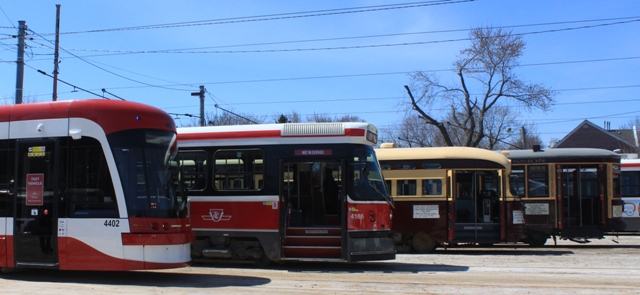
Four Generations of Streetcars for Easter (Updated)

The TTC has announced that one of the new streetcars will be in the Beaches Easter Parade along with the Peter Witt, a PCC and a CLRV.

The parade sets off at 2:00 pm westward from Munro Park [no, not mine] westward to Woodbine.

Updated with photos on April 20, 2014 at 5:00 pm.

IMG_4763w

LFLRV 4402, CLRV 4186, PCC 4549 and Peter Witt 2766 at Russell Yard before the parade.

Continue reading

TTC Board Meeting: March 26, 2014

The Toronto Transit Commission Board will meet on March 26, 2014 at 1:00 pm in Council Chambers at City Hall.  The Agenda contains a number of items of interest.

  • An update on the Union Station project (Revised to add info from Metrolinx)
  • The March 2014 CEO’s report
  • Purchase of 10 additional “TR” subway trains for future demand growth
  • A report on Community Bus services
  • A proposed design for Kennedy Station’s interface to the Eglinton LRT line
  • A report on a temporary bus terminal at Islington Station

Continue reading

Toronto Deserves Better Transit Service Now! Part 4: Streetcar Riders Count Too

Much discussion of improved service has talked about bus riders in the suburbs who have long trips and whose bus routes lost peak service when the crowding standards were rolled back in 2012.

Peak period crowding standards had never been improved for streetcars because there were no spare vehicles, and so there was nothing to roll back. However, over past decades, that shortage of streetcars limited peak service in a way that the bus system didn’t have to deal with.  This was compounded by two factors:

  • The TTC opened a new Spadina-Harbourfront line without increasing the fleet.  This was possible because service cuts on the early 1990s left Toronto with “spare” streetcars.
  • The project to buy new streetcars dragged on for years thanks both to the embrace of 100% low floor technology, and the obstructions posed by Mayor Ford to streetcar and LRT plans in general.

Between 1998 and 2014, the total number of streetcars scheduled for the peak periods has risen only 10%, and there is no headroom for further growth with the existing fleet. Indeed, service quality is compromised by vehicle failures, and the scheduled service may not all get out of the carhouse.

This year, the TTC will finally take delivery of the first “production” vehicles in its new fleet, and claims that service will operate as of August 31, 2014 on 510 Spadina with the new cars.  Whether the line will convert 100% to the new fleet in one go remains to be seen.

The TTC Fleet Plan contains no provision for improving service on any streetcar route beyond the higher capacity that new cars will provide. This will come only as the new fleet rolls out line-by-line and some routes will wait until late this decade to see more capacity (and even then with less frequent service).  Existing cars would be retired at a rate that matches or exceeds the new fleet’s ability to replace service, and would also eliminate any spare capacity for growth on lines running older cars.

This is what passes for responsible planning in an organization that claims a dedication to “customer service”.

This article looks at each streetcar route in turn and at a possible revised fleet plan that would make provision for short term improvements as the new fleet arrives.

Continue reading

When is “LRT” not LRT?

In all the debates about transit options, be they in Scarborough or elsewhere, one of the most abused and frequently misunderstood terms is “LRT”.

The term appears in various contexts over the years under both the guise “Light Rail Transit” and “Light Rapid Transit”.  The difference can be more in local preference including marketing aims.

One can even find “LRRT” where a proposal tries to be all things to be all people.  The Buffalo line, which incongruously runs on the surface downtown, but in a tunnel elsewhere, originally used this term, but was rebranded “Metro Rail”.  The “LRRT” term, however, is still in current use as a Google search will demonstrate.

The term “Light” contrasts “LRT” with systems that require more substantial (or “heavy”) infrastructure such as:

  • mainline railways including commuter rail operations such as GO,
  • “subways” as the term is used in Toronto (with other words such as “Metro” and “Tube” found in other cities),
  • any technology requiring a dedicated, segregated guideway and stations either because of automated control systems or because the right-of-way cannot be crossed for various reasons.

Life gets very confusing because there are overlaps between technologies and their implementation.  One of the oldest streetcar systems in North America, Boston’s, exhibits every conceivable type of operation with the same vehicles running in mixed traffic (little of this remains on the network), on reserved lanes in street medians, on private rights-of-way that run “cross country” relative to the road network, on elevated structures, and in tunnels just like a subway.  (The “Blue Line” running under the Boston harbour was originally a streetcar tunnel, but was converted to “subway” operation in the 1920s.)

The Boston Green Line is the oldest subway on the continent, and it runs with “streetcars” that morph into “light rail vehicles” not because of magic performed where they leave the street pavement, but because of the way the vehicles are used.  This is central to the concept of “LRT” – the ability to operate in many environments as appropriate to demand and local circumstance.

Unlike what Toronto calls a “subway”, an LRT network can adapt to its surroundings and this is a fundamental characteristic of the mode.  The original Scarborough LRT would have run at grade with some road crossings enroute, and a Malvern extension was on the books, but never built.

Continue reading

Streetcar System News: March 2014

On March 11, 2014, photos of car 4401 on training runs appeared in at least two locations:

  • St. Clair & Yonge on Torontoist
  • Spadina south of Adelaide on Twitter (Photo by Kyle Baptista @kylebap)

Delivery of the first production car, 4403, has been delayed until late April according to the TTC’s Brad Ross, but the rate of production can be ramped up by Bombardier.  In any event, 510 Spadina will operate with new cars effective August 31, 2014.

Meanwhile on Queens Quay, construction of the new streetcar right-of-way and the permanent north roadway is expected to begin later in March depending on the weather.  Work will begin west from Lower Simcoe to Rees, a section where utility work is completed and traffic can be shifted to the south side of the road.  West of Rees, installation of sewers is still underway.

Preliminary overhead work has been done at the exit from Queens Quay Loop, and work is also underway at the King/Spadina intersection.  During brief spells of warm weather, track within the loop was set in concrete.

TTC Service Changes Effective March 30, 2014

On March 30, 2014, the TTC will make changes to many routes.  In the detailed listing linked below, these are broken into four groups for miscellaneous service changes, new construction projects, route restructurings, and seasonal changes.

2014.03.30_Service_Changes

Construction Projects

The 29 Dufferin and 329 Dufferin Night routes will divert southbound via College, Lansdowne and Queen around water main work on Dufferin.  The interlined operation with 316 Ossington will be discontinued until late 2014 when this diversion is scheduled to end.

Reconstruction of the Gardiner Expressway will split the 501 Queen, 301 Queen Night, and 508 Lake Shore routes at Humber Loop.  The schedule will be the same one used in fall 2013 during construction on Lake Shore.  This is planned to last only for one schedule period (to mid May).

The intersection of King & Sumach will be rebuilt to add special work leading to new tracks on Cherry Street.  Streetcar service here is already diverting around the closed bridge east of River and so the construction has no effect on service.

Articulated Buses

7 Bathurst will be scheduled to use 18m articulated buses on weekdays with resulting headway widenings.  The effect is greatest during peak periods when headways widen to match the higher capacity of the vehicles.  The changes by time period are:

  • AM Peak:  6’15” to 9’10”
  • Midday:  8’00” to 9’30”
  • PM Peak:  5’30” to 7’45”
  • Early Evening:  9’00” to 10’00”
  • Late Evening:  12’40” to 12’30”

This route is already notorious for erratic service which will likely become even worse with fewer buses.  I plan to compare vehicle tracking data for this route for the “before” and “after” operations in a future article.

Other Changes

Several routes have new and/or adjusted last trip times to meet last subway trains including an allowance for the time it takes riders to get from the subway platform to the bus.

322 Coxwell and 324 Victoria Park Night Buses will operate directly through Bingham Loop.  Eastbound 322 Coxwell buses will enter the loop at the west end via Bingham and exit directly onto Victoria Park as 324s.  Southbound 324 Victoria Park buses will enter the loop on the streetcar platform from Victoria Park and exit via Bingham to Kingston Road as 322s.

Service on 36 Finch West will be reorganized by removal of the scheduled short turns at Kipling (36A) and Jane (36C), and increase of service on the renamed 36 Humberwood (formerly 36B).

The express service on 35 Jane will be split off as 195 Jane Rocket and it will operate independently of the schedule for the local service.  Because the 195 will run during periods that the 35E does not today, the headways at local stops will widen considerably during many periods.

The 52 Lawrence West and 58 Malton routes will be combined as route 52, and the 58 Malton route number and name will be discontinued.  More service will run east between Lawrence West and Lawrence Stations as a result.  Service on the 52C Culford branch of Lawrence West will be provided at all times by 59 Maple Leaf.  Service in the 52G branch to Martin Grove will continue to run via The Westway over the existing Lawrence 52 route.

The 79 Scarlett Road bus will now have split operation via St. Clair during midday service all days, and during the early evening on weekdays.  This extends a practice already used during the peak period.

TTC Board Meeting Followup: February 24, 2014

The TTC Board met on Monday, February 24.  In an earlier article, I gave a preview of issues from the agenda.  This post reports on some of the debate and follow-up information from the meeting.

This was the first meeting under new Chair Maria Augimeri, and it was noteworth for the amount of actual discussion that took place.  The four citizen members, who at one point were a majority of Commissioners actually present, participated at some length with pointed questions.  One can only guess the degree to with former Chair, now mayoral hopeful Karen Stintz, ran tightly scripted meetings that were all about good news with little or no dissent or disruption.

Continue reading

Metrolinx Contemplates Relief (2)

This article is a continuation of a previous commentary on the Metrolinx Yonge Network Relief Strategy.

On February 14, 2014, the Metrolinx Board considered the presentation on the Yonge Network Relief Study, but little information was added in the debate.  One question, from Chair Robert Prichard, went roughly “shouldn’t this have been started two years ago”, but it was left hanging in the air without a response.  Two years, of course, has brought us a new Provincial Premier and a recognition that her predecessor’s timidity on the transit file wasted a great deal of time.

Moreover, there is a long overdue acknowledgement that Metrolinx cannot simply plan one line at a time without understanding network effects including those beyond its own services.

Originally, I planned to leave the next installment in this discussion until public consultation sessions began, but I have now decided to make some brief comments on the various options that will be on the table.  (See Yonge Network Relief Study, page 11.)

Continue reading