How Many Buses Does Toronto Need?

Toronto’s budget debate for 2012 brought many issues of transit financing into the open thanks to an ill-considered proposal by Mayor Ford to cut transit operating subsidies by 10%.  Recently the TTC put off implementing service cuts originally planned for January 8, 2012, pending a decision by Council on the final version of the budget and the level of TTC subsidy.

However, the TTC’s Operating Budget is not the only one that is constrained by City spending policies.  On the Capital Budget, the total projected City borrowing required to pay for all of the projects the TTC would like to undertake exceeds a self-imposed target on total City debt.  To bring the 10-year debt projection within that target, the TTC restructured its capital plans.

Some projects were postponed beyond the 10-year window so that some or all of the spending (and associated debt) did not count, or might be offset by future improvements in subsidy programs from other levels of government.  Other projects were modified in scope or cancelled.

I discussed the amended Capital Budget in a previous article, but the current debate about Service Standards also has a capital component.  Among the cutbacks on the capital side were a purchase of new buses and the provision of storage space to hold these vehicles.

An order for 134 new buses (of which 26 were for “contingency” to handle unexpected growth in demand) has been cancelled along with the provision of temporary yard space.  Before Transit City was proposed, the TTC had planned to build another bus garage to accommodate its growing fleet.  However, Transit City (plus the opening of the Spadina subway extension) would replace some existing bus service with rail, and reduce the total bus fleet requirement.

Even with a short-term pre-Transit City bulge, only temporary storage would have been needed.  However, now that much of Transit City has been either cancelled or pushed off into the next decade, there will be continued pressure on the bus fleet and on the need for storage space.

  • The Spadina extension will not open until late 2015.
  • The Sheppard subway, if it is actually built, will cover only the portion of the Sheppard East bus services west of Kennedy.  Service east to Meadowvale will still be provided by buses.  The original opening date for the Sheppard LRT was 2013.
  • Finch West will continue to be served by buses, not an LRT line that originally would have opened in 2013.
  • The proposed extension of the SRT to Malvern was originally planned to open in 2015.  In the revised plan, this extension has been dropped.

In a briefing note, TTC’s Chief General Manager Gary Webster states that the capital cost of restoring the bus order and storage for the vehicles could be up to $93-million.  However, in the TTC’s budget presentation, this number is stated as $73m (see Shortfall Reduction Plan on page 52).  If the order is reinstated, the quantity of buses will be smaller by at least the contingency of 26 according to staff comments at the TTC’s last meeting.

The challenge in this whole process is to understand just how big the bus fleet should be given the robust state of TTC ridership.  For this we must first go back to the bus fleet plan as it existed in 2006.

There were two competing views of the future for ridership.  In one version, growth would continue at just over 1% per year following a long trend of the past decade.  In another version, growth would be more robust at 3% per year.  The bus fleet plan had been based on the lower rate, but if the stronger trend prevailed, the TTC would need more buses sooner.  A new garage would be needed by 2012/13 even at the low growth rate, possibly by 2010 if the fleet grew faster than expected.

Indeed, stronger growth is exactly what arrived.  On the original projection, ridership was expected to grow from 436m to 469m between 2006 and 2011.  At the higher rate, it would reach 505m.  The actual number we now know will be about 499m.  The accelerated growth began just after the Ridership Growth Strategy (RGS) rolled out, a policy the current crop at the TTC would undo in the name of “efficiency”.

By 2010, the fleet planning had to take into account new factors including the proposed Transit City LRT lines and the Spadina extension.  Transit City was expected to displace 168 buses between 2014 and 2019, and a further 30 would be replaced by the Spadina extension in 2016.  This led to a plan in which there would be no bus purchases for several years, and the total fleet would actually shrink through attrition back to 2008 levels, well within the capacity of existing garages.

By early December 2011, the active bus fleet stands at 1,820 vehicles for a scheduled peak service of 1,520.  Requirements for 2012 and beyond will be very different depending on the service quality and ridership we assume in making fleet plans.

  • Service actually operated in 2011 was based on a budgeted ridership of only 487m, not the 499m Toronto actually achieved.  This is one reason why there are some routes already over the supposed loading “standards” — there is no budget to operate all of the service the standards would dictate.  Conversely, the planned cuts on some routes are impractical and this situation is tacitly admitted by the proposal to retain service on “busy” routes.
  • If the RGS service standards are retained, then the planned peak cutbacks on major bus routes cannot go forward.  In the short term, this can be handled with the existing fleet, but more buses will be needed (by the TTC’s projection) in fall 2013.
  • Multi-year projections in the TTC budget (see TTC Final Budget report for 2012 at Page 7) start from a base of 503m in 2012 and rise to 523m by 2015.  The base itself is less than 1% above 2011’s projected 499m, and the cumulative growth rate is about 1%.  By contrast, ridership is running over 4% above last year, and an ongoing rate of 3% should be easily attained provided that there is sufficient capacity and no economic catastrophe to drive down demand overall.

If we take 499m for 2011 and increase at 3% per annum, this would give a cumulative increase of about 12.5% to 2015.  In turn, the bus fleet would have to grow from 1820 to 2045.

The TTC has not published a detailed fleet plan including such an analysis, but this is as important to the future of Toronto’s transit as the fantasy subway plans.  The capital budget does not include any projection of funding needed to sustain strong transit growth, and the operating budget assumes a much lower rate of growth than we actually see.  The situation is very much like the one back in 2006.

Delaying or cancelling the implementation of Transit City created a crisis in the bus system’s ability to serve growing demand.  The Commission’s response is merely to cut service and ignore future problems with meaningless, low-balled projections of ridership, fleet requirements and operating costs.

Most of the transit Commissioners don’t want to entertain these debates because to do so counters the received wisdom that transit funding must be cut no matter what.  They might even have to admit that the course they advocate — of limiting the growth of service and capacity — is truly a “service cut”, certainly a reduction in the attractiveness and quality, such as it is, of the system, not merely an “efficiency”.

This type of “planning” badly serves Council and the citizens of Toronto because we don’t know what the alternatives are and the implications of various future paths.  Indeed, we risk hobbling the TTC with reduced service, fleet and staff, and creating a hole out of which a more-enlightened administration must first dig just to undo past errors.

Postscript:

In a Briefing Note to the City’s Budget Committee, the TTC advises that it is contemplating the purchase of 150 articulated buses in 2014-16.  If Council decides to retain higher service quality in 2012, the need for these buses could be accelerated.

Seven routes (not named) would convert to artic operation.  The fleet replacement ratio the TTC would use is 1.35:1.

The anticipated annual saving would be $60k/bus mainly in the labour cost of drivers.  The annualized saving with the 150-bus fleet fully in operation would be $9m.  Savings from this scheme have already been built into the multi-year budget projections.

Buses vs Streetcars: The View from the TTC

A recent Globe and Mail report explains how the TTC poured cold water on Rob Ford’s proposal to phase out streetcars and eliminate the Transit City LRT lines.  The details behind this article were posted on the City of Toronto’s website yesterday in the section dedicated to answering questions from candidates.  (Other TTC-related questions appear first, and readers should scroll down to the heading “Present Transit City Plans & Commitments”.)

TTC 2011 Budget Preview — Part II: Capital

In my previous article, I reviewed the TTC’s preliminary information regarding its Operating budget for 2011.  Here I turn to the Capital Budget — the one that pays for major repairs, replacement vehicles and system expansion.

Following this budget from year to year can be challenging.  For the better part of a decade it has been clear that there would be a funding crisis as project deferrals accumulated, and now the dam has finally burst and big-ticket schemes are underway.  The early years of such projects tend to have low cash-flows because they are mainly design work and progress payments on smaller preparatory steps (such as the utility relocations and grade separation on the Sheppard East LRT).  Now, as spending builds on Transit City, the Spadina Subway Extension, replacement subway trains and streetcars, the demand for capital will grow.

During the 2010 Budget Cycle, many projects were deferred beyond 2019 so that they would not appear on the City’s or TTC’s books.  This made the depth of the budgetary hole appear more shallow than it really was.  If that were not bad enough, the TTC has created a new group of projects aimed at Yonge Subway capacity problems and, in the process, is partly pre-judging the outcome of a Downtown Relief Line study.  The combined result is that the funding shortfall shown as $1.344-billion in the 2010 budget papers for the years 2010-2019 has grown substantially, and there is now a funding shortfall of $2.8b for 2011-2020.

The staff budget report does not include a detailed breakdown of the projected funding sources.  Much more information was presented in the September 2009 report in the previous budget cycle.  (Note that the 2009 report does not exactly reflect the budget as it was eventually approved by Council.)

For the 2011-2020 budget planning, the TTC is taking the approach that it should show what spending is required, not just which projects fit within the available envelope.  This puts both Council and various funding agencies on notice about the true scope of future needs.  Council may not like the level of spending, but at least a debate is possible on the relative merit of transit programs.

In theory, this is a welcome change as it avoids the “surprise” factor when unplanned spending requests appear out of thin air.  However, there will be some debate about how critical some “required” projects might be, and what additional projects are still hidden out of sight.

The TTC estimates that restoring previously omitted items as well as new additions will raise the capital requirement by $3-billion over the next ten years.  That is a gross number, but the degree to which it will attract subsidies depends on the generosity and enlightenment of other governments. Continue reading

TTC Capital Budget 2010-2019 (3): Bus Fleet Plan (Update 3)

Updated October 28 at 12:45 pm:  A revised fleet plan appears on the Supplementary Agenda for the TTC meeting on October 29 as an appendix to a report regarding the purchase of new buses for 2011 and 2012 delivery.  This version differs from its predecessors mainly in the removal of vehicles for the Transit City Bus Plan, offset by the additional vehicles required due to deferral of the Transit Signal Priority project for the bus network.  Accounting for maintenance spares and contingency buses has also changed.

The net effect is that bus purchases originally planned have been scaled back by 50 and the remainder are rescheduled:

  • from 40 to 35 in 2011,
  • from 105 to 60 in 2012,
  • from 35 to 60 in 2013,
  • from 85 to 40 in 2014,
  • from 55 to 75 in 2015

An order already placed for 120 buses for 2010 is not affected.

I will comment on this in detail after the Capital Budget Update report also on the October 29 agenda is available.

Updated October 24 at 10:00 pm:  A postscript has been added with notes about other known or possible events affecting the bus fleet.

Updated October 24 at 3:45 pm:  Provision for bus route changes triggered by the Spadina Subway Extension have been added to the projection.

The TTC’s proposed 2010-19 Capital Budget includes an ongoing plan to rejuvenate and expand the bus fleet.  While these may seem to be laudable goals, the actual plans leave much to be desired.

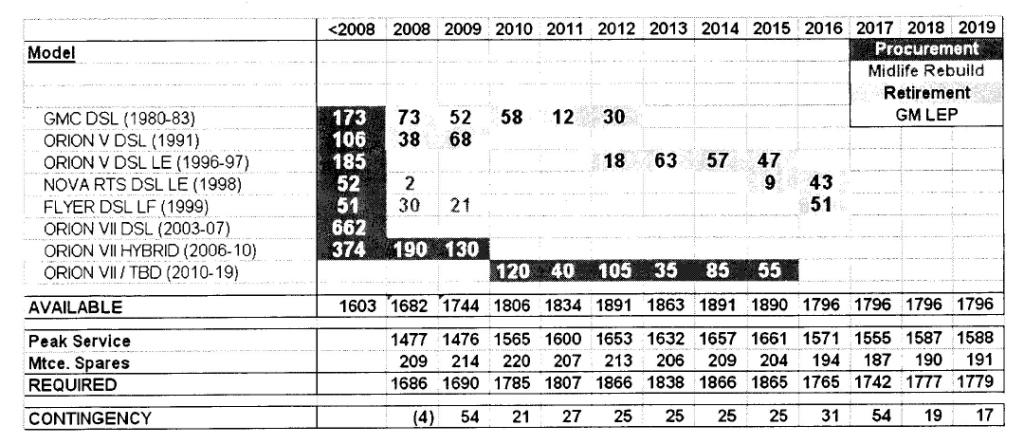
The Bus Fleet Plan is a marvellous document that changes in every iteration.  Barely is the ink dry on one version when it is revised again.  There are three different versions of this plan within the Capital Budget documents alone, and these are a substantial revision from the version shown in the 2009 Capital Budget.

Bus Fleet Plan [From Appendix E of TTC Capital Budget Report, September 24, 2009]

However, two different sets of numbers appear in the version of the plan in the Capital Budget “Blue Books” (the detailed report of all capital projects).  One is in the project covering purchase of new buses, and another in a project for temporary accommodation of an enlarged bus fleet (about which more later).

A major change in the TTC’s fleet planning came earlier in 2009 when, with little fanfare, the TTC decided to get out of the Hybrid Bus business for new purchases starting in 2010.  The special subsidies available to “encourage” hybrid purchases are no longer available, and at the time of the decision, the hybrids were problem children in the fleet.  A project to replace the original lead-acid batteries with lithium-ion batteries will complete within the next half year, but TTC staff have not yet reported on the improved reliability and performance, if any, of vehicles with the new batteries.

Rather than paring the capital cost of future purchases down, the Capital Budget now uses this money to purchase more buses than originally planned.  This can be seen in comparing the projected fleet size in 2018 for different versions of the fleet plan.

  • 2009 plan:  1549
  • 2010 plan (as seen in the Commission Report, Appendix E):  1796
  • 2010 plan (as seen in the project description for bus purchases, Blue Books Page 954):  1793
  • 2010 plan (as seen in the project description for temporary bus storage, Page 927):  1748

In short, the TTC now aims for its 2018 fleet to be roughly 250 buses larger than what it projected only a year ago.  What generates this additional requirement? Continue reading

Trolley Coaches for Toronto?

One side effect of retirement is that I am finally dealing with years of accumulated files.  Yes, I admit it, I have more paper than I need (especially now that so much is available in electronic format), and some of those old reports about obscure parts of the system really are not high points of my bedroom reading.

In the course of sorting through things, one always bumps into items that are misfiled, that faded from memory.  One of these was an envelope I had kept because of the postmark dated May 4, 1972.

TTCPostmark4V72c

So much has changed.  Postage is a lot more than eight cents, and the postal code of “Toronto 7” is positively quaint.  The slogan “Ride With Us No Traffic Fuss!” is classic, but the real gem is the trolley coach as the symbol of progressive transit.

Back in 1972, the trolley coaches had a future.  Vehicles soon to be displaced from the 97 Yonge route by the opening of the Yonge Subway to York Mills were destined to replace streetcars on St. Clair (even though there were nowhere near enough of them to actually do that).  The TTC was still committed to electric operation, and the equipment in these coaches would be recycled into new bus bodies from Flyer.  Nobody had heard of Natural Gas Buses.

Today, the TTC resists calls to re-examine trolley coaches on the grounds that pure electric buses without wires are just around the corner.  I remain unconvinced, and look forward to a day when a modern trolley coach will appear in TTC literature.

Praxis II Showcase 2009 at U of T

When:  Wednesday, April 15 from 9:00 am to 7:00 pm

Where:  Bahen Centre Lobby, 40 St. George Street

What:  First year engineering students spent half a term identifying and researching issues of usability, accessibility, and sustainability within the TTC system.  This led to 80 “Requests for Proposals (RFPs)” of which the top six were selected as design challenges to be solved during the second half of the course.

Topics:

  • Improving Passenger Safety Near TTC’s Exposed Subway Tracks
  • Solving the Heat Loss Problem
  • Improving Wayfinding Signage on the TTC
  • Service Delays Caused by the inefficiency of Passenger Dynamics Into and Out Of Subway Cars
  • Revising TTC Bus Interiors to Maximise Space and Boost Passenger Satisfaction
  • Improving the Emergency Response System on the TTC Subways to Decrease Delay Time and Increase Safety

For more information, please see the full invitation.

Trolley Buses? Not For Toronto (Update 2)

The TTC commissioned a report from Dr. Richard Soberman on the economics of trolley bus operation in Toronto.   Cutting to the chase, the conclusion is that creating a new system from scratch is uneconomic, and we should wait for coming improvements in electric vehicles.

Soberman’s report makes a strong case against trolley buses on its basic economic arguments, and that’s a debate worth having.  However, electric vehicles have yet to make a substantial dent in the personal car market, let alone for vehicles the size of a city bus.

I have one simple reply:  Remember CNG?  The saviour of the enviroment for the TTC?  We lost the old system through neglect and through belief in an unproven technology, not to mention political machinations.

For your reading pleasure:

Commission report and summary

Dr. Soberman’s report

Updated February 15:

A detailed review has been added to this post.  Some of the document is reasonably accurate, but there are enough outright mistakes and misdirections to cast the whole thing in an unsavoury light.  This is a report that tries to sound balanced while hoping we won’t notice what it gets wrong either by accident or by design.

Update 2, February 16: My long-time Vancouver friend Angus McIntyre pointed out two issues with the Soberman report.

  • Vancouver will order an additional 34 articulated trolley buses funded from the Federal gas tax.  This adds to the new fleet of 188 standard and 40 articulated buses.  These plans are not reflected in the TTC report even though the press release is over a month old.
  • The substation spacing of 1.5 to 2km is a measure used on “feederless” systems such as Seattle’s where small local stations feed directly into the contact wires rather than the Toronto or Vancouver model with large substations feeding a local network of services.  Has the report used Seattle’s close spacing, but Toronto’s costs for larger substations?

Continue reading

Better Batteries for Hybrid Buses

The TTC’s supplementary agenda for this week includes a report on the settlement of negotiations with Daimler for the problems with the hybrid bus fleet.  Parts of this report are confidential, but the main items of interest for system users are in the public report.

  • The existing fleet of hybrid buses will be converted from lead acid to Lithium-Ion batteries.  This is expected to greatly improve reliability and to reduce fuel consumption by about five percent due to the much lower weight (4,100 vs 1,000 pounds) of the batteries.  (The TTC quotes the weight in pounds.)
  • The 2009 bus order for 130 hybrids will remain in place.
  • The optional 2010 bus order for 120 diesels will proceed.  It should be noted that supplementary Federal funding for “green” bus technology is not guaranteed into 2010.
  • Due to the larger than expected number of vehicles required both for construction projects (e.g. St. Clair) and to compensate for poor hybrid reliability, 52 “retirement-eligible” GM buses will undergo a life extension.  This is expected to add 2 to 3 years to their life.  Buses now out of service will be the first to go through this rebuild so that the active fleet is not further depleted.  This project will cost $3.5-million or about $65K per bus. 

From a budgetary point of view, the total spending remains below the original Capital Budget mainly due to the savings on diesel versus hybrids on the 2010 bus order.

Diesels, Not Hybrids, At Least For Now (Updated)

Updated October 23:  The TTC amended the staff recommendations by adding two clauses, roughly as follows:

  • The TTC should withhold award of the optional 120-bus add-on order for clean diesels with Daimler Buses until the problem with batteries on the existing fleet are resolved.  If this is not done, the TTC should go with an alternative supplier.
  • The TTC should investigate conversion of the 2009 bus puchase from Hybrid to Clean Diesel.  Staff should explore the options for contract termination as well as the impact of the technology change on funding from various sources.

It is unclear how the first point can be achieved given that the cutoff date for exercising the existing contract’s add-on provision is October 31, 2008.

At this point it is clear that the 2010 bus order will be diesel, and there is a strong move to convert the 2009 order as well notwithstanding possible advances in battery technology.

Continue reading