Welcome to Walmart Station

It really was silly season at the TTC yesterday.  Commissioner Peter Milczyn asked for a report on naming rights for stations in return for corporate sponsorship.  A short debate ensued during which the Commissioners seemed to forget that barely an hour earlier they had approved a report entitled TTC Corporate Policy Review – Policy 2.8.2 Identification of Routes, Stations and Stops.  This report states quite clearly:

Normally, the station name will incorporate the name of the major cross-street at which it is located, so that the location of the station is clearly identified to customers as they travel through the system. If this is not possible (because, for example, confusion would result with existing station names, or because there is no major nearby cross-street), then the station name may be related to the area in which the station is located, or a major destination nearby.

A good example of the last class of station name is “Museum”.

I have a fundamental objection to corporate sponsorships on the basis of equity.  If you want to build a subway station, it will cost anywhere from $70-100 million, and even more for a large terminal or interchange, not to mention ongoing operating costs.  If Pepsi or Walmart wants to sponsor a station, let them shell out at least 2/3 of the cost so that, on an after tax basis, they’re paying at least half the price of the station. 

Meanwhile, you and I, who actually pay for the station through our taxes should expect that naming rights will stay in the public sector.

No sponsor wants to shell out $35-50 million, and they hope to buy a station for a few million.  For that they get a couple of escalators.   Maybe they could actually pay to maintain the escalators so that their logo isn’t associated with a machine sitting in parts all over the floor more often than it actually carries passengers.

What We Got For Five Million

One of my jobs here seems to be the curmudgeon whose view of the latest great thing isn’t quite as gentle and forgiving as other commentators.  This brings me to Museum Station.  You can see lots of photos over at The Torontoist where many (including me) have commented on various aspects of the station.

For me, one big issue is not just that it’s unfinished, but that in doing so, something is lost of the original design.  Just to refresh everyone’s memory, here is what we were supposed to get.

MuseumOriginalDesign

Note the curving ceiling that hides the plumbing and pulls the rows of columns together in a long gallery.  You won’t see that at Museum Station.  I suspect that the TTC didn’t want yet another specialized ceiling finish that would spend half its time disassembled while work went on above, but we’ve lost something important there.

Another issue is the large patches of painted concrete wall at intervals along the station.  Nothing is shown in the image of what might be there, and one wonders whether this was intended for advertising.

Speaking of advertising, there were ads present at the station until last weekend when their negative impact on the overall design was raised by some of us at Transit Camp to people who are in a position to get things changed.  They were.

The other change is that the old Metron, carefully preserved even though it didn’t work, was in the station right up to the weekend.  Odd how we’ve been told the problem is always with getting electrical work done for Onestop installations.  Funny how in a $5-million project they didn’t put in the conduits and wires for the new video screens.  They’re even shown in the drawing above, but that’s something else you won’t find at Museum.

I was kind of hoping the Metrons would stay as the beginning of a TTC museum of horology.  They could have relocated a few of the old analog clocks from Lower Bay to round out things.

Finally, there is an odd, unintended historic reference in the plaque describing each of the columns.  We learn that the red columns modelled on the Forbidden City would have held up yellow ceilings, a colour only the Emperor was allowed to use.  Yellow, of course, was the old colour of Museum Station, and it’s absent now at platform level.  No Emperors here I guess.

For me, Museum has too much the feel of a half-baked project.  Nice columns, but lots left to be done and nobody stepping up to pay for it.  If all this decor cost us five million, we were ripped off.

Kingston Road LRT Update

The Environmental Assessment for the proposed Kingston Road LRT will hold three open houses on March 26, 27 and April 2.

The project’s March 2008 Newsletter includes the meeting locations, a map of various proposals and a breakdown of travel in the corridor.

There are two primary options depending on whether the line stays on Kingston Road all the way west to the existing streetcar network at Bingham Loop (Victoria Park & Kingston Rd.), or if it travels west along Danforth Avenue. Sub-options include connections to the subway at Victoria Park or Main Station.

At the risk of prejudging the evaluation, the route north from Kingston Road either to Main or to Victoria Park would be quite difficult. Victoria Park is a narrow, 3-lane residential street south of Gerrard. Main is a narrow, 4-lane residential street, and has a curved alignment (not shown on the map) and a grade down to Kingston Road. I believe that a connection north to either station from Kingston Road is not practical. (Anyone who wants to argue this point is urged to actually visit the neighbourhood or at least look at Google Maps before taking on this issue.)

The Danforth alignment is more straightforward, and also provides a better connection to the rapid transit network. In the origin-destination survey, only about 1/4 of the respondents showed their AM peak trip as going “downtown”.

Planning for the revised Victoria Park Station (warning – 10MB file) does not show a possible streetcar service, but could accommodate it.

Finally, the Walk 21 conference last fall included a paper about redesigning Kingston Road into a strong shopping and pedestrian community in the Cliffside area. This neighbourhood is now dominated by strip commercial and parking lots, but its transformation is supported by the business community with the new LRT line as a catalyst.

This project is in an odd state of existing in theory, but never appearing on maps showing our bold new Transit City network. This very strange situation makes many wonder whether there is any hope of the project actually being funded and built.

Fleet Street Overhead and Other News of Changing Streetcar Infrastructure

The TTC plans to resume streetcar service on Fleet west of Bathurst with the 509 Harbourfront and 511 Bathurst routes on March 30. Trackwork, except for Fleet Loop, is in place, and the overhead construction is underway working west from Bathurst Street.

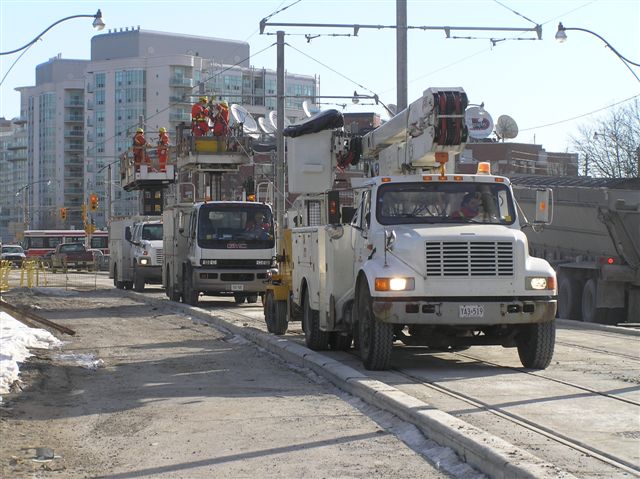
One of my regular readers, Harold McMann, sent me a few photos of overhead installation on Fleet Street and I am including one of them here because it shows a very recent change in the TTC’s standards for streetcar overhead.

Look closely at the hangers and you will see they are different from those commonly seen on Toronto’s system. These hangers are designed so that the contact wire will be held below the span wire and so that both pantographs and trolley poles can navigate them. If you look closely, you will see that hangers on alternate spans face in opposite directions so that there will be a slight meander to the overhead to avoid groove wear on pantographs.

Another change not as obvious from a photo is that the TTC is now using 4/0 gauge wire rather than 2/0. This is a larger cross section, but not twice as big even though the number might imply this. You can read about the arcane world of wire on Wikipedia. The larger cross section allows more current to be delivered by the wire in anticipation of the power demands of the new larger streetcars planned for Toronto.

The TTC Capital Budget contains a project to convert the entire overhead system by 2012, but it’s sad to note how long it took the TTC to accept that this would be necessary.

Further west on Fleet beyond the loop we find a forest of closely spaced poles marching down the centre of the right-of-way. These appear to be much closer together than the normal span wire spacing. This design leaves a lot to be desired if it is an indication of what we will see on future routes because the poles will dominate the visual landscape. I have already written here extensively about the shortcomings of centre poles on downtown streets and will not belabour the point.

Another project in the works is the complete replacement of the automatic track switch system. The current switch machines and their electronics date from the arrival of the ALRV fleet when the distance from the trolley shoe to the front of a car ceased to be constant. This meant that the old contactor-based switching had to be replaced, and a new system with pavement loops was installed.

This has been no end of trouble to the extent that some switches on the Spadina project have switch machines, but have never been activated. Many regularly used switches around the city sport “out of service” signs because they are no longer reliable or their parts have been raided for other more important locations. Because these switches are so unreliable, streetcars must come to a full stop at all facing point switches (including, amusingly, manual switches that cannot leap open in front of a car).

This practice makes for slow and jerky operation at intersections, and the TTC has not bothered to deal with this problem of reliability for quite a long time. Design of a new track switch system is underway and is expected to complete this year with procurement and installation to follow in future years.

Over the next four years, we will see a gradual transformation of the streetcar infrastructure in anticipation of the new fleet. Let’s hope the TTC gets it right this time. We cannot afford another fiasco like the CLRVs and their inability to deal with a system that PCCs had navigated for decades.

Victoria Park Station Re-Design

There is a report up on the TTC’s site showing the plans for renovation of Victoria Park Station. Note that this is a roughly 3.5MB document.

For those of you looking at the URL linked here, yes there is a spelling mistake in the TTC’s filename with “Vcitoria” Park station and terminal “Finsihes”. If they fix this, the link may break, and you will have to go to the general report site to get the document.

The Look of the TTC

Today’s Toronto Star has an article Sick transit: TTC dirty, leaking, decaying about the sorry state of many of our subway stations.

Although this is the worst time of the year for assessing the general look of anything that is used by hundreds of thousands of people per day, many of the complaints from Star readers ring true.

Stations don’t look as clean as they once did despite the TTC’s attempt to arrange its crews for heavy-duty blitzes on stations rather than superficial dusting. This is further complicated by the now-and-forever construction and repair projects that give the impression of jobs half done and forgotten. The TTC could do a much better job, both on site and online, of posting notices that should be kept up to date about what is going on.

Speaking of notices, there is a huge, ongoing problem that notices when they do appear remain in place long after the work is done and they act as magnets for grafitti and other abuse. This sort of thing contributes to a look that says “we don’t care”.

(My personal favourite was College Station during the 506 streetcar track reconstruction where three different generations of diversion notices existed, in some cases side by side, in various locations.)

Oddly enough, just a few days ago I did an interview with some journalism students from Ryerson about “design on the TTC”, to which my first offhand reply was “what design?”. Yes, there are various standards for new signage as well as older generations, but this is obscured by so much pure junk that the clean, unifying benefit of consistent graphics is totally lost.

Plant maintenance is one of those TTC budget lines that was squeezed for years, and gets little respect because it’s always easy to say “just get more productivity out of your staff” rather than looking at the underlying problems. Like so much else in the TTC (and municipal services in general), we need to know what it would cost to provide better service in this area. As long as the attitude is “we can’t afford it”, we (the public) never get a chance to weigh in on where the TTC might spend more money. This was the situation with service quality and, although it has taken forever, the Ridership Growth Strategy allowed those who want better service to advocate for it with hard numbers on costs and benefits.

Litter will always be with us, and the sooner the TTC picks it up, the better. Scratchitti is becoming a major problem and I’m not sure how quickly the TTC addresses this. My gut feeling is that I see far too much of it, and it can’t all be fresh.

Attracting riders isn’t just a matter of better service, it’s the environment in which that service runs. Telling riders that it’s their fault for littering blames the many for the thoughtlessness of the few.

A New Look For Roncesvalles

John Bowker of the Roncesvalles Village BIA (Business Improvement Area) passed on a link to information about the TTC’s new design for Roncesvalles Avenue.

At this point, it is unclear whether this will actually be built in 2008 or 2009 (my own guess is 2009), but this gives an idea of what the TTC would like to do with streetcar stops in locations where the incursions into the road are possible.  At all stops from Dundas down to just north of the carhouse at Queen, sidewalks at stops will be widened out to the tracks to provide a step on-and-off configuration.

Various schemes are used to deal with intersections where there are turns either by using farside stops or moving nearside ones back to leave enough room for a right turn bay.

The PDF with the design is very long and narrow — it really belongs on a roll of paper — but the one drawing covers the entire length of the projecvt.

The community appears to be strongly in favour of this scheme, and within a few years we may see a very new transit and pedestrian friendly street.

Mimico By The Lake

At its upcoming meeting, Etobicoke and York Community Council will consider an information report on the revitalization of Mimico.  A great deal of the report concerns a public meeting held in June 2007 where, judging from the notes, there was much discussion and many ideas.  Clearly people in Mimico want their neighbourhood to improve its look, its economy and its attractiveness without simply yielding to piecemeal, uncontrolled development.

Mimico is one of the old towns on the Lake Shore highway west of Toronto.  The study area lies between Park Lawn Road (just west of Humber Loop) and Royal York Road.  This area has a mix of residential uses with high-rise condos west from Park Lawn and an established low-rise neighbourhood of houses and small apartment buildings east from Royal York.  There is a small commercial area around Mimico Road.

Although the report deals with a variety of issues affecting Mimico’s future, transit does pop up here are there with some interesting comments including:

  • Don’t just concentrate on transit to get people downtown, but also to allow travel along the Lake Shore itself.
  • Consider special fare structures to encourage local travel.
  • Consider separate local and express services to downtown.
  • Abandon the Park Lawn Loop proposal and concentrate on making Humber Loop more attractive and pedestrian friendly.
  • Extend the right-of-way to Long Branch.
  • Increase parking at GO and TTC subway stations.

Local service was once an important function of the 507 Long Branch car when it operated as a separate route.  Since its integration with 501 Queen, service west of Humber Loop is unreliable with very wide gaps in service caused by short turns.  Some cars that do get west of Humber short-turn at Kipling (18th Street) and miss serving the outer end of the route to Brown’s Line (40th Street).  Service that does reach Long Branch does not run on a reliable schedule.

The proposal for a local “shopping fare” echoes the existing arrangement on St. Clair West where a time-based pass using transfer is in effect to encourage system use during the right-of-way construction project.  Whether we get time-based fares on the TTC as part of a smart-card project (e.g. one “fare” provides up to two hours of riding regardless of direction or stopovers) remains to be seen, but this would extend the concept system wide.

A separate express route to downtown will arrive as and when the Waterfront West LRT is actually built.  This project is now in the EA stage looking at the section between the CNE and Sunnyside where there is some debate about the appropriate alignment and the number of stations to serve south Parkdale.

Extending the right-of-way to Long Branch Loop won’t make much difference in transit operations given the current lack of serious congestion.  No choke points showed up in my review of TTC’s vehicle monitoring data from December 2006 for this segment of the route. 

The important thing will be to provide good, reliable service on Lake Shore, something that can be done by giving southern Etobicoke back its own route.  The eastern terminus is a matter for discussion, but the service should definitely be independent of the 501 Queen car.

Park Lawn Loop is one of those TTC mysteries.  It is a remnant of the original WWLRT proposal and has the distinct odour of a scheme to allow abandonment of the streetcar line west of Etobicoke Creek.  However, the WWLRT is now part of Transit City and it goes all the way to Long Branch.  Is Park Lawn an appropriate place to relocate the Humber Loop terminal?

Finally, I cannot help but worry about calls for more parking.  What this shows is that people don’t have any faith in the surface transit system to get them where they want to go, and they are now focussed on rapid transit lines, particularly the Bloor subway, for east-west travel.  Some of this will be demographic change, but some will be the long-term effect of decline in east-west streetcar service.

As Mimico and the communities west to Long Branch redevelop, good transit will be essential.

“The Three Cities” and Transit City

The Centre for Urban & Community Studies at the University of Toronto recently published a bulletin entitled The Three Cities within Toronto:  Income polarization among Toronto’s neighbourhoods, 1970–2000.  This is an important look at the evolution of Toronto’s economy and social structure, with a widening gap between the well-off and the poor.

The authors reviewed the evolution of individual incomes by census tract across the 416 to see which areas showed rises and falls relative to the average level for the “Census Metropolitan Area”.  (The CMA includes part of the 905, but is part of the overall employment area for people living in the 416, the City of Toronto proper.)

What emerges is a pattern they describe as “The Three Cities”. Continue reading