Three Eras of Planning

This article is adapted from a presentation I gave on February 26, 2014, to Paul Bedford’s planning class at Ryerson University.  Paul’s students have a term assignment to design a plan for the GTA in 2067 (as well as other papers along the way).  They will work in teams, just as real-world planners would, and have to consider many factors that would inform a 50-year plan.

The date was chosen to be far enough in the future that the students would have to live with the theoretical consequences, and also because it is Canada’s bicentennial year.  2067 is also well beyond the horizon of many plans already sitting in libraries requiring consideration of what lies beyond work already done.

With this as a starting point, I realized that there are two eras roughly the same length in my own history.  One is the post WWII period during which I was born, grew up and have lived my life as a transit advocate (among many other hats).  One is the era from the 1890s to the 1940s that was dominated by the growth of public transit, but eclipsed by the automotive industry especially after the war.  The tension between the first and second eras, between two views of private and public transport, underlies all of the planning debates we have today, and will be central to any plans for the third era, the next fifty years.

Apologies to those who have seen some of my previous talks on the evolution of transit in Toronto.  Some illustrations are good as examples of certain developments, and I am constrained by material available in the City Archives and other online collections, as well as material in my own library.  It is not unknown for academics to recycle material for lectures, and I am following a well-worn path.

Many thanks to Paul Bedford for the invitation to speak to his class, and to his students for their interest.

Continue reading

Metrolinx Contemplates Relief

At its meeting on February 14, 2014, the Metrolinx Board will receive a presentation on the Yonge Network Relief Study. Despite the need for better regional transit links (and by that I mean links that do not take people to downtown Toronto), the elephant in the room has always been the unstoppable demand for more capacity into the core area. Planning for and debates about catching up with the backlog of transit infrastructure cannot avoid this issue, and it skews the entire discussion because the scale and cost of serving downtown is greater than any other single location in the GTHA.

Conflicting political and professional attitudes across the region colour the view of downtown.  Toronto suburbs, never mind the regions beyond the city boundary, are jealous of downtown’s growth, and for decades have wanted some of the shiny new buildings and jobs for themselves. But the development, such as it was, skipped over the “old” suburbs to new areas in the 905 that could offer lower taxes possible through booming development and the low short-term cost of “new” cities.

Strangling downtown is not a new idea, and politicians decades ago foretold of gleaming suburban centres to redirect growth together with its travel demand. The transit network would force-feed the new centres, and downtown would magically be constrained by not building any new transit capacity to the core.

Someone forgot to tell GO Transit where service and ridership grew over the decades. Downtown Toronto continued to build, and that is now compounded by the shift of residential construction into the older central city.

Thanks to the early 1990s recession, the subway capacity crisis that had built through the 1980s evaporated, and the TTC could talk as if more downtown capacity was unneeded. To the degree it might be required, the marvels of new technology would allow them to stuff more riders on existing lines. A less obvious motive was that this would avoid competition for funding and political support between new downtown capacity with a much-favoured suburban extension into York Region. Whenever they did talk about “downtown relief”, the TTC did so with disdain.

Times have changed. Long commutes are now a burden, not a fast escape to suburban paradise. Every debate starts with “congestion” and the vain hope that there is a simple, take-two-pills-and-call-me-in-the-morning solution. Top that off with an aversion for any taxes that might actually pay for improvements, or sacrifices in convenience until that blissful day when transit arrives at everyone’s doorstep.

Continue reading

The Gardiner Expressway and Transit to Downtown

The City and Waterfront Toronto are holding a public meeting to present an update on the future of the eastern section of the Gardiner Expressway.

Bluma Appel Salon
Toronto Public Library, Yonge North of Bloor
Thursday, February 6, 2014 from 6:30 pm to 9:00 pm

A media briefing on February 5 introduced the material, and there is widespread coverage in the mainstream press that I will not duplicate here. My interest lies more in the relationship of the expressway to travel demand generally, and to the importance of transit for the future development of central Toronto.

The media presentation contains information that will be included in the public meeting, and illustrations here are taken from that file.

StudyArea

The section of the Gardiner under study extends east from Jarvis Street to the Don Valley Parkway, plus the ramp down to Lake Shore Blvd. east of the Don River. It is important to remember what is not being changed.

  • From Jarvis Street west, the existing expressway will be rebuilt under a multi-year program stretching to about 2019.
  • The south end of the DVP will be modified only to the extent needed to connect in with whatever new or revised structure might be built.
  • The ramp down to Lake Shore will remain in its current form except if the Gardiner is removed, in which case the ramp will be demolished and a new Lake Shore will cross the Don on a bridge at grade.

The Gardiner’s design capacity was scaled for connection to a future Scarborough Expressway that was never built, and the structure east of Jarvis is wider than is needed for the demand. This section gives the greatest opportunity for reworking, and releases the most land around the expressway in any new configuration.

Continue reading

Sir John A. Station?

Yes, we must be into the mayoral campaign, even among undeclared candidates.

At today’s meeting of Toronto’s Executive Committee, Councillor and sometimes-mooted candidate for the Mayor’s office, Denzil Minnan-Wong (better known as DMW to the blogging community) walked a proposal into the meeting to rename Union Station as Sir John A. Macdonald Station.  It’s a slow news day, and this is the sort of thing we see at City Hall when the Ford Family hasn’t triggered any new scandals.

Never mind that this is a National Historic Site.  If someone wants publicity, why not pick a great big monument and propose a new name for it?

Don’t ya know that old Sir John A., our first Prime Minister, is coming up on his 200th birthday, and what better excuse to rename the station after that master of the Canadian Pacific (despite the fact the railway was built long, long before the current Union Station even existed).

It seems there is a group called the Toronto Friends of Sir John A. Macdonald who, along with “appropriate groups and individuals”, are to be consulted in the preparation of a report on the subject that will be back at Exec by July 2 at the latest.  This group even has a website with one rather trivial post that is over a year old.

According to The Star:

Supporters include Alan Broadbent of the Maytree Foundation, broadcaster Steve Paikin and journalist Richard Gwyn.

They should be ashamed.  Just because “Union Station” seems rather prosaic does not mean the name is without significance in Toronto.

No doubt, part of the impetus for naming anything in Toronto after Sir John A. might be his reputation for drinking gin (conveniently disguised as a glass of water) in the House.  A role model for our current Mayor, no doubt.

Poor DMW is doomed to be one of the also-rans in the mayoralty race, presuming he even puts himself on the ballot.  The things people do to get attention.  At least he has not changed his mind on transit funding and jumped on the subway bandwagon, yet.

This proposal is a waste of time for staff and Council who have far more important things to consider.

Leave Union Station alone!

Will The TTC Board Ever Discuss Policy, or, Good News Is Not Enough (Updated)

Updated January 21, 2014 at 2:20 pm:  The description of the loading standards introduced with the Ridership Growth Strategy has been corrected.

The election season is upon us in Toronto, and transit made an early appearance on the campaign with mayoral candidate David Soknacki’s proposal that Toronto revert to the LRT plan for Scarborough.  I am not going to rehash that debate here, but there is a much larger issue at stake.

The Ford/Stintz era at Council and at the TTC has been notable for its absence of substantive debate on options and alternatives for our transit future.  Yes, we have had the subways*3 mantra, the palace coup to establish Karen Stintz and LRT, for a time, as a more progressive outlook on the TTC Board, and finally the Scarborough debate.

But that’s not all there is to talk about on the transit file.  Do we have a regular flow of policy papers at Board meetings to discuss what transit could be, should be?  No.  Ford’s stooges may have been deposed, but the conservative fiscal agenda remains.  Make do with less.  Make sacrifices for the greater good, whatever that may be.  Show how “efficiency” can protect taxpayer dollars even while riders freeze in the cold wondering when their bus will appear.

Every Board meeting starts with a little recitation by the Chair of good news, of stories about how TTC staffers helped people and the good will this brings to the organization.  There is ever so much pride in improved cleanliness and attractiveness of the system – a worthwhile achievement, but one that should become second nature to maintain.  It should also be a “canary in the coal mine”, a simple, obvious example of what happens when we make do with “good enough”, with year-by-year trimming to just get by.

If the bathrooms are filthy, imagine the condition of the trains, buses and streetcars you are riding.  I’m not talking about loose newspapers blowing around, but of basic maintenance.  From our experience in the 1990s, we know how a long slide can take a once-proud, almost cocky system to disaster, and how hard it is to rebuild.

In a previous article, I wrote about the threat to basic system maintenance posed by underfunding of the Capital Budget, an issue that has not received enough public debate.  Part of the problem is that the crucial maintenance work that must occur year over year is treated the same way as new projects.  Maintenance competes with the glamour projects for funding, and may be treated as something to be deferred, something we don’t need yet.  Couple that with starvation of funds for basics like a new and expanded fleet and garage space, and there’s a recipe for a TTC that will decline even while more and more is expected of public transit.

The budget isn’t the only issue that deserves more detailed examination, and many other  policies should be up for debate.  Within a month, the TTC will have a new Chair as Karen Stintz departs for the mayoralty campaign.  Within a year, Toronto should have a new Mayor, one whose view of transit is not framed by the window of his SUV.  At Queen’s Park we may have a Liberal government with a fresh, if shaky, mandate to raise new revenues for transit construction and operation, or we may have a populist alternative with a four-year supply of magic beans.

In the remaining months, the TTC Board has a duty to lay the ground for the governments to come, especially at City Hall.  The 2015 budget debates should be well informed about the options for transit, if only for planning where Toronto will need to spend and what services the TTC will offer in years to come.  Will the TTC rise to this challenge, or sit on its hands with a caretaker Board until the end of the current term?

Here is a selection of the major policy issues we should be hearing about, if only the TTC would engage in actual debate to inform itself, Council, the media and the voters.

  • Fare structure:  What is the appropriate way to charge fares for transit service?  By time, distance, week, month?  How does smart card technology change the way fares are collected and monitored?  What are the implications for regional travel and integration?
  • Service standards:  What loading standards should be used to drive service improvements?  Should the TTC build in elbow room to encourage riding and to reduce delays due to crowding?  Should there be a core network of routes with guaranteed frequent service?
  • Service management:  What goals should the TTC aim for in managing service?  Do the measures that are reported today accurately reflect the quality of service?  Are bad schedules to blame for erratic service, or does this stem from management indifference or from labour practices that work against reliable service?  What are the tradeoffs in the relative priority of transit and other traffic?  What are the budgetary effects of moves to improve service?
  • Budgets and Subsidies:  Both the Operating and Capital Budgets have been cut below the level recommended by TTC management.  These cuts will affect service and maintenance in the short and long term, but there has been no debate about the effect, especially if these are not quickly reversed in a post-Ford environment.  The Capital Budget faces a huge gap between available funding and requirements.  Over ten years, the shortfall is 30% in available financing versus requirements, and this is back-end loaded so that the shortfall rises to 50% in later years.  The proposed level of City subsidy is barely half what would be needed if Queen’s Park returned to its historical 50% capital funding formula.  Hoped-for money from Ottawa is more likely to finance major projects such as new subway lines, not the “base” budget for capital  maintenance.  The budget, especially capital, is not well understood by the TTC Board or Council in part because of the confusing way in which it is presented.  Toronto cannot begin to discuss subsidy policies if those responsible for decisions cannot understand their own budgets.
  • The Waterfront:  While battles rage over subway and LRT proposals for the suburbs, a major new development on the waterfront is starved for transit thanks to cost escalation, tepid interest by the TTC, and the perception that waterfront transit can be left for another time.  The pace of development may be threatened if good transit does not materialize on Queens Quay, and later to the Port Lands, but meanwhile this project sits on the back burner little understood by most members of the TTC Board and Council.
  • Rapid transit plans:  The artificial distinction between GO and the subway (or even higher-end LRT operations such as the proposed Scarborough line) will disappear as GO becomes a frequent all-day operation.  There will be one network regardless of the colours of the trains.  GO service to the outer parts of the 416 is particularly important as an alternative to subway construction serving long-haul trips to downtown.  Subways, LRT and BRT each has its place in the network, but electoral planning must not leave us with fragments of a network rather than an integrated whole.
  • Accessibility:  The need for accessibility extends all the way from the severely disabled who require door-to-door service, through a large and growing population who have some degree of independence, to those whose only problem may be bad knees or a weak heart.  Neither the TTC nor the City has taken the issues of accessibility particularly seriously in recent years.  There may be good words, but the budget and service policies clearly limit the growth of the parallel Wheel Trans system.  Meanwhile, retrofitting the system for full access is delayed thanks to funding limitations at both the City and Queen’s Park.  What we do not know is the true extent of the need for accessibility on the TTC and what this means for service and infrastructure.

Continue reading

Sprawl Is Good For You?

There are times I pick up my morning Globe & Mail and wonder who selects their articles, especially in the Report on Business where investigative journalism does not exactly reign.  A few days ago, right on the top of page B2, they had a piece of drivel by Brian Lee Crowley entitled “Sick of congestion? Build roads, not transit“.

Is the Globe playing for the Ford Nation readership?  Is their soon-to-be-neighbour on King East, the dwindling Toronto Sun, rubbing off on the Globe’s brand?  Will being at the mercy of the King car give them second thoughts about downtown?  After all, they’re also unable to plump for mayoral candidates who might be seen as part of the downtown elite even thought they might actually be competent for the position.

Crowley argues that building more roads is the secret of success far more productive than building new transit lines.  This is the orthodoxy one expects from someone who views Wendell Cox as an informed, unbiased source of information.  On the issue of concentrating resources on transit construction, Crowley writes:

As urban geographer Wendell Cox likes to say, this idea that road construction only worsens congestion is like believing that building more maternity wards will cause more babies to be born.

This argument is a total non-sequitur because the issue is not cause and effect, but capacity and latent demand.  The existence of a new, comparatively uncongested road will induce more driving simply by making this a more attractive option.  More maternity wards do not, of themselves, make having a family more attractive.  To continue the analogy, it would be like a construction program fixated with on ramps.

Cox is no “urban geographer”, but an apologist for anti-government, anti-transit arguments going back decades.  There are enough transit boondoggles in the USA for anyone to show how vast resources have been spent to build new lines of dubious value.  The USA, like Canada, has a long history of spending on capital projects as a job creation scheme regardless of the intrinsic value of what is actually built.  Pork barrel politics bring billions to cities and to the construction industry that feeds off of them.

That does not make all transit a waste of money any more than recent subway debates would invalidate any transit spending plans for the GTHA.  What those debates do achieve is to undermine the credibility of those who ask for more money when voters are suspicious that nothing of real value will be created.

Only when one is well into Crowley’s piece, does one find the real heart of his argument — lower density cities with spread out jobs and populations, and lots of road capacity, are actually less congested and have shorter commute times than the more traditional configuration of downtown-plus-suburb we know so well.  His poster children are Phoenix and Houston.

Certainly, if one has a city with ample room to grow, a history of leaving wide swaths of land around main roadways, and a development model that favours decentralization, one can easily have uncongested roads.  We saw exactly this in much of the 905 until growth caught up with road capacity and, suddenly, those quick trips through suburbia became a commuting nightmare.  The problem is not just “downtown” but throughout much of the GTA.

Crowley pulls a “bait and switch” on his readers giving the implication that he has a solution to congestion when, in fact, his answer is to not build denser cities in the first place.  One can easily argue that there are many other benefits of density and that the effect on commute times is a trade-off we make for a more “urban” environment.  Our problem in the GTA is that we only half-heartedly embrace a truly “sprawling” city.  We already have a dense core, and the idea of keeping housing and jobs spread out all the way from Steeles Avenue to Lake Simcoe is not a model the development industry cares to follow.

Crowley ends by exhorting planners to think of sprawl as part of their toolkit to make better, less congested cities.  This is complete nonsense.  He starts with the premise that where sprawling cities do exist, there is little or no congestion, but then reverses cause and effect to imply that sprawl can be used as an antidote.  No, it doesn’t work that way.  Our congestion already exists, and more sprawl won’t make it vanish.  Neither will road building, at least on a scale we can afford and tolerate within our already-developed city.

If anything, our problems are compounded by the demands of the industrial sector who want to see less congestion for their trucks and, by implication, a shift of road priority away from individual motorists by spending on alternatives like transit.

Simplistic analyses like this may keep Ford Nation warm at night dreaming of more expressways (provided the roads and traffic don’t go through their neighbourhood).  For the debate about Toronto’s transit future, Crowley’s empty and misleading thesis is a useless distraction.

Links to Other Articles in Response:

Jarrett Walker on Human Transit

Todd Litman on Facebook

Congestion Management and Transit Priority: Toronto’s Confused Approach

Two studies came through Toronto’s Public Works & Infrastructure Committee at its November meeting revealing a less-than-coherent approach to traffic management and transit priority.

The Congestion Management Plan (CMP) takes a city-wide view with two background reports:

The Downtown Traffic Operations Study (DTOS) has a much tighter focus on the core area from Bathurst to Jarvis with a northern boundary of Queen Street, except between University and Victoria where it extends to Dundas Street.  Background reports include:

Most striking about these reports is the fundamentally different way in which they approach their subject.

DTOS is very much about action, making specific changes “on the ground” to the way streets operate with the goal of improved capacity.  This includes a more sophisticated form of Transit Signal Priority (TSP) that would take into account not just the presence of transit vehicles, but whether they were ready to proceed through intersections.

By contrast, the CMP spends a great deal of time talking about the need for technology upgrades and for co-ordination among various agencies – City Transportation, TTC, Utilities, Emergency Services – to the point one might ask if any of them ever talk to each other today and, by extension, how much “congestion” there is simply in agency-to-agency co-ordination.  TSP gets pushed to the back burner here with a suggestion that it be granted only when vehicles actually need it, although how exactly that would be achieved given TTC’s chaotic approach to line management is anyone’s guess.  More to the point, the TSP facilities now in place were funded by the TTC, but City Transportation now proposes to hobble their usefulness.

Continue reading

How Does The City Grow?

The October 22 meeting of Toronto’s Planning & Growth Management Committee saw the launch of the 2013 edition of a report tracking residential and commercial development patterns in the city.

How Does The City Grow Website

If anyone needs proof that downtown is the focus of development in Toronto, they need only look at the numbers in this report.

Development in the Greater Toronto Area is strong, but Toronto itself is taking a larger proportion of the total.  Across the GTA, dwelling unit completions have been on a long decline since a peak in 2002 while completions within Toronto have grown.  Toronto’s proportion of the total rises as a result with over 40% now located inside the City.

Grows13Fig1

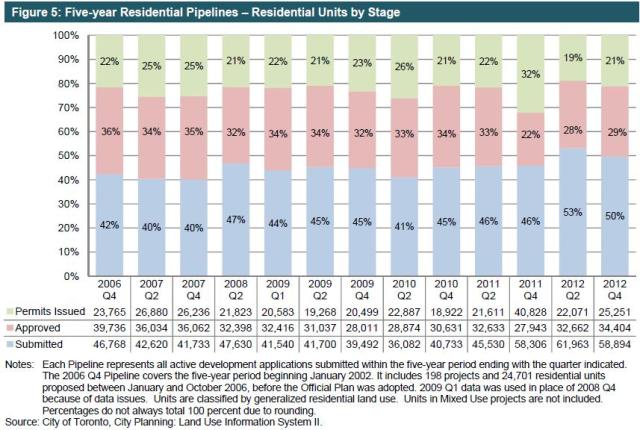
City Planning tracks development applications within a five-year “pipeline” which allows for the long lead times between initial applications, approval, construction and occupancy of buildings.  This smooths out year-over-year variations, but also flags a turndown in future growth if the early stages of that pipeline start to dry up.  There is little sign of this happening up to the 2012 data, although the proportion of applications relative to the total rose slightly.

Grows13Fig5

The overwhelming type of new residential development is in the apartment form (this includes condo and rental projects).  This is not surprising considering that there is almost no vacant land in the city suitable for low-rise development on the scale we see in greenfield subdivisions outside of Toronto.

Grows13Fig4

New development is not evenly distributed across the city, but is concentrated in a few locations, notably downtown.

Grows13Tab3

During the five-year period 2008-2012, 41% of the proposed residential units were downtown.  This shows very strong market demand to live close to the core, but a related number is the 39% of proposed non-residential floorspace (GFA in the chart above) that is downtown.  Downtown commercial development in Toronto is, today, 25% of all such development in Canada.

Although City Planning puts a brave face on things, Table 3 also reveals the comparative failure of the “Centres” as planning mechanisms to focus development.  Only 8.7% of all residential and 3.5% of non-residential proposals are in the four centres: Etobicoke, North York, Scarborough and Yonge/Eglinton.  Scarborough Centre has almost no development planned at all.

The data presentation caused some confusion at the P&GM meeting when North York Councillor Filion compared the “38%” number for his centre with the numbers for downtown.  He was gently reminded that this was 38% of the 8.7% for all of the centres combined.

Where data consolidation does mask important details is in The Avenues, those major streets that are targets for future development, and in the “Other” category.

Almost one quarter of residential proposals are sited on The Avenues (the brown stripes in Map 1 below), but this is not broken down by city region.  Some areas have a great deal of development proposed and already built (many of the early projects in the 2008-2012 pipeline are already substantially completed), while other areas have nothing.  Are The Avenues actually directing development or simply endorsing what would happen naturally?

Grows13Map1

Almost 40% of non-residential development lies in “Other” areas many of which are designated employment zones.

The actual development patterns are clear in the overview maps (for full size versions of all illustrations here, please download the source document from the City’s website linked above).

Grows13Map2

Grows13Map5

The growth of downtown residential population is not tracked in this report, but a few comments at recent meetings give some indication of what is happening.  Cllr. Vaughan spoke of the development pressures in the Entertainment District where the population has gone up 125% in the past four years.  At a recent briefing on the Gardiner Expressway, Deputy City Manager John Livey noted that the population of Planning District 1 (downtown from roughly Dundas to Lake Ontario) has tripled between 2006 and 2011.  With the developments in the pipeline, this pattern will continue.

Non-residential space translates to jobs, and this puts great pressure on the transportation network.  Some of these jobs will be taken by people who will walk, cycle or take surface transit to work, but many commuters will come from further afield via the subway and GO Transit.  The idea that downtown “has enough subways”, to quote Mayor Ford, would be dubious with the existing level of demand, but seen in the context of future development the statement shows foolhardy disregard for investment in city infrastructure.

There will be growth in the suburbs, but not at the scale of the core area.  Moreover, it is unclear that simply designating an area for growth will actually produce the desired effect without considerable incentives.  Motions by Cllrs. Vaughan and Nunziata approved by the Committee speak to opposite sides of the same issue:

The Planning and Growth Management Committee:

1. Directed the Chief Planner and Executive Director, City Planning to report on how to create a policy framework to cap growth in areas of hyper intensification and re-direct development in a strategic way to other parts of the city.

2. Requested the Chief Planner and Executive Director, City Planning in consultation with the General Manager of Economic Development and Culture, to report back to the Planning and Growth Management Committee on the methods the City of Toronto could employ to stimulate economic development in areas currently underused or vacant.

In the case of downtown, there are areas where developments, many proposed at substantially above the zoned density for the land, are skewing the property market and straining services for current and future residents.  In other parts of the city, notably Weston which is among the lowest income areas in Canada, there is plenty of land to develop, but no activity.  How much power does the City actually have (or wish to exercise) in shaping its future growth?

Major transit lines are planned or under construction, but it will be a decade before we see their effect.  Meanwhile, large areas now served by subway lines see little development.  How much of this is nimby-ism throttling growth and how much is simply market forces building where there is both a market and a profit?

The disconnect between actual and proposed development, and the goals and dreams of the City Councillors and their neighbourhoods is quite striking.  Without significant intervention by Council, a move that would be ideologically distasteful to many and certainly would be subject to legal challenges, controlling development, especially that which can occur “as of right”, will be very difficult.  Should the transit system be built to serve what is there today and what we know will develop, or will Council persist in planning based on dreams that do not match market realities?

Moving People Downtown: The Gardiner East Is Only The Beginning

On October 16, 2013, the second public meeting in the Gardiner East Environmental Assessment presented additional information and refinement of the options for dealing with the expressway’s segment between the Don River and Jarvis Street.

The purpose of the meeting was to report on the options that would receive further analysis in the next step of the EA and to provide comparative information about costs and benefits of the various schemes.  Broadly, there are four families of options:

  • Maintain the existing expressway with necessary repairs to make it sound for several decades’ more service.
  • Replace the expressway on a new structure either above or below ground.
  • Improve the existing expressway by selective reconstruction to open up space under the road deck.
  • Remove the expressway and create an at-grade boulevard.

Some options have been dropped from further study:

  • An underground alignment 1km long transitioning to/from existing elevated structured at the Don and at Jarvis.
  • An elevated alignment over the rail corridor.
  • A surface alignment on a berm abutting the south side of the rail corridor.

For any tunnel option, an important consideration is that most of the traffic arriving from the DVP and Lake Shore East is bound for the core area rather than as through trips to the western side of Toronto and beyond.  Therefore, access ramps are essential to any option that is not at grade so that traffic can actually get to downtown.  (By contrast, the “Big Dig” in Boston provided a link between the north and south sides of the core area on a route where 80% of the travel is through traffic and does not create demand for local ramp structures.)

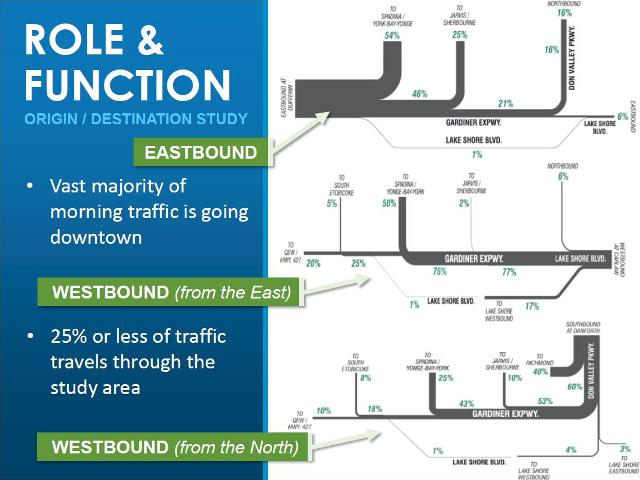
The study claims that 80% of inbound trips have downtown destinations and this argues against a tunnel from which access would be difficult.  However, consider the origin-destination charts on page 15 of the presentation:

GE2P15

Of the traffic arriving from the DVP:

  • 40% leaves at Richmond Street
  • 7% exits to Lake Shore
  • 53% continues onto the Gardiner East, subdivided as
    • 10% exits at Jarvis/Sherbourne
    • 25% exits at Spadina/York/Bay
    • 18% travels beyond downtown.

If we were contemplating a tunnel across all of downtown, the argument about ramps and O-D patterns would be valid, but in this case, from the point of view of such a tunnel, most traffic is “through” traffic.  Only 10% of traffic that would enter a tunnel westbound at the Don leaves at Jarvis, and even this would be served if an off-ramp were incorporated in the transition from tunnel to elevated.  Similar arguments apply to the other O-D maps above.

The real problems with a tunnel are its cost and the barrier effect created by ramps linking the tunnel to the elevated structures at the Don and at Jarvis Street.

The schemes involving the rail corridor have both been dropped because they cannot be fitted into the space available.  In the case of an elevated, there is no room for the support structures needed (not to mention access ramps), and in the case of the berm, the area is reserved for future expansion of rail operations.

A far more important issue hinted at by the presentation but not explored in detail is the wider context of transportation into the core area.

Continue reading