
Looking Back: Services to the CNE

With all the recent talk about Ontario Place, and with Exhibition season almost upon us, I thought this would be a good excuse for photos of streetcar services to the Ex.  Decades ago, the CNE raised much bigger crowds and there was a time it really was a showcase, an “exhibition”.  I remember when the “Better Living Centre” was brand new, and its intent was to give fairgoers a look at all that was new and exciting in household goods.  The Internet didn’t exist yet, and the phenomenon of the shopping mall full of goods manufactured anywhere but here was in its infancy.

The TTC ran many streetcar services into the Ex over the years, and parades of cars would leave the grounds following the evening fireworks.  (Transit Toronto has a short history of the CNE services on its website.)

The photos here have been chosen not just for the fact that cars might be operating on Exhibition routes, but also for interesting details about what is, or is not, still in the city today. Continue reading

Looking Back: Moving House on a Grand Scale

March 31, 1972, brought an unusual sight to downtown Toronto.  An 1822 house, originally the home of Sir William Campbell, sixth Chief Justice of Upper Canada, moved from Adelaide and Frederick Streets in the old Town of York to its current site at Queen and University.  It was the Town’s oldest remaining building.  (Although The Grange behind the Art Gallery on Dundas Street dates from 1817, it was built out in the countryside, far from the few blocks of the original town.)  Campbell House sat in an area now booming with condo development and rejuvenated warehouses, but then a run-down district where an old house just got in the way of a parking lot expansion.

As I write this, we are celebrating Victoria Day weekend.  Victoria herself was only 3 when Campbell House was built.

Moving the house was quite a challenge as the following photographs show.

Looking back at these pictures, I was amazed at how close the crowd following the move was to the building. In these days of Health & Safety Officers (with liability lawyers in close pursuit), the crowd would be kept back for blocks.

Continue reading

A Look Back: Rail Grinder W28

There was a time when the TTC had a fleet of surface work cars:  rail grinders, flat cars, cranes, a sand car, snow ploughs and sweepers.  They’re all gone (a few survive in museums), and maintenance of the surface system uses much more prosaic vehicles.

My favourite was W28, originally Toronto Civic Railway 57, that operated as a rail grinder from 1955 until it was replaced with a PCC rail-grinding train in 1976.

As an early Easter gift to readers, here is a photo gallery of W28 from 1967-8.

Continue reading

A Look Back: July 1967

img395cb

Danforth and Woodbine looking west.

No, it’s not an experimental train of air-electric multiple unit cars, and these are certainly not Bloor streetcars given that the subway had been open for over a year when this was taken.

Russell Carhouse had a pool of old PCCs it used, but there were more in the pool than would fit at Russell and the extras were stored at Danforth Carhouse.  From time to time, cars would be swapped from one location to another, and in this view the front car, 4270, is pulling a stored car along the Danforth enroute to Russell.  (The shorter connection via Coxwell was no longer available.  Cars took the long way around via Danforth, Main, Gerrard and Coxwell to get down to Queen.)

Note the old yellow and blue “Night” stop.

This corner and the vista to the west make an interesting comparison to the present day view on Google Street View.  Even today, the buildings are low rise all the way west, an excellent example of how a subway does not necessarily trigger or require high rise development.

The Royal Bank is still on the northwest corner, but Scotiabank has moved across the street to a new building where National Trust and Kresge’s used to be.  Everything else has changed hands, although the buildings are mostly the same.  Bowling alleys were common in the 60s, but they gradually disappeared.  Billiard halls were not the sort of place respectable teens could hang out.

A Look Back: February 1966

img024a

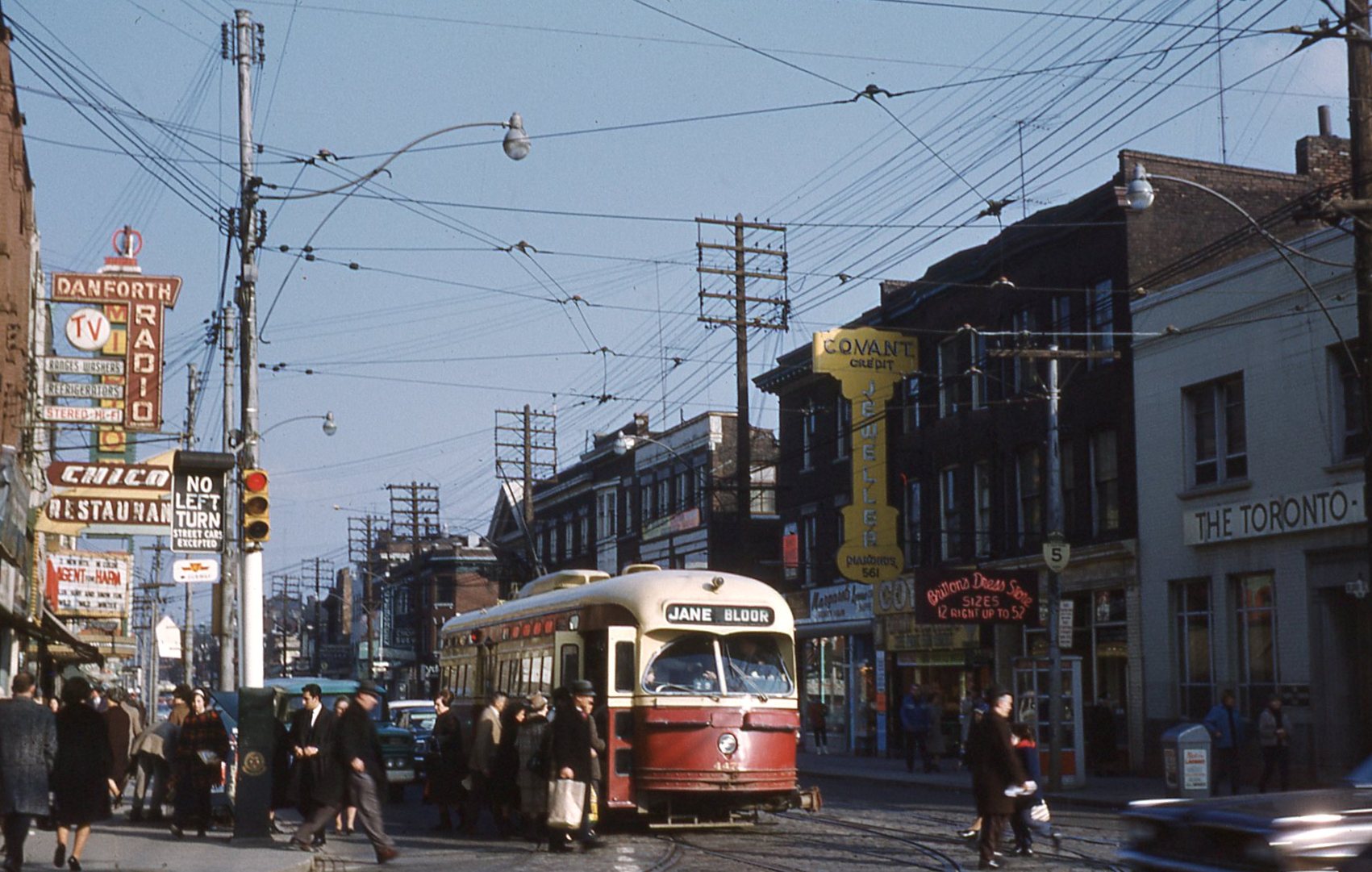
Bloor and Bathurst looking east.

The brand new subway will open in about one week, and the Bloor streetcar is about to vanish into history.  Much else in this photo would disappear as well.  The buildings are still there, but their use has completely changed.  The TD bank is now a coffee shop, Danforth Radio is no more, and the Midtown cinema is now the Bloor.

Street signs have changed a lot since the 60s.  Toronto outlawed the overhanging signs decades ago, and the few that remain are grandfathered.  Traffic regulations are spelled out rather than shown as graphics.  A demure “TTC Subway” sign with a small arrow directs passengers who might be looking for the Bloor car to the subway station just up Bathurst Street.

The hydro wiring is still in overhead box structures, and the classic Toronto acorn luminaires had yet to be replaced by sodium vapour lighting on higher poles.  There’s a phone booth on the sidewalk and a pre-Astral garbage bin.