
Bloor-Danforth Streetcar Shuttles: Demand Without Density

A frequent part of debates about technology choices and network planning is the premise that to succeed, rapid transit must be surrounded by high density development. This is an odd claim given the counter-examples available on Toronto.

The situation is more subtle, and “demand” turns not just on density adjacent to the line, but on its ability to act as a corridor drawing on feeder services to concentrate demand. Whether such concentration is “good” is another matter. Higher demand requires more infrastructure in the corridor and in a worst-case scenario, a line can run out of room. Two good examples in Toronto are the Yonge subway and Highway 401.

Focus on a single corridor can also distort travel patterns and network design. As a non-driver, I have often been amused by motorists who will go miles out of their way to use an expressway, only to find themselve trapped in a traffic jam. For transit riders, the need to force-feed rapid transit can interfere with travel that is not oriented to the primary trip pattern. Try getting around Scarborough if you are not bound for Kennedy or STC stations.

Recently, I was scanning another batch of old phographs and they reminded me of an even older example of high demand in a low density area: the streetcar shuttles on Bloor-Danforth that operated between the opening of the original Keele-Woodbine service, and the extensions a few years later to Islington-Warden. Neither Bloor West nor the Danforth — particularly in the late 1960s — were forests of high rise apartments. All the same, the shuttles had service, capacity and demand beyond that we see on any streetcar line today.

The Bloor West shuttle from Keele Station to Jane Loop operated with 17 cars at peak over a distance of only 2.1km at a headway of 1’07”. That’s 53.7 cars/hour for a design capacity of about 4,000/hr (based on about 75 riders per car) with headroom for peaks at a higher level.

The Danforth shuttle from Woodbine Station to Luttrell Loop operated with 12 cars on a 1.6km line at a headway of 1’30”. At 40 cars/hour this gave a design capacity of about 3,000/hr.

An important point about these shuttles is that the lion’s share of their traffic was bound to or from the subway, and local traffic was comparatively light. Many riders boarded inbound at the Jane and Luttrell terminals, and the streetcars were not attempting to serve very heavy demand from on-street stops. That demand depended on feeder bus services from what we now call “the inner suburbs”.

Moreover, the level of service on the outer ends of the old Bloor-Danforth streetcar route shows how considerable the demand was for these segments, even allowing for some added demand due to the subway’s presence.

The moral of this short article is that a transit network and its routes cannot be thought of with a simplistic model of transit stations surrounded by development. The larger context includes the diversity or concentration of demand patterns and the degree to which the network serves them.

In the next article, a look at Bloor West and The Danforth as they once were.

Correction January 6, 2015: In the original version of this article, I cited the number of cars/hour as the actual assignment of vehicles to each route. Thanks to John F. Bromley for catching this howling error.
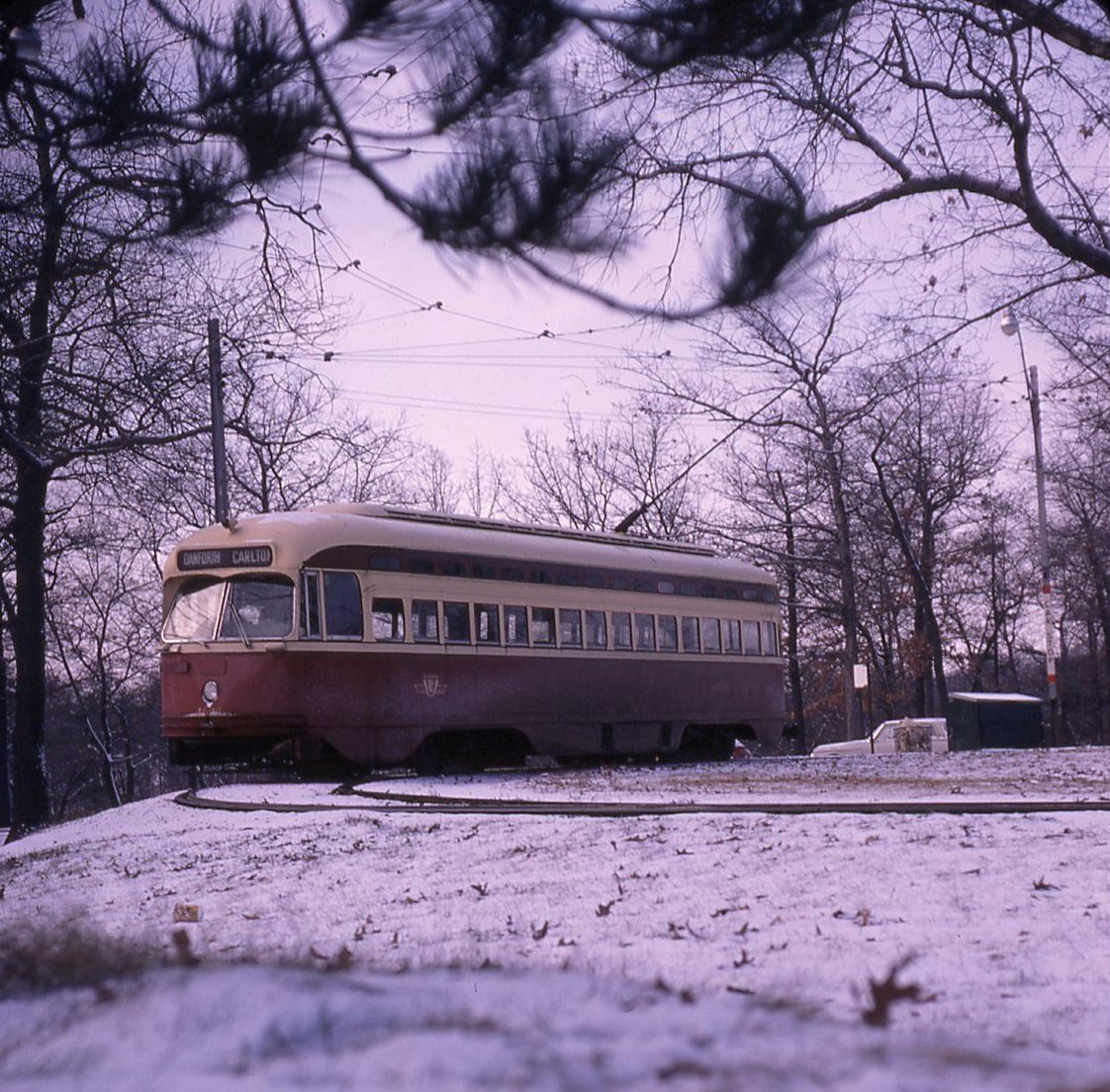
July 19, 1974: The End of the Line on Rogers Road

July 19, 1974 was the last day for streetcar service on Rogers Road, and in honour of the anniversary, this post is a gallery of before and after pictures.

For an historical overview of the line, please see Sean Marshall’s article on spacing.ca.

The Rogers Road car, the last remnant of the York Township Railways, was not saved with the rest of the streetcar system in 1972 because York (then a separate municipality) did not want to spend the extra money required to repave their street with streetcar tracks in it. Although service on Rogers once ran every 3 minutes at peak, by 1974 this had fallen to every 5 minutes as demand was siphoned off by north-south service on 29 Dufferin and 41 Keele feeding south to the Bloor subway.

During off-peak hours, the line was a 15-minute long shuttle from Oakwood Loop at St. Clair to Bicknell Loop just east of Weston Road, but during the peak, cars ran east via St. Clair to the Yonge Subway. The combined service of Rogers, Earlscourt and St. Clair cars between Oakwood and Yonge was considerably more frequent in 1974 than it is today.

After a period as a branch of 63 Ossington, the line was eventually converted to diesel operation and now operates as a separate route, 161 Rogers Rd.

Continue reading

A Subway Anniversary & A Few Old Transfers

The Yonge Subway celebrates its 60th birthday this weekend on March 30, 2014.  In honour of the occasion, I have scanned in a few transfers from the era predating the opening.  With the exception of the souvenirs from 1953, these were rescued from oblivion when the TTC was cleaning house of old files at Hillcrest Transportation many years ago.

Continue reading

Motorists vs Transit — 50 Years On

Mike Filey recently sent me a copy of an editorial written in the Toronto Star of February 12, 1963 by the late Ron Haggart.  For copyright reasons, I cannot reproduce the entire article here, only selectively quote from it, but it could have been written yesterday.

Haggart begins with a 1957 report from the Metropolitan Toronto Planning Board that argued Toronto could improve its streetcar service, possibly avoiding the need for so much subway construction, simply by using tools already at the City’s disposal to manage the streets:

  • Enforce laws that prohibit obstruction of streetcar tracks.
  • Let streetcars control the traffic signals.
  • Enforce “no stopping” laws in curb lanes to keep them open for traffic flow.
  • Limit or ban left turns from streetcar lanes.

The context for these recommendations was a report on subway priorities (Bloor was recommended over Queen), but planners argued that even if subway would come to Bloor eventually, changes should be made to improve streetcar service.  Streetcars could get up to 12-13 miles/hour (19.2-20.8 km/hr)  compared to the expected 15.75 mph (25.2 km/h) for the subway.  (In those days, the line was projected to cost $200-million for the 12km stretch from Woodbine to Keele).

Streetcar priority would “necessarily involve some inconvenience to a number of ratepayers”, but would save the transit system (and those ratepayers) money.  As Haggart observed:

Every politician knows that it is far easier, politically, to build a $200 million subway than it is to keep cars off the streetcar tracks.

He continued:

Present-day leaders in Toronto have continued to play with the expensive but politically popular solutions (subways) or the airy-fairy solutions (monorail) and have shied away from the solutions that are simpler (in the engineering sense) but which are more difficult (in the political sense).

W.E.P. Duncan, then General Manager of the TTC, had observed that the political decision makers come to their jobs in cars.  Haggart goes on to cite the same sort of streetcar-vs-auto capacity numbers we hear today from the TTC.  But politicians of the day thought that replacing streetcars with buses would fix everything.  Not so, said Norman D. Wilson, a consultant to the TTC and father of the “wye” junction, who observed that three times the transit vehicles would be required, and the speed and convenience of transit would not be “one whit improved”.

Haggart concluded that the streetcars should be saved, but that:

Unfortunately, politicians prefer to be known as the father of the Gardiner Expressway … no one wants to be remembered as the Protector of the Streetcar.

Fifty years later, nothing has changed.  Even a fully grade-separated LRT, the most advanced form a “streetcar” can take without simply morphing into a subway line, fails to gain support and advocacy from the very politicians who should defend it.  It is simpler to plump for subways and ignore the expense.

Looking Back: Restoring the Peter Witt Cars 2766 and 2894

1973 was quite a year for the streetcar system in Toronto.  The TTC had just decided to keep its fleet, and embarked on the rebuilding of its PCCs.  At the same time, an interest in TTC heritage led to the creation of the “Belt Line Tour Tram”, a regular fare tour car looping around downtown.

Only one small problem: the TTC didn’t have any cars fit to use for this service.  Car 2766, the last Witt on the property, only operated occasionally around Hillcrest for special events.  Car 2894 was sitting in a barn in Hawkestone, Ontario near Barrie.

Continue reading

Looking Back: Toronto By Night I

As a holiday present for my faithful readers, a selection of photos taken at nights on the streets of Toronto.

This set begins in 1967 and runs through to early 1972.  During this period, a friend and I spent a lot of time chasing works equipment to various track projects around town.  Standard M.O.: sit opposite Hillcrest gate waiting for the work cars to depart, follow them on their way, and set up for photos when they stayed put long enough.

Many of the PCC photos are from all-night charters, yes, I admit it, “fantrips” where a bunch of rail buffs of dubious sanity would not only stay up all night riding a streetcar and photographing it, but would charter a car for the purpose.  Professionals have words for such people, and these tend to be dismissive at best suggesting that the “foamers” are unfit to comment on transit policy.  I won’t say anything about the competence of those making such remarks beyond noting that I have a blog now, four decades on, and they don’t.

Continue reading