Where Is My Streetcar: Fall-Winter 25/26 Edition

With the constant changes in route diversions for various construction projects, water and sewer repairs and overhead reconstruction, the previous Fall 2025 edition was getting cluttered and unwieldy. This version consolidates the current and planned work for late fall and early winter 2025-26.

Updated December 21, 2025 at 8:45am

Current diversions:

  • Until Spring 2026:
    • 501 Queen cars divert both ways via Broadview, Dundas and Parliament.
    • 503 Kingston Road buses divert both ways from River via Queen and Parliament.
    • 504 King cars terminate at Distillery Loop.
    • 504D King buses operate from Broadview Station to King & Parliament
  • Ongoing:
    • 501 Queen cars divert both ways via Church, Richmond/Adelaide and York.
Continue reading

Travel Times and Speeds on Streetcars: 2025 vs 2019

This article reviews the change in travel times and speed profiles on 510 Spadina, 511 Bathurst and 512 St. Clair between October 2019 and October 2025 (pre- and post-pandemic). In almost every case, streetcars are slower today than they were six years ago even though two of the three routes have reserved lanes.

511 Bathurst will soon have red lanes from Fleet to Bloor (except for a section north of Dundas), and I will publish updated charts for that route when the lane changes are in place.

By October 2019, streetcar service was almost completely operated with the new Flexity cars, and so the change over time is not explained with a comparison between the sprightlier CLRVs and the newer cars. (For 512 St. Clair, I have also included a comparison with the CLRV era to show the effect of the vehicle change separate from the pre/post pandemic change in traffic conditions.)

TTC is overly fond of laying blame for transit vehicle speeds on “traffic congestion”, but that is too simplistic an analysis especially for routes with reserved lanes. They also have a bad habit of presenting data without the granularity needed to identify patterns and problems by time of day and location. There are many charts in the main part of this article, but they are intended to show each route in detail.

One important point is that it is impossible to know how much change in speed comes from a more cautious operating philosophy as opposed to traffic conditions. There is, of course, the slow operation through junctions, but that does not explain slower travel on straight track with no special work. Traffic signal effects also show up, particularly in time spent holding nearside at intersections and then again at farside stops. Some areas are inherently slower than others such as Spadina from Queen south with many close-spaced intersections and signals that generally favour east-west traffic. The situation is particularly bad between Front and Queens Quay where the primary job of signals is to handle traffic to/from the Gardiner Expressway.

Any move to speed up operations on streetcar routes requires more than quick fixes like stop eliminations, and detailed block-by-block reviews are needed. In some cases there will be trade-offs between transit and other road users. Arguments for better priority will fare better if and when the TTC improves service so that there are actually transit vehicles to prioritize.

Continue reading

TTC Misrepresents Growth in Streetcar Delays from Blocked Tracks

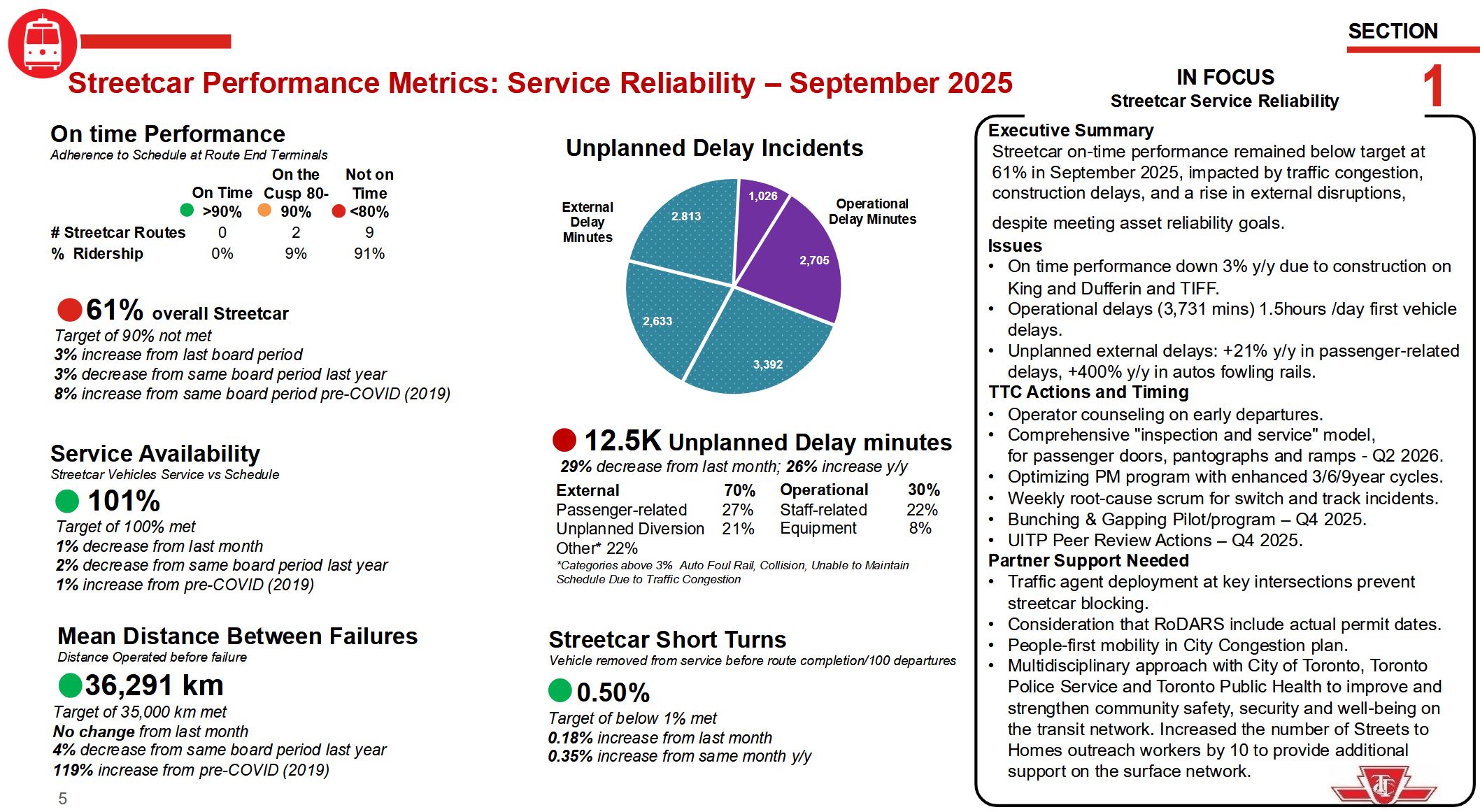
At the TTC Board meeting on November 3, management presented statistics on streetcar delays broken down by type of incident. TTC is quite fond of portraying external incidents, especially those related to congestion, as the root of (almost) all evil. The following page is from the CEO’s Report.

Note that external delays (turquoise) occupy the majority of the chart. During discussion of the problem of autos fouling rails, a passing remark by the Interim Chief Operating Officer piqued my curiosity when he said that there were many delays due to the winter storm.

This sent me to the TTC’s delay statistics which are available on the City’s Open Data site. There are codes for many types of delay including “MTAFR”, short for “Auto Fouling Rails”.

According to the “In Focus” box above there has been a 400% year-over-year increase in these delays, although they are styled as “fowling” implying a flock of chickens might be responsible for service issues.

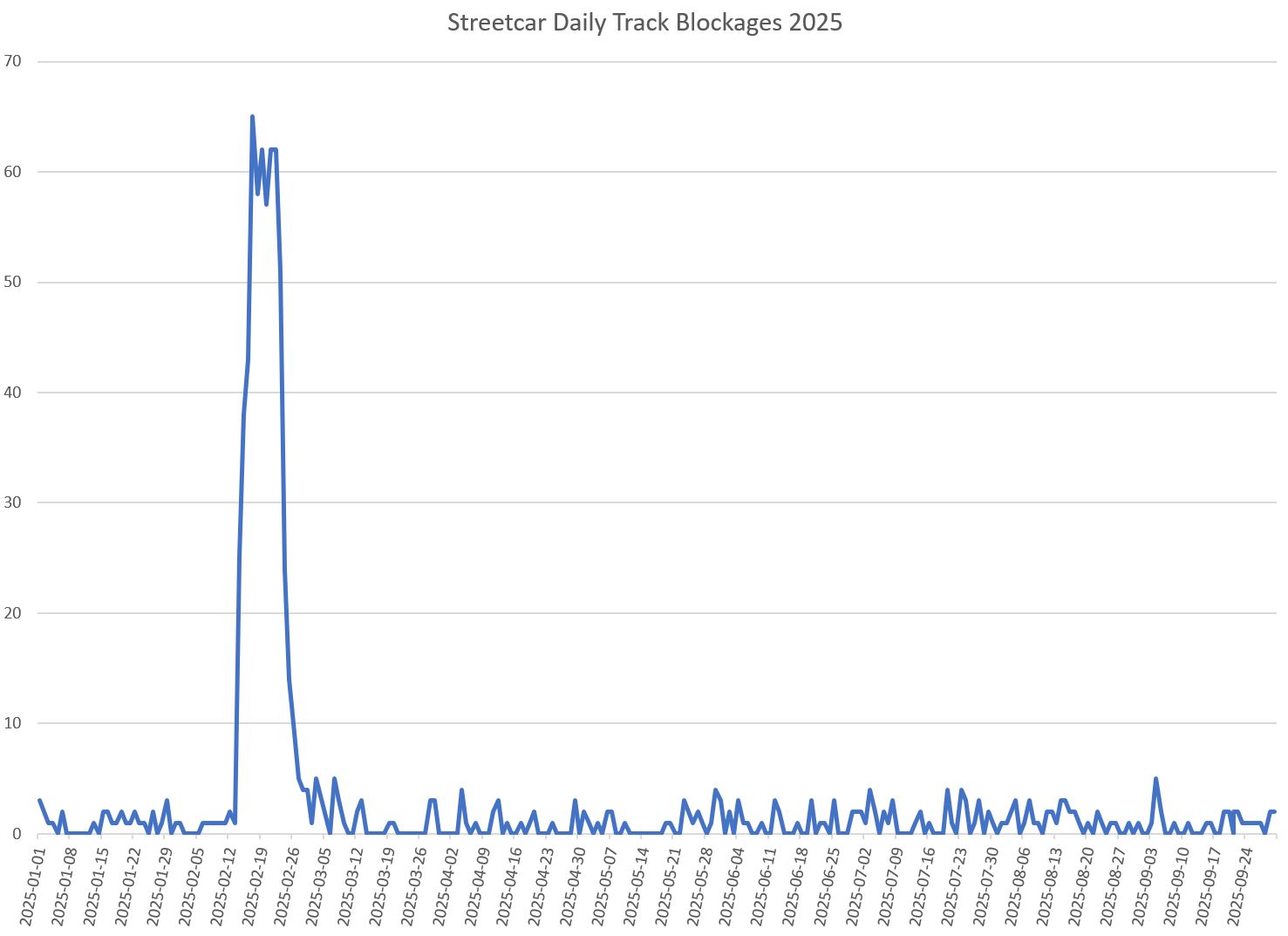
Sorting the data by code and summarizing by date produces interesting results.

  • Between January 1 and September 30, 2025, there were 843 MTAFR events logged.
  • Of these, 586 fall between February 14 and 26 hitting a daily high of 65 on February 17.

These blockages were not caused by the typical traffic congestion, but by the City’s utter failure to clear snow on key streets.

  • 105 were on 501 Queen
  • 42 were on 503 Kingston Rd.
  • 84 were on 504 King
  • 93 were on 505 Dundas
  • 186 were on 506 Carlton
  • 3 were on 507 Long Branch
  • 1 was on 508 Lake Shore
  • 2 were on 509 Harbourfront
  • None were on 510 Spadina or 511 Bathurst
  • 6 were on 512 St. Clair
  • A few dozen were on various night cars

The pattern here is quite clear: routes on wide roads or rights-of-way were not seriously affected, but routes on regular 4-lane streets were hammered. (How 511 Bathurst was spared is a mystery. At the time it was running with streetcars from Bathurst Station to King & Spadina, and with buses on the south end of the route.)

To claim that the 400% increase from 2024 is some indication of worsening traffic problems is gross misrepresentation of what actually happened. Although this is the CEO’s report and he almost certainly did not assemble the information himself, he wears this issue for having reported misleading data to the Board and public.

Direct comparison with published 2024 data is difficult because until 2025 the TTC used a much coarser set of delay codes that lumped many types of events under generic headings. There was a category “Held by” in which there were 625 incidents from January to September in 2024. The 843 MTAFR codes in 2025 are quite clearly not a 400% increase over 2024.

Whenever there is a discussion of unreliable service, we hear endlessly about traffic congestion. This definitely is a problem, but not the only one, and certainly not in the way presented by the CEO.

A question arose during the debate about the problem that performance stats are consolidated across all routes. Route-by-route service quality is presented in detail in the second part of this article for all streetcar routes. This shows that problems are widespread in the system, even on routes with reserved lanes.

As for the delay stats cited by the CEO, it is clear that we are not comparing September 2025 to one year earlier as the text implies, but using events from the entire year to date including a major snowstorm that had no equivalent a year earlier. The so-called 400% jump in delays from blocked tracks is due to snow and poor road clearance by the City.

TTC management owes the Board and the public an apology for blatant misrepresentation of the delay statistics.

Continue reading

TTC Bunching and Gapping Pilot

The TTC has a pilot program underway on several routes with increased supervision in an attempt to improve service quality by addressing service gaps and bunching. These are complementary effects in that a gap is often followed by a bunch, although gaps can also occur due to missing vehicles and short turns. See:

The pilot evolved over the year as some of the challenges and resource needs to manage service became apparent.

March 2025Pilot launched on 7 Bathurst, 24 Victoria Park, 924 Victoria Park Express, 25 Don Mills, 925 Don Mills Express, 29 Dufferin, 929 Dufferin Express, 100 Flemington Park, 165 Weston Road North, 506 Carlton, 512 St Clair.
Dedicated staff to manage each route were not used initially and results were poor.
June 2025The pilot was scaled back to 7 Bathurst, 24 Victoria Park, 924 Victoria Park Express, 506 Carlton, and 512 St Clair.
One route supervisor was assigned to each route.
September 2025100 Flemingdon Park and 165 Weston Road North were added.
October 2025Pilot “refined” to focus on the weekday peak periods.

The TTC recognizes that delays leading to gaps can be caused by several effects: “including including Operator behaviour, customer incidents, traffic congestion, city events, construction, and operational factors, such as door/ramp operations.” [p. 2]

Later in the report, there is mention of the effect of passenger loads and long traffic signal wait times.

If vehicles are crowded either because service is inadequate for demand, or because a gap creates an extra load, they will take longer at stops. Filling vehicles to the brim can be counter-productive and inefficient. Space limitations onboard can delay passenger movement especially for those with large objects (e.g. strollers, luggage) and mobility devices. Although ramp operations are mentioned, there are many other types of passengers with extra space and boarding time needs.

Transit signal priority is also mentioned, but there is no indication of where or what priority measures were added on the pilot routes.

The remainder of this article reviews the metrics used by the TTC to track the success of the pilot project, as well as problems and actions that might be taken to resolve them.

Continue reading

512 St. Clair: Mid-Point Route Management Update

In a previous article, I examined headway reliability on several routes that had been flagged for improved management by the TTC.

The 512 St. Clair car received improved service in September 2025, and this article updates the charts with headway stats to September 30 showing the combined effect of more service and route management.

Weekday service over the 2024-25 period has had three main levels: bus operation during a long-running construction project in 2024, followed by streetcar service with headways improving only in the last month.

EffectiveAM PeakMiddayPM PeakEarly EveLate Eve
5-Sep-23 (Bus)3′5′3’30”6′10′
24-June-24 (*)8′8′8′8′10′
2-Sept-256′6′6′8′10′

(*) For a period in Oct-Nov 2024, the route was split with streetcars operating from Gunn’s Loop (Keele) to Bathurst Station, and buses from Oakwood Loop to St. Clair Station. This was not shown in the published service summary, but does show up in the observed data for the portion of the route operated with buses.

Generally speaking, the range of headways at various points on St. Clair did drop in September 2025, although the effect is more pronounced early in the month than later. Whether this indicates a trend away from tighter headway management as the month wore on will not be clear until more data have accumulated.

During the period of bus operation, the median headway (50th percentile) did not move around much, but this is not the case with the streetcar periods. A reason for this is that with wider scheduled headways, it is more likely that within one hour the scheduled number of vehicles will be higher or lower by a more substantial amount than with the more frequent bus service. Conversely, with the shorter scheduled bus headways, it is much more likely that vehicles will run in pairs because it is much easier to catch up to the bus only a few minutes in front.

A long-standing problem on streetcar routes with larger and larger vehicles (PCC/CLRV, ALRV, Flexity) is that scheduled headways to provide comparable capacity widen, but the laissez-faire attitude to line management results in much worse swings in vehicle spacing. This is compounded by Service Standards that accept a wider range of headways for less frequent service. The issue of meaningful Standards is to be reviewed in coming months by the TTC, and this is an area where Standards should not be compromised just to preserve “good” performance stats for management.

As shown in many analyses published here, there is a general problem with headways becoming more erratic as vehicles move along the route. St. Clair is entirely on its own right-of-way, except for a short stretch at the western end. It also has a mid-point opportunity for headway regulation at St. Clair West Station. Data for departures from that point suggest that little or no headway management occurs there.

TTC Service Standards for terminal departures specify a range of 1 minute early to 5 minutes late, although recently the service metrics were change to eliminate early departures. In any event, a 5 minute window for being “on time” combined with a 6 minute scheduled service means that service can be badly bunched and still “on time” for reporting purposes.

Along the route, the Standards prescribe headway variations of ±50% so that for a 6 minute headway, an actual range of 3-to-9 minutes is permitted. For an 8 minute headway, the permitted range is 4-to-12 minutes. To compound credibility problems, this only has to be achieved on 60% of trips. [See TTC Service Standards at pp 15-16.]

Needless to say, when the TTC says that service meets their standards, the quality can vary quite widely from what riders might expect as “reliable” operation.

Following the “more” break, the first section looks at the evolution of headways along the route west from Yonge and east from Keele during various periods over the day. AM Peak values tend to be slightly more reliable, but even they worsen the further from the terminal one goes.

The second section presents the detailed headway data from September 2025 to show the actual scatter of headway values by day and week, and including weekend data.

There is some indication that the TTC has attempted better headway management on 512 St. Clair, but the results are uneven and there are clear signs of locations and time periods where service is not regulated at all. In turn, this shows what “normal” operations are like without active dispatching and spacing of cars along the route.

Continue reading

Where is my Streetcar? Fall 2025 Edition.

There are many diversions coming up in the Fall for streetcar routes. Information on these appears in various places on the TTC site, mainly but not exclusively under Service Advisories. As an aid to riders, this article consolidates the available information in one place.

Updated November 28, 2025

***** This article is only for archival purposes. It has been replaced by a new one picking up from mid-November 2025. *****

Major events pending and in progress include:

  • Construction on Queen between Davies (just east of the Don Bridge) and Broadview.
  • Reconstruction of the intersection of College and McCaul, and of overhead in the vicinity.
  • Reconstruction of track and overhead at and near Parliament and Carlton.

Other short term diversions will last only overnight or for a weekend.

Many of these are complicated by the ongoing Ontario Line work at Queen & Yonge forcing some diversions to be more complex than they might be otherwise.

This article will be updated when changes are announced.

  • November 21: The 501 diversion via Broadview, Dundas and Parliament around water main and track work west of Broadview will begin on November 22.
  • November 20: Equipment and material mobilization is underway on Queen west of Broadview.
  • November 17: The 506 diversion has been changed today to avoid the intersection of Church & Dundas where construction blocks the northeast corner. Maps have been added from the TTC’s site.
  • Effective November 16: The 503 Kingston Road bus will be cut back from Dufferin, and will now loop at York Street via Richmond and University.
  • November 15: Diversions announced for two projects on 506 Carlton at Parliament & Carlton, and on Gerrard east of Broadview.
  • November 9: King & Dufferin reopened for streetcar service. 503, 504, 508 will operate via their normal routes.
  • October 30: King & Dufferin reopens for general traffic and buses. Streetcars to return following track testing.
  • October 20: Water main reconstruction on Queen west of Broadview has been delayed until early November. 501 Queen streetcars will continue to operate on Queen Street until further notice.
  • October 13: 504 King is operating with streetcars today over its full route except for the King/Dufferin diversion.
  • October 9: Maps for 504 King and 506 Carlton diversions added.
  • October 8: Construction at Queen & Broadview will not start on October 12, and so some diversions will not be required immediately. Information for 501 Queen and 503 Kingston Road has been updated.
  • October 5: Nuit Blanch & Run For the Cure info moved to the archive section.
  • October 1: Diversions of 505/305 Dundas and 506/306 Carlton for Nuit Blance and for the Run For The Cure added for October 3/4/5.
  • September 23: The King/Dufferin start date has been changed to Sunday, September 28.
  • September 12: King/Dufferin start date pushed back to September 29 or later. The project will now extend to mid-November.
  • September 9: College/McCaul and Queen East details added.
  • August 26: King/Dufferin Project
    • The start date for this project has been changed to mid-September with the exact date to be confirmed. Although new schedules will be in place providing for diversions, service will continue to operate through on King Street until construction actually begins. This likely means that the project will extend further into October than the originally planned Thanksgiving weekend end date. The delay also means that the Tiff diversions will end before the King/Dufferin diversions begin.
    • Branch lettering for 504 King A/B corrected.
  • August 25: King/Dufferin Project
    • Information about Kingston Road night service added.
    • 304 King and 329 Dufferin confirmed to be diverted on the same routes as the 504A and 29 daytime services.
Continue reading

TTC’s 2026 Network Plan: Round Two

The TTC is into the second round of its consultation for service changes and construction projects in 2026. There is a general page on the 2026 Network Plan and a Survey for feedback.

If you comment here, be sure to also complete the survey so that your feedback goes into the official record.

Updated August 14, 2025 at 1:20pm: This article was written based on information in the customer survey as it existed about 4:00 pm on August 13 when the link to it went live on the TTC site. This included a reference to a minimum 5 minute time saving for express buses which did not match the TTC’s own service standard. The survey now contains the correct information. Text in this article has been updated accordingly.

Updated August 22, 2025 at 2:40pm: The City of Toronto has confirmed that widening of the St. Clair underpass east of Keele Street will not be part of the Metrolinx/TTC project planned for 2026.

Public Pop-Ups

  • August 13
    Pioneer Village Station near express route bus bays
    7:30-9:30 a.m. 
  • August 14
    Kipling Station near express route bus bays 
    7:30-9:30 a.m. 
  • August 18
    Kennedy Station near express route bus bays (Platform A and B)
    7:30-9:30 a.m.
  • August 19
    Don Mills Station near express route bus bays 
    4-6 p.m. 
  • August 20
    Yonge and College 506 Carlton, Eastbound stop
    4-6 p.m.

Note that almost all of these relate to the review of express bus services, and only one of the construction proposals (College/Carlton) is covered. More consultation in affected neighbourhoods is definitely required.

Continue reading

Does TTC Mid-Point Route Management Work? (Part I)

In February-March 2025, the TTC added on-street supervisors on eleven routes in an attempt to reduce the incidence of gaps and bunching. This is described in the June 2025 CEO’s Report and the associated Metrics Report containing performance stats for the system.

Bunching and gapping of TTC service

Last March, the TTC expanded a pilot to improve service reliability on 11 key bus and streetcar routes. Working through the Transit Control Centre, uniformed Supervisors have been deployed mid-route to ensure our service frequency meets customer expectations and that we reduce the bunching and gapping of our buses and streetcars, which is a source of frustration for riders.

The pilot involves the following routes: 7 Bathurst, 24/924 Victoria Park, 25/925 Don Mills, 29/929 Dufferin, 100 Flemington Park, 165 Weston Rd North, 506 Carton, and 512 St Clair.

Starting in July, the CEO’s Report will include a Hot Topic that will provide news and updates on the progress – and challenges – related to this important issue. [CEO’s Report, p. 9]

Also:

TTC expanded a pilot to improve service reliability on key bus routes. Mid-route Field Supervisor presence on the nine priority bus routes was increased throughout the February and March Board Period, where the focus is on reducing bunching and gapping, in order to improve the reliability of service. Bunching and gapping is measured by “Headway Adherence”: the vehicle is considered on-time when the headway deviation is less than 50% of the scheduled headway. [Metrics Report, p. 15]

Mid-route Field Supervisor presence on the two priority streetcar routes continued throughout the February and March Board Period, to reduce bunching and gapping and improve the reliability of service. Bunching and gapping is measured by “Headway Adherence”: the vehicle is considered on-time when the headway deviation is less than 50% of the scheduled headway. [Metrics Report, p. 16]

Although there is a Service Standard for headway adherence, this is not measured and reported publicly, and results are never cited in ongoing service quality reports. For many years, the TTC clung to the concept that if routes were on time at terminals, the rest of the line would look after itself. However, the “on time” standard is sufficiently lax that badly bunched and gapped service can meet the target. That, combined with reporting only average results, hides the real character of service that riders experience day-to-day.

At the June 23 Board meeting, management gave the impression that they would not report on all routes in July and might have to farm some of the analytical work out.

This is a sad admission considering the years of articles I have written on service analysis showing what could be done with the hope that the TTC would develop internal tools to perform similar tasks. Sadly, however, I have been told by some at TTC they have what they need, and, in effect that I should run along and not bother them.

Partly to hold their feet to the fire, and to provide the type of information that should be routinely available to the Board, management and the public, this article will do the work the TTC claims they cannot. Here are headway reliability analyses for the routes involved over much or all of the period from January 1, 2024 to June 30, 2025.

In a very few cases, it is possible to see a change in service quality (measured as a smaller spread between minimum and maximum headways, or gaps between vehicles) around the beginning of March 2025. These are rare, and short-lived. February was a really bad time to try to implement any new practice as the city was digging out (or not depending on where you live) of a huge snowstorm. (The extended effect of the City’s poor snow clearing on transit routes is evident in the multi-day peaks in irregular service on some routes.)

I have presented 18 months of data to show that problems with headway reliability have existed for some time. There is more data going further back, but 18 months makes the point. Moreover, a consistent pattern is that headways might be well-behaved in the AM peak and Midday, but evening service does not fully “recover” from PM peak conditions, and erratic service is common.

Quite bluntly, service on all of these routes was poor, well beyond the TTC’s own Service Standards, for 2024 and early 2025, and showed little sign of improvement through to mid-year. It will be interesting to compare whatever stats TTC comes up with to the performance shown on charts here.

Part I of this series includes data for 7 Bathurst, 100 Flemingdon Park, 165 Weston Road North, 506 Carlton and 512 St. Clair. Part II will include 24/924 Victoria Park, 25/925 Don Mills and 29/929 Dufferin.

There are a lot of charts and this is a long read. I will put the “more” break here. Those readers interested in specific routes can soldier on. Thanks for reading!

Continue reading

512 St. Clair Traffic Signal Delays

With Toronto’s Congestion Management Plan in the news, we hear about various ways to improve the movement of cars and, oh, by the way, maybe speed transit vehicles too. Toronto talks a lot about “transit priority” but this more often means giving transit vehicles the leftovers, the spare time that can be shaved at some locations from competing traffic, not absolute priority for transit vehicles.

This shows up particularly where transit vehicles have a dedicated lane, but they must wait patiently while other traffic, typically left turns, gets out of the way. This has the perverse effect of making transit slower particularly when combined with the “double stop” effect of farside stops. At these locations, the nearside space a stop would normally use is occupied by a left turn lane, and traffic in that lane has first claim on a green cycle.

Two routes with this as a near-standard stop configuration are 510 Spadina and 512 St. Clair. The Spadina car only recently returned, and I will leave comparative analysis of bus and streetcar operation there until more data have accumulated. A preliminary look is not complimentary to the streetcars because, unlike them, the buses are able to combine waiting for green signals with loading passengers.

On St. Clair, streetcars returned in Fall 2024. This article reviews tracking data for March 2025. In brief, a common situation along the route is that streetcars spend more time waiting at intersections than they do serving stops once they cross to a farside platform. The traffic signals are not organized to favour streetcar movements, and the configuration with farside stops is counterproductive.

To be fair, one cannot simply throw a red signal in front of cross traffic every time a streetcar appears as this will affect both auto and pedestrian crossings that require a minimum time. When both the St. Clair and Spadina lines were designed, a concern was the frequency of streetcar service and the high probability that there would always be a streetcar demanding priority. However, the larger Flexity cars combined with TTC service cuts makes this claim less valid.

Pre-emptive streetcar signals could be challenging at some locations, but there is the separate issue of timing of the phase for left turning autos. Should it come before or after streetcars are allowed to cross the intersection? Streetcar-only phases are only provided at some locations on Spadina where cars are turning across traffic lanes, but not for through movements. There is a streetcar-only phase at Lansdowne and St. Clair westbound, but otherwise left turning auto traffic always has priority.

A related problem lies in TTC’s glacial streetcar speeds through special work which would require a lengthy transit phase to allow streetcars to clear intersections on Spadina with streetcar junctions. With streetcars crossing on the shared north-south green, this does force motorists to wait for streetcars to get out of their way.

The data on St. Clair show a common pattern: streetcars spend more time waiting to cross intersections than they do serving the farside stops. They may operate in their own lane, but the combination of farside stops and signal design works against transit operations. This has implications for the soon-to-open “LRT” lines on Eglinton and Finch.

If we are not prepared to give transit vehicles true priority over cars, how do we expect to attract more riders to the system and, in theory, reduce overall road demand?

The remainder of this article describes the methodology behind my analysis and shows the behaviour at individual intersections along St. Clair.

Continue reading

Service Analysis of 512 St. Clair: January-February 2025

This article reviews the behaviour of service on 512 St. Clair during the first two months of 2025. This period was marked by an intense snow storm in mid-February that left many transit routes in disarray thanks to poor snow clearing.

Updated Mar. 21, 2025 at 10:30pm: The service chart for February 12, 2025, the first of the two major snow storms, has been added to this article.

Updated Mar. 22, 2025 at 1:00pm: Detailed charts of headways and travel times for February 12, 2025, have been added showing the consistency of travel times along the route even though headway quality deteriorated through the evening due to bunching.

The typical problem on four-lane roads was that snow was not removed to the curb causing parked cars to foul the streetcar tracks. Despite streetcar lines being “Snow Routes”, the signs were little more than decorations. The oft threatened but rarely practiced removal of cars for proper clearing did not occur, and some snow/ice banks remained until they eventually melted. Delays for blocked service occurred repeatedly well after the storms.

Another common problem was the absence of breaks in windrows (ploughed snow banks) at stops that lasted weeks after the snowfall. A few special cases had problems that were not addressed:

  • Where a street had permanent curb lane installations such as bump-outs for loading zones at stops, a windrow would be ploughed separating the streetcar lane from the waiting area making entry and exit from cars difficult, dangerous and in some cases impossible.
  • Where a bike lane occupied the curb lane, there would be a windrow between the streetcar and bike lanes blocking transit access.

While the City is officially responsible for snow clearing, the TTC was noticeably silent on a critical issue of operational reliability and passenger safety. They talk a good line about “safety”, but here, in a real crunch, the TTC did nothing beyond pleading by press release with motorists to not block the tracks.

The 512 St. Clair cars run in reserved lanes on a wider-than-usual Toronto street, and snow clearing was much less of an issue for them. Looking over the two-month period, we can see the benefit of a clear, protected right-of-way when many other routes were snarled or inoperative thanks to parked cars.

St. Clair is a relatively short route running between Yonge Street (St. Clair Station) and Keele Street (Gunn’s Loop). It loops through St. Clair West Station underground. In theory, this should provide four points — the two termini and the midpoint at St. Clair West both ways — where service could be regulated easily. Actual headway data show highly erratic service even during the pre-snow period.

By contrast, travel times along the route were consistent, with only small variations thanks to the storm, indicating that the snow was not a major problem. Of course, with a reserved lane, the TTC’s favourite chestnut about “congestion” could not be blamed for headway problems.

The charts in this article show both the travel times and headways (spacing between vehicles) for 512 St. Clair in January and February 2025, as well as detailed charts for specific days.

Continue reading