TTC Meeting May 24, 2013 (Update 3)

The agenda for the TTC meeting on May 24 contains a few items of interest, but also a troubling sign that matters of public interest are being debated behind closed doors.

Items included in this preview:

Updated May 23 at 12:10 am:

Links to the TTC construction pages for the York Street, Ossington Avenue and Kingston Road reconstruction projects have been added.

A reference to a statement about the New Streetcar Implementation Plan attributed to Andy Byford at the April Commission meeting has been corrected to reflect that it was made by Chris Upfold, Chief Customer Officer, who was standing in for Byford at that meeting.  TTC’s Brad Ross has confirmed that this plan will be presented in the public session of the June Commission meeting.

Updated May 23 at 9:15 pm:

The Kingston Road construction project info has been updated to reflect the early replacement of streetcars by buses effective June 3.

Updated May 25 at 1:30 pm:

This article has been updated to reflect events at the Commission meeting.

Continue reading

Spadina Reconstruction News (Updated May 15, 2013)

Updated May 15, 2013 at 1:30 pm:

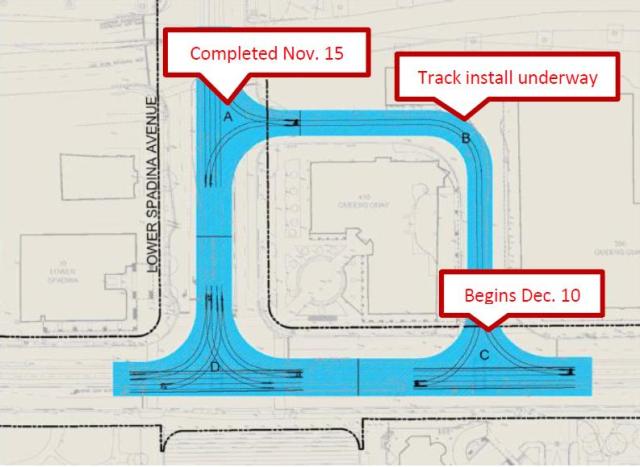
TTC CEO Andy Byford spoke at a meeting of the York Quay Neighbourhood Association yesterday evening and the status of transit service to Queens Quay was a major topic.  There appears to be some confusion among and within agencies about the date when service will return to Queens Quay on the 510 as a through route and as a streetcar.

The TTC Service Planning memo for the schedule period beginning June 23 says that the current operation is expected to last until the end of that period (late July).  However, Waterfront Toronto and Andy Byford himself speak of November or even December dates.  The TTC website has given June 2013 as a date for service resumption for quite some time, although this is to be corrected, presuming someone knows what the information should be.

Part of the confusion may arise from the fact that streetcar service will be suspended for reconstruction of the intersections at King and at Dundas and this will require bus replacement on the route.  Those buses will be able to run through to Queen’s Quay replacing the shuttle and so there will be “through” service, just not with streetcars.

I have asked the TTC for definitive information on the date for resumption of streetcar service to Queens Quay.

The Service Planning  memo also notes that a planned shutdown for reconstruction of the platform at Spadina Station Loop has been deferred to 2014.  One can only hope that this will include changes to allow two LFLRVs to serve the platform simultaneously for unloading and loading.

Continue reading

Past and Future Streetcar Service Capacity

Now that the first Low Floor Light Rail Vehicle (LFLRV) is rolling through Toronto streets on test runs, the question of service quality and capacity for streetcar routes is once again an issue.

The most recent TTC document setting out their intended use of the new fleet appeared in the 2013 Capital Budget Blue Books.  These are not available online, but I presented the TTC’s fleet plan in an article last fall.  From the numbers of vehicles to be assigned to each route, one can work back to the service frequency and capacity numbers.  In general, peak period headways get a bit wider, but the capacity goes up, in some cases dramatically.

The TTC faces two challenges: one on the budget, and one in operations.

Toronto Council has been extremely stingy with operating subsidies and “flat lined” the TTC over the past two budget cycles.  Hard liners will want the TTC to simply replace service on an equivalent capacity basis and maximize the savings in operator costs.  This would be a disaster for service quality even if the TTC actually ran cars on the headways they advertise.

On the operational side, any increase in headways brings even wider gaps when the service is upset by weather, random delays and short turns.  It is already a matter of record that the largest drop in riding over the past two decades came on the lines where 50-foot long CLRVs (the standard Toronto cars) were replaced by 75-foot long ALRVs (the articulated version) on an equivalent capacity basis.  Falling riding led to reduced service and the familiar downward spiral.  This must not happen when the new fleet rolls out across the system.

Since at least the mid-1990s, the TTC has told us that they cannot improve streetcar service because they have no spare cars.  In part, they are the victims of their own fleet planning.  The TTC originally rebuilt some of its old PCC cars (the fleet preceding the current one) in order to have enough to expand operations on the Harbourfront and Spadina lines.  However, by the mid-1990s, service cuts on many routes thanks to the economic downturn in that decade and the subsidy cuts by the Harris government, reduced the fleet requirements to the point where the PCCs could be retired and the Spadina line opened without buying any new cars.  When riding started to grow again, the TTC had no spare vehicles to improve service, and to make matters worse, the fleet was entering a period of lower reliability thanks, in part, to poor design.

Toronto waited a long time for new cars to be ordered, and this process was delayed both by the decision to go with all low-floor cars, and by political meddling at City Hall.  New residential construction along the streetcar lines pushes up demand, but the TTC cannot respond with better service until they have more cars.

Recent discussions about the new cars have included comments about how we cannot possibly have more streetcars on the road.  What many people forget is that the streetcar services were once much better than today.  In this article, I will look back at service levels once operated in Toronto, and at the service that we might see if the TTC actually operates the new fleet in the manner their Fleet Plan claims.

Continue reading

Service Changes Effective June 18, 2012

The TTC will implement many service changes on June 18, 2012 mostly for seasonal changes in demand.  The lion’s share of these are service cuts, with a few increases.  These are detailed on the first six pages of the document linked below.

Construction will continue in many parts of the city notably affecting the streetcar system.

Waterfront / Spadina

The separate operation of 509 Harbourfront and 510 Spadina will continue into June, but the Spadina streetcar service will be replaced with buses running in mixed traffic to permit construction.  This includes both track repairs and changes to the safety islands in anticipation of the new LFLRVs and the implementation of the Presto fare card.

Service on 511 Bathurst will be increased to absorb some of the traffic that might otherwise attempt to use the 510 Spadina service.

Whether this arrangement, with buses stuck in the often-jammed traffic lanes of Spadina, will work at all remains to be seen.  I cannot help wondering why the work is not staged in such a way that buses could use the right-of-way for at least part of the distance with police assistance at merge points.

Welding of new rail for the reconstruction of track on Queen’s Quay is now in progress in front of the Redpath’s Sugar site.  Tentative plans have streetcar service coming off of the 509 Harbourfront car at the end of July for the beginning of construction.

Queen Street East / McCaul Street

Work will continue on Queen near Russell Carhouse, but the reconstruction of McCaul Street will close McCaul Loop.  During this period, the branch of the 501 operating from Russell to McCaul will be extended to Wolseley Loop at Bathurst Street.  Whether it will actually reach this destination in the time allowed is quite another matter, and I expect to see a lot of cars short-turning.

Dufferin Street

Dufferin Street will be closed to transit between King and Queen for track and water main work.  The branches of 29 Dufferin which normally operate to Dufferin Loop will be short-turned at Queen via Gladstone.  The branches which operate to the Princes’ Gate will divert via Queen, Shaw and King around the construction zone.

2012.06.18 Service Changes

King/Bathurst Reconstruction Project (Update 8)

Update 8:  August 10, 2011 at 7:40 am:

Construction of the new safety islands has completed early, and the 511 is back to its normal routing.

Update 7:  July 26, 2011 at 8:00 am:

The TTC has revised dates for resumption of service through the intersection:

  • Wednesday July 27:  504 King and 508 Lake Shore routes return to King Street
  • Saturday July 30:  511 Bathurst route returns temporarily for Caribana
  • Tuesday August 2:  511 Bathurst route resumes diversion via Spadina
  • Monday August 15:  511 Bathurst route diversion ends

Update 6:  July 24, 2011 at 5:00 am:

An excellent overhead view of the completed intersection dated July 17 is available on Flickr.

Service on King Street through the intersection resumes on Monday, July 25.

Continue reading

TTC Meeting Wrapup May 2011

The TTC Agenda for May 11 contained a number of items of interest.  In a previous article, I reviewed the preliminary report for the Finch bus service improvements.

Items detailed below the break are:

  • PRESTO Update
  • Adam Giambrone’s Office Expenses
  • Station Ambassadors
  • Chief General Manager’s Report for January-February 2011
  • 510 Spadina Additional Service South of King Street
  • Additional Commissioners

Continue reading

South Spadina Headways: What the Riders See

The matter of service on Spadina south of King has been before the TTC on two previous occasions, most recently in March 2011.

In brief, local riders and their Councillor, Adam Vaughan, complain that service is poor and riders are packed into streetcars.  TTC staff reply that the average load on a streetcar south of King is 29, and therefore additional service is not justified.  This matter was held down in March in order to get updated riding counts on the route.

The problem with the TTC’s analysis is that it looks at overall averages, not at the specifics of actual experience on the route.  Most importantly, if a service that is supposed to run every 7’30” is badly disrupted and unreliable, then wide headways will be common.  Because more riders accumulate waiting for long gaps than short ones, the “average” rider’s experience will be a long wait followed by an overcrowded car.  This situation exists on many TTC routes, but it is particularly troubling if that is the case on a short route with an entirely private right-of-way.

First, let’s have a look at how well behaved headways are in this area.  Before you even open the file, I will warn you that it’s a real mess.  The intention is to show the mess before attempting an analysis.

South of King Northbound Headways February 2010

Those of you familiar with my previous analyses of TTC’s vehicle monitoring data will recognize this chart as a scatter diagram of headways by time of day.  Each dot represents one car.  The vertical position on the chart is the headway as seen just south of King Street northbound, and the horizontal position is the time of day.

If the service were well-behaved, these points should be clustered on either side of the scheduled headway through the day.  However, the points appear as a cloud with little discernible concentration.  This means that the actual headways seen by customers are essentially random, and they are spread over a wide range.  Many cars run close together, and gaps over 10 minutes are common.

My next step was to break down this information based on the TTC’s standard that service ±3 minutes of schedule is considered to be “on time”.  Of course riders don’t care about the schedule, only the headway, and it is the headway that determines the wait time and average load on a car.  For the purpose of this analysis, I subdivided the information about each car into three categories:

  • Early (headway less than 4.5 minutes on a 7.5 minute schedule)
  • Late (headway greater than 10.5 minutes on a 7.5 minute schedule)
  • On time (headways between 4.5 and 10.5 minutes)

It’s worth noting that, assuming a uniform arrival rate for passengers, that a car carrying a 10.5 minute headway will have over twice the passengers than one carrying 4.5 minutes.

Headway Distribution ±3 minutes South Of King Northbound February 2010

There are four pages for this chart, one for each half-hour interval from 0700 to 0900.  The vertical bars represent each weekday, and the rightmost bar averages the values over the month.

The dark red portion of each bar shows how many cars were “on time”.  The cream and blue portions are the “early” and “late” cars respectively.

On a 7’30” headway, there should be 4 cars in each half hour, although minor variations may give us 3 or 5 where a car expected in one period actually arrived in an adjacent one.

Between 0700 and 0730, things are fairly well behaved, but the service becomes less reliable as the AM peak continues.  At least half of the service fails the TTC’s own “on time” test, even averaged over the entire month.  For some periods and days, most of the headways lie outside of the acceptable range.  This means that a large proportion of the riders on the south end of Spadina receive far worse service than is advertised, or even what is considered acceptable by the TTC’s own standards.

If we considered a tighter standard allowing only ±2 minutes, the situation is even worse.

Headway Distribution ±2 minutes South of King Northbound February 2010

When the TTC reports its riding counts, it does not include any information about the reliability of service.  Moreover, if short turn trips are mixed in, these may be counted and dilute the average even though they are not of use to all riders.

In the case of northbound service at King, this isn’t an issue.  However, short turns southbound do affect the quality of service on Queen’s Quay eastbound to Union Station, as well as westbound for riders wishing to travel northwest to locations on Spadina.  During the AM peak, almost all of the scheduled service reaches Union Station, albeit on an erratic headway.  However, starting about 9am, short turning at Queen’s Quay Loop becomes fairly common and disrupts service reliability on Queen’s Quay.

York Eastbound Headways February 2010

This chart contains five pages.  The first is the monthly headway scatter diagram similar to the one shown above for service northbound at King.  Once again we see a cloud of data points spread over a wide range of values.  It is worth mentioning what the scheduled headway is supposed to be here:

  • AM peak: 7’30”
  • Midday: 5’40”
  • PM peak:  6’00”
  • Early evening:  6’00”
  • Late evening:  6’00”

The next four pages of the chart break down the cloud of data into individual weeks and add trend lines for each day.  These lines show how the typical headways are, overall, higher than the scheduled value.  This is due to short turns at Queen’s Quay Loop.  The variation in headways with many values well over 9 minutes (the high end of the “on time” standard for a 6 minute headway) shows just how far actual service quality is from what the TTC advertises.

Soon, the bus network will switch over completely to GPS-based vehicle tracking, and the data stream is supposed to be made public.  Whether this actually happens depends in part on the success of TTC managers, who prefer to hide information about service quality, in convincing the new Commission of the need for this secrecy.  In our new era of “Customer Service” and “Transparency”, there will be no excuse, and we may finally start to see just how bad service is on the system as a whole.

Meanwhile on Spadina, TTC staff will again claim that there is lots of service.  The problem is that it does not run reliably.  Capacity could be provided out of thin air simply by spacing cars regularly so that wait times were predictable and loads accumulated more evenly.  However, that would require the TTC actually do something about its service rather than gripe about the cost of more service, the lack of equipment or traffic congestion.

Still Waiting for Transit Priority

Back on June 22, 2005, the matter of transit priority signalling was discussed at the TTC meeting.  Arising from that discussion, then Vice-Chair Olivia Chow moved the following motion:

1. That staff be requested to take the necessary action to implement transit priority signalling on Spadina by September 2005 at all locations where it is not already active, with a report back in the Fall of 2006 on the impact.

2. That recommendations 2 to 6 embodied in Mr. Munro’s submission be forwarded to TTC staff and City Transportation staff, with a joint report back to the fall meetings of the TTC and Planning and Transportation Committee.

This item has sat on the list of outstanding Commission requests ever since, but on the recent agenda, it was closed with the notation:

Memorandum dated September 2, 2010 forwarded to Commissioners.

It took a motion of the Commission and a bit of harassment on my part to get this memorandum.  It was not exactly worth the wait.

Transit Priority — Signal priority on St. Clair is complete.  Signal priority on Spadina will be completed by the City in December, 2010.  Signal priority on Harbourfront will be upgraded when the Queen’s Quay Revitalization Project is undertaken by Waterfront Toronto (date unknown).  Recommended comments and action:  Mark complete, and remove from list.

Continue reading