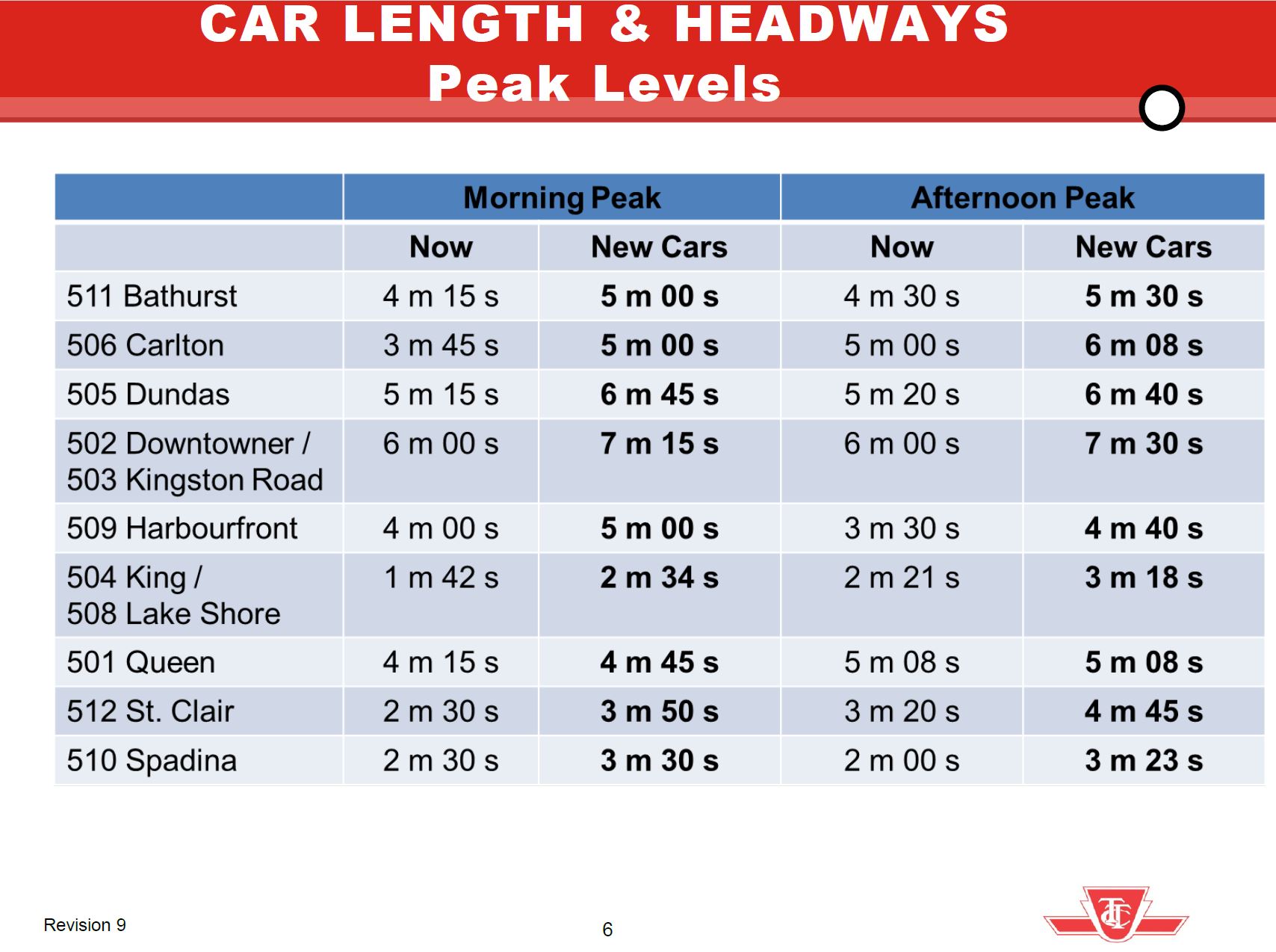
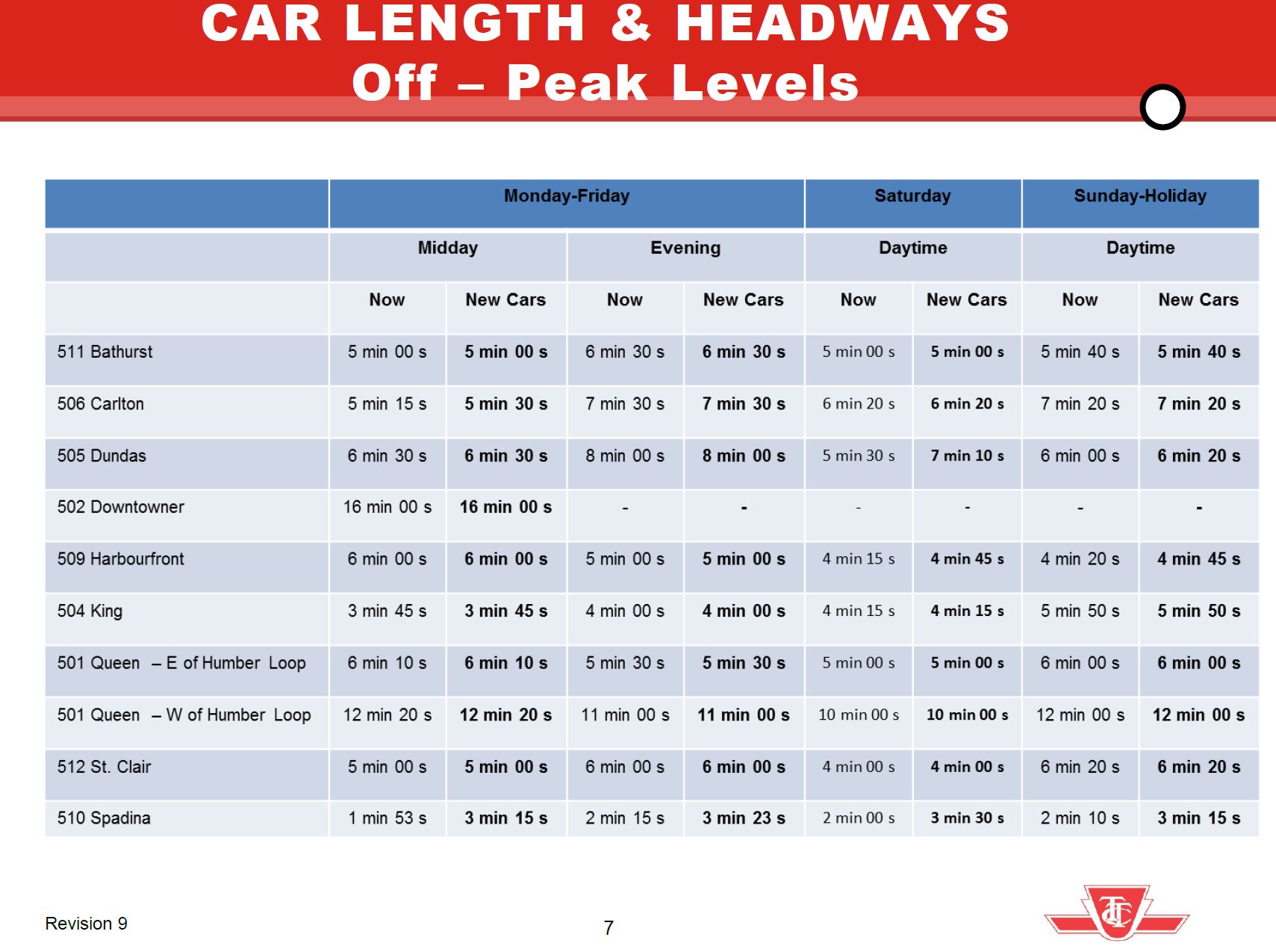
This article reviews the change in travel times and speed profiles on 510 Spadina, 511 Bathurst and 512 St. Clair between October 2019 and October 2025 (pre- and post-pandemic). In almost every case, streetcars are slower today than they were six years ago even though two of the three routes have reserved lanes.
511 Bathurst will soon have red lanes from Fleet to Bloor (except for a section north of Dundas), and I will publish updated charts for that route when the lane changes are in place.
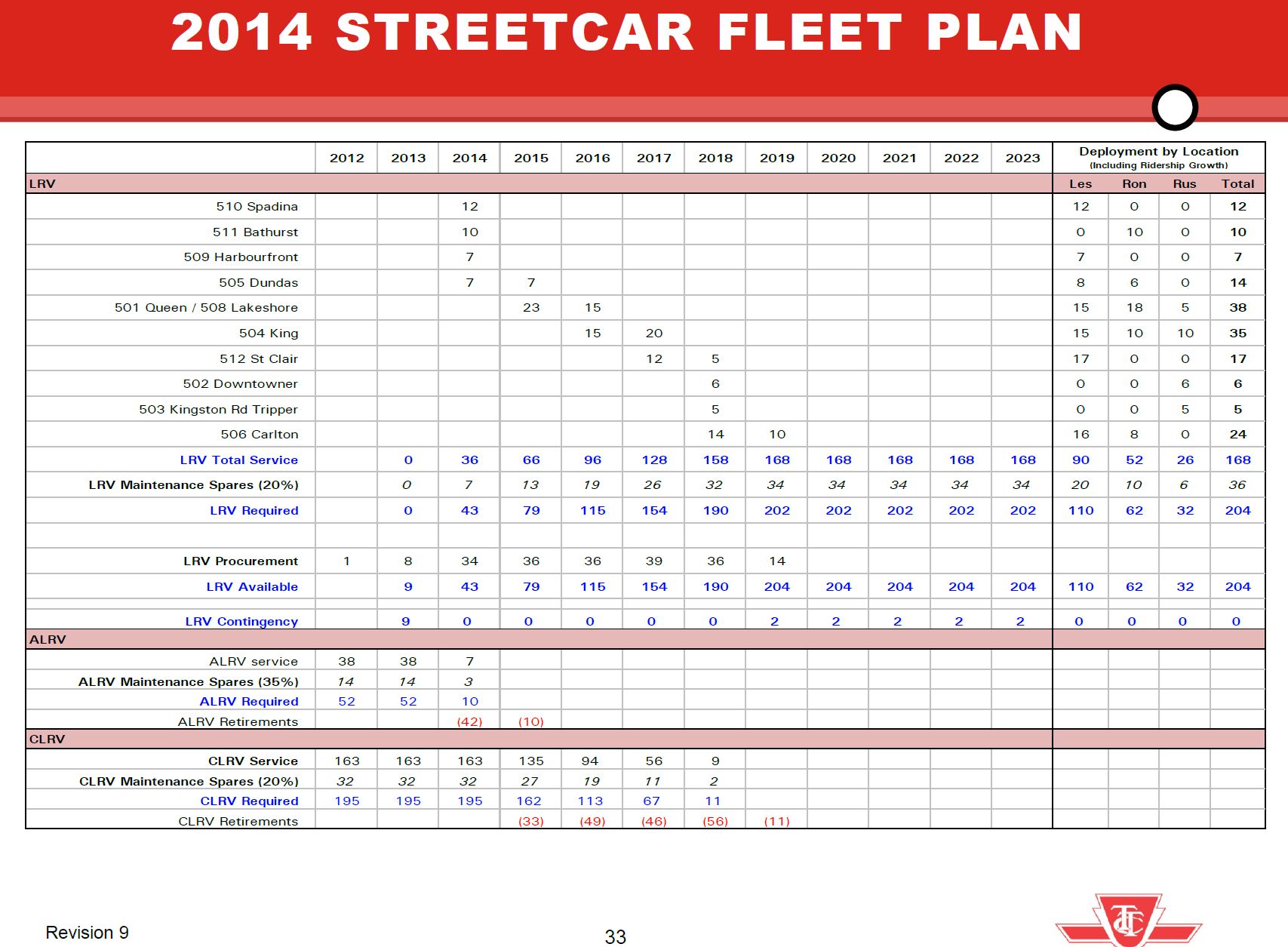
By October 2019, streetcar service was almost completely operated with the new Flexity cars, and so the change over time is not explained with a comparison between the sprightlier CLRVs and the newer cars. (For 512 St. Clair, I have also included a comparison with the CLRV era to show the effect of the vehicle change separate from the pre/post pandemic change in traffic conditions.)
TTC is overly fond of laying blame for transit vehicle speeds on “traffic congestion”, but that is too simplistic an analysis especially for routes with reserved lanes. They also have a bad habit of presenting data without the granularity needed to identify patterns and problems by time of day and location. There are many charts in the main part of this article, but they are intended to show each route in detail.
One important point is that it is impossible to know how much change in speed comes from a more cautious operating philosophy as opposed to traffic conditions. There is, of course, the slow operation through junctions, but that does not explain slower travel on straight track with no special work. Traffic signal effects also show up, particularly in time spent holding nearside at intersections and then again at farside stops. Some areas are inherently slower than others such as Spadina from Queen south with many close-spaced intersections and signals that generally favour east-west traffic. The situation is particularly bad between Front and Queens Quay where the primary job of signals is to handle traffic to/from the Gardiner Expressway.
Any move to speed up operations on streetcar routes requires more than quick fixes like stop eliminations, and detailed block-by-block reviews are needed. In some cases there will be trade-offs between transit and other road users. Arguments for better priority will fare better if and when the TTC improves service so that there are actually transit vehicles to prioritize.
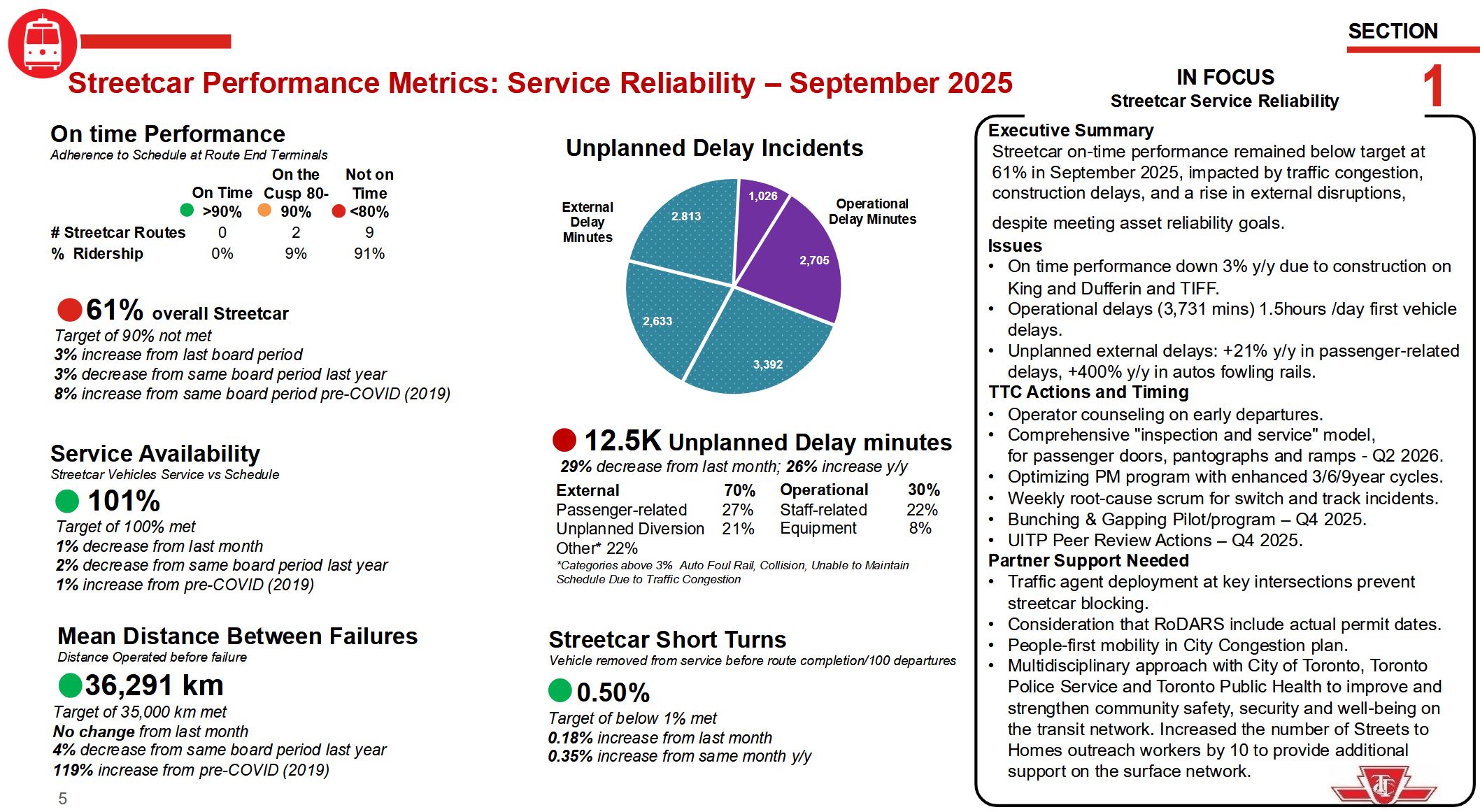
At the TTC Board meeting on November 3, management presented statistics on streetcar delays broken down by type of incident. TTC is quite fond of portraying external incidents, especially those related to congestion, as the root of (almost) all evil. The following page is from the CEO’s Report.
Note that external delays (turquoise) occupy the majority of the chart. During discussion of the problem of autos fouling rails, a passing remark by the Interim Chief Operating Officer piqued my curiosity when he said that there were many delays due to the winter storm.
This sent me to the TTC’s delay statistics which are available on the City’s Open Data site. There are codes for many types of delay including “MTAFR”, short for “Auto Fouling Rails”.
According to the “In Focus” box above there has been a 400% year-over-year increase in these delays, although they are styled as “fowling” implying a flock of chickens might be responsible for service issues.
Sorting the data by code and summarizing by date produces interesting results.
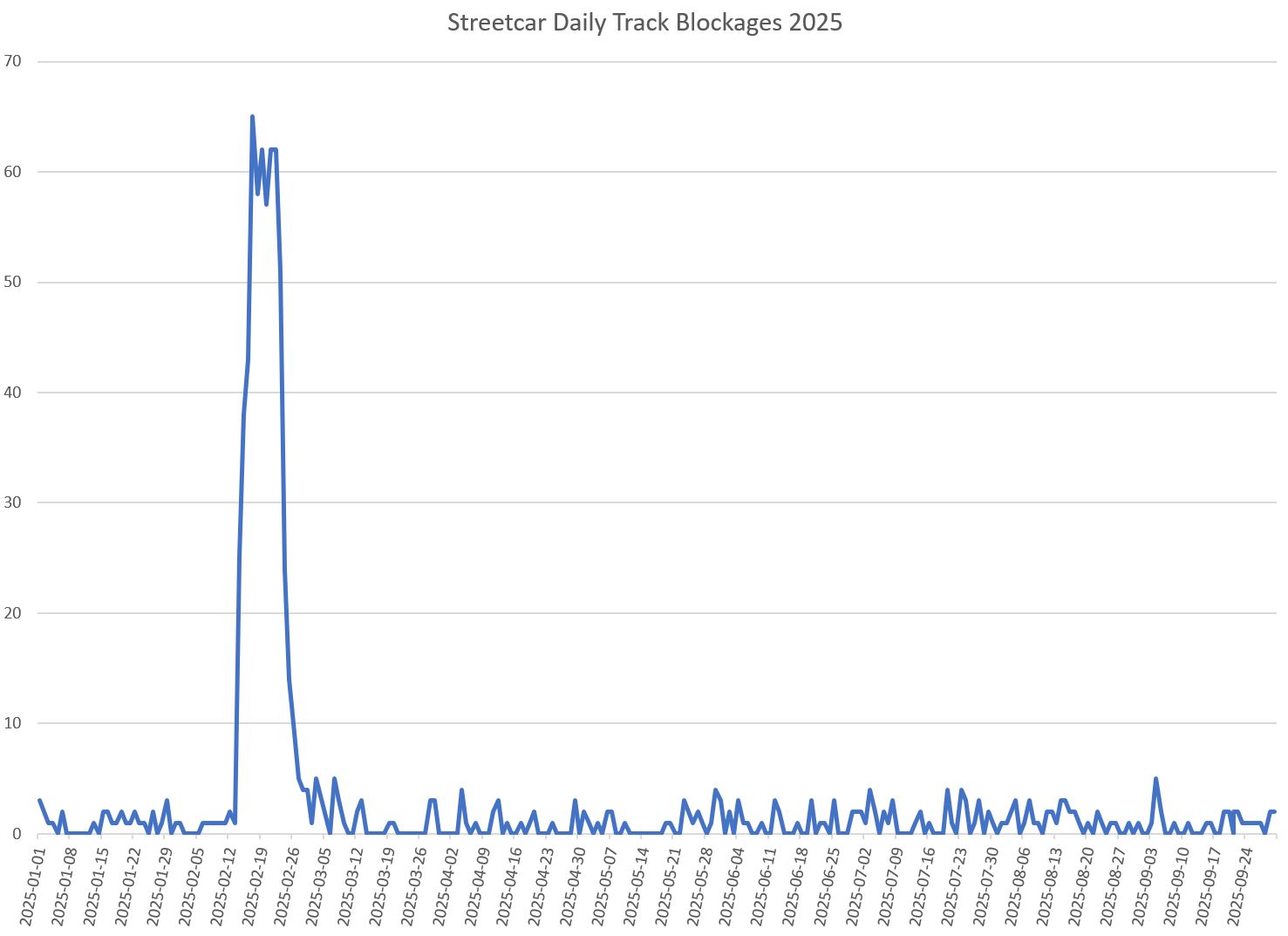
Between January 1 and September 30, 2025, there were 843 MTAFR events logged.
Of these, 586 fall between February 14 and 26 hitting a daily high of 65 on February 17.
These blockages were not caused by the typical traffic congestion, but by the City’s utter failure to clear snow on key streets.
105 were on 501 Queen
42 were on 503 Kingston Rd.
84 were on 504 King
93 were on 505 Dundas
186 were on 506 Carlton
3 were on 507 Long Branch
1 was on 508 Lake Shore
2 were on 509 Harbourfront
None were on 510 Spadina or 511 Bathurst
6 were on 512 St. Clair
A few dozen were on various night cars
The pattern here is quite clear: routes on wide roads or rights-of-way were not seriously affected, but routes on regular 4-lane streets were hammered. (How 511 Bathurst was spared is a mystery. At the time it was running with streetcars from Bathurst Station to King & Spadina, and with buses on the south end of the route.)
To claim that the 400% increase from 2024 is some indication of worsening traffic problems is gross misrepresentation of what actually happened. Although this is the CEO’s report and he almost certainly did not assemble the information himself, he wears this issue for having reported misleading data to the Board and public.
Direct comparison with published 2024 data is difficult because until 2025 the TTC used a much coarser set of delay codes that lumped many types of events under generic headings. There was a category “Held by” in which there were 625 incidents from January to September in 2024. The 843 MTAFR codes in 2025 are quite clearly not a 400% increase over 2024.
Whenever there is a discussion of unreliable service, we hear endlessly about traffic congestion. This definitely is a problem, but not the only one, and certainly not in the way presented by the CEO.
A question arose during the debate about the problem that performance stats are consolidated across all routes. Route-by-route service quality is presented in detail in the second part of this article for all streetcar routes. This shows that problems are widespread in the system, even on routes with reserved lanes.
As for the delay stats cited by the CEO, it is clear that we are not comparing September 2025 to one year earlier as the text implies, but using events from the entire year to date including a major snowstorm that had no equivalent a year earlier. The so-called 400% jump in delays from blocked tracks is due to snow and poor road clearance by the City.
TTC management owes the Board and the public an apology for blatant misrepresentation of the delay statistics.
There are many diversions coming up in the Fall for streetcar routes. Information on these appears in various places on the TTC site, mainly but not exclusively under Service Advisories. As an aid to riders, this article consolidates the available information in one place.
Updated November 28, 2025
***** This article is only for archival purposes. It has been replaced by a new one picking up from mid-November 2025. *****
Major events pending and in progress include:
Construction on Queen between Davies (just east of the Don Bridge) and Broadview.
Reconstruction of the intersection of College and McCaul, and of overhead in the vicinity.
Reconstruction of track and overhead at and near Parliament and Carlton.
Other short term diversions will last only overnight or for a weekend.
Many of these are complicated by the ongoing Ontario Line work at Queen & Yonge forcing some diversions to be more complex than they might be otherwise.
This article will be updated when changes are announced.
November 21: The 501 diversion via Broadview, Dundas and Parliament around water main and track work west of Broadview will begin on November 22.
November 20: Equipment and material mobilization is underway on Queen west of Broadview.
November 17: The 506 diversion has been changed today to avoid the intersection of Church & Dundas where construction blocks the northeast corner. Maps have been added from the TTC’s site.
Effective November 16: The 503 Kingston Road bus will be cut back from Dufferin, and will now loop at York Street via Richmond and University.
November 15: Diversions announced for two projects on 506 Carlton at Parliament & Carlton, and on Gerrard east of Broadview.
November 9: King & Dufferin reopened for streetcar service. 503, 504, 508 will operate via their normal routes.
October 30: King & Dufferin reopens for general traffic and buses. Streetcars to return following track testing.
October 20: Water main reconstruction on Queen west of Broadview has been delayed until early November. 501 Queen streetcars will continue to operate on Queen Street until further notice.
October 13: 504 King is operating with streetcars today over its full route except for the King/Dufferin diversion.
October 9: Maps for 504 King and 506 Carlton diversions added.
October 8: Construction at Queen & Broadview will not start on October 12, and so some diversions will not be required immediately. Information for 501 Queen and 503 Kingston Road has been updated.
October 5: Nuit Blanch & Run For the Cure info moved to the archive section.
October 1: Diversions of 505/305 Dundas and 506/306 Carlton for Nuit Blance and for the Run For The Cure added for October 3/4/5.
September 23: The King/Dufferin start date has been changed to Sunday, September 28.
September 12: King/Dufferin start date pushed back to September 29 or later. The project will now extend to mid-November.
September 9: College/McCaul and Queen East details added.
August 26: King/Dufferin Project
The start date for this project has been changed to mid-September with the exact date to be confirmed. Although new schedules will be in place providing for diversions, service will continue to operate through on King Street until construction actually begins. This likely means that the project will extend further into October than the originally planned Thanksgiving weekend end date. The delay also means that the Tiff diversions will end before the King/Dufferin diversions begin.
Branch lettering for 504 King A/B corrected.
August 25: King/Dufferin Project
Information about Kingston Road night service added.
304 King and 329 Dufferin confirmed to be diverted on the same routes as the 504A and 29 daytime services.
The TTC has announced its services for the CNE for 2025 to operate from Friday, August 15 to Monday, September 1.
CNE Express buses will operate non-stop between Bathurst Station and Exhibition Loop, and between Dufferin Station and Dufferin Loop.
Extra service will operate on the 29 Dufferin and 929 Dufferin Express bus routes, and on the 509 Harbourfront and 511 Bathurst streetcar routes.
Other routes will change to accommodate the CNE services and traffic conditions.
63 Ossington buses normally loop at King via Strachan, East Liberty, Liberty and Atlantic. This will change so that buses loop via Fraser, Liberty and Atlantic.
503 Kingston Road streetcars will be extended west from Dufferin to Sunnyside Loop between 2pm-1am weekdays and 9am-1am on weekends.
510 Spadina streetcars will terminate at Queens Quay Loop until 7:30pm daily, and will run to Union Station afterward.
The TTC now has a web page with details of the changes for the first phase of the construction and diversions. This includes a map showing the diversions to west of Bathurst rather than just downtown. I have added this in the body of the article.
May 5, 2025 at 1:40pm:
Information about the 304 King and 303 Kingston Road night services has been added.
May 5, 2025 at 1:55pm:
The TTC has confirmed that overhead upgrades on King Street East and on Sumach/River will be completed before the King/Church track work end, and streetcar service will resume in September.
May 5, 2025 at 4:30pm:
I asked the City if it thought the intersections used by diverting streetcars and buses could handle the volume of traffic. They replied, but didn’t add much. See the end of the article for the exchange.
Major changes are coming to downtown streetcar routes on May 11 with the next schedule change. This will accommodate a combination of water main replacement, track reconstruction and streetcar overhead upgrades mainly at King and Church. Work is expected to require diversions until the October schedule change on Thanksgiving weekend.Streetcar service is expected to return with the September schedule change on Labour Day weekend.
The effects of work an King and Church have been known for some time through the Annual Service Plan and through a City report on the project. (The original report and recommendations were amended at the recent Council meeting to lessen the effect of various proposed lane closures.) Service levels have been published via the electronic version of schedules used by trip planning apps. The information about vehicles/hour at various locations is taken from those schedules.
(As an aside, the TTC website has still not been updated to include the 2025 Service Plan even though it was approved by the Board in January.)
With the concentration of transit service through various intersections, and the added complexity that most vehicles will make turns at these locations, there simply will not be enough capacity even under ideal conditions. It is no secret that “ideal” is a word rarely appropriate for transit operations downtown thanks to the lack of robust traffic management and real transit priority.
In past years, the diversion of services from King Street around the TIFF street fair created problems for transit travel times and reliability, but this lasted for a brief period. The planned diversions for King/Church will last through the summer.
Many of the water mains in the “old” city have been in service for over a century. Other parts of King Street have seen renewal, occasionally on an emergency basis following a break and sink hole.
The special trackwork at the King/Church intersection has been in bad shape for some time, and was overdue for replacement. Previous reconstructions were in 1983 and 2003. Other competing construction projects got in the way, and the track conditions have worsened year by year. There are many patches, and a well-deserved slow order unlike the standing practice even at freshly rebuilt junctions.
This intersection is also old enough that it predates the era of panel track construction where pre-welded sections are trucked in and assembled on site. This replaced the older style of tracks assembled piece-by-piece and often not welded robustly if at all. TTC has not yet been through its entire inventory of “old” track given the 20-30 year cycle depending on the level of service, wear, and disintegration at intersections.
Other work planned for this period of suspended streetcar service is the reconstruction of overhead on King and on the Distillery branch for pantograph-only operation.
Closing King & Church for an extended period concurrently with the Ontario Line construction at Queen & Yonge will add to the traffic snarls downtown. The City talks about using Traffic Agents to manage key intersections, but whether they provide enough people at enough places at enough times remains to be seen.
Routes Diverting off of King Street
Three routes are affected: 504 King, 503 Kingston Road and 508 Lake Shore.
The 504 King service will be broken into three sections:
A 504 streetcar service between Broadview to Dundas West Stations operating via the same route as 501 Queen between the Don Bridge and Spadina.
A 504C bus shuttle from Wolseley Loop south on Bathurst and east on King terminating at Broadview & Gerrard.
A 504D bus shuttle from Wolseley Loop south on Bathurst, east on King and south on Sumach to Front & Cherry. Buses will loop via [to be announced] and will not serve Distillery Loop.
The 503 Kingston Road service will be changed so that its western terminus shifts from York Street to Dufferin Loop. Cars will follow the same route as the 504 King via Queen from the Don Bridge to Spadina, then shift south onto King to follow the pre-diversion 504B route to Dufferin.
508 Lake Shore cars will follow the same route as 504 King.
Night Service Changes
The 304 King night car will operate every 20 minutes over the same route as the daytime 504 service diverting via Queen and Spadina.
A 304D night bus will run every half-hour over the same route as the 504D bus from Wolseley Loop to Broadview & Gerrard.
The 303 Kingston Road night car will operate every 20 minutes over the same diversion route as the 304 King night car, and will operate as it does now to Sunnyside.
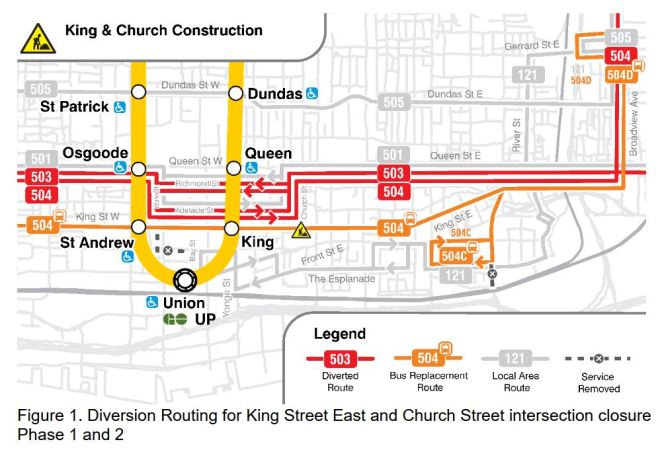
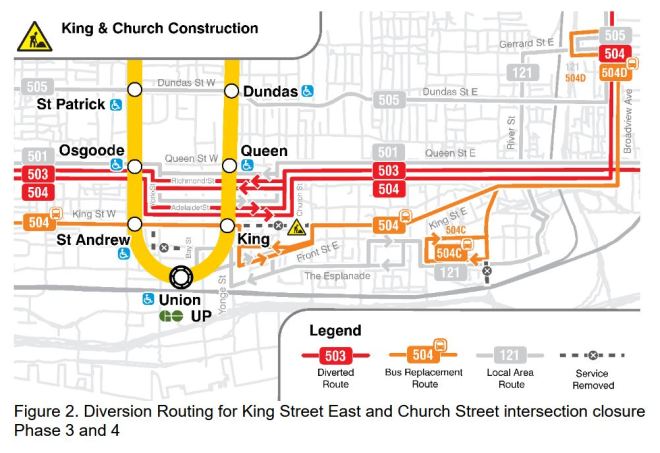
The maps below are from the City Report about this project originally published in February. An updated map for the first phase has been added later in the article.
For part of the construction period, King/Church will be impassible even to the replacement bus service and it will divert south to Wellington and Front.
These maps do not tell the whole story because another set of construction diversions will overlap the King/Church changes until the next schedule change in late June.
Although water main work at Bathurst/Fleet/Lakeshore is now complete, track work continues there and on Bathurst Street further north. 511 Bathurst streetcars will continue to divert east via King to Spadina looping via Adelaide and Charlotte. The 511B shuttle bus will be shortened from Wolseley Loop at Queen to an on-street loop via King, Portland and Richmond to Bathurst Street.
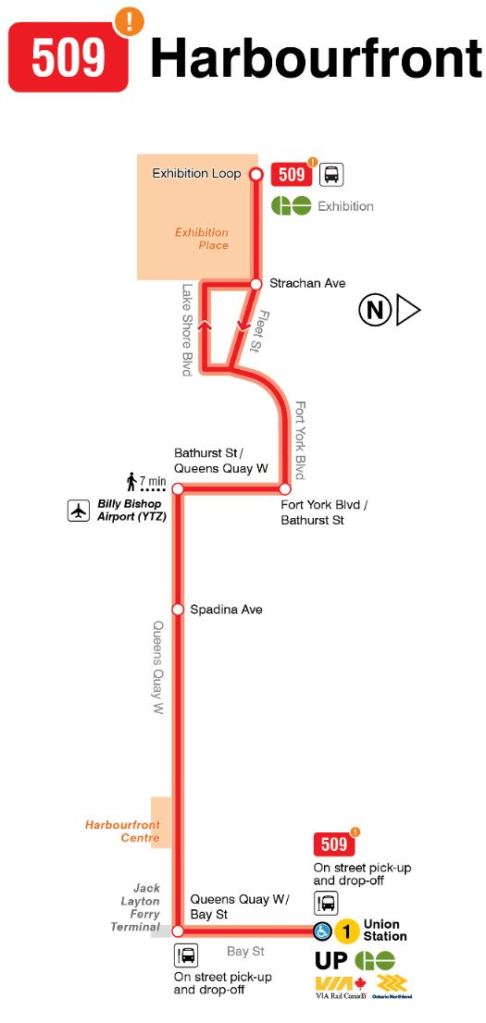
509 shuttle buses continue operating between Exhibition Loop and Queens Quay Loop at Spadina. 510 streetcars continue operating to Union Station.
The combined effect of the diversions will be greater than during the total meltdown of King service in 2024 when all cars diverted north via Church to Queen because volumes of other routes (510 Spadina, 511 Bathurst and 501 Queen) will be added to the King services, and more intersections will be affected over a wider area.
Updated May 5, 2025 at 12:50pm:
The TTC’s project webpage has a consolidated map of the diversions for the first phase of the work.
The TTC has announced several service changes to accommodate crowds expected at the Taylor Swift Eras Tour concerts at the Rogers Centre on November 14-16 and 21-23. For full details, see their site.
On concert nights, subway service will be improved between 5-8pm and 11pm-1:30am with Line 1 trains operating about every 3 minutes, and Line 2 trains every 4 minutes.
509 Harbourfront service will be restored between Union Station and Exhibition Loop from November 1-24 with at least 11 cars, up from the usual 7 on the line, on concert days .
511 Bathurst cars will operate from Bathurst Station to Union on November 14-16, and starting on November 17 on a scheduled basis.
19 Bay, a normally infrequent service, will have 10 extra buses. Post-show they will operate express northbound stopping only at King, Queen, Dundas and College enroute to Bay Station.
510D Spadina bus will similarly provide an express service stopping at the same intermediate destinations as 19 Bay enroute to Spadina Station.
The express services will be styled as “Swiftbus”. Extra service on 504 King will be styled as “Swiftcar”.
Access at Union Station will be monitored and controlled to prevent the overcrowding that occurred on past occasions with large events.
The TTC has announced that streetcar service will be suspended, in part, over the 509 Harbourfront and part of 511 Bathurst at various times between Tuesday, September 3 and January 2025. This will allow the reconstruction and upgrading of the overhead system between Union Station and Exhibition Loop to be fully pantograph-compliant.
Information is posted in three separate items on the TTC site with the first being the most extensive.
In a previous article, I reviewed travel times for the bus and streetcar operations on 510 Spadina Avenue at the north and south ends of the route where severe traffic congestion made bus operation extremely difficult. The north end problem resolved itself first with a diversion, then at least partly with completion of construction on Bloor Street, but the south end required a reserved bus lane to bypass the traffic queue for the Gardiner Expressway on ramp.
With all the attention on these areas, a separate factor is often overlooked in comparing the services: when and where there is little or no congestion, the buses are faster than the streetcars in spite of the “transit priority” treatment with dedicated lanes. The problem lies in a combination of different stopping patterns, traffic signals that do not favour streetcars, and operational practices requiring streetcars to creep through intersections.
This is the daily experience of regular riders on Spadina, and it is a “dirty little secret” that factors conspire to undermine the quality and speed of streetcar service. This is both a City and TTC problem because responsibility for road design and streetcar operations rest with the two organizations.
Updated August 11 at 2:20 pm: Charts have been added at the end comparing streetcar travel times over the central portion of the Spadina route in September 2014 and May 2024. The differences reflect both loading times, acceleration and operating practices of the former CLRVs compared to the current Flexitys,
In a previous article, I reviewed the transition from streetcar to bus operation on 510 Spadina in mid-June. Since then, the route saw other changes:
Beginning on July 8, TTC suspended service south from Front Street between 3 and 7pm on weekdays due to congestion and very extended travel times on the southbound approach to the Gardiner Expressway. See 510 Spadina Bus Modified Diversion Tracking.
On July 29, implementation of a reserved bus and cycling lane began south from Richmond to Lake Shore. See Reserved Bus Lanes for Spadina?
The reserved lane has greatly reduced delays at the south end of the route, albeit at the expense of road capacity.
This article presents travel times over various segments of Spadina from Bloor Street to Queens Quay during July 2024 to show the effect of the changing route configuration.
A key factor evident in the tracking data is that congestion occurs outside of the peak periods, and not necessarily in the same way each day. It can be tempting to cherry pick the afternoon peak as a worst case target, but that does not solve all problems. The extent of congestion also varies, and transit priority must be on a sufficient scale to deal with the bad days, not simply to improve conditions a bit over a short distance.
What is quite clear is that the City and TTC reaction to congestion problems gave the impression of surprise rather than preparedness, and that weeks of delays for riders could have been avoided or at least reduced in severity at both ends of the route.
The July 17 Board meeting was extraordinarily long thanks to three in camera items, plus extended discussions of the CEO’s Report and of use of buses as homeless shelters during the winter.
The confidential session dealt with:
A collective bargaining update for two small groups of customer service and operations supervisor employees.
An update on advice from External Counsel. On a recorded vote, this was adopted with all Board members except Councillor Saxe in favour. As of the publication of this article (July 28), there have been no leaks about the subject of this report.
An update on the fare modernization program including the status of the Presto contract. The report was also discussed briefly in the public session later in the meeting.
The public meeting included:
The July 16 storm, flooding and hardening of infrastructure against climate change.
New subway trains and federal funding announced earlier the same day (July 17).
Prioritization of State of Good Repair projects. This item received scant attention although the report contains much interesting background on capital plans.
Safety on the TTC.
Use of shelter buses.
Transit network expansion update.
Fare Compliance Action Plan: See the updated version of my previous article on this report which includes the debate at the Board meeting.
Not discussed was the issue of hydraulic fluid leaks from subway work cars of which one quarter are still out of service. A report is supposed to be coming to the Board soon. It is not clear how much this situation is affecting the TTC’s ability to stay on top of track maintenance issues and the growing list of slow orders for track that cannot be safely operated at full speed.