“Service” on the 320 Yonge Night Bus

A reader commented in another post that he had a very long wait this morning (Sunday, December 22, 2024) for the 320 Yonge night bus around 6am. I had a look at the tracking data on Darwin O’Connor’s TransSee website to see what was happening. What I found was not pretty, not by a long shot.

320 Yonge is one of many all-night routes that riders depend on for transportation at a difficult time of the day, but the way the TTC operates this and other 3xx routes in the Blue Night network is a testament to how badly riders are treated at off hours.

I plan a detailed review of overnight service in January, but this will give a taste of what is going on.

Here are the tracking charts showing vehicle spacing and crowding on 320 Yonge for the past four Sundays. Each line represents a bus moving north and south from Steeles at the top to Queens Quay at the bottom. The horizontal spacing shows the gap in service, and the thickness of the dot shows the crowding level. The really fat dots show a bus at 90% or more of its maximum load.

Service between 5 and 6am is scheduled to be thin, but sometimes it can totally vanish as it did northbound on December 1st and 15th, and almost completely for over an hour on the 22nd. There are wide gaps at other times on some dates. For example, a wide gap southbound from Steeles at about 2:30am travels south and echoes back and forth on the line until nearly 6am.

Remember the usual tropes to explain poor service such as traffic congestion, bike lanes and the occasional plague of frogs that are cited to explain bad service. Oh yes, we mustn’t forget how streetcars cannot run reliably in mixed traffic, but, oh dear, the last streetcar ran on Yonge Street 70 years ago.

There is only a minor sign of traffic congestion in the period from 2-3am northhbound. This is a common issue and should be provided for in the schedules. Instead, it generally creates clumps of buses than run together to Steeles and back again southbound.

This is down to bad service regulation in the off hours, something already visible for evening and weekend services in many of my previous article. Overnight bus and streetcar routes have the worst reliability in the system, but they are not important enough for the TTC to care about them.

Another factor evident in these charts is that the buses have inadequate recovery time with which to recover from any delays or simply to give operators a break. This is shown by the immediate turnaround of buses at terminals (top and bottom of charts) with very little dwell time (shown by horizontal lines indicating a stopped bus).

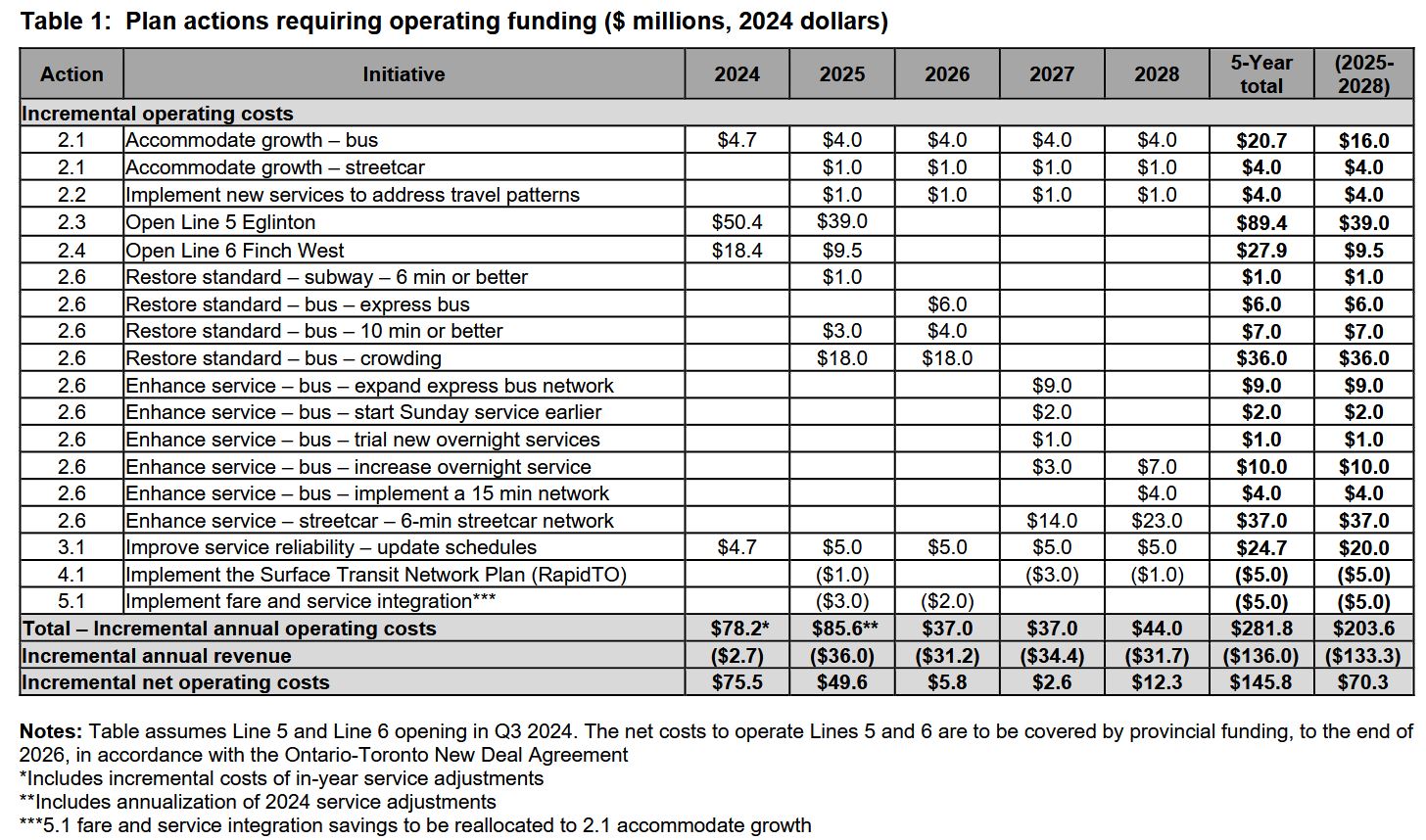
In the Five Year Service Plan, the TTC talks of future Night Service improvements, assuming that they are funded. Here is a table showing possible changes:

Nothing is even proposed for night service improvements until 2027, and based on typical budget cycles, that really means fall 2027, not New Year’s Day.

The problem shown in the tracking charts above is very much one of poor line management, scheduling and wasted resources. It is almost impossible to tell whether, if buses were evenly spaced, any more would actually be needed, except during that 5-6am hour when service is thin on the ground, at best.

The TTC operates under difficult circumstances, but too many problems are “own goals” all the way from service adequacy and management through infrastructure and fleet maintenance.

Biblical plagues are not responsible for poor service, although the TTC would love to have a supernatural excuse. In the new year, we will see what the TTC proposes for 2025 and whether this will really make a difference for riders.

Analysis of 63 Ossington – September/October 2024

This article reviews the operation of 63 Ossington in September and October 2024. This route operates from Eglinton West station to Liberty Village with a peak period short turn at St. Clair through Oakwood Loop. Historically, the route is a patchwork of former streetcar, later trolleybus, lines including Oakwood and Dovercourt. Service south of King Street runs through Liberty Village, formerly an industrial neighbourhood, and now a dense residential area.

Until early October, the route’s south end extended west to Sunnyside Loop replacing part of 504 King during road and track construction. On October 6, it resumed the standard looping through Liberty Village. With the new schedule, service was reduced during several periods, although in some cases not by much.

General observations:

  • Departures from Sunnyside Loop were irregular, but headways improved east of Roncesvalles because buses took their layovers on King Street, not at the loop.
  • Service was less reliable on the route while the extension operated, but improved with the return of the normal south end loop. Demand on the Sunnyside extension was rather light.
  • Ossington is a fairly short route (9km one way), but it is subject to some of the same problems as longer routes. Headway reliability is poor during some periods even though there are three locations where buses could be dispatched on a regular spacing: from the two terminals, and at Ossington Station.
  • There is some evidence of headway management at Ossington Station to restore proper bus spacing, but the effect is short-lived.

Note to readers: This article and a previous one about 129 McCowan North arose from reader suggestions, and I used them for detailed presentations of tracking data in various formats. Both routes had new schedules in early October, and this provided a chance to look at how service changed for the better or worse. For some, this will be a case of “TL/DR”, and I understand that this sort of thing is not everyone’s cup of tea. To those of you who love the detail, happy reading!

Continue reading

TTC’s Dubious Short Turn Statistics

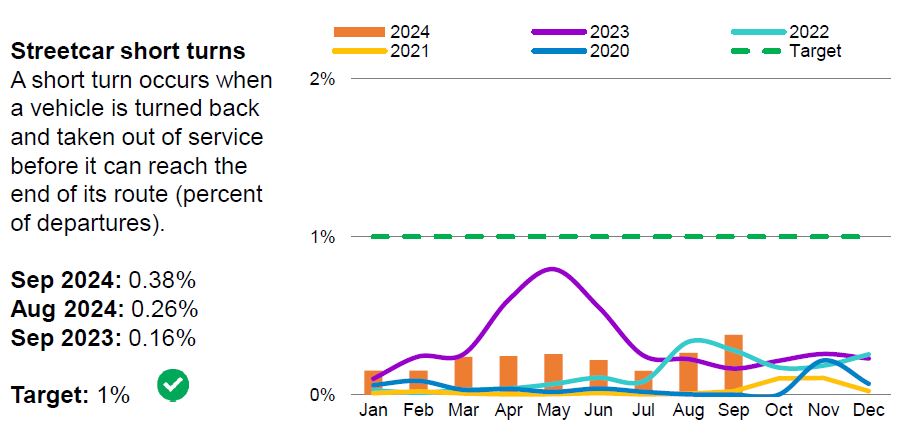
In the monthly CEO’s Report, one of the KPIs (Key Performance Indices) is a measure of the number of short-turned streetcars. This used to be reported as an absolute count, but is now expressed as a percentage of all trips.

Here is the most recent version:

This chart is a fiction born of the Rick Leary era when, in theory, all short turns were banned and the stats were made to fit the objective. Like many KPIs, this suffers from a combination of system-wide consolidation across all routes and time periods, as well as under-reporting of what is really happening.

An easy way to get the true count is to look at tracking data and compare two points on either side of a short-turn location. For example, Woodbine Loop at Queen and Kingston Rd. is a favourite spot for 501 Queen and some 503 Kingston Road cars to turn back. Counting the number of vehicles crossing Coxwell (west of the loop) with the number at Woodbine Avenue (east of the loop) shows how many cars did not travel east of Kingston Road and, therefore, were short-turned.

The TTC claims that they better their 1% target for trips short turned, but it is clear that they rarely achieve this. In some cases, the value rises above 20% indicating that although much service does get to the terminal, there is a good chance that a rider will encounter a short turn. This is separate from frustrations caused by gaps and bunching.

Short turns happen for many reasons including traffic congestion, too-tight schedules, service blockages for collisions, medical problems, parades … it’s a long list. Riders really don’t care. The basic point is that service they expected to receive is not there, and usually with no advance warning.

The table below summarizes the statistics from the vehicle tracking records in November 2024 for the period from 6am to midnight. It is clear that even on an aggregated level, the proportion of short turns is much higher on these routes that the TTC KPIs indicate.

Updated Dec. 6/24 at 1:30pm: Short turn counts for 504 King eastbound, 507 Long Branch and 508 Lake Shore westbound trips added.

Note: The legends on the original charts in this post were misleading. They have been changed to better reflect what the columns and lines on the charts represent..

RouteLocationTotal TripsShort Turns% Short Turns
501 QueenWoodbine Loop EB35471985.6%
Roncesvalles WB35372477.0%
503 Kingston RdWoodbine Loop EB32521364.2%
504 KingSpadina WB64532564.0%
Roncesvalles WB327536411.1%
Church EB63191262.0%
Parliament EB61982043.3%
Dundas EB2943712.4%
505 DundasParliament EB30402127.0%
Lansdowne WB306239713.0%
506 CarltonCoxwell EB30312939.7%
Lansdowne WB325657217.6%
507 Long BranchKipling WB2074883.0%
508 Lake ShoreKipling WB193199.8%
512 St. Clair (*)Lansdowne WB206824912.0%
Oakwood WB21131225.8%

(*) For 512 St. Clair, only data from November 14 onwards when streetcar service was restored are included.

Continue reading

Actual vs Advertised Wait Times

A central part of any transit rider’s journey is the wait for a vehicle that may or may not show up when expected. Even with an app that tells you where the bus is, the news might not be good. Rather than being just around the corner, the bus might be several miles away, and heading in the wrong direction.

The only statistic the TTC publishes on service quality is an “on time” metric. This is measured only at terminals, and even there “on time” means that a bus departs within a six-minute window around the scheduled time. Performance is averaged over all time periods and routes to produce system-wide numbers, although there are occasional references to individual routes in the CEO’s Report.

Riders complain, Councillors complain, and they are fobbed off with on time stats that are meaningless to a rider’s experience.

The problem then becomes how to measure the extra time riders spend waiting for their bus, and to report this in a granular way for routes, locations and times.

This article presents a proposed method for generating an index of wait times as a ratio comparing actual times to scheduled values, and their effect on the rider experience. The data are presented hour-by-hour for major locations along a route to see how conditions change from place to place.

An important concept here is that when buses are unevenly spaced, more riders wait for the bus in the long gap and fewer benefit from buses bunched close together. The experience of those longer waits raises the ratio of the rider’s waiting experience to the theoretical scheduled value. The more erratic the service with gaps and bunching, the higher the ratio of rider wait time to scheduled time. This is compounded by comfort and delay problems from crowded buses, and is responsible for rider complaints that do not match the official TTC story.

There’s some math later to explain how the calculations are done for those who want to see how the wheels turn, so to speak.

Note that this is a work in progress for comment by readers with suggestions to fine tune the scheme.

Continue reading

Analysis of 129 McCowan North – September/October 2024

This article reviews the quality of service and crowding on the 129 McCowan North bus in September and October of 2024.

Updated Nov . 18/24 at 5:00 pm: Bus spacing charts were omitted in the original posts, and they have been added. Also, crowding and spacing charts have been added for Wednesday, October 2 as an example of route behaviour before the October 6 schedule change.

Summary

This route has two branches:

  • 129A operates north of Steeles under contract to York Region to Major Mackenzie Drive.
  • 129B operates to Steeles Avenue.

In the September schedules, much of the 129A service was provided as an “every nth” through bus on the Steeles service. This changed on October 6 so that the 129A and 129B services operate independently, and the 129B service changed from regular-sized to articulated buses. Service in peak periods is scheduled to be uneven even if it is “on time” by TTC standards.

With a combination of bus sizes and uneven headways, the effect on crowding can be severe if a smaller bus is travelling on a headway designed for a larger one.

Details of the scheduled service are in the main part of the article.

Construction at Sheppard severely affected travel times for much of the last two weeks in October. In turn, there was more bunching and gaps, and headway reliability declined considerably.

The segment of the route where bus crowding is most reported lies between STC and Steeles, and extends into York Region.

Service leaving Kennedy Station northbound shows a small range of headways only with the September schedule which had regular departure intervals. From week 2 of October onward, and compounded by effects of construction, headway reliability at Kennedy Station was poor. The situation was worse further north on the route. Southbound services merging at Steeles did not do so on a controlled basis even though the schedule purports a “blended” service.

Service north of Steeles can be quite erratic northbound. Southbound service benefits from recovery time at the Major Mackenzie terminus, but can still be uneven.

The remainder of this article contains many charts for readers who like the detailed analysis.

Continue reading

Analysis of 903 Kennedy Station-STC Express October 2024

The 903 Express bus replacing the former Scarborough Rapid Transit Line 3 began operating formally in September 2023 after the SRT shut down in July. Initially the route operated totally in mixed traffic, but red lanes were added to speed operation. Also, the route initially operated via Progress, but shifted to Ellesmere in mid-November after roadway changes to support the route.

Initial service was extremely frequent, but this was cut back in November 2023 when several other routes were extended south from STC to Kennedy Station to provide a one-seat ride to passengers who otherwise would have to transfer at STC station. The 903 Express remains in operation, but less frequently thanks to the presence of other services.

Although many routes now share the corridor south via Midland and north via Kennedy between Ellesmere and Kennedy Station, the 903 Express can stand in for all routes to measure travel times.

A few points revealed here:

  • Service on this route is fairly regular with much less of the headway spread into gaps and bunches seen on other route analyses. This is likely due to the demand pattern with few stops, and less cumulative delay from boarding/alighting passengers along the route, combined with reliable departures at the terminals.
  • Where buses are crowded, this usually shows up as a series of regularly spaced vehicles with heavy loads, not as single crowded buses after wide gaps.
  • The benefit of the red lanes varies by location, direction and time of day. Travel times are included here as a reference point for future comparison when the SRT busway goes into service, as well as to track any spillover effects from Scarborough Subway construction.

Updated November 9, 2024 at 4:40pm: The operating chart including crowding status has been added for October 16 as a counterpart to the bus spacing charts for the same day.

Continue reading

501/301 Queen Diversion via Richmond/Adelaide Begins November 10 [Corrected Date]

The TTC has announced that the Queen car diversion around Ontario Line construction at Yonge Street will be simplified effective Sunday, November 10, 2024.

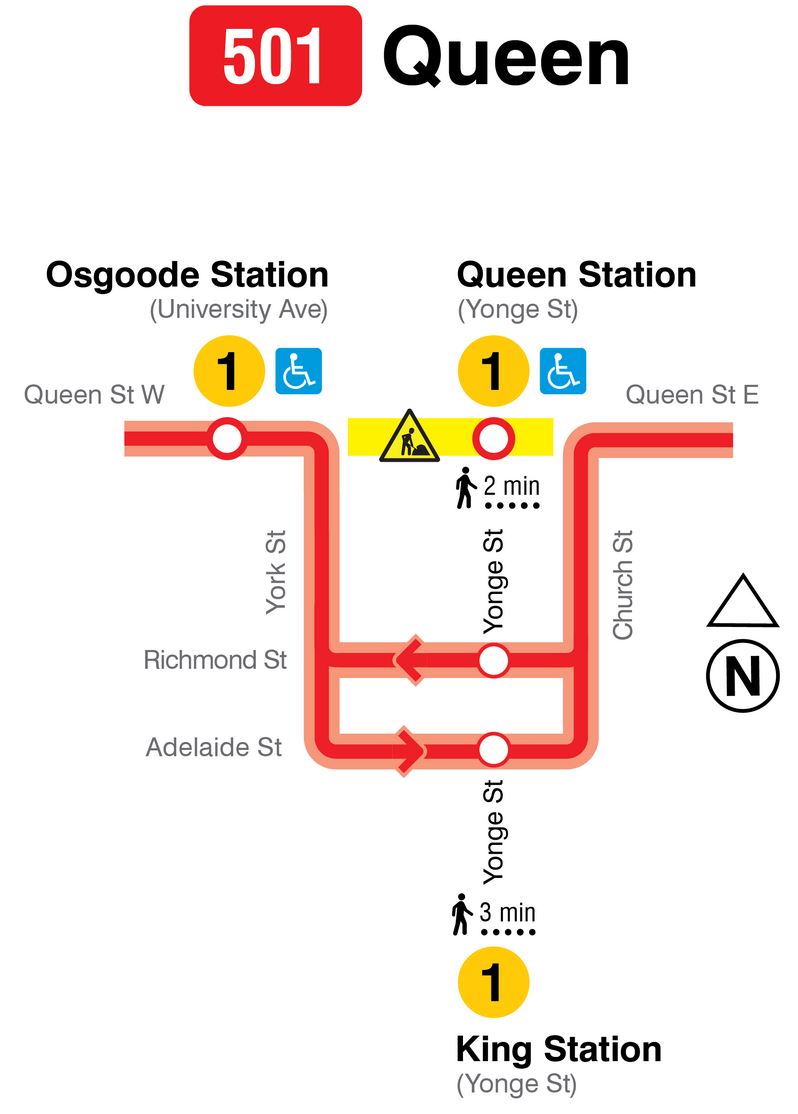
Streetcars will operate westbound via Church, Richmond and York, and eastbound via new track on York, Adelaide and Church. Connections to the subway will be via walking transfers south from Queen Station to Richmond (westbound service) and north from King Station to Adelaide (eastbound service). Connections to the University Line will be at Osgoode Station both ways.

Updated Nov 8 at 6pm: The TTC has confirmed that there will be no stops at Victoria, Bay or York as these are within walking distance of other stops.

The 501B shuttle bus from Broadview/Gerrard to Wolseley Loop at Bathurst Street will no longer operate.

There will be no 501/301 service on King Street at King or St. Andrew Stations.

Other services in the King Street corridor will remain: 503 Kingston Road, 504 King and 508 Lake Shore.

[An earlier version of this article cited November 6, not the 10th.]

Analysis of 29/929 Dufferin – September 2024 (Updated)

This article continues a series of reviews of various routes in September 2024, and in particular the crowding conditions on buses.

The data for Wednesday, September 25 are reviewed in detail to show some of the factors that vanish in stats averaged at the level of a month.

Updated Nov. 4, 2024 at 6:45am: Charts have been added at the end of the article showing the combined local and express service on September 25, and comparing travel times over segments of the route.

General notes:

  • Although the TTC Service Standards are based on the premise that vehicles leave terminals more-or-less “on time”, in practice there is a considerable variation that extends beyond the approved standard.
  • Irregular vehicles spacing tends to grow along a route so that bunches and gaps become more accentuated. There does not appear to much attempt to regulate vehicle spacing enroute.
  • Crowded buses are likely to appear after gaps in service, and loads on groups of buses are not evenly distributed. The average load measured over time might be within standards, but the load experienced by most riders is above that average.
  • Both the local and express services suffer from irregular vehicle spacing. The express buses make the journey between King and Wilson about five minutes faster than the locals.
  • Severe traffic congestion northbound near Yorkdale in the afternoon affects both the local and express buses.

This is a rather long article with a lot of charts to illustrate how vehicle tracking data can be presented in many ways.

Continue reading

Temporary Replacement of 512 St. Clair Streetcars

Starting at 11pm on Friday, November 1 until 5am on Thursday, November 14, streetcars will be replaced by buses over the entire 512 St. Clair route. Buses are already covering the east end of the route due to a sinkhole near Avenue Road and streetcars are diverting south to Bathurst Station.

This substitution will allow various works including completion of reconstruction at St. Clair West Station.

The 10 streetcars assigned to the line will be replaced by 15-30 buses.

Full streetcar service will resume on November 14, subject to completion of construction work.

Bus service on 33 Forest Hill, 90 Vaughan and 126 Christie will return to St. Clair West Station on Sunday, November 17, the next schedule change.

TTC’s Service Changes for the Swift Eras Tour

The TTC has announced several service changes to accommodate crowds expected at the Taylor Swift Eras Tour concerts at the Rogers Centre on November 14-16 and 21-23. For full details, see their site.

On concert nights, subway service will be improved between 5-8pm and 11pm-1:30am with Line 1 trains operating about every 3 minutes, and Line 2 trains every 4 minutes.

509 Harbourfront service will be restored between Union Station and Exhibition Loop from November 1-24 with at least 11 cars, up from the usual 7 on the line, on concert days .

511 Bathurst cars will operate from Bathurst Station to Union on November 14-16, and starting on November 17 on a scheduled basis.

19 Bay, a normally infrequent service, will have 10 extra buses. Post-show they will operate express northbound stopping only at King, Queen, Dundas and College enroute to Bay Station.

510D Spadina bus will similarly provide an express service stopping at the same intermediate destinations as 19 Bay enroute to Spadina Station.

The express services will be styled as “Swiftbus”. Extra service on 504 King will be styled as “Swiftcar”.

Access at Union Station will be monitored and controlled to prevent the overcrowding that occurred on past occasions with large events.