
Starting on October 19 mid-afternoon, streetcar service on King Street east of Church was blocked by a sinkhole caused by a broken watermain. Streetcar service was diverted from King to Queen, and the 501B Queen bus was shifted south to King.
The sinkhole repairs completed a few days ago, and effective October 25, the diversions are only in effect until 7pm while water main repairs continue. While this arrangement does improve evening service, it perpetuates the operational problems caused by the total lack of transit signal priority and traffic management at key intersections.
Updated Oct 27 at 11:15pm: The modified routes will not be in operation over the weekend, but will resume on Monday morning, October 30 according to the @ttchelps X account.
A separate problem occurs at the transition back to “normal” service in the evening. The buses revert to normal or run back to the garage, but it takes some time for the congestion to abate and normal streetcar service to resume. This puts a large gap between the two services.
Diversion Announcement This diversion announcement linked below has disappeared from the TTC site. As the TTC updates their info, I will amend this article.
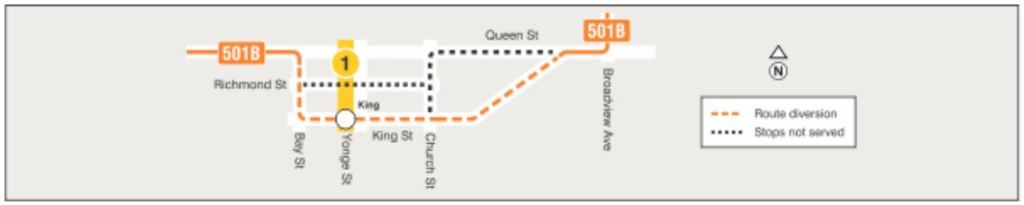


In summary, here are the normal (now evening only) and modified (daytime) routes through the affected area:
- 501B bus: Bathurst to Broadview/Gerrard
- Normal: Via Queen, Bay, King/Richmond (EB/WB), Church to Queen
- Diverted: Via Queen, Bay, King to Queen at the Don River (Both ways)
- 501D streetcar: Neville to York & Wellington
- Normal: Via Queen, Church, Wellington/York/King loop
- Diverted: No route change, but many Queen cars never get to York street and are short turned further east including to Distillery Loop during the most congested periods.
- 503 streetcar: Spadina to Bingham
- Normal: Via King, Queen, Kingston Rd
- Diverted: Via King, Church, Queen, Kingston Rd
- 504 streetcar:
- Normal: From King West to Distillery Loop via King, Sumach and Cherry
- Diverted:
- Streetcars short turn at Church via Church, Richmond, Victoria, Adelaide, Church
- Bus shuttle to Distillery looping downtown via Bay, Adelaide, Yonge to King
This arrangement has extremely severe effects on transit and traffic in general notably at locations where streetcars must turn. There is no Transit Signal Priority (TSP), no Traffic Warden (aka “Agent”), and no attempt to manage the conflicts between turning streetcars, other traffic and high pedestrian volumes at affected intersections. Concurrent work on Adelaide Street diverts traffic to Yonge Street and adds to congestion on streets used for the bus diversion.
Travel times of half an hour and more between Spadina and Church are common.
The situation makes total mockery of the City’s recent Congestion Management Plan by showing how they are utterly unprepared and unwilling to respond to an event that requires major reallocation of road space and time among various types of users, and active management in place of passive acceptance of chaos.
A fundamental part of traffic planning is to determine intersection capacity. This is not rocket science. If there are “N” green phases per hour, and in practice it is only possible for at best one streetcar to turn per cycle, this sets an upper bound on capacity. In fact, one per cycle is amazingly optimistic and could only likely be achieved with both TSP signalling (a “white bar” transit only phase) and a Traffic Agent to ensure the TSP was respected.
Service frequencies on the streetcar routes, and the equivalent cars/hour are:
- 501D Queen/Neville service: 10′ / 6 cars/hour
- 503 Kingston Rd Bingham service: 10′ / 6 cars/hour
- 504 King Church service: 4′ / 15 cars/hour
This translates to the following demands by turning cars/hour:
- King/Church
- Eastbound left: 35
- Southbound right: 25
- Queen/Church:
- Westbound left: 20
- Northbound right: 20
- Church/Richmond:
- Northbound left: 15
A typical traffic signal cycle time is 80 seconds, or 45 times per hour. It is self-evident that attempting to turn 35 cars/hour would be a challenge. This is compounded by the fact that many cars will stop to serve passengers before turning and will almost certainly lose one cycle for that purpose.
Another source of delay is that the electric switches for turns do not always work requiring operators to manually set their route where some cars turn and others go straight through. This can also affect TSP signals where they do exist because the switch electronics “tell” the signals that a transit phase is needed.
This is a crisis-level example of why TSP should be installed everywhere that streetcars might need it, not just for standard scheduled movements (e.g. eastbound at Queen and Broadview, turns at King & Sumach). It is precisely during events where operations go off kilter that the best possible priority is needed. If the facilities were sitting there, they would benefit occasional diversions and short turns, as well as major service interruptions like this one.
The City’s plan is utterly silent on this need, and that must change. For its part, the TTC must insist on improved TSP for streetcar and bus routes. This is not a panacea, but an important contribution to transit reliability and credibility.


 Steve Munro