TTC Misrepresents Growth in Streetcar Delays from Blocked Tracks

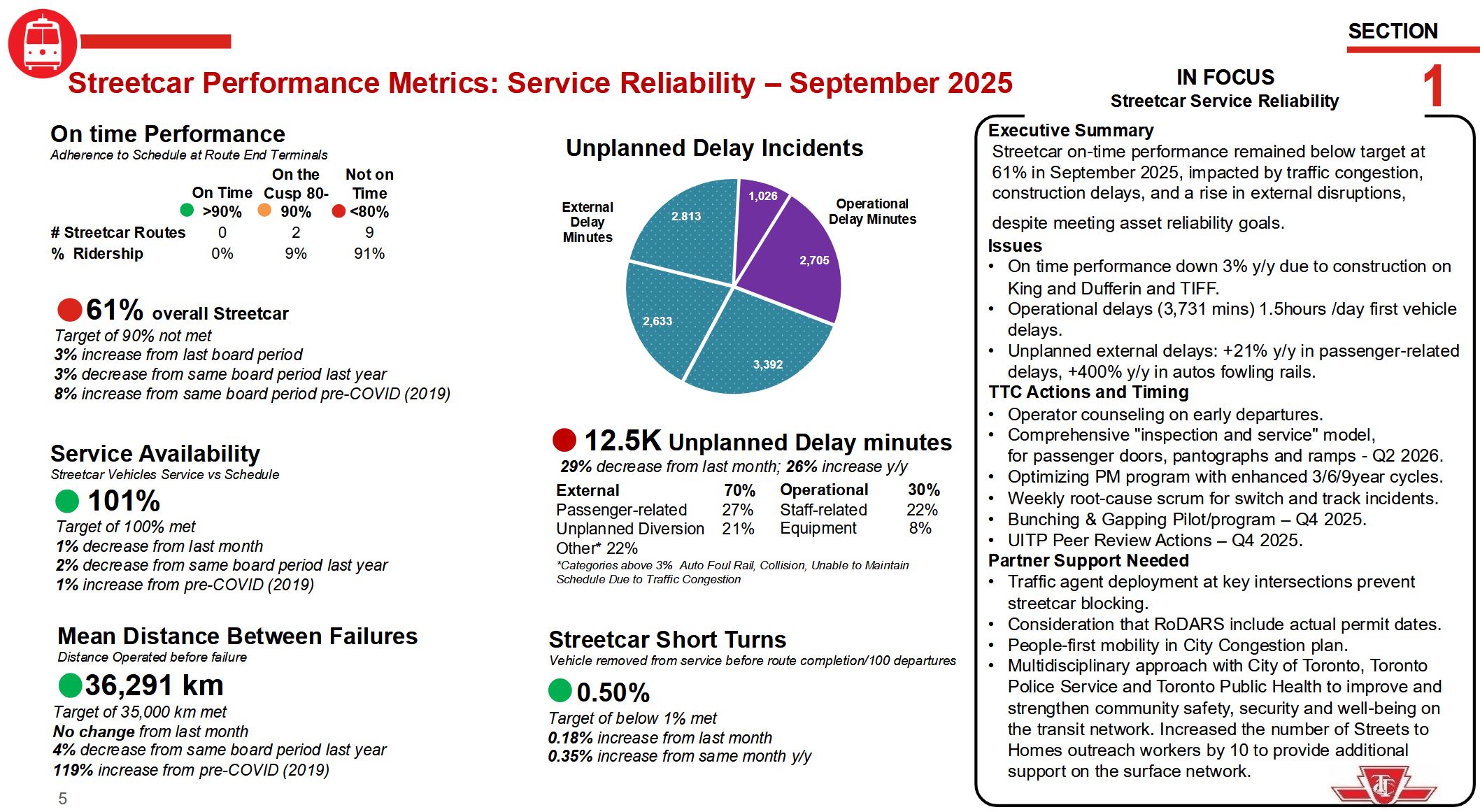
At the TTC Board meeting on November 3, management presented statistics on streetcar delays broken down by type of incident. TTC is quite fond of portraying external incidents, especially those related to congestion, as the root of (almost) all evil. The following page is from the CEO’s Report.

Note that external delays (turquoise) occupy the majority of the chart. During discussion of the problem of autos fouling rails, a passing remark by the Interim Chief Operating Officer piqued my curiosity when he said that there were many delays due to the winter storm.

This sent me to the TTC’s delay statistics which are available on the City’s Open Data site. There are codes for many types of delay including “MTAFR”, short for “Auto Fouling Rails”.

According to the “In Focus” box above there has been a 400% year-over-year increase in these delays, although they are styled as “fowling” implying a flock of chickens might be responsible for service issues.

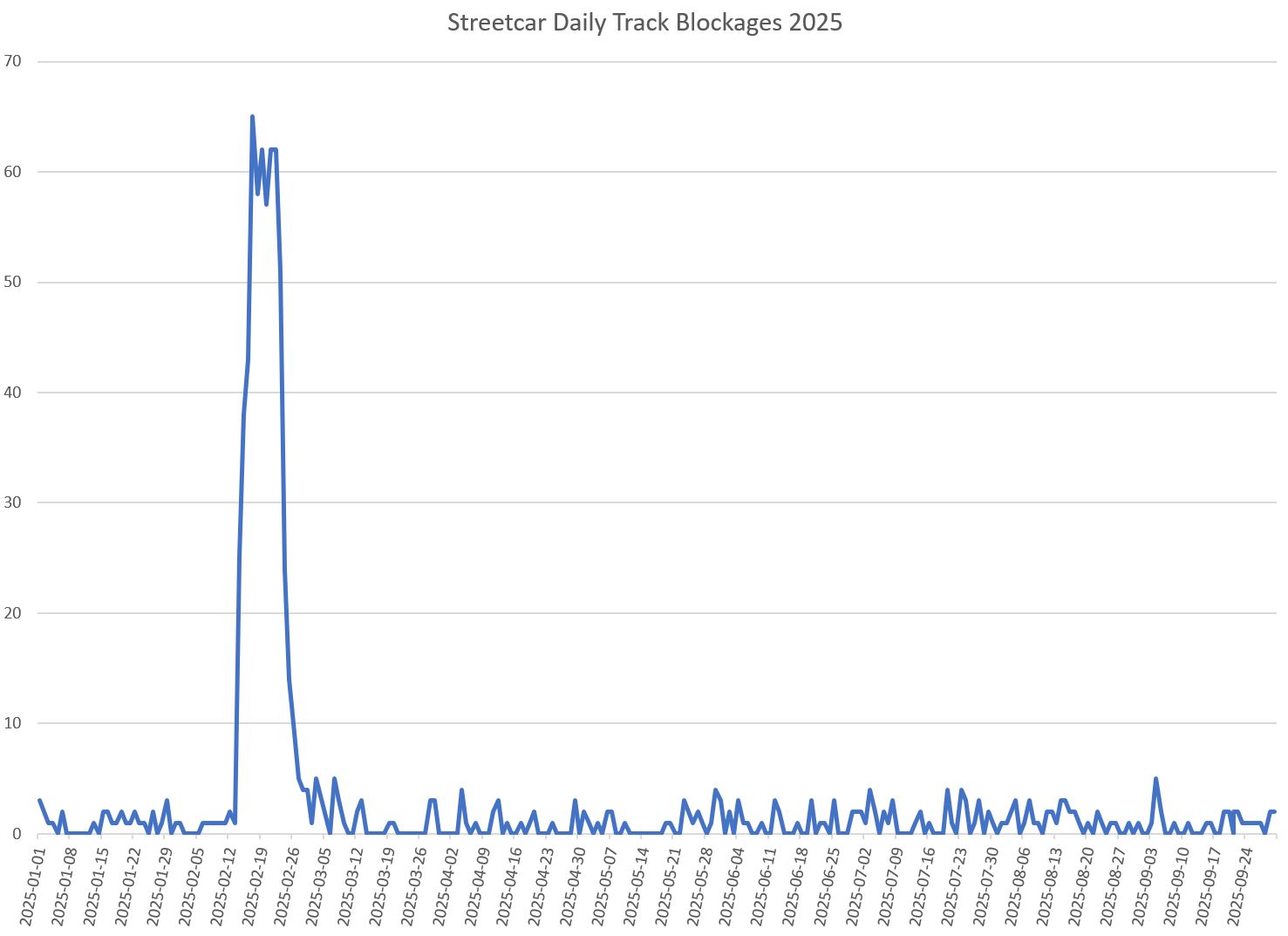
Sorting the data by code and summarizing by date produces interesting results.

  • Between January 1 and September 30, 2025, there were 843 MTAFR events logged.
  • Of these, 586 fall between February 14 and 26 hitting a daily high of 65 on February 17.

These blockages were not caused by the typical traffic congestion, but by the City’s utter failure to clear snow on key streets.

  • 105 were on 501 Queen
  • 42 were on 503 Kingston Rd.
  • 84 were on 504 King
  • 93 were on 505 Dundas
  • 186 were on 506 Carlton
  • 3 were on 507 Long Branch
  • 1 was on 508 Lake Shore
  • 2 were on 509 Harbourfront
  • None were on 510 Spadina or 511 Bathurst
  • 6 were on 512 St. Clair
  • A few dozen were on various night cars

The pattern here is quite clear: routes on wide roads or rights-of-way were not seriously affected, but routes on regular 4-lane streets were hammered. (How 511 Bathurst was spared is a mystery. At the time it was running with streetcars from Bathurst Station to King & Spadina, and with buses on the south end of the route.)

To claim that the 400% increase from 2024 is some indication of worsening traffic problems is gross misrepresentation of what actually happened. Although this is the CEO’s report and he almost certainly did not assemble the information himself, he wears this issue for having reported misleading data to the Board and public.

Direct comparison with published 2024 data is difficult because until 2025 the TTC used a much coarser set of delay codes that lumped many types of events under generic headings. There was a category “Held by” in which there were 625 incidents from January to September in 2024. The 843 MTAFR codes in 2025 are quite clearly not a 400% increase over 2024.

Whenever there is a discussion of unreliable service, we hear endlessly about traffic congestion. This definitely is a problem, but not the only one, and certainly not in the way presented by the CEO.

A question arose during the debate about the problem that performance stats are consolidated across all routes. Route-by-route service quality is presented in detail in the second part of this article for all streetcar routes. This shows that problems are widespread in the system, even on routes with reserved lanes.

As for the delay stats cited by the CEO, it is clear that we are not comparing September 2025 to one year earlier as the text implies, but using events from the entire year to date including a major snowstorm that had no equivalent a year earlier. The so-called 400% jump in delays from blocked tracks is due to snow and poor road clearance by the City.

TTC management owes the Board and the public an apology for blatant misrepresentation of the delay statistics.

Continue reading

King/Dufferin Reopening / Better 505 Dundas and 511 Bathurst Service Soon

The City of Toronto has announced that work at King & Dufferin is finished and the intersection will reopen to traffic on Wednesday, October 29 after 7pm.

Regular service will be restored on 29/929/329 Dufferin, and the 503 Kingston Road bus will be extended west from Joe Shuster Way (east of Dufferin) to Roncesvalles at 5am on Thursday, October 30.

TTC will test the new track and overhead during the week of November 3 and will restore 504 King and 508 Lake Shore services from their current Shaw/Queen diversion when the intersection is cleared for streetcar operation.

Meanwhile, the TTC CEO’s Report notes that six minute or better service will come to 505 Dundas and 511 Bathurst from 7am-7pm 7 days/week starting November 16.

Where is my Streetcar? Fall 2025 Edition.

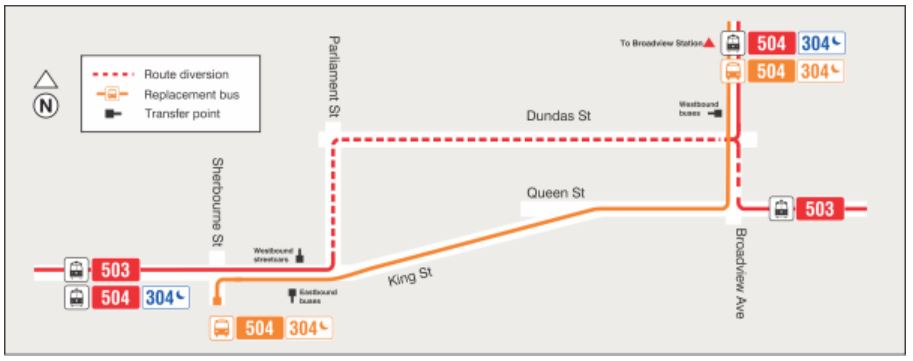
There are many diversions coming up in the Fall for streetcar routes. Information on these appears in various places on the TTC site, mainly but not exclusively under Service Advisories. As an aid to riders, this article consolidates the available information in one place.

Updated November 28, 2025

***** This article is only for archival purposes. It has been replaced by a new one picking up from mid-November 2025. *****

Major events pending and in progress include:

  • Construction on Queen between Davies (just east of the Don Bridge) and Broadview.
  • Reconstruction of the intersection of College and McCaul, and of overhead in the vicinity.
  • Reconstruction of track and overhead at and near Parliament and Carlton.

Other short term diversions will last only overnight or for a weekend.

Many of these are complicated by the ongoing Ontario Line work at Queen & Yonge forcing some diversions to be more complex than they might be otherwise.

This article will be updated when changes are announced.

  • November 21: The 501 diversion via Broadview, Dundas and Parliament around water main and track work west of Broadview will begin on November 22.
  • November 20: Equipment and material mobilization is underway on Queen west of Broadview.
  • November 17: The 506 diversion has been changed today to avoid the intersection of Church & Dundas where construction blocks the northeast corner. Maps have been added from the TTC’s site.
  • Effective November 16: The 503 Kingston Road bus will be cut back from Dufferin, and will now loop at York Street via Richmond and University.
  • November 15: Diversions announced for two projects on 506 Carlton at Parliament & Carlton, and on Gerrard east of Broadview.
  • November 9: King & Dufferin reopened for streetcar service. 503, 504, 508 will operate via their normal routes.
  • October 30: King & Dufferin reopens for general traffic and buses. Streetcars to return following track testing.
  • October 20: Water main reconstruction on Queen west of Broadview has been delayed until early November. 501 Queen streetcars will continue to operate on Queen Street until further notice.
  • October 13: 504 King is operating with streetcars today over its full route except for the King/Dufferin diversion.
  • October 9: Maps for 504 King and 506 Carlton diversions added.
  • October 8: Construction at Queen & Broadview will not start on October 12, and so some diversions will not be required immediately. Information for 501 Queen and 503 Kingston Road has been updated.
  • October 5: Nuit Blanch & Run For the Cure info moved to the archive section.
  • October 1: Diversions of 505/305 Dundas and 506/306 Carlton for Nuit Blance and for the Run For The Cure added for October 3/4/5.
  • September 23: The King/Dufferin start date has been changed to Sunday, September 28.
  • September 12: King/Dufferin start date pushed back to September 29 or later. The project will now extend to mid-November.
  • September 9: College/McCaul and Queen East details added.
  • August 26: King/Dufferin Project
    • The start date for this project has been changed to mid-September with the exact date to be confirmed. Although new schedules will be in place providing for diversions, service will continue to operate through on King Street until construction actually begins. This likely means that the project will extend further into October than the originally planned Thanksgiving weekend end date. The delay also means that the Tiff diversions will end before the King/Dufferin diversions begin.
    • Branch lettering for 504 King A/B corrected.
  • August 25: King/Dufferin Project
    • Information about Kingston Road night service added.
    • 304 King and 329 Dufferin confirmed to be diverted on the same routes as the 504A and 29 daytime services.
Continue reading

TTC’s Dubious Short Turn Statistics

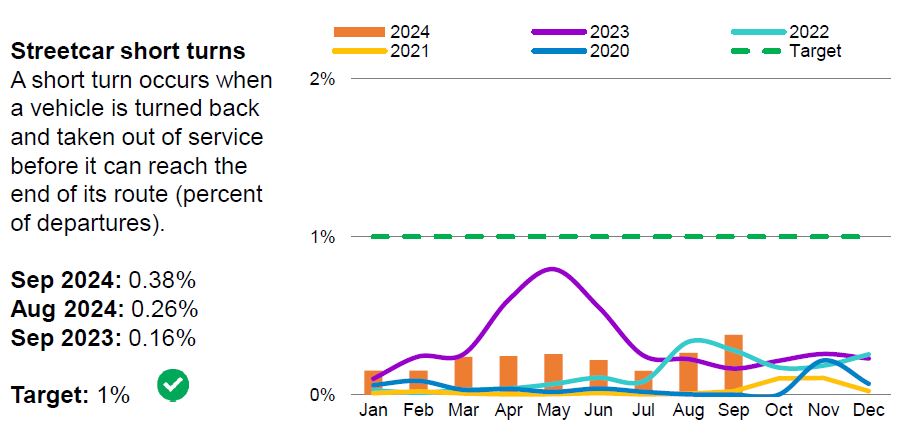
In the monthly CEO’s Report, one of the KPIs (Key Performance Indices) is a measure of the number of short-turned streetcars. This used to be reported as an absolute count, but is now expressed as a percentage of all trips.

Here is the most recent version:

This chart is a fiction born of the Rick Leary era when, in theory, all short turns were banned and the stats were made to fit the objective. Like many KPIs, this suffers from a combination of system-wide consolidation across all routes and time periods, as well as under-reporting of what is really happening.

An easy way to get the true count is to look at tracking data and compare two points on either side of a short-turn location. For example, Woodbine Loop at Queen and Kingston Rd. is a favourite spot for 501 Queen and some 503 Kingston Road cars to turn back. Counting the number of vehicles crossing Coxwell (west of the loop) with the number at Woodbine Avenue (east of the loop) shows how many cars did not travel east of Kingston Road and, therefore, were short-turned.

The TTC claims that they better their 1% target for trips short turned, but it is clear that they rarely achieve this. In some cases, the value rises above 20% indicating that although much service does get to the terminal, there is a good chance that a rider will encounter a short turn. This is separate from frustrations caused by gaps and bunching.

Short turns happen for many reasons including traffic congestion, too-tight schedules, service blockages for collisions, medical problems, parades … it’s a long list. Riders really don’t care. The basic point is that service they expected to receive is not there, and usually with no advance warning.

The table below summarizes the statistics from the vehicle tracking records in November 2024 for the period from 6am to midnight. It is clear that even on an aggregated level, the proportion of short turns is much higher on these routes that the TTC KPIs indicate.

Updated Dec. 6/24 at 1:30pm: Short turn counts for 504 King eastbound, 507 Long Branch and 508 Lake Shore westbound trips added.

Note: The legends on the original charts in this post were misleading. They have been changed to better reflect what the columns and lines on the charts represent..

RouteLocationTotal TripsShort Turns% Short Turns
501 QueenWoodbine Loop EB35471985.6%
Roncesvalles WB35372477.0%
503 Kingston RdWoodbine Loop EB32521364.2%
504 KingSpadina WB64532564.0%
Roncesvalles WB327536411.1%
Church EB63191262.0%
Parliament EB61982043.3%
Dundas EB2943712.4%
505 DundasParliament EB30402127.0%
Lansdowne WB306239713.0%
506 CarltonCoxwell EB30312939.7%
Lansdowne WB325657217.6%
507 Long BranchKipling WB2074883.0%
508 Lake ShoreKipling WB193199.8%
512 St. Clair (*)Lansdowne WB206824912.0%
Oakwood WB21131225.8%

(*) For 512 St. Clair, only data from November 14 onwards when streetcar service was restored are included.

Continue reading

Analysis of 505 Dundas: September 2024

This is the third in a series of reviews of various transit lines in Toronto. Although the streetcar fleet is not yet reporting passenger loads (automatic counter installation is in progress), it is still worth looking at the quality of service provided on some of these lines.

For 505 Dundas, I will look at seven days’ operation from Monday, September 16 to Sunday, September 22. The intent is to show that conditions on the route are not “one of” instances, but a continuing pattern. The article includes:

  • operating charts (sometimes called Marey diagrams after their supposed inventor well over a century ago),
  • vehicle spacing charts showing bunching and gapping of streetcars, and
  • headway summary charts for the month showing the range of headways at various times and places along the route.

An added topic at the end is a review of travel times on Dundas between University Avenue and Bathurst Street and the effect of parking restrictions that were implemented there earlier in 2024.

Items of particular note:

  • During some periods, streetcars leave terminals fairly evenly spaced, but do not stay in this condition across the route. The bunching and gaps seen by most riders are not as good as terminal-based stats might indicate.
  • Some periods when there is no specific event impeding service see pairs, and occasionally trios, of streetcars travel together for extended periods.
  • Terminal dwell times are adequate for a rest break in most periods, but there are times when this does not occur. Short turns, notably westbound at Lansdowne, become more frequent.
  • Two major delays/diversion occurred during the period covered by this article from demonstrations downtown. The after-effects on service lasted hours beyond the events.
  • Only one event, an early-morning “operational problem”, triggered the use of shuttle buses, at least to the extent that these were tracked and appear in the data feed.

There are a lot of charts in this article. For some readers, this will be a case of “TL,DR” but others really like all of the detail.

Continue reading

TTC Board Meeting: July 17, 2024

The July 17 Board meeting was extraordinarily long thanks to three in camera items, plus extended discussions of the CEO’s Report and of use of buses as homeless shelters during the winter.

The confidential session dealt with:

  • A collective bargaining update for two small groups of customer service and operations supervisor employees.
  • An update on advice from External Counsel. On a recorded vote, this was adopted with all Board members except Councillor Saxe in favour. As of the publication of this article (July 28), there have been no leaks about the subject of this report.
  • An update on the fare modernization program including the status of the Presto contract. The report was also discussed briefly in the public session later in the meeting.

The public meeting included:

  • The July 16 storm, flooding and hardening of infrastructure against climate change.
  • New subway trains and federal funding announced earlier the same day (July 17).
  • Prioritization of State of Good Repair projects. This item received scant attention although the report contains much interesting background on capital plans.
  • Safety on the TTC.
  • Use of shelter buses.
  • Transit network expansion update.
  • Fare Compliance Action Plan: See the updated version of my previous article on this report which includes the debate at the Board meeting.

Not discussed was the issue of hydraulic fluid leaks from subway work cars of which one quarter are still out of service. A report is supposed to be coming to the Board soon. It is not clear how much this situation is affecting the TTC’s ability to stay on top of track maintenance issues and the growing list of slow orders for track that cannot be safely operated at full speed.

Continue reading

505 Dundas Headways: April 2024

In the previous article, I reviewed travel times on 505 Dundas for the month of April 2024. Now, here are charts of the headway data.

Service on this route comes nowhere near meeting the TTC’s own rather lax standards for service quality. The TTC measures On Time Performance (“OTP”) with the assumption that if cars are on time, then regular service will take care of itself. However, there is considerable leeway in the words “on time”.

OTP is measured only at terminals and compares the scheduled trip time to the actual one. If a car leaves no more than 1 minute early or 5 minutes late, it is “on time” for the stats. There is no measurement of OTP along the route, and the spacing from terminals is rarely maintained.

The six minute window this provides allows service to be quite erratic, but still counted as “on time”. For example, on a route like Dundas with a 10 minute headway, cars could alternately be 5 minutes late and 1 minute early. This would produce the following departure pattern:

Scheduled12:0012:1012:2012:3012:4012:501:00
Actual12:0512:0912:2512:2912:4512:491:05
Headway4′16′4′16′4′16′

The cars on short headways would inevitably catch up with the cars on wide headways, and pairs 20′ apart would travel across the route. There is nothing in TTC standards to measure this. and reports will blissfully say that service is “on time”. In fact, the TTC does not even achieve its own lax standard.

There is also no metric for missed trips caused by absent cars. Conversely, a trip at a terminal can legitimately be missing if a car was short-turned to restore regular service. The TTC’s focus on OTP stats to the exclusion of any other metric is one reason for the no short-turn policy. This can do much damage by blocking legitimate service management techniques. In the article on travel times, there are many examples of short turns to preserve service on the central part of the route rather than letting vehicles pile up at terminals.

This article shows how service leaving the terminals of 505 Dundas is disorganized from the outset, and how this evolves along the route. For an organization that hopes to win back riders, this is not an ideal example of what service should look like.

Continue reading

505 Dundas Travel Times: April 2024

On the Toronto Council agenda for May 22, 2024, there was a motion asking for Transportation Services to investigate changes in traffic regulations on Dundas Street in anticipation of coming work on Spadina Avenue and at Spadina Station. This will replace streetcars with buses for a period from late June to mid-December, 2024, and the buses will not operate on the streetcar right-of-way.

Community Council Decision Advice and Other Information

The Toronto and East York Community Council requested the General Manager, Transportation Services to report directly to the May 22, 2024 meeting of City Council on recommended temporary parking, loading and traffic amendments on Dundas Street West that would support timely and reliable streetcar service on Dundas Street West between Spadina Avenue and McCaul Street during construction at Spadina Station.

Summary

During the June to December 2024 closure of the 510 Spadina streetcar for construction at Spadina Station, the Toronto Transit Commission (TTC) wishes to enhance alternate routes for customer movement to and through the Chinatown neighbourhood. One key alternate route is the 505 Dundas streetcar. Unfortunately, this streetcar is frequently delayed by acute traffic congestion between Spadina Avenue and McCaul Street. To improve timeliness and reliability of 505 Dundas streetcar service through Chinatown during the Spadina closure, TTC is requesting that Council temporarily modify left-turn prohibitions, reduce on-street general-use parking, and add no stopping restrictions in strategic locations and timeframes along Dundas Street West between Spadina Avenue and McCaul Street. Designated loading zones may also help to reduce conflicts with streetcar service while supporting local businesses.

Transportation Services has replied to this request with a recommendation for changes in parking, stopping and turning restrictions on Dundas between McCaul and Spadina. Current curb lane restrictions are for no parking or stopping only in peak periods, with a mixture of paid and unpaid parking allowed at other times. There are also various turning restrictions (see the reply for details). The proposed changes are:

  • Between McCaul and Spadina, Dundas would be a No Stopping zone in both directions at all times.
  • Between University and McCaul, the peak direction (eastbound AM, westbound PM) would be a No Stopping zone.
  • Left turns eastbound and westbound at Dundas and Spadina would be banned between 7 am and 10 pm on all days.

A coach loading zone will be preserved in front of the Art Gallery (south side of Dundas, west of McCaul), and “consultation will be undertaken with the Chinatown BIA to identify areas where loading zone could be designated”.

Council amended the staff recommendation to asked for a “report back to the Toronto and East York Community Council by the fourth quarter of 2024 on the effectiveness of these changes for streetcar operations and a recommended long-term plan for parking, loading and traffic regulations on Dundas Street West between Spadina Avenue and McCaul Street.”

How much these changes will contribute to the Dundas car’s operation remains to be seen. There are already peak period restrictions on Dundas, and so there would be no change at those times. As always, the question of enforcement in practice vs regulation in theory is a problem. Moreover, 505 Dundas service is much less frequent than the combined services on King, and transit’s presence on Dundas is nowhere near as dominant. At most times, the scheduled service is every 10 minutes, and the most frequent service, 7 minutes, is on Saturday afternoons.

There is much more to the 505 Dundas route than the short section east of Spadina, and any review of the route should look at it over all. The travel time between University and Spadina, even on “bad” days, is under 10 minutes and the likely saving of any restrictions will be at best 4 minutes, likely less. Focus on a single segment will not address wider problems along the route.

The remainder of this article looks at travel times for 505 Dundas cars in April 2024 as a “before” point of reference, and to high light other areas where cars are (and are not) delayed.

Continue reading

East End Streetcar Diversions April 19-29, 2024

Once again, streetcar service in the east end will be disrupted for construction diversions, although this will not be as long lasting as projects in recent years.

Updated April 27, 2024: The diversion for work at the Don Bridge on Queen Street finished early and all streetcar routes returned to their normal routes today.

505 Dundas Late Night Diversion

On Friday, April 19 and Saturday, April 21, service after 11pm on 505 Dundas cars will divert both ways via the Carlton route (College, Carlton, Parliament, Gerrard) between Bay and Broadview. Replacement bus service will cover the missed portion of the streetcar route. This work is for track drain repairs at Mutual Street.

501/503/504/508/301/304 Don Bridge Diversion

From Monday, April 22 at 4am to Monday, April 29 at 4am, all streetcar service will divert via Dundas between Broadview and Parliament to bypass expansion joint replacement on the Queen Street bridge at the Don River. The work finished early and normal routings across the bridge were restored on April 27.

Shuttle bus service will operate on Queen between Carlaw and Sherbourne, and on the King route between Broadview Station and Sherbourne.

As of 7am on April 20, the TTC has posted a Service Change notice for King Street services (503, 504 and 304), but has not yet posted one for 501/301 Queen or 508 Lake Shore although these are also affected. The 501B bus service between Broadview and Bathurst should continue on its normal route. There is also an item on their News page describing this change.

Although not shown on this map, the diversion should not affect the 504A Distillery service.

Expansion joint replacement on this bridge occurs from time to time as this is a high traffic area, and the bridge can be damaged if the joint is in poor condition from vibration of passing streetcars.

How Slow Is My Streetcar: Part I

At its November 2023 meeting, Council passed a motion proposed by Councillor Chris Moise whose ward covers the east side of downtown, and who also sits on the TTC Board:

1. City Council direct the General Manager, Transportation Services, in consultation with the Toronto Transit Commission, the Toronto Police Service, and the City Solicitor to review and report back to the Executive Committee in the second quarter of 2024, including:
a. an update on streetcar performance over the last five years;
b. suggested improvements to the public realm along King Street until the permanent capital project can be delivered; and
c. the feasibility of implementing automated traffic enforcement on the King Street Transit Priority Corridor, including details on what legislative amendments would be required to provincial legislation including, but not limited to, the Ontario Highway Traffic Act.

This article addresses point “a” with a review of streetcar lines over the past five years. It is important to go back to 2019 before the pandemic fundamentally shifted traffic and transit patterns downtown as a point of reference.

From time to time, there are calls to expand a “King Street” redesign to other parts of the network, but there are two “cart before the horse” issues to address first:

  • Figure out how to make King Street operate as it was intended and return at least to its pre-pandemic behaviour, if not better, as a model.
  • Understand how other streets operate including where and when problems for transit performance exist.

An update on transit priority will come to Council in February 2024, although this will look more widely at the city, not just downtown. In previous articles I have reviewed the growing problem of transit travel times as traffic builds on the proposed RapidTO corridors, some of which exceeded pre-pandemic levels some time ago. In future articles I will refresh these analyses with data through to the end of 2023.

An important distinction between most RapidTO bus corridors and the downtown streetcar system is the design of suburban vs downtown streets. In the suburbs, the streets are mostly wide, have relatively few points of access (e.g. driveways) or pedestrian oriented uses (e.g. shops), and travel distances tend to be longer. In the core, streets are narrow, mostly four lanes with no possibility of widening, access points are more frequent, there is a strong pedestrian orientation, and trips tend to be short. Even if buses were running, express operations would be almost impossible and would save very little time on the downtown routes.

There are exceptions such as some older parts of the inner suburbs that bring physical challenges for transit priority, but also the political challenge that the transit share of road use is lower as one moves outward from the core. King Street is a very different place from Steeles, and Dufferin is somewhere in between depending on which section one considers.

An important message in all of this is that “congestion” (put in quotes because it is so often cited as a get-out-of-jail-free excuse for all transit woes) varies from place to place and time to time. Simply putting transit priority everywhere will not solve all problems and could even be overkill (even assuming that it is true “priority” and not a sham to keep transit vehicles out of motorists’ way). It is simple to colour a bunch of key routes end-to-end on a map, but much harder to identify changes that will actually make a difference. Meanwhile, a focus on “priority” could divert attention from badly-needed improvements in headway reliability and more reliable wait times.

This article begins with a comparison of scheduled travel speed on each route, and then turns to actual travel speeds by route segment. In the interest of length, I will leave a discussion of headway reliability to future articles. This is an important component of total travel time, especially for short trips or trip segments.

I have also included tables showing the constant change in route configurations on the four major east-west corridors thanks to a never-ending procession of track and water main work, rapid transit construction, and overhead changes for pantograph operation. Some of this work was accelerated to take advantage of lighter traffic conditions during the pandemic, and some to bring forward work to keep staff employed.

However, the rate of route changes persisted well beyond the heart of the pandemic and threatens the credibility of transit service on major corridors leaving riders constantly wondering where their streetcar or replacement bus might be. Some changes occurred without the planned work actually taking place, or work started and ended later than announced (sometimes much later as in the never-ending KQQR project).

An important change over recent years, separate from the pandemic, has been the move to larger streetcars on wider headways. What might have been a tolerable unevenness in service when streetcars arrived every 4 or 5 minutes simply does not work for scheduled headways of 10 minutes with much wider swings. Bunching when it occurs leaves much bigger gaps between vehicles. A laissez faire attitude to route management, and especially the assumption that routes under construction cannot be managed, has led both to unreliable service and basic questions of how or if the TTC can recover the quality riders expect.

For all the talk of project co-ordination, the last people who seem to count are the riders. Simply studying raw travel times be they scheduled or actual does not capture the frustration, delay and despair from the ever-changing and unreliable services, be they by streetcar or bus.

Continue reading