505 Dundas Headways: April 2024

In the previous article, I reviewed travel times on 505 Dundas for the month of April 2024. Now, here are charts of the headway data.

Service on this route comes nowhere near meeting the TTC’s own rather lax standards for service quality. The TTC measures On Time Performance (“OTP”) with the assumption that if cars are on time, then regular service will take care of itself. However, there is considerable leeway in the words “on time”.

OTP is measured only at terminals and compares the scheduled trip time to the actual one. If a car leaves no more than 1 minute early or 5 minutes late, it is “on time” for the stats. There is no measurement of OTP along the route, and the spacing from terminals is rarely maintained.

The six minute window this provides allows service to be quite erratic, but still counted as “on time”. For example, on a route like Dundas with a 10 minute headway, cars could alternately be 5 minutes late and 1 minute early. This would produce the following departure pattern:

Scheduled12:0012:1012:2012:3012:4012:501:00
Actual12:0512:0912:2512:2912:4512:491:05
Headway4′16′4′16′4′16′

The cars on short headways would inevitably catch up with the cars on wide headways, and pairs 20′ apart would travel across the route. There is nothing in TTC standards to measure this. and reports will blissfully say that service is “on time”. In fact, the TTC does not even achieve its own lax standard.

There is also no metric for missed trips caused by absent cars. Conversely, a trip at a terminal can legitimately be missing if a car was short-turned to restore regular service. The TTC’s focus on OTP stats to the exclusion of any other metric is one reason for the no short-turn policy. This can do much damage by blocking legitimate service management techniques. In the article on travel times, there are many examples of short turns to preserve service on the central part of the route rather than letting vehicles pile up at terminals.

This article shows how service leaving the terminals of 505 Dundas is disorganized from the outset, and how this evolves along the route. For an organization that hopes to win back riders, this is not an ideal example of what service should look like.

Continue reading

505 Dundas Travel Times: April 2024

On the Toronto Council agenda for May 22, 2024, there was a motion asking for Transportation Services to investigate changes in traffic regulations on Dundas Street in anticipation of coming work on Spadina Avenue and at Spadina Station. This will replace streetcars with buses for a period from late June to mid-December, 2024, and the buses will not operate on the streetcar right-of-way.

Community Council Decision Advice and Other Information

The Toronto and East York Community Council requested the General Manager, Transportation Services to report directly to the May 22, 2024 meeting of City Council on recommended temporary parking, loading and traffic amendments on Dundas Street West that would support timely and reliable streetcar service on Dundas Street West between Spadina Avenue and McCaul Street during construction at Spadina Station.

Summary

During the June to December 2024 closure of the 510 Spadina streetcar for construction at Spadina Station, the Toronto Transit Commission (TTC) wishes to enhance alternate routes for customer movement to and through the Chinatown neighbourhood. One key alternate route is the 505 Dundas streetcar. Unfortunately, this streetcar is frequently delayed by acute traffic congestion between Spadina Avenue and McCaul Street. To improve timeliness and reliability of 505 Dundas streetcar service through Chinatown during the Spadina closure, TTC is requesting that Council temporarily modify left-turn prohibitions, reduce on-street general-use parking, and add no stopping restrictions in strategic locations and timeframes along Dundas Street West between Spadina Avenue and McCaul Street. Designated loading zones may also help to reduce conflicts with streetcar service while supporting local businesses.

Transportation Services has replied to this request with a recommendation for changes in parking, stopping and turning restrictions on Dundas between McCaul and Spadina. Current curb lane restrictions are for no parking or stopping only in peak periods, with a mixture of paid and unpaid parking allowed at other times. There are also various turning restrictions (see the reply for details). The proposed changes are:

  • Between McCaul and Spadina, Dundas would be a No Stopping zone in both directions at all times.
  • Between University and McCaul, the peak direction (eastbound AM, westbound PM) would be a No Stopping zone.
  • Left turns eastbound and westbound at Dundas and Spadina would be banned between 7 am and 10 pm on all days.

A coach loading zone will be preserved in front of the Art Gallery (south side of Dundas, west of McCaul), and “consultation will be undertaken with the Chinatown BIA to identify areas where loading zone could be designated”.

Council amended the staff recommendation to asked for a “report back to the Toronto and East York Community Council by the fourth quarter of 2024 on the effectiveness of these changes for streetcar operations and a recommended long-term plan for parking, loading and traffic regulations on Dundas Street West between Spadina Avenue and McCaul Street.”

How much these changes will contribute to the Dundas car’s operation remains to be seen. There are already peak period restrictions on Dundas, and so there would be no change at those times. As always, the question of enforcement in practice vs regulation in theory is a problem. Moreover, 505 Dundas service is much less frequent than the combined services on King, and transit’s presence on Dundas is nowhere near as dominant. At most times, the scheduled service is every 10 minutes, and the most frequent service, 7 minutes, is on Saturday afternoons.

There is much more to the 505 Dundas route than the short section east of Spadina, and any review of the route should look at it over all. The travel time between University and Spadina, even on “bad” days, is under 10 minutes and the likely saving of any restrictions will be at best 4 minutes, likely less. Focus on a single segment will not address wider problems along the route.

The remainder of this article looks at travel times for 505 Dundas cars in April 2024 as a “before” point of reference, and to high light other areas where cars are (and are not) delayed.

Continue reading

East End Streetcar Diversions April 19-29, 2024

Once again, streetcar service in the east end will be disrupted for construction diversions, although this will not be as long lasting as projects in recent years.

Updated April 27, 2024: The diversion for work at the Don Bridge on Queen Street finished early and all streetcar routes returned to their normal routes today.

505 Dundas Late Night Diversion

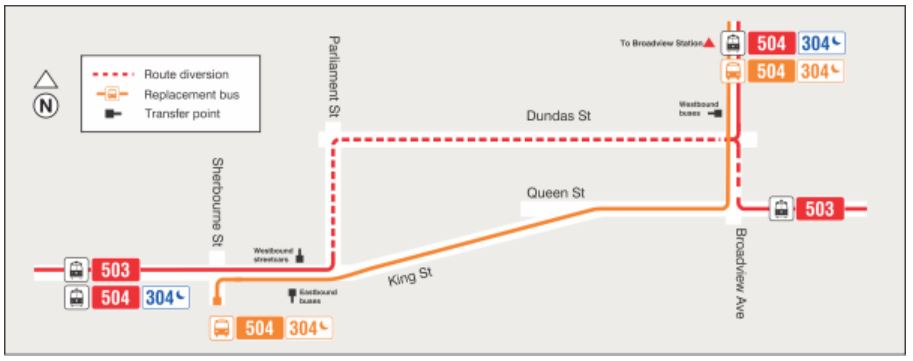
On Friday, April 19 and Saturday, April 21, service after 11pm on 505 Dundas cars will divert both ways via the Carlton route (College, Carlton, Parliament, Gerrard) between Bay and Broadview. Replacement bus service will cover the missed portion of the streetcar route. This work is for track drain repairs at Mutual Street.

501/503/504/508/301/304 Don Bridge Diversion

From Monday, April 22 at 4am to Monday, April 29 at 4am, all streetcar service will divert via Dundas between Broadview and Parliament to bypass expansion joint replacement on the Queen Street bridge at the Don River. The work finished early and normal routings across the bridge were restored on April 27.

Shuttle bus service will operate on Queen between Carlaw and Sherbourne, and on the King route between Broadview Station and Sherbourne.

As of 7am on April 20, the TTC has posted a Service Change notice for King Street services (503, 504 and 304), but has not yet posted one for 501/301 Queen or 508 Lake Shore although these are also affected. The 501B bus service between Broadview and Bathurst should continue on its normal route. There is also an item on their News page describing this change.

Although not shown on this map, the diversion should not affect the 504A Distillery service.

Expansion joint replacement on this bridge occurs from time to time as this is a high traffic area, and the bridge can be damaged if the joint is in poor condition from vibration of passing streetcars.

How Slow Is My Streetcar: Part I

At its November 2023 meeting, Council passed a motion proposed by Councillor Chris Moise whose ward covers the east side of downtown, and who also sits on the TTC Board:

1. City Council direct the General Manager, Transportation Services, in consultation with the Toronto Transit Commission, the Toronto Police Service, and the City Solicitor to review and report back to the Executive Committee in the second quarter of 2024, including:
a. an update on streetcar performance over the last five years;
b. suggested improvements to the public realm along King Street until the permanent capital project can be delivered; and
c. the feasibility of implementing automated traffic enforcement on the King Street Transit Priority Corridor, including details on what legislative amendments would be required to provincial legislation including, but not limited to, the Ontario Highway Traffic Act.

This article addresses point “a” with a review of streetcar lines over the past five years. It is important to go back to 2019 before the pandemic fundamentally shifted traffic and transit patterns downtown as a point of reference.

From time to time, there are calls to expand a “King Street” redesign to other parts of the network, but there are two “cart before the horse” issues to address first:

  • Figure out how to make King Street operate as it was intended and return at least to its pre-pandemic behaviour, if not better, as a model.
  • Understand how other streets operate including where and when problems for transit performance exist.

An update on transit priority will come to Council in February 2024, although this will look more widely at the city, not just downtown. In previous articles I have reviewed the growing problem of transit travel times as traffic builds on the proposed RapidTO corridors, some of which exceeded pre-pandemic levels some time ago. In future articles I will refresh these analyses with data through to the end of 2023.

An important distinction between most RapidTO bus corridors and the downtown streetcar system is the design of suburban vs downtown streets. In the suburbs, the streets are mostly wide, have relatively few points of access (e.g. driveways) or pedestrian oriented uses (e.g. shops), and travel distances tend to be longer. In the core, streets are narrow, mostly four lanes with no possibility of widening, access points are more frequent, there is a strong pedestrian orientation, and trips tend to be short. Even if buses were running, express operations would be almost impossible and would save very little time on the downtown routes.

There are exceptions such as some older parts of the inner suburbs that bring physical challenges for transit priority, but also the political challenge that the transit share of road use is lower as one moves outward from the core. King Street is a very different place from Steeles, and Dufferin is somewhere in between depending on which section one considers.

An important message in all of this is that “congestion” (put in quotes because it is so often cited as a get-out-of-jail-free excuse for all transit woes) varies from place to place and time to time. Simply putting transit priority everywhere will not solve all problems and could even be overkill (even assuming that it is true “priority” and not a sham to keep transit vehicles out of motorists’ way). It is simple to colour a bunch of key routes end-to-end on a map, but much harder to identify changes that will actually make a difference. Meanwhile, a focus on “priority” could divert attention from badly-needed improvements in headway reliability and more reliable wait times.

This article begins with a comparison of scheduled travel speed on each route, and then turns to actual travel speeds by route segment. In the interest of length, I will leave a discussion of headway reliability to future articles. This is an important component of total travel time, especially for short trips or trip segments.

I have also included tables showing the constant change in route configurations on the four major east-west corridors thanks to a never-ending procession of track and water main work, rapid transit construction, and overhead changes for pantograph operation. Some of this work was accelerated to take advantage of lighter traffic conditions during the pandemic, and some to bring forward work to keep staff employed.

However, the rate of route changes persisted well beyond the heart of the pandemic and threatens the credibility of transit service on major corridors leaving riders constantly wondering where their streetcar or replacement bus might be. Some changes occurred without the planned work actually taking place, or work started and ended later than announced (sometimes much later as in the never-ending KQQR project).

An important change over recent years, separate from the pandemic, has been the move to larger streetcars on wider headways. What might have been a tolerable unevenness in service when streetcars arrived every 4 or 5 minutes simply does not work for scheduled headways of 10 minutes with much wider swings. Bunching when it occurs leaves much bigger gaps between vehicles. A laissez faire attitude to route management, and especially the assumption that routes under construction cannot be managed, has led both to unreliable service and basic questions of how or if the TTC can recover the quality riders expect.

For all the talk of project co-ordination, the last people who seem to count are the riders. Simply studying raw travel times be they scheduled or actual does not capture the frustration, delay and despair from the ever-changing and unreliable services, be they by streetcar or bus.

Continue reading

Downtown Route Changes Effective December 11, 2023 (Updated)

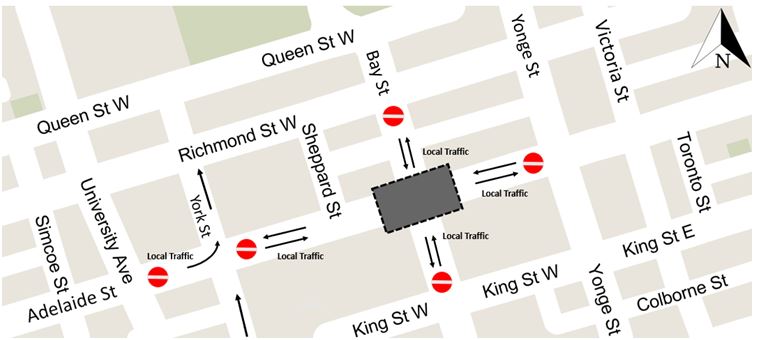
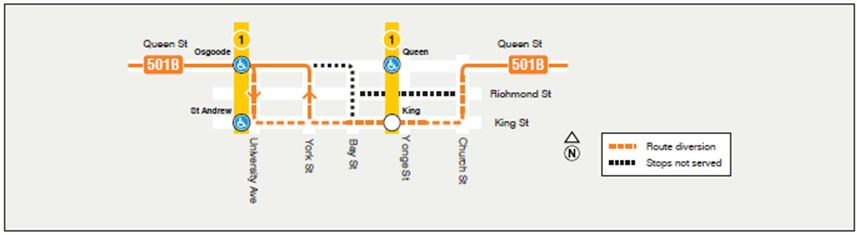
The City of Toronto will completely close the intersection of Bay & Adelaide from 7am Monday, December 11 to 7am on Saturday December 16 to all vehicles. Bay and Adelaide Streets will be open only for local traffic in the immediate area of the closure. This continues the work of (re-)installing streetcar track on Adelaide for the eastbound 501 Queen streetcar diversion around Ontario Line contruction.

Updated: Work at Bay and Adelaide actually completed on the afternoon of Friday, December 15 and the intersection reopened earlier than planned.

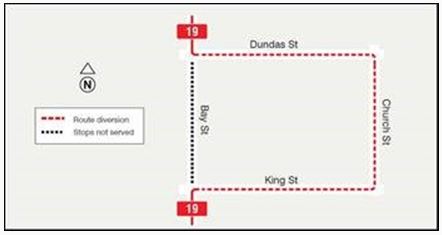
This will require diversion of the 19 Bay and 501B Queen bus routes.

The 19 Bay bus will divert via Dundas, Church and King both ways.

The 501B Queen bus which normally operates on Bay from King to Queen will use York Street for north/westbound trips and University Avenue for south/eastbound trips. Buses will operate both ways via King Street, and there will be no westbound service on Richmond Street

[Apologies for the soft images. They are from a City construction notice, and I used what is available.]

End of the King East Diversions

As the map for 501B Queen above shows, service is supposed to resume the normal routes east of Church with the completion of water main and Hydro work on the coming weekend which has a December 10 end date. This means that:

  • 501B Queen buses return to Queen Street east of Church
  • 503 Kingston Road streetcars return to King Street between the Don River and Church
  • 504 King streetcar service to Distillery Loop resumes

Updated December 11, 2023 at 4:15 pm

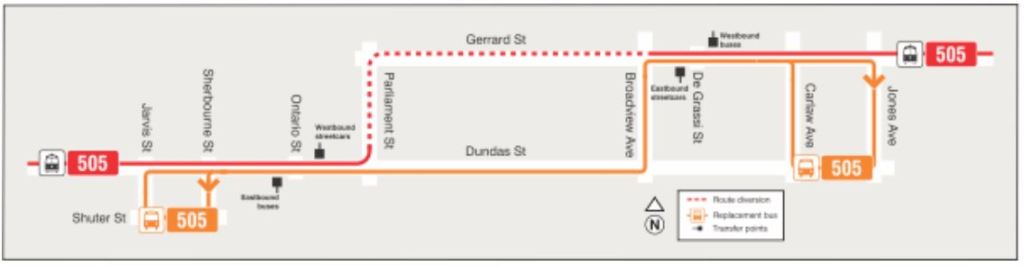
Another diversion has been added to the list. The 505 Dundas cars will divert both ways via Parliament and Gerrard. A 505 shuttle bus will run from Jarvis to Jones.

This diversion is required for track repairs, and will last until Thursday, December 21, 2023.

Updated: This diversion ended on Tuesday, December 19.

Broadview Station Reopening Delayed

The construction work on Broadview north of Danforth has not run particularly quickly with a few intervals where nothing happened at all for over a week. This appeared to be not the TTC’s problem, but rather the contractor, Sanscon, who simply did not have anyone working on site at times.

As of November 16, they have only now reached the point of excavating the north end of Broadview Station Loop. Both track and concrete are incomplete, albeit progressing, on Broadview and at the loop entrance. Broadview Avenue cannot reopen until this track work has finished and the pavement is restored.

The reopening of the station for bus service is now expected in December (exact date unspecified).

The schedules for “normal” operation at Broadview Station are already in place, but service will operate in an interim configuration pending completion of work at the station.

  • 8 Broadview will operate from Broadview & O’Connor Mortimer to Warden Station. It will no longer interline with 62 Mortimer. [Corrected 6:35 pm, November 16]
  • 62 Mortimer will operate from Broadview & Mortimer to Main Station. It will no longer interline with 8 Broadview.
  • 87 Cosburn will continue operating to Pape Station via Mortimer and Pape.
  • 72 Pape will no longer provide replacement service for Broadview Avenue, but this will be taken over by a 504/505 shuttle. 72A Pape will no longer be interlined with 100 Flemingdon Park.
  • 100 Flemingdon Park will operate from Pape Station independently of 72A Pape.
  • The 504/505 Broadview shuttle will operate from Castle Frank Station to King & Parliament via Bloor, Danforth, Broadview, Queen and King, and it will use on-street stops at Broadview & Danforth.
  • 304 King Night Bus will operate from Castle Frank Station east to Broadview and then over the 504 King daytime route to Dundas West Station.
  • 322 Coxwell Night Bus will divert to Pape Station.

When Broadview Station Loop reopens, routes 8, 62, 87, 100, 504/505, 304 and 322 will resume their normal routes to that loop.

The TTC has not yet published information about on street stops for the temporary western terminals of 8 Broadview and 62 Mortimer.

Here are two views of construction work at the north end of Broadview Station on November 16.

Streetcar operation to Broadview Station will resume in mid-February 2024 following sewer rehab work by Toronto Water.

Streetcar Diversion Update, Sept. 24, 2023

The weekend of Sept 23-24 saw another shuffle in the streetcar diversion list on which I last reported a few weeks ago. This round of changes is triggered by two events:

  • Metrolinx work on the Lakeshore East corridor at Queen & Degrassi streets prevents streetcar operation through the underpass, and at times the road will be closed to all traffic.
  • Toronto Hydro work on Queen West has completed to the point that streetcars are no longer diverting via King Street through Parkdale.

Services now operating on Queen Street include:

  • 501L (aka 507) Queen bus from Long Branch to Dufferin. These buses do not appear on transit apps.
  • 501B Queen bus from Bathurst to Broadview & Gerrard, with downtown diversion around Ontario Line construction.
  • 501 Queen streetcar from Sunnyside Loop to McCaul Loop.
  • 501D (aka 513) Queen bus from Victoria Street (looping via Church, Richmond and Victoria) to Neville Loop. These buses appear on transit apps as 513 Queen East.
  • 503 Kingston Road bus between the Don River and Kingston Road.

During certain periods, the underpass at Degrassi will be closed to all traffic and the 501/503/513 services will divert via Broadview, Dundas and Carlaw.

Complete closures are planned for Sunday, September 24 all day, and from Friday, September 29 at 10pm to Monday, October 2 at 4am.

The 504 King car operates only west of Distillery Loop pending completion of road and track construction on Broadview from Gerrard to Broadview Station Loop. Heavy construction at the loop will begin on Monday, September 25. Paving in the curb lanes on Broadview south of Danforth has begun following completion of track work.

The 72A Pape bus serving King Street East will use the same diversion around Queen & Degrassi as the Queen services, and will not serve stops south of Dundas nor on Queen east of Broadview during periods when the underpass is closed.

The 505 Dundas car no longer serves Queen Street East except between Coxwell and Woodbine Loop. It now operates via Broadview, Gerrard, Coxwell and Queen to Kingston Road.

There is no map of the current route arrangement in the east end on the TTC’s Streetcar Service Changes page, and some maps for 505 Dundas reflect its route before the shift north to Gerrard Street. The 505 Dundas section also still includes a reference to the 506C bus from Castle Frank Station which no longer operates.

The 506 Carlton car is unchanged with normal service except at the west end where cars divert to Dundas West Station due to water main construction on Howard Park Avenue.

Routes 509 Harbourfront, 510 Spadina and 511 Bathurst are operating normally.

Route 512 St. Clair will remain a bus operation until summer 2024 for various construction projects.

Yet Another Change to East End Streetcar Services

Further to my recent post about planned service changes effective September 3, the TTC has issued a revised set of route arrangements thanks to a change in the schedule for Metrolinx work at Queen & Degrassi.

There will be four stages to the service modifications:

  • Sunday, September 3 to Friday, September 22 at 10 pm
  • Friday, September 22 at 10 pm to Friday, September 29 at 10 pm
  • Friday, September 29 at 10pm to Monday, October 2 at 4 am
  • Monday, October 2 at 4am to Sunday, October 8

October 8 falls on Thanksgiving weekend which is the October TTC schedule change date. Service arrangements beyond that point have not been announced.

The information here is adapted, with corrections, from the TTC’s website Streetcar Service Changes page. As I write this (4:50 pm, August 29), there are several inconsistencies or errors on the TTC’s site. This article is an attempt to consolidate the available information.

Continue reading

TTC Service Changes Effective Sunday, September 3, 2023 (Preliminary)

This is a preliminary version based on GTFS data (the standard format for transit schedules used by online services) and some Service Advisories on the TTC site. I expect to receive the full list of September service changes early in the week of August 28 and will update this article accordingly including the usual detailed comparison of service levels.

Updated August 26 at 9:15 pm: 512 St. Clair updated to reflect complete bus replacement for work at various locations on the line.

Updated August 27 at 4:30 pm: At 10:30 am on August 28, the Mayor, TTC Chair and CEO will hold a press conference at STC Station to “outline how the TTC will increase service beginning September and into the fall.”

Updated August 29 at 5:30 pm: Due to changes in the Metrolinx schedule for work on the Lake Shore East Queen Street bridge, there has been a further revision of planned service. Please see this post for details.

Continue reading