Many Meetings on the Waterfront (Updated)

The week of December 8 brings a series of meetings on various aspects of the waterfront redesign and transit services.

Monday December 8:  Queen’s Quay Revitalization EA Public Meeting #2  Harbourfront Community Centre, 627 Queen’s Quay West at Bathurst.  Open house at 6:00 pm, presentation and discussion at 7:00 pm.

Also of interest is the presentation from the Stakeholders’ Meeting held on November 27 (erroneously dated December on its cover page).  The Study Area now extends from Parliament Street to Bathurst Street, and there are signs that the many overlapping projects are being treated as a unified set rather than a few blocks at a time.

A great deal of time was spent in 2008 sorting out the competing requirements of various agancies and their plans, but the dust is settling now.  Queen’s Quay itself will generally stay at its existing width with selective widenings.  The streetcar tracks will remain in the “middle” of the street where they are now, but their relationship to auto, pedestrian and cycling traffic will likely change.

There are many design demands for the street summarized in text and photos from page 13 to 26.  Various options for street layout are discussed starting on page 35.  Three of five alternatives survive the screening process.  The two that are rejected are “do nothing” (the existing layout) as well as a scheme with the Martin Goodman trail taking over what is now the curb lane of Queen’s Quay eastbound.

Of the remaining three, the one that stands out (Alternative 5) is the conversion of Queen’s Quay for auto traffic to one-way westbound using the existing lanes, more or less, with the entire south side taken over for pedestrians and cycling.  This scheme simplifies intersection layouts and provides a generous landscaped area adjacent to the transit right-of-way.  At the east end of Queen’s Quay, it will also blend directly into the proposed design for Cherry Street north of the railway.

Wednesday December 10:  Lower Don Lands Infrastructure EA Public Meeting #2, St. Lawrence Hall (Great Hall), King & Jarvis.  Open house at 6:00 pm, presentation and discussion at 7:00 pm.

This meeting will address many issues such as water supply and sewage, street layout, and transit routes.  The presentation at the first public meeting held in July 2008 gives a good overview of the scope.  In particular, page 17 shows the proposed alternative road configurations, and this affects the design of the new LRT lines in this area.

Two alternatives are shown for Cherry Street.  The easternmost one is the existing street, and the alternative is slightly to the west as far south as Commissioners Street.  The alternative helps to sort out the Cherry, Lake Shore, Queen’s Quay intersection by shifting it to the west.  This would also require a new portal under the railway, but would eliminate problems with available right-of-way for roads, cyclists and transit within the existing portal, and would avoid any conflict with the Cherry Street Tower, and historic building within the railway lands. 

Tuesday December 9:  Western Waterfront Master Plan

St. Joseph’s Health Centre, 30 The Queensway, 7:00 to 9:00 pm.

Tuesday and Thursday December 9 and 11:  Waterfront West LRT Parklawn to Long Branch

Tuesday, December 9, 2008
James S. Bell School
90 Thirty-First Street (Gym, southeast entrance)
6:30pm – 9:00pm Open House

December 11, 2008
John English School (Cafeteria)
95 Mimico Avenue (east of Royal York Rd)
Parking and entrance from George Street lot
6:30pm – 9:00pm Open House

At the risk of sounding like a curmudgeon, I can’t help wondering whether we might see vastly improved service on the 501/507/508 well in advance of any LRT to “build ridership”, rather like the 190 Rocket from Don Mills Station to STC.  The good folk of Etobicoke might be forgiven some skepticism that a beautiful new right-of-way will be conspicuously empty most of the time.

Humber Bay Gets Its Express Bus

Today, the TTC, in the best tradition of oiling the squeaky wheel, agreed to a one-year trial operation of a premium fare express bus from eastern Mimico to Union Station.  This ran contrary to the staff recommendation that the route would not meet the criteria for a financially viable operation.

During the debate, Commissioner Hall suggested that, as a condition of this trial, the Humber Bay condo owners should stop operating their own private bus service over the same route.  However, this idea was withdrawn.  Chair Adam Giambrone supported the scheme with reservations, but expected that the ridership numbers would bear out what staff predicted and the route would not survive its one-year review.  We shall see.

This service will require 3 additional peak buses to provide 5 inbound morning and 4 outbound afternoon trips.

I cannot help observing that this situation (the demand for a special bus) mirrors the situation in the Beach.  The TTC is reaping the effect of two decades of ignoring the poor quality of service offered on Lake Shore.  Despite all the claims of better operation on the 501, the efforts at managing operators to avoid short turns only takes place in the east, and has yet to be implemented westbound at Roncesvalles.  Moreover, the 3 morning trips on the 508 Lake Shore, trips that should run like clockwork, are not predictable or worth waiting for.

It will be amusing to see whether the TTC manages to get the buses to their stops on schedule, and how long it takes for the would-be riders to complain about infrequent, unreliable service.

It’s always interesting to listen to people talking about how fast they can drive downtown, and therefore how good the bus would be.  They ignore the need to walk to a stop, to wait for a bus and to get through downtown traffic to their stop.

Meanwhile, all of you whose routes are still crowded will wait a little longer for service meeting the TTC’s own standards.  Even with recent increases, there remains a considerable number of routes that are overcrowded and for which the TTC has no spare equipment.

Sometime late in 2009, we may see the 501 Queen service extended from Humber to Park Lawn, provided that the forty-two municipal agencies that appear to be incapable of co-ordinating any transit-related construction can get their acts together.  It will be intriguing to see what effect this has on demand for the premium fare bus service and what the comparable running times, including waits, really are.

Front Street Extension: RIP?

On November 13, Toronto’s Planning & Growth Management Committee will consider a report recommending that the Front Street Extension be deleted from the Official Plan, and that an Environmental Assessment be conducted on a local road north of the rail corridor in Liberty Village.

Official Plan Amendments take time, and the formal change would come before the January committee meeting and then go on to Council.

This change is long, long overdue.  For decades, planning for downtown streets was influenced by Front Street’s eventual purpose as a distributor for traffic from the Gardiner.  Streetcars for Toronto’s original scheme for the Harbourfront line was a bidirectional loop line via Front, Bay, Queen’s Quay and Spadina with a surface transfer station directly above the mezzanine of Union Station modelled after the Bloor Station transferway.  This option was rejected specifically because it would interfere with Front Street’s use as part of the expressway network.

(We were also told that the line could not possibly be on the surface under Bay Street because there was no place to shift the pedestrian traffic.  Tell that to all the people streaming through the teamways today enroute to GO trains and the ACC.)

With the FSE removed from the plans, we can examine transit needs in the western waterfront without it getting in the way.  The Waterfront West LRT is itself badly in need of review as a single entity, not as a hodgepodge of separate projects.

Sadly, the WWLRT seems condemned to travel through the Exhibition Grounds via a route under the Gardiner rather than along the south edge of the park where it could serve Ontario Place and any redevelopment on the CNE lands.  The alignment east of Strachan via Bremner Boulevard is fraught with problems of available road space, conflict with pedestrians and road traffic at Skydome and overcommitment of the capacity of the Union Station loop.

So much of our waterfront transit planning is done piecemeal with past studies used as excuses for continuing down the same failed path, a path of compromises and bad choices where transit always comes second.

Killing off the Front Street Extension is only a first step.

Harbourfront Tunnel Slow Order

In a spectacular piece of bad timing, the TTC has instituted a slow order in the tunnel between Union and Queen’s Quay Stations for track repairs due to problems with the concrete.

One can’t help wondering why they didn’t find and fix whatever was wrong earlier this year when the line was closed down elsewhere.  Were they hoping to save this for next winter, but lost the gamble?

Meanwhile, operators have been directed as follows:

To all operators on the 509 and 510 routes, the following announcement should be read to your customers when entering the tunnel on the Harbourfront route and when leaving Union Station.  The announcement may help the customers understand the slow speeds required.

YOUR ATTENTION PLEASE:

SLOW VEHICLE OPERATION IS IN EFFECT WITHIN THE TUNNEL.  THEREFORE, IT WILL TAKE A FEW EXTRA MINUTES TO REACH

UNION STATION (INBOUND) (or)

QUEEN’S QUAY (OUTBOUND)

YOUR PATIENCE IS APPRECIATED.

The TTC’s website is silent on this situation.  Any added information would be appreciated.

Waterfront West LRT and Fort York (Updated)

Updated July 5:  I have added new links to the list at the start of the post, and commentary on them down at the end.

A few posts back, I wrote about the two main options proposed by the TTC for the Waterfront West LRT (WWLRT) route between Bathurst Street and Exhibition Loop.  This post stirred up a good deal of email as the implications of the plans for Fort York became apparent.

Recent events and actions by the TTC regarding the WWLRT and its proposed alignment are rather strange.  This route has suddenly jumped from the bottom of the barrel among future Transit City routes, to a high priority project for which the TTC seeks funding.  Have they finally discovered that there is a large and growing population living just west of downtown which threatens to become a car-oriented “suburb” without substantially improved transit?  Better late than never, I suppose.

However, the process is leapfrogging ahead with a major new “preferred option” that has not been subject to public review.  Indeed, the report itself appeared at the last minute on the Supplementary Agenda for the June TTC meeting.  At least one Commissioner had not read it before the meeting, and there was only perfunctory debate.  There were no deputations or critical voices because nobody expected the report.

Meanwhile, various aspects of the entire WWLRT EA are supposed to be on hold at the request of local Councillors pending integration of the EA with other planning work underway for waterfront districts.

If this is an indication of how the TTC plans to use or abuse the new, streamlined EA process for transit projects, then we are in for some major battles on Transit City and on Metrolinx’ Regional Plan.  The more people distrust an agency’s intentions and expect that it will ignore their concerns, the more combative and obstructionist they will be.  This is not the setting we need for widespread expansion of transit services, and the TTC would do well to be more sensitive to community input. Continue reading

Waterfront LRT — Bremner Boulevard Option

At the June 18 TTC meeting, a report on the Supplementary Agenda recommends that the Commission approve the concept for the portion of the Waterfront West LRT between Union Station and Exhibition Place.  The linked document is the full report including illustrations.

The preferred route from Union Station (which itself must be expanded to accommodate increased streetcar traffic from the eastern and western waterfront lines) runs:

  • south in the existing tunnel to the end of the railway viaduct,
  • west through a new tunnel under the Air Canada Centre Galleria, under an office building now under construction at York and Bremner, and under Bremner itself to emerge in a portal near Simcoe Street,
  • via Bremner to Bathurst where the street name changes to Fort York Boulevard,
  • via Fort York Blvd. to its crossing under the Gardiner Expressway,
  • via the land under the Gardiner and a former railway underpass under Strachan Avenue to merge with the existing Exhibition Loop trackage.

An alternative route via Fort York Blvd. all the way to Fleet and the existing Bathurst/Harbourfront route tracks is the less-desired alternative.

The report discusses the capacity problems at Bathurst/Fleet/Lake Shore where the long cycle times limit the number of transit movements per hour.  This has been a long-standing problem at a supposedly transit-priority location.

Changing the route as described above is expected to shave considerable travel time off of the run from southern Etobicoke into Union Station.  At this point, the WWLRT route west of Dufferin is still under study (as part of a south Parkdale overall review), but the TTC is looking at routing some service from 501 Queen and 504 King into Union via Dufferin Street and the new WWLRT.

The TTC will send this proposal to Metrolinx for inclusion in its grab-bag of regional transit schemes.

Thoughts on Taking Down The Gardiner East

On Friday, Waterfront Toronto announced a plan to relocate the Gardiner Expressway from Jarvis to the DVP into a surface road parallel to the rail corridor.  For reasons that are unclear, the Environmental Assessment for this project will take four years — even longer that the infinitely tedious transit EAs for simple lines like Cherry Street through which many of us have suffered.

(The issues about how long or short an EA should be are complex in their own right and I won’t dwell on them here.)

In brief, the scheme replaces the elevated road with an at-grade eight-lane divided street, with  University Avenue cited as the prototype.  The new road would be north of the existing expressway structure allowing all of the land south of the rail corridor to be reconfigured and redeveloped.

Traffic projections indicate a slight rise in travel times for trips through this area.  Not unexpectedly, the motoring lobby already predicts at least doom and gloom, if not fire and brimstone for good measure.  I have no sympathy for them at all. 

The eastern part of the Gardiner is lightly used.  Even during the AM peak, the traffic flowing south on the DVP past my apartment (just north of Bloor) is rarely bumper-to-bumper because so many cars leave the road further north.  Jammed traffic means there has been an accident, not that there is no capacity.  Northbound backlogs on the DVP are inevitably caused by accidents much further north, by early closings downtown on long weekends, and by the end of major sporting events.  The queue rarely reaches to Dundas Street.  Lowering the capacity west of the Don will have little effect on overall travel times because the main areas of congestion lie elsewhere.

The new configuration will simplify the work on rearranging roads at the Don Mouth where a knot formed by Lake Shore, Cherry, Parliament, and Queen’s Quay (not to mention the Gardiner) is a very pedestrian-hostile environment.  Moreover, with the new “Waterfront Boulevard” being a street, not an expressway, connections with local roads will not require ramp structures, only traffic lights.

Why we have to wait eight years for this wonderful new arrangement is a mystery, but I am sure that many consultants will retire, or at least buy a nice house in the country, on this project.

Mixed in with Friday’s announcement are two other items of more than passing interest.

The York Street Ramp

Although we don’t have any details, there is a plan to realign the York Street off ramp, the corkscrew that occupies much of the northeast corner of Queen’s Quay and York.  When I can find out what exactly is involved, I will publish details here.

The neighbourhood groups along Queen’s Quay have been pushing for this for some time, but until we know the details, we won’t see whether all we get is a larger parkette but also a new off-ramp fouling up some other intersection.

The Front Street Extension

This road is now about as dead as it can be without  the requisite wooden stake through its heart.  Even Councillor Joe Pantalone, long an advocate for this road, says it is something for another generation, according to media reports.  Meanwhile, former Councillor Dominelli, a landowner in the Liberty Village area long reputed to be pushing for the FSE, has actually stated he just wants a local road, thank you, so that he can get on with his redevelopment.

Considering how long many people have tried to get just that proposal on the table and been rebuffed at every turn, this is a very strange development.  Finally, we can get on with properly designing and building roads to serve the community from Bathurst to Dufferin, rather than an off-ramp to the expressway serving commuters from Burlington.

In deference to his long battles on this front [you can groan here], I propose that the new road be called Hamish Boulevard.

New Carhouses for New Cars (Updated)

The TTC Supplementary Agenda for May 21 includes a report on the Master Plan for new carhouses.  These will be needed both to house the replacement fleet for the existing downtown network and for the far-flung Transit City system.

In brief, the proposed scheme involves the building of five new carhouses:

  • One in either the Portlands or in New Toronto to house the downtown network’s fleet.  The New Toronto option is mentioned only once in the text  (with “new” in lower case), and the map shows only the Portlands location.  This would be the primary carhouse for the core area routes, but Roncesvalles and Russell would continue to have a role as regional yards for new cars once the CLRV fleet starts to retire.
  • A Sheppard East carhouse would initially operate the Sheppard line, but later take on the Scarborough/Malvern and part of Eglinton once the Malvern link was in place.
  • A Finch West carhouse would serve that line and, eventually, part of the Jane line as well.
  • An Eglinton West carhouse would serve the Eglinton line initially, and later the Jane and, possibly, the St. Clair line.
  • A Don Mills carhouse would serve the Don Mills line and possibly part of Sheppard.  By the time we get this far into the plan, there will no doubt be more Transit City proposals on the table and it’s anyone’s guess what the real carhouse needs will be.

The four Transit City carhouses are estimated at about $770-million (reference year not stated), while the new downtown carhouse is estimated at $330-million due to the larger fleet it must house.    It’s clear that the long-term status of the existing Russell and Roncesvalles buildings is dubious both because they are not suited to house and maintain the new cars, and because of building code issues if they were to undergo major changes.  However, these properties provide a few advantages over a consolidated operation in the Portlands.

  • If they are used as yards with basic servicing facilities, the dead-head time for cars entering and leaving service will be shorter than if everything funnels back to a Portlands carhouse.
  • As riding grows on the existing system, the TTC needs somewhere to store more than the initial 204 low flow cars they plan to order this year.  The existing yards will provide an overflow.  Whether both of them are needed once all of the existing CLRVs and ALRVs are retired is another question, but that’s almost a decade away.

Note that the map used in this report is the original Transit City map and does not reflect any of the optional changes that have cropped up in discussions about some routes.  It also doesn’t show the new Waterfront East lines, nor the Kingston Road project.  With luck, one of these days, the TTC will start using a new base map for all of its surface rail project reports.

Updated May 21:

The dates for new carhouse availability are driven both by the expected arrival of the new fleet for the downtown system and for the opening dates of the Transit City lines.

The demonstration prototype cars are to arrive at the end of 2010, and it is likely they will be temporary stored and serviced at Hillcrest.  The first 20 production cars will arrive by the end of 2012, and they will need a carhouse and shops.  This sets the date for the Portlands carhouse to be available.  The complete replacement fleet arrives by the end of 2017.

There are seven Transit City lines (not to mention other plans such as Waterfront East and Kingston Road).  The startup dates and estimated fleets for each of these lines are:

  • Sheppard East:  2012 / 35
  • Finch West:  2013 /37
  • Eglinton:  2015 /129
  • Waterfront West:  2015 / 23
  • Don Mills:  2016 / 46
  • Jane:  2017: /41
  • Scarborough Malvern:  2018 / 53

At least 90% of this fleet, possibly with the addition of cars for the St. Clair line, will be housed in the four new carhouses all of which should have room to accommodate growth in requirements.

Service Changes for March 30, 2008

Updated March 30, 2008: The attached spreadsheet has been updated to include information on the projected changes in vehicle loads and the list of outstanding changes that are awaiting sufficient resources to be implemented.

One of my readers, Brent, sent in a long note with a summary of service changes that will take place in one week. His introductory comments were:

I see the service summary is out early like usual this time (as opposed to the top secrecy back before the February improvements) and it shows most of the main service changes. (Searching the PDF for “Mar-08″ and “Apr-08″ highlights all the adjustments.) I have compiled them below (I have no life!!), except for cases where there is no noticeable change and it may relate to minor trip adjustments.

Note that the Bathurst streetcar has service reductions on Saturday what with the replacement of CLRVs with ALRVs…

The St. Clair service sounds interesting. With tracks to the carhouses cut off, they’ll just run the same 7 streetcars at 3-minute intervals all day until the late evening, when presumably they’ll just park them somewhere on the ROW and run buses instead (since of course we can’t run the buses on the ROW anyway…)

One service change that doesn’t show up as a change in the schedule is the decoupling of the Evans bus from the Prince Edward bus on weekends, which means that the Evans bus will end up with a 15-minute layover (plus 45 minutes round trip traveling) to maintain a 30-minute headway.

Special arrangements for St. Clair are required because track from Bathurst Station Loop north to St. Clair will be replaced, and a captive set of cars will remain on St. Clair for the duration. These will run a three-minute headway between the two subway stations until mid-evening when the full route will switch over to bus operation.

The TTC has not posted a service advisory for this project on their site yet, but I suspect that this arrangement will carry through until June given the speed of track construction jobs of this size. Even then, until the reconstruction from Vaughan to Dufferin is completed, streetcars will be limited to serving the east end of the line.

One notable problem that the TTC has not addressed is overcrowding in the AM peak period on 509 Harbourfront. With the construction diversions, this seems to have fallen off of the radar, but there was a deputation at the TTC last year from people complaining that cars were full eastbound before they reached Bathurst Street. The new service is actually slightly worse than what was there a year ago in the AM peak, although some off-peak headways have been shortened.

As we know both from riding experience on the 509 and the analysis of CIS data for this line I published earlier this year, the schedule for service on Harbourfront is often more creative writing than reliable fact. In an analysis of the 511 Bathurst route now in preparation will confirm, layovers at Exhibition Loop are quite generous and eastbound service on Fleet is quite erratic. The TTC really needs to start treating the new residential neighbourhoods on Queen’s Quay and Fleet to good, reliable service, not as a seasonal tag end of a route serving an amusement park.

Fleet Street Overhead and Other News of Changing Streetcar Infrastructure

The TTC plans to resume streetcar service on Fleet west of Bathurst with the 509 Harbourfront and 511 Bathurst routes on March 30. Trackwork, except for Fleet Loop, is in place, and the overhead construction is underway working west from Bathurst Street.

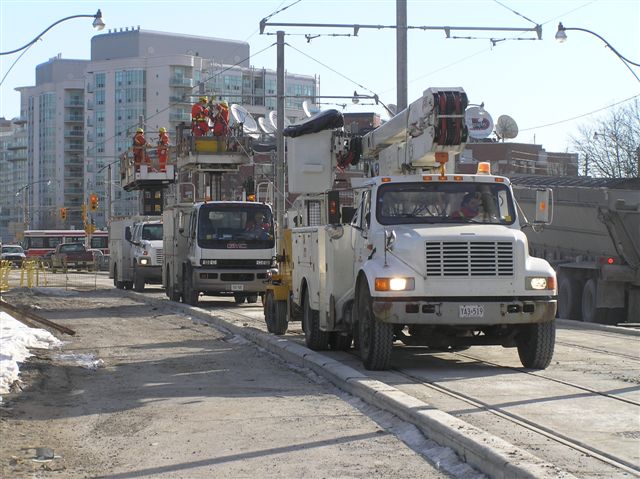
One of my regular readers, Harold McMann, sent me a few photos of overhead installation on Fleet Street and I am including one of them here because it shows a very recent change in the TTC’s standards for streetcar overhead.

Look closely at the hangers and you will see they are different from those commonly seen on Toronto’s system. These hangers are designed so that the contact wire will be held below the span wire and so that both pantographs and trolley poles can navigate them. If you look closely, you will see that hangers on alternate spans face in opposite directions so that there will be a slight meander to the overhead to avoid groove wear on pantographs.

Another change not as obvious from a photo is that the TTC is now using 4/0 gauge wire rather than 2/0. This is a larger cross section, but not twice as big even though the number might imply this. You can read about the arcane world of wire on Wikipedia. The larger cross section allows more current to be delivered by the wire in anticipation of the power demands of the new larger streetcars planned for Toronto.

The TTC Capital Budget contains a project to convert the entire overhead system by 2012, but it’s sad to note how long it took the TTC to accept that this would be necessary.

Further west on Fleet beyond the loop we find a forest of closely spaced poles marching down the centre of the right-of-way. These appear to be much closer together than the normal span wire spacing. This design leaves a lot to be desired if it is an indication of what we will see on future routes because the poles will dominate the visual landscape. I have already written here extensively about the shortcomings of centre poles on downtown streets and will not belabour the point.

Another project in the works is the complete replacement of the automatic track switch system. The current switch machines and their electronics date from the arrival of the ALRV fleet when the distance from the trolley shoe to the front of a car ceased to be constant. This meant that the old contactor-based switching had to be replaced, and a new system with pavement loops was installed.

This has been no end of trouble to the extent that some switches on the Spadina project have switch machines, but have never been activated. Many regularly used switches around the city sport “out of service” signs because they are no longer reliable or their parts have been raided for other more important locations. Because these switches are so unreliable, streetcars must come to a full stop at all facing point switches (including, amusingly, manual switches that cannot leap open in front of a car).

This practice makes for slow and jerky operation at intersections, and the TTC has not bothered to deal with this problem of reliability for quite a long time. Design of a new track switch system is underway and is expected to complete this year with procurement and installation to follow in future years.

Over the next four years, we will see a gradual transformation of the streetcar infrastructure in anticipation of the new fleet. Let’s hope the TTC gets it right this time. We cannot afford another fiasco like the CLRVs and their inability to deal with a system that PCCs had navigated for decades.