Streetcars on the Waterfront (1968)

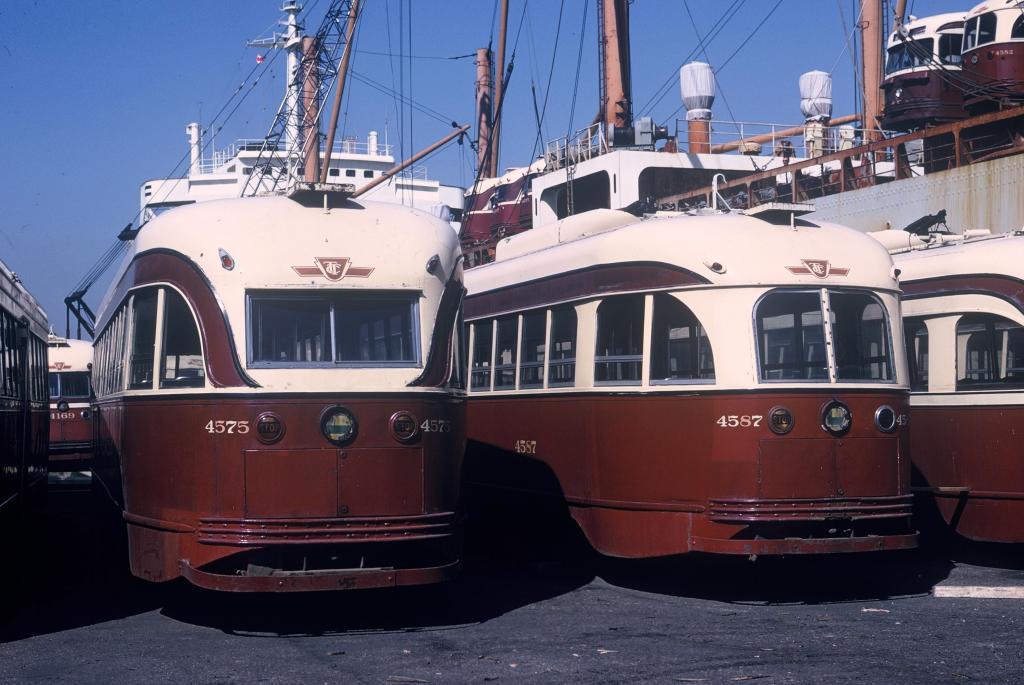
With all the discussion of waterfront transit, many people may forget (or never have seen) a previous visit of streetcars to the water’s edge.  Back in 1968, the TTC sold many of the PCC cars retired after the Bloor-Danforth Subway opened, and a batch of these went to Egypt.  On July 20, 1968, a much younger version of your faithful scribe was there along with many others to record the event.

All photos here were taken by me and I reserve copyright in them.

E010C

Sitting on the dock, here are two ex-Cincinnati PCCs including TTC 4575, a 1939-built  demonstration car for Cincinnati.  This car had many oddities including windows, marker lights and some interior features as befits a one-of vehicle.

Cars were loaded from both sides of the ship, the Mare Tranquillo.

Here, 4217 joins its mate 4222 on deck. A short turn destination right to the end!

A group of cars begins their sea voyage from a lighter. The railfans have obviously been busy with destination and route combinations that were already obsolete when these photos were taken. Parliament and Harbord vanished with the opening of the BD subway in 1966, and Dupont was a casualty of the University line in 1963.

A quartet of cars sits on deck seen from the dock.

The view from the bridge.

Looking out from the bridge to the Toronto Islands.

4007, one of Toronto’s first PCCs, meets the Island Ferry for the last time.

Rethinking the Waterfront West LRT

The TTC’s 2010-2019 Capital Budget contains a project description for the WWLRT that throws the whole project into serious doubt.  Metrolinx funding has been deferred to 2022, and the schedule for the project now looks like this:

  • 2022 Construction starts; Park Lawn Loop is built
  • 2026 Service begins from Exhibition Loop to Dufferin
  • 2028 Service begins from Dufferin to Park Lawn
  • 2029 Service begins from Park Lawn to Long Branch

Most of the Lake Shore community residents who have attended EA meetings to discuss the design and effect on their neighbourhoods will have to wait two decades to see the project implemented.  Whatever happened to Toronto’s “Transit First” model for the waterfront?  Must we wait for the complete condoization of Lake Shore before anything happens with transit service?  How relevant will 2009 studies be if the project isn’t actually in operation until 2029?

This project has been gerrymandered throughout its history to suit whatever pet project (pro or con transit) happened to be on the front pages, and the idea that the line might actually have some useful transit function often appeared secondary.  Indeed, the original 1990 study describes a line that is unrecognizable in today’s plans which have been updated by amendment without any formal public participation or any sense of overall direction for the project. Continue reading

Why Do We Need Another Bus Terminal?

From time to time, discussions here about Union Station turn to the question of a bus terminal.  A bigger terminal.  A better terminal.  A terminal with seamless connections to the trains.

Why?

GO/Metrolinx has major service expansion plans for its rail network including all-day service to cities now with, at best, peak hour, peak direction trains.  As service frequencies increase and good, all-day service is the norm on GO rail corridors, what do we need the bus routes (and their terminal) for?

A review of the list of all GO scheduled services shows us the future, such as it is, of GO bus operations downtown.

Timetables 01, 09, and 12 are all Lakeshore rail services whose bus components connect with rail terminals at all hours.

Timetable 16 is the Hamiton QEW bus service.  When GO reaches the point of having all day, 30 minute rail service to Hamilton, why run a parallel bus service?

Timetables 21 and 31 are the Milton and Georgetown services, both of which will receive frequent rail service that, like the Lakeshore routes, should be fed by buses at the outer, all-day terminals.

Timetable 32 is the Brampton to Union via Thornhill bus service.  Although this route connects today with the Yonge Subway at Finch and Sheppard Stations, it will eventually connect with the Richmond Hill subway extension.  The  buses do not need to come into downtown.  Updated August 29, 2008.

Timetable 61 is the Richmond Hill service.  Like the other rail corridors, this is scheduled to receive frequent all-day service, as well as a subway extension.

Timetables 65 and 71 are the Barrie and Stouffville services.  All-day train service over part of these lines is included in the 15-year Regional Plan.  Off-peak buses services beyond would feed the trains as on other all-day corridors.  In the same timeframe, the subway will be extended to Vaughan.  Even without all-day train service to Bradford, Vaughan Centre (or York U) is a much more appropriate connection for the bus service than bringing trips all the way into downtown.

Timetables 19, 20, 22, 27, 29, 32, 34, 37, 38, 40, 46, 50, 52, 60, 62, 64, 66, 69, 81, 88, 93, 94, 95 and 96 are all bus services that do not come into downtown.  They either connect with the subway at suburban stations, or they are between points in the GO network outside of Toronto.

Planned expansion of rail service in the Niagara peninsula and northwest from Georgetown will compete with and may replace private bus operations to these areas.

Land near Union Station for bus operations is difficult to find, and the last thing we need is an oversized bus terminal that will have no buses operating from it in less than 20 years.

Metrolinx is studying possibilities for such a terminal, but they need to step back and ask whether such a terminal is even required.  The rail networks of both GO and TTC are expanding at very substantial cost well into the GTAH.  Why spend all this money only to perpetuate limited capacity bus operations running all the way to Union?

Overall, operation of intercity bus routes into downtown Toronto will decline substantially over the next decade and beyond. If we are to have a new bus terminal, it should be planned for the services that will exist, that will survive into the future, not for today’s routes that are soon to be replaced with rail.

Why Streetcars?

Tom Jurenka sent in the following note, and it raises questions that deserve a debate.

Hello Steve

As a non-native Torontonian (grew up in Winnipeg, but have lived in Toronto for 24 years now) I have always been puzzled — and often infuriated — by streetcars (and the absolutely terrible traffic light timing in Toronto, but that is another story).

My question is an honest one — WHY? All I can see is the negatives of streetcars:

  • they tear up streets (I’ve lived through Queen Street E, Gerrard, now St. Clair, being torn up utterly to undo the damage of streetcars pounding the rails)
  • they are slow as molasses (as a bicyclist, I routinely pass 5 or 6 streetcars on Queen Street heading from AC Harris to downtown)
  • because of their slowness and immobility they delay traffic all the time, causing snarls and the attendant idling pollution
  • they are super expensive (witness the recent funding mess)

So I’m really curious why streetcars are a better alternative to trolley buses or just plain old buses, which move fast, are mobile, and are less expensive per unit to buy. Would you be able to point me at some links/articles/studies/whatever to help me understand this issue?

Thank you for your time.

Best regards,

Tom Jurenka

This is a far more complex question than just the list above, but I will use this as a jumping off point. Continue reading

Safety for Lake Shore Streetcar Riders

As a followup to the Waterfront West thread, “Ed” left a long comment which really belongs in a post of its own.  My own comments follow at the bottom.

I’ve been thinking about safety for riders on Lake Shore Blvd.

Currently, there are safety islands west of Humber loop through Louisa, and east of Long Branch loop through Thirtieth. The long central part of Lake Shore has no safety islands.

It’s been my experience that motor vehicles speeding by the open doors of a streetcar is a regular occurence on Lake Shore; I suspect that it’s a likely occurence *every* run. Why?

  • suburban area; drivers not really familiar with streetcars and the door laws
  • fast traffic on Lake Shore
  • wide road

This [last point] deserves attention: drivers seem to feel that the further they are from the streetcar, the more they’re allowed to pass. On Queen itself, the prime points for cars zipping past open doors seems to be eastbound and Shaw and westbound at Ossington, where there are clear additional right-turn lanes. This is the same behaviour that leads MTO to put signs up saying “Stop for School Bus with Signals flashing BOTH DIRECTIONS” on four-lane highways.)

Note that St. Clair had safety islands for just about every stop along its wider part (roughly east of Old Weston Rd.), and the width of St. Clair is quite similar to the width of Lake Shore, taking the varying widths of both roads into account.

Finally, the long and potentially dangerous walk to and from the curb makes stops slower along Lake Shore than they would be on central-city routes with equal numbers of embarking/disembarking passengers (outer ends of the Carlton car, for example).

Is the answer putting in safety islands all along Lake Shore?

Unfortunately, the speed of motor vehicles on Lake Shore, and again a general unfamiliarity with street railways, results in safety islands being struck (delaying streetcar service!), and also the safety islands distracting drivers who then run the red light (or so I suppose — for some reason, I see a lot of red-light running on Lake Shore at intersections where there’s also a safety island, for example at Long Branch Ave.).

With go-around-either-side safety islands disappearing on St. Clair due to the ROW, they will remain only in a few scattered locations in the city (offhand: Dundas at Bloor, Bathurst at Queen, Main and Gerrard, Queen at Kingston) prompting motorists to hit the remaining ones as things they just don’t understand or are unfamiliar with.

Also, I just went and measured the lane width inside a safety island; it’s 3.0 metres from the edge of the island to the centre line. This isn’t too much of a problem with cars (though you get splashed in rain and snowy conditions) but Lake Shore also has a lot of truck traffic, particularly in the west end. Trucks are allowed a width of 2.60 metres; so two trucks meeting at 39th where there are safety islands facing each other have 80 cm *total* to miss each other and also the safety island. This is one reason I often wait at the curb, instead of on the safety island.

And I’ve seen a semi-trailer sideswipe a streetcar going in the opposite direction at 39th. Maybe significantly, the tractor had western Canadian plates. After a 6 or 8 hour shift on the 401, he made it down Brown’s Line and then just couldn’t place the rig properly when faced with an oncoming ALRV in a safety island gap?

So, what are the potential solutions?

1) Status quo/do nothing (not attractive).
2) Put in safety islands all along the route (still a problem with auto/island collisions and trucks passing centimetres from your face as you wait for the car).
3) Drastically narrow Lake Shore through lanes so safety islands aren’t necessary.
4) LRT so there is no traffic passing by the safety islands and less chance of a motor vehicle getting confused and trying to split the sides of an island, thus running into it.
5) Move to bus operations on Lake Shore.

Of these choices, I expect the locals will be in favour of:

1) These are the ones who don’t ride the TTC at all, and I have confirmation from WWLRT planning that they haven’t looked at safety issues on Lake Shore yet; certainly safety wasn’t a significant part of the LRT presentations.
5) Hey, buses are “superior, quicker” technology, right?

Personally, I’m in favour of 4) or 3). I bet the anti-LRT crowd dislikes these choices equally — even though 3) would solve a number of other issues raised in Lake Shore transportation planning workshops.

This all begs the interesting question of whether issues with access to streetcars — the walk from the curb, the vertical height to board, the width of the “safety island” and the comfort of riders on that island — can be addressed without going for a full-blown right-of-way.  (At the risk of beating a worn-out drum, better service would also shorten the length of time would-be riders have to wait on an island.)

The recent charette held by the Lake Shore Planning Council produced a lot of concerns and ideas, and although this happened after the formal cutoff for feedback to the TTC’s study, I hope that this material finds its way into the hopper.  The TTC was represented at the charette, and that’s a good sign.

Now we await an updated set of design options and, one hopes, more sensitivity and less lecturing from the TTC at public meetings.

A Long Day At City Hall

Tuesday, June 2 was a long day for members of Toronto Council’s Executive Committee.  Many transportation issues were on the agenda including Union Station Revitalization, Western Waterfront Master Plan, Queen’s Quay redesign, and the Gardiner Expressway replacement EA.

As if that wasn’t enough, an open house for the Scarborough RT extension took me out for a ride on the Milner bus.

This transit blogging is harder than my pre-retirement work! Continue reading

Analysis of 501 Queen Service Winter 2008/2009: Part II Long Branch to Parkside

In the previous installment, I reviewed the headway patterns for the 501 Queen route outbound to terminals at Neville, Humber and Long Branch.  Now I will turn to the operation of the west end of the route between Long Branch and Parkside Drive.  I used Parkside (the east side of High Park, and the continuation of Keele Street south of Bloor) as the eastern end of the measurement because it is at the end of the private right-of-way and because this avoids problems with variations caused by operations at Roncesvalles.

The charts presented here show headways (the frequency and regularity of service) as well as link times (the time needed to traverse part of the route).  Headways are important to riders because they show how predictable service will be, and they also bear on riding comfort because crowding is directly affected by regularity of service.  Link times are important for service planning because they show where and when congestion occurs, and how predictable (or not) the running time between locations will be. Continue reading

WWLRT Public Meetings: Park Lawn to Long Branch

There will be two public meetings to discuss the design for this section of the WWLRT, essentially an upgrade of the Long Branch streetcar.

Monday, May 11, 2009
2:00pm-4:00pm 6:30pm to 9:00pm
Mimico Adult Learning Centre
255 Royal York Road

Tuesday, May 12, 2009
2:00pm to 4:00pm 6:30pm to 9:00pm
The Assembly Hall
1 Colonel Samuel Smith Park Drive

For further information, including the display panels from the previous open houses, please see the project’s website.

After the first round in December 2008 where many felt that the available information and proposal left much to be desired, this is described as a “re-start” of a “new consultation process”.

Union Loop: Trading One Bad Design For Another? (Update 1)


I have received a drawing of Union Station Loop that shows its end-state configuration including provision for all services.  This drawing is different from the version in the Queen’s Quay Revitalization document in (a) showing the full length of the west platform and (b) clarifying the staging of implementation for different routes.

The orange section is the first phase to expand capacity onto two platforms.  The pink section would be added to serve the Port Lands development, and the blue section for Bremner.  In its final configuration, according to the TTC:

The currently-proposed layout would ultimately have all of the service to and from the east on the platform under the east teamway allowing us to run two routes/branches from the east, one of which could be a 60m train. Service to and from the west would load under the west teamway with a Queens Quay route (509 or 510, not both) loading on the northern-most platform and the Bremner service loading on the southern-most platform. All of the platforms would operate independently from each other allowing flexibility for service management.

Original Post from March 29:

In my enthusiasm for the new Queen’s Quay designs, I neglected to look carefully at the current scheme for Union Station Loop, especially in the context of plans to build the expanded loop in stages.

Back in the days when the existing loop was designed, Philip Webb and I had a rather testy meeting with TTC Engineering about the capacity of this loop.  Outrageous claims were made for its ability to handle riders even though the TTC (a) completely missed the loss of platform space to carbody swingout and (b) assumed the full capacity of the corridor would be available for passenger flow rather than being used for stacking space as it is today.  The loop is and has been for some time grossly inadequate, and it is a monument to the TTC’s pig-headedness. Continue reading