Ontario’s 2025 Budget and Transit

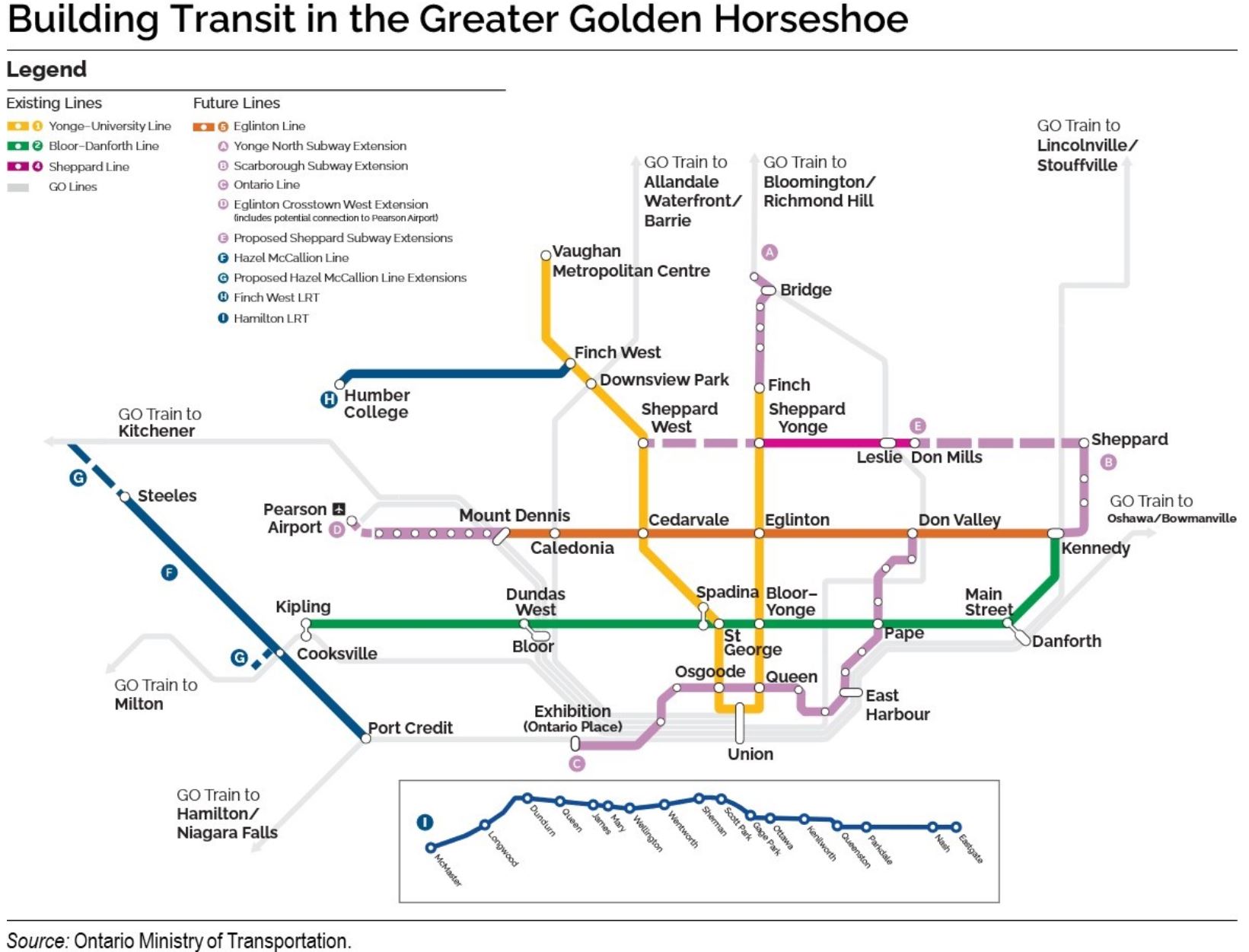
Ontario unveiled its 2025 budget on May 15. Although it speaks of “Approximately $61 billion over 10 years for public transit”, by far the lion’s share of this spending is for projects already underway in the construction and design stages.

All of this is for capital expansion and renewal, and nothing has been announced for day-to-day improvement of transit service.

GO Transit

The budget cites:

  • The Hamilton-Niagara through service connection at West Harbour Station which is already in service.
  • The proposed Bowmanville extension which has been announced before, but is only barely underway at the “early works” stage. This extension has physical alignment issues.
  • GO 2.0 includes “delivering all-day, two-way service to Kitchener and Milton, building new GO stations across the region and advancing planning to unlock potential new rail corridors through midtown Toronto, Etobicoke, York Region and Bolton.” There are no dates attached, and some of these have been on maps for a very long time. Notable by its absence is any mention of electrification.
  • A total of $850 million to refurbish GO Transit rail coaches at the Thunder Bay Alstom the North Bay ONR facility. This work is already announced. The cars may receive convenience upgrades such as “charging plug ports, cup holders and improved Wi-Fi”, but the long-term retention of these cars indicates that the operating model for GO electrification, if and when it occurs, will have a large component of locomotive-hauled trains rather than electric multiple units.

Subways

Subway projects in the budget are:

  • Ontario Line (under construction).
  • Eglinton-Crosstown Western Extension (under construction).
  • Yonge North to Richmond Hill (procurement underway).
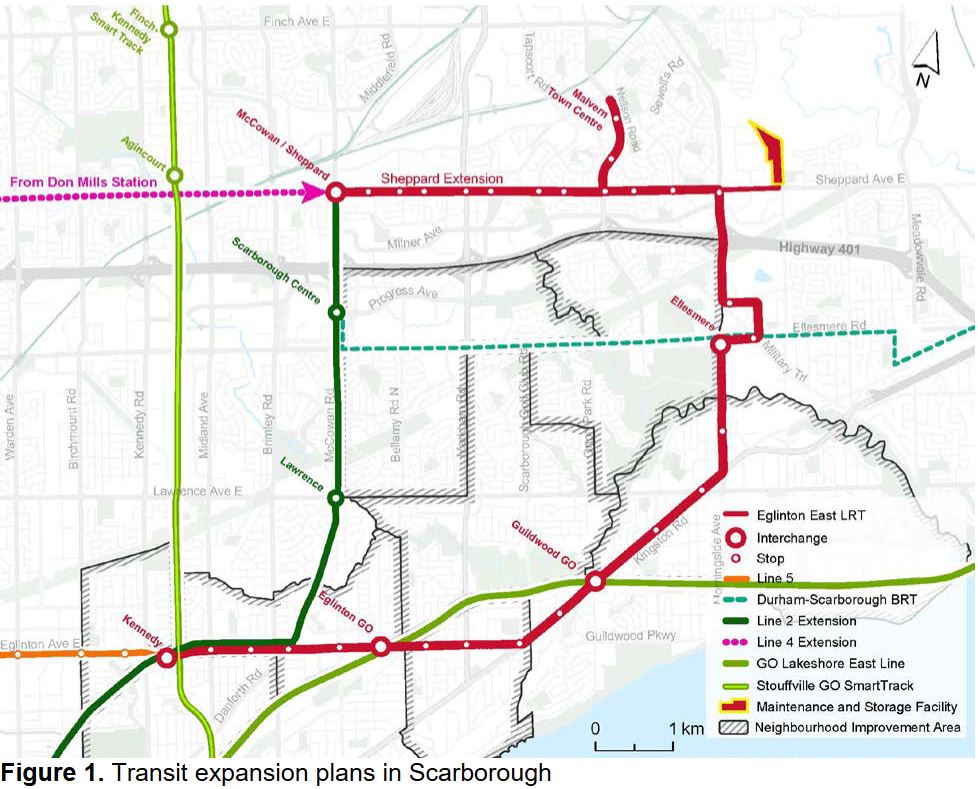
  • Sheppard Subway Extension (planning, consultation and business case preparation underway). Notable in the map below is the absence of a line east of McCowan where there is a conflict with the City’s Eglinton East LRT project and with maintenance yard property requirements.
  • New subway cars for Line 2. Provincial funding for these trains has been in place for some time. What is not yet funded are trains for service expansion beyond pre-covid 2019 levels. Trains for the Yonge North and Scarborough extensions are included in those projects. The TTC is in the Request for Proposals process for new trains, but this has been skewed by provincial statements that the work should go to Alstom’s Thunder Bay plant.

Yes, they seem to have forgotten the Scarborough Subway Extension (now under construction) in the text although it is included in the map below..

East Harbour Transit Hub

The hub at East Harbour Station, near the point where the Lakeshore East GO line crosses the Don River, will eventually serve GO Transit, the Ontario Line, and the local streetcar/LRT system via the Broadview Avenue Extension and a link west via Commissioners Street.

A substantial portion of this project is funded by the City of Toronto as a remnant of John Tory’s “SmartTrack” plan.

Light Rail Projects

  • Hamilton LRT: This is in early states with procurement underway for Civil Works and Utilities.
  • Hazel McCallion (Mississauga) LRT: Construction is well underway for the initial phase of this project, and the Province is studying whether the extension into downtown Brampton should be tunneled.
  • Ottawa LRT: The Province is studying a potential upload of the Ottawa LRT “to help reduce costs for Ottawa taxpayers”. What implications this might have for future network operation and expansion is not clear.
  • Eglinton Crosstown and Finch West LRTs: “Major construction for both projects is now complete. Metrolinx continues to focus on safety and operational readiness testing, as the projects advance toward revenue service.” There is still no commitment to opening dates, and we are getting close to the three-month lead-time required for a go/no-go decision for an early fall 2025 start of service. Meanwhile, TTC has begun the process to update subway train announcements and maps to reflect the new lines.’
  • There is no mention of the Eglinton East or Waterfront East projects. In a recent letter, Mayor Chow asked the Federal government to contribute 1/3 to these schemes, but there is no indication of support in the Provincial budget.
Eglinton East LRT Update

On December 5, 2023, Toronto’s Executive Committee will receive an update on the Eglinton East LRT project. Readers with long memories will recall that there was a time when a “peace in our time” solution to the Scarborough Subway debate would have seen both an extended subway and at least part of the EELRT built with the monies already earmarked for the Scarborough projects. This claim was a work of creative fiction, but it got the subway extension’s approval through Council.

We are still waiting for the LRT, and Scarborough will be lucky to see it until the late 2030s at best.

This set of reports keeps the ball rolling on the EELRT, albeit slowly. Until the Provincial aims for extension of Line 4 Sheppard are clear, the degree of conflict with the LRT plans and the scope of the LRT will not be known.

The most recent proposal has a U-shaped line running from Kennedy Station east and north to the University of Toronto’s Scarborough Campus (UTSC), and then north and west to Sheppard and McCowan with a branch to Malvern Centre. These shadow the original Transit City proposals for a Scarborough-Malvern line and a Sheppard East line, although the latter would have run west to Don Mills Station.

The cost estimate for the full EELRT project sits at $4.65 billion based on construction in the 2027-2034 period. This is a class 3/4 estimate with a potential range of -20% to +30%. This excludes key items including: property, procurement, vehicles, lifecycle maintenance, and future operations and maintenance.

With Ontario studying potential expansion of the Sheppard subway west to Downsview and east to at least McCowan, any Sheppard branch of the LRT has an uncertain status.

The map on the left shows the City’s version of the EELRT while the one on the right shows how the Metrolinx study area extends to Meadowvale road.

Metrolinx claims to be reviewing a range of technologies including subway, “light metro” and LRT, but it does not take a genius to figure out that any true extension of Line 4 Sheppard would use subway technology just as extensions to Lines 1 Yonge and 2 Bloor-Danforth already do. This would be especially important for a westward connection to Downsview which would not make any sense as a short, free-standing route.

Continue reading

TTC Transit Network Expansion: February 2023 Update

At its meeting on February 28, the TTC Board will receive a report summarizing the status of most of the rapid transit plans in Toronto. This article condenses the TTC report and reorders some sections to group related items together.

Dominant among many projects are, of course, the “big four” provincial projects: Ontario Line, Scarborough Subway, Yonge North Subway, and Eglinton West LRT extension.

Project Status Overview

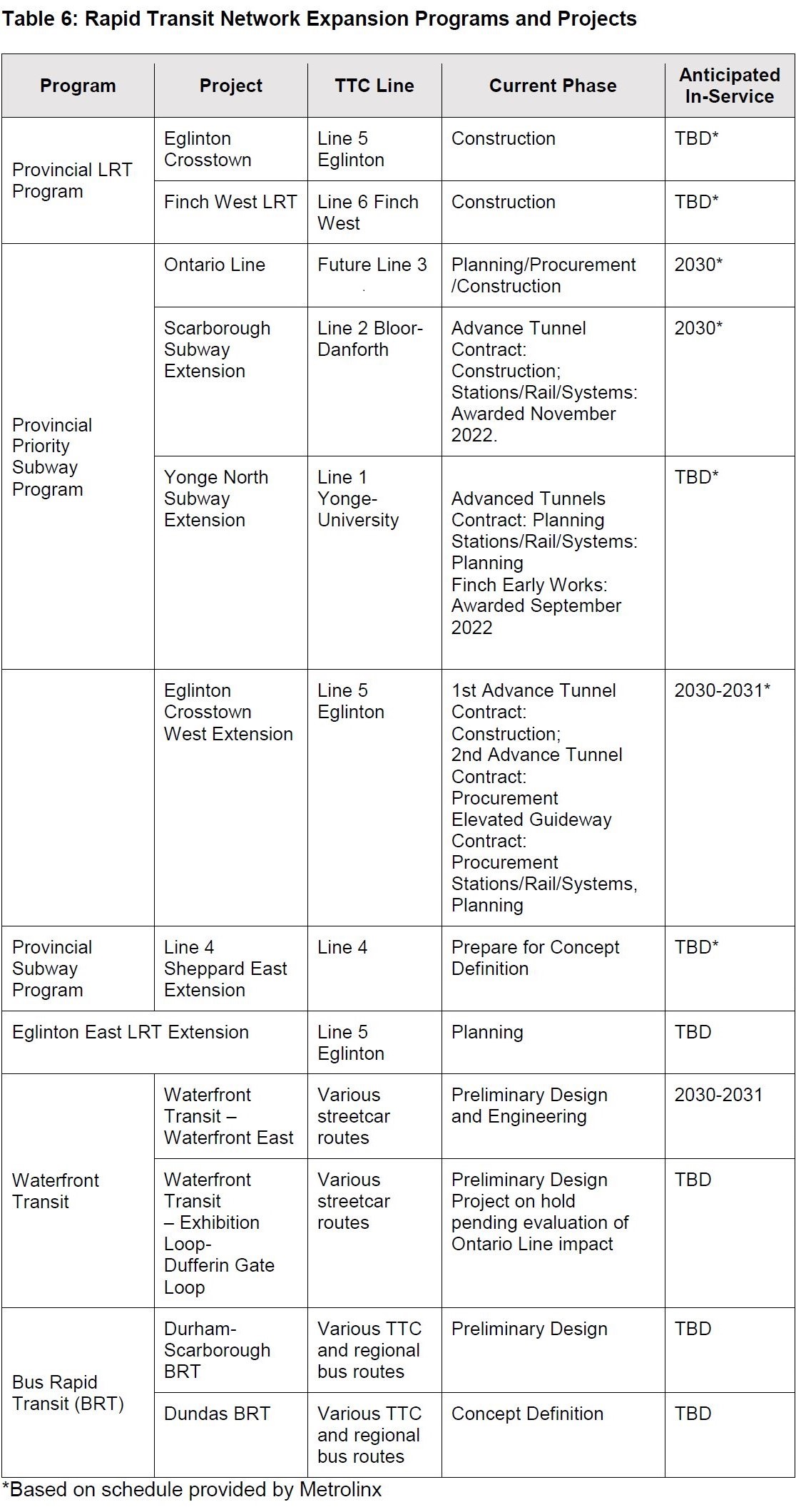
The effect of major projects elbowing everything else aside is clear in the table below. Some projects do not have in service dates because they are not funded, and the timing of that (when and if it occurs) will determine when various lines can open.

Not shown in this table are several major projects that pop up from time to time:

  • Bloor-Yonge Station Expansion
  • Waterfront West LRT from Dufferin to The Queensway
  • Bloor West subway extension
  • New Line 2 fleet and yard at Kipling (Obico yard property)
  • Sheppard East subway extension
  • Platform Edge Doors

Of these, only the Bloor-Yonge project has funding, and some are only a glimmer in various politicians’ eyes.

Continue reading

TTC Board Meeting: July 14, 2022

The TTC Board held its last scheduled meeting of the current term on July 14. Barring an emergency requiring a special meeting, the next regular meeting will follow reconstitution of the Board after the municipal election in the Fall.

Some items on the agenda have already been covered in previous articles:

This article covers:

  • The CEO’s Report
  • Outsourcing of non-revenue automotive vehicle and equipment maintenance
  • Automatic Train Control for Line 1 Yonge-University
  • Five and ten year service plans
  • Transit network expansion update

I will review the Green Bus program update in a separate article.

CEO’s Report

The CEO’s Report contains many charts purporting to show the operation of the system. Unfortunately some of these hide as much as they tell by giving a simplistic view of the system.

I have already written about the wide discrepancy between actual short turning of vehicles and the reported number. A distortion this major calls into question the accuracy and honesty of other metrics in the report.

In a future article, I will turn to the appropriateness of various metrics, but here are some key areas:

  • Averages do not represent conditions riders experience. Data that are consolidated across hours, days, locations and routes hide the prevalence of disruptions. Service that is fairly good on average can be terrible for riders who try to use it at the wrong time.
  • Values for some metrics are reported with capped charts that show only that a target is met, but not by how much it was exceeded. This gives no indication of the room to improve the target value, nor of the variation that could make a higher target difficult to achieve consistently.
  • Reliability is shown only for vehicles that actually operate in service, but there is no measure of actual fleet utilization and the headroom for service growth using available buses, streetcars and subway trains.

In discussion of the report, Commissioner Carroll noted that the TTC still has a problem with on time performance for streetcars. CEO Rick Leary replied that there is an On Time Performance team who are looking at details including recognition that there are three types of routes: those that run well, those affected by construction and those with other problems.

Carroll replied that people are quick to complain about King Street and wondering why they are still waiting for the 504. The TTC says that construction is the reason, but do they have a strategy to deal with bunching and communicate with riders. Management replied that they have strategies for keeping riders informed during planned diversions, but for unplanned emergencies there are service alerts. Changes are coming and service should improve.

This discussion was frustrating to hear because, first off, the central part of 504 King between Dufferin and Parliament is not affected by construction. Only the outer ends in Parkdale/Roncesvalles and on Broadview have (or had until recently) bus shuttles. As for keeping riders informed, irregular service plagues all routes in the system as I have documented in articles here many times. The problem is line management, or the absence of it.

On another topic, Carroll noted that the TTC seems to have a lower standard for the condition of stations than it does for vehicles, or at least tracks the latter at more detail. Leary replied that a summer blitz using student workers will scrub down all stations to bring the system back to a better quality for riders returning in the Fall.

Continue reading

TTC 2023 Annual Service Plan Preview

The TTC began consultations for its 2023 Service Plan on June 29 with a pair of online meetings for community groups, and more will follow. There will be an online survey available starting on July 11.

At this point, the Service Plan is only a collection of proposals. The TTC seeks feedback on them that will lead to a revised version in the fall and a second consultation round before they go to the TTC Board for approval. The round one proposals relate mainly to the SRT shutdown in fall 2023 and the opening of Line 6 Finch West. In the second round, these proposals will be fine-tuned and other possible changes unrelated to the rapid transit plans will be added.

2022 Service Plan Follow-Up

Some service changes proposed in the 2022 plan have been implemented, and others will follow later this year:

  • Seasonal service on the new 172 Cherry Beach route (replacing the former 121 Front-Esplanade bus) was implemented in May, but the planned route through the Distillery District was impossible due to construction on Cherry at Lake Shore.
  • 65 Parliament will be extended to George Brown College’s Waterfront Campus in September. There is no word on an extension of the 365 Parliament Blue Night bus which originally was going to be dropped. The 365 lost its weekend service in 2021, but that was recently restored.
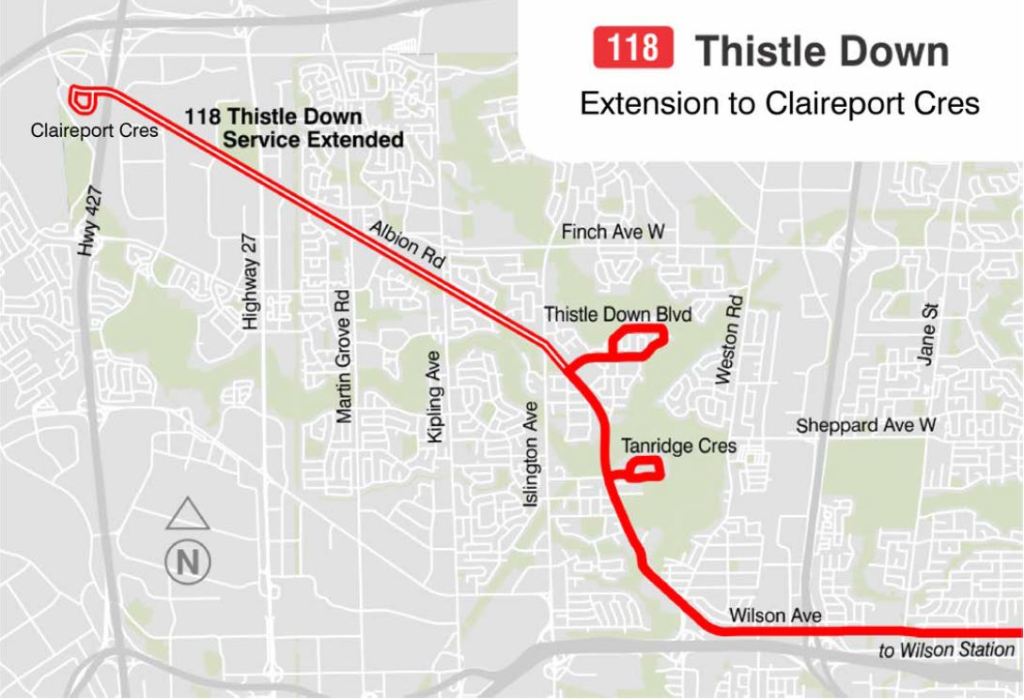
  • The 118 Thistledown extension to Claireport & Albion and the 8 Broadview extension to Coxwell Station will occur later in the fall, date TBA.

With the completion of the Line 1 Automatic Train Control project later this year, the TTC will be able to improve service on the subway. However, just what this means depends on the base against which “improvement” is measured.

  • There is a planned service improvement in September. Current service is not running at pre-pandemic levels, and we do not yet know if September will see a full restoration.
  • ATC will provide two benefits: trains can run closer together, but also travel times can be trimmed to reduce the number of trains needed. The degree that each of these will show up in new schedules remains to be seen. A related problem is that more frequent service can compound with excess running time to worsen terminal approach queues driving up travel time for riders.

Overall system ridership was at 57 per cent of pre-pandemic levels in June 2022 and is expected to rise to 70 percent in the fall. The TTC is finalizing their fall service plan to accommodate some return to in person office travel and post secondary demand. They plan to restore services to post secondary schools that were cut because of online courses. Details TBA.

There is no announced date for the opening of Line 5 Crosstown by Metrolinx, and so the planned route restructuring to support that line will likely not occur in 2022.

Continue reading

Eglinton East & Waterfront LRT Update

On June 15, 2022, City Council debated a report about future LRT lines in the Waterfront and on Eglinton Avenue East. As with all transit discussions transit discussions, other topics including the Sheppard West subway made an appearance. A short staff presentation added a few more details about problems at Kennedy Station that triggered changes in the Eglinton East proposal.

The Changing Configuration of the Scarborough Subway Extension and LRT

Some of the issues at Kennedy Station arise from changes made over the years in the Scarborough Subway Extension (SSE) project effecting the alignment and size of the subway tunnel. The staff presentation did not explore all of this history, but one cannot really understand what has happened without all of the details.

The City talks of Metrolinx deciding to widen the subway structure, but the story is more complicated.

The original plan for Kennedy Station (when the Scarborough network was LRT-based under Transit City) would have seen the new LRT station immediately north of and adjacent to the subway station. It would have been a multi-level station given the number of lines it would serve.

  • The bottom level, at the same elevation as the subway platform, would have served the Crosstown (Line 5). This would have provision for eastward extension under the GO corridor and then surfacing in Eglinton Avenue as the Scarborough-Malvern LRT line (now known as the Eglinton East LRT, or EELRT).
  • The upper level, at the same elevation as the mezzanine of the subway station and one below the surface bus loop, would have served the LRT replacement for the SRT (SLRT). There would have been a large loop and loading platform at the north side of the mezzanine somewhat like the arrangement at Spadina Station for the 510 Spadina streetcar, but considerably larger given the passenger volumes and size of trains that would operate on the SLRT.

This configuration would give a short transfer connection to the subway via the mezzanine up one and then down one level for the Crosstown, or simply across the mezzanine from the SLRT and down one level to the subway. Connections to surface bus routes would not change.

Drawings for this design are in the following article from July 2016:

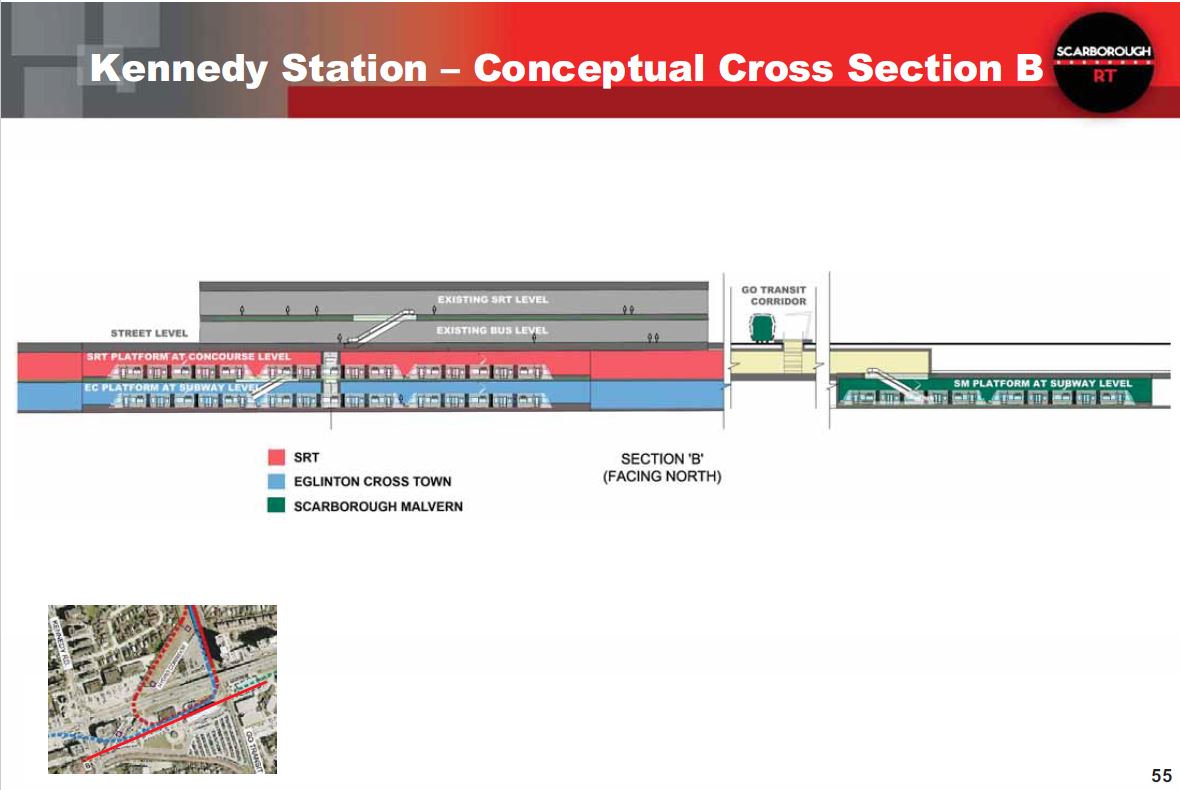
Here is a cross section showing the platforms for the SLRT and Crosstown stacked west of the GO corridor, and the SMLRT to the east. It was already in its own station and shows a two-car train rather than a three-car train for the Crosstown and SLRT.

When the City proposed the SSE, the extension included a third track east of Kennedy Station that would be used to short turn half of the peak period service similar to what was done at Glencairn Station on the Spadina leg of Line 1 in pre-pandemic service. This scheme also had the advantage that it could be operated with the existing fleet of T-1 trains on Line 2, and for time there were plans to rebuild these trains for life to 2040 to avoid a new car order.

This is an example of the budgetary machinations needed to keep TTC spending within unrealistic City targets.

Scarborough Councillors and activists objected to getting only half of the full service, and the third track was deleted from the plan. This made the tunnel narrower, and that was the version of the project Metrolinx inherited in the provincial takeover of the SSE.

Subsequently, Metrolinx reinstated the third track causing the tunnel to widen again. (Any decision on the future service plan will affect the size of the new train order when the T-1 fleet is replaced later in the 2020s.)

Meanwhile, with the deletion of the SLRT from the plan, Metrolinx changed the elevation of the Crosstown station to be at the mezzanine level as they no longer had to provide for an SLRT interchange. The EELRT, if built as an extension of the Crosstown, would cross under the GO corridor at Mezzanine level and then rise to the surface.

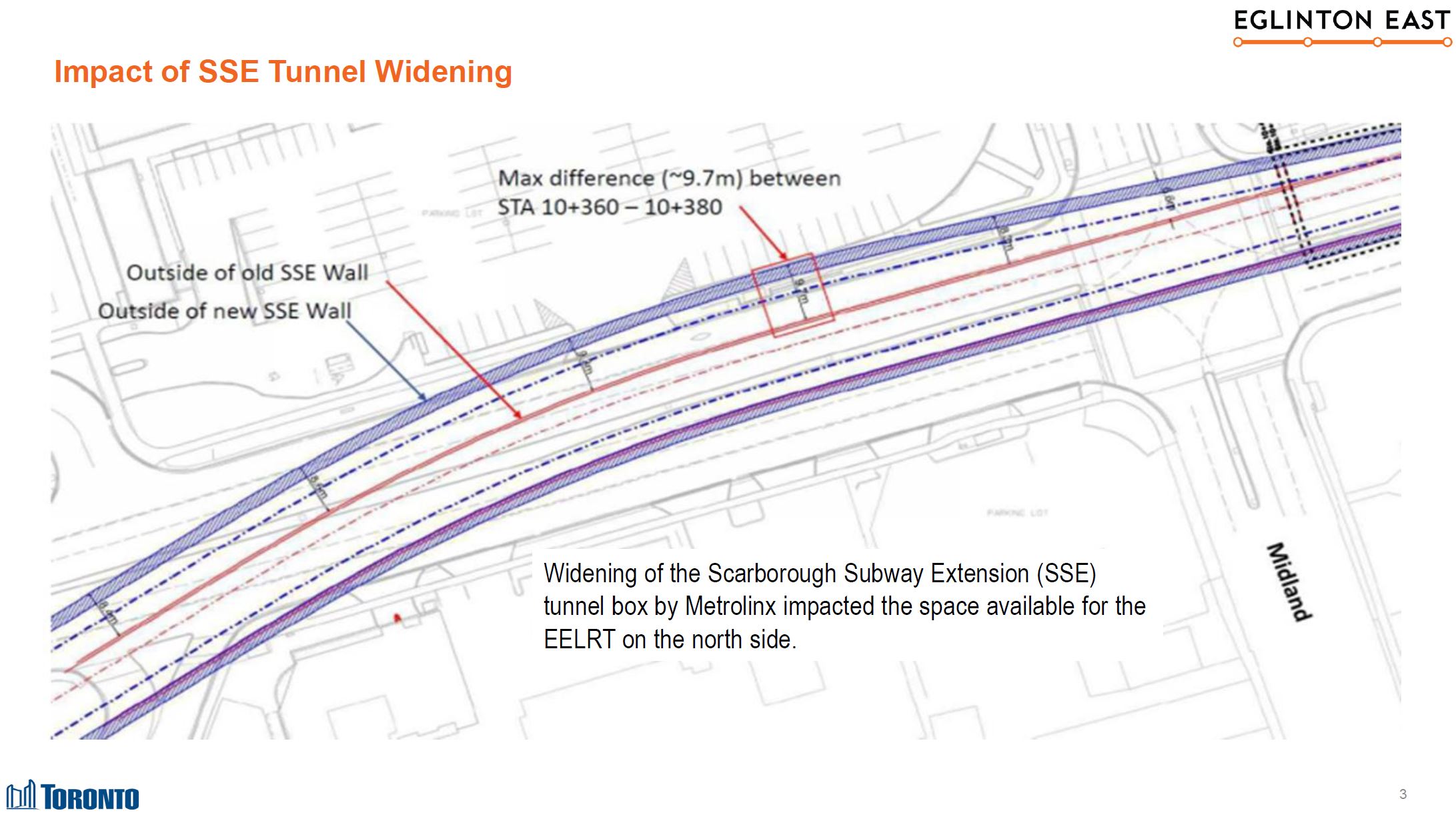
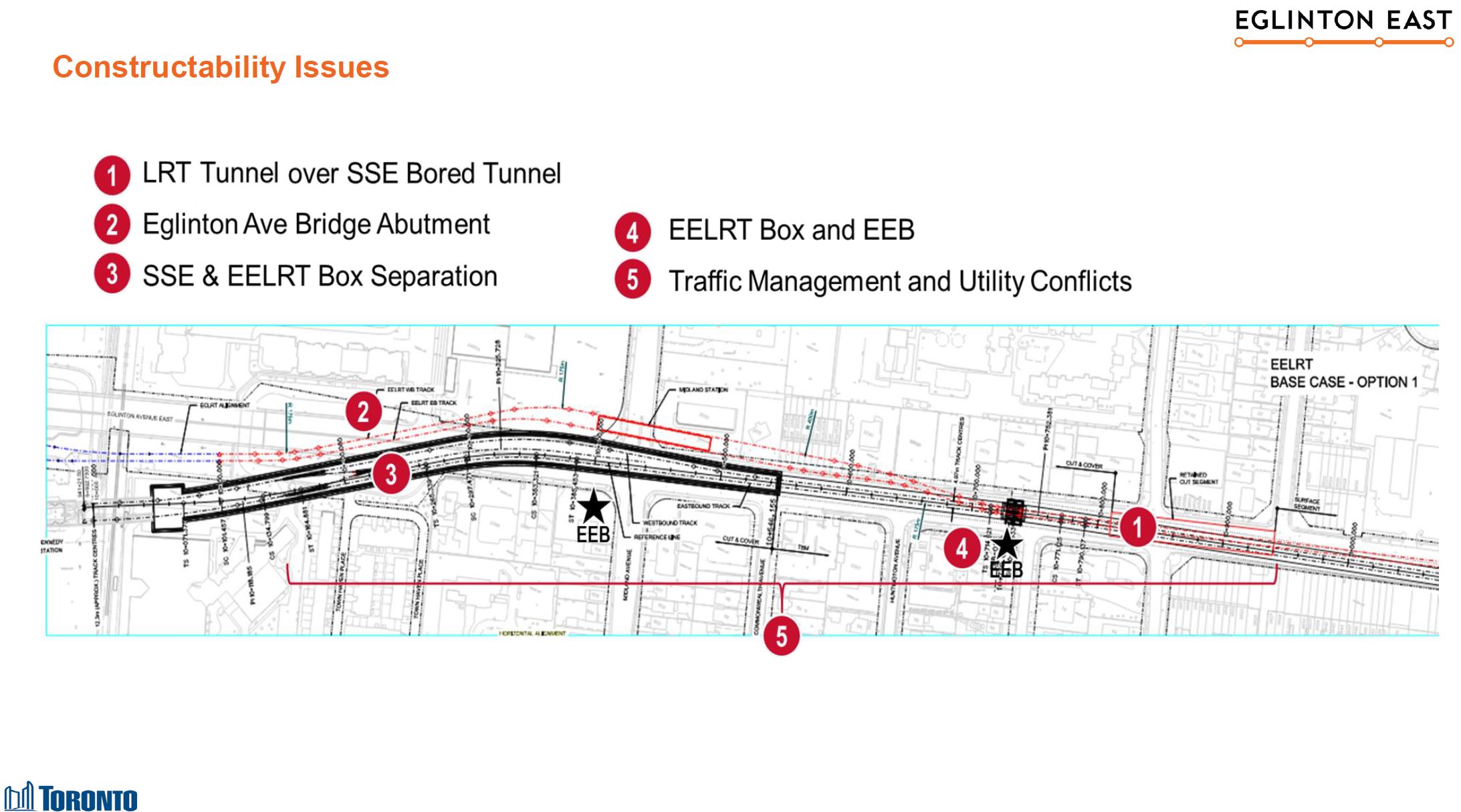
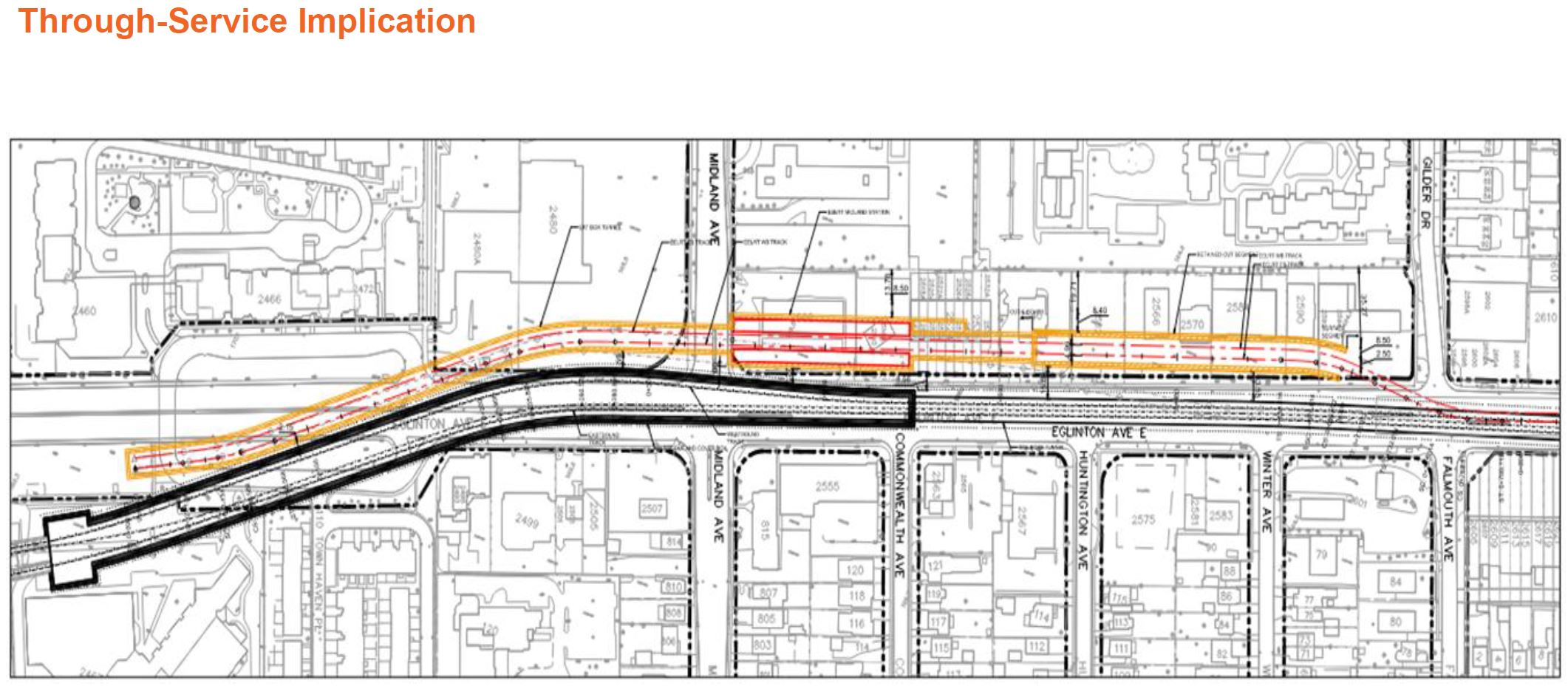
However, the widened subway tunnel does not give enough room for the EELRT tunnel above it, although obviously if this had been designed as a single structure that would not have been an issue. A good example is St. George Station which houses two lines within a single structure. This shows what happens when the province designed its own projects, and the City dropped the ball on necessary integration because the EELRT was much less important politically than the SSE.

As an alternative scheme, a completely separate tunnel would be needed along the north side of Eglinton for the EELRT. This would be built cut-and-cover given how close to the surface it would have to be, and this would mean the acquisition and demolition of many properties along Eglinton.

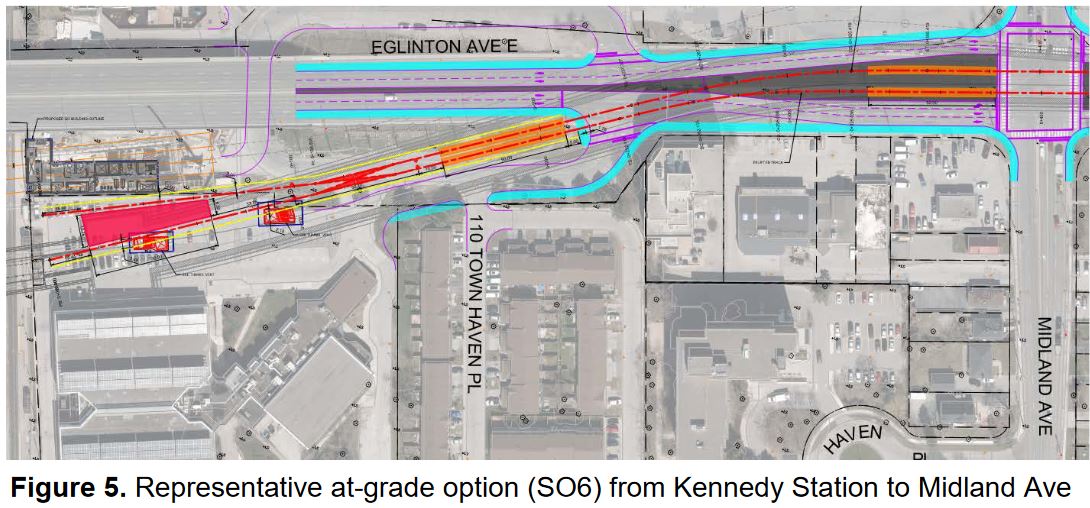
As I reported in a previous article, the EELRT station at Kennedy will now be on the surface south of Eglinton and East of the GO corridor. It will share access to the subway and the Crosstown line via the existing tunnel to the station mezzanine. No details beyond the drawing below have been provided yet.

Continue reading

Eglinton East LRT Update, June 2022 (Revised)

Revised June 9, 2022: A section has been added at the end of the article based on the discussion at the Executive Committee meeting.

Two reports are on Toronto’s Executive Committee Agenda for June 8, 2022. Between them, they provide updates for various rapid transit projects around the city.

Rather than attempting a single, omnibus article covering all of the projects, I will break the review apart on a line-by-line basis. This is the first in a series of articles.

I will update this article if any further details come out in the Executive Committee meeting.

A Scarborough Network

Several projects over coming decades will change the transit map in Scarborough including the Line 2 Danforth Subway extension to Sheppard, the Line 4 Sheppard Subway extension to McCowan, the Durham-Scarborough BRT, GO service expansion on the Lakeshore East and Stouffville corridors, and the Eglinton East LRT.

Continue reading

Eglinton East & Waterfront LRT Updates

Toronto’s Executive Committee considered a report on the current status of the Eglinton East LRT and Waterfront East LRT projects at its meeting on December 10, 2020.

The primary function of this report is to authorize continued study, not to set priorities nor to discuss funding schemes. As such, its recommendations passed easily because it preserves the convenient fiction of progress without actual commitment. The real battles come when there are $30 billion worth of transit projects and less than $10 billion to pay for them.

In a beautifully ironic touch, the same morning brought news from the Toronto Star’s Jennifer Pagliaro that the Scarborough RT would not last long enough to avoid a shutdown well before the Scarborough Subway could be completed. That announcement raises a raft of questions about Toronto’s transit future that go well beyond Scarborough itself, and I will turn to those issues in a separate article.

Continue reading

Toronto’s Omnibus Transit Report: Part III

This is the third and final part of my review of the transit reports that will be before Toronto’s Executive Committee on April 9, 2019, and at Council a week later.

In part one, I reviewed the financial issues presented in the reports together with the Scarborough Subway Extension, now known as the Line 2 East Extension (L2EE).

In part two, I turned to SmartTrack, the Relief Line and the Bloor-Yonge station expansion project.

This article reviews the streetcar/LRT projects as presented in the current set of reports.

Relevant documents include:

  • Main report: Toronto’s Transit Expansion Program – Update and Next Steps
  • Attachment 1: A status update on all projects
  • Attachment 3: Waterfront Transit Network – Union Station-Queens Quay Link and East Bayfront Light Rail Transit. [Note: The properties of this attachment were incorrectly set by the authors. Although it really is Attachment 3, it appears on browser tabs as if it were Attachment 2 for the Scarborough Extension.]
  • Attachment 4: Eglinton East LRT
  • Attachment 5: Eglinton West LRT

Much of the LRT network still at some stage of design or construction is a remnant of the Transit City plan announced in 2007. Pieces have have fallen off of that network proposal, notably in Scarborough, but also a few key links that would have knitted the network together allowing sharing of carhouse and maintenance facilities. Confusion about the planning, ownership and funding scheme for parts of the network complicates the situation further.

Although the province has announced that it wishes to take over “the subway”, the boundary is unclear because a previous government decided to take over at least part of the Transit City LRT network, notably the Eglinton/Crosstown and Finch West routes. The Ford government prefers to put as much transit underground as possible, but if Toronto wants to extend an existing route (for example on Eglinton East), the city’s preference will be for surface construction to keep cost within its ability to fund projects.

Continue reading

Council Approves Tory Transit Plan, Attempts Pet Project Revivals

Toronto Council has approved the transit plan for Toronto featuring Mayor John Tory’s SmartTrack line and the Scarborough Subway after a long debate on July 14, 2016. Notwithstanding severe problems with financial pressures and the blind faith needed to expect that the entire package can actually be funded, Council added a few pet projects that never quite fade from view thanks to the efforts of individual members.

LRT proposals for Eglinton East and West survived the vote largely because they are part of larger packages – SmartTrack in the west, and the Scarborough Subway Extension in the east. The subway debate has so polarized camps that “LRT” is synonymous with third class transit simply because it was the heart of the “non subway” option. Without the bitterness of the SSE that required subway advocates to paint LRT in the worst possible light, its potential role in Toronto’s future network might not have been so poisoned while other cities embrace this mode.

Staff recommendations in the report were amended in some respects, and a few new clauses were added, notably one asking for City staff to pursue a co-fare arrangement with GO Transit.

The Waterfront Transit Reset report is a separate agenda item and, at the time of writing, Council has not yet dealt with it.

The Finch West and Eglinton Crosstown LRT projects are under Metrolinx, and they are already underway to varying degrees.

Continue reading