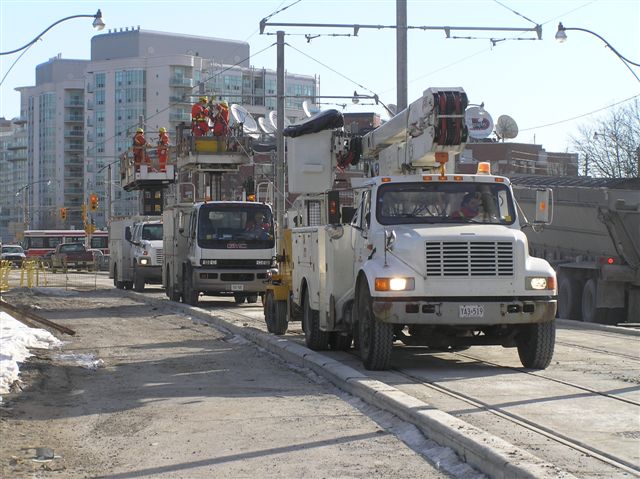
[Yes, I know it’s February, but I had hoped to finish this post sooner.]
In the first part of this thread, I discussed the WWLRT plans from Dufferin Street west to Sunnyside. Now, let’s look at the route through Exhibition Place and into downtown.
The presentation materials from the Environmental Assessment are on the City’s website.
Dufferin to Strachan Through Exhibition Place
Four routes were evaluated:
- Extend west from the existing Exhibition Loop to Dufferin Street. This option includes relocation of the GO Station to just east of Dufferin, and the construction of a new Dufferin bridge over the rail/expressway corridor.
- Turn north at Strachan Avenue crossing the rail/expressway corridor and running west to Dufferin along the south edge of Liberty Village.
- Turn south at Strachan Avenue, follow the north side of Lake Shore to a southerly projection of Dufferin Street, then turn north to Dufferin Loop.
- Identical to the previous version except following the south side of Lake Shore.
The first option is preferred because it is by far the cheapest to build and has little impact on its surroundings in part, of course, because it is also the shortest.
The second option ranks highest for the Land Use criterion because it would serve Liberty Village rather than a collection of mostly empty parking lots. However, this comes at an impact on the Natural Environment that is undesirable for reasons not explained in the online material. (I was not at the public meeting and if someone knows the details, please comment here.) This begs an interesting question that, but for the environmental issues, this route would be a strong contender.
The remaining options, actually numbered 3A and 3B, are the longest and most expensive and rank lower on other criteria, although not fatally. The question remains of what to do about service to Ontario Place and to any future development of the lands on the Lake Shore side of the CNE grounds.
What is quite striking in the evaluation is the complete isolation of study for the Lake Shore routes west of Dufferin and those to the east. At no point is consideration given to an alignment that stays on Lake Shore all the way from Sunnyside to Strachan Avenue. This is a good example of how the “divide and conquer” approach to an alternative analysis can eliminate options by selectively ignoring them.
A similar issue can be seen in the evaluation of the options for connecting the WWLRT to the existing system at Sunnyside where the Colborne Lodge Road scheme is downgraded because it is “More difficult to connect streetcars to other routes and TTC transit facility at Roncesvalles.” Oddly enough, the study ignores the planned connection at Dufferin Street as one of the possible connections to Roncesvalles Carhouse.
Exhibition to Union Station
As this part of the study is only now getting underway, we’re back at the first steps where basic options are reviewed and eliminated. After a brief look at various bus options as well as streetcars in mixed traffic, the option of streetcars on dedicated lanes is the one carried forward for detailed review. This is no surprise considering the context that all other lines in the study area are similar implementations.
Next comes the choice of alignment in which two options — Front Street or Bremner Boulevard — are compared at a cursory level. The Front Street alignment is rejected because of, among other things, “Greater connectivity to Waterfront West streetcars and Union Station”.
You may recall a few paragraphs back I talked about an alignment of the WWLRT on the north side of the rail/expressway corridor. Quite obviously, if this were the chosen alignment from Dufferin to Strachan, then a similar alignment eastward from there would connect well with it. Again, this is an example of a segmented alternative analysis dismissing options because of assumptions made regarding other sections of the line.
Without question, an alignment north of the railway has its own problems, but by structuring the analysis as the TTC has, this alignment is discarded without proper study even though it would, by their own admission, provide better service to Liberty Village.
Moreover, the TTC has not considered the rather obvious possibility that a route could come east through Liberty Village and a local version of Front Street as far as Bathurst, then jog south to Bremner Boulevard. Obviously, an all-Front route right over to Union would run into problems with street space, not to mention proposed major changes in road use in the Union Station Precinct.
The next stage of the EA will look at alternatives in the chosen alignment via Fort York and Bremner and will discard any discussion of a Front Street alignment because the EA process has already filtered them out. This sort of approach gives Environmental Assessments a bad name.
Ridership Projections
Projections for the section of the line west of Dufferin are included in the EA materials. These show 2000 to 2400 peak period trips eastbound at Dufferin, and (by an ad hoc rule about the distribution of trips within the peak) means a peak hour of about 1200 rides. To this we must add the riders who will board east of Dufferin, although the route through Exhibition Place itself will add almost nothing. From Strachan to Bathurst, we will pick up demand from the new condos, but these folks will also be served by the existing Harbourfront line via Queen’s Quay and Fleet.
Once the line reaches Bremner Boulevard (by whatever route), it will serve the new condos under construction west of Spadina, and all of this riding will try to fit into Union Station Loop via a new connection to the tunnel via the basement of the Air Canada Centre at Bay and Bremner.
The operational complexity of Union Station Loop with the many waterfront services remains a concern to many people involved both in the waterfront transit studies and Union Station itself. Detailed design and operational planning for this component must proceed immediately so that we understand the implications of focussing all of these new lines on a single terminal.
Where Do We Go From Here?
The TTC needs to address the fact that there are many separate current and future demands for transit in, broadly speaking, the West Waterfront, and stop trying to design one facility that will somehow serve all of them. Here are the questions the EA must address:
- Why is the projected demand west of Sunnyside so low even though population is growing in the Queensway and Lake Shore Corridor? What are the destinations of people living in these areas, and how much is the simulated demand affected by travel time?
- What benefits could be achieved with an alignment following the north side of the rail corridor west from Bathurst to Dufferin and possibly beyond?
- How will Ontario Place, the south side of Exhibition Place and the Western Waterfront (which gave its name to this line in the first place) be served in the future, and should this be a separate route from a line serving Front Street, Liberty Village and south Parkdale?
- How will the Bremner Boulevard line interoperate at Union Station with other waterfront services?
Now that we are finally studying the entire WWLRT route, we must see how the various parts of the line can fit together to provide attractive routes into a previously ignored part of the city.

 Steve Munro