Eglinton LRT: Martin Grove to Pearson Airport

On September 2, the TTC held an open house to present designs for the section of the proposed Eglinton LRT west of Martin Grove.  The display panels and an updated FAQ are available on the project’s website.

The display starts with introductory materials for the project and shows the current schedule for the overall study.  By November 2009 when the next round of public meetings occurs, the design options should be settled in preparation for the formal Transit Project Assessment.  However, the length and complexity of the line may interfere with this schedule depending on how the project team reacts to comments at the neighbourhood and political levels.

The TTC needs to “get it right” before the TPA starts because that process runs to a fixed timetable and does not offer much opportunity for significant change.  Any “alternatives analysis” is presumed to be completed before the TPA itself.

Continue reading

Why Do We Need Another Bus Terminal?

From time to time, discussions here about Union Station turn to the question of a bus terminal.  A bigger terminal.  A better terminal.  A terminal with seamless connections to the trains.

Why?

GO/Metrolinx has major service expansion plans for its rail network including all-day service to cities now with, at best, peak hour, peak direction trains.  As service frequencies increase and good, all-day service is the norm on GO rail corridors, what do we need the bus routes (and their terminal) for?

A review of the list of all GO scheduled services shows us the future, such as it is, of GO bus operations downtown.

Timetables 01, 09, and 12 are all Lakeshore rail services whose bus components connect with rail terminals at all hours.

Timetable 16 is the Hamiton QEW bus service.  When GO reaches the point of having all day, 30 minute rail service to Hamilton, why run a parallel bus service?

Timetables 21 and 31 are the Milton and Georgetown services, both of which will receive frequent rail service that, like the Lakeshore routes, should be fed by buses at the outer, all-day terminals.

Timetable 32 is the Brampton to Union via Thornhill bus service.  Although this route connects today with the Yonge Subway at Finch and Sheppard Stations, it will eventually connect with the Richmond Hill subway extension.  The  buses do not need to come into downtown.  Updated August 29, 2008.

Timetable 61 is the Richmond Hill service.  Like the other rail corridors, this is scheduled to receive frequent all-day service, as well as a subway extension.

Timetables 65 and 71 are the Barrie and Stouffville services.  All-day train service over part of these lines is included in the 15-year Regional Plan.  Off-peak buses services beyond would feed the trains as on other all-day corridors.  In the same timeframe, the subway will be extended to Vaughan.  Even without all-day train service to Bradford, Vaughan Centre (or York U) is a much more appropriate connection for the bus service than bringing trips all the way into downtown.

Timetables 19, 20, 22, 27, 29, 32, 34, 37, 38, 40, 46, 50, 52, 60, 62, 64, 66, 69, 81, 88, 93, 94, 95 and 96 are all bus services that do not come into downtown.  They either connect with the subway at suburban stations, or they are between points in the GO network outside of Toronto.

Planned expansion of rail service in the Niagara peninsula and northwest from Georgetown will compete with and may replace private bus operations to these areas.

Land near Union Station for bus operations is difficult to find, and the last thing we need is an oversized bus terminal that will have no buses operating from it in less than 20 years.

Metrolinx is studying possibilities for such a terminal, but they need to step back and ask whether such a terminal is even required.  The rail networks of both GO and TTC are expanding at very substantial cost well into the GTAH.  Why spend all this money only to perpetuate limited capacity bus operations running all the way to Union?

Overall, operation of intercity bus routes into downtown Toronto will decline substantially over the next decade and beyond. If we are to have a new bus terminal, it should be planned for the services that will exist, that will survive into the future, not for today’s routes that are soon to be replaced with rail.

What Shall We Do With Don Mills (2)?

When I talk about taking a Downtown Relief Line north to Eglinton, some people, including some at the TTC, look at me as if I had at least two heads.  That’s a shame, considering that the TTC itself did a preliminary design for this 35 years ago.

I offer these tidbits from my archives not to reignite a discussion we have had here extensively before, but to put to rest any claims that this line was only ever intended to stop at the Danforth.

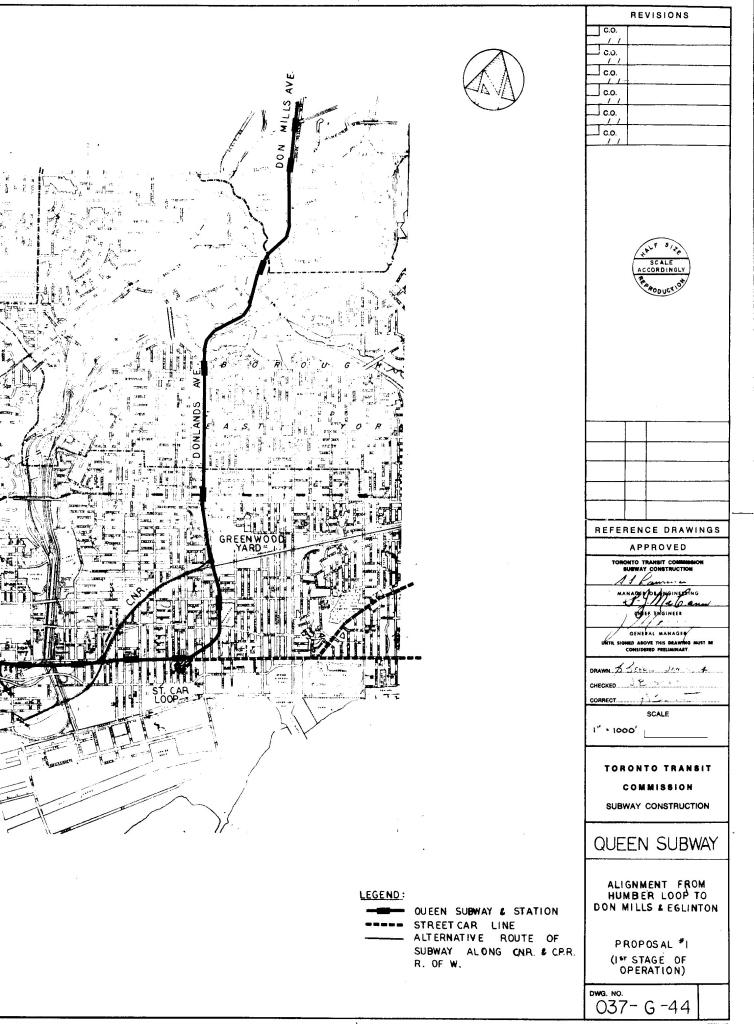
DRLAlignment19740112cBack in October 1974, the TTC was considering various proposals for new rapid transit lines, one of which was the Queen Street subway. This line would have run from Roncesvalles and Queen east to somewhere beyond Broadview, then turned north past Greenwood yard and continued via Donlands to O’Connor. At that point, the line would cross the Don River to serve Thorncliffe and Flemingdon Parks winding up at the CPR crossing north of Eglinton. The map linked here is a bit fuzzy in places because the original is not clear, but it shows the alignment (including an alternative via the CNR corridor) quite clearly.


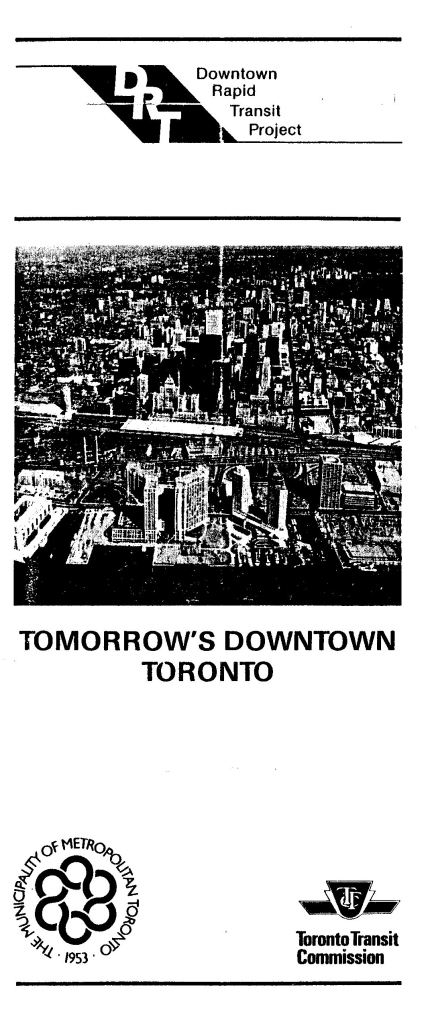
DRLBrochureCovercTen years later, the TTC was working on the Downtown Rapid Transit Study, and the route had morphed into an ICTS line to Union Station. 


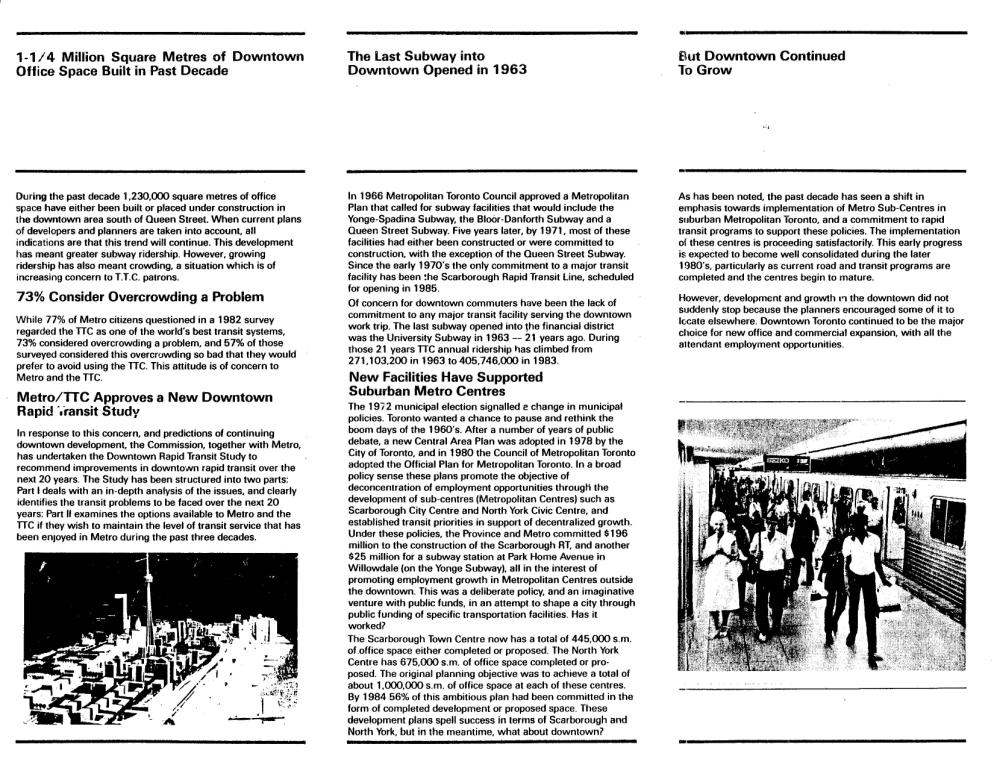
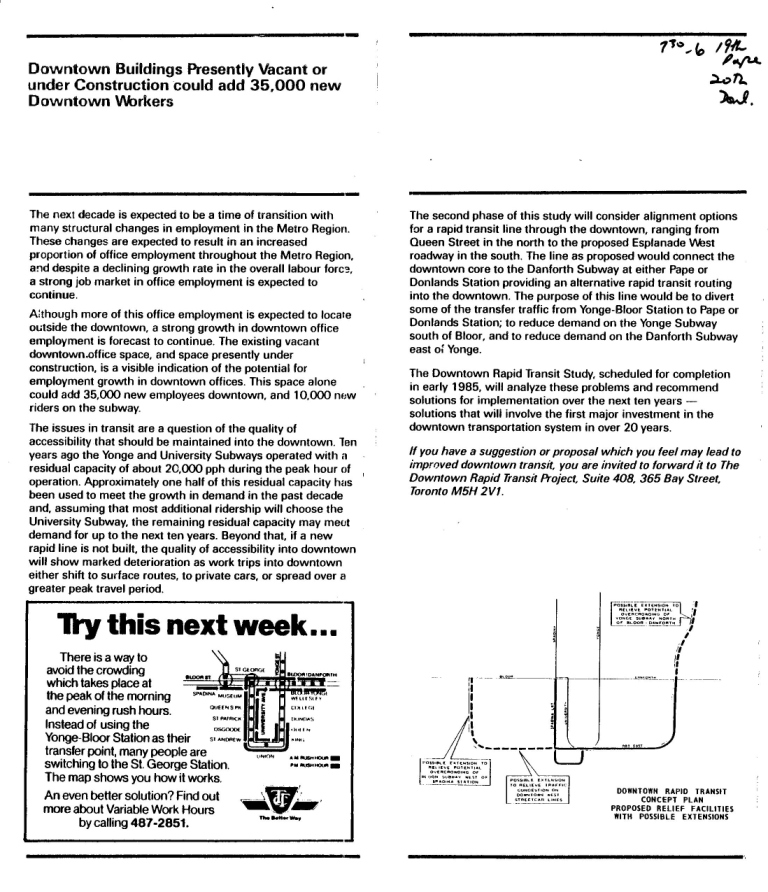
DRLBrochure1cA brochure advertised this study and explained the growing problem of central area subway congestion complete with a suggestion that passengers transfer at St. George rather than Bloor-Yonge.


DRLBrochure2cThe DRL was never built because politics of the day favoured suburban projects, and instead we got the Sheppard Subway.

What Shall We Do With Don Mills?

Recent planning and political activity focussed on the Weston rail corridor studies and the potential effect of substantially increased train service there.  Meanwhile, work is about to start on reviewing one aspect of an eastern corridor, a the so-called “Downtown Relief Line”.

The eastern leg of the DRL has a long history, but in the modern (post WW2) era this began as a Queen Subway proposal.  Before the Bloor-Danforth subway, Queen was regarded as the next logical part of a subway network after the Yonge line, but this status was quickly overtaken by the northward shift of population in the growing suburbs.

One early version of the Queen line would have gone north to Don Mills and Eglinton.  When the Network 2011 Plan was published in 1985, its priority list was

  • the Sheppard Subway from Yonge to Victoria Park (to be completed by 1994)
  • the Downtown Rapid Transit line (using ICTS) from Pape to Spadina (to be completed by 1999)
  • the Eglinton West line from Scarlett Road to Eglinton West Station (to be completed by 2004)

Although the Netwok 2011 background studies showed a DRL would have substantial effects on peak point demands on the existing subway network, this wasn’t enough to save the scheme from a strong political bias against building more subways into downtown.  We all know that the actual priorities became Sheppard and Eglinton West.

In December 2002, the Don Valley Corridor Transportation Master Plan was launched to consider ways of improving travel in the entire corridor from Steeles to the lake, and roughly from Leslie to Victoria Park (swinging further west in the southern section to follow the river’s alignment).  That study arose from a scheme to increase capacity on the Don Valley Parkway, but the study was to consider transit as well as road options.

The study reported in 2005 with a recommendation for BRT on the DVP and various ways to route such a service either to downtown or to the BD subway at Pape, Broadview or Castle Frank.  (The scheme for BRT to Castle Frank prompted an alternative proposal using Swan Boats early in the life of this blog.) 

By 2007, the Transit City scheme had shifted planning focus to Don Mills Road itself and to LRT away from BRT.  However, old studies die hard, and the LRT study persisted in reviewing that same trio of southern destinations for the LRT line.  Major problems include how to thread an “LRT” service through an established neighbourhood on a four-lane street.  We have seen one possible approach with the redesign of Roncesvalles Avenue, but the Don Mills route is quite another matter.

Projected peak demand on the Don Mills LRT is 3,000 per hour, about 35% higher than the current design capacity of the King Streetcar.  Moreover, the 504’s peak point is not on Roncesvalles, and future increases in capacity through Liberty Village will likely be achieved with service entering the line at Sunnyside and possibly by diversion of demand to a Waterfront West line (depending on the path it takes east of Dufferin Street).  There will never be a requirement to operate more frequent service than today on Roncesvalles Avenue.

The total of all bus services to Broadview and Pape Stations from the north is 62 vehicles/hour or a combined design capacity of 3,100 passengers.  Many, but not all, of these would use a Don Mills LRT especially if they had no choice to transfer because of new route structures.  (Broadview — 2, Flemingdon Park — 15, Mortimer — 4, Cosburn — 11, Don Mills — 17, Thorncliffe Park — 13).  However, any existing demand diverted to the LRT plus any new riding would now be placed on one rather than two subway interchanges.  Neither Broadview nor Pape has room for substantially increased traffic and a proper junction would almost certainly have to be underground.  (The 1985 DRL design included an underground interchange at Pape Station.)

All of this is a perfect example of a project with a narrow scope, one that considers only a single problem, not the larger context of the transit network. Continue reading

Why Streetcars?

Tom Jurenka sent in the following note, and it raises questions that deserve a debate.

Hello Steve

As a non-native Torontonian (grew up in Winnipeg, but have lived in Toronto for 24 years now) I have always been puzzled — and often infuriated — by streetcars (and the absolutely terrible traffic light timing in Toronto, but that is another story).

My question is an honest one — WHY? All I can see is the negatives of streetcars:

  • they tear up streets (I’ve lived through Queen Street E, Gerrard, now St. Clair, being torn up utterly to undo the damage of streetcars pounding the rails)
  • they are slow as molasses (as a bicyclist, I routinely pass 5 or 6 streetcars on Queen Street heading from AC Harris to downtown)
  • because of their slowness and immobility they delay traffic all the time, causing snarls and the attendant idling pollution
  • they are super expensive (witness the recent funding mess)

So I’m really curious why streetcars are a better alternative to trolley buses or just plain old buses, which move fast, are mobile, and are less expensive per unit to buy. Would you be able to point me at some links/articles/studies/whatever to help me understand this issue?

Thank you for your time.

Best regards,

Tom Jurenka

This is a far more complex question than just the list above, but I will use this as a jumping off point. Continue reading

How Big a Hole Do We Need?

At its meeting on July 9, the TTC approved purchase of four tunnel boring machines from LOVAT Inc. for construction of the Spadina Subway extension at a cost of about $58-million.  There was considerable discussion about this expense from the point of view of whether any could be recouped after construction, or what commonality there might be with Transit City requirements.

Various tidbits came out during the questions to staff from Commissioners.

The Sheppard tunnels are 5200mm inside diameter, whereas the Spadina tunnels will be 5400mm.  The larger bore is required both to meet current fire code, and to allow trains to travel through curves with sufficient clearance.  (The Sheppard line is, pardon the pun, rather boringly straight.)  The larger tunnel size adds about $35-million to the cost of the 6km of bored tunnel on the Spadina line.

Transit City tunnel size will be determined by the dynamic envelope required for its cars and for the overhead power supply.  These tunnels may not be the same diameter as those on the Spadina subway, but more to the point, the construction period for both Spadina and Eglinton overlap and using the Spadina machines for Eglinton will delay that project.  It is conceivable that the Richmond Hill subway, if funded, might inherit the machines.  Otherwise, the TTC expects to be able to sell them for about 30% of their original value.

This question will also affect the Sheppard tunnel at Don Mills, a short but necessary piece of work to get under Highway 404.

The TTC has canvassed the world market for second hand tunnelling machinery, but none which has the required bore diameter and soil condition design is available.

In a conversation after the meeting, I learned that although the single large bore tunnel (13m) proposed for Eglinton might be feasible, this large tunnel greatly increases the cost of removing spoil (earth and rock) because the tunnel structure is much larger than would be the case for two single tunnels.  In turn, this begs the question of how much of the Eglinton line will be built cut-and-cover so that it is not dependent on the availability of tunnel boring equipment.  We shall see in the fall when the next set of community meetings come around for the Eglinton corridor study.

Queen’s Park Reveals Metrolinx’ Role

My thanks to Peter Miasek who sent me the link to this item on York Region’s website.

Recently, Ontario’s Deputy Minister of Transportation, Bruce McQuaig, wrote to York Region advising on the financial and operational framework for “designated projects” as defined in the recently enacted Metrolinx legislation.  This letter can be found among several pieces of correspondence bundled into one PDF starting on pages 12-16.

I understand that a similar letter went to the City of Toronto, but it has not yet appeared in any public debates, partly because there are so few of them currently.  It is alluded to in a TTC report on Transit City funding.

The scheme begins with a desire by Queen’s Park to bring its books into line with current accepted accounting principles.  What this means, in practice, is that instead of shipping money off to York Region and Toronto, never to be seen again except as part of the Provincial Debt, Ontario will now own the assets purchased with those funds.  Nothing in the letter explains how those portions of projects funded by others such as Ottawa would be treated, nor what would happen with extensions of existing lines owned municipally like the Yonge-University Subway.

The assets would be depreciated over their expected lifetimes and would show up as an offset on the provincial books to the debt raised to fund them.  This is a neat bit of accounting that ignores the fact that an asset only has a real value if you could sell it and recapture your investment, but it keeps the bean counters happy and makes the books look better for the politicians.  To quote the letter:

Through retaining the risks and rewards of asset ownership over regional transportation assets, the Province can best achieve its accounting and financial management objectives.

This, of course, has nothing to do with transit and could equally refer to a hospital, a school or a highway.

There are some fine words about partnerships with the municipal governments coupled with concern about “value-for-money to taxpayers and transit customers”.  Then we get into the details.

Ontario, through Metrolinx, will own and control the Sheppard LRT, Eglinton LRT, Finch LRT, Scarborough RT and VIVA Next Bus Rapid Transit.  Ownership, from an accounting point of view, requires control and this means that Queen’s Park can’t just build the lines, they have to actually appear to manage them rather than effectively ceding them to municipalities via a long-term lease.  This does not prevent Metrolinx from contracting with local agencies for construction, operation and maintenance, but on paper, the lines remain Queen’s Park’s property, and they could be assigned to some other entity if they chose to do so.

Terms of any operating agreement would be set at 75% or less than the expected lifespan of the asset so that, in a worst case scenario, Metrolinx would regain control of a line before it was run into the ground.  A great deal of legal verbiage must be created to define the criteria to which local agencies (or any private entity) will be held by Metrolinx.  This strikes me as an opportunity for a huge bureaucratic waste of time especially if all parties involved are in the public sector.

Metrolinx will define project scope, budgets and schedules, and any changes will require their approval.  Given the total absence of political input from the municipal level to Metrolinx, these discussions will likely happen in private.  Of note is the exclusion for Metrolinx funding of ancilliary upgrades to utilities, streetscaping, etc. that are thought to be add-ons of convenience for a municipality rather than an integral part of a transit project.  It will be interesting to see what standards Metrolinx defines as the “basic” level it will fund, and how much will fall on municipal budgets.

Queen’s Park wants transit riders to “experience the benefits of a regionally integrated and inter-operable system”, and the Presto fare card will be a requirement for all of the designated lines.  In a telling comment, the Deputy Minister states:

 … the Province and Metrolinx will … monitor the evolution of technologies, and will consider how to plan for enhancements and improvements as part of an overall strategy to sustain the Presto electronic fare collection system.

“Evolution” will no doubt include a recognition that this is not a situation where Ontario should develop or adapt a proprietary technology, but should work with internationally recognized electronic payment standards and systems.  The time is long past when Ontario could get away with building “roll your own” systems, and they need to look at the extensive experience in other jurisdictions.

While Metrolinx is working on the benefits of a regional service, they will also need to address the integration of GO Transit fares and service into the wider regional system.  GO, as a separate entity, has remained aloof from regional integration except as it suits them with cost sharing arranements in 905 municipalities.  These arrangements are to GO’s advantage because the joint fares with local operators are much cheaper than the cost and development effects of building more parking at stations.

Finally, Infrastructure Ontario will act on Metrolinx’ behalf for projects that are to use Alternative Financing and Procurement (AFP).  This is a variation on a PPP in which the asset may actually be built and held by a private company and leased to Metrolinx.  The accounting fig leaves are thick on the ground here.  One way or another, Ontario borrows money, Metrolinx builds something (or has it built for them), and, likely, the local operating agency contracts to run it.

Lurking under all of this is a clear indication that it is Queen’s Park, not the Metrolinx Board of Directors, who runs the show.  To be fair, it is their money (or more accurately our money), but the opportunities for interference and sheer bureaucratic incompetence are legion.  There’s a reason transit has been in local hands for decades — the Ministry of Transportation hasn’t the first idea how to operate large systems, nor any feeling for the local issues involved.

Metrolinx itself becomes little more than a construction planning and, later, a holding company on the Province’s behalf.  This should not overly tax the skills of the new, non-political Board, for whom all of the important decisions will be made elsewhere.

Eglinton LRT Design (Part 3: Warden to Kennedy & Tunnelling Options)

This series works through the three-part presentation of the proposed Eglinton LRT design that appears on the project’s website.  Part 1 brought us east from the Airport to Black Creek, and Part 2 covered most of the remainder east to Warden.

Part 3 of the presentation deals with the short section from Warden to Kennedy as well as various construction issues, notably an alternative scheme for tunnelling.

Continue reading

Eglinton LRT Design (Part 1: Introduction & Western Segment)

My apologies to regular readers for the delay in posting news and comment on the last round of Eglinton LRT designs.  Over the next few days, I hope to catch up on this and other topics.

June 2009 brought a major round of public meetings for the Eglinton LRT complete with a detailed look at how the line would be implemented.  The display panels for the current proposals are available on the project website.

The Eglinton line is a huge project, and if it’s done right, will show off the capabilities of LRT versus other modes.  The line will be partly on the surface, partly grade separated (mainly underground), and will be a real test of fitting infrastructure appropriate to demand levels across much of the city.

The comments below follow the display panels in the order presented by the TTC to save readers from jumping back and forth to locate various topics. Continue reading