
First Steps for a Transit Compromise (Update 3)

[Updates with links to media coverage are at the end of this article.]

Elizabeth Church reports in the Globe about a proposed compromise that would redistribute the funding for the proposed all-underground Eglinton LRT line.

Tess Kalinowski and David Rider in the Star cover the same story and include a map.

  • Eglinton would stay on the surface east of Leaside with a dip underground at Don Mills to surface east of the DVP.  This is similar but not identical to the original Transit City scheme.
  • Part of the money released from the Eglinton project would be used to extend the Sheppard Subway east to Victoria Park and include a stop at Consumers Road.
  • A bus transit corridor would be provided on Finch West and East.

The article implies that there may be good support from various parts of Council for this scheme, and a clear endorsement by a motion would send Metrolinx the signal it claims to be waiting for of just what Toronto wants to build.

Updated January 25, 2012 at 10:45am:

Natalie Alcoba reports in the National Post that although there may be support growing on Council for this plan, the Mayor’s office appears unmoved.

But an official from the Mayor’s office suggested he is not interested in relinquishing ground on his LRT stance. “We’re happy with the Metrolinx plan that they’re working on now,” said Mark Towhey, the Mayor’s policy director. “Residents don’t want trains running down the middle of the street.”

On the radio on Tuesday, Mr. Ford seemed to distance himself from the Eglinton line, saying he doesn’t want to stick his nose in a provincial project.

“I’m concentrating on the Sheppard line, and building a subway up there. If Metrolinx or the province wants to do this… I’m not a fan of streetcars, I’m not a fan of LRTs. If they’re underground I am, that’s been my position all along.”

[End of update]

There are longer range issues here, but retention of a subway-surface alignment on Eglinton will permit future extensions to the west and northeast that would likely be unaffordable if an all-underground structure had been repurposed as a full subway line.  The difficult problems of an alignment from Black Creek to Jane have yet to be addressed.

Finch will see BRT at least initially, and it will be important that no design elements preclude future conversion to LRT when demand justifies this.  This would also avoid the cost of a carhouse on Finch West in the short term that was part of the Transit City scheme.

The unknown would be Sheppard and the terminal at Victoria Park.  Will this be a “temporary” end of the line, or will the design allow further extension by either subway or by LRT with a convenient transfer connection?  An argument now about the technology east of Victoria Park will only muddle the debate, but the option of either form of extension should be left open for a future decision.  Will a BRT on Finch stand in for the Sheppard East LRT?

Portions of the Ford subway scheme appear to have fallen off of the table.  We still need those debates about the role of subways, LRT and BRT (not to mention such lowly creatures as simple buses running in mixed traffic) in a suburban network.  Part of this will fall to Metrolinx’ “Big Move 2.0” about which we know very little today and to the degree that solid transit funding actually shows up through new revenue sources such as tolls, sales taxes or maybe even a casino.

Meanwhile, we debate the disposition of billions in capital spending while proposing a few millions in savings by widespread service cuts.  Such is the madness of Toronto’s transit politics.

I can quibble about some aspects of this proposed compromise, but it is a good start.  Here is a sign that finally Council takes seriously the need to plan and make responsible decisions about our transit future.  For a year, by its inaction, Council gave de facto endorsement to a half-baked campaign promise that Metrolinx adopted as its working plan.  Now we can have a real debate.

Updated January 26, 2012 at 12:40am:

Robyn Doolittle in the Star reports that momentum is building for the compromise plan.

Elizabeth Church and Patrick White report in the Globe with more details about response from Queen’s Park and Metrolinx.

Natalie Alcoba in the Post suggests that Mayor Ford is still wedded to a subway plan, but that support for surface LRT is building.

One troubling point in all of this is a comment by Metrolinx chair Rob Prichard who wants to see Council, the Mayor and the TTC all onside.  Whether Rob Ford will actually endorse a new plan, or wind up as one of a few voting against it remains to be seen, but at some point Queen’s Park has to listen to the majority of the citizens’ representatives.

Updated January 26, 2012 at 12:50:

Royson James in the Star gives Metrolinx a well-deserved thrashing.  By its own admission, this agency proceeded with the all-underground Eglinton plan even without Council approval, a clear requirement of the Memorandum of Understanding between Queen’s Park and Mayor Ford.

Christopher Hume weighs in with a video commentary including a call for an all-surface Eglinton LRT.
Stintz Supports LRT, Maybe (Update 3)

Updated January 23 at 11:00pm:  Links to updated coverage including signs of movement toward a new transit plan have been added.

From the Star:

Tess Kalinowski writes about support building for a new plan.  In this version, a surface-subway LRT on Eglinton frees up money for, possibly, a short extension on Sheppard to Victoria Park and something on Finch West.

It’s too early to tell which combination will win out, and there’s no reference to eastern Scarborough.

Martin Cohn writes about the imminent collapse of the McGuinty-Ford transit deal.  We learn that Queen’s Park was prepared to pay the extra cost of expropriating property to widen Eglinton to compensate for space lost to surface LRT, but this option was rejected by Ford.

A Star Editorial congratulates Karen Stintz for telling us the obvious and urges her to begin a campaign for a subway-surface line on Eglinton.  At this rate, they’ll be casting a bronze of Stintz arm-in-arm with David Miller.

From the Globe:

Marcus Gee writes favourably about a move to bring Eglinton back to the surface.

From the National Post:

Natalie Alcoba writes about the proposed change including comments from supportive Councillors.

Updated January 23 at 5:50 pm:  I recently spoke with Bruce McCuaig, President and CEO of Metrolinx, about this issue.  Notes from our conversation are at the end of this article.

Adrian Morrow reports in today’s Globe that TTC Chair Karen Stintz feels an all-underground Eglinton line should just be what it is, a subway, but that it belongs on the surface as LRT for its outer suburban section.

Karen Stintz argues it makes more sense to put the LRT underground only along the most congested part of the route, in midtown, while building it on the surface in the spacious suburbs.

“If the decision is to go with an LRT, it should be at-grade,” she said. “If there’s a decision to put it underground, it should be a subway.”

That’s an interesting position for someone in the Ford camp because it continues the anti-streetcar rhetoric of the Mayor’s office.  If Eglinton is built as a subway line, the option of converting it to LRT and resurrecting Transit City falls because a major link (and the proposed main shops for the LRT network) would vanish.

As Morrow points out in his article, other systems use a combination of surface and underground alignments (including Boston where downtown streetcars went underground over a century ago) so that a network of surface routes can share a common tunnel in the congested central area while switching to a simpler surface alignment elsewhere.

If Eglinton were to become a subway, the problem of valley crossings won’t disappear and Metrolinx will still face the problem of either going under several valleys, or bridging them with parallel structures.

The real question a subway option begs is the future of the SRT.  If Eglinton becomes a subway, it will not easily through-route to Scarborough Town Centre along the existing alignment, and this will reopen the debate over a Bloor-Danforth extension.

Morrow’s article implies that Stintz may be shifting into the pro-LRT camp, but I am not convinced.  If she were really shifting positions, there would be more talk about revival of some parts of Transit City, notably the Finch West line which, unlike Sheppard East, is completely independent of the Ford subway proposals.

The pending release of Gordon Chong’s report on financing the Sheppard Subway will trigger, finally, a debate on the future of Toronto’s transit technologies at Council.  We will see whether Stintz is truly an LRT supporter, or simply pitching Ford’s “no streetcars” view of the world.

Continue reading

Whither the Port Lands? Waterfront Toronto Public Meeting

With all the brouhaha over the Port Lands, and the Fords’ failed coup d’état on the Waterfront, attention now shifts to actually “getting something done”.

The Port Lands cover a large area south and east of the mouth of the Don River that is comparable in size to downtown Toronto.  This is a huge opportunity for redevelopment, but also a huge chance to screw things up pretty much forever.

Do we want a boring, car-oriented suburb complete with megamall, or do we want a new neighbourhood that brings a 21st century twist on downtown living?

Will we redevelop the river mouth as a striking park, a signature piece for Toronto’s waterfront, or will it simply become Exhibition Place East complete with Ferris Wheel and monorail?

How will we move people to and from this area?  Will transit be an afterthought or, for once, will we actually invest in capacity and service before the new buildings go up?

Waterfront Toronto begins its public consultations on the future of the Port Lands on Monday December 12 between 6:30 and 9:00pm at the Toronto Central Library (Yonge north of Bloor) in the Bram & Bluma Appel Salon on the second floor.

Metrolinx Toys With 3Ps

The Toronto Star reports that Metrolinx is considering the private sector option for delivery of some or all of the Eglinton LRT project.  This is not much of a surprise given that Queen’s Park has an entire Ministry, Infrastructure Ontario, dedicated to building stuff, and their standard delivery model is a partnership with the private sector.

Advocates and opponents of public-private-partnerships often take extreme views that these schemes are either the saviour of government services, or evil works meant to transfer control (and money) of vital projects from public to private hands.  The devil, as they say, is in the details.

Every project the TTC or Metrolinx undertakes has a large private sector component:  engineering, construction, provision of materials.  Delays and cost overruns can arise from poor planning and design, some of it carried out by those same private sector engineers, or from contractors who view changes and delays as a potential source of profit.  They can also come from a client who can’t make up its mind and changes requirements as the project unfolds.

Continue reading

Sheppard Subway Inches Along (Updated)

Updated November 9 at 11:20pm:  The Toronto Star reports that Queen’s Park has told Mayor Ford that it will not advance any provincial funds from a possible “surplus” on the Eglinton project to jump start the Sheppard line.  This leaves Ford’s camp having to find money on its own if work on a first phase to Victoria Park were attempted.

The original article from November 8 follows:

The Toronto Star reports that Rob Ford’s Sheppard Subway proposal might creep eastward from Don Mills Station rather than bounding in one leap to Scarborough Town Centre.  An initial push east to Victoria Park might be a target for 2014, in time for the next municipal election, although the opening date would come later.

Considering that Ford was going to finance and build the entire Sheppard line in that time, this is a tad slower than promised during his election campaign.

The big problem, of course, is money.  Ford doesn’t have much and, as the Star points out, the engineering difficulties for an all-underground Eglinton line won’t leave much unspent of the provincial fund earmarked for that route.  For a route that was going to be financed by the private sector, Sheppard, or what we may see of it, is turning into a traditionally funded public sector project.

The specifics are no surprise.  Don Mills was always an odd place to end the Sheppard line, and this choice was dictated by available funding, not by network planning.  The proposed LRT connection into Don Mills is less than ideal, and a tunnel under the DVP would be required regardless of the technology.  The extra cost lies in continuing east to Victoria Park.

What we don’t know yet is whether this extension would include a Consumer’s Road Station, or just go straight through to the new terminal.

During the debates over possible adjustments to the Transit City network, a subway extension was one option proposed by some.  The typical reaction to this (and to any other schemes that would add to the cost of Transit City) was to reject the idea out of hand because the overall budget was already very tight.  However, now that Queen’s Park has decided that no price is too high to keep Mayor Ford happy, it’s much harder to argue against rethinking some Transit City options.

Victoria Park could be a good terminal for a Sheppard LRT, but there’s a problem of timing.  The “interim” subway terminal should be designed with provision for an LRT rather than subway continuation.  I suspect that no one at the TTC will be allowed to even discuss, let alone design such an option.  This will be a challenge for Councillors thinking ahead to a post-Ford era when LRT plans can be resurrected.

According to the Star, Gordon Chong should be reporting on a scheme to get the Sheppard line underway “before Christmas”.  Will Santa have a nice shiny subway train for little Rob’s stocking, or just a lump of coal?

Meanwhile for comic relief, Matt Elliot’s Ford for Toronto site reports how that pesky Don River just won’t get out of Ford’s way.

November 2011: A Month of Meetings (Updated)

Front Street Redesign

November 3, 2011 (Thursday) from 3:00 to 7:00 pm
Room 309, Metro Hall

This is the second public information centre as part of the Environmental Assessment process for the proposed redesign of Front Street between York and Bay Streets in front of Union Station.  The intent is to make the street much more pedestrian to support the very large volume of foot traffic to and from the station.

One through lane of auto traffic would be maintained in each direction (effectively what is now the case given parked cars, buses and taxis), but the lanes would be wider and would also provide space for cyclists.

This is a drop-in event, not a formal meeting.

For background information, visit the project page.

Updated November 4:  The display panels are now available online.

Ashbridges Bay Carhouse

November 9, 2011 (Wednesday) 6:30 to 8:30 pm
Toronto EMS, 895 Eastern Avenue (at Knox)

This meeting will present the landscape design for the new Maintenance and Storage Facility at Leslie and Lake Shore.  Site preparation work for the new building is already underway, but the contract for construction has not been let by the TTC.  There have been rumours that this will come before the November Commission meeting, but until we see the agenda as well as details of the 2012 Capital Budget this is still uncertain given funding constraints.

Note:  The public display of a mockup of the new TTC low-floor Light Rail Vehicles will likely occur over the weekend of November 11-14.  Further details will be posted here when they are available.

For background information, visit the project page.

Toronto Talks Mobility

The Cities Centre at the University of Toronto will host a two day forum on mobility in the GTA.  There will be two free events, but both of these require pre-registration.

November 9, 2011 (Wednesday) 7:00 to 9:00 pm
City Hall Council Chambers

November 10, 2011 (Thursday) 8:00 am to 5:00 pm
Wychwood Barns

According to the event description:

… this event is not about re-hashing the “Transit City” vs. subway discussion debate. Rather, “Toronto Talks Mobility” will examine what we do next as a region to build on progress made to date (including the Big Move) and how we can ensure long-term success. Ultimately, the event aims to kick-start a campaign to bring a broader civic voice to our transportation future.

I can understand the organizers’ reluctance to get bogged down in debating Transit City or various alternative.  However, any discussion of mobility must address the basic questions of whether we plan for networks we can afford to build, how we will pay for them (and by extension, just what “afford” means) and the tradeoffs between transit modes, speed, road space and network capacity.  This will inevitably touch on Transit City, if only as a starting point.

A “broader civic voice” is definitely required, but this requires ears willing to hear the message.  If Queen’s Park and the City of Toronto reject funding strategies that inevitably require new sources of revenue, this will be an exercise in debating the obvious to no effect.

Calling on Ottawa for new funding is a predictable, but pointless, exercise if we are not prepared to begin the work of funding transit ourselves.  We will be talking about massive network expansion at a time when day-to-day service and quality are under attack not just in Toronto but in many parts of the GTA.

Metrolinx Board Meeting

The regular meeting of the Metrolinx board will be held on Wednesday, November 23 at 8:30 am.  I will post a summary of major issues when the agenda is released.

TTC Commission Meeting

The regular meeting of the TTC will be held on Wednesday, November 23 at 1:00 pm.  I will post a summary of major issues when the agenda is released.

TTC Customer Information Town Hall

November 24, 2011 (Thursday)
City Hall Council Chambers (final details TBA)

This is planned as the first of an ongoing series of Town Hall meetings around the city for the TTC to get public input on a range of issues.  Whether we will actually get to complain about budgets and their effect on service quality remains to be seen.

Waterfront Toronto Queen’s Quay Project

Waterfront Toronto recently hired a Project Manager to oversee this project, and they plan to hold a public meeting covering the construction plans for work on the redesigned Queen’s Quay.  Details will be posted here when they are available, but the meeting is likely to be in late November.

There is also a Community Update meeting planned for the East Bayfront (Yonge Street east to about Parliament).  This is a general update regarding land developments and related projects, but there is not likely to be much info on transit as the whole question of the “Harbourfront East” LRT is hung up in funding problems at the City and TTC.

November 22, 2011 (Tuesday) 6:00 to 8:00 pm
Corus Quay (Atrium), 25 Dockside Drive

How Many Riders Will Use The Crosstown (2)

In a previous article, I discussed the Eglinton-Crosstown LRT subway and the issues raised by demand projections for it.  On July 26, I met with staff from Metrolinx to explore the subject in detail, and this post summarizes our discussion.

What Network and Land Use Drove the Demand Model?

Before we can understand the numbers generated from any model, it is important to know the assumptions behind it.  Is the network a realistic view of services that will actually be in place?  What residential and work locations and densities are used to generate the travel demand flowing through the model?

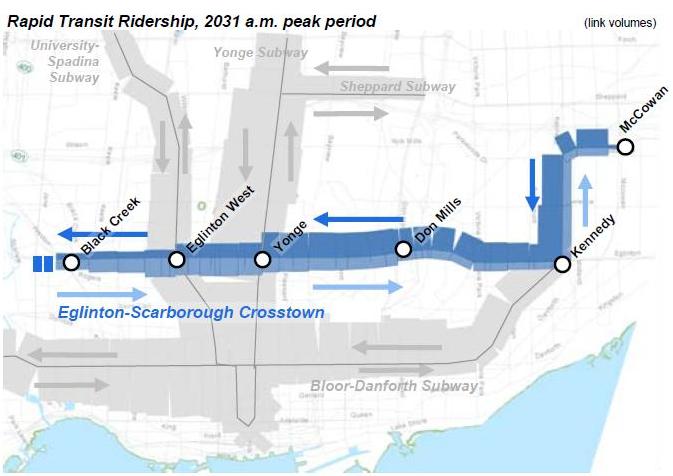
Notable by their absence from the map of passenger flows are any extension of the Sheppard subway, the proposed Richmond Hill extension of the Yonge subway and any reference to GO Transit routes or demand.

Metrolinx replied that their model includes only those routes and services for which funding is committed.  This means that only the Spadina Extension, the Eglinton line, and the GO improvements in GO’s 2020 plan are part of the model.  In effect, this takes the transportation network to roughly a 2020 state.

However, the underlying land use represents 2031 population and job projections with growth concentrated in major nodes such as Yonge-Eglinton and Scarborough Town Centre. Continue reading

How Many Riders Will Use The Crosstown?

[See also Part 2 of this discussion.]

In a previous article and its long comment thread, readers and I have discussed the question of demand for the Eglinton-Crosstown LRT subway.  After the Metrolinx board meeting in June that started all this, I asked Metrolinx for more information about their projected ridership for the underground line.  In particular, I was interested in the numbers behind not just Eglinton, but the other routes on the demand map below.

Here is Metrolinx’ reply:

Under the previous Transit City plan, most morning Scarborough RT passengers arriving at Kennedy would transfer to the Bloor-Danforth subway. However, a small number of them would transfer to the Eglinton LRT, and bus riders would also transfer to the Eglinton LRT

Under the current Toronto transit plan agreement, many morning Eglinton – Scarborough Crosstown passengers arriving at Kennedy are not expected to transfer to the Bloor-Danforth line. Instead, we expect those passengers to stay on board the Eglinton – Scarborough Crosstown and continue west along Eglinton Ave.

It is important to note that the Eglinton – Scarborough Crosstown morning morning peak hour westbound ridership leaving from Kennedy station is roughly 6,500 higher than the Transit City plan forecast. In the Transit City plan, the forecasted behaviour of these 6,500 new Eglinton-Scarborough Crosstown passengers was as follows:

  • 60% rode the Bloor-Danforth subway out of Kennedy station.
  • 40% rode parallel bus routes or used different modes

We also expect an increase of ridership at the other stations along the Bloor-Danforth Eglinton-Scarborough line, but passenger behaviour at Kennedy is the dominant factor distinguishing the two plans.

Finally, below is a comparison of the anticipated 2031 morning peak demand points for the two plans:

SRT section (southbound into Kennedy)

  • Transit City (5 in 10 plan):  10,000 pphpd
  • Eglinton-Crosstown:  11,000 pphpd

Eglinton section:

  • Transit City:  5,000 pphpd eastbound into Eglinton West
  • Eglinton-Crosstown:  12,000 pphpd westbound into Eglinton/Yonge

[Corrections to the original text provided by Metrolinx July 26, 2011]

This is the entire reply, and there is no information on the following issues:

  • What are the numbers for other lines on the demand chart both for 2011 and 2031?  In particular, to what extent does the model show growth in demand on the existing subway system?
  • What other elements of a regional network exist in the 2031 model that could alter the growth pattern and future ridership flows?  In particular, there is no Downtown Relief Line even though it is part of The Big Move, and there is no indication of what GO services might also be in place.

My ongoing complaint about regional planning, both by the TTC and by Metrolinx, is that we talk a good line about networks, but we plan lines in isolation.  It is trivially simple to produce a huge demand on a new route simply by making it the only addition to an existing network — that’s how the TTC “justified” the Sheppard subway.

Ontario is spending $8-billion keeping Rob Ford happy by burying the Eglinton line, and they desperately need to justify this investment.  A 12k demand at the peak point is just the ticket!  Where else might the extra $4b have been spent to better overall effect?  We don’t know because Metrolinx has reverted from network planning to the traditional one-at-a-time methodology it was set up to avoid.

Metrolinx needs to be much more transparent about the way it projects ridership and the underlying assumptions of its models.  What routes are in the model network?  What frequency of service operates on them?  What is the fare structure?  What is the presumed future cost or practicality of using an automobile?  Where are the capacity constraints in the road and transit neworks?  How do these factors interact to shift projected demands?

This is the heart of regional planning, and Metrolinx is utterly silent on these issues.  Instead, they prefer to show us fully built-out networks decades in the future, networks we already know will be different thanks to various short-term changes and likely funding constraints, networks we will never see in actual operation.  We see simulations of the impossible, not the practical or the likely conditions we will have to live with.

This may serve short-term political needs, but the approach evades, no ignores, the vital debate we must have about what we might (or might not) build with the limited funding that our parsimonious, if not bankrupt, governments are likely to devote to transit.

A Few Questions About Eglinton-Crosstown (Update 3)

Updated July 4, 2011 at 11:10 am:

Recently, the Toronto Star reported that Metrolinx had claimed that the travel time by underground LRT from Kennedy Station to Jane Street would be 25 minutes.  They have now confirmed that the correct figure should be 35 minutes.

Also, the full presentation given at the recent board meeting regarding the Eglinton line is now available online.  Only the station design portion had been posted originally.

Continue reading